190
Scheeren B et al. Bilateral Killian-Jamieson diverticula
Radiol Bras. 2013 Mai/Jun;46(3):190–192
Bilateral Killian-Jamieson diverticula demonstrated
by videofluoroscopic swallowing study: case report
*
Divertículo de Killian-Jamieson bilateral demonstrado pela videofluoroscopia da deglutição: relato de caso
Betina Scheeren1, Renato José Kist de Mello2, Caren Meneghetti Gonçalves2, Antonio Carlos Maciel3
The authors report the case of a 56-year-old male patient complaining of dysphagia for solids and food impaction, sub-mitted to videofluoroscopic swallowing study that demonstrated the presence of two esophageal diverticula. The videofluoroscopic swallowing study was critical in the identification and diagnosis of the diverticula, an esophageal cause of dysphagia.
Keywords: Deglutition disorders; Diverticulum.
Os autores relatam um caso de paciente do sexo masculino, de 56 anos de idade, com queixa de disfagia para sólidos e impactação de alimentos, submetido a videofluoroscopia da deglutição que demonstrou a presença de dois divertícu-los esofágicos. O estudo da deglutição foi um importante exame para identificar e diagnosticar o divertículo, uma causa esofágica da disfagia.
Unitermos: Transtornos da deglutição; Divertículo.
Abstract
Resumo
* Study developed at Santa Casa de Misericórdia de Porto Alegre, Porto Alegre, RS, Brazil.
1. Speech Therapist at Santa Casa de Misericórdia de Porto Alegre, Porto Alegre, RS, Brazil.
2. MDs, Residents, Unit of Radiology and Imaging Diagno-sis, Santa Casa de Misericórdia de Porto Alegre, Porto Alegre, RS, Brazil.
3. PhD, Head of the Unit of Radiology and Imaging Diagno-sis, Hospital Santa Clara and Hospital São Francisco da Santa Casa de Misericórdia de Porto Alegre, MD, Radiologist, Hospital de Clínicas de Porto Alegre (HCPA), Porto Alegre, RS, Brazil.
Mailing Address: Betina Scheeren. Rua Fernandes Vieira, 353, ap. 46, Bairro Bom Fim. Porto Alegre, RS, Brazil, 90035-091. E-mail: [email protected].
Received June 12, 2012. Accepted after revision January 28, 2013.
Scheeren B, Mello RJK, Gonçalves CM, MacieL AC. Bilateral Killian-Jamieson diverticula demonstrated by videofluoroscopic swallowing study: case report. Radiol Bras. 2013 Mai/Jun;46(3):190–192.
0100-3984 © Colégio Brasileiro de Radiologia e Diagnóstico por Imagem CASE REPORT
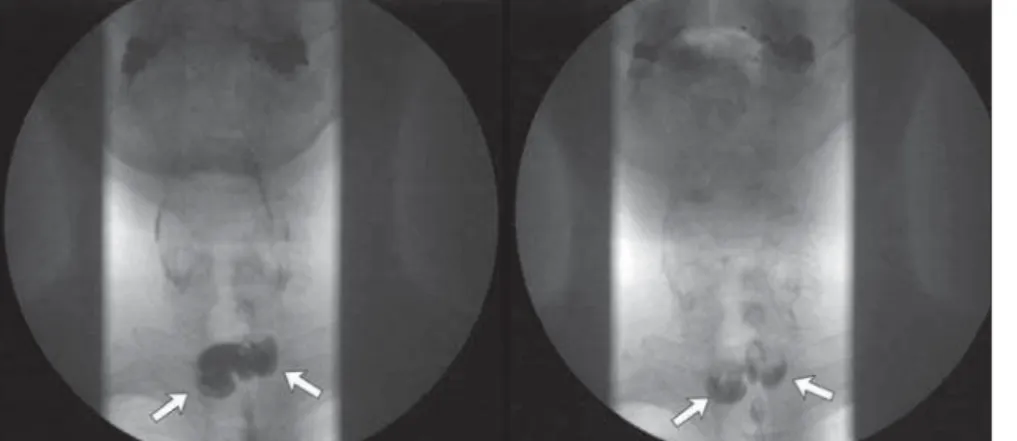
patient upright. The patient ingested food of three different consistencies – liquid, pasty and solid – with barium sulfate con-trast suspension. The study was performed by a speech therapist under the guidance of a radiologist. Such study demonstrated the presence of two diverticular structures in communication with the cervical esopha-gus, located below the upper esophageal sphincter, with retention of the contrast-enhanced food bolus (Figures 1, 2 and 3).
DISCUSSION
Killian-Jamieson diverticulum develops because of herniation of the mucosa and submucosa in a site of weakness in the anterolateral wall of the cervical esopha-gus, inferiorly to the cricopharyngeal muscle and superolaterally to the esoph-ageal longitudinal muscle. This gap in the muscle was initially described by Killian as the site where the recurrent laryngeal nerve inserts into the pharynx. Jamieson con-firmed such finding and thus this area was named Killian-Jamieson triangle(3).
On the other hand, Zenker’s diverticu-lum originates proximally to the upper esophageal sphincter and is classified as a pharyngeal diverticulum. This diverticulum protrudes through the weakened area of the Dysphagia is the main symptom of
Killian-Jamieson diverticulum, particularly for solid foods(3). However, because of its location, it is less susceptible to cause as-piration(2). The diagnosis is made by means of barium esophagram(4), and videofluoro-scopic swallowing study is a dynamic method which evaluates the deglutition process, allowing the detection of ana-tomic/functional dysfunctions(5–7).
The present report is aimed at describ-ing the case of a patient with bilateral Killian-Jamieson diverticula demonstrated by videofluoroscopic swallowing study.
CASE REPORT
Male, 56-year-old patient complaining of dysphagia for solids and food impaction referred to undergo videofluoroscopic swal-lowing study. The patient had undergone other diagnostic procedures, among them upper digestive endoscopy, which demon-strated only the presence of mild antral ero-sive gastritis, and barium esophagram, whose report described the presence of a Zenker’s diverticulum. The patient was sub-mitted to swallowing videofluoroscopy, including lateral and frontal dynamic im-aging of the oral, pharyngeal and esophageal phases of deglutition performed with the INTRODUCTION
Killian-Jamieson diverticulum was de-scribed in 1983 by Ekberg et al. and occurs in the anterolateral wall of the cervical esophagus and distally to the cricopha-ryngeal muscle(1). In the literature, it is de-scribed as a rare, generally unilateral diver-ticulum – only in 25% of cases it occurs bilaterally. It is different from Zenker’s di-verticulum that is most commonly known and develops at the midline of the posterior esophageal wall, above the cricopharyngeal muscle (a region that is also named Killian’s triangle), frequently causing aspi-ration. Both types of diverticula occur in sites of anatomical weakness of the hy-popharynx or cervical esophagus(2).
191
Scheeren B et al. Bilateral Killian-Jamieson diverticula
Radiol Bras. 2013 Mai/Jun;46(3):190–192 muscle located between the cricopharyn-geal and lower constrictor muscles and named Killian triangle (Figure 4)(8). In cases of large diverticula, food retention causing regurgitation, dysphagia and even aspiration pneumonia may occur(9).
The location of the cricopharyngeal muscle is important to define and
subse-quently diagnose the type of diverticulum. It is possible to identify the cricopharyngeal muscle located ventrally at the level of C4– C6 and cricoids cartilage. It is observed during the videofluoroscopic swallowing study at the moment f its relaxation and consequential opening of the upper esoph-ageal sphincter. The diagnosis of
Killian-Jamieson diverticulum is generally made with barium esophagram, where it is seen as a lateral protrusion at frontal views, and overlapping to the anterior esophageal wall at lateral views(2). Studies in the litera-ture(10–12) report the Killian-Jamieson diver-ticulum diagnosis by means of ultrasonog-raphy, either as an incidental finding or mimicking a thyroid nodule. At ultrasonog-raphy, Killian-Jamieson diverticulum is seen as an echogenic and heterogeneous nodule, with some hyperechoic spots sug-gesting the presence of air which do not move during swallowing. In a report about 13 cases of Killian-Jamieson diverticulum observed at ultrasonography(10), the com-munication with the adjacent esophageal wall could be demonstrated in 54% of the patients at the moment of the initial diag-nosis. The advantage of ultrasonography is the non-invasiveness and absence of ion-izing radiation as compared with other imaging methods, besides the fact that the scan can be performed outside a hospital Figure 2. Lateral views demonstrate the presence of a Killian-Jamieson diverticulum (white arrows)
lo-cated distally to the cricopharyngeal muscle (black arrows).
Figure 1. Frontal views demonstrate two lateral prominences (arrows) corresponding to Killian-Jamieson diverticula.
Figure 4. Anatomical drawing demonstrating weak-ened muscle areas through which Zenker’s (8) and Killian-Jamieson (13) diverticula protrude. 1, upper constrictor muscle; 2, middle constrictor muscle; 3, styloid hyoid ligament; 4, hyoid bone; 5, thyro-hyoid membrane; 6, thyropharyngeus muscle; 7, thyroid cartilage; 8, Killian’s dehiscence; 9, cricoid cartilage; 10, cricopharyngeal muscle; 11, trachea; 12, esophagus; 13, recurrent laryngeal nerve. (drawing adapted from Siddiq et al.(8)).
192
Scheeren B et al. Bilateral Killian-Jamieson diverticula
Radiol Bras. 2013 Mai/Jun;46(3):190–192 setting(13). However, in the present case,
videofluoroscopic swallowing study was required for the differential diagnosis with Zenker’s diverticulum. Sometimes, it may be difficult to differentiate between the two diverticula at barium esophagram, since the Zenker’s diverticulum may extend down-wards and, in cases of a large diverticulum, protrude to the left in relation to the mid-line(3). When unilateral, Killian-Jamieson diverticulum may sometimes be confused with Zenker’s diverticulum. But, at lateral view the Killian-Jamieson diverticulum protrudes anteriorly in relation to the cer-vical esophagus, while the Zenker’s diver-ticulum protrudes posteriorly(14).
It is important to differentiate these two diverticula, particularly under the clinical point of view in relation to complications and therapeutic approach. Amongst the re-lated complications, the main difference is concerned with tracheal aspiration which is much more frequent in cases of Zenker’s diverticulum because of its location above the upper esophageal sphincter(2,3).
Only symptomatic patients and those with large diverticula should be treated. Treatment options include either open or endoscopic surgery, with diverticolotomy, diverticulolectomy or diverticulopexy. Ac-cording to Chea et al.(4), diverticulopexy is recommended as an effective and preferen-tial option for treatment of Killian-Jamie-son diverticula. For the treatment(15), it is important to differentiate Killian-Jamieson diverticulum from Zenker’s diverticulum because despite the surgical and endo-scopic options, the endoendo-scopic treatment is preferable for Zenker’s diverticula
(particu-larly those < 3 cm); and for the Killian-Jamieson diverticula, the safety of the en-doscopic approach is still to be completely established, mostly because of the rarity of cases. The main complication associated with the endoscopic treatment is injury to the recurrent laryngeal nerve, since the base of the Killian-Jamieson diverticulum is the site of insertion of the nerve into the larynx. The traditional videofluoroscopic swal-lowing study generally emphasizes the as-sessment of the oral cavity and pharynx, but constitutes a relevant diagnostic tool also in cases of disorders of the hypopharynx and esophagus because the symptom of cervical dysphagia may have an esophageal cause(16).
CONCLUSION
In the presently reported case, barium esophagram could not correctly identify the nature of the dysphagia and the food impac-tion reported by the patient. Such identifi-cation might be possible at the videofluo-roscopic swallowing study. Therefore, the authors highlight the relevance of the analysis of the oral, pharyngeal and esoph-ageal swallowing phases for the differen-tial diagnosis of oropharyngeal complaints related to esophageal alterations.
REFERENCES
1. Ekberg O, Nylander G. Lateral diverticula from the pharyngo-esophageal junction area. Radiology. 1983;146:117–22.
2. Rubesin SE, Levine MS. Killian-Jamieson diver-ticula: radiographic findings in 16 patients. AJR Am J Roentgenol. 2001;177:85–9.
3. Boisvert RD, Bethune DC, Acton D, et al. Bilat-eral Killian-Jamieson diverticula: a case report
and literature review. Can J Gastroenterol. 2010; 24:173–4.
4. Chea CH, Siow SL, Khor TW, et al. Killian-Jamieson diverticulum: the rarer cervical esoph-ageal diverticulum. Med J Malaysia. 2011;66:73– 4.
5. Cappabianca S, Reginelli A, Monaco L, et al. Combined videofluoroscopy and manometry in the diagnosis of oropharyngeal dysphagia: exami-nation technique and preliminary experience. Radiol Med. 2008;113:923–40.
6. Levine MS, Rubesin SE, Laufer I. Barium esopha-gography: a study for all seasons. Clin Gastroen-terol Hepatol. 2008;6:11–25.
7. Martin-Harris B, Jones B. The videofluorographic swallowing study. Phys Med Rehabil Clin N Am. 2008;19:769–85.
8. Siddiq MA, Sood S, Strachan D. Pharyngeal pouch (Zenker’s diverticulum). Postrgrad Med J. 2001;77:506–11.
9. Freeny PC, Stevenson GW. Benign structural dis-eases of the pharynx. In: Margulis AR, Burhenne HJ, editors. Alimentary tract radiology. St. Louis, MO: Mosby; 1994. p. 114–26.
10. Kim HK, Lee JI, Jang HW, et al. Characteristics of Killian-Jamieson diverticula mimicking a thy-roid nodule. Head Neck. 2012;34:599–603. 11. Kim MH, Kim EK, Kwak JY, et al. Bilateral
Killian-Jamieson diverticula incidentally found on thyroid ultrasonography. Thyroid. 2010;20: 1041–2.
12. Pang JC, Chong S, Na HI, et al. Killian-Jamieson diverticulum mimicking a suspicious thyroid nod-ule: sonographic diagnosis. J Clin Ultrasound. 2009;37:528–30.
13. Sakate M, Yamashita S, Toledo CGC, et al. Ava-liação do tempo de trânsito esofágico pelo ultras-som: influência do gênero e índice de massa cor-pórea. Radiol Bras. 2011;44:360–2.
14. Johnson CD, Schmit GD. Mayo Clinic gas-trointestinal imaging review. Rochester, MN: Mayo Clinic Scientific Press; 2005.
15. Kim DC, Hwang JJ, Lee WS, et al. Surgical treat-ment of Killian-Jamieson diverticulum. Korean J Thorac Cardiovasc Surg. 2012;45:272–4. 16. Allen JE, White C, Leonard R, et al. Comparison