Anthropometric indicators and their adequacy in older
adults from two towns in distinct Brazilian regions
Aline Rodrigues BarbosaI, Moane MarchesanI, Alexsander Vieira GuimarãesI, Vivian Francielle FrançaI, Maria de Fátima
Nunes MarucciII, Raildo da Silva CoqueiroIII, Marcos Henrique FernandesIII
DOI: 10.5935/MedicalExpress.2015.06.05
I Departamento de Educação Física, Centro de Desportos, Universidade Federal de Santa Catarina, Florianópolis-Santa Catarina, Brazil II Departamento de Nutrição, Faculdade de Saúde Pública, Universidade de São Paulo, São Paulo-São Paulo, Brazil
III Departamento de Saúde, Universidade Estadual do Sudoeste da Bahia, Jequié- Bahia, Brazil
OBJECTIVE: To compare anthropometric indicators and their adequacy among older adults from two towns of distinct Brazilian regions.
METHODS: A cross-sectional, population, and household-based epidemiological study. A total of 793 persons (age ≥ 60) from the Southern and Northeastern regions of Brazil were evaluated, according to age groups (60-69, 70-79, and ≥ 80 years) and sex. Data for body mass, height, body mass index, triceps skinfold thickness, arm muscle circumference, arm, waist and calf circumferences are presented. The prevalence of adequate anthropometric indicators was also compared for body mass index, arm circumference arm muscle circumference, triceps skinfold thickness, calf circumference and waist circumference.
RESULTS: Subjects from the Southern region (n = 477) showed significantly greater mean values for all anthropometric variables vs. subjects from the Northeastern region (n = 316). Underweight (BMI < 22.0 kg/m2) was prevalent in the Northeast, overweight (BMI > 27.0 kg/m2) in the South. Older adults from the Northeast presented a higher proportion of adequate weight circumference. Other measured anthropometric indicators revealed a greater proportion of older adults with nutritional adequacy in the Southern region.
CONCLUSION: This study provides information that can be used for anthropometric assessment of older adults in towns within the same context. Older adults of the two regions show vulnerable nutritional status, deiciency in the northeastern and excess in the southern region.
KEYWORDS: Ageing; Nutritional evaluation; Cross-sectional studies.
Barbosa AR, Marchesan M, Guimarães AV, França VF, Marucci MFN, Coqueiro RS, Fernandes MH. Anthropometric indicators and their adequacy in older adults from two towns in distinct Brazilian regions. MedicalExpress 2015;2(6):M150605
Received for Publication on August 19, 2015; First review on September 18, 2015; Accepted for publication on October 1, 2015
E-mail: [email protected]
■
INTRODUCTIONHuman aging is marked by morphological and physiological changes such as reduction in muscular mass, body fat increase redistribution (fat tissue in the arms and legs decreases, with a larger deposition of fat in the trunk).1-6 These changes can be assessed by anthropometry, a non-invasive method included in nutritional assessment and screening scales.7-8 and widely used in studies involving older adults.1-4 Although these morphological and physiological changes appear universal, they do not occur at the same rate in all populations.4-6 Data from different
countries3,6-8 indicate that the patterns of alterations in anthropometric characteristics with increasing age are similar; however, the intensity of the alterations varies between the populations, even in the same country.9,10 The determinants of body shape changes and body mass index of older adults are based on differences in the endogenous, environmental, and socio-economic characteristics, such as life style, health, and functional state.10,11
and urban zones enrolled in the ESF program. All subjects (n = 134) aged ≥ 80 years plus 343 individuals (probability sampling) of 60 to 79 years of age were interviewed during 2010-2011. The study population of LC-BA included all individuals aged ≥ 60 (n = 355) that were residents of the town’s urban zone; a total of 316 subjects (89.0% of the senior population) were included in the research, performed during 2011.
Study exclusion criteria: absence of an appropriate informant; absence of the elderly after three unsuccessful attempts in alternating days; lack of access due to the conditions of rural roads (AC-SC).
The interviewers were previously trained for testing of the instruments, and for precision and accuracy of the anthropometric measurements.17
The measurements anthropometric parameters were: body mass (BM), height, body mass index (BMI), triceps skinfold thickness (TSF), arm muscle circumference (AMC), arm circumference (AC), waist circumference (WC), calf circumference (CC).
Nutritional status evaluation
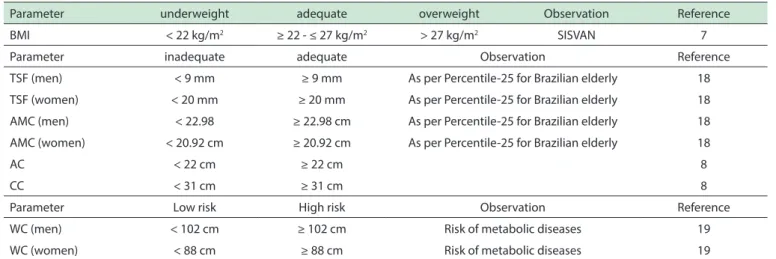
The parameters used for nutritional status evaluation adhered to the boundaries displayed in Table 1.
Body mass was measured using a digital scale, with the subject dressed in minimal clothing and barefoot.20 Height was measured in accordance with Chumlea et al.21. Circumferences were measured with a non-elastic tape measure and the TSF with a Lange skinfold caliper22. Body Mass Index (BMI) was calculated as the ratio between the body mass (kg) and squared height (m) (BMI = kg/m2), and the AMC according to the Gurney and Jelliffe23 equation: AMC = AC - (π *TSF).
All measures were made in triplicate (except BM), and the mean values were used for the analyses. In the case of nine persons in AC-SC and seven in LC-BA, it was impossible to obtain measurements of body mass and height. The following equations were used to estimate the missing parameters:
Body mass [women: (AC x 1.63) + (CC x 1.43) - 37.46; men: (AC x 2.31) + (CC x1.50) - 50.10], according Chumlea et al.20.
Height [women: (1.83 x knee height) - (0.24 x age) + 84.88; men: (2.02 x knee height) - (0.04 x age) + 64.19], according Chumlea et al.21.
The following variables were used to characterize the population: sex, age groups (60-69, 70-79 and ≥ 80 years), literacy (yes/no), marital status (with/without partner), living arrangement (alone/with someone); work (yes/no), hunger during the first 15 years of life (yes/no); any disease in the first 15 years of life (yes/no).
Statistical analysis
The means and standard deviation or the medians of the anthropometric variables were calculated according Data from the Brazilian National Household Sample
Survey (Portuguese acronym PNAD) 2004-200913 showed that 18.7% of the housing units of the Southern region had some type of nutritional insecurity, compared to 46.1% in the Northeast. For dwellings with inhabitants aged 65 years and more, the percentage of housing units suffering moderate or severe food insecurity was 6.8 and 22.9% for the Southern and Northeastern regions respectively.13 It is believed that these environmental and socio-economic differences may influence the anthropometric characteristics and body mass index of the older adults. Data from Brazilian National Survey on Health and Nutrition14 (Portuguese acronym PNSN), suggest that regional differences in body mass index reflect the conditions of life, occupational history and lifestyle. Anthropometric data from studies recently conducted in some Brazilian large cities1,2,4,5 also seem to reflect national diversity.
Most information available on this topic in Brazil is limited to large urban centers where the social, cultural and lifestyle conditions differ from those prevailing in small towns. A comparison of the anthropometric characteristics and body mass index of older adults in different contexts may reflect regional characteristics, distinguishing populations. In addition, such data would be useful for both health surveillance and clinical practice. This study aimed to compare the anthropometric indicators and their adequacy among older adults from two towns of distinct Brazilian regions
■
METHODSThis is a cross-sectional study that used data from the following epidemiological surveys: “Effectiveness of health interventions, physical activity, and nutrition of older adults from Antônio Carlos, Santa Catarina” and “Nutritional status, risk behaviors, and health status of elderly in Lafaiete Coutinho, Bahia”.15Antonio Carlos, in the state of Santa Catarina (AC-SC) is located in Southern Brazil; and Lafaiete Coutinho, in the state of Bahia (LC-BA) in the Northeast.
Data from the 2010 Brazilian census15,16 showed that the AC-SC population was 7,458 inhabitants, with 955 (12.8%) aged ≥ 60 years; the LC-BA population was 3,901 inhabitants, with 598 (15.4%) aged ≥ 60 years. In AC-SC, the average nominal monthly per capita income was ~2.9 times higher than that in LC-BA.16 AC-SC and LC-BA had three and two Family Health Strategy teams (Portuguese acronym, ESF), respectively, which covered 100% of each municipality. ESF is a national program focused on basic attention to health.
Population and sample
Table 1 - Parametric basis of nutritional status evaluation used in this project
Parameter underweight adequate overweight Observation Reference
BMI < 22 kg/m2 ≥ 22 - ≤ 27 kg/m2 > 27 kg/m2 SISVAN 7
Parameter inadequate adequate Observation Reference
TSF (men) < 9 mm ≥ 9 mm As per Percentile-25 for Brazilian elderly 18
TSF (women) < 20 mm ≥ 20 mm As per Percentile-25 for Brazilian elderly 18
AMC (men) < 22.98 ≥ 22.98 cm As per Percentile-25 for Brazilian elderly 18
AMC (women) < 20.92 cm ≥ 20.92 cm As per Percentile-25 for Brazilian elderly 18
AC < 22 cm ≥ 22 cm 8
CC < 31 cm ≥ 31 cm 8
Parameter Low risk High risk Observation Reference
WC (men) < 102 cm ≥ 102 cm Risk of metabolic diseases 19
WC (women) < 88 cm ≥ 88 cm Risk of metabolic diseases 19
BMI: Body mass index; TSF: Triceps skinfold thickness; AMC: Arm muscle circumference; AC: Arm circumference; CC: Calf circumference; WC: Waist circumference.
to sex and age groups (60-69, 70-79 and ≥ 80 years). The Kruskal-Wallis test compared age groups, as the data did not present normality. Differences between means (all older adults) were determined by Student’s t test or Mann-Whitney (independent samples) for comparison of sexes. The significance level was defined as 5% (p <0.05). The
chi-squared or Fisher exact tests were used to compare prevalence.
The statistical program SPSS (version 16.0) was used to analyze the data. The analysis of the data referring to AC-SC was weighted by the post-stratification weights
resulting from the method of sampling.
The study was approved by the ethics committees of Universidade Federal de Santa Catarina (case number 189/09) and Universidade Estadual do Sudoeste da Bahia (case number 064/10).
■
RESULTSWomen in AC-SC (age: 71.0 ± 7.7 years), were younger (p<0.001) than in LC-BA (age: 74.9 ± 10.0); men in AC-SC (age: 71.2 ± 7.9) were also younger (p = 0.019) than in LC-BA (age: 73.4 ± 9.4).
Except for sex and living arrangement, the prevalence of other demographic and clinical variables presented significant differences between the two regions. As regards the variables ‘living with someone’, ‘working’ and ‘literacy’, the higher prevalence were observed for the older adults of AC-SC (Table 2).
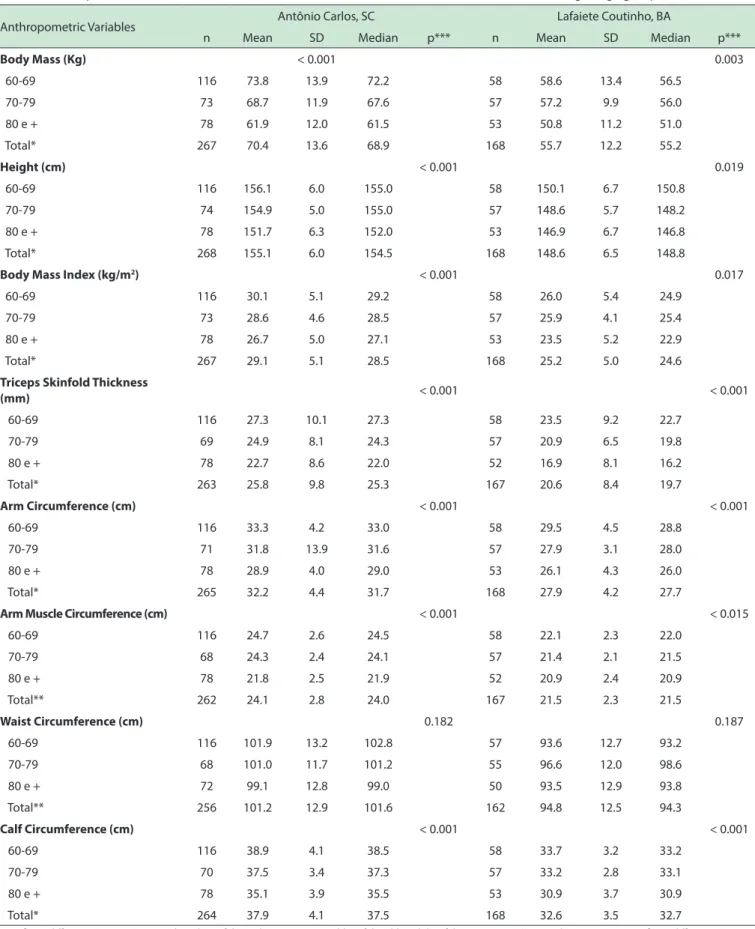
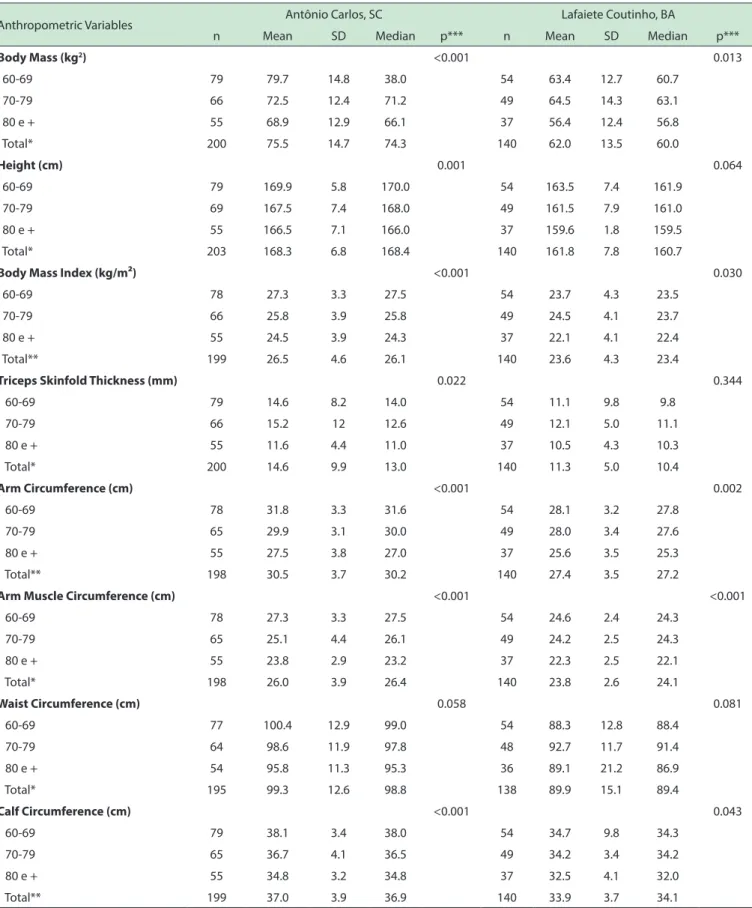
The men and women from AC-SC showed significantly greater mean values for all other anthropometric variables, compared to the subjects of LC-BA. Compared to younger age groups, the subjects over 80 years (AC-SC and LC-BA) presented lower mean values in most anthropometric variables, with statistical differences. There were exceptions for Triceps Skinfold thickness of the men from LC-BA, and
Waist Circumference of men and women of the two towns. Comparing age groups, there were significant differences in the mean values of all anthropometric variables, except for Triceps Skinfold thickness among men over 80 years. The mean values were higher for older AC-SC (Tables 3 and 4).
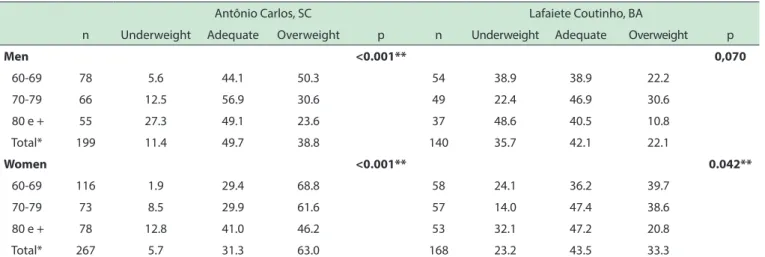
Subjects over 80 years presented higher prevalence of underweight and lower of overweight, without significant difference for the men from LC-BA. The women and men from AC-SC presented higher prevalence of overweight, while the elderly from LC-BA presented greatest proportion of underweight, with significant difference (p < 0.05), as shown in Table 5.
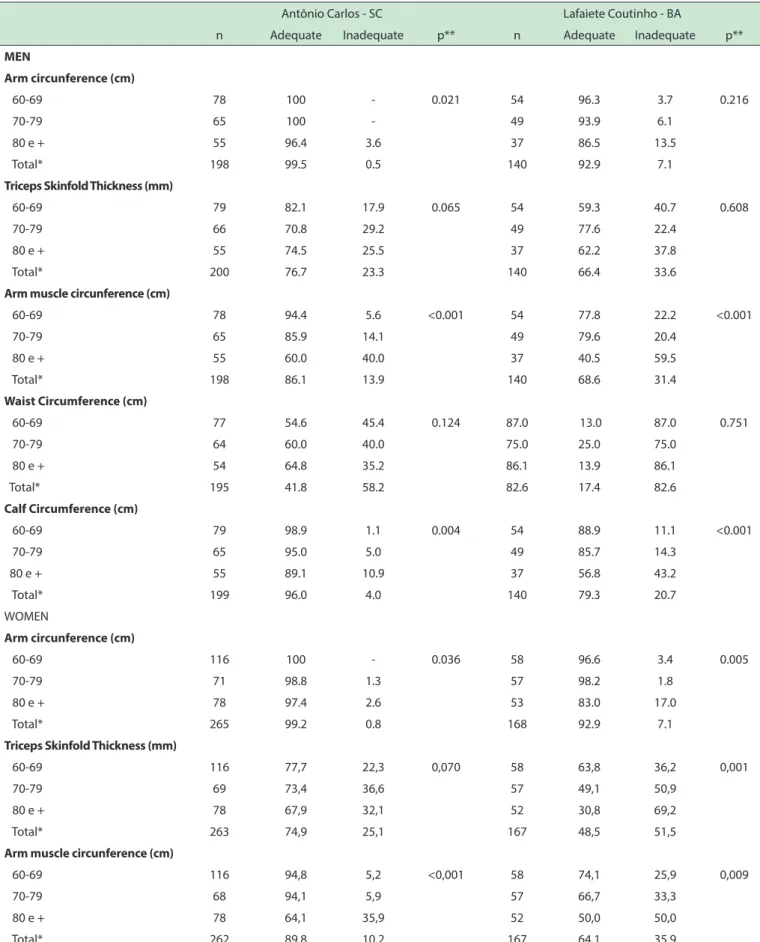
The women from AC-SC presented higher proportion of individuals with risk of metabolic diseases, according to their Waist Circumference. As regards the remaining anthropometric variables analyzed, there was a greatest proportion of older adults from AC-SC with adequate nutritional status. In AC-SC and LC-BA, the prevalence of men with adequate nutritional status was lower in the subjects over 80 years, according to Arm Muscle and Calf Circumferences. Between the women of the two towns this same result was observed for the variables Arm, Arm Muscle and Calf Circumferences, with a reduction of the Triceps Skinfold thickness among the women from LC-BA, as displayed in Table 6.
■
DISCUSSIONTable 2 - Distribution (%) of the older adults, according to the demographic and clinical variables
Antônio Carlos - SC Lafaiete Coutinho - BA
p*
% %
Sex
Female 56.8 54.9
0.540
Male 43.2 45.1
Age group (years)
60 - 69 49.5 36.5
< 0.001
70 - 79 35.8 33.7
≥ 80 14.7 29.8
Marital Status
With partner 75.3 56.6
< 0.001
Without partner 24.7 43.4
Current Occupation
Yes 40.7 11.4
< 0.001
No 59.3 88.6
Literacy
Yes 81.8 33.2
< 0.001
No 18.2 66.8
Living arrangements
Alone 13.1 16.5
0.140
With someone 86.9 83.5
Hunger in the irst 15 years
Yes 10.5 25.0
<0.001
No 89.5 75.0
Some disease in the irst 15 years
Yes 22.9 57.7
<0.001
No 77.1 42.3
* Chi-squared test (χ2)
of AC-SC presented higher values in all anthropometric variables compared to the subjects of LC-BA. Consistent with the anthropometric variables, the older subjects (≥ 80 years) presented lower values in almost all anthropometric variables, as well as higher prevalence of inadequate nutritional status.
The reduction in anthropometric values with advance of age agree with previous studies,1-5 and can be explained by the loss of muscular mass and subcutaneous fat. An increase in intra-abdominal fat with advance of age might explain the lack of reduction in Waist Circumference values in the older age groups. The amount of subcutaneous fat reduces with aging, even in the occurrence of increased relative and absolute total body fat. This may be partly explained by the infiltration of fat in muscle and the increase of visceral fat.6
Anthropometric values of the AC-SC subjects were higher than those in Brazilian older adults dwelling in the larger cities of Joinville (South),4 São Paulo (southeast),1 and
Fortaleza (northeast).2 But anthropometric values for the older adults in LC-BA were lower than those reported in previous studies1,2,4. However, in comparison with Cuban older adults,3 the women in LC-BA presented higher Triceps Skinfold thickness and Waist Circumference values, while the values for the LC-BA men were similar. Among the older adults of LC-BA, the anthropometric values were lower than values found in older adults of others Brazilian cities.
The prevalence of underweight was more frequent in LC-BA than AC-SC, whereas excess weight was more frequent in AC-SC. The underweight rate was higher among the men of the two towns, compared to the women, and in agreement with data from cities of various regions of Brazil.1,2,4,5,24,25 The increase in the proportion of underweight, concomitant with the reduction of the prevalence of overweight with advancing aging, agrees with other Brazilian5, 20-23 and international studies.10,26
Table 3 - Anthropometric values for women from Antônio Carlos-SC and Lafaiete Coutinho-BA, according to age groups
Anthropometric Variables Antônio Carlos, SC Lafaiete Coutinho, BA
n Mean SD Median p*** n Mean SD Median p***
Body Mass (Kg) < 0.001 0.003
60-69 116 73.8 13.9 72.2 58 58.6 13.4 56.5
70-79 73 68.7 11.9 67.6 57 57.2 9.9 56.0
80 e + 78 61.9 12.0 61.5 53 50.8 11.2 51.0
Total* 267 70.4 13.6 68.9 168 55.7 12.2 55.2
Height (cm) < 0.001 0.019
60-69 116 156.1 6.0 155.0 58 150.1 6.7 150.8
70-79 74 154.9 5.0 155.0 57 148.6 5.7 148.2
80 e + 78 151.7 6.3 152.0 53 146.9 6.7 146.8
Total* 268 155.1 6.0 154.5 168 148.6 6.5 148.8
Body Mass Index (kg/m2) < 0.001 0.017
60-69 116 30.1 5.1 29.2 58 26.0 5.4 24.9
70-79 73 28.6 4.6 28.5 57 25.9 4.1 25.4
80 e + 78 26.7 5.0 27.1 53 23.5 5.2 22.9
Total* 267 29.1 5.1 28.5 168 25.2 5.0 24.6
Triceps Skinfold Thickness
(mm) < 0.001 < 0.001
60-69 116 27.3 10.1 27.3 58 23.5 9.2 22.7
70-79 69 24.9 8.1 24.3 57 20.9 6.5 19.8
80 e + 78 22.7 8.6 22.0 52 16.9 8.1 16.2
Total* 263 25.8 9.8 25.3 167 20.6 8.4 19.7
Arm Circumference (cm) < 0.001 < 0.001
60-69 116 33.3 4.2 33.0 58 29.5 4.5 28.8
70-79 71 31.8 13.9 31.6 57 27.9 3.1 28.0
80 e + 78 28.9 4.0 29.0 53 26.1 4.3 26.0
Total* 265 32.2 4.4 31.7 168 27.9 4.2 27.7
Arm Muscle Circumference (cm) < 0.001 < 0.015
60-69 116 24.7 2.6 24.5 58 22.1 2.3 22.0
70-79 68 24.3 2.4 24.1 57 21.4 2.1 21.5
80 e + 78 21.8 2.5 21.9 52 20.9 2.4 20.9
Total** 262 24.1 2.8 24.0 167 21.5 2.3 21.5
Waist Circumference (cm) 0.182 0.187
60-69 116 101.9 13.2 102.8 57 93.6 12.7 93.2
70-79 68 101.0 11.7 101.2 55 96.6 12.0 98.6
80 e + 72 99.1 12.8 99.0 50 93.5 12.9 93.8
Total** 256 101.2 12.9 101.6 162 94.8 12.5 94.3
Calf Circumference (cm) < 0.001 < 0.001
60-69 116 38.9 4.1 38.5 58 33.7 3.2 33.2
70-79 70 37.5 3.4 37.3 57 33.2 2.8 33.1
80 e + 78 35.1 3.9 35.5 53 30.9 3.7 30.9
Total* 264 37.9 4.1 37.5 168 32.6 3.5 32.7
Table 4 - Anthropometric values for men from Antônio Carlos-SC and Lafaiete Coutinho-BA, according to age groups
Anthropometric Variables Antônio Carlos, SC Lafaiete Coutinho, BA
n Mean SD Median p*** n Mean SD Median p***
Body Mass (kg2) <0.001 0.013
60-69 79 79.7 14.8 38.0 54 63.4 12.7 60.7
70-79 66 72.5 12.4 71.2 49 64.5 14.3 63.1
80 e + 55 68.9 12.9 66.1 37 56.4 12.4 56.8
Total* 200 75.5 14.7 74.3 140 62.0 13.5 60.0
Height (cm) 0.001 0.064
60-69 79 169.9 5.8 170.0 54 163.5 7.4 161.9
70-79 69 167.5 7.4 168.0 49 161.5 7.9 161.0
80 e + 55 166.5 7.1 166.0 37 159.6 1.8 159.5
Total* 203 168.3 6.8 168.4 140 161.8 7.8 160.7
Body Mass Index (kg/m²) <0.001 0.030
60-69 78 27.3 3.3 27.5 54 23.7 4.3 23.5
70-79 66 25.8 3.9 25.8 49 24.5 4.1 23.7
80 e + 55 24.5 3.9 24.3 37 22.1 4.1 22.4
Total** 199 26.5 4.6 26.1 140 23.6 4.3 23.4
Triceps Skinfold Thickness (mm) 0.022 0.344
60-69 79 14.6 8.2 14.0 54 11.1 9.8 9.8
70-79 66 15.2 12 12.6 49 12.1 5.0 11.1
80 e + 55 11.6 4.4 11.0 37 10.5 4.3 10.3
Total* 200 14.6 9.9 13.0 140 11.3 5.0 10.4
Arm Circumference (cm) <0.001 0.002
60-69 78 31.8 3.3 31.6 54 28.1 3.2 27.8
70-79 65 29.9 3.1 30.0 49 28.0 3.4 27.6
80 e + 55 27.5 3.8 27.0 37 25.6 3.5 25.3
Total** 198 30.5 3.7 30.2 140 27.4 3.5 27.2
Arm Muscle Circumference (cm) <0.001 <0.001
60-69 78 27.3 3.3 27.5 54 24.6 2.4 24.3
70-79 65 25.1 4.4 26.1 49 24.2 2.5 24.3
80 e + 55 23.8 2.9 23.2 37 22.3 2.5 22.1
Total* 198 26.0 3.9 26.4 140 23.8 2.6 24.1
Waist Circumference (cm) 0.058 0.081
60-69 77 100.4 12.9 99.0 54 88.3 12.8 88.4
70-79 64 98.6 11.9 97.8 48 92.7 11.7 91.4
80 e + 54 95.8 11.3 95.3 36 89.1 21.2 86.9
Total* 195 99.3 12.6 98.8 138 89.9 15.1 89.4
Calf Circumference (cm) <0.001 0.043
60-69 79 38.1 3.4 38.0 54 34.7 9.8 34.3
70-79 65 36.7 4.1 36.5 49 34.2 3.4 34.2
80 e + 55 34.8 3.2 34.8 37 32.5 4.1 32.0
Total** 199 37.0 3.9 36.9 140 33.9 3.7 34.1
Table 5 - Adequacy of body mass index, according to sex, age groups and towns
Antônio Carlos, SC Lafaiete Coutinho, BA
n Underweight Adequate Overweight p n Underweight Adequate Overweight p
Men <0.001** 0,070
60-69 78 5.6 44.1 50.3 54 38.9 38.9 22.2
70-79 66 12.5 56.9 30.6 49 22.4 46.9 30.6
80 e + 55 27.3 49.1 23.6 37 48.6 40.5 10.8
Total* 199 11.4 49.7 38.8 140 35.7 42.1 22.1
Women <0.001** 0.042**
60-69 116 1.9 29.4 68.8 58 24.1 36.2 39.7
70-79 73 8.5 29.9 61.6 57 14.0 47.4 38.6
80 e + 78 12.8 41.0 46.2 53 32.1 47.2 20.8
Total* 267 5.7 31.3 63.0 168 23.2 43.5 33.3
* Signiicant diference (p < 0.05) among the proportion of the elderly of the two regions, according to the nutritional status (BMI); chi-squared test. ** Diference between age groups and body mass index.
registered in the city of Fortaleza, northeast of Brazil (33.5%),5 as well to those observed among the older adults of Havana, Cuba26 (33.0%), a communist country that faces problems of economic productivity and food production.27 For women, the prevalence of overweight in AC-SC was higher than in the larger cities of Viçosa (54.4%)25 and Pelotas (53.4%),24 in the southeast and south of Brazil, respectively. Among the men, the proportions of overweight older adults was similar for AC-SC (38.8), Viçosa (35.4%)25 and Pelotas, (40.1%).24
However, comparisons between the estimates of prevalence must be observed with care. Although the cut-off points used to detect underweight were the same for Cuba,26 Viçosa25 and Pelotas,24 there are differences in the sampling process, and in the periods of collection.
The higher prevalence of muscular mass inadequacy (Arm, Arm Muscle and Calf Circumferences and subcutaneous fat - Triceps Skinfold thickness) variables found among the LC-BA group, agree with Body Mass Index findings. The high prevalence of women with Waist Circumference increase is of concern, as well as the high percentage of overweight in women of AC-SC. It should be noted that although Waist Circumference is a marker of the accumulation of abdominal fat, this is not considered adequate to diagnose visceral fat; however, this indicator has been shown to be clinically and epidemiologically useful.28 Increased Waist Circumference combined with short stature, often a reflection of socioeconomic deprivation in childhood, can increase the risk of cardiovascular diseases, stroke, and diabetes.29 In the older adults the effects of being overweight are generally associated to morbidities and on the onset of functional impairment. At the other end of the scale, undernutrition/ underweight is a major risk factor for mortality.30 Finally the effects of overweight seem less important in the elderly when compared with the same in younger individuals.31
The differences observed in the anthropometric variables of the subjects from the two towns seem related to the differences in the socio-economic development, conditions of life, occupational history and life style,12 rather than differences in the migration patterns among the regions.32 Although there might be a genetic component associated to these differences,33 our results showed that
the self-report of unfavorable health and nutrition problems
in the first 15 years of life were more prevalent among the older adults of LC-BA. Unsatisfactory food intake and health problem during childhood are closely linked to the general standard of living, and can be a reflected in short stature,29 as observed in the present study.
Socio-economic conditions affect access to health services and characteristics, affects the acquisition of foods and, consequently, impinge upon the nutritional status of individuals.11 Social differences in Brazil have been reduced over recent decades, but some indicators still evidence regional differences. The incidence of poverty was distinctly lesser in AC-SC (11.88%) than in LC-BA (47.77%); in 2010, the per capita Gross Domestic Product (GDP) in AC-SC was 7-times higher than that in LC-BA.16 Moreover, it is important to note that the population of oldest older adults (≥ 80 years) is larger in LC-BA, compared to AC-SC. This age group is the most heterogeneous, a condition that is reflected in the anthropometric variables.
Table 6 - Adequacy of anthropometric indicators, according to sex, age groups and towns
Antônio Carlos - SC Lafaiete Coutinho - BA
n Adequate Inadequate p** n Adequate Inadequate p**
MEN
Arm circunference (cm)
60-69 78 100 - 0.021 54 96.3 3.7 0.216
70-79 65 100 - 49 93.9 6.1
80 e + 55 96.4 3.6 37 86.5 13.5
Total* 198 99.5 0.5 140 92.9 7.1
Triceps Skinfold Thickness (mm)
60-69 79 82.1 17.9 0.065 54 59.3 40.7 0.608
70-79 66 70.8 29.2 49 77.6 22.4
80 e + 55 74.5 25.5 37 62.2 37.8
Total* 200 76.7 23.3 140 66.4 33.6
Arm muscle circunference (cm)
60-69 78 94.4 5.6 <0.001 54 77.8 22.2 <0.001
70-79 65 85.9 14.1 49 79.6 20.4
80 e + 55 60.0 40.0 37 40.5 59.5
Total* 198 86.1 13.9 140 68.6 31.4
Waist Circumference (cm)
60-69 77 54.6 45.4 0.124 87.0 13.0 87.0 0.751
70-79 64 60.0 40.0 75.0 25.0 75.0
80 e + 54 64.8 35.2 86.1 13.9 86.1
Total* 195 41.8 58.2 82.6 17.4 82.6
Calf Circumference (cm)
60-69 79 98.9 1.1 0.004 54 88.9 11.1 <0.001
70-79 65 95.0 5.0 49 85.7 14.3
80 e + 55 89.1 10.9 37 56.8 43.2
Total* 199 96.0 4.0 140 79.3 20.7
WOMEN
Arm circunference (cm)
60-69 116 100 - 0.036 58 96.6 3.4 0.005
70-79 71 98.8 1.3 57 98.2 1.8
80 e + 78 97.4 2.6 53 83.0 17.0
Total* 265 99.2 0.8 168 92.9 7.1
Triceps Skinfold Thickness (mm)
60-69 116 77,7 22,3 0,070 58 63,8 36,2 0,001
70-79 69 73,4 36,6 57 49,1 50,9
80 e + 78 67,9 32,1 52 30,8 69,2
Total* 263 74,9 25,1 167 48,5 51,5
Arm muscle circunference (cm)
60-69 116 94,8 5,2 <0,001 58 74,1 25,9 0,009
70-79 68 94,1 5,9 57 66,7 33,3
80 e + 78 64,1 35,9 52 50,0 50,0
Waist Circumference (cm)
60-69 116 11.9 88.1 0,989 57 31.6 68.4 0,845
70-79 68 9.8 90.2 55 23.6 76.4
80 e + 72 16.7 83.3 50 32.0 68.0
Total* 256 11.9 88.1 162 29.0 71.0
Calf Circumference (cm)
60-69 116 100 - <0,001 58 82,8 17,2 <0,001
70-79 70 98,7 1,3 57 78,9 21,1
80 e + 78 83,3 16,7 53 49,1 50,9
Total* 264 97,0 3,0 168 70,8 29,2
Continued Table 6
* Signiicant diference (p<0.05) among the proportion of older adults of the two regions; chi-square test. ** Diference between age groups and anthropometric indicators.
well as in comparison to conditions prevailing in large cities. Our results indicate that the public policies must be tailored with respect to each region, and the health departments of both towns received the original results of the survey. They became the subject matter of courses and training lectures for health agents, nurses, doctors, and older adults.
■
CONCLUSIONThe anthropometric variables and nutritional status (body mass index) of the subjects of the two towns are divergent and identify vulnerability of the nutritional status, either in terms of excess (AC-SC) or of deficiency (LC-BA). Although the anthropometric characteristics and nutritional adequacy change with the advance of age, these regional differences (or the factors that they represent) appear to be determinant factors in the characteristics of older adults. These findings highlight the importance of the use of anthropometric indicators in clinical practice and health monitoring, and stress the importance of differentiating actions and public policies in Brazil.
■
ACKNOWLEDGMENTSIn AC-SC, the research was supported by the Brazilian
National Council of Technological and Scientific Development
(Conselho Nacional de Desenvolvimento Científico e
Tecnológico- CNPq, Process number 478073/2009-7). In
LC-BA, the research was partly funded by Universidade Federal de Santa Catarina (UESB 117/2009 and 011/2010).
■
AUTHOR CONTRIBUTIONSBarbosa AR, Coqueiro RS, Fernandes MH contribu-ted for the conception and planning of the study; Marucci MFN, Barbosa AR, Coqueiro RS contributed significantly to the draft and critical review of the content; Marchesan M,
Guimarães AV and França VF contributed to the draft and data analysis/interpretation. All authors approved the final version of the manuscript.
■
CONFLICT OF INTERESTAuthors declare that they have no conflict of interest concerning this study.
INDICADORES ANTROPOMÉTRICOS EM IDOSOS DE DUAS CIDADES DE REGIÕES BRASILEIRAS DISTINTAS
OBJETIVO: Comparar os indicadores antropomé-tricos e sua adequação em idosos de residentes de duas cidades de regiões distintas do Brasil.
MÉTODOS: Estudo transversal, epidemiológico de base domiciliar. Foram examinados 793 indivíduos (≥ 60 anos) das regiões sul e nordeste, de acordo com grupos etários (60-69, 70-79 e ≥ 80 anos) e sexo.
Os dados foram apresentados como médias (± DP) ou medianas para massa corporal estatura, dobra cutânea triciptal (DCT), índice de massa corporal (IMC), circunferência muscular do braço (CMB) e circunferências do braço (CB), cintura (CC) e panturrilha (CP). A adequação dos indicadores antropométricos (prevalência) também foi comparada: CB (≥22 cm) CMB (≥ 22,98 cm, homen; ≥ 20,92 cm, mulher), TSF (≥ 9,0 mm, homem; ≥ 20 mm, mulher), CP (≤ 31 cm), CC (< 102 cm, homem; < 88 cm, mulher) and IMC (≥ 22,0 and ≤ 27,0 kg/m2).
indicadores analisados, houve maior proporção de idosos da região sul com adequação nutricional.
CONCLUSÃO: Os resultados fornecem informações que podem ser usadas na avaliação de idosos de cidades com o mesmo contexto. A vulnerabilidade nutricional está presente nas duas regiões, por deficiência (nordeste) e por excesso (sul).
PALAVRAS-CHAVE: Envelhecimento; Avaliação Nutricional; Estudos transversais.
■
REFERENCES1. Barbosa AR, Souza JMP, Lebrão ML, Laurenti R, Marucci MFN. Anthro-pometry of elderly residents in the city of São Paulo, Brazil. Cad Saude
Publica. 2005;21(6):1929-38.
2. Menezes TN, Marucci MFN. Perfil dos indicadores de gordura e massa
muscular corporal dos idosos de Fortaleza, Ceará, Brasil. Cad Saude
Publica. 2007;23(12):2887-95.
3. Coqueiro RS, Barbosa AR, Borgatto AF. Anthropometric measurements in the elderly of Havana, Cuba: age and sex differences. Nutrition.
2009;25(1):33-9.
4. Mastroeni MF, Marucci MFN, Mastroeni SSBS, Erzinger GS. Antropo-metria de idosos residentes no município de Joinville-SC, Brasil. Rev Bras Geriatr Gerontol 2010;13(1):29-40.
5. Menezes TN, Souza JMP, Marucci MFN. Avaliação do estado nutricional
dos idosos residentes em Fortaleza/CE: o uso de diferentes indicadores antropométricos. Rev Bras Cineantropom e Desempenho Humano.
2008;10(4):315-22.
6. Gavriilidou NN, Pihlsgård M, Elmståhl S. Anthropometric reference data for elderly Swedes and its disease-related pattern. Eur J Clin Nutr.
2015;69(9):1066-75.
7. Brasil. Ministério da Saúde. Secretaria de Atenção à Saúde. Departa-mento de Atenção Básica. Protocolos do Sistema de Vigilância Alimen-tar e Nutricional - SISVAN na atenção à saúde 2008; Brasília, 61 pages (Série B. Textos básicos de saúde). Available in: http://189.28.128.100/ nutricao/docs/geral/protocolo_sisvan.pdf (Acessed on Dec/2012). 8. Guigoz Y, Vellas B, Garry PJ. Mini Nutrition Assessment: a practical
assessment tool grading the nutrition state of elderly patients. Facts
Res Gerontol 1994; 4(1):15-59.
9. Batsis JA, Singh S, Lopez-Jimenez F. Anthropometric measurements and survival in older Americans: Results from the third National Health and Nutrition Examination Survey. J Nutr Health Aging. 2014;18(2):123-30. 10. Sánchez-García S, García-Peña C, Duque-López MX, Juárez-Cedillo T,
Cortés-Núñez AR, Reyes-Beaman S. Anthropometric measures and nutri-tional status in a healthy elderly population. BMC Public Health. 2007;7:2. 11. Ahmed T, Haboubi N. Assessment and management of nutrition in older
people and its importance to health. Clin Interv Aging 2010;5:207-16.
12. Instituto Brasileiro de Geografia e Estatística (IBGE). Censo 2010. Avai
-lable in: http://www.ibge.gov.br/censo2010 (Acessed on Dec/2012). 13. Ministério do Planejamento, Orçamento e Gestão, Instituto Brasileiro
de Geografia e Estatística, Pesquisa Nacional por Amostra de Domi
-cílios. Segurança alimentar 2004/2009. Rio de Janeiro: IBGE; 2010. http://www.ibge.gov.br/home/estatistica/populacao/seguranca_ali-mentar_2004_2009/pnadalimentar.pdf (acessed on Dec/2012).
14. Tavares EL, Anjos LA. Perfil antropométrico da população idosa brasi
-leira. Resultados da Pesquisa Nacional de Saúde e Nutrição. Cad Saúde
Pública. 1999;15(4):759-68.
15. Fares D, Barbosa AR, Borgatto AF, Coqueiro RS, Fernandes MH. Factors
associated with nutritional status of the elderly in two regions of Brazil.
Rev Assoc Med Bras. 2012;58(4):434-41.
16. Instituto Brasileiro de Geografia e Estatística. IBGE Cidades@. Available
in: http://www.ibge.gov.br/cidadesat/topwindow.htm?1 (Accessed on Dec/2012).
17. Pederson D, Gore C. Error en la medición antropométrica. In: Norton K, Olds T, editors. Antropométrica. Argentina: Biosystem Servicio Educativo, 2000;71-86.
18. Marucci MFN, Barbosa AR. Estado nutricional e capacidade física. In:
Lebrão ML e Duarte YAO, organizadoras. O Projeto SABE no município de São Paulo: uma abordagem inicial. Brasília: Organização
Pan--Americana de Saúde; 2003. p. 95-117.
19. Lean MEJ, Han TS, Morrison CE. Waist circumference as a measure for
indicating need for weight management. BMJ.
1995;311(6998):158-61.
20. Chumlea WC, Guo SS, Roche AF, Steinbaugh ML. Prediction of body weight for the nonambulatory elderly from anthropometry. J Am Diet
Assoc. 1988;88(5):564-8.
21. Chumlea WC, Roche AF, Mukherjee D. Nutritional assessment of the elderly through anthropometry. 2nd ed. Columbus, Ohio: Ross Labo-ratories; 1987.
22. Harrison GG, Buskirk ER, Carter JEL, Johnston FE, Lohman TG, Pollo-ck ML, et al.. Skinfold thiPollo-cknesses and measurement technique. In: Lohman TG, Roche AF, Martorell R. Anthropometric standardization reference manual. Champaign, Illinois: Human Kinetics Books; 1988.
p. 55-70.
23. Gurney JM, Jelliffe DB. Arm anthropometry in nutrition assessment normogram for rapid calculation of muscle circumference and
cross--sectional muscle and fat areas. Am J Clin Nutr. 1973;26(9):912-5.
24. Silveira EA, Kac G, Barbosa LS. Prevalência e fatores associados à obesidade em idosos residentes em Pelotas, Rio Grande do Sul, Brasil:
classificação da obesidade segundo dois pontos de corte do índice de massa corporal. Cad Saude Publica. 2009;25(7):1569-77.
25. Nascimento CM, Ribeiro AQ, Cotta RMM, Acurcio FA, Peixoto SV, Priore
SE, Franceschini SC. Estado nutricional e fatores associados em ido-sos do Município de Viçosa, Minas Gerais, Brasil. Cad Saude Publica. 2011;27(12):2409-18.
26. Coqueiro RS, Barbosa AR, Borgatto AF. Nutritional status, health con-ditions and socio-demographic factors in the elderly of Havana, Cuba: data from SABE survey. J Nutr Health Aging. 2010;14(10):803-8. 27. Federação das Indústrias do Estado de Minas Gerais - Centro
Interna-cional de Negócios (FIEMG/CIN). Perfil socioeconômico Cuba/Brasil /Minas Gerais. 2009. Available in: http://www.fiemg.org.br/admin/
BibliotecaDeArquivos/Image.aspx?ImgId=12419&TabId=1036. (Aces-sed on Dec/2012).
28. Munaretti DB, Barbosa AR, Marucci MFN, Lebrão ML. Self-rated hyper-tension and anthropometric indicators of body fat in elderly. Rev Assoc
Med Bras. 2011;57(1):25-30.
29. Amine E, Baba N, Belhadj M, Deurenbery-Yap M, Djazayery A, Forrester T, Galuska,D et al. Diet, nutrition and the prevention of chronic dise-ases: report of a Joint WHO/FAO Expert Consultation, World Health Organization, Geneva, Switzerland.2002.
30. Ferreira LS, Amaral TF, Marucci MFN, Nascimento LF, Lebrão ML et al. Undernutrition as a major risk factor for death among older Brazilian adults in the community-dwelling setting: SABE survey. Nutrition. 2011;27(10):1017-22.
31. Brown RF, Kuk JL. Consequences of obesity and weight loss: a devil’s
advocate position. Obes Rev. 2015;16(1):77-87.
32. Berquó E, Baeninger R. Os idosos no Brasil: considerações demográficas. Textos Nepo [site da Internet]. Available in: http://www.nepo.unicamp.
br/textos_publish/textos_ nepo_37.pdf. (Acessed on Jan/2013). 33. Lins TC, Vieira RG, Abreu BS, Grattapaglia D, Pereira RW. Genetic