O
ri
gi
na
l
a
rt
ic
le
s
Factors associated with the functional independence of elderly women
in the city of Cuiabá
Idilaine de Fátima Lima1 Rosemeiry Capriata de Souza Azevedo2 Annelita Almeida Oliveira Reiners2 Ageo Mario Cândido da Silva3 Luciane Cegati de Souza4 Natália Araujo de Almeida5
1 Faculdade de Ciências Sociais Aplicadas de Tangará da Serra (FACISA/TS) – UNIC Tangará Sul,
Departamento de Enfermagem. Tangará da Serra, Mato Grosso, Brasil.
2 Universidade Federal de Mato Grosso (UFMT), Faculdade de Enfermagem (FAEN). Cuiabá, Mato
Grosso, Brasil.
3 Universidade Federal de Mato Grosso (UFMT), Instituto de Saúde Coletiva (ISC). Cuiabá, Mato Grosso,
Brasil.
4 Secretaria de Estado e Saúde (SES), Auditoria Geral do SUS. Cuiabá, Mato Grosso, Brasil.
5 Hospital Universitário Júlio Müller (HUJM), Assistência de enfermagem. Cuiabá, Mato Grosso, Brasil.
Correspondence Idilaine de Fátima Lima Email: [email protected]
Abstract
Objective: To analyze the prevalence of and factors associated with functional independence among community based elderly women. Methods: A cross-sectional study was conducted in the urban area of the city of Cuiabá, in the state of Mato Grosso, involving 247 women aged 60 and over. Data was collected through interviews, using instruments such as the Mini Mental State Examination, a questionnaire about demographic and health data, the Katz Index and the Lawton and Brody Scale. Prevalence ratio and the chi-squared test (p=0.05) were used as measures of association, whereas for multivariate analysis, the Poisson regression model was used. Calculations were performed with the Statistical Package for Social Sciences 22.0 program. Results: The prevalence of functional independence was 63.2%. The variables associated with independence were a younger age, an income greater than the minimum wage; the use of up to two drugs, did not need hospitalization in the last 6 months, had not experienced immobilization that prevented locomotion after age 60, visiting friends and relatives, social participation and physical activity. Conclusion: All the variables were strongly associated with healthy aging. Even in the presence of pathologies considered common to the aging process, the practice of physical activity and social interaction are important markers of functional independence.
INTRODUCTION
The 60 years or older age group is the fastest growing population segment in the world when compared proportionally with other age groups. Globally, the number of elderly women is significantly higher (a difference of 70 million) than
the number of elderly men.1 In Brazil, 55.8% of all
individuals aged 60 years or more are female.2 This
phenomenon has been called the "feminization of the elderly" and is caused by the greater longevity
of women when compared to men.3
This increase in the number of elderly individuals has led to global concerns about the need to implement new public policies that favor the maintenance of the functional independence of this segment of the population throughout the aging process. In accordance with a proposal by
the World Health Organization,4 the Ministry of
Health has used its care network and certain public policies to develop strategies for the recovery, maintenance and promotion of independence
among the elderly.5 It is therefore hoped that
this group of people will retain their ability to perform activities of daily living for as long as possible, without requiring assistance, as well as their autonomy, freedom of action and decision making skills.6,7
A number of tools have been created to assess the degree of care (from third parties) required by the patient in order to complete motor and cognitive tasks. One such tool is the Functional Independence
Measure (FIM).8 However, these assessments are
difficult to apply to community-dwelling elderly individuals and are usually conducted with institutionalized or hospitalized patients.
The independence scale for basic activities of daily living (ADLs) was originally created to assess the results of treatment protocols for elderly patients, the prognosis of which provides a brief description of the ability of patients with chronic illnesses to take care of themselves and perform daily functions. This instrument is used to measure the functional capacity of community-dwelling and
institutionalized elderly individuals.9 Instrumental
activities of daily living (IADLs) are considered more complex and are related to the capacity of
the elderly individual to live in the community. 10
Several authors have reported that the prevalence of dependence is higher among women
than men.11,12 Since they tend to live longer, women
become more susceptible to a reduction in their functional capacity, as well as in their ability to perform activities of daily living or community-based activities, even when certain morbidities
are involved.13,14However, reports in literature
do not always agree on the functional capacity of
elderly women.15,16
In this context, it is important to understand the conditions that favor the independence of these elderly women and the complex inter-relationships between all the factors involved in the aging process.
It is common knowledge that the main healthcare models for the elderly in Brazil are highly medicalized, inefficient and expensive, due to the use of highly-complex services. The identification of factors associated with functional independence can guide health promotion and disease prevention practices in other sections of the population, thereby decreasing the intense use of more complex health care services among the elderly.
The monitoring of health conditions and its determinants can favor the development of more effective health and social policies. Therefore, the aim of the present study was to analyze the prevalence (and associated factors) of functional independence among elderly community-dwelling women.
METHOD
A cross-sectional study was conducted with elderly women who lived in the urban zone of the municipality of Cuiabá, in the state of Mato Grosso. The women were selected based on a
previous study by Cardoso et al.,17 who assessed
confidence interval of 95% and a sampling error of 5%. Sampling by conglomerates was used to determine visitation in 11 census sectors. In order to determine the quantity of elderly individuals to be interviewed in the urban districts of Cuiabá, the total number of elderly residents in each district was stratified by gender, giving a total of 573 elderly individuals. Of this total, 319 were women aged 60 years or more. These women were selected for participation in the present study.
The following exclusion criteria were applied: the presence of cognitive decline; or when present, the absence of a caregiver to help the elderly individual with the interview responses. Cognitive decline was assessed using the mini mental state examination (MMSE), applying the education
score established by the Ministry of Health.6
The following situations were classified as cognitive decline: illiterate elderly women with a total MMSE score of less than 19; elderly women with one to three years of education and a score of less than 23; elderly women who studied for between four and seven years and scored less than 24 points; and elderly women who studied for more
than seven years and scored less than 28 points.6
Data was collected between March 30 and May 30 of 2014 in the home of the participant, after they had read and signed a free and informed consent form. The data was collected through semi-structured interviews using a previously-tested questionnaire containing the following socio-demographic information: age was categorized as between 60 and 79 years or 80 years or more; marital status was dichotomized as married versus separated/widow/single; living conditions were classified as living alone or living with somebody; education was classified as illiterate, 1 to 3 years, four to seven years, or more than seven years (this was later reclassified as illiterate or up to three or four years of study or more); retired (yes or no); occupation (active/inactive); and income of up to or more than the minimum wage (MW). The health condition of the participants was classified as follows: self-perception of health (very good/good versus normal/poor/very poor); hospitalization in the previous six months (yes/no); health issues (yes/no), which were obtained from a list of health
issues that are common in the elderly population; how many health issues (one and two or more); regular use of medication (yes/no); how many different drugs used (up to two or three or more); reported falls after reaching 60 years of age (yes/ no); suffering injuries or fractures after reaching 60 years of age (yes/no); immobility after 60 years of age (yes/no), which meant be unable to move, be bedridden or use a wheelchair, irrespective of the cause. Social relationships were classified as follows: visits friends or relatives (yes/no); receives visitors (yes/no); attends a social group (yes/no); performed physical exercise at least once a week in the previous month (yes/no).
Functional independence was determined using
the Katz index,9 which assesses the capacity of
elderly individuals to perform six ADLs (take a shower/bath, dress themselves, go to the toilet, get around, continence and nourishment), and the
Lawton and Brody scale,10 which determines the
capacity to perform nine IADL activities (using the telephone, travelling a long distance using some form of transport, going shopping, making their own meals, cleaning the house, performing manual domestic tasks, washing clothes, taking medication and looking after their finances). Both of these scales have been validated and adapted for use in Brazil and are recommended by the Ministry of Health.6
From a hierarchical perspective, functional losses occur in the IADL>ADL direction. Following this principle, the elderly women were
classified a priori as independent if they scored 27
points on the Lawton and Brody scale and did not require assistance to perform the Katz index tasks. Participants who scored between 10 and 26 points were classified as partially dependent, while those who scored up to nine points for IADLs and required complete assistance in all ADLs were considered to be completely dependent.
The data was codified and digitalized, with bivariate analysis conducted using EPI-INFO
7.0 software.The variables were described using
absolute (n) and relative (%) frequencies. Bivariate analysis identified associations between the variable response (functional independence) and the other variables of exposure. The chi-squared
test (p≤0.05) and the Mantel-Haenszel method
(CI 95%) were used to calculate the statistical significance of the associations.
Multiple analysis was conducted using the Poisson regression model and the Statistical Package for Social Sciences 22.0 (SPSS). All
variables with a p-value of ≤0.20 in the crude
analysis were included, using a method that enabled the insertion of blocks of variables. Socio-demographic data was inserted first, followed by health conditions and social relationships. Associations that lost their statistical significance (p>0.05) in each block were excluded using the progressive withdrawal method (stepwise backward). At the end of the analysis, variables
with a p-value of ≤0.05 were considered as having
a statistically significant association.
The present study was approved by the Research Ethics Committee of the Hospital Universitário Júlio Müller ( Júlio Müller University Hospital) under protocol number 528.443/2014 and fulfilled the guidelines of resolution 466/12 of the National Health Council.
RESULT
The final sample contained 247 elderly women, after the following exclusions: one individual was excluded due to a diagnosis of cognitive decline; 33 participants were excluded due to a change of address or interrupted monitoring (after three visits had been completed); 28 individuals had died since the completion of the previous study; and 10 elderly women refused to participate in the research. Of the 247 individuals who did participate, 40.4% were aged between 70 and 79 years, and the mean age was 73 years (SD±7.9). There was a predominance of widows (44.5%) with four to seven years of education (29.5%), who were retired (54.7%) and received an income of up to the minimum wage (55.1%). These values are not contained in the tables.
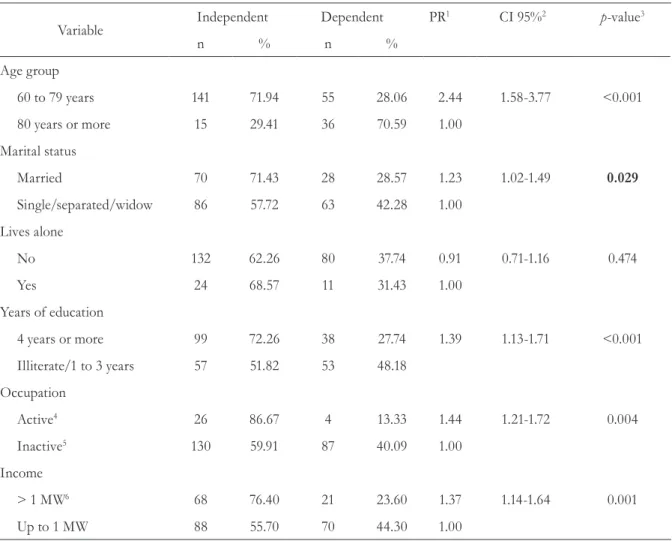
Concerning the distribution of the elderly women in accordance with functional capacity, the prevalence recorded for independence was 63.2% (CI: 57.0-68.9) of the population assessed, while the remaining 36.8% (CI: 31.1-43.0) were classified as partially dependent. None of the subjects was classified as completely dependent.
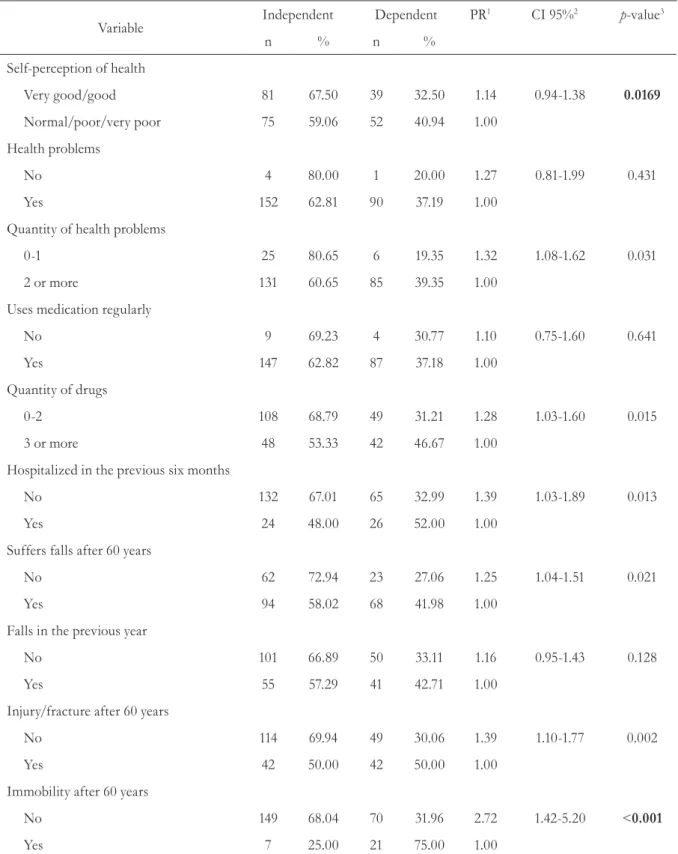
Concerning health conditions, the following variables correlated with independence among the elderly women: no more than one health problem; taking no more than two drugs concomitantly; and no hospitalizations in the previous six months. Statistically significant associations were maintained for participants who had suffered
no falls, immobility, injuries or fractures after reaching 60 years of age (Table 2).
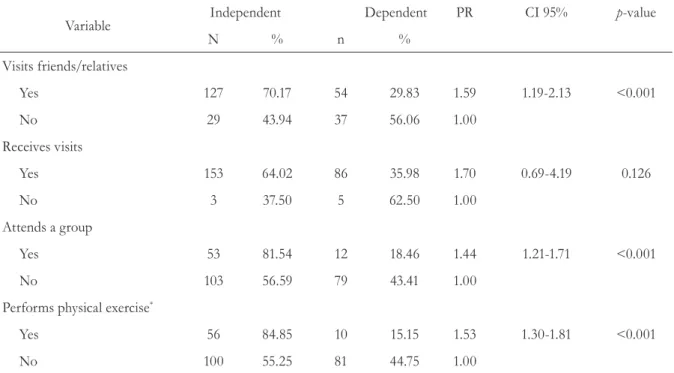
In the analysis of social relationships, statistically significant associations were recorded for the following variables: visiting friends or relatives; attending a social group; and performing physical exercise (Table 3).
Table 1. Distribution of the elderly women, according to socio-demographic variables. Cuiabá, Mato
Grosso, 2014.
Variable Independent Dependent PR
1 CI 95%2 p-value3
n % n %
Age group
60 to 79 years 141 71.94 55 28.06 2.44 1.58-3.77 <0.001 80 years or more 15 29.41 36 70.59 1.00
Marital status
Married 70 71.43 28 28.57 1.23 1.02-1.49 0.029
Single/separated/widow 86 57.72 63 42.28 1.00 Lives alone
No 132 62.26 80 37.74 0.91 0.71-1.16 0.474
Yes 24 68.57 11 31.43 1.00
Years of education
4 years or more 99 72.26 38 27.74 1.39 1.13-1.71 <0.001 Illiterate/1 to 3 years 57 51.82 53 48.18
Occupation
Active4 26 86.67 4 13.33 1.44 1.21-1.72 0.004
Inactive5 130 59.91 87 40.09 1.00
Income
> 1 MW6 68 76.40 21 23.60 1.37 1.14-1.64 0.001
Up to 1 MW 88 55.70 70 44.30 1.00
PR1: prevalence ratio; CI2 95%: confidence interval for the proportion of 95%; P3: level of significance considering the distribution of the
chi-squared test (p<0.05); Active4: income from work only or from work and other sources; Inactive5: income from non-work sources (retirement
Table 2. Distribution of elderly women, according to the health condition variables. Cuiabá, Mato Grosso, 2014.
Variable Independent Dependent PR
1 CI 95%2 p-value3
n % n %
Self-perception of health
Very good/good 81 67.50 39 32.50 1.14 0.94-1.38 0.0169
Normal/poor/very poor 75 59.06 52 40.94 1.00 Health problems
No 4 80.00 1 20.00 1.27 0.81-1.99 0.431
Yes 152 62.81 90 37.19 1.00
Quantity of health problems
0-1 25 80.65 6 19.35 1.32 1.08-1.62 0.031
2 or more 131 60.65 85 39.35 1.00
Uses medication regularly
No 9 69.23 4 30.77 1.10 0.75-1.60 0.641
Yes 147 62.82 87 37.18 1.00
Quantity of drugs
0-2 108 68.79 49 31.21 1.28 1.03-1.60 0.015
3 or more 48 53.33 42 46.67 1.00
Hospitalized in the previous six months
No 132 67.01 65 32.99 1.39 1.03-1.89 0.013
Yes 24 48.00 26 52.00 1.00
Suffers falls after 60 years
No 62 72.94 23 27.06 1.25 1.04-1.51 0.021
Yes 94 58.02 68 41.98 1.00
Falls in the previous year
No 101 66.89 50 33.11 1.16 0.95-1.43 0.128
Yes 55 57.29 41 42.71 1.00
Injury/fracture after 60 years
No 114 69.94 49 30.06 1.39 1.10-1.77 0.002
Yes 42 50.00 42 50.00 1.00
Immobility after 60 years
No 149 68.04 70 31.96 2.72 1.42-5.20 <0.001
Yes 7 25.00 21 75.00 1.00
PR1: prevalence ratio; CI2 95%: confidence interval for the proportion of 95%; P3: level of significance considering the distribution of the
In the Poissonmultiple regression analysis, the following variables remained associated with functional independence: an age of between 60 and 79 years; having an income of more than the minimum wage; no hospitalizations in the
previous six months; using no more than two types of medicine on a regular basis; the absence of immobilization after 60 years of age; visiting friends or relatives; attending social groups and performing some form of physical exercise (Table 4).
Table 3. Distribution of the elderly women, according to social relationships. Cuiabá, Mato Grosso, 2014.
Variable Independent Dependent PR CI 95% p-value
N % n %
Visits friends/relatives
Yes 127 70.17 54 29.83 1.59 1.19-2.13 <0.001
No 29 43.94 37 56.06 1.00
Receives visits
Yes 153 64.02 86 35.98 1.70 0.69-4.19 0.126
No 3 37.50 5 62.50 1.00
Attends a group
Yes 53 81.54 12 18.46 1.44 1.21-1.71 <0.001
No 103 56.59 79 43.41 1.00
Performs physical exercise*
Yes 56 84.85 10 15.15 1.53 1.30-1.81 <0.001
No 100 55.25 81 44.75 1.00
PR1: prevalence ratio; CI2 95%: confidence interval for the proportion of 95%; P3: level of significance considering the distribution of the
chi-squared test(p≤0,05)
Table 4. Poisson multiple regression model of the variables associated with the functional independence
of elderly women. Cuiabá, Mato Grosso, 2014.
Variable PRGross* CI – 95% PRadjusted** IC – 95% p-value Age group
60-79 2.44 1.58-3.77 1.32 1.21-1.43 <0.001
80 years or more 1.00 1.00
Income
>1 MW 1.37 1.14-1.64 1.16 1.07-1.24 0.002
Up to 1 MW 1.00 1.00
Quantity of drugs
0- 2 1.28 1.03-1.60 1.11 1.03-1.20 0.015
3 or more 1.00 1.00
DISCUSSION
The prevalence of functional independence (FI) in the present study was 63.2%, which is quite similar to the results of a study conducted in Norway, in which 74.3% of the women monitored
were classified as independent.15 Similarly, a study
of 1339 elderly women in Uberaba, in the state of Minas Gerais (Brazil) reported a FI prevalence of
69.2%.18 However, other studies have shown lower
levels of independence among elderly women.19
One of the possible explanations for this result is the fact that most of the participants have lived at a time when, historically, women have more
rights and opportunities.20 The oldest women
exhibited the greatest growth in relation to their
inclusion in the workforce21 and their involvement
in family decisions. These modern benefits have
made them more financially independent.22,23 In
addition, they have found new meaning in their lives, broadening their horizons, seeking more information, incorporating new knowledge and
expanding their interpersonal relationships.24
A number of studies have shown that many elderly women are more physically resistant,
maintaining their health and autonomy. 23,25
Nowadays, they take care of themselves and participate in social activities that preserve their physical and cognitive condition through activities such as dancing, travelling and crafts workshops.
22,25,26
The association found in the present study between the age group of younger elderly women and FI is not surprising. Studies have shown that women aged under 80 years are
more independent.18,27,28 This is due to the aging
process itself, in which physiological decline and pathological risks progress over time, leading to
the onset of disabilities at more advanced ages.3
Similarly, elderly women who did not exhibit immobility after 60 years of age, had not been hospitalized recently and performed some form of physical exercise were associated with FI, thereby confirming that the maintenance of an active and healthy body is directly related to the preservation of FI.13
Variable PRGross* CI – 95% PRadjusted** IC – 95% p-value Hospitalized in the previous
six months
No 1.39 1.03-1.89 1.11 1.02-1.21 0.003
Yes 1.00 1.00
Immobility after 60 years
No 2.72 1.42-5.20 1.19 1.01-1.32 0.002
Yes 1.00 1.00
Visits friends/relatives
Yes 1.59 1.19-2.13 1.11 1.02-1.20 0.007
No 1.00 1.00
Attends groups
Yes 1.44 1.21-1.71 1.11 1.01-1.21 0.049
No 1.00 1.00
Performs physical exercise
Yes 1.53 1.30-1.81 1.11 1.01-1.21 0.050
No 1.00 1.00
The reduction of disabilities comes from the conservation of physical mobility and the prevention and control of chronic illnesses and
biopsychosocial equilibrium. 29 Women tend to
perform less physical exercise than men,30 which
leads to organic-functional benefits, as well as other benefits related to sociability, beauty and
esthetics.31 In addition, active aging reduces the
demand for health services, thereby reducing the
cost of treating illnesses and hospitalizaitons.13
The association found between elderly women with a higher income and FI in the present study
was also reported by Ribeiro and Neri.30 These
authors assessed 1538 elderly individuals aged 65 years or more in six Brazilian cities and determined the influence of socioeconomic factors on aging. A higher salary improves the level of self-care of an individual (in terms of their health), ensuring that incapacitating processes are delayed and the
autonomy of the individual is maintained.25,30 A
higher family and per capita income favors more socializing among elderly individuals, thereby improving their ability to perform daily activities and interact with different social groups. Consequently, a higher income “socially modifies the idea that
aging is linked to reclusion, passivity and rest”.23
The association between the non-use or low consumption of drugs and FI is significant. Polypharmacy occurs when an elderly individual exhibits several chronic illnesses concomitantly, which usually involves greater functional
dependence.32 However, knowledge about the
adequate and safe use of drugs can prevent illnesses
and functional decline.13
The social interactions involved in visiting friends or relatives were important to the FI of the elderly women, corroborating the findings
of other studies.7,30,33 These activities prevent the
individual from developing a sedentary lifestyle, thereby delaying the onset of disabilities and the
loss of autonomy.7,34 Domestic tasks that make
up the daily life of women can also prolong their independence. Furthermore, the maintenance of social relationships and recreation/leisure activities can assist the physical and psychological wellbeing
of elderly women. Prevention measures that delay the evolution of illnesses reduce the complexity of the care required and improve the social and family life of individuals, while also increasing
their desire to perform physical exercise.35
Since this was a cross-sectional study in which the exposure factors and the outcome were determined simultaneously, caution should be used when interpreting associations between factors related to the functional independence of the participants.
It is not possible to rule out the occurrence of information bias or memory bias, given the fact that this study assessed the recollections of elderly women. Functional dependence may be related to cognitive decline or a lack of awareness of the previous situation of the patient (on behalf of the person who helped them to complete the questionnaire). However, the participation of the main researcher in the interviews may have minimized the possibility of this occurrence.
In cross-sectional studies such as this, the use of the prevalence ratio as an effect measurement in
both the bivariate analysis and the Poisson multiple
model favors a satisfactory adjustment of the effect measurements and prevents the overestimation of association measurements.
The significance of the present study lies in the fact that it focused on the identification of factors associated with the functional independence (FI) of elderly women, thereby ensuring that such data could identify predictor variables for healthy aging, specifically among women.
CONCLUSION
to friends/parents, attending social groups and performing some form of physical exercise.
The results of the present study showed the diversity of factors that are directly correlated with FI and confirmed that different aspects of daily activities and the physiological aging process can affect an individual's ability to perform ADLs or IADLs.
It is believed that the present study could stimulate new subsidies for the implementation of policies focusing on this segment of the population. Health professionals need to invest in the health education of these women before they become chronologically elderly in order to promote active aging and effective participation in society and in family environments.
REFERENCES
1. World Economic Forum. Global Population Ageing: Peril or Promise? Geneva; 2012. Disponível em: http://www.weforum.org/reports/global-population-ageing-peril-or-promise.
2. Instituto Brasileiro de Geografia e Estatística (IBGE). Sala de imprensa. Comunicação Social. Disponível em: http://saladeimprensa.ibge.gov.br. Dezembro, 2013. 3. Camarano AA, Kanso S, Fernandes F.
Envelhecimento populacional, perda da capacidade laborativa e políticas públicas brasileiras entre 1992 e 2011. IPEA-Instituto de Pesquisa Econômica Aplicada. Rio de Janeiro. 2013.
4. ORGANIZAÇÃO MUNDIAL DE SAÚDE. Classificação Internacional de Funcionalidade, Incapacidade e Saúde. Lisboa. 2004, 238p. 5. Brasil. Ministério da Saúde. Atenção à saúde da
pessoa idosa e Envelhecimento. Secretaria de Atenção à Saúde, Departamento de Ações Programáticas e Estratégicas, Área Técnica Saúde do Idoso. Série Pactos pela Saúde 2006, v. 12 – Brasília/DF. 2010. 6. Brasil. Ministério da Saúde. Secretaria de Atenção a
Saúde. Departamento de Atenção Básica. Caderno de Atenção Básica. Envelhecimento e saúde da pessoa idosa. Brasília: ed. Ministério da Saúde, 2007. 7. Ferreira OGL, Maciel SC, Costa SMG, Silva AO,
Moreira MASP. Envelhecimento ativo e sua relação com a independência funcional. Texto Contexto Enferm. Florianópolis 2012; 21(3): 513-8. 8. Riberto M, Miyazaki MH, Jorge Filho D,
Sakamoto H, Battistella LR. Reprodutibilidade da versão brasileira da Medida de Independência Funcional. Acta Fisiátrica 2001; 8(1): 45-52.
9. Katz S, Ford AB, Moskowitz RW, Jackson BA, Jaffe MW. Studies of illness in the aged the index of adl: a standardized measure of biological and psychosocial function. Journal of the American Medical
Association 1963; 185(12): 914-919.
10. Lawton MP, Brody EM. Assessment of older people; self-maintaining and instrumental activities of daily-living. Gerontologist 1969; 9(3): 179-86.
11. Palacios-Ceña D, Jiménez-García R, Hernández-Barrera V, Alonso-Blanco C, Carrasco-Garrido P, Fernández-de-Las-Peñas C. Has the Prevalence of Disability Increased Over the Past Decade (2000– 2007) in Elderly People? A Spanish Population-based Survey. Journal of the American Medical Directors Association 2012; 13(2): 136-142.
12. Rosso AL, Eaton CB, Wallace R, Gold R, Stefanick ML, Ockene JK., et al. Geriatric syndromes and incident disability in older women: results from the women's health initiative observational study. J Am Geriatr Soc 2013; 61(3): 371-379.
13. World Health Organization (WHO). Envelhecimento ativo: uma política de saúde / World Health
Organization; tradução Suzana Gontijo. – Brasília: Organização Pan-Americana da Saúde, 2005. 14. Cardoso JH, Costa. Características epidemiológicas,
capacidade funcional e fatores associados em idosos de um plano de saúde. Ciênc. saúde coletiva [online] 2010; 15(6): 2871-2878.
15. Idland G, Pettersen R, Avlund K, Bergland A. Physical performance as long-term predictor of onset of activities of daily living (ADL) disability: A 9-year longitudinal study among community-dwelling older women. Archives of Gerontology and Geriatrics 2013; 56(3): 501–506.
16. Pereira GN, Bastos GAN, Duca GFD, Bós AJG. Indicadores demográficos e socioeconômicos associados à incapacidade funcional em idosos. Cad. Saúde Pública [online] 2012; 28(11): 2035-2042. 17. Cardoso JDC, Azevedo RCS, Reiners AAO, Louzada
18. Soares MBO,Tavares DMS, Dias FA, Diniz MA, Geib S. Morbidades, capacidade funcional e qualidade de vida de mulheres idosas. Esc. Anna Nery [online] 2010; 14(4): 705-711.
19. Pilger C, Menon MU, Mathias TAF. Capacidade funcional de idosos atendidos em unidades básicas de saúde do SUS. Rev Bras Enferm 2013; 66: 907-13. 20. Carvalho, DJ. A conquista da cidadania feminina.
Revista Multidisciplinar da UNIESP. Saber Acadêmico 2011; 11: 143-153.
21. Bandeira L, Melo HP, Pinheiro LS. Mulheres em dados: o que informa a PNAD/IBGE 2008. In: BRASIL. Presidência da república. Secretaria de políticas para as mulheres. Edição especial da revista do Observatório Brasil da Igualdade de Gênero. 1ª impressão Brasília: Secretaria de Políticas para as Mulheres. 2010; 107-119. 22. Moura MAV, Domingos AM, Rassy ME C. A
qualidade na atenção à saúde da mulher idosa: um relato de experiência. Esc Anna Nery [online] 2010; 14(4): 848-855.
23. Argimon IIdeL, Pizzinato A, Ecker DSDI, Lindern D, Torres. Velhice e Identidade: Significações de Mulheres Idosas. Revista Kairós Gerontologia, São Paulo (SP) 2011; 14(4): 79-99.
24. Rodrigues AP, JUSTO JS. A ressignificação da feminilidade na terceira idade. Estud. interdiscipl envelhec. Porto Alegre 2009; 14(2): 169-186. 25. Figueiredo MDOLF, Tyrrel MAR, Carvalho
CMRGde; Luz MHBA, Amorim FCM, Loiola NLdeA. As diferenças de gênero na velhice. Rev Bras Enferm 2007; 60(4): 422-7.
26. Merighi MAB, Oliveira DM, Jesus MCP, Souto RQ, Thamada AA. Mulheres idosas: desvelando suas vivências e necessidades de cuidado. Rev. Esc. enferm. USP [online] 2013; 47(2): 408-414.
27. Virtuoso Junior JS, Guerra RO. Incapacidade funcional em mulheres idosas de baixa renda. Ciênc. saúde coletiva [online] 2011; 16(5): 2541-2548. 28. Alexandre Tda S, Corona LP, Nunes DP, Santos
JL, Duarte YA, Lebrão ML. Gender differences in incidence and determinants of disability in activities of daily living among elderly individuals: SABE study. Arch Gerontol Geriatr 2012; 55(2): 431-437.
29. Meisner BA, Dogra S, Logan AJ, Baker J, Weir PL. Do or decline? Comparing the effects of physical inactivity on biopsychosocial components of successful aging. J Health Psychol 2010; 15(5): 688-696.
30. Ribeiro LHM, Neri AL. Exercícios físicos, força muscular e atividades de vida diária em mulheres idosas. Ciênc. saúde coletiva [online] 2012; 17(8): 2169-2180. 31. Fraga VM, Novelli MMPC, Ferreira SE, Oliveira
RCde. Significados da atividade física para mulheres idosas. Rev. Bras. Pesq. Saúde 2013; 15(1): 59-68. 32. Maher Junior RL, Hanlon JT, Hajjar ER. Clinical
Consequences of Polypharmacy in Elderly. Expert Opinion Drug Safety, January 2014; 13(1): 57-65. 33. Torres JL, Dias RC, Ferreira FR, Macinko J,
Lima-Costa MF. Functional performance and social relations among the elderly in Greater Metropolitan Belo Horizonte, Minas Gerais State, Brazil: a population-based epidemiological study. Cad. Saúde Pública [online] 2014; 30(5): 1018-1028.
34. Doimo LA, Derntl AM, Lago OC. O uso do tempo no cotidiano de mulheres idosas: um método indicador do estilo de vida de grupos populacionais. Ciência & Saúde Coletiva 2008; 13(4): 1133-1142. 35. Veras R. Envelhecimento populacional
contemporâneo: demandas, desafios e inovações. Rev. Saúde Pública [online] 2009; 43(3): 548-554.