23 Analysis of the new classification of bone densitometry reports
Radiol Bras 2007;40(1):23–25 Original Article
ANALYSIS OF THE NEW CLASSIFICATION OF BONE DENSITOMETRY
REPORTS*
Osvaldo Sampaio Netto1, Larissa de Oliveira Lima Coutinho2, Danielle Cristina de Souza2
OBJECTIVE: To compare the new normatization of bone densitometry reports on findings at the level of the lumbar spine (L1-L4) proposed by International Society for Clinical Densitometry (ISCD) in 2005, with the classification of World Health Organization (WHO) that was routinely been utilized since 1994. MATERIALS AND METHODS: Bone densitometry studies performed on the lumbar spine of 200 patients at Universidade Católica de Brasília and Hospital das Forças Armadas, Brasília, DF, Brazil, have been evaluated. Inclusion criteria were: female gender, age ranging between 20 and 49 years, and absence of spine morphological changes visualized on the images. The exclusion criteria were: women more than 50 years or menopausal women. RESULTS: Analyzing the bone densitometry reports under the WHO classification, 29 patients were found with osteoporosis, 76 with osteopenia and 95 within normality levels. On the other hand, according to the new ISCD 2005 classification, only 32 patients presented results “below the expected range for age”, and 162 “within the expected range for age”. CONCLUSION: Significant differences were found when com-paring the traditional WHO densitometric classification versus the new one proposed by ISCD 2005. So, this new classification should be known and understood by physicians who request or perform bone densitom-etry studies, aiming at the correct interpretation, explanation and orientation to the patients.
Keywords: Densitometry; Osteoporosis; Spine; Bone density.
Análise da nova classificação de laudos de densitometria óssea.
OBJETIVO: Comparar a nova normatização de laudos densitométricos de coluna lombar proposta pela Inter-national Society for Clinical Densitometry (ISCD) em 2005 com a classificação rotineiramente usada da Organização Mundial da Saúde (OMS) desde 1994. MATERIAIS E MÉTODOS: Foram analisados 200 exa-mes de densitometria óssea da coluna lombar realizados na Universidade Católica de Brasília e no Hospital das Forças Armadas. Os critérios de inclusão foram: sexo feminino, idade mínima de 20 anos e máxima de 49 anos, e ausência de alterações morfológicas na coluna lombar visualizadas no exame densitométrico. Como critério de exclusão, foram consideradas as mulheres com mais de 50 anos ou em menopausa. RE-SULTADOS: Pela classificação da OMS, obtivemos 29 pacientes com osteoporose na coluna lombar, 76 com osteopenia e 95 em níveis de normalidade. Entretanto, pela nova classificação da ISCD 2005, apenas 32 pacientes foram classificados em valores “abaixo do estimado para a faixa etária” e 162, em valores “den-tro do estimado para a faixa etária”. CONCLUSÃO: Importante diferença foi encontrada na classificação dos resultados densitométricos ao se confrontar a classificação tradicional da OMS e a nova classificação pro-posta pela ISCD, o que ressalta a importância da divulgação da classificação entre os médicos que realizam e os que solicitam os exames, para a correta interpretação, explicação e orientação ao paciente.
Unitermos: Densitometria; Osteoporose; Coluna vertebral; Densidade óssea. Abstract
Resumo
* Study developed at Universidade Católica de Brasília, Brasí-lia, DF, Brazil.
1. MD, Nuclear Medicine Specialist, Qualifying in Bone Den-sitometry, Professor for the Course of Medicine at Universidade Católica de Brasília.
2. Academics of the Course of Medicine at Universidade Ca-tólica de Brasília.
Mailing Address: Prof. Dr. Osvaldo Sampaio Netto. SQN 311, Bloco I, ap. 202. Brasília, DF, 70757-090 – Brazil. E-mail: [email protected]
Received January 27, 2006. Accepted after revision June 29, 2006.
INTRODUCTION
Osteoporosis is a condition character-ized by low bone mass, capable of result-ing in development of bone fractures in the absence of trauma or caused by a low-im-pact trauma(1).
Since 1994, dual energy x-ray bone den-sitometry has been considered by the World Health Organization (WHO) as a golden-standard for diagnosing osteoporosis(2) and
so the number of bone densitometry stud-ies has increased considerably.
An American survey published in 1992 estimated 1.5 million osteoporotic fractures per year(3), and if this prevalence of
osteo-porotic fractures remains the same until 2025, about a quarter of the whole female population should present osteoporotic fracture(4).
In the interpretation of bone densitom-etry studies (Table 1), the result may be ex-pressed in bone mineral density value,
stan-dard deviation in relation to young adults (T-score), bone mineral density percentage for young adult (%T), standard deviation in relation to people in the same age range (Z-score), mineral bone density percentage for people in the same age range (%Z).
In 1994, WHO defined the criteria cur-rently utilized worldwide in bone densito-metry reports, based on standard deviation in relation to young adult, as follows:
a) normal: standard deviation up to – 1.00;
b) osteopenia: standard deviation rang-ing between –1,00 and –2.50;
24
Sampaio Netto O et al.
Radiol Bras 2007;40(1):23–25 In an official publication of 2005, the
International Society for Clinical Densito-metry (ISCD) recommends the utilization of the T-score and WHO standards only for post-menopausal women and men with = 50 years of age. In premenopausal women and men with less than 50 years of age, the Z-score utilization is recommended as fol-lows(5):
a) “below the expected range for age”: Z-score = –2.00;
b) “within the expected range for age”: Z-score > –2.00.
The present study has been developed considering this new classification for bone densitometry reports, and is aimed at com-paring the new normatization of lumbar spine bone densitometry reports proposed by ISCD in 2005, with the WHO classifi-cation routinely utilized since 1994.
MATERIALS AND METHODS
Two hundred spine bone densitometry studies have been analyzed; 136 of them had been performed in a Lunar DPX-IQ equipment at Universidade Católica de Brasília, and 64 in a Hologic QDR4500 equipment of Hospital das Forças Arma-das.
Inclusion criteria were: female gender, 20 years as the minimum age, and 49 as the maximum, and absence of lumbar spine morphological changes visualized on den-sitometric studies. The exclusion criteria were: women more than 50 years or meno-pausal women.
The software MSExcel was employed for results analysis.
RESULTS
Mean age in the 200 densitometric stud-ies analyzed was 32.42 ± 9.53 years (age range = 20–49 years).
Results obtained from the analysis ac-cording to the WHO classification were the following: 29 patients with osteoporosis of the lumbar spine (T-score ≤ –2.50), 76 with osteopenia (T-score ≤ –1.00 and > –2.50), and 95 within normality levels (T-score > –1.00). Mean ages were, respectively, 43.3, 31.1 and 30.2 years.
Once the new ISCD 2005 classification was applied, the results were the following:
only 32 patients were “below the expected range for age” (Z-score ≤ –2.00), and 162 “within the expected range for age” (Z-score > –2.00).
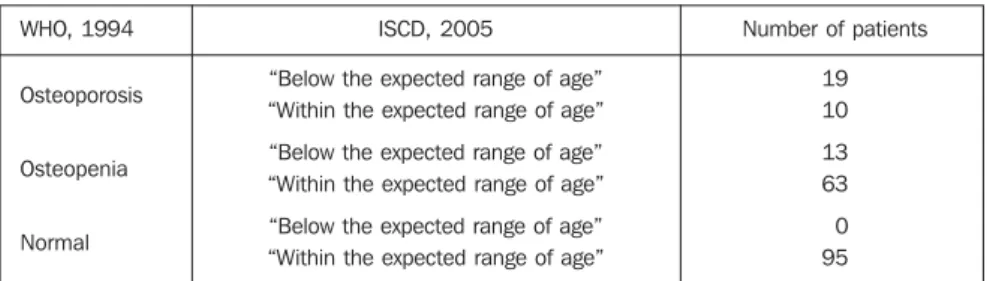
Applying the new classification to the 29 osteoporotic patients (Table 2), 19 of them were “below the expected range for age”, and 10 were “within the expected range for age”.
In the present study, following the WHO criteria, we had 76 patients with osteopenia (Table 2), 13 of them “below the expected range for age”, and 63 “within the expected range for age”.
All the patients rated as “normal” ac-cording the WHO criteria (Table 2) re-mained in the group “within the expected range for age” in the ISCD classification, as it could be expected.
DISCUSSION
In 1994, the WHO normatization played a significant role in the unification of bone densitometry reports, since, at that time, the densitometry technique was in its very be-ginning, and the studies interpretation was based on different criteria. With such uni-fication, this diagnostic method was dif-fused, allowing a great progress in the knowledge of osteoporosis. In the last 12 years, the terms osteoporosis and osteo-penia became common knowledge among physicians and patients. The arrival of this new classification is significant for
repre-senting a progress in the interpretation of this analysis methodology.
The terms Z-score and T-score must be understood by physicians, allowing the correct interpretation of densitometric stud-ies, and for them to be able to explain their meaning for the patients. In the last 12 years, T-score was the classification stan-dard for bone densitometry reports. Based on this new classification, the Z-score starts being utilized in patients up to 49 years of age, and the use of the T-score (OMS, 1994) remains restricted to patients aged 50 years or older. The fact of following two different classification criteria according to the patient’s age, might complicate the study interpretation, both for the physician and the patient.
An issue to be highlighted and ad-dressed on a case-by-case basis, is the fact of patients aged up to 49 years who had previously undergone bone densitometry studies, and, according to the WHO crite-ria, had been considered as osteoporotic, and, on a new study interpreted according to the new criteria, might be rated as nor-mal (“within the expected range for age”). In our survey, we have found this condition in 34.5% of osteoporotic patients.
It is important to note that ten patients rated as osteoporotic, and probably fol-lowed-up and oriented towards stopping or reverting the disease progression, started being rated “within the expected range for age”, and, consequently, included in the
Table 1 Values included in a lumbar spine bone densitometry report.
L1 L2 L3 L4 L1–L4 BMD (g/cm²) 0.861 0.881 0.924 1.007 0.940 T-score –0.58 –1.34 –1.45 –0.99 –1.27 %T 93 86 85 90 87 Z-score 0.40 –0.24 –0.30 0.19 –0.12 %Z 105 97 97 102 99
BMD, bone mineral density.
Table 2 Distribution of patients according to WHO and ISCD classification criteria.
WHO, 1994
Osteoporosis
Osteopenia
Normal
ISCD, 2005
“Below the expected range of age” “Within the expected range of age”
“Below the expected range of age” “Within the expected range of age”
“Below the expected range of age” “Within the expected range of age”
Number of patients
25 Analysis of the new classification of bone densitometry reports
Radiol Bras 2007;40(1):23–25
normality group, in spite of the decrease in their bone mineral density according to the WHO criteria of 1994.
The fact of using this new classification “within the expected range for age”, leads to an unconcern about these patients who had previously been considered with low rates of bone mineral density an increased risk of fracture. Notwithstanding, ISCD does not present a proposal of conduct and treatment for each classification.
So, this new classification should be comprehensively known and understood by physicians who request or perform bone densitometry studies, aiming at the correct interpretation, explanation and orientation to the patients.
REFERENCES
1. Kanis JA. Bone density measurements and os-teoporosis. J Intern Med 1997;241:173–175. 2. World Health Organization. Assessment of
frac-ture risk and its application to screening for
post-menopausal osteoporosis. WHO Technical Re-port Series, 843. Génève: WHO, 1994. 3. Gabriel SE, Tosteson AN, Leibson CL, et al.
Di-rect medical costs attributable to osteoporotic fractures. Osteoporos Int 2002;13:323–330. 4. Cuddihy MT, Gabriel SE, Crowson CS, et al.
Osteoporosis intervention following distal fore-arm fractures: a missed opportunity? Arch Intern Med 2002;162:421–426.