Predictors for the functional incapacity of the elderly in primary health care
Fatores preditores para incapacidade funcional de idosos atendidos na atenção básica
Factores predictores para la incapacidad funcional de adultos mayores atendidos en la atención básica
Lívia Carvalho Pereira
I, Maria do Livramento Fortes Figueiredo
I, Cinara Maria Feitosa Beleza
I,
Elaine Maria Leite Rangel Andrade
II, Maria Josefi na da Silva
III, Antonio Francisco Machado Pereira
III Universidade Federal do Piauí, Center of Health Sciences, Postgraduate Program in Nursing. Teresina, Piauí, Brazil. II Universidade Federal do Piauí, Center of Health Sciences, Department of Nursing. Teresina, Piauí, Brazil.
III Universidade Federal do Ceará, School of Pharmacy, Dentistry and Nursing, Department of Nursing. Fortaleza, Ceará, Brazil.
How to cite this article:
Pereira LC, Figueiredo MLF, Beleza CMF, Andrade EMLR, Silva MJ, Pereira AFM. Predictors
for the functional incapacity of the elderly in primary health care. Rev Bras Enferm [Internet]. 2017;70(1):106-12. DOI: http://dx.doi.org/10.1590/0034-7167-2016-0046
Submission: 02-04-2016 Approval: 09-01-2016
ABSTRACT
Objectives: to assess the predictors for the functional incapacity of the elderly in primary health care. Method: cross-sectional study, of which 388 older people participated, conducted in three Primary health care Units, using the Katz index and Lawton’s scale. The
research project was approved by the Research Ethics Committee. Results:regarding the degree of dependency for Basic Activities,
90.2% were less independent for dressing themselves; and for Instrumental Activities, 77.1% of the elderly were less independent for doing handwork. The functional incapacity for basic activities was associated with age and color; for instrumental activities, with age,
education, income of the elderly and self-assessment of health. Conclusion: attention should be paid to the overall assessment of the
elderly person, in order to tailor care plans geared towards the preservation of their autonomy and the promotion of active ageing. Descriptors:Primary Health Care; Elderly; Health of the Elderly, Daily Activities, Nursing.
RESUMO
Objetivos: avaliar os fatores preditores para incapacidade funcional de idosos atendidos na atenção básica. Método: estudo transversal, do qual participaram 388 idosos, realizado em três Unidades Básicas de Saúde, utilizando-se o Índice de Katz e
a escala de Lawton. O projeto de pesquisa foi aprovado pelo Comitê de Ética em Pesquisa. Resultados:Quanto ao grau de
dependência para Atividades Básicas, 90,2% eram menos independentes para vestir-se; e para as Atividades Instrumentais, 77,1% dos idosos foram menos independentes para fazer trabalhos manuais. A incapacidade funcional para atividades básicas esteve associada à idade e à cor; as atividades instrumentais, à idade, à escolaridade, à renda do idoso e à autoavaliação de
saúde. Conclusão: deve-se atentar para a avaliação global da pessoa idosa, com vistas a adequar planos de cuidados voltados
para a preservação da autonomia dos idosos e para a promoção do envelhecimento ativo.
Descritores:Atenção Primária à Saúde; Idoso; Saúde do Idoso, Atividades Cotidianas, Enfermagem.
RESUMEN
Objetivos: valorar los factores predictores para la incapacidad funcional de adultos mayores atendidos en la atención básica. Método:estudio transversal, del cual han participado 388 adultos mayores, llevado a cabo en tres unidades de atención básica de salud, empleando el índice de Katz y la escala de Lawton. El proyecto de investigación ha sido aprobado por el Comité
de Ética en Investigación brasileño. Resultados: En relación al grado de dependencia para sus actividades básicas, un 90,2%
Lívia Carvalho Pereira E-mail: [email protected]
CORRESPONDING AUTHOR
INTRODUCTION
The demographic phenomenon of increased life expec-tancy has sparked debates on aging. Estimates indicate that, in 2050, there will be in the world about 2 billion older people, i.e., people with 60 years of age or more, and that the
major-ity will be concentrated in developing countries, like Brazil(1).
This phenomenon is considered one of the greatest chal-lenges to Public Health, especially in developing countries where the demographic transition occurred abruptly, without time for a social reorganization and developing of appropriate
services to meet the new demand(2).
With the increase in life expectancy, there was a growth of the risk factors associated with chronic degenerative diseases, which tend to compromise, significantly, the quality of life of older people. Such illnesses may be responsible for the pro-cess through which a certain condition affects the functional-ity of older people and, consequently, the performance of
ev-eryday activities, what is known as “functional impairment”(3).
The investigation of functional capacity is one of the major markers for the health of the elderly and has been emerging as key component for the evaluation of the health of this popula-tion. The concept of functional capacity arises from this, i.e., the ability to maintain physical and mental abilities for an indepen-dent and autonomous life. It is a concept which, from the point of view of public health, is the one best suited to instrumentalize
and operationalize the health care of the elderly(4).
The decline of functional capacity may be related with a series of multidimensional factors, which interact with each other and define this ability in the elderly, and the early iden-tification of these factors can assist in the prevention of
func-tional dependency in this group(3-4).
It is of paramount importance to identify the functional ca-pacity of the elderly, as well as to relate it with environmental conditions, to then investigate which may be subject to inter-ventions. The knowledge gained may become a subside for the implementation of programs, planning of strategies and
appropriate interventions to the reality of the country(5-6). On
light of the above, the present study aimed to evaluate the predictive factors to the functional incapacity of the elderly in primary health care.
METHOD
Ethical aspects
This study was submitted to and approved by the Standing Human Research Ethics Committee of the Federal University of Piauí, in accordance with resolution 466/12 of the National Health Council. The interviews were held in compliance with the ethical criteria and the confidentiality standard.
Study design, location and period
Cross-sectional study, carried out in three Brazilian Primary Healthcare Units (UBS) of Teresina (PI), Brazil. In Teresina, the Family Health Strategy currently has a coverage of ap-proximately 86% of the population, with 191,938 registered families, serving 720,785 individuals, and, of these, 80,766 are elderly(7).
Population or sample
The participants of the study were 388 elderly persons selected through a process of systematic random sampling from a universe of approximately 80000 older people. The inclusion criteria ad-opted were: age equal to or older than 60 years; residing in the area covered by the project; being registered in the Family Health Strategy; and to accept participating in the research.
Study protocol
The data were collected in the months from June to No-vember 2013, through individual interviews with the elderly in their residence, in a private place, and guided by a form with questions addressing demographic data and health is-sues. The functional capacity of the elderly for Basic Activities of Daily Living (BADLs) was assessed through the Katz Index, which assesses the capacity for six basic activities, namely: bathing, dressing, going to the bathroom, transferring from a chair to a bed and vice versa, control of the sphincters and feeding themselves. In what concerns the functional capacity for Instrumental Activities of Daily Living (IADLs), Lawton’s scale was used to evaluates the tasks: using the phone, shop-ping, preparing meals, housekeeshop-ping, using transportations, using medicines and managing money. The interviews had an average duration of 20 minutes.
Statistical analysis
The collected data were processed in the software Statisti-cal Package for the Social Sciences (SPSS) version 18.0, using the Kolmogorov-Smirnov test and Spearman’s rank correlation coefficient. For comparison of the means of the BADLs and IADLs according to the categories of the dichotomous qual-itative variables, the Mann-Whitney test was used; and, for comparison of the means between qualitative variables with three or more categories, the Kruskal-Wallis test was used with
Dunn’s post hoc test.
For the multiple linear regression analysis, the variables were reclassified. In the crude analysis, Chi-square tests were employed for heterogeneity or linear trend, considering as sta-tistically significant values of p ≤ 0.05.
In the adjusted analysis Poisson regression was used with robust variance, being respected the hierarchy between the possible factors associated with the outcome. To facilitate the
mayor. Conclusión: la valoración del adulto mayor debe ser llevada en consideración, con el fin de adecuar los cuidados
dirigidos a la mantención de su autonomía y promoción del envejecimiento activo.
analysis and conducting of the statistical tests, functional incapacity both for the BADLs and for the IADLs was defined as the need for partial or complete assistance in at least one of the daily activities investigated. Thus, the Katz and Lawton indexes were dichotomized in zero (independent for all activities) and 1 (dependent for one or more activities).
RESULTS
The population of the study consisted of 250 women (64.4%) and 138 men (35.6%), with ages ranging from 60 to 97 years old, average of 71 (8.2). Most of the elderly (206;
53.1%) were married or in a stable union, from the country-side region of the state (68.6%), never studied or for 4 years only
(63.2%); pardos (60.1%) and
Catholic (75.3%). Most lived with other people (91.8%), were retired (71.1%), with individual income of up to two minimum wages (84.3%).
Among the BADLs, the lowest proportion of independence was seen in dressing themselves, with 350 (90.2%) elderly persons. Re-garding the IADLs, 269 (69.3%) of the elderly were less indepen-dent to get around, do handwork, wash and iron clothes (77.1%).
Using the definition of func-tional incapacity as need for par-tial or complete assistance in at least one activity, the prevalence of incapacity for BADLs was 12.4% (n = 48; 95% confidence interval - 95%CI: 9.1 – 15.7); and, for the IADLs, 45.6% (n = 177; 95%CI: 40,6–50,6) (Figure 1).
It was observed that there were no significant differences con-cerning gender, origin, religion and who they lived with. There was association with functional incapacity both for the BADLs and the IADLs (p< 0,001), in the schooling and age variables.
The variable marital status had significant association only for functional incapacity for BADLs (p = 0.021), like what was ob-served for the variable color, which had the same outcome (p = 0.025) (Table 1).
87.6% 54.4%
6.7% 8.5%
4.4% 17.8%
1.3% 19.3%
00% 20% 40% 60% 80% 100%
ABVD’s AIVD's
No activity One activity Two to four activity Five or more activity
Note: IADLs: Instrumental Activities of Daily Living; BADLs: Basic Activities of Daily Living.
Figure 1 – Frequency of activities with inability for the Instrumental and Basic domains of Daily Living in the elderly in Primary health care
Table 1 - Association between the socioeconomic and demographic profile and functional incapacity for Basic (BADLs) and Instrumental (IADLs) Activities of Daily Living of the elderly who participated in the research (N = 388), Teresina, Piauí, Brazil, 2013
Variables Total
Functional incapacity
BADLs
p value* IADLs p value*
n n % n %
Gender 0.322 0.400
Male 138 14 29.2 59 33.3
Female 250 34 70.8 118 66.7
Age group, years <0.001 <0.001
60-70 196 10 20.8 54 30.5
70-80 120 9 18.8 62 35.0
≥ 80 72 29 60.4 61 34.5
Schooling 0.001 < 0.001
No schooling 133 27 56.2 87 49.2 With schooling 255 21 43.8 90 50.8
Marital status 0.021 0.310
No partner 182 30 62.5 88 49.7 With partner 206 18 37.5 89 50.3
Origin 0.222 0.471
Capital 66 04 8.3 26 14.7
Countryside of the State 266 37 77.1 123 69.5 Other States 56 7 14.6 28 15.8
Color 0.025 0.619
Not white 58 43 89.5 138 78.0
White 90 5 10.5 39 22.0
Religion 0.141 0.030
Not Catholic 96 32 66.7 53 29.9 Catholic 292 16 33.3 124 70.1
Who they live with 0.982 0.336
By themselves 32 4 8.3 12 6.8 Not by themselves 352 44 91.7 165 93.2
Occupation 0.006 <0.001
No occupation 341 48 100.0 167 94.4 With occupation 47 0 0.0 10 5.6
Household income 0.023 0.002
Up to 2 MW** 191 31 64.6 102 57.6 > 2 MW 197 17 35.4 75 42.4
Income of the elderly person 0.002 <0.001
Up to 1 MW** 210 36 75.0 120 67.8 > 1 MW 178 12 25.0 57 32.2
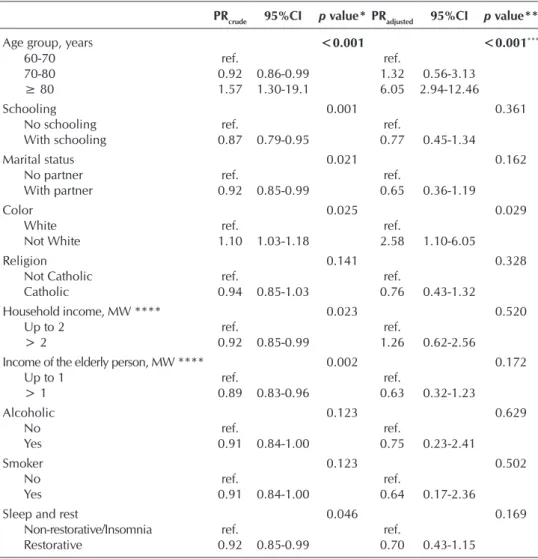
When comparing the hab-its, lifestyle, self-assessment of health and comorbidities of the elderly with functional incapacity, it was found that there was no significant dif-ference with the smoking, physical activity and comor-bidities variables. The vari-ables that showed statistically significant difference are list-ed in Table 2.
In the analysis of function-al incapacity for the IADLs, age group, schooling, reli-gion, occupation, family and individual income, alcohol-ism, sleep and rest and self-assessment of health were the variables that had the highest risk of the outcome, as de-scribed in Table 3.
DISCUSSION
Feminization in old age is evidenced in this study and seems to be a reflection of the demographic compo-sition of the elderly with a higher probability of survival for women, who still pay more attention to health and self-care than elderly men. The elderly, in their home environment, usually reside with spouses and children, or with spouse, children and grandchildren, the so-called “multi-generational arrange-ment”, which has become
common in Brazil(8).
A characteristic feature of old age in developing or underdeveloped countries is the high proportion of older people who lead a sedentary lifestyle, still associated with the image of the elderly as being dependent and isolat-ed. Despite the limitations of age, the engagement of these elderly people in educational activities must be promoted. Regarding the self-assessment of health, this study demon-strated a predominance of Table 2 – Crude and adjusted analysis of functional incapacity for the Basic Activities of
Daily Living (BADLs) according to independent variables (N = 388), Teresina, Piauí, Brazil, 2013
PRcrude 95%CI p value* PRadjusted 95%CI p value**
Age group, years <0.001 <0.001***
60-70 ref. ref.
70-80 0.92 0.86-0.99 1.32 0.56-3.13 ≥ 80 1.57 1.30-19.1 6.05 2.94-12.46
Schooling 0.001 0.361
No schooling ref. ref.
With schooling 0.87 0.79-0.95 0.77 0.45-1.34
Marital status 0.021 0.162
No partner ref. ref.
With partner 0.92 0.85-0.99 0.65 0.36-1.19
Color 0.025 0.029
White ref. ref.
Not White 1.10 1.03-1.18 2.58 1.10-6.05
Religion 0.141 0.328
Not Catholic ref. ref.
Catholic 0.94 0.85-1.03 0.76 0.43-1.32
Household income, MW **** 0.023 0.520
Up to 2 ref. ref.
> 2 0.92 0.85-0.99 1.26 0.62-2.56
Income of the elderly person, MW **** 0.002 0.172
Up to 1 ref. ref.
> 1 0.89 0.83-0.96 0.63 0.32-1.23
Alcoholic 0.123 0.629
No ref. ref.
Yes 0.91 0.84-1.00 0.75 0.23-2.41
Smoker 0.123 0.502
No ref. ref.
Yes 0.91 0.84-1.00 0.64 0.17-2.36
Sleep and rest 0.046 0.169
Non-restorative/Insomnia ref. ref.
Restorative 0.92 0.85-0.99 0.70 0.43-1.15
Note: *Pearson’s Chi-square Test; **Wald test of heterogeneity; ***Wald test of linear trend; ****at the time of
re-search, the current MW was 678.00 R$; MW = minimum wage; PRcrude = crude prevalence ratio non-adjusted variables
– bivariate analysis; 95%CI = confidence interval of 95%; PRadjusted = adjusted prevalence ratio - variables adjusted
amongst themselves; MW = minimum wage.
Table 3 – Crude and adjusted analysis of functional incapacity for the Basic Activities of Daily Living (BADLs) according to independent variables (N = 388), Teresina, Piauí, Brazil, 2013
RPcrude 95%CI p value* PRadjusted 95%CI p value**
Age group, years <0.001 <0.001***
60-70 ref. ref.
70-80 1.18 0.96-1.46 1.68 1.29-2.20 ≥ 80 4.14 2.39-7.18 2.38 1.85-3.06
Schooling <0.001 <0.001
No schooling ref. ref.
With schooling 0.53 0.42-0.69 0.68 0.57-0.84
Religion 0.030 0.288
Not Catholic ref. ref.
Catholic 0.78 0.61-0.99 0.90 0.73-1.10
Occupation <0.001 0.181
No occupation ref. ref.
With occupation 0.65 0.54-0.78 0.68 0.39-1.20
older people characterizing their health as “neither good nor
bad”, following the example of other studies(9).
Regarding the degree of dependency for the BADLs, it was noted that dressing, bathing and continence were the activi-ties which the elderly had the least independence to perform. Nevertheless, some of these activities, such as dressing and bathing, may be considered a complex activity, requiring a lot of coordination, dexterity, balance, range of motion and muscle strength.
The “continence” BADL may be associated with the ag-ing process itself, since the genitourinary system changes over time, mainly organs such as the bladder, which undergoes changes between the striated and smooth muscles, and may
cause urinary incontinence(10).
As for the IADLs, the elderly had the least independence to get around using a means of transportation, to use the phone, to do handwork, and to wash and iron clothes. The difficulty for the use of the phone of the elderly is addressed from vari-ous aspects in the literature. It is important to note that “using the phone” should not concern the physical limitations of the senescent only. The rapid advancement in telecommunica-tions, with constant changes in the uses of telephone services, possibly generates some level of difficulty in the performance of this task(11).
In what concerns the functional incapacity for the IADLs, it is noted that there is a tendency to it, especially for the elderly with ages older than 75 years, evidenced in several
countries of Latin America(12). In Brazil, this epidemiological
tendency can also be noted, with marked differences between regions(13).
There is a hierarchy in the functional losses, being the IADLs the first to be affected. Functional losses result in an im-pairment to the autonomy of the elderly, which may influence
their quality of life(14).
The present study showed that the variables which have important association with functional incapacity, for both the BADLs and the IADLs, are age and schooling. Such findings converge with other researches that have already been carried out within na-tional and internana-tional con-texts, indicating age as a risk factor to the loss of functional
capacity(3,13). The
advance-ment of chronological age, coupled with the aging pro-cess itself, relates directly to the higher levels of functional incapacity, there being a ten-dency to, with the increase of age, the chances of functional losses raising.
The other variable that re-mained associated with the outcome in this study was schooling. Polls show that the higher the educational level, the lower the likelihood of the
elderly reporting a worse functional capacity(15). Education
de-termines several advantages for health because it influences psychosocial and behavior factors. Elderly individuals with higher educational level are less likely to expose themselves to risk factors for diseases and to subject themselves to
inap-propriate working conditions(3).
Elderly persons without partners have a higher tendency to functional incapacity. It is known that the state of widow-hood may influence negatively the functional capacity of the
elderly(8). The representativeness of the variable “color”
high-lighted the need for reflecting on the social inequalities that pervade society, different life experiences being determined from ethnic differences, and should therefore be interpreted with caution.
The variable “occupation” could be seen as protector of the functional incapacity. The elderly who has a job is less likely to have worse functional capacity, with few difficulties for Activities of Daily Living, when compared with those who
do not work(16).
The association of low socioeconomic levels with worse health conditions has been documented, through population
studies, in different age groups and in different areas(1,4-5). The
low socioeconomic condition is related with a series of nega-tive conditions and may contribute to the loss of functional au-tonomy, as with low education and poor conditions of health, among other factors.
It is understood from this result that this association is due to the fact that the IADLs are more complex, and require cog-nition and social interactivity, which may be modified by the use of alcohol. After the adjusted analysis, the variable did not remain associated.
RPcrude 95%CI p value* PRadjusted 95%CI p value**
Household income, MW **** 0.002 0.817
Up to 2 ref. ref.
> 2 0.75 0.62-0.91 0.98 0.78-1.21 Income of the elderly person, MW **** <0.001 0.028
Up to 1 ref. ref.
> 1 0.63 0.52-0.76 0.77 0.61-0.97
Alcoholic <0.001 0.107
No ref. ref.
Yes 0.64 0.53-0.77 0.60 0.33-1.12
Sleep and rest 0.020 0.347
Non-restorative/Insomnia ref. ref.
Restorative 0.80 0.65-0.97 0.91 0.75-1.11
Self-assessment of 0.003 0.021***
health condition ref. ref.
Very bad/weak 1.07 0.88-1.30 0.94 0.75-1.18 Neither good, nor bad 0.76 0.63-0.90 0.73 0.57-0.92
Very good/good 0.197
With morbidities ref. ref.
Without morbidities 1.13 0.94-1.36 1.13 0.92-1.40 0.236
Note: *Pearson’s Chi-square Test; **Wald test of heterogeneity; ***Wald test of linear trend; ****at the time of
research, the current MW was 678.00 R$; MW = minimum wage; PRcrude = crude prevalence ratio non-adjusted
variables – bivariate analysis; 95%CI = confidence interval of 95%; PRadjusted = adjusted prevalence ratio - variables adjusted amongst themselves.
Sleep and rest had association with functional incapacity for both the BADLs and the IADLs, which is justified by the fact that changes in sleep and rest, caused by the aging process itself, al-ter the homeostatic balance, with repercussions on the psycho-logical function, immune system, behavioral response, humor,
among others(17). After the adjusted analysis, the variable “sleep
and rest” did not remain associated with the outcome.
One point worthy of attention is that, after the circumscribing of the factors associated with lower functional capacity of the el-derly, it is possible to establish interventions to be made by Nurs-ing, as well as by the multidisciplinary health team, in order to mitigate the modifiable factors related with functional capacity.
The practice of appropriate physical activity, healthy eat-ing, abstinence from smoking and alcohol as well as using medicines wisely can prevent diseases and functional decline, increasing the longevity and quality of life of the individual, being modifiable factors that can be worked on by the multi-disciplinary health team aiming at the promotion of active and healthy ageing(18).
Limitations and contributions to the field of Nursing This study has some limitations. It had a cross-sectional meth-odological design, which restricts its extensibility. Researches
with other methodological designs should be conducted in or-der to deepen the study on the functional losses of olor-der people and, perhaps, interventions in order to minimize such losses.
Nursing, which is the key component of Primary Health Care, should be alert to the global assessment of the elderly person, such as the functional assessment here included, as well as the factors associated with this functionality, to tailor care plans geared towards the preservation of the autonomy of the elderly; and the promotion of active ageing.
CONCLUSION
This study evaluated the predictive factors for functional incapacity in the elderly in Primary health care, using the Katz index and Lawton’s scale. Regarding the degree of de-pendency for Basic Activities, there was a prevalence of those who were less independent for dressing themselves; and for Instrumental Activities, the elderly were less independent for doing handwork. After the adjusted analysis, it was noted that the functional incapacity for Basic Activities was associated with age and color; and, for Instrumental Activities, with the age, education, income of the elderly and self-assessment of health variables.
REFERENCES
1. Sousa MAS, Lima TR, Sousa AFL, Carvalho MM, Brito GMI, Camilotti A. Prevalence of bloodstream infection in hospitalized elderly in a General Hospital. Rev Prev In-fec Saúde [Internet]. 2015[cited 2016 Mar 18];1(3):11-7. Available from: http://www.ojs.ufpi.br/index.php/nupcis/ article/view/4252/pdf
2. Cruz GECP, Ramos LR. Functional limitation and disabili-ties of older people with acquired immunodeficiency syn-drome. Acta Paul Enferm [Internet]. 2015[cited 2016 Aug 20];28(5):488-93. Available from: http://www.scielo.br/ pdf/ape/v28n5/en_1982-0194-ape-28-05-0488.pdf 3. Mattos IE, do Carmo CN, Santiago LM, Luz LL. Factors
associated with functional incapacity in elders living in long stay institutions in Brazil: a cross-sectional study. BMC Geriatric [Internet]. 2014[cited 2016 Mar 18];14:47. Available from: https://bmcgeriatr.biomedcentral.com/ articles/10.1186/1471-2318-14-47
4. Faustino AM, Gandolfi L, Moura LBA. Functional capabil-ity and violence situations against the elderly. Acta Paul Enferm [Internet]. 2014[cited 2016 Aug 20];27(5):392-8. Available from: http://www.scielo.br/pdf/ape/v27n5/1982-0 194-ape-027-005-0392.pdf
5. Clares JWB, Freitas MC, Borges CL. Social and clinical fac-tors causing mobility limitations in the elderly. Acta Paul Enferm [Internet]. 2014[cited 2016 Aug 20];27(3):237-42. Available from: http://www.scielo.br/pdf/ape/v27n3/ en_1982-0194-ape-027-003-0237.pdf
6. Szanton LS, Thorpe RJ, Boyd C, Tanner EK, Leff B, Agree E, et al. Community aging in place, advancing better living for elders: a bio-behavioral-environmental intervention to im-prove function and health-related quality of life in disabled
older adults. J Am Geriatr Soc [Internet]. 2011[cited 2016 Mar 18];59(12):2314-20. Available from: http://onlinelibrary. wiley.com/doi/10.1111/j.1532-5415.2011.03698.x/epdf 7. Sistema de Informação da Atenção Básica (SIAB).
Popula-ção cadastrada na atenPopula-ção básica – Teresina (PI) [Internet]. 2012[cited 2016 Mar 18]. Available from: http://www2. datasus.gov.br/SIAB/index.php
8. Robles TF, Slatcher RB, Trombello JM, McGinn MM. Mari-tal quality and health: a meta-analytic review. Psychol Bull [Internet]. 2014[cited 2016 Mar 18];140(1):140-87. Avail-able from: http://psycnet.apa.org/journals/bul/140/1/140/. 9. Arredondo EM, Lemus H, Elder JP, Molina M, Martinez
S, Sumek C, et al. The relationship between sedentary behavior and depression among Latinos. Ment Health Physic Activ. 2013;6:3-9.
10. Ebbesen MH, Hunskaar S, Rortveit G, Hannestad YS. Prevalence, incidence and remission of urinary inconti-nence in women: longitudinal data from the Norwegian HUNT study (EPINCONT). BMC Urol [Internet]. 2013[cit-ed 2016 Mar 18];13:27. Available from: http://bmcurol. biomedcentral.com/articles/10.1186/1471-2490-13-27 11. Heinz M, Martin P, Margrett JA, Yearns M, Franke W,
Yang HI, Perceptions of technology among older adults. J Gerontol Nurs. 2013;39(1):42-51.
12. Freire AN, Guerra RO, Alvarado B, Guralnik JM, Zunzune-gui MV. Validity and reliability of the short physical per-formance battery in two diverse older adult populations in Quebec and Brazil. J Aging Health. 2012;24(5):863-78. 13. Fialho CB, Lima-Costa MF, Giacomin KC, Loyola Filho
Greater Metropolitan Belo Horizonte, Minas Gerais State, Brazil: a population-based study. Cad Saude Publica [Inter-net]. 2014[cited 2016 Mar 18];30(3):599-610. Available from: http://www.scielo.br/pdf/csp/v30n3/0102-311X-csp-30-3-0 599.pdf
14. Weening-Dijksterhuis E, Greef MH, Scherder EJ, Slaets JP, van der Schans CP. Frail institutionalized older persons: a comprehensive review on physical exercise, physi-cal fitness, activities of daily living, and quality-of-life. Am J Phys Med Rehabil [Internet]. 2011[cited 2016 Mar 18];90(2):156-68. Available from: https://www.ncbi.nlm. nih.gov/pubmedhealth/PMH0032075/.
15. Jyrkkä J, Enlund H, Lavikainen P, Sulkava R, Hartikainen S. As-sociation of polypharmacy with nutritional status, functional ability and cognitive capacity over a three-year period in an elderly population. Pharmaco Epidemiol Drug Saf [Internet]. 2011[cited 2016 Mar 18];20(5):514-22. Available from: http:// onlinelibrary.wiley.com/doi/10.1002/pds.2116/epdf
16. César CC, Mambrini JV, Ferreira FR, Lima-Costa MF. Func-tional capacity in the elderly: analyzing questions on mobility and basic and instrumental activities of daily living using Item Response Theory. Cad Saude Publica [Internet]. 2015[cited 2016 Mar 18];31(5):931-45. Available from: http://www.scie lo.br/pdf/csp/v31n5/0102-311X-csp-31-5-0931.pdf
17. Spira AP, Beaudreau SA, Stone KL, Kezirian EJ, Lui LY, Red-line S, et al. Reliability and validity of the Pittsburgh sleep quality index and the epworth sleepiness scale in older men. J Gerontol A Biol Sci Med Sci [Internet]. 2012[cited 2016 Mar 18];67(4):433-9. Available from: http://biomed-gerontology.oxfordjournals.org/content/67A/4/433.full. pdf+html