RESEARCH
Cristina Arreguy-Sena
I, Tais de Oliveira Marques
II, Luciene Carnevale de Souza
I, Nathália Alvarenga-Martins
I,
Paula Krempser
III, Luciene Muniz Braga
IV,V, Pedro Miguel dos Santos Dinis Parreira
VII Universidade Federal de Juiz de Fora, Postgraduate Program in Nursing. Juiz de Fora, Minas Gerais, Brazil. II Universidade Federal de Juiz de Fora, Faculty of Nursing, Undergraduate in Nursing. Juiz de Fora, Minas Gerais, Brazil. III Universidade do Estado do Rio de Janeiro, Faculty of Nursing, Postgraduate Program in Nursing. Rio de Janeiro, Brazil.
IV Universidade Federal de Viçosa, Department of Medicine and Nursing. Viçosa, Minas Gerais, Brazil. V Universidade de Lisboa, Doctoral Program in Nursing. Lisboa, Portugal.
VI Escola Superior de Enfermagem de Coimbra, Research Unit in Health Sciences: Nursing. Coimbra, Portugal.
How to cite this article:
Arreguy-Sena C, Marques TO, Souza LC, Alvarenga-Martins N, Krempser P, Braga LM, et al. Construction and validation of forms: systematization of the care of people under hemodialysis.
Rev Bras Enferm [Internet]. 2018;71(2):379-90. DOI: http://dx.doi.org/ 10.1590/0034-7167-2015-0130
Submission: 12-27-2015 Approval: 04-12-2017
ABSTRACT
Objective: create and validate forms to subsidize the systematization of nursing care with people on hemodialysis. Method: institutional case study to support the systematization of assistance from the construction of forms for data collection, diagnoses, interventions and nursing results, using cross-mapping, Risner’s reasoning, Neuman’s theory, taxonomies of diagnoses, interventions and nursing results with application in clinical practice and validation by focal group with specialist nurses. Results: 18 people on hemodialysis and 7 nurses participated. Consensus content of form matter with specialist nurses in the area (Crombach 0.86). The papers captured 43 diagnoses, 26 interventions and 78 nursing results depicting human responses in their singularities. Final considerations: the validated forms fi ll a gap by enabling the capture of human responses from people on hemodialysis and by subsidizing the planning of nursing care on a scientifi c basis. Descriptors: Nursing Cares; Kidney Dialysis; Nursing Processes; Nursing Theory; Nursing.
RESUMO
Objetivo: criar e validar impressos para subsidiar a sistematização do cuidado de enfermagem com pessoas em hemodiálise. Método: estudo de caso institucional para subsidiar sistematização da assistência a partir da construção de impressos para coleta de dados, diagnósticos, intervenções e resultados de enfermagem, usando mapeamento cruzado, raciocínio de Risner, teoria de Neuman, taxonomias de diagnósticos, intervenções e resultados de enfermagem com aplicação na prática clínica e validação por grupo focal com enfermeiras especialistas. Resultados: participaram 18 pessoas em hemodiálise e 7 enfermeiros. Consensualizados conteúdos dos impressos com enfermeiras especialistas da área (Crombach 0,86). Os impressos captaram 43 diagnósticos, 26 intervenções e 78 resultados de enfermagem retratando respostas humanas em suas singularidades. Considerações fi nais: os impressos validados preenchem uma lacuna ao possibilitar a captação de respostas humanas de pessoas em hemodiálise e ao subsidiar o planejamento dos cuidados de enfermagem em bases científi cas.
Descritores: Cuidados de Enfermagem; Diálise Renal; Processos de Enfermagem; Teoria de Enfermagem; Enfermagem.
RESUMEN
Objetivo: creary validar impresos para subsidiar la sistematización del cuidado de enfermería con personas en hemodiálisis. Método: estudio de caso institucional para subsidiar la sistematización de la asistencia a partir de la construcción de impresos para recolección de datos, diagnósticos, intervenciones y resultados de enfermería, utilizando el mapeo cruzado, el raciocinio de Risner, la teoría de Neuman, taxonomías de diagnósticos, intervenciones y resultados de enfermería con aplicación en la práctica clínica y validación por grupo focal con enfermeras especialistas. Resultados: participaron 18 personas en hemodiálisis y 7 enfermeros. Consensuados
Construction and validation of forms:
systematization of the care of people under hemodialysis
INTRODUCTION
It is estimated that the number of people with Chronic Kidney Disease (CKD) in hemodialysis treatment per year in Brazil is 100,397, with 90.1% performing conventional treat-ment. The prevalence is in the age group of 19 to 64 years (66.9%) and in the male sex (57.3%)(1).
Hemodialysis is a complex procedure, performed in three shifts of four hours a week, through arteriovenous fistula (AVF) or double lumen venous catheter(2), requiring daily
adjust-ments and specific nursing care(3-4).
The insertion of the nurse in the process of caring for people undergoing hemodialysis needs to be based on theoretical, philo-sophical, conceptual and taxonomic references to capture the pe-culiarities of how people experience the process of renal replace-ment therapy and to plan with individualization care to the point of empowerment the nurses’ work performance(4-5).
The authors of this study, in the search to identify the diagnoses, interventions and nursing results that would characterize the profile of the people undergoing hemodialysis treatment, carried out a bib-liographic survey that indicated information gaps and disconnec-tion among nursing problems, intervendisconnec-tions and results.
In order to capture the conflicts, social problems, accep-tance of hemodialysis treatment by the people in renal re-placement therapy, to direct the nurses’ gaze to the human responses that portray the internally experienced stressors / situations, interpersonal and environmental relations, we opt-ed to use the framework proposopt-ed by Betty Neuman(6).
Neuman’s theory conceives the human being as an open en-ergy system whose stressful situations / circumstances can impact the health / disease process(6). When applied in people under
hemodialysis, this theory can favor the apprehension of ways of coping with changes in habits and routines; identification of im-minent death; emergence of internal, interpersonal and environ-mental conflicts; and readjustment of the conceptions of life and of how they are assimilated, experienced and faced.
Such information is able to subsidize demands for care and therapeutical possibilities of nurses’ performance, which will use professional knowledge and clinical practice to act on the vari-ables (physiological, psychological, sociocultural, developmental and spiritual) that structure the human being in this conception(6).
In view of the need to express what the most frequent diag-noses, interventions and nursing outcomes among hemodialysis patients were, we sought, in a language compatible with their sharing in different services, the taxonomic possibilities that could standardize the language of diagnoses, interventions and NAN-DA(7), Nursing Intervention Classification (NIC)(8) and Nursing
Outcome Classification (NOC)(9), known as NNN, were selected.
According to NNN taxonomies, nursing diagnoses consist of: “clinical judgments of individual / family / community re-sponses / experiences to health problems / actual or poten-tial life processes”(7), which provide the basis for selecting the
interventions, giving the nursing process the relational con-sistency necessary for the individualization of care. Nursing diagnoses can be of the following types: real, risk, health pro-motion and syndrome(7).
Nursing interventions correspond to “any treatment based on judgment and clinical knowledge”(8) and nursing outcomes
are “states, behaviors or perceptions of individual, family or community”(9) measured by scales.
The assumptions of Neuman are: 1) the tension caused by environmental stressors leads the individual, in its total di-mension, to interact with the environment (inter-relationship and interdependence); 2) the stimuli are interpreted by each individual in a differentiated way and 3) according to the in-dividual’s reaction it is possible to verify when the nursing should intervene(5). It is possible for nurses to infer in three
levels of performance: a) primary - when it acts on the flexible line to minimize or prevent stress reaching the normal line of defense and generate misfits; b) secondary - when it strength-ens the internal resistance lines to reduce the reaction; and c) tertiary - when it adapts and re-educates the individual to face stress situations, strengthening the resistance lines(6).
Such research is justified by the following arguments: 1) the presence of gaps identified in the literature with the focus of taxonomies and the chosen theoretical framework; 2) the need for scientific work to support the clinical practices performed in the hemodialysis sectors; 3) assistance to nurses in complying with the legal recommendations recommended for their profes-sional practice; and 4) subsidy for the nurse’s role with people under hemodialysis to the point of empowering him to act in the context of the scientifically supported health team.
OBJECTIVE
In order to subsidize the nurse’s role with people under hemodialysis, research was carried out with the objective of constructing and validating forms for recording the stages of the nursing process in this specialty.
METHOD
Ethical aspects
In this study, all ethical and legal research requirements involv-ing humans were met. Research approved by Ethics Committee of 2/21/2013.
Paula Krempser E-mail: [email protected] CORRESPONDING AUTHOR
contenidos de los impresos con enfermeras especialistas del área (Crombach 0,86). Los impresos captaron 43 diagnósticos, 26 intervenciones y 78 resultados de enfermería retratando respuestas humanas en sus singularidades. Consideraciones finales: los impresos validados llenan una brecha al posibilitar la captación de respuestas humanas de personas en hemodiálisis y al subsidiar la planificación de los cuidados de enfermería en bases científicas.
Type of study
Institutional case study with the construction of forms to systematize the nursing care in hemodialysis service.
Methodological procedures- Study scenario
The scenario was a hemodialysis service of the Unified Health System (SUS) of a city of Minas Gerais state, Brazil.
Data source
Sample of typicity composed of 18 people who were under hemodialysis during the period of data collection. Complete selection for nurses who cared and / or acted in the sector and had experience in the construction of theoretical-philosophi-cal proposals for the category, totaling seven nurses.
The data were collected from February to May 2013 with subsequent analysis and re-adaptation of the forms.
All those who did not meet the inclusion criteria did not integrate the investigation, plus those under hemodialysis, who performed kidney transplantation, were hospitalized, died or requested to be discontinued in the investigation, and nurses who were on leave / leave during the collection period of data. Participants were individually recruited to conduct interviews, in which there were three denials of people under hemodialysis and total adherence of nursing professionals to participation in the focal group.
Hemodialysis patients were eligible: 1) they were attended in the morning or evening shifts; 2) age ≥18 years and 3) presented diversity in the treatment / disease coping and were counter-signed by the nurses to be treated in the hemodialysis sector for at least 12 months. Nurses specialized in nephrology, with renal re-placement therapy in hemodialysis and clinical experience in the area or experience in the use of NNN taxonomies and theoretical models applicable to clinical practice were eligible.
Data collection and organization
Form papers were designed to record the history of nursing / evolution, diagnoses, interventions and nursing outcomes based on theoretical and philosophical references (Betty Neu-man’s theory)(6); technical / conceptual / normative and
meth-odological (class council resolutions)(10); consensual thematic
guidelines in the (inter) national literature; relational and com-municational (normalization of records in records, interper-sonal communication and therapeutic relationship); and taxo-nomic (NANDA I, NIC and NOC)(7-9).
For the construction of the forms, the diagnostic reasoning was used from two techniques: cross-mappin (11) and Risner’s reasoning(12).
Cross-sectional mapping(11) sought to link nursing
interven-tions, results and diagnoses, based on the available literature and / or the authors’ experience with the themes (nursing classificatory systems and approach to people undergoing hemodialysis).
For this, the alignment of these taxonomies and the search for the correspondence between the domains and the classes of the taxonomies of intervention, result and nursing diagno-sis were adopted as criterion. This strategy made it possible to fill the gap identified in the literature regarding the correspon-dence and articulation of the taxonomies for the desired theme.
With Risner’s line of reasoning(12) it was possible to apply the
analytical and synthetic reasoning sequentially, considering the data collection (from observation, interaction and measurement), the scientific knowledge and experiences of nurses in search of the correspondence between these elements, and a standardized language adopted in the NANDA International taxonomy to link the structures that make up the nursing diagnoses.
The product obtained through the application of the two tech-niques by the researchers enabled the construction of prototypes of form material to support the collection of data, identification of problems (diagnoses), interventions and nursing results.
The prototype forms were applied to 18 participants who underwent hemodialysis, characterizing a period of period of data collection, analysis and treatment of the results obtained, based on clinical reasoning and nursing diagnosis.
The use of the snowball technique was a strategy adopted by nurses for the eligibility of potential hemodialysis patients, who were recruited by invitation to join the investigation through an interview, in which the prototype forms were ap-plied. The eligibility criteria were the diversity of clinical situ-ations and their human responses to hemodialysis treatment and renal disease.
Individual interviews were conducted with cursive records for the application of form material whose contents subsidized the identification of nursing diagnoses, interventions and re-sults. By aligning this information it was possible to identify the taxonomic correspondences.
The contact with the people under hemodialysis was struc-tured in theoretical foundations, communicational and semio-logical techniques in a sequence compatible with recommen-dations recommended in the nursing process(10).
There was consultation of the patient’s report to support diagnostic decisions, and complement information regarding the defining characteristics or risk factors that were confirma-tory for nursing diagnoses.
The content obtained with the application of the forms to the participants was grouped according to the affinity of how they faced the hemodialytic treatment and / or renal disease and motivated meetings to study cases using the focal group technique(13) with the participation of the nurses from the
sec-tor and researchers.
The focus group was operationalized from the presentation of four to five clinical cases per session, whose contents motivated the development of the technique under the coordination of a moderator and two secretaries (made cursive records of the sug-gestions, comments, additions and suppressions of contents).
for use as markers of quality of care and the achievement of therapeutic goals? 7) What do you nurses feel that you lacked in our approach when we mentioned the needs of Mr. (s) X? 8) What are your suggestions for improving our approach and making the form matter compatible for use in your clinical practice? 9) What are the points mentioned in this research that you, nurses, considered relevant? 10) Would you like to add some suggestion, recommendation, comment or informa-tion to what we talked about?
The content and dynamics of these meetings addressed the diagnoses, interventions and nursing outcomes constructed and planned specifically for the care needs of each previously interviewed hemodialysis person, besides expressing the in-terventions and the results of the therapeutic measures recom-mended by nurses in the nursing care planning.
The specialist nurses who participated in the focus group appreciated the content obtained, the level of comprehensive-ness, the accuracy of the information and the adequacy of the planned therapeutic proposals until the consensus on the final version of the forms.
The use of the focus group made it possible to overcome the inability of some nurses who were unaware of the theoretical-philosophical reference (Neuman theory) and the taxonomic system employed (NANDA I, NIC and NOC) and obtain from them the judgment of how much the contents captured with the prototypes of data collection, diagnoses, interventions and nursing results were able to portray reality and clinical situa-tions / circumstances to the point of assessing the diversity of human responses of people under hemodialysis.
The definition of the components that integrate the nurs-ing diagnoses (risk factors or definnurs-ing characteristics) simul-taneously guided the inclusion of approaches in the nursing history and created indications for the search for therapeutic interventions in the taxonomic system used that could be can-celed, minimized or prevented. This strategy made it possible to ensure the alignment between the taxonomies used, aided by the similarity of some domains in which NIC and NOC taxonomies were structured(7-9).
Work steps
The study was implemented in three stages: 1) construction of forms to support data collection, identification of diagno-ses (NANDA I), interventions (NIC) and evaluation of nursing outcomes (NOC); 2) application of form matter in the clinical practice of nurses in the care of people under hemodialysis; and 3) presentation of the results of the application of the forms in the clinical practice of the specialist nurses with the focal group technique.
Data analysis
All the forms were applied to the participants in order to identify how much they could capture: 1) the diversity of emergent situations among the interviewees; 2) layout com-patible with the storage of information in a smaller space, to ensure environmental sustainability for the records and pos-sibility of transposition of the proposal prepared for a comput-erized electronic model; and 3) the nursing care process in
a scientific way and structured in a theoretical/philosophical framework, using NNN taxonomies.
In this way, the forms were re-adapted so as to be able to capture the most common vulnerabilities among hemodialy-sis patients and to ashemodialy-sist reflexive critical thinking in the diag-nostic decision process in the clinical practice of hemodialysis nurses.
The focus group was performed with nurses to identify pos-sible gaps in the approach and thus guided content inclusions to consensus.
RESULTS
Participating were 18 people who were under hemodial-ysis, 11 men, aged between 46 and 78 years, hemodialysis time from 12 months to 16 years; 6 patients underwent he-modialysis by double lumen catheter and 12 by AVF. Also participating were 7 nurses, all with less than 15 years of work in the area of nephrology and/or systematization of nursing care/use of theoretical models applied to nursing. The nurses knew in depth the family, social and economic context of the participants and provided care directly to them.
The nursing process(11) (history, diagnosis, planning,
imple-mentation and evaluation of nursing) were portrayed in four forms: history, diagnoses, interventions and nursing results. They contemplated contents, conceptions and theoretical-philosophical models(6) pertinent to the theme.
The forms designed to carry out the systematization of nursing care were validated with a level of agreement among specialist nurses with scores ≥ 90% to fully adequate in terms of content, comprehensiveness and layout compatible with in-formation storage and score ≥ 85% to be very adequate for the criteria of precision of the information and the adequacy of the planned therapeutic proposals. The reliability of the in-struments was assessed by internal consistency (Cronbach’s alpha values equal to 0.86).
It should be mentioned that the feasibility of the applica-tion of systematizaapplica-tion in the context of nursing care to people undergoing hemodialysis was questioned, a fact attributed and justified by the distancing of a systematized care and the predominance of the technical profile present in the daily life of renal therapy services substitutive.
The first form was destined to the accomplishment of the history and evolution of nursing (Figure 1).
The Nursing History form (Figure 1) made it possible to identify: 24 situations involving intrapersonal stressors, 11 in-volving interpersonal stressors and 8 transpersonal stressors. This means that there was (dis) equilibrium in the continuum health/disease in two situations involving sociocultural vari-ables; in three situations related to the physiological variables and in a situation linked to the psychological variable.
The information on the nursing history form (communicational and semiologic technique) and the nursing evolution were organized in a single page, aiming at an environmental sustainability and a re-duction in the number of form matter, both for the form format and for its possibility in format and additional space is provided for record-ing weight, blood pressure and gain or loss of volume. These data are collected before and after each hemodialysis session (Figure 1).
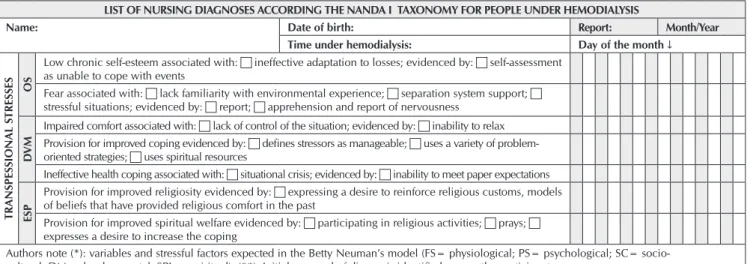
The second form Nursing Diagnostic List (Figure 2) was or-ganized into three axes: 1) on the left, there are two columns
consistent with the structure of Neuman’s theory; 2) to the right, there are 14 columns destined to the daily record of the evolu-tion of the nursing diagnoses by means of codes that will indicate the beginning, the accompaniment or the end of a diagnosis; and 3) in the central column, there is a list of possible real, risk or health promotion diagnoses, containing the evidences arising (in) directly from those identified in the literature, and there are ad-ditional spaces for the inclusion of diagnoses not listed by cursive registration.
Date: NURSING HISTORY TO APPROACH PEOPLE UNDER HEMODIALYSIS (Forward)
Name: Date of birth: Record:
(*) Time under hemodialysis (HD): Month/Year: Intrapersonal stressful factors Interpersonal stressful factors Transpersonal stressful factors
(*)V
ar
iables of ener
gy lines
PH
Vital signs:(*) BP, FC, FR, pain; Ad-ditional parameters: weight, swell-ing; Exams:(*) Ur, Cr, Na, K, Ca, P, uric acid, hemogram, leucogram and coaogulogram; Arteriovenous Fistula Evaluation (AFE): permeability, bleed-ing, integrity; Transplantation: indica-tion; Nutrition: accession or not to food restrictions;correlated comorbities.
Degree of (in) dependence: type and activity;
Mobility: autonomy, freedom;
Sexuality: sexual practice.
Appearance and exposure of AFE: discrimination, curiosity.
PS
Feelings: positive, negative, of defense, of coping; Strategies of coping: posi-tive, negaposi-tive, deffense mechanisms, accession; Behaviors and attitudes: (in) adequate; Self-image and self-concept: perceptions and self-worth.
Involvement/isolation: availability for links.
Profile of the person who has affin-ity.
SC
Leisure, recreation and physical activi-ties; life habits: autonomy, functional capacity, activities of daily living (ADL) and instrumental activities of daily living (AIVD).
Routine, habits and customs: type;
Conviviality with the other: friendship, environments that attends; Links: affec-tive life, significant people, family life;
Reference Person: availability.
Social life: friendships, cultural activi-ties; Habits and social life;
Transplantation: insertion in the transplant queue, potential donor and acceptance.
D
SV
Chronic kidney disease ethiology; Ad-aptation to the disease; Treatment and life style.
Resilience: adjustment of hemodialysis to weekly routine.
Use of social benefits.
SPI
Beliefs. Celebrations.
Transplantation: conception, expecta-tion, Family donors.
Rituals, Practices and Integration, and feeling of belonging.
Date:
Physiologic: Vital signs and measurement/evaluations (backside) Record of emerging stressful factors Weight Blood Pressure Gained Volume Lost Volume Ultrafiltration
Before After Before After
Authors note (*): variables of energy lines (PH= physiological; PS= psychological; SC= sociocultural; DM= developmental; SPI= spirituals). Vital signs (BP= blood pressure, HR= heart rate; RR= respiratory rate). Exams (Ur= urea; Cr= chromium; Na= sodium; K= potassium; Ca= calcium; P= phosphoforus).
LIST OF NURSING DIAGNOSES ACCORDING THE NANDA I TAXONOMY FOR PEOPLE UNDER HEMODIALYSIS
Name: Date of birth: Report: Month/Year
Time under hemodialysis: Day of the month ↓
Legend: I: diagnosis initially identified C: diagnosis at follow-up T: diagnosis resolved N: diagnosis not identified Susp: suspense Mod: modified
INTRAPERSON
AL S
TRESSFUL F
A
CT
ORS
PH
Excessive fluid volume associated with: c compromised regulatory mechanisms; evidenced by: c anasarca c
dispineia c sweling c electrolytes altered c weight gain in short time
Risk of infection associated with: c invasive procedures
Risk for vascular trauma associated with: c catheter type inadequate catheter fixation
Ineffective protection associated with: c drug therapy; evidenced by: c change coagulation c chills c pruritus
Fatigue associated with: c disease state; evidenced by: c report of fatigue
Impaired skin integrity associated with: c mechanical factors: impaired metabolic state c unbalanced nutritional;
evidenced by evidenced by: c disruption of the skin surface c invasion body structures
Sexual dysfunction associated with: c biopsychosocial alteration c sexuality alter altered bodily function;
evidenced by: c imitations perceived and imposed by the disease c verbalization of the problem
Risk for impaired skin integrity associated with: impaired sensations c mechanical factors; state: c impaired
metabolic c unbalanced nutritional
Intolerance to activity associated with: c generalized weakness; evidenced by: c discomfort and exertional
dyspnea and verbal reporting (fatigue / weakness)
Risk of falls associated with: c visual impairments and impaired physical mobility and orthostatic hypotension
(**) Provision to perform improved physical activity evidenced by: c reporting to enjoy doing physical
activity; c disposition to become active
Risk of electrolyte imbalance associated with: c treatment-related side effects
PS
Anxiety related to death associated with: c perception of the proximity of death; evidenced by: c report of
impotence regarding the process of dying
Insomnia associated with: c stress; evidenced by: c report of difficulty falling asleep
Anxiety associated with: situational crises c stress evidenced by: c restlessness c insomnia c report of
concerns about the reason for changes in life events
Ineffective health maintenance associated with: c ineffective individual coping; evidenced by: c lack of
knowledge of health practices
Disorder in body image associated with: c biophysical; evidenced by: c report of perceptions that reflect
an altered vision of the body itself
SC Ineffective role performance associated with: c physical illness; evidenced by: c inadequate adaptation to change
DV
M
Self-neglect associated with: c major stressor of life c depression; evidenced by: lack of adherence to
health activity
Provision for improved resilience as evidenced by: c sets goals c effective use of conflict control strategies
Impaired individual resilience associated with: c vulnerability factors that encompass indexes that
exacerbate the negative effects of the risk condition; evidenced by: c perceived health condition as inferior
Inefficient activity planning associated with: c non-realistic perception of personal competence; c
defensive escape behavior when faced with a proposed solution; evidenced by: c lack of a plan; c lack of
an appeal; c failure in a pattern of behavior
Ineffective denial associated with: c fear of death; c lack of control over life situation; evidenced by: c
shifts source of symptoms to other organs
Provision for improved self-control of health evidenced by: c expressed desire to control disease
INTERPERSON
AL S
TRESSFUL F
A
CT
ORS
PS Ineffective sexuality pattern associated with: reporting limitations in sexual behavior c impaired relationship with person; significant evidence of: c
OS
Complicated sorrow associated with: c death of significant person; evidenced by: c depression; c
decreased performance in life roles; evidenced by: c depression; c decreased performance in life roles
Risk of low situational self-esteem associated with: c changes in the social role
Chronic sadness associated with: c death of a loved one; evidenced by negative feelings; c that interfere
with the patient's ability to achieve his or her highest level of social well-being
SC
Poor knowledge associated with: c cognitive limitation; c lack of exposure; c lack of familiarity with
resources / information; evidenced by: c verbalization of the problem
Provision for improved knowledge evidenced by: expressed interest in learning; c demonstrates topic knowledge
Poor recreation activity associated with: environmental activity recreation activity; evidenced by: c
reporting feeling understood
Ineffective relationship risk associated with: c stressful life events; c unsatisfactory communication skills
Provision for improved relationship evidenced by: c reports satisfaction with the complementary
relationship between the partners
Provision for improved family processes evidenced by: c family functioning meets the needs of family members;
ties between family members are maintained
Impaired social interaction associated with: c deficiency in strengthening mutuality; evidenced by: c
dysfunctional interaction with other people; ability to receive a satisfactory sense of social involvement
A total of 43 nursing diagnoses were identified among 18 peo-ple on hemodialysis, using the NANDA I taxonomy(8), 27 of which
were of the real type, seven of risk and nine of health promotion. The most prevalent diagnoses were: limitation of social and family coexistence due to the time spent in substitute renal thera-pies and the restrictions imposed by them; the presence of the AVF or the venous catheter, which evidence the disease and the risk of acquiring infections, as well as interfere with the hygiene habits and situations of dependency of the relatives/people of ref-erence or caregivers to perform activities self-care. The diagnoses listed rescue a set of situations that portray the profile of problems/ situations shared among people on hemodialysis.
We identified some nursing diagnoses that were repeated more frequently among participants, such as: excessive fluid volume; risk of infection; activity intolerance; anxiety; self-neglect; impaired comfort; impaired social interaction; and ineffective coping.
The nursing diagnoses form was structured to allow the indi-vidualized approach, characterization of the demands of interven-tions and nursing results (Figure 3). Its structured three-axis format was a strategy to reduce the documentation to be archived (when printed) and monitor the evolution of the diagnoses during the 14 sessions of hemodialysis and / or monthly evaluations.
The third form entitled Nursing Interventions and Results (Figure 3) made it possible to reaffirm 26 interventions and 78 outcome indicators with their respective measurable scales from clinical practice and expert support. The scales contain values ranging from one to five, with a value of five represent-ing the best possible condition.
Nursing interventions and outcomes, according to NIC(8) and
NOC(9), were grouped in the same form to make it possible to:
make a layout compatible and optimize space; give speed to completion of registration; facilitate handling and link interven-tions to outcome indicators (measurable scales), with room for them (Figure 3). The criterion adopted was the guarantee of the specification of the general guidelines to define the therapeutic behavior, the indicators and the measurable scales for each item.
There were criteria for layout adequacy: to match the maximum of information in the minimum of possible space and to gather in-formation standards according to the variables contemplated in the layers of the system of energies advocated by the theory of Neu-man. A layout compatible with the compaction of the nursing re-cords was obtained, with a comparative analysis between the stages of the nursing process and that allowed to check the coherence between the alignments of the taxonomic elements used (NNN). LIST OF NURSING DIAGNOSES ACCORDING THE NANDA I TAXONOMY FOR PEOPLE UNDER HEMODIALYSIS
Name: Date of birth: Report: Month/Year
Time under hemodialysis: Day of the month ↓
TRANSPESSION
AL S
TRESSES
OS
Low chronic self-esteem associated with: c ineffective adaptation to losses; evidenced by: c self-assessment
as unable to cope with events
Fear associated with: c lack familiarity with environmental experience; c separation system support; c
stressful situations; evidenced by: c report; c apprehension and report of nervousness
DV
M
Impaired comfort associated with: c lack of control of the situation; evidenced by: c inability to relax
Provision for improved coping evidenced by: c defines stressors as manageable; c uses a variety of
problem-oriented strategies; c uses spiritual resources
Ineffective health coping associated with: c situational crisis; evidenced by: c inability to meet paper expectations
ESP
Provision for improved religiosity evidenced by: c expressing a desire to reinforce religious customs, models
of beliefs that have provided religious comfort in the past
Provision for improved spiritual welfare evidenced by: c participating in religious activities; c prays; c
expresses a desire to increase the coping
Authors note (*): variables and stressful factors expected in the Betty Neuman’s model (FS= physiological; PS= psychological; SC= socio-cultural; DM= developmental; SPI= espiritual). (**): Initial proposal of diagnosis identified among the participants.
Figure 2 – Form for the History and Evolution of Nursing of Hemodialysis People
Figure 2 (concluded)
NURSING INTERVENTIONS AND RESULTS BY NIC AND NOC FOR PATIENTS UNDER HEMODIALYSIS
Name: Date of birth: Month/Year:
Report: Time under hemodialysis:
NIC Results (NOC) Scale: Indicators Schedule NIC Results (NOC) Scale: Indicators Schedule Advance
Guidance
Precautions against disease complications
c1 c2 c3 c4 c5 Modifying
behavior: social skills
Reports feeling socially engaged
c1 c2 c3 c4 c5
Diet plan for social situations
c1 c2 c3 c4 c5 Verbalizes feeling better
control
c1 c2 c3 c4 c5
Self-monitoring techniques
c1 c2 c3 c4 c5 Withdrawal from abusive
situations
c1 c2 c3 c4 c5
Advantages of diet c1 c2 c3 c4 c5 Diet advantages c1 c2 c3 c4 c5
Responsibility for self-care in continuous treatment
c1 c2 c3 c4 c5 Foods to Avoid c1 c2 c3 c4 c5
NURSING INTERVENTIONS AND RESULTS BY NIC AND NOC FOR PATIENTS UNDER HEMODIALYSIS
Name: Date of birth: Month/Year:
Report: Time under hemodialysis:
NIC Results (NOC) Scale: Indicators Schedule NIC Results (NOC) Scale: Indicators Schedule Coping
improvement
Recognition reality health situation
c1 c2 c3 c4 c5 Modifying
behavior: social skills
Liquids and food allowed c1 c2 c3 c4 c5
Identifying Effective Coping Patterns
c1 c2 c3 c4 c5 Strategies for changing
eating habits
c1 c2 c3 c4 c5
Psychological comfort increase report
c1 c2 c3 c4 c5 Protection
against infection
Infection control practice c1 c2 c3 c4 c5
Uses effective coping strategies
c1 c2 c3 c4 c5 Recognition of behaviors
associated with risk of infection
c1 c2 c3 c4 c5
Reports feeling socially engaged
c1 c2 c3 c4 c5 Risk
identification
Identification of potential health risks
c1 c2 c3 c4 c5
Interaction with family members
c1 c2 c3 c4 c5 Precautions to prevent
disease complications
c1 c2 c3 c4 c5
Maintains productivity c1 c2 c3 c4 c5 Improvement
in the support system
Searches for emotional support
c1 c2 c3 c4 c5
Uses effective financial control strategy
c1 c2 c3 c4 c5 Participation as
a member of an organization
c1 c2 c3 c4 c5
Uses social support available
c1 c2 c3 c4 c5 Participation with a
member of a church
c1 c2 c3 c4 c5
Emotional Support
Assistance from others c1 c2 c3 c4 c5 Interaction with closest
friends
c1 c2 c3 c4 c5
Time provided by others c1 c2 c3 c4 c5 Control
behavior
Receptivity demonstration
c1 c2 c3 c4 c5
Trusts c1 c2 c3 c4 c5 Use of assertive
behaviors if necessary
c1 c2 c3 c4 c5
People help when needed c1 c2 c3 c4 c5 Consideration
demonstration
c1 c2 c3 c4 c5
Self-care responsibility: continuous treatment
c1 c2 c3 c4 c5 Support group Search for emotional
support
c1 c2 c3 c4 c5
Exercise promotion
Movements easily performed
c1 c2 c3 c4 c5 Improvement of
body image
Coping 1 c2 c3 c4 c5
Activity c1 c2 c3 c4 c5 Body image c1 c2 c3 c4 c5
Muscle resistance c1 c2 c3 c4 c5 Personal autonomy c1 c2 c3 c4 c5
Hemoglobin c1 c2 c3 c4 c5 Psychological adjustment
to life change
c1 c2 c3 c4 c5
Hematocrit c1 c2 c3 c4 c5 Self-esteem c1 c2 c3 c4 c5
Blood glucose c1 c2 c3 c4 c5 Personal resilience c1 c2 c3 c4 c5
Serum electrolytes c1 c2 c3 c4 c5 Strengthening
self-esteem
Maintains self-esteem c1 c2 c3 c4 c5
Familiar mobilization
Assistance from others c1 c2 c3 c4 c5 Uses well coping
strategies
c1 c2 c3 c4 c5
Time provided by others c1 c2 c3 c4 c5 Expresses optimism
about the future
c1 c2 c3 c4 c5
Trusts c1 c2 c3 c4 c5 Report feeling empowered c1 c2 c3 c4 c5
People help when needed c1 c2 c3 c4 c5 Psychosocial Adaptation c1 c2 c3 c4 c5
Promotion of family involvement
Interaction with family members
c1 c2 c3 c4 c5 Spiritual support State of comfort:
psycho-spiritual
c1 c2 c3 c4 c5
People help when needed c1 c2 c3 c4 c5 Faith c1 c2 c3 c4 c5
Assistance from others c1 c2 c3 c4 c5 Spiritual satisfaction c1 c2 c3 c4 c5
Time provided by others c1 c2 c3 c4 c5 Psychological well-being c1 c2 c3 c4 c5
Figure 3
NURSING INTERVENTIONS AND RESULTS BY NIC AND NOC FOR PATIENTS UNDER HEMODIALYSIS
Name: Date of birth: Month/Year:
Report: Time under hemodialysis:
NIC Results (NOC) Scale: Indicators Schedule NIC Results (NOC) Scale: Indicators Schedule Electrolytic
control
Water balance c1 c2 c3 c4 c5 Sexual
Counseling
Role performance c1 c2 c3 c4 c5
Stable body weight c1 c2 c3 c4 c5 Role performance
expectations
c1 c2 c3 c4 c5
Teaching: Activity / Prescribed Exercise
Description of activity precautions
c1 c2 c3 c4 c Uses well coping
strategies
c1 c2 c3 c4 c5
Realistic workout plan c1 c2 c3 c4 c5 Role performance in
intimacy
c1 c2 c3 c4 c5
Behavior of adhesion c1 c2 c3 c4 c5 Encouragement
of religious rituals
State of comfort: psycho-spiritual
c1 c2 c3 c4 c5
Considers risk / health behavior benefits
c1 c2 c3 c4 c5 Faith c1 c2 c3 c4 c5
Teaching Disease process
Knowledge: Disease processes
c1 c2 c3 c4 c5 Spiritual satisfaction c1 c2 c3 c4 c5
Description of the disease process
c1 c2 c3 c4 c5 Psychological well-being c1 c2 c3 c4 c5
Teaching: Prescribed Diet
Advantages of diet c1 c2 c3 c4 c5 Self-care
essential activities of daily living
Self-care: DLA c1 c2 c3 c4 c5
Foods to Avoid c1 c2 c3 c4 c5 Performance of domestic
work
c1 c2 c3 c4 c5
Strategy to change eating habits
c1 c2 c3 c4 c5 Performing gardening
tasks
c1 c2 c3 c4 c5
Liquids and food allowed c1 c2 c3 c4 c5 Fall Prevention Fall prevention c1 c2 c3 c4 c5
Counseling Adaptation / changes
physical appearance
c1 c2 c3 c4 c5 When requesting
personal assistance
c1 c2 c3 c4 c5
Adaptation / changes on health status
c1 c2 c3 c4 c5 Strategies to get around
with safely
c1 c2 c3 c4 c5
Family support during treatment
c1 c2 c3 c4 c5 Facilitating the
sorrow process
Coping Personal resilience
c1 c2 c3 c4 c5
Family members comfort offer
c1 c2 c3 c4 c5 Positive self-esteem and
display
c1 c2 c3 c4 c5
Promotion Capacity Resilience
Use of effective coping strategies
c1 c2 c3 c4 c5 Progress towards goals c1 c2 c3 c4 c5
Others, specify c1 c2 c3 c4 c5 Others, specify c1 c2 c3 c4 c5
c1 c2 c3 c4 c5 c1 c2 c3 c4 c5
Work Team: Nurse name, stamp, date and time.
Note: Write indicators using DC (characteristics that define the real diagnoses) or the RF (related factor of the risk diagnoses).
Figure 3 – Printed for registration of nursing interventions and results in people on hemodialysis (forward and backward)
Figure 3 (concluded)
DISCUSSION
Chronic kidney disease, hemodialysis patients, and lifestyle changes constituted stresses, that is, stresses that produced changes in normal energy flow and were expressed in the following dimensions: intrapersonal (man being spiritual and psychological ); interpersonal (man being social) and extrap-ersonal (environmental factors)(6).
In this sense, the individual was perceived as a system of forces, influenced by physiological, psychological, sociocul-tural, spiritual and developmental variables that, when cap-tured in an integrated and articulated way in the same theoret-ical model, enabled the data collection instrument of nursing
to instrumentalize the nurse for the access to the stressors that generated (dis) balance in the organism to the point of portray-ing the health / illness continuum(6).
All forms were able to capture the internal (intraperson-al) and external (interpersonal and extraperson(intraperson-al) stressors(6),
which constitute a thermometer to identify the emerging prob-lems and at what point the nursing needed to intervene.
information, based on the adopted references(6-9) and
theo-retical knowledge(2-4) and clinical knowledge renal disease(14)
and renal replacement therapy(2). This concern was due to the
need to portray the profile of demands for nursing care. The contents were structured according to the assumptions and divisions of the selected theory(6) in order to: 1) capture
environmental stimuli by living with therapeutic technology, institutional routine, hemodialysis treatment and change in lifestyle; 2) to obtain the perception of the users for the situa-tions considered stressful in the coexistence with profession-als, relatives, friends, (dis) acquaintances and companions of treatment; and 3) identify the reactions of individuals to inter-nal stressors, such as persointer-nality and coping with adversity.
In their structure, the form material makes it possible to capture evidence, signs, symptoms and manifestations that characterize the profile of people undergoing hemodialysis, such as dietary restrictions and time required to effect treatment(3,15-16).
Stressors such as coexistence with the possibility of death, adherence or not to renal transplantation, and follow-up of the (in) compatibility result for transplantation are corroborated with evidence from the literature(2,14-15), being considered
pe-culiar to the presence of other stressors impaired renal func-tion, hemodialysis machine dependence for blood clearance, availability of time for the sessions, changes in daily habits / behaviors, and uncertainty about whether or not a relative is positioned to be a donor or queue).
The list of possible nursing diagnoses according to the NAN-DA I taxonomy(7) was designed to make layout compatible;
ra-pidity of completion, procedural follow-up of the evolution of the diagnoses and explanation of all the components of each diagnosis (causes, risk factors and clinical manifestations) and guided simultaneously the choice of nursing interventions and the explanation of the results indicators used in the evolution of nursing, contributing to the improvement of nursing records(17).
To reconcile the priorities of demands for care and emerg-ing needs with the organization of contents accordemerg-ing to the theoretical-philosophical model of Neuman(6) and the eligible
taxonomic approaches - NNN(7-9), was a criterion for the
pre-sentation of nursing diagnoses. The experience of adjusting the diagnoses by the axes of the intrapersonal variables sought to take into account the recommendation of the systematization process of care(10) and facilitated its handling by the nurses.
The focus group was able to obtain / reaffirm information and identify that the printouts were able to capture the de-mands of care in an individualized way from the answers of the people under hemodialysis. The pertinence of the use of the focal group technique was corroborated by another study, in which it favored sensitizing the participants, stimulating their participation by motivating the group to the theme pro-posed for discussion(13).
The number of nursing interventions and outcome indica-tors identified among the 18 people under hemodialysis trans-lated the diversity of stressors to which they are exposed. It was possible to identify the impact of people’s responses to internal and external stressors(6) and reactions to them from
the interpretation of the basic factors that make up the hu-man being adopted by Neuhu-man (physiological, psychological,
sociocultural, developmental, spiritual and concentric lines)(6)
and which were listed individually for each type of diagnosis. The problems identified from the nuclear situations of re-nal replacement therapy due to hemodialysis justify the mands of intrapersonal and physiological origin, and the de-privations, restrictions and dependencies arising from renal replacement therapy justify interpersonal problems and their impact on sociocultural and psychological variables(12,17-18).
The defining characteristics and the risk factors evidenced in the nursing diagnosis instrument (Picture 2) guided the identification of the problems, as well as the title of the diag-nosis favored the identification of the therapeutic goals, assist-ing in the selection of nursassist-ing interventions. Such information subsidized the collection of pertinent interventions to solve each problem and allowed the selection of the most appropri-ate indicators to evaluappropri-ate nursing outcomes(7-9).
The search for nursing interventions in the light of the identifi-cation of the stressors facilitated the selection of nursing care that favored the adaptation of the individual to the point of avoiding that the stressors penetrated the normal line of defense, strength-ening the lines of resistance to reduce the reaction of the indi-vidual to the stressor, as well as to prevent future occurrences(6).
The choice of interventions(8) and nursing outcomes(9) were
prioritized according to nuclear situations(2-4). A nuclear situation
was conceived in the present investigation as one that: 1) derives directly from the CKD and the problems arising from the progres-sive and irreversible loss of kidney function and occurs when they are unable to remove the products from the degradation metabo-lism of the body or to perform its regulatory functions(2-4,14); and
2) it is directly related to hemodialysis, whose average duration is four hours / day on three days in the week and operated by means of an AVF or a double lumen catheter(15); and 3) it is a stressor for
the person with renal disorder or their family member (s). The structuring of each form made it possible to capture the demands of human needs and care; define emerging problems compatible with nursing work performance; to subsidize the pro-cess of clinical reasoning; and to identify the indicators to evalu-ate the therapeutic interventions of the nursing team. This fact filled a previously identified gap in the use of form matter con-structed for a given reality and was able to direct the nurse’s look to the questions of technical, scientific and philosophical perti-nence of his role in a specialty of renal replacement therapy(19).
From the legal point of view, the form material guides the perti-nent contents that need to be recorded and documented when an individualized care is sought and capable of capturing the specificities of the human responses of those under hemodialysis.
The process of construction of the forms enabled the sharing of experiences, discussions of therapeutic behaviors, definition of markers of evaluation and their consensus from the chosen refer-ence points (Betty Neuman theory, use / handling of NNN taxono-mies and therapeutic approach for people under hemodialysis)(5-9).
The contents of the forms were in line with scientific evi-dence consistent with the approach of the subject and with Resolution 358/2009(10) of the Brazilian Federal Nursing
vulnerability and causal factors (etiology or etiopathology) were obtained, which later, through clinical reasoning, al-lowed its transposition to the NNN taxonomies(7-9).
Study limitation
It occurred for the application in a Brazilian reality that can be overcome with the validation of the form ones in other contexts.
Contribution of the study for the nursing, health and pub-lic politics
The contribution of the present study was the construction of form material to subsidize the health care of people who undergo hemodialysis in a specialized public health service, presenting the most common vulnerability situations. The use of the forms elaborated in this study provides a reflexive critical thinking and subsidizes the diagnostic decision process in the labor practice.
The methodological trajectory made it possible to fill gaps in the literature on the subject, to consider identified needs among hemodialysis patients when attending a specialized service, and to validate the contents, layout of the form matter and its pertinence to capture individualized situations among hemodialysis patients.
FINAL CONSIDERATIONS
The construction of the forms using Neuman’s theory made it possible to identify stressors capable of acting on the physi-ological, psychphysi-ological, sociocultural, developmental and
spiritual structure of the people under hemodialysis enabled the use of NNN taxonomies and the standardization of the lexical components of the nursing language.
The application of the forms in a hemodialysis sector al-lowed to identify situations arising from: changes in habits and routines; possibility of death; emergence of conflicts; config-uring the family and social life and resizing the conception of life, using standardized language that can be shared by nurses of different nationalities and thus, operationalize the system-atization of nursing care in hemodialysis sectors.
The present research allowed gathering cognitive abilities (analysis, application of patterns, discernment, information search, logical reasoning, prediction and transformation of knowledge) and mental habits (trust, contextual perspective, creativity, flexibility, intellectual integrity, intuition, and reflec-tion). It should be noted that this strategy for the construction of the forms for the systematization of nursing care constituted a process of permanent education for the participants.
ACKNOLEDGEMENTS
We thank the nurses of the hemodialysis service who par-ticipated in the focus group and contributed to the improve-ment of the form matter, and to the patients who participated in the data collection and made possible the construction and validation of the form matter.
REFERENCES
1. Sociedade Brasileira de Nefrologia. Censo de diálise: SBN 2013 [Internet]. 2013 [cited 2015 Sep 13]. Available from: http://www. sbn.org.br/censos
2. Andrade SV, Sesso R, Diniz DHMP. Hopelessness, suicide ideation, and depression in chronic kidney disease patients on hemodialysis or transplant recipients. J Bras Nefrol [Internet]. 2015 [cited 2015 Sep 13];37(1):55-63. Available from: http://www. scielo.br/pdf/jbn/v37n1/en_0101-2800-jbn-37-01-0055.pdf
3. Lira CLOB, Avelar TC, Bueno JMMH. [Coping and quality of life of the patients in hemodialysis]. Est Interdisc Psic [Internet]. 2015[cited 2015 Sep 13];6(1):82-99. Available from: http://www.uel.br/revistas/uel/index.php/eip/article/view/21464/16763 Portuguese
4. Frazão CMFQ, Araújo MGA, Tinôco JDS, Delgado MF, Kadyjina DBL, Lira ALBC. Defined characteristics of the nursing diagnosis identified on individuals in hemodialysis. Cienc Cuid Saude [Internet]. 2015[cited 2015 Sep 28];14(2):1157-64. Available from: http://periodicos.uem.br/ojs/index.php/CiencCuidSaude/article/view/22906
5. Barbosa GDS, Valadares GV. Becoming proficient: knowledge and practice of hemodialysis nurses. Esc. Anna Nery Rev Enferm [Internet]. 2014[cited 2015 Sep 15];18(1):163-6. Available from: http://dx.doi.org/10.5935/1414-8145.20140024
6. Neuman B, Fawcett J. The Neuman Systems Model. 5 th ed. Prentice Hall; 2010.
7. Herdman TH, Kamitsuru S. NANDA International Nursing diagnoses: definitions and classification, 2015-2017. Oxford: Wiley-Blackwell; 2015.
8. Bulechek GM, Butcher HK, Dochterman JM. Classificação das intervenções de enfermagem (NIC). 6 ed. Denise Costa Rodrigues. (Trad.). Rio de Janeiro: Elsevier; 2016.
9. Moorhead S, Johnson M, Maas M, Swanson E. Classificação dos resultados de enfermagem: mensuração dos resultados em saúde (NOC). Rio de Janeiro: Elsevier; 2016.
10. Brasil. Conselho Federal de Enfermagem (COFEN). Resolução 358, de 23 de outubro de 2009: Dispõe sobre a Sistematização da Assistência de Enfermagem e a implementação do processo de Enfermagem em ambientes públicos ou privados, em que ocorre o cuidado profissional de Enfermagem, e dá outras providências. Brasília (Br): 2009.
of NANDA International]. Rev Bras Enferm [Internet]. 2014[cited 2015 Sep 17];67(6):972-8. Available from: http://www.scielo.br/ pdf/reben/v67n6/0034-7167-reben-67-06-0972.pdf Portuguese
12. Christensen PJ, Kenney JW. (Eds). Nursing process: application of conceptual models. 4a ed. St. Louis: Mosby; 1995. 367p
13. Soares MI, Camelo SHH, Resck ZMR. A técnica de grupo focal na coleta de dados qualitativos: relato de experiência. REME [Internet]. 2016 [cited 2017 Feb 29];20:e942. Available from: https://dx.doi.org/10.5935/1415-2762.20160012
14. Munaretto LF, Corrêa LH, Cunha JAC. [A study on the characteristics of the Delphi method and focus group as techniques to obtain data in exploratory research]. Rev Adm UFSM [Internet]. 2013[cited 2015 Sep 18];6(1):9-24. Available from: http://cascavel.ufsm. br/revistas/ojs-2.2.2/index.php/reaufsm/article/view/6243 Portuguese
15. Johnson M, Moorhead S, Butcher HK, Maas ML, Swanson E. Ligações entre NANDA, NOC e NIC. Rio de Janeiro: Elsevier Brasil; 2012.
16. Roso CC, Beuter M, Bruinsma JL, Silva JH, Timm AMB, Pauletto MR. [Clinical aspects of people with chronic renal failure in conservative treatment]. Rev Rene [Internet]. 2014[cited 2015 Sep 17];14(6):1201-8. Available from: http://www.revistarene.ufc. br/revista/index.php/revista/article/view/1380/pdf. Portuguese
17. Moraes A, Cintra KTGV, Cintra HDE, Braz E. [The daily life of chronic renal patients submitted to outpatient treatment hemodialysis]. UDESC Ação[Internet]. 2014 [cited 2015 Sep 18];8(2):87-99. Available from: http://www.revistas.udesc.br/index. php/udescemacao/issue/current/showToc Portuguese.
18. Silva LMD, Bueno CD. [Adherence to dietary treatment from the perspective of patients with chronic renal failure on hemodialysis]. Nutrire Rev Soc Bras [Internet]. 2014[cited 2015 Sep 18];39(3):276-83. Available from: http://revistanutrire.org.br/doi/10.4322/ nutrire Portuguese.