Methyl Methacrylate Initiated by Two Single-Component
Dinuclear
b
-Diketone Cobalt (II) Catalysts
Feng Bao1*, Lingling Feng1, Jie Gao1, Zhifang Tan1, Bin Xing1, Rui Ma2*, Chunjie Yan2
1College of Chemistry, Central China Normal University, Wuhan, China,2Department of Materials Science and Chemical Engineering, China University of Geosciences, Wuhan, China
Abstract
Two dinuclear cobalt complexes based on bis-diketonate ligands (ligand1: 3,39 -(1,3-phenylene)bis(1-phenylpropane-1,3-dione); ligand 2: 3,39-(1,4-phenylene)bis(1-phenylpropane-1,3-dione)) were successfully synthesized. The two neutral catalysts all showed satisfactory activities in the cobalt-mediated radical polymerization (CMRP) of methyl methacrylate (MMA) with the common initiator of azodiisobutyronitrile (AIBN). The resulting polymerizations have all of the characteristics of a living polymerization and displayed linear semilogarithmic kinetic plots, a linear correlation between the number-average molecular weight and the monomer conversion, and low polydispersities. Mono- or dicomponent low polydispersity polymers could be obtained by using the two dinuclear catalysts under proper reaction conditions. All these improvements facilitate the implementation of the acrylate CMRP and open the door to the scale-up of the syntheses and applications of the multicomponent low polydispersity polymers.
Citation:Bao F, Feng L, Gao J, Tan Z, Xing B, et al. (2010) New Cobalt-Mediated Radical Polymerization (CMRP) of Methyl Methacrylate Initiated by Two Single-Component Dinuclearb-Diketone Cobalt (II) Catalysts. PLoS ONE 5(10): e13629. doi:10.1371/journal.pone.0013629
Editor:Matthew H. Todd, University of Sydney, Australia
ReceivedFebruary 18, 2010;AcceptedJuly 13, 2010;PublishedOctober 26, 2010
Copyright:ß2010 Bao et al. This is an open-access article distributed under the terms of the Creative Commons Attribution License, which permits unrestricted use, distribution, and reproduction in any medium, provided the original author and source are credited.
Funding:This work was supported by the Fundamental Research Funds for the Central Universities (CUGL100407) and the National Natural Science Foundation of China (50903077, 20872044), the Natural Science Foundation of Hubei Province (2009CDB163, 2008CDZ065). The funders had no role in study design, data collection and analysis, decision to publish, or preparation of the manuscript.
Competing Interests:The authors have declared that no competing interests exist. * E-mail: [email protected] (FB); [email protected] (RM)
Introduction
In recent years the development of the controlled/living techniques of radical polymerization (CRPs) was developed as an answer to the steadily increasing demand for new materials with controlled properties [1–4]. This concept is indeed a valuable strategy to provide a large range of polymers with well-defined molecular characteristics (length, composition and architecture), under non-very demanding conditions. The past few years have witnessed the rapid growth in the development and understanding of new CRP methods. All of these methods are based on establishing a rapid dynamic equilibration between a minute amount of growing free radicals and a large majority of the dormant species. Nowadays, nitroxide-mediated polymerization (NMP), atom transfer radical polymerization (ATRP), and radical addition fragmentation chain transfer (RAFT) are among the more popular CRP techniques [4]. NMP and ATRP rely on the same concept, which consists of decreasing the radical concentra-tion in the medium and thus the probability of irreversible termination. This is achieved by reversible conversion of the growing macroradicals P?to dormant species PX. The persistent-radical effect (PRE) is the origin of the high propensity of the radicals to undergo reversible deactivation rather than self-coupling reactions. The lability of the cobalt–carbon bond under thermal and photolytic treatment, and thus the reversibility of its cleavage, makes cobalt complexes suitable candidates for PRE and regulation of CRP.
Results and Discussion
Up to now, the catalyst activity and efficiency of cobalt catalyst are still not so high for CRPs (CMRP or ATRP). These facts mean that these catalysts coprecipitate with the polymer products after polymerization, coloring and contaminating the products. Thus, post-polymerization purification methods and in situ catalyst separations by liquid-liquid and solid-liquid (i.e., solid-supported catalysts) biphasic polymerization have been explored for CRPs to reduce the catalyst residue concentration in the polymers. However, these techniques lead to high costs and scale-up difficulties.
The most attractive approach to reduce the catalyst residue in CRPs products is to substantially increase the catalyst activity so that only a very small amount of catalyst is needed to catalyze the polymerization. Thus, no post-purification or catalyst recovery is necessary and the catalyst can be safely and economically left in the polymer products, as in polyolefins [17]. One approach to increase the catalytic activities is to introduce suitable ligands with multiple binding sites.
Herein we report the synthesis, reactivity, and polymerization behavior of two dinuclear cobalt catalyst (Scheme S1) capable of controlled radical polymerization of methyl methacrylate. In a comparison of bis(b-diketone) [ligand1: 3,39 -(1,3-phenylene)bis(1-phenylpropane-1,3-dione), ligand 2: 3,39 -(1,4-phenylene)bis(1-phenylpropane-1,3-dione)] with b-diketone (acetylacetonate) li-gands, the former have two binding sites and the latter have only one. Interestingly, the structures of the two bis(b-diketone) ligands could be regarded as a joint model of two acetylacetone ligands. Therefore, this communication could be considered as a continuous research to the former paper (Scheme S2).
The ligands and Co(II) complexes were synthesized by an improved procedure of the literature [18], as shown in Scheme S1. The synthetic way is easily performed to the previous report [19]. The single crystal of ligand 2 was grown in appropriate mixed solvents, and they were fit for X-ray crystallography description.
The structure of ligand2has already been reported by Soldatov et al [19]. Two different crystalline forms of the H2L2 were isolated in that paper. As the forms were distinct (as attested by solid state experimental characterization), they were thus con-firmed as polymorphs. The crystal structure ofH2L2 (Figure1)
shows a planar structure with the two diketonate units in trans-arrangement to maximized conjugation. The two crystal cell parameters of the ligand2obtained by Soldatov group are distinct to the ligand 2 reported by our group. Similarly, the ligand 2 of this paper could be seen as the third polymorphs.
Not long before, a cobalt complex with ligand2 has already been reported and crystallographically characterized [19] as a
trinuclear compound [Co3Py6L3]*4.11(CHCl3). Another recent paper reports the same compound as a water solvate and argues that it must be trinuclear, like other characterized members having the same stoichiometry [20–24].
Cobalt-mediated radical polymerization of the dinuclear catalytic systems
Recently, R. Je´roˆme and his coworkers reported a system based on cobalt acetylacetonate [Co(acac)2] that imparts control to the radical polymerization of vinyl acetate initiated by 2,29 -azobis(4-methoxy-2,4-dimethyl valeronitrile), V-70, in the bulk at 30uC. The molar mass of poly(vinyl acetate) indeed changes linearly with monomer conversion, in good agreement with the predicted values. Moreover, the polydispersity is as low as 1.2 [7–13]. These observations are consistent with a mechanism based on reversible addition of the growing radicals to the cobalt complex and establishment of an equilibrium between alkylcobalt(III) and cobalt(II) complexes, that is, the dormant and the active species, respectively. A similar mechanism was previously proposed for acrylate polymerization mediated by cobalt porphyrin and cobaloxime complexes. However, the CMRP of vinyl acetate was initiated at higher temperature (60uC) by AIBN instead of V-70 in the presence of [Co(acac)2]. Under these conditions, the molar mass again increases with monomer conversion, the polymerization rate is higher, but the experimental molar masses are higher than predicted (Mn,theor/Mn,SEC <0.5), which is evidence for higher probability of irreversible chain termination. Consistently, the molar mass distribution is much broader (Mw/ Mn = 2.0–3.5). Seemingly, the AIBN is not a preferable initiator for CMRP of MMA up to now. In this report, we make an attempt to use a common initiator instead of V-70 in the presence of CMRP. Under the using of the new bis(b-ketone) dinuclear cobalt complexes, the AIBN is an effective initiator in CMRP.
In addition, we also expected that the polymerization could be controlled. The results well coincided with our expection of obtaining higher activity in CMRP. Beyond our expectations, the molecular weight distributions of the obtained polymers showed an uncommon result. The polymerization results were reported in the following text.
We carried out the polymerization of MMA catalyzed by4–5
(Scheme S2) under conditions similar to those used with the cobalt catalyst reported by Matyjaszewski and Je´roˆme et al and the results were summarized in Table 1. When the polymerization of methyl methacrylate (MMA) is conducted in the presence of complex5
under the same experimental conditions, clear polymer is formed for only one hour at 80uC (Table 1, sample6). More interestingly,
the polymerization of MMA starts after this short period of time,
Figure 1. X-ray structure of ligand 5. Hydrogen atoms are omitted for clarity.
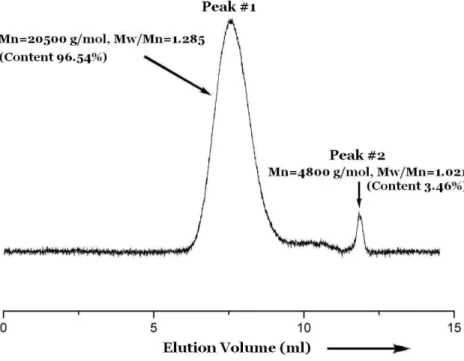
and two independent controlled processes is observed by judging from the GPC curve of the polymer as portrayed in Figure2. The polymer shows two separate narrow distribution peaks in the GPC curve. The Mn of the polymer of peak#1 is 20500 g/mol and the Mw/Mn is 1.285. The content of the peak#1 in the total polymer is estimated to 96.54% by using Wyatt Technology (Astra 473) software. The Mn of the polymer of peak#2 is 8400 g/mol and the Mw/Mn is 1.021. Similar results are also found in many other polymerization products.
As far as our knowledge goes, many dinuclear catalysts had been reported for using in ethylene or norbornene polymerization through coordination mechanism [25–27]. We are interested in comparing our results with those applications of dinuclear late transition metal complexes. In ethylene or norbornene polymer-ization, the results showed that the catalytic activity evidently increased and molecular weight distributions of the obtained polymers broadened. The observed effects can be explained on the basis of and steric and electronic effects and cooperative
Figure 2. Size-exclusion chromatogram for Sample 6.
doi:10.1371/journal.pone.0013629.g002
Table 1.Bulk cobalt mediated radical polymerization of methyl methacrylate in the presence of dinuclear complex4and complex
5.
Complex
Sample
number [M]/[Co] [Co]/
[AIBN] t [h] Z[b]
[%] Peak#1 Peak#2
Mn,sec[c] [gmol21]
Mn,theor[d]/ Mn,sec[c] MW/Mn
Content [%]
Mn,sec[c]
[gmol21] Mw/Mn
Content [%]
4 1 320 3 4 66 16400 1.28 1.441 97.95 5950 1.008 2.05
4 2 320 3 8 92 25100 1.17 1.632 95.37 9420 1.032 4.63
4 8 320 2 6 65 17900 1.16 1.382 100 / / 0
4 3 320 2 8 76 24400 1.00 1.566 100 / / 0
4 9 320 2 2 39 12100 1.03 1.421 100 / / 0
4 10 320 1 4 77 24300 1.02 1.273 100 / / 0
5 4 600 3 6 78 34500 1.35 1.076 89.17 30700 1.001 10.83
5 6 600 2 1 29 20500 0.85 1.285 96.54 4800 1.021 3.46
5 5 600 2 2 54 23200 1.40 1.310 87.58 7820 1.015 12.42
5 7 600 2 4 66 29200 1.36 1.594 76.90 9470 1.007 23.10
5 11 600 2 5 73 33100 1.32 1.602 72.58 11890 1.010 27.42
5 12 600 1 4 55 30800 1.08 1.083 98.62 3100 1.025 1.38
[a] Bulk polymerization of MMA at 80uC. [b] The monomer conversion Z is determined gravimetrically after removal of the unconverted monomer in vacuo. [c] Determined by size-exclusion chromatography (SEC). [d]Mn,theor= ([M]0/[CoII]0)6Mmono6Z.
interactions of the two adjacent metal centers in dinuclear complexes. These two metal centers are electronically coupled through the ligand bridge. When one of the centers was activated at a given time, it had an electronwithdrawing effect on another center. The interaction between two metals made it possible to create more than one kind of active species during the polymerization. The two separate late metal complex units act as the mutual bulky steric effects for each other, which leads to the excellent catalytic performance.
Not long ago, a significant research about dinuclear catalyst system arouses our attention. Matyjaszewski group developed a highly active dinuclear copper-based catalyst of copper-based complex CuBr/N,N,N’,N’-tetrakis(2-pyridylmethyl)- ethylenedi-amine (TPEN) for atom transfer radical polymerization [17]. The activator CuIBr/TPEN existed in solution as dinuclear and mononuclear complexes in equilibrium but as a dinuclear complex in its single crystals. Therefore, both mononuclear and dinuclear complexes coexisted in the solution of CuBr/TPEN at a 1/1 molar ratio. There was fast exchange equilibrium between the dinuclear and mononuclear complexes. The facts of the real active species of CuBr/TPEN catalyst in solution might be the mononuclear species were found by the large differences in catalytic activity between CuBr/TPEN and CuBr/BPMPrA. Therefore, only single narrow molecular weight distribution peak was found in GPC curve.
Originally, we expected to get higher activity systems in CMRP by using the dinuclear cobalt complexes. It’s a pleasant surprise to us, higher catalytic activities in CMRP is successfully obtained as expected. On the contrary to the ethylene polymerization, the molecular weight distributions of the obtained CMRP polymers did not broaden. Moreover, the polydispersity (PDI) of the two different constituents in Sample 6 (Table 1) are all very narrow (1.285 and 1.021). Similar to ethylene polymerization catalyzed by
dinuclear catalysts, it has the same possibilities to create two kinds of active species during the CMRP for the electronwithdrawing effect on another center. As described in Scheme S3, a cobalt complex corresponds to polymerization equilibrium in CMRP of acrylates. In an individual polymerization process, the two kinds of active species catalyzed two independent cobalt-mediated radical polymerization processes. That is why we got the peculiar polymer of two distinct molecular weights as the GPC curve shown in Figure 2. The very narrow polydispersities of the two polymer components indicate the two independent cobalt-mediated radical polymerization processes are controlled and living.
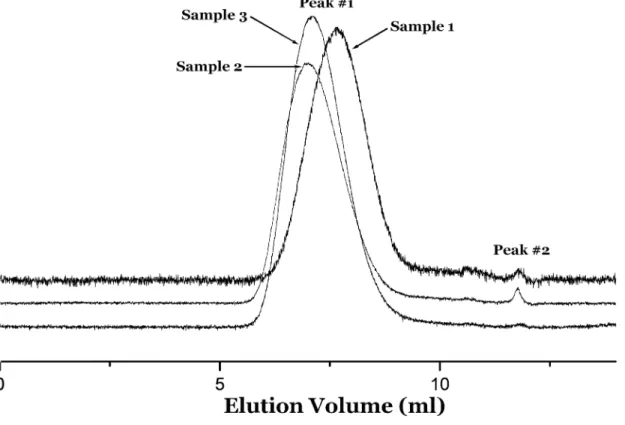
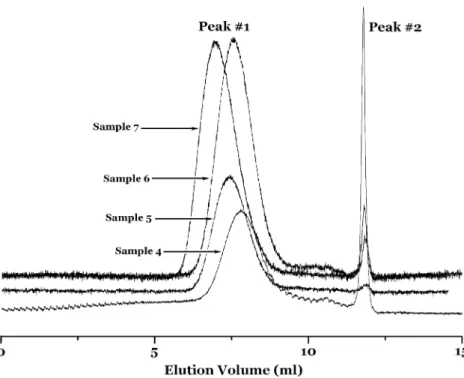
Other bulk CMRP results are summarized in Table 1 and the other GPC curves are shown in Figure3and Figure4. The results of two peaks in an individual GPC curves are found in most bulk CMRPs. Nonetheless, there still some polymers had only single narrow molecular weight distribution peak in GPC curve. It could be observed in Figure3(Sample3) and Table 1 (Sample8,9,10). From the above-mentioned GPC results, some unimodal distri-bution means only one active species worked in the CMRP with the catalyzation of a dinuclear cobalt complex under certain reaction conditions. Take all the GPC results shown in Table 1 into account, we could find the monocomponent polymer obtained by CMRP are all catalyzed by complex 4 (shown in Scheme S2) system. Similar results were not found in complex5
systems. When will we get monocomponent narrow distribution polymers as well as when will we get two-component narrow distribution polymers, that are very significant questions to us. It is natural for us to explain these questions from the molecular structures of the two dinuclear complexes (complex 4 and complex 5). From Scheme S2, in complex 4, one benzoylacetone substituent group is in the para position to the other benzoyla-cetone substituent. Relatively, in complex 5, the benzoylabenzoyla-cetone substituent group is in the ortho position to the other
Figure 3. Size-exclusion chromatograms for Sample 1–3.
benzoylacetone substituent. These facts mean the two cobalt metal center in complex5is closer than in complex4. Therefore, for the
higher electrophilic and steric effect, the complex5is more liable to generate two active species in CMRP. With a comparison to the bi-component polymers catalyzed by complex 4, the
mono-component polymers catalyzed by the same complex are all high molecular weight constituent.
As expected, the molar mass of primary constituent of PMMA, is controlled by the [MMA]/[Co2+
] ratio. Moreover, the
polymerization of MMA starts after this period of time, and a controlled process is observed, as assessed by the linear increase of the molar mass with monomer conversion (Figure5and Figure6). As a rule the polydispersity is very low (1.076#Mw/Mn#1.632) throughout the polymerization. The slight but significant increase in polydispersity with monomer conversion is observed in any controlled radical processes as result of irreversible termination reactions and, in this case, possible transfer reactions to monomer and/or polymer. Further evidence for the pronounced efficacy of Figure 4. Size-exclusion chromatograms for Sample 4–7.
doi:10.1371/journal.pone.0013629.g004
Figure 5. Dependence of PMMA molar mass Mn on monomer conversion Z for bulk polymerization of MMA at 80uC (for the primary constituent of the obtained PMMA).[MMA]/[Co(II)] = 600 (Table 1). (%complex 4,
this cobalt complex in mediating the radical polymerization of MMA can be found in the good agreement between experimental and theoretical molar masses (Mn,theor/Mn,SEC= 160.40, Table 1, for the peak#1). The theoretical values were calculated under the assumption that one polymer chain is growing per cobalt complex unit, according to the mechanism proposed by Wayland and co-workers for the CMRP of acrylates (Scheme S3). 1H NMR and FT-IR analyses showed that the obtained polymers were more or less syndiotactic, similar to samples prepared with ordinary CRPs. There were almost no effects of AIBN on their tacticity. Lowering the temperature increased the racemic (rr) content, which would be expected for a free-radical polymerization. These also support the radical propagation mechanism with the cobalt catalysts.
The kinetics of this CMRP of MMA are first-order in monomer, as assessed by the linear dependence of ln([M]0/[M]) versus time (Figure 5 and 6), which confirms that the macroradical concentration remains essentially constant and that irreversible chain termination reactions are quite restricted. In contrast to vinyl acetate polymerization reported by Je´roˆme et al, an induction period is not evidently observed in the radical polymerization of MMA, which would be almost simultaneous of the radicals generated in situ to convert CoIIinto CoIII_P with the polymerization beginning. During this beginning period of CMRP, a drastic change in the color of the medium, from purple to dark brown-green, is observed, consistent with the suggested change in oxidation state of the cobalt complex.
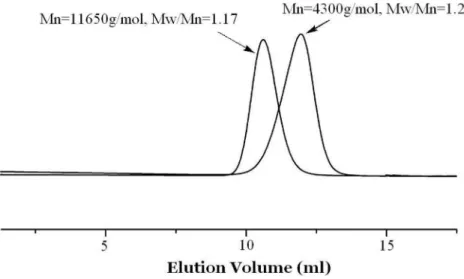
MMA oligomers (Mn = 4300 gmol21, Mw/Mn = 1.21), pre-formed in bulk at 50uC with AIBN in the presence of complex4, were collected and purified by repeated precipitation in heptane, and finally used as macroinitiators for MMA polymerization. As shown in Figure7, resumption of the MMA polymerization was successful, as assessed by the shift of the SEC chromatograms with time towards lower elution volumes. A new MMA homopolymer (Mn = 11650 g/ mol) was obtained with its maintained narrow polydispersity (PDI = 1.17), and a very small amount of unconverted macro-initiator. This observation paves the way for the synthesis of block
copolymers by sequential polymerization of MMA and any comonomer whose polymerization is controlled by the same initiator/Co complex system. In that case, exchange of Co complexes is required between the consecutive polymerization steps.
Conclusion
In conclusion, we have developed the first dinuclear catalyst for rapid, living MMA polymerization as demonstrated by kinetics studies and GPC data. The two unique, symmetrical, dinuclear cobalt complexes can be easily synthesized in one step from the bis-diketonate ligands. The neutral catalysts show satisfactory activities in MMA living polymerization. Interestingly, one or two low polydispersity polymers could be obtained by using the two dinuclear catalysts under proper reaction conditions. As we know, in precision gel permeation chromatographic (GPC) work, the calibration curve is obtained by using standard polystyrenes or other low polydispersity polymers. A general idea is to make ‘‘cocktails’’ – mixtures that contain several standards. That way, we don’t have to make so many injections. But don’t make the polymers too close. Therefore, the syntheses of multicomponent low polydispersity polymers have significant values in polymer chemistry. In this study, our successful producing two-component low polydispersity PMMA confirm the feasibility of multicomponent low polydispersity polymers syntheses. The further study of the multinuclear catalysts in CRP is currently under investigation and will be published shortly.
Materials and Methods
All manipulations involving air- and moisture-sensitive com-pounds were carried out under an atmosphere of dried and purified nitrogen using standard Schlenk and vacuoline techniques. Solvents were purified using standard procedures. Reagents of the 2,29 -azobisisobutyronitrile (AR) were obtained from Aldrich and used without further purification. Methyl methacrylate were dried over CaH2, and then freshly distilled under vacuo prior to use. Molecular weights and molecular weight distributions were determined using Figure 6. Time dependence of ln([M]0/[M]) for the bulk polymerization of MMA at 80uC (for the primary constituent of the obtained
PMMA).[MMA]/[Co(II)] = 600 (Table 1). [M]0and [M] are the MMA concentration at times 0 and t, respectively. (%complex 5;&complex 4)
gel permeation chromatography (GPC) coupled with multiangle laser-light scattering (MALLS). The system included a StyragelH
HMW 6E GPC column (7.86300 mm), a Wyatt OPTILAB RI detector, and a Wyatt multiangle laser-light scattering detector (DAWN E). The MALLS operated at 18 angles, from 26uto 149u and was equipped with a He-Ne laser (690 nm). The column and the RI detector were set at 40uC. The mobile phase was THF and the polymer solutions of injected sample were filtered through 0.2mm syringe filters before injection. The molecular weights and polydispersity indexes were measured for the main peaks and were calculated using Wyatt Technology (Astra 473) software. The MALLS detector allowed the calculation of absolute molecular weights. Infrared spectra were recorded on polymer-KBr pellets with a Bruker EQUINOX55 FT-IR spectrophotometer in the region of 4000,400 cm21. NMR spectra were obtained using a Varian 400 MHz at room temperature in CDCl3 solution using tetramethylsilane as internal standard.
Synthesis of two cobalt complexes
Complex5: The ligand 1 of 3,39 -(1,3-phenylene)bis(1-phenyl-propane-1,3-dione) was synthesized according to Pikramenou and his coworkers’ previous work.
To a DMF (5 ml) solution of 1,3-bis(3-phenyl-3-oxopropanoyl)-benzene (40 mg, 0.11 mmol) were added triethylamine (0.31 ml, 0.22 mmol) and cobalt(II) chloride (16 mg, 0.12 mmol) dissolved in DMF (5 ml). The brown precipitate was collected for further characterized in about 80% yield. Elemental analysis calculated for C48H32Co2O8: C 67.46, H 3.77; found: C 67.52, H 3.68. However, attempts to get mono-crystal structure of complex 5 were unsuccessful. 1H NMR of Complex 5 (400M Hz, CDCl3): 8.59 (H, m), 7.50–7.59(12H, m), 6.94(6H, s). FT-IR(KBr): 2924, 1661, 1599, 1508, 1454, 1424, 1292, 1208, 1106, 1057, 744, 700 cm21.
Complex4: The ligand 2 of 3,39 -(1,4-phenylene)bis(1-phenyl-propane-1,3-dione) was synthesized improving to the synthesis of ligand1. Elemental analysis calculated for C24H18O4: C 77.82, H 4.90; found: C 77.90, H 5.01. The single-crystals (yellow crystals) of Ligand 2 were grown in ethanol, and the ORTEP plot of
structure is shown in Fig. 1. (CCDC reference number is 678685.) The complex4(as brown crystal) was obtained analogously to the preparation of complex 1. Elemental analysis calculated for
C48H32Co2O8: C 67.46, H 3.77; found: C 67.72, H 3.85. However, attempts to get mono-crystal structure of complex 4 were
unsuccessful. 1H NMR of Complex 4 (400M Hz, CDCl3): 8.70
(6H, m), 7.57–7.64(12H, m), 6.99(6H, s). FT-IR(KBr): 2986, 1709, 1611, 1497, 1439, 1313, 1229, 1146, 1089, 1016, 750, 713 cm21.
General polymerization procedure
AIBN (98.4 mg, 0.60 mmol) and cobalt complex 4 (85.4 mg, 0.1 mmol) and solvent (xylene, 10 ml) were placed in a 50 mL flask and degassed by three vacuum/nitrogen cycles. Dry, degassed methyl methacrylate (11 mL, 120 mmol) was then added by syringe under nitrogen. The purple mixture was stirred after heated at 80uC. After a few hours, the color changed from purple to dark brown-green. Polymerization occurred for no less than 4 h, after which the viscosity of the solution increased substan-tially. After a given time, the mixture was diluted with THF and poured into 10-fold methanol. The resulting precipitated polymers were treated by filtering, washing with methanol several times, and drying under vacuum at 40uC to a constant weight. Some samples were preceded at different reaction times, and monomer conversion was determined by weighing the collected polymer after removal of the unconverted monomer in vacuo.
PMMA oligomers of only one constituent (460 mg, Mn,SEC = 4300 gmol21, Mw/Mn = 1.21) were prepared at 50uC with AIBN in the presence of complex4and collected at low monomer conversion by repeated precipitation in heptane. They were dissolved in degassed MMA (2.5 mL, 26.5 mmol) and heated at 50uC to resume the controlled radical polymerization.
Supporting Information
Scheme S1 Syntheses of dinuclear cobalt(II) complexes Found at: doi:10.1371/journal.pone.0013629.s001 (0.42 MB TIF)
Scheme S2 Structure of cobalt(II) complexes (1–5)
Found at: doi:10.1371/journal.pone.0013629.s002 (0.39 MB TIF)
Scheme S3 Equilibrium between dormant and active species in CMRP of acrylates
Found at: doi:10.1371/journal.pone.0013629.s003 (0.06 MB TIF)
Author Contributions
Conceived and designed the experiments: JG BX RM. Performed the experiments: lF ZT BX RM CY. Analyzed the data: lF ZT CY. Wrote the paper: FB.
Figure 7. Size-exclusion chromatogram for the macroinitiator and block copolymer.
References
1. Matyjaszewski K, Xia J (2001) Atom transfer radical polymerization. Chem Rev 101: 2921–2990.
2. Patten TE, Xia J, Abernathy T, Matyjaszewski K (1996) Polymers with very low polydispersities from atom transfer radical polymerization. Science 272: 866–868.
3. Percec V, Barboiu B (1995) ‘‘Living’’ radical polymerization of styrene initiated by arenesulfonyl chlorides and CuI(bpy)nCl. Macromolecules 28: 7970–7972. 4. Goto A, Fukuda T (2004) Kinetics of living radical polymerization.Prog Polym Sci
29: 329–385.
5. Wayland BB, Poszmik G, Mukerjee SL, Fryd M (1994) Living radical polymerization of acrylates by organocobalt porphyrin complexes. J Am Chem Soc 116: 7943–7944.
6. Arvanitopoulos LD, Greuel MP, Harwood HJ (1994) ‘‘Living’’ free radical polymerization using alkyl cobaloximes as photoinitiators. Polym Prepr 35: 549–550.
7. Debuigne A, Caille J, Je´roˆme R (2005) Highly efficient cobalt-mediated radical polymerization of vinyl acetate. Angew Chem Int Ed 44: 1101–1104. 8. Debuigne A, Caille J, Detrembleur C, Je´roˆme R (2005) Effective cobalt
mediation of the radical polymerization of vinyl acetate in suspension. Angew Chem Int Ed 44: 3439–3442.
9. Wayland BB, Basickes L, Mukerjee S, Wei M, Fryd M (1997) Living radical polymerization of acrylates initiated and controlled by organocobalt porphyrin complexes. Macromolecules 30: 8109–8112.
10. Bryaskova R, Detrembleur C, Debuigne A, Je´roˆme R (2006) Cobalt-mediated radical polymerization (cmrp) of vinyl acetate initiated by redox systems: toward the scale-up of CMRP. Macromolecules 39: 8263–8268.
11. Lu Z, Fryd M, Wayland BB (2004) New life for living radical polymerization mediated by cobalt(II) metalloradicals. Macromolecules 37: 2686–2687. 12. Peng CH, Scricco J, Li S, Fryd M, Wayland BB (2008) Organo-cobalt mediated
living radical polymerization of vinyl acetate. Macromolecules 41: 2368–2373. 13. Kaneyoshi H, Matyjaszewski K (2005) Effect of ligand and n-butyl acrylate on cobalt-mediated radical polymerization of vinyl acetate. Macromolecules 38: 8163–8169.
14. Wang B, Zhuang Y, Luo X, Xu S, Zhou X (2003) Controlled/‘‘living’’ radical polymerization of MMA catalyzed by cobaltocene. Macromolecules 36: 9684–9686.
15. Matsubara K, Matsumoto M (2006) Cobalt(I)-mediated living radical polymer-ization of methyl methacrylate. J Polym Sci Part A: Polym Chem 44: 4222–4228.
16. Weiser MS, Mu¨lhaupt R (2005) Cobalt(II) octanoate and cobalt(II) perfluor-ooctanoate catalyzed atom transfer radical polymerization of styrene in toluene
and fluorous media—A versatile route to catalyst recycling and oligomer formation. J Polym Sci Part A: Polym Chem 43: 3804–3813.
17. Tang H, Arulsamy N, Radosz M, Shen Y, Tsarevsky NV, et al. (2006) Highly active copper-based catalyst for atom transfer radical polymerization. J Am Chem Soc 128: 16277–16285.
18. Bassett AP, Magennis SW, Glover PB, Lewis DJ, Spencer N, et al. (2004) Highly luminescent, triple- and quadruple-stranded, dinuclear Eu, Nd, and Sm(III) lanthanide complexes based on bis-diketonate ligands. J Am Chem Soc 126: 9413–9424.
19. Soldatov DV, Zanina AS, Enright GD, Ratcliffe CI, Ripmeester JA (2003) A new bridging chelating ligand for crystal engineering: synthesis, polymorphism, and two modes of assembly of 1,4-bis(3-phenyl-1,3-propanedion)benzene with metal cations resulting in either discrete or polymeric complexes. Crystal Growth & Design 3: 1005–1013.
20. Clegg JK, Bray DJ, Gloe K, Gloe K, Jolliffe KA, et al. (2008) Synthetic, structural, electrochemical and solvent extraction studies of neutral trinuclear cobalt(II), nickel(II), copper(II) and zinc(II) metallocycles and tetrahedral tetranuclear iron(III) species incorporating 1,4-aryl-linked bis-b-diketonato ligands. Dalton Transactions. pp 1331–1340.
21. Cotton FA, Soderberg RH (1964) A spectroscopic study of the polymeric nature of bis(acetylacetonato)cobalt(II). Inorg Chem 3: 1.
22. Burgess J, Fawcett J, Ressel DR, Gilani SR (2000) Monomeric bis(2,4-pentanedionato)cobalt(II). Acta Crystallogr Sect C 56: 649–650.
23. Wang LC, Jang HY, Roh Y, Iynch V, Schultz AJ, et al. (2002) Diastereoselective cycloreductions and cycloadditions catalyzed by co(dpm)2-silane (dpm = 2,2,6,6-tetramethylheptane-3,5-dionate): mechanism and partitioning of hydro-metallative versus anion radical pathways. J Am Chem Soc 124: 9448–9453. 24. Maria S, Kaneyoshi H, Matyjaszewski K, Poli R (2007) Effect of electron donors
on the radical polymerization of vinyl acetate mediated by [Co(acac)2]: degenerative transfer versus reversible homolytic cleavage of an organocobal-t(III) complex. Chem Eur J 13: 2480–2492.
25. Hu T, Tang LM, Li XF, Li YS, Hu NH (2005) Synthesis and ethylene polymerization activity of a novel, highly active single-component binuclear neutral nickel(II) catalyst. Organometallics 24: 2628–2632.
26. Zhang D, Jin GX (2003) Novel highly active bimuclear 2, 5-disubstituted amino-p-benzoquinone nickel (II) ethylene polymerization catalysts. Organometallics 22: 2851–2854.