HBV Genotypic Variability in Cuba
Carmen L. Loureiro1, Julio C. Aguilar2, Jorge Aguiar2, Verena Muzio2, Eduardo Pentón2, Daymir Garcia2, Gerardo Guillen2, Flor H. Pujol1
*
1Laboratorio de Virología Molecular, Centro de Microbiología y Biología Ceular, Instituto Venezolano de Investigaciones Científicas, Caracas, Venezuela,2Centro de Ingeniería Genética y Biotecnología, La Habana, Cuba
Abstract
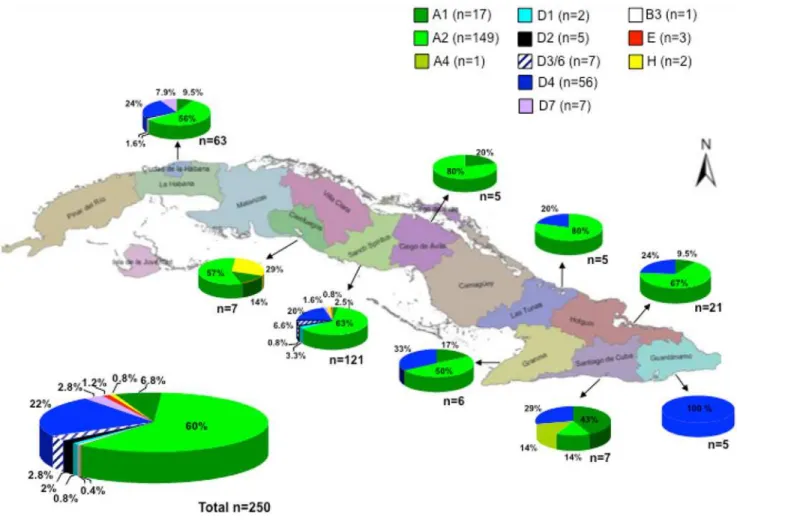
The genetic diversity of HBV in human population is often a reflection of its genetic admix-ture. The aim of this study was to explore the genotypic diversity of HBV in Cuba. The S ge-nomic region of Cuban HBV isolates was sequenced and for selected isolates the complete genome or precore-core sequence was analyzed. The most frequent genotype was A (167/ 250, 67%), mainly A2 (149, 60%) but also A1 and one A4. A total of 77 isolates were classi-fied as genotype D (31%), with co-circulation of several subgenotypes (56 D4, 2 D1, 5 D2, 7 D3/6 and 7 D7). Three isolates belonged to genotype E, two to H and one to B3. Complete genome sequence analysis of selected isolates confirmed the phylogenetic analysis per-formed with the S region. Mutations or polymorphisms in precore region were more com-mon acom-mong genotype D compared to genotype A isolates. The HBV genotypic distribution in this Caribbean island correlates with the Y lineage genetic background of the population, where a European and African origin prevails. HBV genotypes E, B3 and H isolates might represent more recent introductions.
Introduction
Even though the highest HBV prevalence is found in the Eastern Southern Asia and in the Southern and Equatorial Africa, around 13 million persons are infected with HBV in America and around 11 million of them are found in Latin America, a region exhibiting an intermediate prevalence of infection, varying from 2 to 7% [1]. HBV has been classified in 8 genotypes (A–H), exhibiting a minimum divergence of 8% in the complete genome sequences [2]. In ad-dition, 2 new genotypes, I and J, have been proposed [3]. Genotypes A and D are also widely distributed in all the continents. Genotypes B and C are found mainly in South East Asia and the Far East, while genotype E circulates in sub-Saharan West Africa [4]. Several lines of evi-dence suggest that HBV genotype E might be a recent genotype: the low intragenotypic varia-tion exhibited by these strains and the fact that it was not introduced to the Americas during slave trade, suggesting a posterior origin [5,6]. Genotype G has been reported in the US, Me-xico and Europe, but its distribution is not fully known [7]. HBV genotype F is the most diver-gent of the HBV genotypes, autochthonous to South America and highly predominant in the
a11111
OPEN ACCESS
Citation:Loureiro CL, Aguilar JC, Aguiar J, Muzio V, Pentón E, Garcia D, et al. (2015) HBV Genotypic Variability in Cuba. PLoS ONE 10(3): e0118959. doi:10.1371/journal.pone.0118959
Academic Editor:Isabelle A Chemin, CRCL-INSERM, FRANCE
Received:September 29, 2014
Accepted:January 8, 2015
Published:March 5, 2015
Copyright:© 2015 Loureiro et al. This is an open access article distributed under the terms of the Creative Commons Attribution License, which permits unrestricted use, distribution, and reproduction in any medium, provided the original author and source are credited.
Data Availability Statement:Nucleotide sequence data have been deposited into the GenBank database under the accession numbers KM606642-KM606972.
Funding:Proyecto de Cooperación Científica Cuba-Venezuela. PEI 20122000768 from Venezuela provided funding for this project. The funders had no role in study design, data collection and analysis, decision to publish, or preparation of the manuscript.
region [8–10]. HBV genotype H is closely related to genotype F and is prevalent Central and North America [11,12].
Although HBV genotypes F and H are indigenous to America, their prevalence varies markedly among different countries. In the Southern region of South America, HBV genotype A prevails over genotype F, while in the Northern region genotype F is highly predominant. In Brazil, the genotype distribution is related with the immigration pattern, and a high prevalence of genotype A can be seen in African-Brazilians. HBV genotype H has only been found in Cen-tral America and is found circulating either with genotype A or F. The relative frequency of HBV genotype F in Latin America is in close correlation with the degree of admixture of the general population with Amerindians, in many cases through the maternal contribution to the genetic pool. For example, in Colombia and Venezuela, where the frequency of HBV genotype F is around 80% in the general population [13], the majority of mtDNA is of Amerindian ori-gin [14,15]. In contrast, in Brazil, the Amerindian contribution to the mtDNA genetic pool is only 33%, with a more significant contribution of African mtDNA [16]. HBV genotype A is more common than HBV genotype F in this country [17,18].
Cuba exhibits an intermediate prevalence of HBV, which has been declining with the active vaccination program in the country. The prevalence of HBV surface antigen (HBsAg) has been reducing in blood donors from more than 1% before the starting of vaccination in 1992, to around 0.5% in the last years [19]. No information is available on the genotypic diversity of HBV in the island. The aim of this study was to explore the genotypic diversity of HBV in Cuba.
Materials and Methods
This study was approved by Comité de Revisión y Etica of Sanctis Spiritus, Cuba and by Comité de Bioética del IVIC, Venezuela. The S (700 nt and 1200 nt respectively), X gene and precore-core, and complete genomic regions were amplified from 250, 14, 109 and 19 HBsAg positive sera, respectively, as previously described [13,20,21]. These sera were from Cuban untreated pa-tients, collected in 2006 (samples Cuba) and 2013 (samples Cuba“a”), obtained with written in-formed consent of the donor. PCR purified fragments were sent to Macrogen Sequencing Service (Macrogen, Korea) for sequencing. Both strands of DNA were sequenced. Sequence alignment and phylogenetic analysis by the Neighbor Joining method (500 bootstrap replicas) with genetic distances evaluated with Kimura 2 parameters corrections, were conducted using DNAman 5.2.2 (Lynnon Bio Soft, Canada). Reference sequences from the different genotypes and subgenotypes were included in the phylogenetic analysis, as well as sequences closely relat-ed to the Cuban sequences analyzrelat-ed, obtainrelat-ed by BLAST analysis. Electropherotypes were also visually inspected to detect the presence of variants in specific nucleotides, associated to stop co-dons or other relevant mutations or polymorphisms. Nucleotide sequence data have been de-posited into the GenBank database under the accession numbers KM606642-KM606972.
Statistical differences were evaluated by the Chi-Squares test with Yates correction, or Fisher Exact test (when a cell number under 5), according to a computerized Epi Info program, ver-sion 3.5.3 (Centers for Disease Control and Prevention, Atlanta, GA).
Results
subgenotypes (56 D4, 2 D1, 5 D2, 7 D3/6 and 7 D7). Three isolates belonged to genotype E, two to genotype H, and one to genotype B3. For the B3 isolate, only 700 nt from the S region were available for phylogenetic analysis. This isolate was closely related to an isolate form Aus-tralia, but also with isolates from USA and Vietnam (data not shown). No significant difference was found in HBV genotype distribution among the studied Cuban localities (Fig. 1). In addi-tion, when examining the sequence electropherotypes, evidence suggesting mixed A/D infec-tion was found in 9 isolates (data not shown). In addiinfec-tion, for 2 isolates, genotype deduced from the core region was different from the one assigned by analysis of the S region: Cuba 15a (genotype A2 in the S region and A1 in the core region), and Cuba99a (genotype D4 in the S re-gion and A2 in the core one), suggesting mixed infection or recombination.
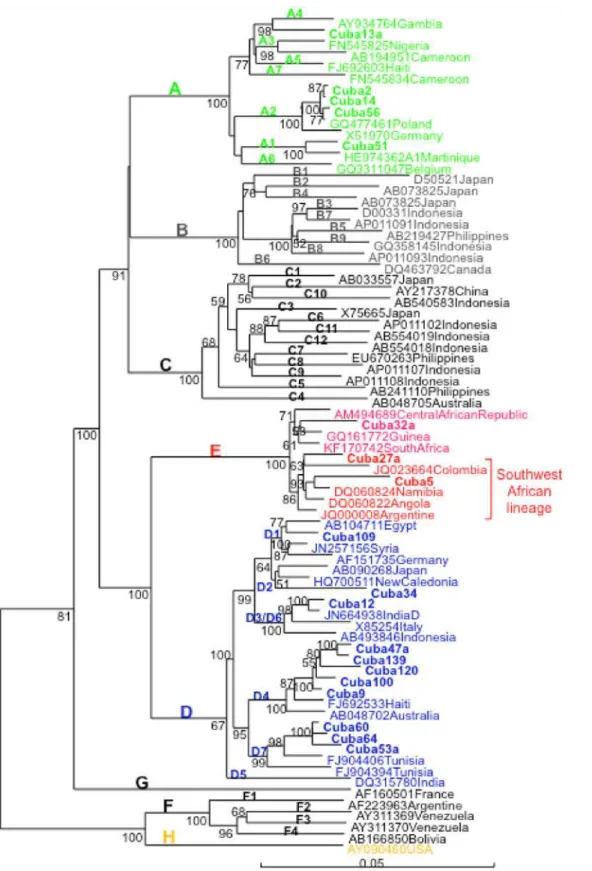
Complete genome sequence analysis of 19 selected isolates confirmed the phylogenetic anal-ysis performed with the S region and allowed analyzing phylogenetic relatedness of Cuban HBV isolates with the ones from other countries (Fig. 2). BLAST analysis was performed using the Cuban sequences and the most similar sequence available at GenBank was included in the phylogenetic tree. Cuban HBV A1 isolates were closely related to an isolate from Martinique, A2 isolates to a European isolate (Poland), and A4 with an African (Gambian) isolate. A2 iso-lates were also related to Spanish isoiso-lates (GenBank accession numbers AJ627226 and AJ627228, data not shown). D1 isolate was closely related to an isolate from Egypt, D2 with Asian isolates. D3/D6 isolate–D3 and D6 subgenotypes were recently regrouped in a single Fig 1. HBV genotype distribution in Cuba.
Fig 2. Phylogenetic analysis of HBV complete genome of Cuban isolates.Genetic distance was estimated by Kimura 2 parameters and phylogenetic tree was constructed with the Neighbor joining method. Numbers at each node correspond to bootstrap values (greater than 50%) obtained with 500 replicates. Isolates are designated by their GenBank accession number, followed by their country of origin, except for Cuban ones which are shown in bold.
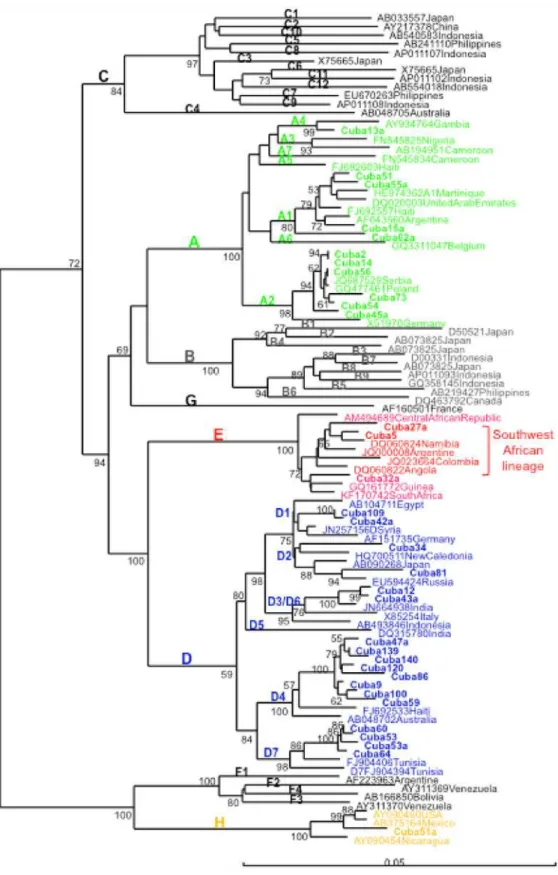
subgenotype [22]—was closely related to an Indian isolate, D4 isolates were closely related to HBV an isolate from Haiti and D7 isolates were closely related to Tunisian isolates, where this subgenotype was first identified [23]. D4 and D7 Cuban isolates formed monophyletic clusters inside this subgenotype. Cuban D4 isolates were also closely related to a Spanish D4 isolate (Accession number AJ627219) and more distantly related to D4 isolates from Maranhao Brazil (Accession number KJ470898) (data not shown). From the 3 genotype E isolates, two were more closely related to the HBV genotype E isolate were from Argentine, Colombia, Angola, Namibia and Congo, the recently proposed South West African lineage [24]. However, a third Cuban genotype E isolate grouped outside this lineage.
In addition, genomic analysis of large S genomic region (more than 1100 nucleotides) al-lowed identifying closely related isolates in more samples for which complete genome sequence was not available, with high bootstrap support (Fig. 3). The same topology was found compared to the complete genome analysis, supporting the adequacy of this region to analyze genetic re-latedness among strains. Two D3/D6 isolates formed a closely related cluster, related also to an Indian isolate, as described previously. D2 isolates did not form a monophyletic cluster, being one isolate related to a New Caledonian one and another to a Russian isolate. One HBV geno-type H isolate was more closely related to isolates from Mexico and USA than from Nicaragua.
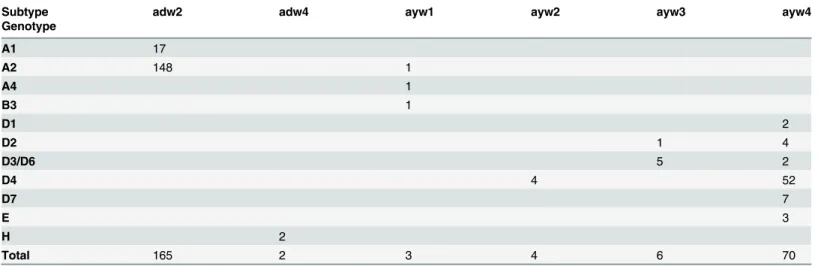
Subtype and genotype distribution of Cuban isolates were highly correlated (Table 1). All but one genotype A isolates were subtype adw2, as expected. All but 12 of the genotype D iso-lates were subtype ayw4, being only 3 subgenotype D4 isoiso-lates subtype ayw2, which is a more common subtype found in genotype D isolates [2]. The 3 genotype E isolates were subtype ayw4 and the two genotype H ones subtype adw4, as expected.
The presence of mutations or polymorphisms in basal core promoter (BCP) and precore (PC) regions were analyzed and compared between the two more frequent genotypes, A and D (Fig. 4). A tendency toward a higher frequency in HBV genotype A isolates to harbor the BCP mutations A1762T/G1764T was found, although not statistically significant. Some polymor-phisms were more frequently found in genotype D compared to genotype A: C1858T, predis-posing to the precore mutation G1896A, which was also found significantly more frequently in genotype D isolates. The other precore mutation G1899A was also found significantly more frequently in genotype D isolates, although this mutation was less frequent that the G1896A one. Two other polymorphisms, A1846T and A2189C, were found at high frequency in geno-type D isolates, and were almost absent in genogeno-type A ones.
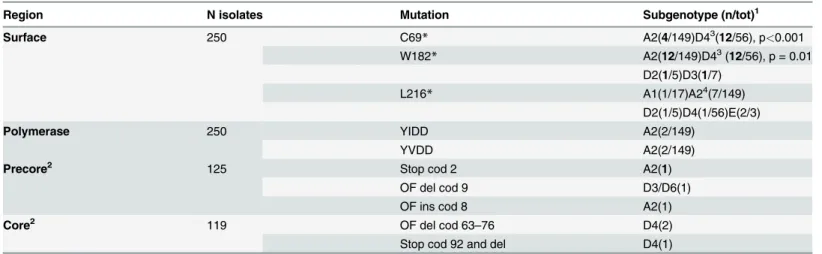
In addition, deletions were found in the core region in 3 isolates, leading to truncated core proteins (Table 2). Another deletion leading to a C-terminal truncated X protein was found in one D2 isolate. Three stop codon mutations were relatively frequent in the Surface protein: C69, W182and L216, circulating mostly as variants along with the wild type codon
(Table 2). The combination C69W182was frequently found and these mutations were signif-icantly more frequent in the D4 isolates compared to the A2 ones. Finally, 4 isolates harbored mutations in the Polymerase protein, associated to resistance to Lamivudine.
Discussion
Fig 3. Phylogenetic analysis of HBV S region (1245 nt) of Cuban isolates.Genetic distance was estimated by Kimura 2 parameters and phylogenetic tree was constructed with the Neighbor joining method. Numbers at each node correspond to bootstrap values (greater than 50%) obtained with 500 replicates. Isolates are designated by their GenBank accession number, followed by their country of origin, except for Cuban ones which are shown in bold.
maternal ancestries in Cuba. In the paternal ancestry, the European genetic contribution is al-most 80%, with only 20% African one [27]. The most frequent European immigrants were Spanish from the Canary Islands, being some haplogroups characteristic of these Spanish is-lands found frequently in Cuba [27].
Table 1. Genotype and subtype in Cuban HBV isolates.
Subtype adw2 adw4 ayw1 ayw2 ayw3 ayw4
Genotype
A1 17
A2 148 1
A4 1
B3 1
D1 2
D2 1 4
D3/D6 5 2
D4 4 52
D7 7
E 3
H 2
Total 165 2 3 4 6 70
doi:10.1371/journal.pone.0118959.t001
Fig 4. Frequency of X, BCP, precore and core mutations/polymorphisms in genotype A and D Cuban isolates.Nucleotide position and mutation is shown. Hatched part of the bar reflects the frequency of mixed wild type and mutated sequence. Significant differences in frequency between the two genotypes are shown with a bracket.
The HBV genotype distribution in Cuba is interestingly correlated with its phylogeographic structure of the Y-chromosome lineages [27]. The most common subgenotype was the Europe-an A2, followed by the AfricEurope-an subgenotype D4. The A2 isolates were closely related to isolates from Eastern Europe (Figs.2and3). They were also related to Spanish HBV A2 isolates. The Cuban A2 isolates did not form a monophyletic cluster (Fig. 3). Being the most common subge-notype, multiple introductions might have been expected, probably most from the first Spanish immigrants, but also arising from more recent contacts with the former Soviet Union and relat-ed countries. In Spain, the most common HBV genotype is D, followrelat-ed by A [29,30]. Analysis of the only 14 complete genome HBV sequences available at GenBank allows suggesting that the most common subgenotype circulating in Spain is D2 (GenBank accession numbers AJ627215, AJ6272156, AJ627218, AJ627220, AJ627222, AJ627223), followed by A2 (GenBank accession numbers AJ627226-AJ627228). However, HBV D2 isolates are not common in Cuba, with only 2% prevalence (Fig. 1). Interestingly, both A2 and D2 Cuban isolates did not form monophyletic clusters, suggesting multiple introductions of these subgenotypes. This situation is in agreement with multiples introductions of HBV in the island by Spanish colonizers.
In contrast, the A1 isolates, closely related to isolates found in Haiti and Martinique (Fig. 3), might have been imported during the slave trade to the island, as in the other Caribbean islands [31,32]. In Haiti and Martinique, however, the A1 subgenotype is by far the most prevalent, sit-uation not shared with Cuba. The higher prevalence of A1 in Haiti and Martinique is in agree-ment with a higher contribution of an African genetic background in these islands, compared to Cuba. The Cuban A1 isolates did not form a monophyletic cluster (Fig. 3), suggesting multi-ples introductions during slave trade. Kramvis and Paraskevis [26] suggested that phylogenetic analysis of HBV A1 isolates can be used to trace human migrations outside and from Africa. Indeed, the A1 Cuban isolates, although not forming a monophyletic group, were related to isolates from the Asian-American clade, which groups sequences from Haiti, Martinique, Table 2. Mutations in precore, core, surface and polymerase of Cuban HBV isolates.
Region N isolates Mutation Subgenotype (n/tot)1
Surface 250 C69* A2(4/149)D43(12/56), p<0.001
W182* A2(12/149)D43(12/56), p = 0.01
D2(1/5)D3(1/7)
L216* A1(1/17)A24(7/149)
D2(1/5)D4(1/56)E(2/3)
Polymerase 250 YIDD A2(2/149)
YVDD A2(2/149)
Precore2 125 Stop cod 2 A2(1)
OF del cod 9 D3/D6(1)
OF ins cod 8 A2(1)
Core2 119 OF del cod 63
–76 D4(2)
Stop cod 92 and del D4(1)
1Mutations found circulating with wild type variant are shown in bold. 2Mutations other than the ones analyzed inFig. 4.
3One D4 isolate exhibits both mutation without wild type variant. 4One D4, one E and 3 A2 isolates exhibit L216
*mutation without wild type variant.
OF: Out of frame. Cod: codon. Del: deletion. Ins: insertion
Brazil and other Latin American countries [26,33]. Another A4 isolate was related to an isolate from Gambia, suggesting again a probable African origin.
Likewise, the Cuban D4 isolates were closely related to an isolate from Haiti, suggesting a route of introduction for this subgenotype similar to the A1 one. This subgenotype is not frequent how-ever in Haiti, or in Martnique [31,32]. HBV subgenotype D4 was also found very frequently in Maranhao state, Northeast Brazil, together with subgenotype A1 [34]. The authors suggest that HBV D4 might have been more prevalent in Africa in the past, during slave trade. The Cuban D4 isolates were not closely related with the Brazilian ones (data not shown). As for Maranhao´s iso-lates, Cuban ones formed a monophyletic cluster, suggesting single introduction of this subgeno-type in the island, independent from the one occurred in the Brazilian region. The most frequent subtype associated to Cuban HBV D4 isolates was ayw4, while the isolates form Maranhao and Spain were subtype ayw2, as more usually found in this subgenotype. Altogether these results sug-gest an independent introduction of D4 subgenotype from Africa to Cuba.
Cuban D7 isolates were related with Tunisian isolates, but formed a monophyletic group. This subgenotype predominates also in Morocco [35]. No information is available about the genetic diversity of HBV in Libya, but this subgenotype might also circulate in this country, with which the island displayed some interaction in the past century. Cuban D3/D6 isolates were related to an Indian isolate (Fig. 3) and formed a monophyletic cluster (data not shown). A single introduction from this Asiatic country might be predicted from these results. Cuban D1 isolates were related to isolates from the Middle East and Egypt. The Cuban isolates did not form a monophyletic cluster (data not shown), suggesting multiple introductions from Middle East and Northern Africa.
None of the Cuban isolates belonged to the American genotype F, and only two genotype H isolates were found. This situation is in agreement with the absence of Amerindian genetic background at the phylogeographic structure of the Y-chromosome lineages found in the Cuban general population. The genotype H isolates found in Cuba might be related to the in-teraction of this island with Nicaragua in the past century. Alternatively, the presence of this American genotype might be related to the fact that Amerindian haplogroups are still found in maternal specific gene pool of the Cuban population. Indeed, one Cuban H isolate was more closely related to a Mexican isolate than to the Nicaraguan ones (Fig. 3). The origin of Native Americans in the Caribbean, such as Siboneys and Tainos, is a controversial issue. Two possible origins have been hypothesized for the origin of Native American Cuban people: coming from the Orinoco Valley, but also from Yucatan or Florida peninsulas [27]. The finding of HBV ge-notype H in Cuba, instead of gege-notype F, if related to the Native American genetic pool of the population, might favor the second hypothesis.
No HBV genotype G was also found among the Cuban isolates. Genotype G is not frequent in Latin America. In Venezuela, for example, only one isolate genotype G has been described, in-fecting an HIV-infected patient [36]. None of these Cuban patients were co-infected with HIV.
The other HBV E isolate was related to an isolate from Guinea. It is noteworthy to highlight at this point the medical missions sent by Cuba to many African countries too.
HBV displays genome variability, particularly at the precore/core and the BCP region, which have been associated to poor prognostic and HCC in infected patients [41]. These mutations or polymorphisms occur more frequently in some genotypes compared to others. Many mutations, polymorphisms and even deletions were found in the BCP, precore/core and X protein, particu-larly in HBV genotype D isolates, as expected. The frequency of these mutations/polymorphisms is similar to the one described previously in non-HCC bearing patients, in other locations [42]. Although found in non HCC bearing patients, the presence of a truncated form of the X protein in one patient, which has been associated to HCC [43], together with BCP mutations, warrant a careful follow up of these patients in order to prevent metastatic development. Mutations confer-ring resistance to lamivudine were found in 4 patients: two patients harbored the YIDD and two the YVDD one. Each pair of sequences were closely related at the S gene (data not shown), sug-gesting transmission of resistant viruses to Naïve patients. Three stop codon mutations were fre-quently found in the Surface protein, mostly circulating in the isolates as variants with the wild type amino acid. C69mutation has been associated with occult HBV infection [44], and causes an impaired secretion of this antigen [45]. Moreover, this mutation is associated with S78T mu-tation in the Polymerase protein, which has been correlated with the use of Adefovir in treated patients [44]. W182mutation has been associated to progression to liver disease and HCC [46] and occult infection [47]. L216was found circulating in several genotypes A1, A2, D4 and E, and was found previously in one patient with occult infection [48].
In conclusion, a high HBV genetic diversity was found in Cuba, and a good correlation could be established between the genetic diversity, the genetic pool of the population and the history of human migrations and relations of the island.
Acknowledgments
We thank UNISIG from Centro de Ecología, Instituto Venezolano de Investigaciones Científi-cas, CaraCientífi-cas, Venezuela, for providing the map for HBV prevalence representation.
Author Contributions
Conceived and designed the experiments: CLL JCA JA VM EP DG GG FHP. Performed the ex-periments: CLL JCA JA VM EP DG. Analyzed the data: CLL JCA JA VM EP DG GG FHP. Contributed reagents/materials/analysis tools: JCA JA VM EP DG GG FHP. Wrote the paper: CLL JCA JA VM EP DG GG FHP.
References
1. Tanaka J. Hepatitis B epidemiology in Latin America. Vaccine. 2000; 18: S17–S9. PMID:10683537 2. Norder H, Courouce AM, Coursaget P, Echevarria JM, Lee SD, Mushahwar IK, et al. Genetic diversity
of hepatitis B virus strains derived worldwide: genotypes, subgenotypes, and HBsAg subtypes. Intervir-ology. 2004; 47: 289–309. PMID:15564741
3. Araujo NM, Waizbort R, Kay A. Hepatitis B virus infection from an evolutionary point of view: how viral, host, and environmental factors shape genotypes and subgenotypes. Infect Genet Evol. 2011; 11: 1199–1207. doi:10.1016/j.meegid.2011.04.017PMID:21539937
4. Pujol FH, Devesa M. Genotypic variability of hepatitis viruses associated with chronic infection and the development of hepatocellular carcinoma. J Clin Gastroenterol. 2005; 39: 611–618. PMID:16000930 5. Quintero A, Martinez D, Alarcon De Noya B, Costagliola A, Urbina L, González N, et al. Molecular
epi-demiology of hepatitis B virus in Afro-Venezuelan populations. Arch Virol. 2002; 147: 1829–1836.
6. Kramvis A, Restorp K, Norder H, Botha JF, Magnius LO, Kew MC. Full genome analysis of hepatitis B virus genotype E strains from South-Western Africa and Madagascar reveals low genetic variability. J Med Virol. 2005; 77: 47–52. PMID:16032729
7. Lindh M. HBV genotype G-an odd genotype of unknown origin. J Clin Virol. 2005; 34: 315–316. PMID:
16271510
8. Blitz L, Pujol FH, Swenson PD, Porto L, Atencio R, Araujo M, et al. Antigenic diversity of hepatitis B virus strains of genotype F in Amerindians and other population groups from Venezuela. J Clin Micro-biol. 1998; 36: 648–651. PMID:9508289
9. Huy TT, Ushijima H, Sata T, Abe K. Genomic characterization of HBV genotype F in Bolivia: genotype F subgenotypes correlate with geographic distribution and T(1858) variant. Arch Virol. 2006; 151: 589–597. PMID:16328135
10. Telenta PF, Poggio GP, Lopez JL, Gonzalez J, Lemberg A, Campos RH. Increased prevalence of ge-notype F hepatitis B virus isolates in Buenos Aires, Argentina. J Clin Microbiol. 1997; 35: 1873–1875.
PMID:9196213
11. Sanchez L, Maldonado M, Bastidas-Ramirez B, Norder H, Panduro A. Genotypes and S-gene variabili-ty of Mexican hepatitis B virus strains. J Med Virol. 2002; 68: 24–32. PMID:12210427
12. Arauz-Ruiz P, Norder H, Robertson BH, Magnius LO. Genotype H: a new Amerindian genotype of hep-atitis B virus revealed in Central America. J Gen Virol. 2002; 83: 2059–2073. PMID:12124470 13. Devesa M, Loureiro CL, Rivas Y, Monsalve F, Cardona N, Duarte MC, et al. Subgenotype diversity of
hepatitis B virus American genotype F in Amerindians from Venezuela and the general population of Colombia. J Med Virol. 2008; 80: 20–26. PMID:18041024
14. Bedoya G, Montoya P, García J, Soto I, Bourgeois S, Carvajal L, et al. Admixture dynamics in Hispan-ics: a shift in the nuclear genetic ancestry of a South American population isolate. Proc Natl Acad Sci U S A. 2006; 103: 7234–7239. PMID:16648268
15. Guerra DC, Pérez CF, Izaguirre MH, Barahona EA, Larralde AR, Lugo MV. Gender differences in an-cestral contribution and admixture in Venezuelan populations. Hum Biol. 2011; 83: 345–361. doi:10.
3378/027.083.0302PMID:21740152
16. Carvalho-Silva DR, Santos FR, Rocha J, Pena SD. The phylogeography of Brazilian Y-chromosome lineages. Am J Hum Genet. 2001; 68: 281–286. PMID:11090340
17. Devesa M, Pujol FH. Hepatitis B virus genetic diversity in Latin America. Virus Res. 2007; 127: 177–184. PMID:17280734
18. Mello FC, Souto FJ, Nabuco LC, Villela-Nogueira CA, Coelho HS, Franz HC, et al. Hepatitis B virus ge-notypes circulating in Brazil: molecular characterization of genotype F isolates. BMC Microbiol. 2007; 7: 103.
19. Valdivia I, Ochoa O, Trujillo J, Delahanty A, Ventura J, Ortega D, et al. Importancia del pesquisaje de hepatitis virales en el diseño de estrategias de vacunación. Vaccinomotor. 2005; 14:7–12.
20. Gutiérrez C, Devesa M, Loureiro CL, León G, Liprandi F, Pujol FH. Molecular and serological evaluation of surface antigen negative hepatitis B virus infection in blood donors from Venezuela. J Med Virol. 2004; 73: 200–207. PMID:15122793
21. Lu X, Block TM, Gerlich WH. Protease-induced infectivity of Hepatitis B Virus for a human hepatoblas-toma cell line. J Virol. 1996; 70: 2277–2285. PMID:8642654
22. Yousif M, Kramvis A. Genotype D of hepatitis B virus and its subgenotypes: An update. Hepatol Res. 2013; 43:355–364. doi:10.1111/j.1872-034X.2012.01090.xPMID:22978460
23. Meldal BH, Moula NM, Barnes IH, Boukef K, Allain JP. A novel hepatitis B virus subgenotype, D7, in Tu-nisian blood donors. J Gen Virol. 2009; 90: 1622–1628. doi:10.1099/vir.0.009738-0PMID:19339480 24. Lago BV, Mello FC, Ribas FS, Valente F, Soares CC, Niel C, et al. Analysis of Complete Nucleotide
Se-quences of Angolan Hepatitis B Virus Isolates Reveals the Existence of a Separate Lineage within Ge-notype E. PLoS One. 2014; 9: e92223. doi:10.1371/journal.pone.0092223PMID:24632784
25. Ghany M, Perrillo R, Li R, Belle SH, Janssen HL, Terrault NA, et al. Characteristics of Adults in the Hep-atitis B Research Network in North America Reflect Their Country of Origin and HBV Genotype. Clin Gastroenterol Hepatol. 2015; 13: 183–192. doi:10.1016/j.cgh.2014.06.028PMID:25010003 26. Paraskevis D. Subgenotype A1 of HBV—tracing human migrations in and out of Africa. Antivir Ther.
2013; 18: 513–521. doi:10.3851/IMP2657PMID:23792935
27. Mendizabal I, Sandoval K, Berniell-Lee G, Calafell F, Salas A, Martínez-Fuentes A, et al. Genetic origin, admixture, and asymmetry in maternal and paternal human lineages in Cuba. BMC Evol Biol. 2008; 8: 213. doi:10.1186/1471-2148-8-213PMID:18644108
29. Echevarría JM, Avellón A, Magnius LO. Molecular epidemiology of hepatitis B virus in Spain: identifica-tion of viral genotypes and predicidentifica-tion of antigenic subtypes by limited sequencing. J Med Virol. 2005; 76: 176–184. PMID:15834869
30. Rodriguez-Frias F, Jardi R, Buti M, Schaper M, Hermosilla E, Valdes A, et al. Hepatitis B virus geno-types and G1896A precore mutation in 486 Spanish patients with acute and chronic HBV infection. J Viral Hepat. 2006; 13: 343–350. PMID:16637866
31. Andernach IE, Nolte C, Pape JW, Muller CP. Slave trade and hepatitis B virus genotypes and subgeno-types in Haiti and Africa. Emerg Infect Dis. 2009; 15: 1222–1228. doi:10.3201/eid1508.081642PMID:
19751583
32. Lagathu G, Chekaraou MA, Le Gal F, Edouard A, Dény P, et al. African, Amerindian and European hep-atitis B virus strains circulate on the Caribbean Island of Martinique. J Gen Virol. 2013; 94: 2318–2329.
doi:10.1099/vir.0.055459-0PMID:23884366
33. Lago BV, Mello FC, Kramvis A, Niel C, Gomes SA. Hepatitis B Virus Subgenotype A1: Evolutionary Re-lationships between Brazilian, African and Asian Isolates. PLoS One. 2014; 9: e105317. doi:10.1371/ journal.pone.0105317PMID:25122004
34. Barros LM, Gomes-Gouvêa MS, Kramvis A, Mendes-Corrêa MC, dos Santos A, Souza LA, et al. High
prevalence of hepatitis B virus subgenotypes A1 and D4 in Maranhão state, Northeast Brazil. Infect
Genet Evol. 2014; 24: 68–75. doi:10.1016/j.meegid.2014.03.007PMID:24642137
35. Kitab B, El Feydi AE, Afifi R, Derdabi O, Cherradi Y, Benazzouz M, et al. Hepatitis B genotypes/subge-notypes and MHR variants among Moroccan chronic carriers. J Infect. 2011; 63: 66–75. doi:10.1016/j.
jinf.2011.05.007PMID:21640384
36. Jaspe RC, Sulbaran YF, Loureiro CL, Martinez N, Devesa M, Rodríguez Y, et al. Genetic diversity of hepatitis B and C virus in HIV-co-infected patients from Venezuela. J Med Microbiol. 2014; 63: 1099–
1104. doi:10.1099/jmm.0.067496-0PMID:24895404
37. Andernach IE, Hunewald OE, Muller CP. Bayesian inference of the evolution of HBV/E. PLoS One. 2013; 8: e81690. doi:10.1371/journal.pone.0081690PMID:24312336
38. Bekondi C, Olinger CM, Boua N, Talarmin A, Muller CP, Le Faou A, et al. Central African Republic is part of the West-African hepatitis B virus genotype E crescent. J Clin Virol. 2007; 40: 31–37. PMID:
17689139
39. Valente F, Lago BV, Castro CA, Almeida AJ, Gomes SA, Soares CC. Epidemiology and molecular characterization of hepatitis B virus in Luanda, Angola. Mem Inst Oswaldo Cruz. 2010; 105: 970–977.
PMID:21225192
40. George E. The Cuban intervention in Angola, 1965–1991. From the Che Guevara to Cuito Cuanavale.
Frank Cass. Taylor & Francis Group. New York. 2005;pp 1–372.
41. Lazarevic I. Clinical implications of hepatitis B virus mutations: recent advances. World J Gastroenterol. 2014; 20:7653–7664. doi:10.3748/wjg.v20.i24.7653PMID:24976703
42. Gopalakrishnan D, Keyter M, Shenoy KT, Leena KB, Thayumanavan L, Thomas V, et al. Hepatitis B virus subgenotype A1 predominates in liver disease patients from Kerala, India. World J Gastroenterol. 2013; 19: 9294–9306. doi:10.3748/wjg.v19.i48.9294PMID:24409056
43. Sze KM, Chu GK, Lee JM, Ng IO. C-terminal truncated hepatitis B virus x protein is associated with me-tastasis and enhances invasiveness by C-Jun/matrix metalloproteinase protein 10 activation in hepato-cellular carcinoma. Hepatology. 2013; 57: 131–139. doi:10.1002/hep.25979PMID:22821423 44. Cento V, Van Hemert F, Neumann-Fraune M, Mirabelli C, Di Maio VC, Salpini R, et al. Anti-HBV
treat-ment induces novel reverse transcriptase mutations with reflective effect on HBV S antigen. J Infect. 2013; 67: 303–312. doi:10.1016/j.jinf.2013.05.008PMID:23796863
45. Mangold CM, Streeck RE. Mutational analysis of the cysteine residues in the hepatitis B virus small en-velope protein. J Virol. 1993; 67: 4588–4597. PMID:8392600
46. Kim H, Lee SA, Kim DW, Lee SH, Kim BJ. Naturally occurring mutations in large surface genes related to occult infection of hepatitis B virus genotype C. PLoS One. 2013; 8: e54486. doi:10.1371/journal. pone.0054486PMID:23349904
47. Lee SA, Kim K, Kim H, Kim BJ. Nucleotide change of codon 182 in the surface gene of hepatitis B virus genotype C leading to truncated surface protein is associated with progression of liver diseases. J Hepatol. 2012; 56: 63–69. doi:10.1016/j.jhep.2011.06.028PMID:21827734