Review Article
Public Perception of “Scarless”
Surgery: A Critical Analysis of the Literature
Riccardo Autorino, Wesley M. White, Matthew T. Gettman, Ali Khalifeh, Marco De Sio,
Estevão Lima, and Jihad H. Kaouk
Evidence relating to the perception and view of patients and physicians on natural orifice transluminal endoscopic surgery (NOTES) and laparoendoscopic single-site surgery (LESS) was scrutinized. A comprehensive literature search was performed through PubMed. A total of 18 studies were included in the analysis. Patients demonstrated interest in scarless surgery, with a preference for LESS over NOTES. Safety and efficacy remain the key factors in the decision-making process of patients. With more information about the safety and reproducibility of LESS and NOTES, and with improved educational efforts, patients and physicians alike may feel more comfortable in widespread application of scarless surgery. UROLOGY80: 495–502, 2012. © 2012 Elsevier Inc.
M
inimally invasive surgery has revolutionizedthe management of urologic disease, and our aggressive application of laparoscopy has trans-lated into improved surgical outcomes.1 The introduc-tion of surgical robotics has further accelerated this par-adigm shift and placed urology at the forefront of minimally invasive innovation.2 By contrast, this trend has faced some issues such as the need for specific training and the costs related to new technology.3,4
A litany of new iterations of laparoscopy has been proposed recently, with purported benefits including fur-ther reductions in postoperative pain and optimized es-thetics.5 Laparoendoscopic single-site surgery (LESS) uses a single incision through which the abdominal cav-ity and/or retroperitoneum is entered, the surgical field is exposed, and the diseased organ is directly addressed.6 Early reports with LESS have cited its feasibility and potential for improved outcomes, particularly cosmesis. However, serious questions remain regarding its pragma-tism outside of centers of excellence.7
Even more experimental and technically challenging is the concept of natural orifice translumenal endoscopic surgery (NOTES).8-10 NOTES uses transgastric, trans-vesical, transcolonic, and/or transvaginal access to ap-proach the peritoneal cavity and organ of interest. The ultimate goal is to avoid trauma to the abdominal wall.
Without question, NOTES represents a significantly more challenging approach even compared with LESS. Not only do substantial engineering limitations still exist with regards to instrumentation, but there also remain larger questions regarding the wisdom of transvisceral access. Thus far, reports of successful NOTES procedures remain anecdotal, and the use of this technique is still investigational.7
Laparoscopic cholecystectomy was introduced in the late 1980s and embraced by a minority of surgeons. Early studies showed that laparoscopy resulted in little patient benefit, increased cost, and potential harm to patients.11 The public, however, with help from the lay press and industry, essentially demanded that their surgeons pro-vide this innovative operation. Thus, the rapid dissemi-nation and establishment as the current gold standard was actually driven largely by public demand. Thus, be-sides a more reliable assessment of the outcomes and the need for better instrumentation, a major issue for any novel surgical procedure is represented by the patients’ demand and perception of techniques.12
Despite the myriad limitations inherent to LESS and NOTES, and despite a paucity of evidence to support its superiority compared with standard laparoscopy, there has been increasing public interest for these techniques. Naturally, supply has followed such demand, owing to competitive pressures, and the industry has responded to demands from surgeons for improved engineering and a robotics interface.13 The larger question then becomes
the public’s perception and expectations of “scarless” sur-gery and how we as providers should address the role of these techniques during surgical counseling.
The purpose of this review is to provide an evidentiary overview of the available published literature on the specific issue of public views on these latest developments in minimally invasive surgery.
Financial Disclosure: The authors declare that they have no relevant financial interests.
From the Glickman Urological and Kidney Institute, Cleveland Clinic, Cleveland, OH; Urology Unit, Second University of Naples, Naples, Italy; Division of Urologic Surgery, University of Tennessee, Knoxville, TN; Department of Urology, Mayo Clinic, Rochester, MN; and Department of Urology, Hospital of Braga, Life and Health Sciences Research Institute (ICVS), ICVS/3Bs - PT Government Associate Laboratory, University of Minho Braga/Guimarães, Portugal
Reprint requests: Riccardo Autorino, M.D., Ph.D., Glickman Urological and Kidney Institute, Cleveland Clinic, 9500 Euclid Avenue Q10, Cleveland, OH 44195. E-mail:[email protected];[email protected]
Submitted: February 29, 2012, accepted (with revisions): April 2, 2012
MATERIAL AND METHODS
A comprehensive electronic literature search was performed in December 2011 using the MEDLINE database through PubMed as a search engine. The search was conducted using a free-text protocol and included the following terms:natural orifice translu-minal endoscopic surgery, laparoendoscopic single-site surgery, sin-gle-port laparoscopy, scarless urologic surgery, mini-laparoscopy, needlescopic surgery, patient preference, patient view, patient opin-ion, patient perceptopin-ion, body image,andcosmesis. A hand search of article references was done to ensure that further relevant publications could be found and included.
RESULTS
Eighteen studies were identified and included in the analysis: 11 on NOTES, 3 on LESS, and 4 on both techniques. The first 3 reports were published in 2008, whereas half of the studies appeared in 2011 only. Investi-gators from the United States (8 studies) and Europe (7 studies) contributed primarily to the field. General surgery specialties, including digestive, bariatric, and transplant sur-gery, represented (12/18) the studies most frequently con-ducted, the remaining being in gastroenterology (3 studies), urology (2 studies), and gynecology (1 study).
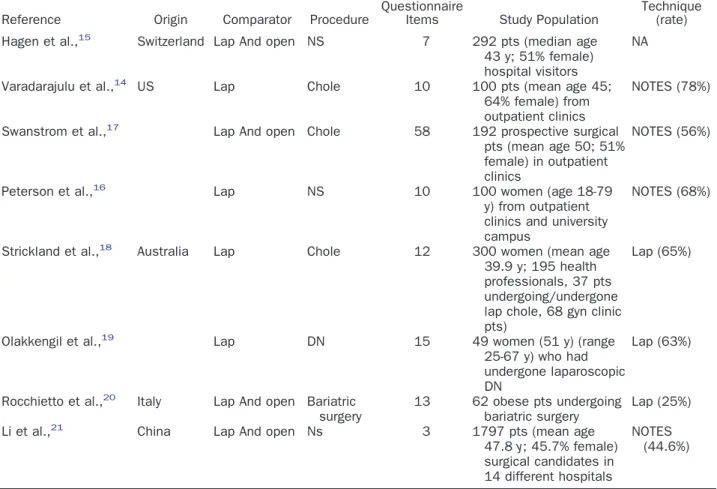
Most of the available studies were conducted on NOTES compared with laparoscopy (Table 1). Three
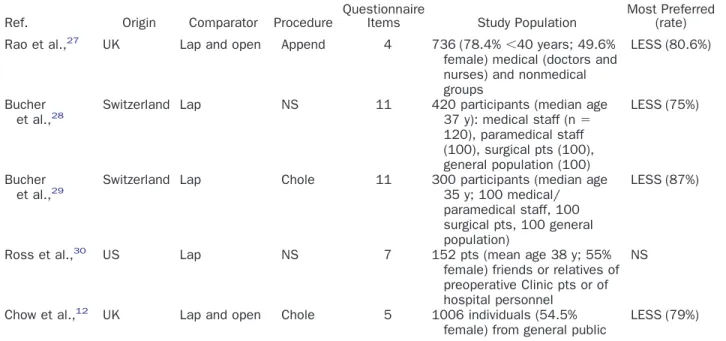
studies recently published in the urology literature looked at patients’ view on LESS (Table 2). More recent reports have taken into account both NOTES and LESS as “scarless” options; thus, comparative analyses have be-come available (Table 3).
COMMENT
Which Patients Would Prefer NOTES and Why?
Varadarajulu and colleagues performed the first study that specifically addressed the issue of patient preferences for NOTES. The authors evaluated patient perception of NOTES cholecystectomy by assessing their preference regarding the orifice for NOTES as well as the procedural risks they were willing to accept.14 This cross-sectional
survey of 100 patients included patients with an intact gallbladder who were undergoing evaluation for abdom-inal pain. Seventy-eight percent of the patients preferred NOTES, and the most common reasons for this prefer-ence were lack of external pain and lack of scarring. Young age, female sex, and prior endoscopy were associ-ated with a bias in favor of NOTES. Study limitations included selection bias, limited available information on NOTES that could be provided to patients, evaluation only in the setting of cholecystectomy, and lack of a validated questionnaire.
Table 1. NOTES techniques: patients’ preference and perception
Reference Origin Comparator Procedure
Questionnaire
Items Study Population
Preferred Technique (rate) Hagen et al.,15 Switzerland Lap And open NS 7 292 pts (median age
43 y; 51% female) hospital visitors
NA
Varadarajulu et al.,14 US Lap Chole 10 100 pts (mean age 45;
64% female) from outpatient clinics
NOTES (78%)
Swanstrom et al.,17 Lap And open Chole 58 192 prospective surgical
pts (mean age 50; 51% female) in outpatient clinics
NOTES (56%)
Peterson et al.,16 Lap NS 10 100 women (age 18-79
y) from outpatient clinics and university campus
NOTES (68%)
Strickland et al.,18 Australia Lap Chole 12 300 women (mean age
39.9 y; 195 health professionals, 37 pts undergoing/undergone lap chole, 68 gyn clinic pts)
Lap (65%)
Olakkengil et al.,19 Lap DN 15 49 women (51 y) (range
25-67 y) who had undergone laparoscopic DN
Lap (63%)
Rocchietto et al.,20 Italy Lap And open Bariatric
surgery
13 62 obese pts undergoing bariatric surgery
Lap (25%)
Li et al.,21 China Lap And open Ns 3 1797 pts (mean age
47.8y; 45.7% female) surgical candidates in 14 different hospitals
NOTES (44.6%)
In a similar fashion, Hagen et al used a 7-item ques-tionnaire in structured interviews with hospital visitors.15
After a detailed explanation of terms used and of possible complications, groups of 10 participants were
sequen-tially asked questions concerning the importance of cos-metic results in abdominal surgery, satisfaction regarding existing scars, hypothetical acceptance of increased risk as a trade-off for the absence of scars, and other issues.
Table 2. LESS: patients’ views
Reference Origin Comparator Procedure QuestionnaireItems Study Population Main Study Findings
Lucas et al.,24 US Lap Kidney surgery 15 79 pts (median
age 54.8 y; 65% men) returning to clinic after transperitoneal laparoscopy
Cosmesis score increased in females, patients⬍50 y, and benign surgical indication.
LESS preferred in 30.4% vs lap in 39.2%
Concern for cosmesis associated with LESS preference
Olweny et al.,25 US Lap and open Kidney surgery 4 90 pts (mean age
51.1 y; 44.4% male)
scheduled for kidney surgery
“Surgeon reputation” and “no complications” most important factors Score for “size/number of
scars” significantly higher for the LESS cohort before surgery, but nonsignificant after surgery
Score for “size/number of scars” before surgery significantly higher for younger and nononcology patients
Benesath et al.,26 US Lap and open Chole 5 125 women
(mean age 31.4 y) who underwent lap chole
⬍50% of pts remembered the number of incisions -65.5% cited the umbilical site as the most painful -68.6% would have preferred
to eliminate an incision (63% of them choosing to eliminate the umbilical incision)
Abbreviations as in Table 1.
Table 3. NOTES vs LESS: comparative views
Ref. Origin Comparator Procedure
Questionnaire
Items Study Population
Most Preferred (rate)
Rao et al.,27 UK Lap and open Append 4 736 (78.4%
⬍40 years; 49.6% female) medical (doctors and nurses) and nonmedical groups
LESS (80.6%)
Bucher
et al.,28 Switzerland Lap NS 11 420 participants (median age37 y): medical staff (n
⫽
120), paramedical staff (100), surgical pts (100), general population (100)
LESS (75%)
Bucher
et al.,29 Switzerland Lap Chole 11 300 participants (median age35 y; 100 medical/
paramedical staff, 100 surgical pts, 100 general population)
LESS (87%)
Ross et al.,30 US Lap NS 7 152 pts (mean age 38 y; 55%
female) friends or relatives of preoperative Clinic pts or of hospital personnel
NS
Chow et al.,12 UK Lap and open Chole 5 1006 individuals (54.5%
female) from general public
LESS (79%)
Findings from this survey demonstrated that cosmetic results are an important and perhaps co-dominant issue among healthy individuals.
Peterson and colleagues focused on what concerns women would have, as well as what they perceive as incentives to having NOTES.16An anonymous,
10-ques-tion, validated survey was distributed to 100 women. Notably, 68% indicated that, assuming an equivalency between laparoscopic and transvaginal procedures, they would prefer the transvaginal approach. Reasons to con-sider transvaginal procedures were cosmetic/aesthetic ones, minimizing the risk of hernia formation, and de-creased pain. There was no difference in the percentage of women who would choose a NOTES approach over laparoscopy based on age or parity. Nulliparous women would also more often consider transvaginal surgery for cosmetic/aesthetic benefits. Perceived benefits of the NOTES approach appeared to be minimization of hernia formation and pain, as well as optimization of cosmesis. Limitations of this survey were the relatively small sam-ple size and the narrow focus group.
Swanstrom et al created a 58-item survey instrument to assess patient attitudes toward NOTES using NOTES cholecystectomy as the index procedure. In this study, surgical patients seen in 2 busy gastrointestinal surgical clinics were evaluated.17 Subjects reported the risk of
having a complication, recovery time, and the amount of postoperative pain to be of greater importance than the length of hospital stay, anesthesia type, cosmesis, or cost. NOTES was perceived to be associated with less pain, cost, risk of complications, and recovery time, but it required more surgical skill. Fifty-six percent of the pa-tients reported that they would opt for a NOTES ap-proach. Patients older than 70 years and those who had undergone previous flexible endoscopy were less likely to select NOTES.
From Australia, Strickland et al investigated the opin-ions of female patients and health care workers at a teaching hospital.18In their study, 300 individuals were
surveyed, including 195 health professionals, 37 patients who were undergoing or had recently undergone laparo-scopic cholecystectomy, and 68 gynecologic clinic pa-tients. The results suggested that the compelling incen-tive for NOTES, namely the absence of abdominal scars, might not be such an important factor for many patients. The majority (66%) of respondents were not concerned about the scars caused by surgery. However, as expected, younger respondents were more concerned with cosmetic issues. When given the option of an operation not caus-ing scars, scarcely more than half of the individuals surveyed responded positively, although this response decreased significantly with increasing age. These find-ings appear to be in contrast to those obtained from previously conducted investigations, all of which were conducted in the United States.14,16,17 Australian women therefore appear to be less convinced about the potential benefits of NOTES procedures than their
American counterparts. This may be a result of cultural differences but a more likely explanation stems from public awareness and perception of the technique.
In another study from the same multidisciplinary Aus-tralian group, a 15-point questionnaire was administered to women who had previously undergone laparoscopic
donor nephrectomy.19 Participants were asked their
thoughts on a transvaginal approach for this procedure. Although the majority (90%) of these women did not have adverse feelings toward scars, 37% stated that they would consider a transvaginal NOTES donor nephrec-tomy. However, this figure was increased to 51% if the patients could be reassured that NOTES was as safe as standard laparoscopy.
Given the potential dovetailing role that NOTES could play in bariatric surgery, Rocchietto et al carried out a study with the aim of investigating female bariatric patients’ opinions about NOTES.20Overall, 62 patients (mean body mass index 45.3 kg/m2) entered the study.
The risk of complications was classified as the most important factor by 87.1% of patients. Postoperative pain, hospital length of stay, recovery time, and cosmetic result were classified as most important by 19.4%, 4.8%, 16.1%, and 16.1% of patients, respectively. A total of 74.2% of patients stated that even with knowledge of NOTES, they would still prefer a traditional surgical approach. None of the patients would accept an increase in complication rates in favor of a better cosmetic out-come. Among those agreeing to a NOTES approach, 22.2% would undergo it for an aesthetic purpose, 88.9% to minimize the risk of incisional hernias, and 94.4% to reduce postoperative pain.
In the largest reported survey on this topic, Li et al investigated the preference for scarless surgery among Chinese patients.21Overall, 1797 surgical candidates for
What Do Physicians Think About NOTES?
For NOTES to advance and become a mainstream surgical procedure, it will need to be accepted and embraced by both patients and physicians. Thus the understanding of physician perceptions of NOTES is also important to help guide the trajectory of research efforts and the allocation of research and development funding. Two studies have investigated surgeons’ percep-tions of NOTES.
Thele et al assessed physician attitudes regarding trans-vaginal access to the abdominal cavity within the gyne-cologic community.22 A questionnaire was sent to 181
gynecologic departments in Germany, Austria, and Swit-zerland. Fifty-two questionnaires were returned (response rate 28.7%). The transvaginal approach was classified as medically acceptable by 69.2% of the respondents, whereas the other 30.8% considered it experimental. Only 32.7% of respondents considered NOTES transvag-inal access a suitable approach for intraabdomtransvag-inal sur-gery, and the vast majority of respondents indicated pa-tients over the age of 50 to be most suitable for this approach. With identical operative risks, only 28.8% of the respondents would suggest transvaginal NOTES to their patients. Regarding potential complications, 73.1% were concerned about the risk of infection/peritonitis, whereas 61.5% feared visceral lesions and 44.2% worried about the risk of infertility after transvaginal NOTES. Regarding potential long-term sequelae after NOTES transvaginal surgery, respondents were most concerned with dyspareunia and infertility. On the basis of the aforementioned responses, it appears that the plurality of gynecologists perceive NOTES transvaginal access and surgery to be best confined to women who are past the reproductive age and/or are no longer sexually active.
Volckmann et al conducted an opinion survey of sur-geons from 3 major surgical societies.23A 75-item survey
was completed electronically by 357 members of the Society for Surgery of the Alimentay Tract, Society of American Gastrointestinal and Endoscopic Surgeons (SAGES), and American College of Surgeons. In decid-ing on a surgical approach, the risk of a complication was the most important consideration. Further, the risk of a complication, recovery time, degree of postoperative pain, and length of stay were each felt to be to be more important than cosmesis, cost, or anesthesia type. When NOTES was compared independently with laparoscopy and laparotomy, it was felt to require significantly greater technical skill and to be associated with less pain, shorter recovery, higher costs, and an increased risk of compli-cations. Seventy-two percent of these surgeons expressed an interest in becoming trained in NOTES. Stepwise logistic regression analysis of physician characteristics showed that age less than 60, minimally invasive surgery specialization, and SAGES membership correlated signif-icantly with increased interest in NOTES training. Only 3% would still prefer NOTES if the complication rate was significantly higher (10% vs 1%). Among the 56% of
surgeons who would not prefer to perform cholecystec-tomy by NOTES, 88% indicated that they would change to a NOTES approach if data demonstrated improved outcomes vs laparoscopy. However, when surgeons were asked whether they would choose to personally undergo NOTES, having these data available, only 26% of them opted for NOTES.
What Are Patients’
Explicit Concerns About NOTES?
In multiple studies, safety and efficacy represented the most common reasons for patients to prefer laparoscopy as opposed to NOTES.14,17,19,21 In the previously cited
study by Peterson et al, most women who were unwilling to undergo transvaginal surgery were most concerned with the potential for infectious complications. Not sur-prisingly, young and nulliparous women were more often concerned about dyspareunia and fertility after transvag-inal surgery.16In the study by Rocchietto et al, 83.9% of
patients stated that they were concerned about the
post-operative infection rate related to NOTES.20 Among
younger patients, all reported concerns about NOTES’ effects on their sexual activity and the potential risk of dyspareunia. Moreover, the influence of NOTES on fu-ture fertility was considered very important for 85.7% of the nulliparous women who were surveyed. When asked about the reason they would refuse a NOTES procedure, 9.7% indicated that it is too dangerous, 83.9% indicated a lack of defined benefits, and 6.5% declared that they were not interested in it. None of the patients would accept an increased risk of surgical complications for a better cosmetic result.
What Would Be the Trade-off to Choose NOTES?
An interesting and important finding of the study by Varadarajulu et al addressed the specific risk-benefit trade-off inherent among newer technologies.14
Specifi-cally, among patients in the aforementioned survey who preferred NOTES, up to 99% demanded complication rates comparable with the standard of care—in this case laparoscopy. This preference for NOTES declined to 15% if the complication rate was twice that of laparos-copy, and it further declined to 6% if the complication rate was 3 times that for laparoscopy. These findings somewhat held true in the study by Hagen and col-leagues. An absolute complication rate of 10% was con-sidered acceptable among respondents if a total absence of scarring could be guaranteed. In keeping with similar findings, younger patients valued cosmesis more highly and were willing to accept an increased complication rate as a result.15Likewise, Swanstrom et al found that 80% of
What About LESS?
Lucas et al surveyed patients returning to clinic after transperitoneal laparoscopy.24Patients were first asked to
rate certain factors and how these factors affected their choice to pursue open surgery, laparoscopy, or LESS. Patients were likewise asked whether they preferred LESS or laparoscopy, assuming equivalence of outcomes. Re-spondents were thereafter asked their opinions on LESS, assuming comparative surgical naivety on the part of the operating surgeon, and how increased complication rates and/or surgical failure would affect their decision to pur-sue LESS. In the second survey, a validated cosmesis and body image impact survey was administered. The findings of the surveys were intriguing. First, surgical success and complications were considered the driving factors among patients. Pain and convalescence were of moderate im-port, wherea scars carried less importance. Postoperative cosmesis was valued more heavily among women, younger patients, and those with benign surgical indica-tions. Finally, the authors found a slight preference for laparoscopy (39%) compared with LESS (30%).
Olweny et al evaluated the importance of scarring in urology patients relative to other surgical outcomes.25
Patients scheduled for LESS, laparoscopic, or open kid-ney surgery were recruited for the study. Overall, 90 patients completed surveys. The LESS cohort was younger and more likely to be undergoing surgery for benign indications. Before surgery, the most important surgical consideration was “surgeon reputation” and the least important factors were “delay in resuming normal diet” and “size/number of scars.” After surgery, the most important considerations were “surgeon reputation” and “no complications,” whereas “size/number of scars” rep-resented the second least important consideration. Among the subset of patients who completed surveys both before and after surgery, there was no significant change in median scores for any of the outcomes except “duration of hospital admission.” The median score for “size/number of scars” was significantly higher for the LESS cohort before surgery, but there was no significant difference among the cohorts after surgery. The median preoperative score for “size/number of scars” was signifi-cantly higher for younger patients and those with benign surgical conditions. Overall, the authors demonstrated that, when compared with surgeon reputation or avoid-ance of complications, surgical scarring was a relatively unimportant outcome for most patients before and after undergoing kidney surgery. Younger patients and those undergoing surgery for benign indications ranked scarring higher than older patients and those with oncologic indications before surgery, but these differences were nonsignificant after surgery. The primary study limitation was a response bias given that patients had decided on a particular surgical approach before completion of the study.
In the nonurology field, Bencsath et al reported a study intended to determine whether single-incision
ap-proaches to laparoscopic cholecystectomy might be de-sirable to patients.26 Of 281 eligible patients, 125 were successfully contacted and consented to inclusion (44.5% response rate). Only sixty patients (47.2%) correctly recalled the exact number of incisions. The primary find-ing of the study was that patients appear interested in reducing the number of incisions. Not unexpectedly, pain seemed to be a motivating factor because an overwhelm-ing majority of patients who identified one incision as most painful were interested in eliminating that same incision.
NOTES versus LESS: Comparative Analysis
Rao et al were the first to evaluate both NOTES and LESS and the potential competitive role of these ap-proaches.27A hypothetical scenario was then presented
to respondents in which the necessity for an emergent appendectomy was defined. Overall, only 34.4% of the participants felt comfortable using newer surgical tech-niques. Overall, LESS was the preferred choice (80.6%) of surgical technique for an appendectomy. The authors speculated that LESS may be more acceptable because it is an adaptation of an already established surgical tech-nique (laparoscopy) that offers a virtually scarless appear-ance. Conversely, NOTES was considered a completely novel technique without proven benefit. Moreover, pa-tients were hesitant to undergo transvisceral access. Sec-ondary findings included physician preference for open surgery, especially compared with nurses and nonmedical personnel. Nurses favored laparoscopic surgery more than doctors and the nonmedical group, whereas the nonmed-ical group favored LESS more than nurses and doctors. The authors concluded that medical professionals might appreciate the difficulties of any new surgical technique and therefore be hesitant to proceed in this manner. With respect to age, a surprising finding was a preference for LESS in⬎30% of patients over the age of 60 years. Thus, one should not assume that only the young are interested in these emerging techniques.
Chow et al conducted a questionnaire-based study among 1006 individuals from the general public.12
Ques-tions were asked regarding preference for surgical tech-niques, including open surgery, laparoscopic surgery, NOTES, and LESS in the situation of acute appendicitis. The authors elected to focus on the scenario of emergent appendicitis because patients in this situation typically have a limited time frame during which to consider their treatment options. The vast majority of respondents cited safety as the paramount factor in choosing a surgical approach. Only 37.9% of patients stated they would be comfortable undergoing a new procedure without an es-tablished safety profile. If all safety profiles were reported as equal, most participants reported a preference for LESS and only 20.7% of patients preferred NOTES. Moreover, transvaginal NOTES was considered an unpopular surgi-cal approach.
their expectations for surgical treatment and their ap-proach preference.28 Again, the main concern of the
survey responders was the risk of surgical complications (92%). When asked about the relative importance of different parameters, cure was placed first by 74%, safety by 33%, and cosmesis by only 3%. By assuming a similar operative, 90% of the participants preferred a scarless approach (75% preferred LESS and 15% NOTES) to laparoscopy and this preference was significantly higher among the younger participants. A decreasing trend of preference for LESS and NOTES was observed with increased procedural risks. Thus, despite safety represent-ing the first concern among patients, the importance of cosmesis is not neglected. NOTES was preferred by only 15% of participants, which may contradict previously reported surveys.14,15,17,19In all of these studies, NOTES was offered as the sole scarless option to laparoscopy, and population acceptance of LESS was not investigated. In the following survey, the authors focused their attention on a specific procedure, ie, cholecystectomy.29With sim-ilar operative risk, 87% preferred LESS, 4% NOTES, and 8% laparoscopy. LESS/NOTES choice was influenced by a desire of improved cosmetics and lower pain. Ninety-six percent had concerns regarding the transvaginal access, including dyspareunia, decreased sensibility during inter-course, short-term sexual abstinence, and infertility. By contrast, the most frequent concerns about the transum-bilical access were umtransum-bilical pain, postoperative umbili-cal sensibility, and incisional hernia. Postoperative inter-course abstinence after transvaginal NOTES elicited worry in 76% of responders. As previously reported,18
concerns related to sexual function and fertility must be taken into account when dealing with a female popula-tion.
Finally, Ross et al sought to evaluate public percep-tions of LESS and NOTES, including factors that may influence decision making.30A validated 7-item tool, as
well as a visual analog scale, were administered. Most adults were unwilling to undergo LESS if it was associated with additional surgical risk compared with standard op-erative approaches. Participant body image satisfaction was the only variable that was reported as a compelling justification for LESS. With regard to NOTES, nearly one third of participants were willing to undergo NOTES rather than conventional “open” or laparoscopic opera-tions, which is different from previously reported find-ings.16
CONCLUSIONS
Based on the results of our literature analysis, patients demonstrate a modicum of interest in scarless surgical approaches, with a preference for LESS over NOTES. We speculate that reasons for this preference might in-clude the newness of NOTES as a concept, whereas LESS can be somehow regarded as an evolution of laparoscopy. Moreover, different cultural backgrounds and geographic
origins influence the patients’ perspectives and expecta-tions about scarless surgery.
Because most patients still cite safety and efficacy as the most important factors in their decision making, surgeons must be honest and balanced when offering conventional vs investigational treatment options. Cer-tainly, there is a need for objective, multicenter outcomes that specifically address the safety and reproducibility of LESS and NOTES. With such information in hand, and with improved educational efforts, patients and physi-cians alike may feel comfortable in the widespread appli-cation of scarless surgery.
References
1. Kerbl DC, McDougall EM, Clayman RV, et al. A history and evolution of laparoscopic nephrectomy: perspectives from the past and future directions in the surgical management of renal tumors. J Urol. 2011;185(3):1150-1154.
2. Skolarus TA, Zhang Y, Hollenbeck BK. Robotic surgery in urologic oncology: gathering the evidence.Expert Rev Pharmacoecon Out-comes Res. 2010;10(4):421-432.
3. Patel HR, Linares A, Joseph JV. Robotic and laparoscopic surgery: cost and training.Surg Oncol. 2009;18(3):242-246.
4. Autorino R, Haber GP, Stein RJ, et al. Laparoscopic training in urology: critical analysis of current evidence. J Endourol. 2010; 24(9):1377-1390.
5. Gettman MT, White WM, Aron M, et al. Where do we really stand with LESS and NOTES?Eur Urol. 2011;59(2):231-234. 6. Kaouk JH, Autorino R, Kim FJ, et al. Laparoendoscopic single-site
surgery in urology: worldwide multi-institutional analysis of 1076 cases.Eur Urol. 2011;60(5):998-1005.
7. Autorino R, Cadeddu JA, Desai MM, et al. Laparoendoscopic single-site and natural orifice transluminal endoscopic surgery in urology: a critical analysis of the literature.Eur Urol. 2011;59(1): 26-45.
8. Gettman MT, Lotan Y, Napper CA, et al. Transvaginal laparo-scopic nephrectomy: development and feasibility in the porcine model.Urology. 2002;59:446-450.
9. Lima E, Rolanda C, Pêgo JM, et al. Transvesical endoscopic peri-toneoscopy: a novel 5 mm port for intra-abdominal scarless surgery. J Urol. 2006;176:802-805.
10. Kaouk JH, Haber GP, Goel RK, et al. Pure natural orifice translu-menal endoscopic surgery (NOTES) transvaginal nephrectomy. Eur Urol. 2010;57:723-726.
11. Schirmer BD, Dix J. Cost effectiveness of laparoscopic cholecys-tectomy.J Laparoendosc Surg. 1992;2:145-150.
12. Chow A, Purkayastha S, Dosanjh D, et al. Patient reported out-comes and their importance in the development of novel surgical techniques.Surg Innov. 2011 [Epub ahead of print].
13. Rane A, Autorino R. Robotic natural orifice translumenal endo-scopic surgery and laparoendoendo-scopic single-site surgery: current status.Curr Opin Urol. 2011;21(1):71-77.
14. Varadarajulu S, Tamhane A, Drelichman ER. Patient perception of natural orifice transluminal endoscopic surgery as a technique for cholecystectomy.Gastrointest Endosc. 2008;67(6):854-860. 15. Hagen ME, Wagner OJ, Christen D, et al. Cosmetic issues of
abdominal surgery: results of an inquiry into possible grounds for a natural orifice transluminal endoscopic surgery (NOTES) ap-proach.Endoscopy. 2008;40(7):581-583.
16. Peterson CY, Ramamoorthy S, Andrews B, et al. Women’s positive perception of transvaginal NOTES surgery. Surg Endosc. 2009; 23(8):1770-1774.
18. Strickland AD, Norwood MG, Behnia-Willison F, et al. Transvag-inal natural orifice translumenal endoscopic surgery (NOTES): a survey of women’s views on a new technique.Surg Endosc. 2010; 24(10):2424-2431.
19. Olakkengil SA, Norwood MG, Strickland AD, et al. Perspectives of laparoscopic donors toward a new procedure: transvaginal donor nephrectomy.J Laparoendosc Adv Surg Tech A. 2010;20(10):803-806.
20. Rocchietto S, Scozzari G, Arezzo A, et al. Obese women’s percep-tion of bariatric trans-vaginal NOTES.Obes Surg. 2012;22(3):452-459.
21. Li W, Xu H, Wang ZK, et al. Natural orifice translumenal endo-scopic surgery (NOTES): patients’ perceptions and attitudes.Dig Dis Sci. 2011;56(8):2415-2422.
22. Thele F, Zygmunt M, Glitsch A, et al. How do gynecologists feel about transvaginal NOTES surgery? Endoscopy. 2008;40(7):576-580.
23. Volckmann ET, Hungness ES, Soper NJ, et al. Surgeon perceptions of natural orifice translumenal endoscopic surgery (NOTES). J Gastrointest Surg. 2009;13(8):1401-1410.
24. Lucas SM, Baber J, Sundaram CP. Determination of patient con-cerns in choosing surgery and preference for laparoendoscopic
single-site surgery and assessment of satisfaction with postoperative cosmesis.J Endourol. 2011 [Epub ahead of print].
25. Olweny EO, Mir SA, Best SL, et al. Importance of cosmesis to patients undergoing renal surgery: a comparison of laparoendo-scopic single-site (LESS), laparolaparoendo-scopic and open surgery.BJU Int. 2011 [Epub ahead of print].
26. Bencsath KP, Falk G, Morris-Stiff G, et al. Single-incision laparo-scopic cholecystectomy: do patients care?J Gastrointest Surg. 2012; 16(3):535-539.
27. Rao A, Kynaston J, MacDonald ER, et al. Patient preferences for surgical techniques: should we invest in new approaches? Surg Endosc. 2010;24(2):3016-3025.
28. Bucher P, Pugin F, Ostermann S, et al. Population perception of surgical safety and body image trauma: a plea for scarless surgery? Surg Endosc. 2011;25(2):408-415.
29. Bucher P, Ostermann S, Pugin F, et al. Female population percep-tion of convenpercep-tional laparoscopy, transumbilical LESS, and trans-vaginal NOTES for cholecystectomy. Surg Endosc. 2011;25(7): 2308-2315.