ADVANCES
IN PEDIATRICS
AND CHILD
CARE IN CUBA,
1959~1974l
Ralil River& Corteguera, M.D.; 2Helenio Ferrer Garcia, M.D.;3 and Francisco Vald& Laze, M.D. 4
Childhood mortality in Cuba has declined considerably sznce 1959. The present article describes key health activities which have helped to bring about this change.
Introduction
Before the Revolution, Cuban Medicine confronted many obstacles in seeking to solve the country’s fundamental health problems. That is, a kind of medical practice making relatively little social contribution operated through a health service structure of limited and poorly endowed state and parastate institutions on the one hand, and private or cooperative agencies working essentially for profit on the other.
Health professionals, including pediatri- cians, devoted most of their time to private practice, since the compensation received for public health service work was very low. Pediatric care was primarily curative, preven- tive measures generally being adopted only to control epidemics (I).
There were insufficient pediatric beds anywhere in the country, and most of the existing ones were concentrated in Havana.
‘A slightly condensed version of the Spanish text “Avarices en pediatria y atencidn infantil en Cuba (1959.1974)” published in the B&tin de [a Oficim
Sanital-ia Panamericana, Volume LXXX, No. 3, March 197.6, pp. 187.204.
‘Secretary, National Pediatrics Group, Public Health
Ministry of Cuba.
“National Director of Epidemiology, Public Health MFistry of Cuba.
Chief, Province Pediatric Group, La Habana, Cuba.
Thus the nation’s second-largest city, Santia- go de Cuba, had only one small children’s hospital (with 48 beds) and only one children’s ward (in the Saturnino Lora Hospital). There were no hospitals in the rural areas, and hospitals in urban zones invariably lacked medicaments and the most basic working conditions needed to provide adequate pedi- atric care (2). As a consequence, communi- cable diseases and gastroenteritis, together with intestinal parasitism and malnutrition, were very prevalent among children.
Even though there was no reliable system for registering vital statistics (births and deaths generally going unrecorded in rural areas), it is clear that less than 40 per cent of all births were taking place in health institutions. Much of the population was illiterate, conditions of public health and hygiene were extremely poor, and there was insufficient vaccination to immunize the whole child population. Together, all these things created a somber outlook for the Cuban child.
Background
In 1959 a National Health System was established. This System was foended on the following basic principles:
l The health of the people should be a re-
sponsibility of the State.
l Health services should be available to all. l The community should play an active part
in health programs.
l Health services should have integrated
preventive and curative functions.
l To establish new schools of nursing and to
train nursing auxiliaries.
All cooperatively operated hospitals and clinics were placed within the Health System, and gradually the private hospitals and clinics were included as well. The system also took in
new rural hospitals and medical centers, along with new hospitals and polyclinics in Havana and other parts of the country, as they came into being (3). A Rural Social Medical Service, established by Law 723 in January 1960, paved the way for extending
medical care to the rural population (4). In 1960 a Maternal and Child Health Department was established within the Minis- try of Public Health and regulation of pediatric care was begun. This new depart- ment, in close cooperation with the Depart- ment of Pediatrics of the Havana University School of Medicine, was assigned the job of supervising and setting standards for all pediatric care. Gradually, similar depart- ments were established in the provinces.
By the end of 1961 the structure of the Ministry of Public Health had been defined, and regional directorates and health districts (later changed to regional and provincial directorates) had been created.
Among the health goals set forth in this initial period were the following:
l To increase the number of consultations
in prenatal care, childrearing, and gen- eral pediatrics, and to carry out public health education campaigns and pro- grams of systematic vaccination, with em- phasis on the vaccination of children. a To create a specialized pediatric intern-
ship.
While many other related objectives were also sought in this period, those listed were the most important ones pursued ( 5) .
In 1962 Cuba established a new system of residencies. This system enabled medical school graduates to pursue studies in various specialized areas after completing their period of rural medical service. That same year saw the activities of community organizations incorporated into the work of the Ministry of Public Health, as well as implementation of Cuba’s first national poliomyelitis vaccination campaign. At about the same time a campaign against acute diarrhea1 disease was begun. Based on educational measures, improvement of sanitary conditions, and more efficient provision of medical services, this latter program brought about funda- mental changes in child care. Taken together, all of these activities contributed to the eventual reduction of infant mortality in Cuba.
l To strengthen pediatric care in rural
areas.
a To increase the number of pediatric and obstetric beds, especially for those pro- vinces most in need.
l To increase the proportion of babies born
at health institutions and to encourage breast-feeding.
In the years that followed, these programs were consolidated and their effects were increasingly felt. The structure of the Health Ministry’s Department of Pediatrics was gradually extended, and in early 1968 a National Pediatric Group and provincial groups were set up. This provided a mechanism for including the most highly qualified pediatric specialists within the Health System, and for providing them with leadership responsibilities in health work relating to regulation, supervision, guidance, and evaluation of all pediatric matters (6, 7).
l To create more neonatology services out-
side the capital and to improve existing
ones. I- -~~--- 1
In 1958 the only facilities for training nediatric uersonnel in Cuba were the Reina
Corteguera, et al. l ADVANCES IN PEDIATRICS AND CHILD CARE IN CUBA 11
Mercedes, Municipal de Infancia, and Calix- to Garcia hospitals, where pediatrics was taught to medical students. Medical intern- ships also existed, but they involved no commitment on the part of the intern to become a specialist in this field.
The Havana Medical School was the only one in the country until 1962, when the Oriente University School of Medicine was founded. A system of internships and residencies, later extended to the provincial capitals, was instituted that same year in Havana, and this necessitated broadening the areas of pediatric instruction. At that point, in view of the medical student’s primarily theoretical preparation, a final year of internship was added so as to better enable graduates to carry out their duties in the rural medical service.
In 1966 the Las Villas School of Medicine was created and clinical teaching units were established in the towns of Holguin, Cama- giiey, Matanzas, and Pinar de1 Rio. The Camagiiey School of Medicine was established in 1972 (8).
Besides producing more general pediatri- cians, attention has been given to preparing related specialists-including neonatologists, child psychiatrists, and pediatric surgeons, nutritionists, allergists, cardiologists, endocri- nologists, and gastroenterologists.
In addition, an Advanced Medical Studies Directorate established in 1973 has been conducting a course program designed to provide refresher training in both general pediatrics and pediatric specialties to gradu- ate personnel. This advanced training is supplemented with continuing education pro- vided by the National Medical Sciences Information Center, which sends out booklets and periodicals to specialists throughout the country (9).
At the present time (see Figure 1) a Pediatric Specialist, Grade I, is required to devote at least five years to pediatrics (one year of internship, two in the rural medical service, and two of residency). This total will soon become six years, since the length of
FIGURE 1 - Prefiaration of a grade I medical specialist in pediatrics.
PrlmorY rrhoo, _ ,6 leO.,,
Klndergorten 11 Y-04 Source: Education Directorate, Public Health Ministry of Cuba.
national social service in rural areas has been increased to three years.
A new program relating to pediatric residencies received a good deal of attention in 1974, and it appears that the length of these residencies may be increased. Until now, however, preparation of specialists has been slow, an average of 30 to 40 being graduated per year. Therefore, there is also a need to increase the number of graduates. According- ly, current plans call for increasing the& number substantially over the next four to five years.
Twelve pediatric teaching hospitals-five in in Havana, two in Santiago de Cuba, and one in each provincial capital-are now available for training pediatric personnel. These hospitals have a total of approximately 4,500 pediatric beds, 500 of which are devoted to neonatology and instruction in this specialty.
The total number of physicians, including pediatricians, has increased since 1959, despite a large exodus of doctors in the first years after the Revolution. As shown in Figure 2, Cuba had 1,181 pediatricians in 1974, of whom 28.5 per cent were specialists, 33.5 per cent were general practitioners working exclusively in pediatrics, 17.0 per cent were residents, and 21.0 per cent were medical school graduates.
12 PAHO BULLETIN b Vol. X, No. 1, 1976
FIGURE 2 -Physicians of Cuba in pediatric practice, 1974.
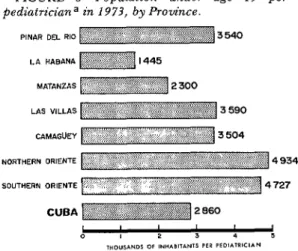
under 15 (that is, 3.5 for every 10,000 children). At present, approximately 14.2 per cent of all physicians are engaged in the practice of pediatrics. A current objective is to have one pediatrician for every 1,800 children by 1980 (8).
In 1974 a pilot study was begun at the Alamar Polyclinic in Havana relating to the role of the physician (including the pediatri- cian) in the community. Current plans call for extending community pediatric services na- tionwide in the near future, so as to hopefully e’nable one pediatrician to provide coverage for 900 to 1,000 children.
In addition, pediatric nurses and nursing auxiliaries have also been trained. These personnel were generally unavailable before the Revolution. As of 1974 there were 685 pediatric nurses and 5,029 pediatric nursing auxiliaries serving pediatric and maternity hospitals, polyclinics, and child care institu- tions. The ratio of nursing personnel to pediatric beds at children’s hospitals was 34.8 to 100; there are plans for raising this to 40.0 over the next few years. At the present time, graduate courses in’teaching and neonatology for pediatric nurses provide a vehicle for continuing improvement in the preparation of these personnel.
There were 20 pediatric hospitals in Cuba in 1974, including 12 teaching hospitals. These were supplemented by 27 maternal and child hospitals, 24 maternity hospitals with neonatology services (among them 12 teach-
FIGURE 3-Population under age 15 per pediatrician a in 1973, by Province.
PINAR DEL RIO 3540
LA HABANA
MATANZAS
LAS VILLAS 3 590
CUBA 2660
“Including medical graduates, residents, and general practitioners working in pediatrics, as well as pediatric specialists.
Source: National Statistics Directorate, Public Health Ministry of Cuba.
ing hospitals), and 15 general regional hospitals with pediatric services (10).
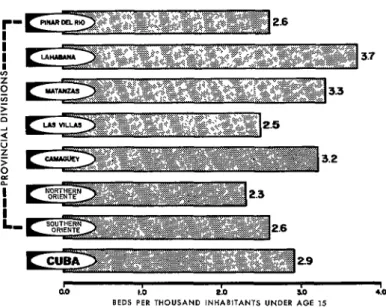
In all there were 9,620 pediatric beds as of 1973, constituting 23.5 per cent of all hospital beds. This means there were 1.1 pediatric beds for 4 every 1,000 inhabitants, and 2.9 for every 1,000 children under age 15. Over half of these beds (54.2 per cent) were in pediatric hospitals. These figures do not include the beds for normal newborns or those at nutri- tional recovery centers or homes for the handicapped. The bed-to-child ratio is still considered too low in certain provinces, but eight hospitals were being built in 1975 and another 49 were scheduled for construction in 1976-1980. It is expected that this extensive building program will lead to creation of 4,320 new pediatric beds. The intended uses assigned to the beds available for general clinical pediatrics in 1973 are shown in Figure 4.
Corteguera, et al. l ADVANCES IN PEDIATRICS AND CHILD CARE IN CUBA 13
FIGURE 4-Distribution of pediatric beds in 1973, by intended use.
Source: National Statistics Directorate, Public Health Ministry of Cuba.
FIGURE 5-Distribution of pediatric beds in 1973, by Province.
Source: National Statistics Directorate, Public Health Ministry of Cuba.
for the differences in these ratios to be reduced (10).
Other important resources are pediatric and child care clinics, which have been planned for all 332 of the nation’s health areas. 5 To measure the advances made in this
endeavor, it is sufficient to note that in 1962 there were only 161 polyclinics, and that by 1973 there were 3.26. An additional 110
14 PAHO BULLETIN l Vol. X, No. 1, 1976
polyclinics (98 comprehensive and 12 special- ized) are scheduled for construction in 1976-1980.
Improvements have also been made in the equipment provided at pediatric and mater- nity hospitals, including that used in neona- tology, pathological anatomy, radiology, and clinical laboratory work. This has contributed to better child care. For the future, substantial improvements are to be sought in the milk banks of many pediatric hospitals, and research activities at most pediatric services will be making increased use of dark-field microscopy methods.
The Comprehensive Child Care Program
To help bring together and systematize all pediatric activities, a program of comprehen- sive child care was instituted in 1967. This program has sought “to promote the health of the population, assuring children a normal growth and development through public health activities (prevention, promotion, cure, and rehabilitation) regulated by the Ministry of Public Health and carried out in cooperation with community organizations.” (II, 12). The program’s basic objectives and activities are described on the pages that follow.
Early Enrollment of Newborns (Including Pathologic and Premature Infants) on Dis- charge from the Maternity
To ensure both enrollment in the program and adequate health care, the health team was integrated at the level of the maternity hospital and the health area, and action was taken to promote rational use of available medical and paramedical personnel. Provi- sion was also made for suitable scheduling of shifts in the health areas and for having the pediatric registration card and discharge record delivered by the maternity to the polyclinic. In addition, a close working relationship was established between the
maternity hospital and the corresponding health region or polyclinic. Together, these measures led to scheduled and orderly referral of newborns to child care clinics as well as follow-up of premature or pathological infants.
Coordination was also improved by notify- ing the appropriate health area or region when a newborn infant was discharged or when a premature infant was kept on at the hospital. In the latter case, the notification enables health area personnel to arrange for a visit to observe conditions in the child’s home, to prepare an epidemiologic record when needed, and to send this to the maternity, which endeavors to make the discharge of the premature infant contingent on the report received (11, 13).
Promotion of Breast-Feeding
Breast-feeding is encouraged at the mater- nity. In addition, banks of mothers’ milk have been established for use in feeding newborns and premature infants.
Child Care Clinics
Facilities for examining healthy children are provided within the program by child care clinics. The entire health team, supported by community organizations ( i.e., The Federa- tion of Cuban Women, Committees for the Defense of the Revolution, farmers’ associa- tions, and trade unions), conducts educa- tional and other activities designed to promote attendance at these clinics. A basic premise underlying the work of these clinics is that babies should be examined up to seven times in their first year, preschool children should be examined three times a year, and schoolchildren should be examined at least once a year (10, 11, 14).
Corteguera, et al. . ADVANCES IN PEDIATRICS AND CHILD CARE IN CUBA 15
each clinic the physician establishes the guidelines in effect for this type of activity and records salient data on the child’s pediatric card.
Follow-up examination of premature in- fants or pathological newborns has in many cases been decentralized to the health areas, even though in selected cases such examina- tions are still provided at the maternity (14). A key ingredient of these follow-up examina- tions has been effective nursing care-pro- vided through regular home visits as well as special visits to mothers who have failed to bring their children to the clinic. Health education is provided to the mother during these visits, along with training in such matters as personal and environmental hygiene and child bathing and feeding. Community organizations cooperate in this control and follow-up work, all of which is supplemented by visits to the physician at the clinic, as previously described.
Control of Malnourished Infants
Malnourished children constitute a high health-risk group. It is necessary to provide special consultations and examinations for such children, including, if needed, efforts to secure their admission to nutritional recovery homes.
As in the case of premature infants, there are plans for malnourished children to receive home visits from members of the health team (11, 13). These visits should be made once a month if the child is under one year of age. There are also plans for the health areas to arrange educational discussion groups for mothers at their places of work and at community centers (15). At present, com- munity organizations in each health area help to find cases of malnourishment and to notify appropriate health personnel. In addition, pediatric hospitals and services report on the children they discharge who are suffering from any form of malnutrition.
Care of School and Preschool Children Diseases of school and preschool children are diagnosed and treated at outpatient clinics. Should appropriate treatment be unavailable in the health area, the clinic will refer the case to a specialized center for study and will arrange for hospital admission. In each area appropriate vaccinations are prescribed and supervised, and mothers are provided with information on prevention of dental caries and early correction of dental anomalies. Caries prevention is also pro- moted, ifl accord with a program begun several years ago, by having the children at all primary schools rinse their mouths with sodium fluoride (16). As in the case of newborns and infants, home visits are made in cases where there appears to be an unusual degree of health risk involved.
In addition, health education activities are carried out at the primary schools, under the supervision of a teacher who has received the necessary preparation in special courses forming part of his or her training curricu- lum.
Health recovery activities are also con- ducted in the schools. Such activities include care for handicapped children and, if appropriate, their referral to special schools after consultation with the Ministry of Education.
Supplementing these primary school activi- ties, rural secondary schools and regular secondary schools operating part of the year in the countryside perform health promotion, protection, and recovery functions (17). One example of the many significant activities of this kind is use of disodium chromoglycate by secondary schools in rural areas for the treatment of bronchial asthma.
Medical Visits to the Home
16 PAHO BULLETIN l Vol. X, No. 1, 1976
to all the provinces (18), and by the end of 1973 a total of 43,879 medical home consultations had been provided.
close coordination with the corresponding hospital service (I 7).6
Camps for Diabetic Children
Camps for Asthmatic Children
It is well-known that asthmatic children often make better use of the gains obtained through specialized treatment if they are temporarily removed from the home environ- ment. One reason is that this home environ- ment, including possible family frictions and other circumstances contributing- to the illness, strongly resists modification.
Recognizing this, the Ministry of Health became interested in establishing special centers where asthma patients could be removed from conditions aggravating their illness and where they could achieve a physical and psychological development pre- paring them for an essentially normal life. This led to creation of vacation camps for asthmatic children, which have operated since 1970 during the summer months in all of the provinces, in close collaboration with other agencies such as the Ministry of Education, the National Sports Institute, the Book Institute, the Cuban Art and Motion Picture Institute, the Union of Communist Youth, the Federation of Cuban Women, the National Cultural Council, and the Cuban Radio Broadcasting Institute.
Education about diabetes and regulation of physical activity are two key elements of diabetes mellitus treatment, the others being a low-glucose diet and provision of hypoglyce- mic medication. In recognition of the fact that camps could help in implementing the first two measures, camps for diabetic children have been created. These camps have operated continuously since 1969 with very positive results (20). Like the camps for asthmatic children, these camps are operated under the child care program in close coordination with other agencies.
Assistance to Pioneer Camps
Another important program activity has been to provide pediatric services to pioneer camps and national camps for schoolchildren, in close collaboration with the Cuban Pioneers Union.
Health Education
With a view to observing a selected group of these patients for a year and learning about their subsequent behavior, studies by psy- chologists and pediatricians have been carried out (19). In addition, because increased numbers of allergy consultations were cre- ating long waiting lists at area health centers, it was decided after careful analysis that it would be feasible to provide pediatricians with training in a number of matters relating to diagnosis, treatment, and follow-up of bronchial asthma cases. Such training is directed at establishing a system of asthma
This is an extremely important feature of the program and one that has achieved noteworthy results. The educational activities carried out include talks in polyclinic and hospital waiting rooms and at local centers of community organizations, holding of public health meetings, publication of posters and newspaper articles, and broadcast of televi- sion and radio messages.
Prevention of Communicable Diseases Prevention of communicable childhood disease is an area where the program, by
‘See A Rodriguez de la Vega, et al., Investigation of the prevalence and inheritance of bronchial asthma in San Antonio de 10s BaRos, Cuba. Bull Pan Am Health
Corteguera, et al. l ADVANCES IN PEDIATRICS AND CHILD CARE IN CUBA 17
stressing the need for comprehensive cover- age, has made important advances. Some of these are as follows:
BCG vaccination of newborns has been steadily and systematically increased, to the extent that in 1974 coverage was provided to over 90 per cent of all institution-born infants. (As of 1973, institutional births accounted for 98 per cent of all deliveries- I, 3.) This vaccination coverage, together with measures designed for early diagnosis and controlled ambulatory treatment of patients, reduced reported cases of tuberculosis in children from 418 in 1964 to 37 in 1973. Similarly, registered mortality from tubercu- losis dropped from 43 deaths in 1960 to two in 1973 (3, 21). No cases of tubercular meningoencephalitis were reported in 1972 or
1973.
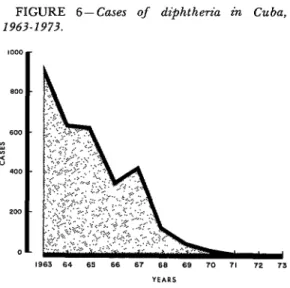
‘Diphtheria has been nearly eradicated as a result of the high immunity levels achieved in the young child population (see Figure 6).
The incidence of tetanus, which was always a serious health problem, has been substan- tially reduced by vaccination programs. Childhood morbidity dropped from 142 cases in 1964 to 25 in 1973, and neonatal tetanus has been eliminated. Eighty cases of neonatal
FIGURE 6-Cases of &$&the?-iu in Cuba, 1963-1973.
Source: National Statistics Directorate, Public Health Ministry of Cuba.
tetanus were reported in 1964, two in 1971, one in 1972, and none in 1973.
Approximately 62.1 per cent of all those less than one year of age received a DPT vaccination in 1973 (ZZ), as did about 30 per cent of all children in the l-5 age group. Overall, it is estimated that protection is being provided to approximately 70 per cent of all children nationwide.
Near eradication of poliomyelitis has been achieved. This disease used to be endemic, periodically causing outbreaks involving hun- dreds of cases. Now, as a result of vaccination campaigns begun in 1962 and repeated regularly every year, it no longer poses a significant health threat. Only five cases, spread over a variety of years and affecting only unvaccinated children, were detected from 1962 to 1973. Nevertheless, after each yearly vaccination drive, serum samples obtained throughout the country are analyzed at the virology laboratory of the National Institute of Hygiene, Epidemiology, and Microbiology to determine antibody levels. The surveys have shown progressively lower proportions of negative sera in all juvenile age groups and progressively higher proportions (recently about 80 per cent) resistant to all three types of poliovirus (23). The detailed results of these surveys are used to determine which specific age groups will require initial or booster vaccinations the following year.
The measles vaccination program, which was started during 1971 in Oriente Province, was extended in 1972 and 1973 to cover all Cuban children between 6 months and 6 years of age. Following initiation of this program, measles morbidity and mortality began to decline, even though total coverage was not achieved in all areas. To date this coverage is not yet complete, and the children of some health regions still have relatively low immunity levels.
18 PAHO BULLETIN . Vol. X, No. 1, 1976
FIGURE 7 -Infant mortality from acute diarrhea1 diseases in Cuba, 1962-1973.
o-
1962 63 64 65 66 67 68 69’ 70. 71. 72. 73.
Y E A R S
Source: National Statistics Ministry of Cuba.
100,000 in 1962 to 10.0 in 1973. Among subjects under one year of age, the rate declined from 13.8 deaths per 1,000 live births in 1962 to 3.0 in 1973 (9); in the 1-4 age group the rate dropped from 6.5 per 10,000 inhabitants in 1962 to 0.6 in 1973; and in the 5-14 age group the decline was from 3.6 per 100,000 inhabitants in 1962 to 0.3 in 1973 (3, 21, 24, 25, 26).
Malaria was a problem of considerable proportions in 1962, there being 3,519 reported cases that year. The health threat was especially severe in Oriente Province. However, as a result of an eradication program begun in 1959, no autochthonous cases have been reported since June 1967, and Cuba was declared free of malaria in 1973.
Sepsis is also playing a diminished role in infant deaths, mortality from this cause dropping from 4.4 deaths per 1,000 live births in 1968 to 2.7 in 1973.
A nationwide morbidity survey of intestinal parasitism was conducted in late 1972 and early 1973, and examinations were performed on 32,617 fecal specimens obtained from a representative sample of urban and rural
Directorate, Public Health
dwellers of all ages. The findings indicated that 28.5 per cent of these subjects were positive for one or more intestinal parasites. The specimens from the 5-14 year group showed a higher rate of infestation than those obtained from other age groups. Trichuris trichiura was the parasite isolated most often in both urban and rural areas. Ascaris lumbricoides was found to be especially common in urban areas and Necator amer- icanus in rural areas (27). The results of this survey will provide support for control measures that need to be adopted for prevention of parasitism in both urban and rural schoolchildren.
Reduction of Infant and Childhood Mortality
Infant Mortality
Corteguera, et al. l ADVANCES IN PEDIATRICS AND CHILD CARE IN CUBA 19
other hand, deaths were not registered in the rural areas, nor was there any record of the number of children who were born. Fragmen- tary data for 1962 show that 10,389 deaths were reported among those less than one year of age, indicating a death rate of 43.6. Of these deaths, 5,116 (49.3 per cent) were neonatal, the rate being 21.4, and 5,273 (50.7 per cent) were postneonatal, the rate being 22.1.
Beginning in 1960, organized efforts were made to reduce infant mortality, mainly through vaccination campaigns and a pro- gram for control of acute diarrhea1 disease. Over the years these activities have reduced infant mortality, especially postneonatal mor- tality, but progress has been slow. In 1968 the number of deaths was 9,636, and the mortality rate was 39.0 deaths per 1,000 live births; of the total, 5,708 (59.2 per cent) were neonatal, the rate being 23.1, and 3,928 (40.8 per cent) were postneonatal, the rate being 15.9 (28).
This downward trend was reversed in 1969 as a result of a combined increase in acute respiratory disease (attributed to Hong Kong A2 influenza virus) and acute diarrhea1 disease. Overall, an alarming total of 11,366 infant deaths were reported, raising the mortality rate to 47.7 per 1,000 live births. Of these deaths, 6,129 (53.9 per cent) were neonatal, the rate being25.7, and 5,237 (46.1 per cent) were postneonatal, the rate being 22.0 (28, 29).
This reversal prompted careful study of infant mortality, and resulted in a commit- ment being made to the Ministry of Public Health by pediatricians throughout the country to the effect that infant mortality would be reduced 50 per cent below the 1968 level, by means of a special program commencing in 1970 (30). Since then a great deal has been accomplished and infant mortality has been markedly reduced (28).
Measures contributing to this trend have in- cluded the following:
l Increased health education for the general
public.
a Improvement of nutritional levels, espe- cially in suburban and rural areas.
l Motivation of the entire health team-
pediatricians, obstetricians, nurses, auxilia- ries, technicians, administrators, and super- visory personnel-to pursue this program.
l Improved organization of the pediatric
work done by provincial groups and develop- ment of regional groups concerned with this specialty.
l Better integration of the provincial and
regional directorates’ health teams- a devel- opment that paved the way for programmed supervision.
l Preparation of larger numbers of better-
qualified pediatricians, obstetricians, pediat- ric and obstetric nurses, and pediatric nursing auxiliaries.
l Reduction of overcrowding in pediatric
wards, a change permitting improvement in hospital care and adoption of a system whereby the mother stays with her baby. (It has been found that this latter procedure encourages better care of the infant and better education of the mother in how to care for her child.)
a Establishment of pediatric norms making possible nationwide standardization of diag- nosis and treatment for most childhood dis- eases.
l Early hospitalization of children with
acute diarrhea1 and respiratory diseases. a Analysis of all cases of infant and perinatal mortality by the whole health team- by means of infant and perinatalmortalitycommittees- at the unit involved as well as at the regional and provincial levels..
20
PAHO BULLETIN lVol. X, No. I,1976
to improve methods used to transfer premature
infants;
to train pediatricians
dedicated
ex-
clusively to neonatology ; to establish
post-
basic neonatology
courses for nurses ; and to
increase the number
of follow-up
examina-
tions provided for premature
infants.
l
Provision of a greater number of prenatal
and child care consultations
beginning
at an
earlier stage.
l
Improvement
of the infant population’s
immunity
levels.
0 Provision of timely transfer for pregnant
women in rural areas experiencing
high ob-
stetric risk ; expansion of nutritional
recovery
and maternity
centers; and provision of more
follow-up
examinations
for children discharg-
ed from
acute
respriatory
and diarrhea1
disease wards.
l
Establishment
of a home-visit medical ser-
vice, with emphasis on the care of children
under one year of age.
As a result
of all these activities,
the
number
of
infant
deaths
has
declined
significantly.
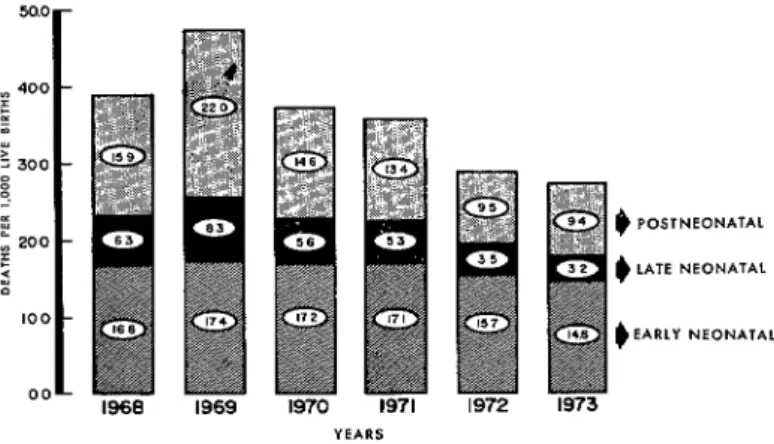
In 1973 there were 6,685 such
deaths, or 27.4 per 1,000 live births,
a rate
which was clearly among the lowest in Latin
America.
Of this total, 4,383 (65.6 per cent)
were neonatal deaths, the neonatal mortality
rate for this period being 18.0 per 1,000 live
births. Early neonatal deaths (those occurring
in the first seven days of life) accounted
for
3,600 of these, the remaining
783 being late
neonatal deaths (at seven through
27 days of
age). The respective early and late neonatal
mortality
rates were thus 14.8 and 3.2 per
1,000 live births.
In addition,
there were
2,302 postneonatal
deaths (at 28 days to one
year of age),
the
rate
of postneonatal
mortality
being 9.4 per 1,000 live births (see
Figure 8). Leading causes of death in the first
year of life, grouped in accord with the WHO
International
Clussz~ication
of
D&eases
(Eighth
Revision,
Geneva,
1967, pp. 445-
446), were as shown below:
Cause
No. per
1,000
No. of
live
deaths
births
B43 (Birth injury, difficult
la-
bor, and other anoxic and
hypoxic conditions)
B44 (Causes of perinatal mor-
tality not listed elsewhere)
B42 (Congenital anomalies)
B4 (Enteritis
and other diar-
rhea1 diseases)
B31 and B32 (Influenza
and
pneumonia)
1,945
8.0999
4.1
868 3.6
724 3.0
713
2.9
It is likely
that
infant
mortality
will
continue
to decline
in the years ahead,
reaching levels below 20.0 deaths per 1,000
live births by 1980. And it is hoped that
improved
sanitary
conditions,
better urban
Corteguera, et al. l ADVANCES IN PEDIATRICS AND CHILD CARE IN CUBA 21
FIGURE 8-Infant mortality and its com$onents, 1968-1973.
50.0 -
f 400 - 3 YI ‘: 300 8 e
I 9 POSTNEONATAL
- : 200
5 e LATE NEON/ITAL
;I 100 -
# EARLY NEONAT*L oo-
1968 1969 1970 1971 1972 1973
YEARS
Source: National Statistics Directorate, Public Health Ministry of Cuba.
and rural housing, better medical equipment, Perinatal Mortality I
construction of new hospitals, and growing Information on perinatal mortality I (late numbers of pediatric personnel (including fetal and early neonatal deaths) is available nurses, pediatricians, neonatologists, and from 1968 on (see Figure 9). In that year obstetricians) may make it possible to reduce there were 8,376 perinatal deaths (33.9 per these mortality figures even more, 1,000 live births), of which 4,235 (50.6 per
FIGURE 9 - Perinatal mortality and its components, 1968-l 973.
36.0 -
g 5 24.0 - z z 9 B L ; 12.0 - : z
o- 1968
,969 ,970 1971 1972 1973
22 PAHO BULLETIN l Vol. X, No. 1, 1976
FIGURE lo- Five principal causes of death in children l-4 years of age, 1973.
b 3 10 I5 2w
RATE PER 100.000
Source: National Statistics Directorate, Public Health Ministry of Cuba.
cent) were late fetal deaths and 4,141 (49.4 per cent) were early neonatal deaths (3, 21). Perinatal mortality declined slightly over the next three years, but its early neonatal component remained virtually unchanged. Then in 1972 this latter component declined as well. In 1973 the number of perinatal deaths in Cuba fell to 6,566, bringing the perinatal mortality rate down to 26.9 deaths per 1,000 live births. Of these deaths, 2,966 (45.2 per cent) were late fetal deaths and 3,600 (54.8 per cent) were early neonatal deaths.
The current goal of the program for
reduction of infant mortality is to reduce perinatal mortality to 24.0 deaths per 1,000 live births by 1980. However, some provinces are already approaching this goal, and it appears possible that reductions well below the target level may be achieved in both individual provinces and the country as a whole.
Preschool Mortality
Mortality among preschoolers (children l-4 years of age) was cut almost in half over an eleven-year span, falling from 2.1 deaths per 1,000 in 1962 to 1.2 per 1,000 in 1973. As shown in Figure 10, the five leading causes of FIGURE 11- The five leading calties of death in children 5-14
years of age, 1973.
HEART DISEASE (826~8291
Corteguera et al. l ADVANCES IN PEDIATRICS AND CHILD CARE IN CUBA 23
death in 1973 were influenza and pneumonia, accidents, congenital anomalies, malignant tumors, and diarrhea1 diseases (21).
Schoolchild Mortality
The annual rate of mortality among school- children 5 to 14 years of age has been very low since 1962, ranging between 0.4 and 0.5 deaths per 1,000. The five leading causes of death among schoolchildren in 1973 are shown in Figure 11.
Research
Two national surveys relevant to pediatric
care have been undertaken in recent years. These are a national survey of growth and development and a perinatal survey. The first is aimed at determining growth and develop- ment parameters for Cuban children, with a view to making clinical and social use of the results. The second seeks information about the influence of biological, social, and health care factors affecting perinatal morbidity and mortality. It is expected that actions resulting from these two surveys, together with the important advances currently being made in pediatric care, will make a significant contribution to reducing childhood morbidity and mortality in the years ahead.
SUMMARY
This article describes the major activities carried out since 1959 in the field of pediatrics and child care in Cuba. In particular, it notes the improvements made through establishment of a national health system and through the participa- tion of community organizations (the Federation of Cuban Women, Committees for the Defense of the Revolution, associations of small farmers, and trade unions) and shows how perinatal, infant, and childhood mortality have been significantly re- duced. As of 1973 perinatal mortality had fallen to 27.9 deaths per 1,000 live births, infant mortality to 27.4 deaths per 1,000 live births, preschool mortality to 1.2 per 1,000 children, and school-age mortality, to 0.4 per 1,000 children.
This report also cites data on available physical and manpower resources, and outlines a large range of activities linked to a Comprehensive Child Care Program undertaken in 1967. This program, in which newborns are enrolled upon leaving the
maternity, seeks to encourage breast-feeding, to promote the activities of well-baby clinics, to provide special examinations for malnourished infants, to provide health care for preschool and school-age children, to promote pediatric medical visits to the home, to assist with camps for asthmatic and diabetic children, to provide pediatric services at pioneer and other camps for schoolchildren, to carry out health education activities, and to combat communicable disease.
In particular, activities to prevent communic- able disease appear responsible for a good part of the progress achieved to date. As a result of these activities malaria and diphtheria have been eradicated, poliomyelitis has been overcome, and the incidences of tuberculosis, tuberculous menin- gitis, tetanus (among both newborns and children under 15), and acute diarrhea1 disease have been substantially reduced.
REFERENCES
(I) Cuba, Ministerio de Salud Pbblica. “111 (3) Cuba, Ministerio de Salud Piiblica. “Cuba: Reunion Especial de Ministros de Salud de las Organization de 10s servicios y niveles de salud.” Americas: Informe de la Repfiblica de Cuba.” XIX Pan American Sanitary Conference, Pan
Santiago, Chile, 1972. American Health Organization, Washington,
(2) Cuba, Ministerio de Salud Pbblica. “XXVI D.C., 1974.
24 PAHO BULLETIN l Vol. X, No. 1, 1976
Dominicana de Pediatria.” Santo Domingo, Dominican Republic, August 1974.
(6) Azcuy Henriquez, P. “Normas y funciona- miento de 10s grupos nacionales” (Unpublished document). Havana, April 1973.
(7) River& Corteguera, R.; E. Dueiias Gomez; and J. Peres Corral. “Organization de la Pediatria en Cuba.” XIV International Congress of Pedi- atrics, Buenos Aires, Argentina, October 1974
(8) Riveron Corteguera, R., and A. Peralta Quintero. “Recursos humanos en la atencion materno-infantil en Cuba.” XIV International Congress of Pediatrics, Buenos Aires, Argentina, October 1974.
(9) Cuba, Ministerio de Salud Pablica, Direc- ci6n National de Perfeccionamiento. “Enseiianza continuada y perfeccionamiento medico estomato- logico.” Havana, March 1973.
(10) Duefias Gomez, E.; R. River-on Corteguera; and F. Rojas Ochoa. “Criterios en la planificacion de la atencidn pediatrica.” Plenary Session, XIV International Congress of Pediatrics, Buenos Aires, Argentina, October 1974.
(11) Valdes Lazo, F. Programa de atencio’n integral al nhio. Havana, May 1967.
(12) HernPndez Elias, R. Administracidn de la salud ptiblica. Cuban Book Institute, Havana,
1971.
(13) Cuba, Ministerio de Salud Pbblica, Di- reccion de Planificacion de Salud. Consolidado de informacio’n para la eualuacihz de 10s programas bkicos de1 area de salud. Havana, August 1974. (14) Cuba, Ministerio de Salud Pfiblica. Normas de pediatria. Cuban Book Institute, Havana, 1971.
(15) Riveron Corteguera, R.; 0. Machado; J. Pagola; and F. Vald6 Lazo. “Integracidn de1 equip0 de salud en el policlinico y sus relaciones con la comunidad.” XIV International Congress of Pediatrics, Buenos Aires, Argentina, October 1974.
(16) Borroto Chao, R. “Programa preventivo de las caries dental a escolares, basado en enjuago- torios con solution de fluoruro de sodio en Cuba.” XVIII National Pediatrics Workshop. Cienfuegos, Cuba, December 1974.
(17) Cuba, Ministerio deSalud Ptiblica. Progra- ma National de Atencio’n al Asmcttico. National Asthma Commission, Havana.
j (18) Cuba, Ministerio de Salud Publica. Pro-
grama de atencidn me’dica domiciliaria. Havana, May 1973.
(19) Cuba, Comision National de Asma. Regla- mento para campamentos uacacionales de nifios asmbticos. Havana, 1970.
(20) Cuba, Instituto de Enfermedades Endocri- nas y Metab6licas. Reglamento para campamen- tos uacacionales de nzrios diabe’ticos. Havana, 1960.
(21) Cuba, Ministerio de Salud Pbblica, Direc- cidn National de Estadistica. Pediatria 1974 (pamphlet). August, 1974.
(22) Cuba, Ministerio de Salud Publica, Direc- c&n National de Epidemiologla. “Vacunacion: situation actual y perspectivas.” II National Hygiene and Epidemiology Forum, Havana, September 1974.
(23) Mas Lago. P., and M. Berros. “Estado actual de1 Programa de Erradicacion de la Poliomielitis en Cuba.” VI Latin American and I Venezuelan Congress of Microbiology, December 1974.
(24) Cuba, Ministerio de Salud Ptiblica. Enfer- medades diarreicas agudas (monograph). Havana 1963.
(25) Moreno Vizquez, 0. ; F. Vald6 Lazo; and J. A. Caparo. “Lucha contra las enfermedades diarreicas agudas.” XII International Congress of Pediatrics, Mexico City, Mexico, May 1968.
(26) Rive& Corteguera, R.; F. Valdb Lazo, and J. Peres Corral. “Morbimortalidad por enfermedades diarreicas agudas: Cuba, 1962. 1973.” XIV International Congress of Pediatrics, Buenos Aires, Argentina, October 1974.
(27) Ferrer Garcia, H; M. Berros; F. Sotolongo; A. Tejeiro; and J. M. Ballester. “Encuesta National de Morbilidad por Parasitism0 Intestinal en Cuba, 1973.” II National Hygiene and Epidemiology Forum, Havana, September 1974.
(28) River-on Corteguera, R. ; E. Dueiias Gomez; and J. Peres Corral. Mortalidad infantil en Cuba: 1973. XIV International Congress of Pediatrics, Buenos Aires, Argentina, October 1974.
(29) Riveron Corteguera, R. Situacihz actual y perspectivas de la pediatria en Cuba, 1973. Havana, March 1973.