Abstracts and Reports
444
Status of the AIDS Epidemic
Eight years have passed since the United States Centers for Disease Con- trol reported the occurrence of an un- usual disease in five homosexual men in San Francisco. This was the first aware- ness of an epidemic that is now known to have begun before 1981 with the silent spread of the human irnmunodeficiency virus (HIV) throughout the world during the mid- to late 1970s. The magnitude of HIV’s spread can still only be estimated. According to the World Health Organiza- tion, 5 to 10 million people are currently infected worldwide, and, using the best available data, the Pan American Health Organization estimates that 2.0 to 2.5 million of those infected people reside in the Region of the Americas.
CURRENT KNOWLEDGE ABOUT
AIDS
A vast amount of information has been gathered about HIV and many significant advances have been made in understand- ing the virus’s genetic composition and how it interacts with human cells. How- ever, the knowledge that has emerged
Sources: Pan American Health Organization, Ac- wired Immunodefkiencv Svndrome IAIDS) in the Americas (Document Cd33121 and Annex); Wash- ington, D.C., 11 August 1988; and ADS in the Americas, Presentation to the XXXIII Meeting of the Directing Council of PAHO by Dr. Ronald SE John, Prozxam Coordinator, Health Situation and Trend Ass&ment, Pan Aderican Health Organization, Washington, D.C., 28 September 1988.
leads to the sobering conclusion that public health interventions will be more complex and difficult than had been thought. For example, the virus has an impressive ability to change its outer en- velope, the part of the virus which is es- sential for its attachment to cells and which is very active immunologically. One single amino acid change in the en- velope glycoprotein may result in a total loss of reaction with antibodies produced by the host. These changes take place with amazing frequency as the virus makes mistakes-in its favor-during replication. Various new mechanisms have been described by which the virus can incorporate itself into a number of cells other than lymphocytes, its primary targets. Moreover, laboratory studies suggest that under certain conditions, the human immune response itself may contribute to enhancement of viral repli- cation in human monocytes. Finally, many areas of the viral structure which contribute to its infectiveness are not readily accessible to the immune system.
It is now clear that the asymptomatic infected person is not disease-free; the slow, steady, progressive deterioration of the immune system and the inevitable progression from an asymptomatic in- fected state to AIDS may take much longer than was originally supposed. Roughly 3% of infected people develop AIDS per year; only about 18% to 20% of those infected will develop the disease within five years and 48% within 10 years. It is estimated that the median time from infection to disease may be as long as 14 years. The implication is that asymptomatic infected persons who may have no reason to be tested for AIDS may remain undetected and infectious for a very long period of time. Also, infected people must be persuaded to change their lifestyles and sexual behaviors and sustain those changes for a very long time.
Evidence has also come to light that a small number of infected people may lose their antibody production when the virus goes into a dormant phase, a phenome- non that has been found in both adults and children. In these people, the virus enters quietly and may undergo rapid proliferation with a readily detectable an- tibody response. Then follows a gradual slowdown in replication and finally a truly dormant period of unknown dura- tion with a concomitant shutdown of the antibody response. Thus, an infected, antibody-positive person may no longer be detectable by currently available tests, but nevertheless remains infectious.
In summary, the more that is learned, the more apparent it is how difficult and complex the fight against AIDS will be.
CURRENT SITUATION IN THE
AMERICAS
The Pan American Health Organiza- tion initiated AIDS surveillance through- out the Region of the Americas in 1983.
Only officially reported cases of full- blown AIDS have been tabulated, and, as elsewhere in the world, the number of reported AIDS cases grossly underesti- mates the magnitude of the problem. As of 2 March 1989, 101,368 cases of AIDS had been reported in the Americas, and of those cases, 55,825 had died.
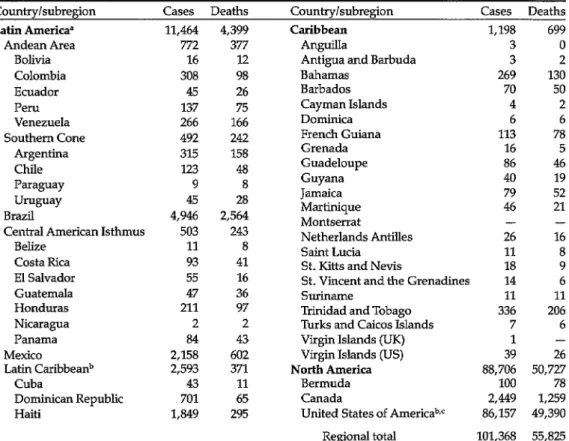
Table 1 reveals the large differences that exist between different subregions in totals of cases reported. The Andean group of countries had reported 772 cases through 31 December 1989, and the Southern Cone countries had reached a total of 492, while Brazil had reported 4,946 cases. In the Central American countries and Panama, there had been 503 reported cases, while the total in Mexico was 2,158. The Latin Caribbean, which includes Cuba, the Dominican Re- public, and Haiti, had reported a total of 2,593 cases, and the non-Latin Caribbean countries 1,198 cases. North America had reported a total of 88,706 cases, the great majority of those from the United States of America. Five countries-the United States, Brazil, Canada, Haiti, and Mexico-had contributed approximately 96% of the total number of cases in the Region (Figure 1).
The percentage increase between 1986 and 1987 in the number of reported cases in the subregions is shown in Table 2. Although reported cases from North America increased by 13%, several other subregions experienced much more dra- matic increases, for example, 213% in the Southern Cone countries, 155% in the Latin Caribbean, and 117% in the Central American Isthmus.
This epidemic has been tracked by monitoring the total number of accumu- lated cases since 1981, but comparisons based on the total number of cases are not particularly useful because they do not take into account the size of the pop- ulations out of which the cases arise. A better method of comparison is provided
Table 1. Cumulative reported AIDS cases and deaths for subregions and countries of the Americas, through 31 December 1988, as received by 2 March 1989.
Country/subregion Cases Deaths Country/subregion Cases Deaths
Latin America” 11,464 4,399 Andean Area 772 377 Bolivia 16 12 Colombia 308 98 Ecuador 45 26 Peru 137 75 Venezuela 266 166 Southern Cone 492 242 Argentina 315 158 Chile 123 48 Paraguay 9 8 umguay 45 28 Brazil 4,946 2,564 Central American Isthmus 503 243 Belize 11 8 Costa Rica 93 41 El Salvador 55 16 Guatemala 47 36 Honduras 211 97 Nicaragua 2 2 Panama 84 43 Mexico 2,158 602 Latin Caribbeanb 2,593 371 Cuba 43 11
Dominican Republic 701 65 Haiti 1,849 295
Caribbean Anguilla
Antigua and Barbuda Bahamas
Barbados Cayman Islands Dominica French Guiana Grenada Guadeloupe Guyana - Jamaica Martinique Montserrat
Netherlands Antilles Saint Lucia St. Kitts and Nevis
St. Vincent and the Grenadines Suriname
Trinidad and Tobago Turks and Caicos Islands Virgin Islands (UK) Virgin Islands (US) North America
Bermuda Canada
United States of Americab*c
1,198 699 3 0
3 2 269 130 70 50 4 2 6 6 113 78 16 5 86 46 40 19 79 52 46 21
-
26
11
18 14
11
336 7
1
39 88,706
100
2,449 86,157
-
16 8 9 6
11
206 6
-
26 50,727 78 1,259 49,390 Regional total 101,368 55,825
Source: Pan American Health Organization. AIDS Sun&lance in the Americas. Health Situation and Trend Assessment Program, PAHOlWHO Global Program on AIDS in the Americas.
aFrench Guiana, Guyana, and Suriname included under Caribbean. bPuerto Rico included under USA.
CData through 13 February 1989.
by calculating the ratio of reported cases in a given calendar year to the median population estimates for that year. This ratio, shown in Table 2, reveals that prev- alence is highest in North America, with 67.2 AIDS cases per million population, and that the non-Latin Caribbean area, with 53.9 cases per million in 1987, is second.
mas ranged from 240 to 400 cases per mil- lion inhabitants.
With the exception of Montserrat, AIDS cases, and thus evidence of the spread of HN, have been found in all the countries and territories of the Americas.
Patterns of Transmission
Halt1 (2%) Mexco (2%) Canada (2%)
3thers (4%)
!I1 (5%)
Figure 1. Distribution of reported AIDS cases, by country in the Americas, based on information as of 2 March 1989.
be the predominant pattern in most countries in the southern part of South America (Chile, Argentina, Uruguay, and Paraguay), as well as the Andean coun- tries (Venezuela, Colombia, Ecuador, Peru, and Bolivia).
Seroprevalence studies of HIV in some groups of homosexual and bisexual men, most of them volunteers, have disclosed rates of infection of 8.3% in the Domini- can Republic in 1986, 20% in Costa Rica in 1985-1986,37.5% in Brazil in 1987, and 30.9% in Mexico in 1987. Although these
rates are far below the very high rates (above 70%) of HIV infection found among some homosexual groups in some areas of the United States, the difference may only indicate the later introduction and spread of HIV infection among ho- mosexual men in Latin American and Caribbean countries. Indeed, HIV preva- lence rates found in prospective studies have risen from below 5% to lo-20% in some countries, such as Argentina and Uruguay.
The proportion of cases in which het-
Table 2. Number of AIDS cases and ratios per million population in 1986 and 1987, with percentage increase.
A
1986 1987 Subregion/country Cases
Latin America 1,807 Andean Area 111 Southern Cone 42
Brazil a44
Central American Isthmus 62
Mexico 440
Latin Caribbean 308 Caribbean 252 North America 15,886
Cases per million pop.
4.5 1.3 0.8 6.1 2.3 5.4 13.2 35.1 59.5
Cases 3,337 246 129 1,574 139 451 798 393 18,111
Cases per % million pop. increase
8.1 80 2.9 123 2.5 213 11.1 82 5.0 117 5.4 0 33.7 155 53.9 54 67.2 13 Regional total 17,945 26.5 21,841 31.7 20
erosexual transmission of HIV is impli- cated is still below 10% of all cases in most countries of Latin America. How- ever, in the Caribbean and parts of Cen- tral America, significant numbers of AIDS cases and HIV infections in women are being detected. As an example, 24 cases of AIDS were diagnosed in Jamaica in 1987, of which 10 occurred in women.
Studies of HIV infection rates in female prostitutes have found rates ranging from zero in some studies in Mexico and Argentina to 49% in one limited study in Haiti.
Transmission associated with blood and blood products. In some countries, notably Costa Rica, Mexico, Brazil, and Jamaica, between 5% and 10% of all cases of AIDS are presumed to be secondary to blood transfusions. HIV antibody preva- lence among blood donors is highly vari- able, ranging from 0.00% among 4,000 donors in Argentina and 0.1% in more than 1,400 blood samples tested in Barba- dos to as high as 1.6% in the Dominican Republic and 7.3% among some paid blood donors in high-risk areas of Mexico City.
The contribution of contaminated nee- dles and syringes to the transmission of the AIDS virus among 1.V drug abusers appears to be less significant in Latin America than in the United States. Less than 1% of AIDS cases are believed to be associated with 1.V drug abuse in Latin America, as opposed to 17% in the USA.
Transmission in children. Cases of perinatal transmission in Latin America and the Caribbean have been few so far. For example, less than one-fifth of cases in infants and children have been associ- ated with perinatal transmission in Bra- zil. In Mexico, 16% of cases occur in in- fants of infected mothers. However, limited studies in Haiti have found prev- alences of HIV infection of 3% to 8% in
pregnant women. The small number of reported cases in women and children may be related to the recent introduction of the virus into these two groups, as well as inadequate surveillance methods for identifying such cases.
The majority of cases in children out- side the United States have thus far been associated with transfusion of blood and blood products, and in rare cases with sexual abuse and child prostitution. In contrast, more than 75% of pediatric cases in the United States can be traced to a parent with proven HIV infection or who engages in a high-risk behavior, principally 1.V drug abuse.
THE GLOBAL
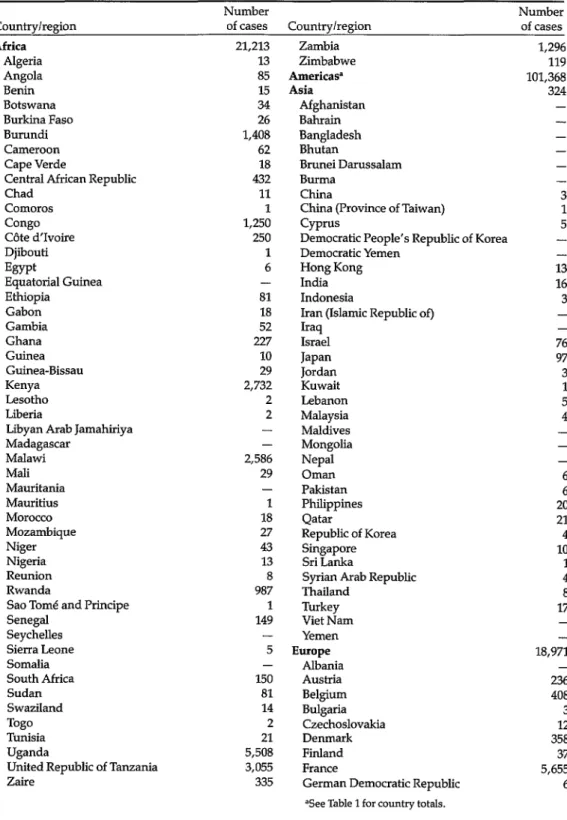
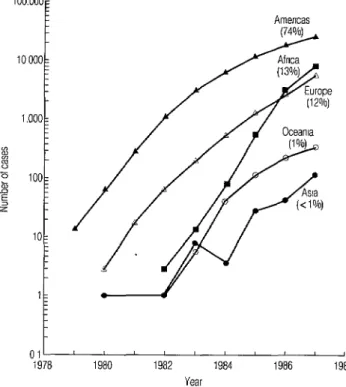
AIDS SITIJKJXON As of 31 January 1989, 145 countries had reported 143,156 cases of AIDS to WHO’s Global Program on AIDS (Table 3). As a result of underreporting and un- derdiagnosis, this total probably repre- sents a two- to fourfold underestimate of the actual number of cases. Figure 2 illus- trates the evolution of the epidemic, based on case reports, and the distribu- tion of those cases by region.In Europe, 28 countries have reported almost 19,000 AIDS cases. The incidence rates per million population have been highest in France, Switzerland, and Den- mark. WHO estimates that about 500,000 persons in Europe are infected with the AIDS virus.
The number of African countries re- porting AIDS cases to WHO has in- creased substantially in the past year. In the most recent tabulation, 46 countries reported over 21,000 cases of AIDS.
Table 3. Cumulative AIDS cases for countries and regions worldwide, as reported to WHO by 31 January 1989.
Number Number
Countrylregion of cases Country/region of cases
Africa 21,213
Algeria 13
Angola 85
Benin 15
Botswana 34
Burkina Faso 26 Burundi 1,408
Cameroon 62
Cape Verde 18 Central African Republic 432
Chad 11
Comoros 1
Congo 1,250
C&e d’Ivoire 250
Djibouti 1
Empt 6
Equatorial Guinea Ethiopia Gabon Gambia Ghana Guinea Guinea-Bissau Kenya Lesotho Liberia
Libyan Arab Jamahiriya Madagascar Malawi Mali Mauritania Mauritius Morocco Mozambique Niger Nigeria Reunion Rwanda
Sao Tome and Principe Senegal Seychelles Sierra Leone Somalia South Africa Sudan Swaziland Togo Tunisia Uganda
United Republic of Tanzania Zaire - 81 18 52 227 10 29 2,732 2 2 - - 2,586 29 - 1 18 27 43 13 8 987 1 149 - 5 - 150 81 14 2 21 5,508 3,055 335
144 PAHO Bulletin 23(1-2), 1989
Zambia Zimbabwe Americas” Asia Afghanistan Bahrain Bangladesh Bhutan
Brunei Darussalarn Burma
China
China (Province of Taiwan) Cyprus
Democratic People’s Republic of Korea Democratic Yemen
Hong Kong India Indonesia
Iran (Islamic Republic of) Iraq Israel Japan Jordan Kuwait Lebanon Malaysia Maldives Mongolia Nepal Oman Pakistan Philippines Qatar
Republic of Korea Singapore Sri Lanka
Syrian Arab Republic Thailand
Turkey Viet Narn Yemen Europe Albania Austria Belgium Bulgaria Czechoslovakia Denmark Finland France
German Democratic Republic
“See Table 1 for country totals.
Table 3. (Continued)
Number Number
Country/region of cases Country/region of cases Germany, Federal Republic of 2,779 USSR 5 Greece 170 United Kingdom 1,982
Hungary 17 Yugoslavia 65
Iceland 10 Oceania 1,280
Ireland 64 Australia 1,168
Italy 3,008 Cook Islands -
Luxembourg 13 Fiji -
Malta 12 French Polynesia 3
Monaco 1 Kiribati -
Netherlands 694 Mariana Islands - Norway 100 New Caledonia and Dependencies 2
Poland 5 New Zealand 100
Portugal 199 Papua New Guinea 6
Romania 9 Samoa -
San Marino - Solomon Islands -
Spain 2,165 Tonga 1
Sweden 256 Tuvalu -
Switzerland 702 Vanuatu -
World total 143,156
“See Table 1 for country totals.
Source: World Health Organization. Acquired immunodeficiency syndrome (AIDS)-data as of 31 January 1989. wkly EpidemioZ Ret C&(5):29-30, 1989.
100.000~
1ooooz
1.000 =
h? % " B s loo=
E z‘
1OZ
1:
Americas
01’
1976 1980
I 1982 1984 1986 1988
Year
ited areas where AIDS is more prevalent. In Europe, Australia, and New Zealand, as in the Americas, most AIDS cases have occurred among homosexual and bisexual men and intravenous drug users between the ages of 20 and 49. The proportion of cases acquired through het- erosexual contact in these areas is esti- mated at about 5%. In Africa, however, heterosexual transmission is a major fac- tor in the spread of Hw, along with trans- fusion of unscreened blood and use of unsterilized needles or syringes. Perina- tal transmission is also a significant prob- lem in Africa. In some urban areas, HIV infection has been found in up to 20% of pregnant women.
Outlook for the Future
In the coming years, the situation will get worse. The number of people in- fected with HIV is increasing, since trans-
mission is still taking place. The vast ma- jority of infected people will progress to disease. Thus, given the long period be- tween infection and disease, the number of cases of AIDS will continue to increase for some time in spite of prevention ef- forts already under way.
This disease will have repercussions for the basic legal, moral, and religious prin- ciples of society. Its impact on health care services and the burden that caring for affected people will place on society will be enormous. In economic terms alone, the cost would be very high even if an effective preventive measure were found tomorrow. AIDS cannot be approached with a traditional vertical disease-control mentality. Community participation, full commitment on the part of the health sector and other sectors such as educa- tion and finance, and planning for the fu- ture will be essential to minimize the im- pact of AIDS on all societies.
444
The World Health Organization’s Global
Program oti AIDS
As many as 100 million persons may be infected with HIV by 1991. As many as three million new AIDS cases may occur between 1987 and 1991 among persons already infected by HIV in 1986. No vac- cine will be available for widespread use. For each AIDS case, there may be up to 100 HIV-infected persons.
Even accepting that these projections are tentative and issued with great cau- tion pending the collection and analysis of more worldwide epidemiological data, the numbers are still staggering. Without question, the epidemic of infection by HIV and related retroviruses is an inter- national health problem of extraordinary
146 PAHO Bulletin 23U-2), 1989
scope that demands unprecedented and urgent global responses. The World Health Organization (WHO), fulfilling its constitutional mandate to direct and co- ordinate international health, has re- sponded by establishing its Global Pro- gram on AIDS (GPA).