Dionísia Aparecida Cusin Lamônica1 Mariana Germano Gejão1 Lívia Maria do Prado1 Amanda Tragueta Ferreira2
Descritores
Transtorno autístico Síndrome de Asperger Linguagem Leitura Escrita manual Vocabulário Aprendizagem
Keywords
Autistic disorder Asperger’s syndrome Language Reading Handwriting Vocabulary Learning
Correspondence address:
Dionísia Aparecida Cusin Lamônica Al. Octávio Pinheiro Brisolla, 9-75, Vila Universitária, Bauru (SP), Brazil, CEP: 17012-901.
E-mail: [email protected]
Received: 03/22/2012
Study carried out at the School of Dentistry of the Universidade de São Paulo – USP – Bauru (SP), Brazil. (1) School of Dentistry of Universidade de São Paulo – USP – Bauru (SP), Brazil.
(2) Hospital Oftalmológico de Sorocaba – Sorocaba (SP), Brazil.
Conlict of interests: nothing to declare.
case reports
Habilidades de leitura em crianças com diagnóstico de
hiperlexia: relato de caso
ABSTRACT
Hyperlexia is characterized by spontaneous and early acquisition of reading skills, manifested before the age of ive, without any formal education. Expressive and receptive language deicit, excellent memory, delayed language skills, echolalia, perseverations, and dificulty to understand verbal contexts, are common symptoms in individuals with hyperlexia and global developmental disorders, including Asperger’s syndrome. The aim of this study was to describe the reading skills of individuals with hyperlexia. The participants were six boys with a history of hyperlexia, perceived by relatives before 36 months of life, chronologically aged between four years and four months to ive years and two months. The following evaluation procedures were applied: interview with the parents or responsible guardians, communicative behavior observation, Peabody Picture Vocabulary Test (PPVT), recognition of alphabet letters and numbers, School Performance Test, text reading, and reading comprehension. The participants showed different performances in the PPVT, and recognized letters, numbers and isolated words. There was dificulty in answering the writing subtest; the majority did not understand the text that they read and all of them demonstrated recognition of letters and numbers. Some participants were able to read words and texts. However, all participants presented alterations in other areas of language development, such as receptive vocabulary, communicative behavior and understanding of the material read, in addition to altered behaviors of social adaptation, both interactive and restrictive.
RESUMO
INTRODUCTION
Hyperlexiais is characterized by spontaneous and early acquisition of reading skills, manifested before the age of ive, without any formal education(1,2). It can be a result
of obsessive behavior associated with excellent development of visual-perceptive skills in a context of altered language development, and it is not necessarily correlated to intel-lectual abilities(3,4). Precocious reading skills may indeed
suggest that a child has superior intellectual abilities(5).
However, according to the literature, a child will present advancements in the development of speciic brain areas, but with alterations in the areas of language and learning(6,7).
The mechanisms subjacent to this process have not been en-tirely understood(8). It is inferred that this lack of knowledge
is related to the prevalence of the phenomenon; in other words, the literature(2,7) shows that the accurate prevalence
rate of hyperlexia has not been entirely discovered, varying according to speciic criteria(9). The less rigorous these
cri-teria are in relation to the diagnosis of hyperlexia in autistic children, the higher the discrepancy of prevalence rates. In addition, the few existing studies have presented isolated clinical cases. Joshi et al.(4) conducted a study based on the
bibliography published from 1999 to 2009 and found only 22 works on this topic.
The literature indicates, moreover, that individuals with hyperlexia demonstrate intense fascination for letters and num-bers, dificulty to interact socially, and signiicant dificulty to understand spoken language(2-4,7,10,11).
Expressive and receptive language deicit, excellent memo-ry, delayed language skills, echolalia, persistent behavior, and dificulty to understand verbal context are common symptoms in individuals with hyperlexia and global developmental dis-orders, including Asperger’s syndrome(1,3,12,13).
Supported by the scarcity of studies on reading skills in early ages, the aim of this study was to describe them in individuals with hyperlexia.
PRESENTATION OF THE CLINICAL CASES
This project was approved by the Research Ethics Committee of School of Dentristy of Bauru of the University of São Paulo, where the study was carried out (protocol number 008/2012), and we complied with the criteria listed in Resolution 196/96. The participants’ legal guardians signed the informed consent form.
The inclusion criteria for this study were: having a history of the development of reading skills before the age of ive without formal education (hyperlexia) and having undergone a hear-ing evaluation that presented results within normal standards. The legal guardians illed out an interview protocol com-posed of the following items: personal data and information about communicative and hearing development, behavioral characteristics, and medical diagnosis.
Following the selection, based on the data presented during the interview and on information about precocious reading, the participants were assessed through the application of the proce-dures described below:
a) Communicative behavior observation (CBO): the child was exposed to a ludic activity with miniature toys in a semi-guided situation with the purpose of observing com-municative intention, interaction with the assessor, eye contact, comprehension of simple commands, and luency of verbal expression (speech acquisition and speech syn-tactic organization).
b) Peabody Picture Vocabulary Test (PPVT)(14): it provides
objective information about receptive-auditory vocabulary. We followed the rules proposed in the instruction manual of the instrument, and the score obtained was distributed into the following categories: lower low, higher low, lower average, average, higher average, lower high, high, and higher high.
For the assessment of reading and writing skills, we used the following procedures:
a) Recognition of isolated letters of the Latin alphabet (26 letters) and of numbers from 1 to 10.
b) School Performance Test (SPT)(15): we applied reading and
writing subtests and obtained the total score (sum of the raw scores in both subtests). In accordance with the SPT manual, the participants were positioned within one of three levels of academic performance, taking into consideration the irst year of elementary school: below average, average, and above average.
c) Text reading and reading comprehension: after reading a children’s text (The Ugly Duckling), the child was sup-posed to tell the interlocutor what he/she had read. After the free retelling of what he/she had understood of the text, the assessor asked open and simple questions about it and its main characters. For the evaluation of the par-ticipant’s answers, the following categories were used: did not comprehend the text (DNC), in case the child was unable of reproducing the text and its central idea or did not answer correctly; comprehended partially (CP), if the child was not able to re-enact the text but demonstrated comprehension of its central idea, answering the questions posed by the assessor; and comprehended (C), in case the child comprehended the text that was read and answered all the questions correctly.
Six boys participated in this study, with behaviors compat-ible with global developmental delay and history of hyperlexia, perceived by relatives before 36 months of age. The medical diagnoses were given by several professionals, neurologists, or child psychiatrists. The medical reports presented participants P1, P2, P3, and P5 with ICD (World Health Organization international classiication of diseases) F84.5 (Asperger’s Syndrome), and P4 and P6 with ICD F84 (global develop-mental delay). None of the participants were in therapy prior to the study.
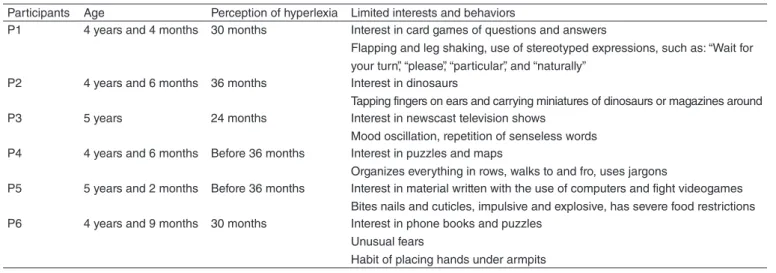
Table 1 displays the observed participants’ characteristics in relation to their age at the time of the evaluation, the age when the family noticed the child’s reading skills (hyperlexia), limited interests, and poor adaptive behavior. With regard to schooling, P1, P3, P4 and P5 attended public school and were enrolled between the second and third year of life, and P2 and P6 did not attend school because of adaptation dificulties.
During the interview, the following characteristics were common in the participating family members’ reports: social isolation, poor adaptive behaviors, dificulty to change routines, dificulty in school integration, impulsiveness, interest in activi-ties that involve reading, and limited interests.
During the CBO, we veriied that P5 and P6 presented communicative intention and interaction with the evaluator, and P1, P2, P3 and P4 showed communicative intention and interaction only in situations of their own interest. P1, P2 and P4 did not make eye contact, while P3, P5 and P6 indi-cated limited eye contact. All the participants demonstrated comprehension of simple commands and formed words or sentences, especially in relation to topics of their own inter-est. Through observation of communicative behavior, the participants presented syntactically correct speech and luency in verbal expression, without the presence of phonological processes unexpected in this age range.
Table 2 shows the results of the PPVT, tests of recognition of letters and numbers, SPT reading and writing subtests, and reading comprehension.
DISCUSSION
During the CBO, we veriied that the majority of the partici-pants presented limited interaction with the evaluator, always related to situations that met their own interest. All participants demonstrated comprehension of simple commands, and the syntactic organization and speech development were adequate to their chronological age.
The analysis of the receptive language of the six participants assessed through receptive-auditory vocabulary resulted in dif-ferent scores, considering the classiication standards proposed by the PPVT. Lexical development relects a child’s ability to understand and elaborate the enunciations that will be present in his/her communication. This ability facilitates and promotes information exchange between the child and his/her interlocu-tors, allowing and permeating the communicative process.
Through the use of the same instrument (PPVT), a study(12)
with individuals with Asperger’s syndrome demonstrated their dificulty with receptive language. Indeed, the literature(13)
indi-cates that language development in individuals with Asperger’s syndrome is founded on isolated and limited interests, which impairs the process of language acquisition. Another study(5)
reports that problems with receptive language are more com-mon than dificulties with expressive language and that the nature of this compromise remains insuficiently described. The authors inform that the problems with language reception can affect the social behavior of children with Asperger’s syndrome
Table 1. Characteristics of the participants in relation to their age at the time of the evaluation, age when their relatives perceived hyperlexia, limited interests, and behaviors
Participants Age Perception of hyperlexia Limited interests and behaviors
P1 4 years and 4 months 30 months Interest in card games of questions and answers
Flapping and leg shaking, use of stereotyped expressions, such as: “Wait for your turn”, “please”, “particular”, and “naturally”
P2 4 years and 6 months 36 months Interest in dinosaurs
Tapping fingers on ears and carrying miniatures of dinosaurs or magazines around P3 5 years 24 months Interest in newscast television shows
Mood oscillation, repetition of senseless words P4 4 years and 6 months Before 36 months Interest in puzzles and maps
Organizes everything in rows, walks to and fro, uses jargons
P5 5 years and 2 months Before 36 months Interest in material written with the use of computers and fight videogames Bites nails and cuticles, impulsive and explosive, has severe food restrictions P6 4 years and 9 months 30 months Interest in phone books and puzzles
Unusual fears
Habit of placing hands under armpits
Table 2. Results of the PPVT, recognition of graphemes and numbers, SPT (writing and reading), and comprehension of the material read
Procedures P1 P2 P3 P4 P5 P6
PPVT Lower
average Lower low Lower low Lower low Higher
Higher average
Grapheme recognition (%) 100 100 100 100 100 100
Number recognition (%) 100 100 100 100 100 100
SPT: reading Higher Average Average Lower Higher Higher
SPT: writing -* Lower - - Lower -*
and Pervasive Developmental Disorders, thus contributing to deicits in communication, especially inluencing the use of language. With regard to the scores obtained in the PPVT, the participants of the present study proved to be a heterogeneous group in relation to this skill. This inding is veriied through the performance of P5 and P6, who presented higher and higher average PPVT classiications respectively, while P2, P3 and P4 registered lower low, and P1 lower average.
Even when imbued with a good receptive-auditory vocabulary, hyperlexics might not comprehend the mate-rial read. For this reason, the role of semantic knowledge in reading has been the object of considerable debates, particularly in relation to the degree in which semantics is necessary for the successful reading of regular and es-pecially, unusual words(7).
On the other hand, alterations in communicative skills, such as dificulty to understand a verbal context, to initiate and main-tain eye contact and dialogues, and the utilization of unusual words, besides the lack of interest in activities not related to reading, were observed in a more consistent and homogeneous manner in the participants of this study, which is in accordance with the indings reported in the literature(2,5,12,13).
Concerning the recognition of letters and numbers, we observed that all participants had this ability, and the same was veriied in the SPT reading activities. In other words, all par-ticipants were able to read isolated words, but with differences in performance (Table 2), which varied from below average to average and above average, considering the scores of the irst year of elementary school. Child P4, for instance, was not able to read all the words on the reading test, but was able to do so with high frequency words, such as “duck”.
According to the connectionist model, the decoding of a word can occur by different routes — phonological, ortho-graphical, and semantic — depending on the child’s level of reading(3). Another model(7) suggests that the lexical route
favors the access to stored representations of orthographical forms of known words, which, in turn, are linked to their phonological form, thus prompting the correct pronunciation of the word in question.
There seem to be two sub-routes of the lexical route in this model. In the irst, the spoken representations are accessed directly from their orthographical representations without se-mantic mediation, and the second route involves the conversion of orthography to phonology through semantics. According to Newman et al.(3), the dissociation between the ability to read
and the semantic knowledge seems evident in some hyperlex-ics, given that the acquisition of the ability to read regular and especially unusual words, can occur in a context of impaired comprehension. Nevertheless, as time goes by, some hyperlex-ics are able to comprehend contents they read, depending on the development of maturing processes. This heterogeneity offers the ideal opportunity to test hypotheses about this barely known phenomenon(7).
Indeed, on the course of the application of the instruments, we veriied that the participants demonstrated different per-formances in verbal behavior as well as reading, in addition
to altered behaviors of social adaptation, both interactive and restrictive. Despite the occurrence of atypical and restrictive behaviors, P1, P5 and P6 were less reluctant to activities that were not of their interest. This behavior was particularly dif-icult for P2, P3 and P4.
A study by Nation et al.(1) about the reading skills of
chil-dren with disorders of the autistic spectrum, demonstrated that the nature of the reading abilities in these individuals is heterogeneous.
The writing subtest was also dificult to apply because of the lack of interest in this activity. Participants P3 and P4 refused to take part, and P1 and P5 presented motor dificulty in the subtest as well as in the codifying of written words. P2 and P6 performed the task with dificulty to write the words dictated due to motor problems.
In the reading comprehension test, participants P1, P2, P3 and P4 did not demonstrate comprehension. According to the literature, this behavior is expected in hyperlexics and is related to an obsessive conduct along with an ex-cellent development of visual-perceptive abilities, visual association and memory, in a context of altered language development(2-4,8). This might indicate(3,8) that even with
dif-iculties in the use of linguistic abilities, these children take the phonological route in order to decode graphic symbols. However, they do not comprehend the material read, which conirms the literary afirmation that hyperlexia seems to be a mechanical activity of graphemephoneme transcod-ing(5). Another hypothesis for this phenomenon is that the
child can develop an orthographical memory conducive to an advantageous analytical visual coniguration, which, in turn, favors the act of reading(8).
According to the literature(3), children with hyperlexia
depend on phonological and orthographical skills in order to read, but the strong and weak points of these skills remain unclear. Newman et al.(3) inform that for these individuals,
read-ing cannot be explained based exclusively on visual memory; instead, it involves, at least to a certain degree, mapping and decoding, which suggests that these individuals rely on phono-logical processing to identify regular words. Another study(9)
presented the concept of parallel mapping between graphic and phonological codes, stating that this notion draws on the evidence that when the order of the words in a text is changed, typical children tend to demonstrate decreased reading speed in comparison to hyperlexics.
Indeed, intensive practice with printed words leads to a precocious ability to read isolated words. However, evidence suggests that although they start reading earlier, individuals in this sphere might not develop the same processes of typi-cal readers, i.e. the phonologitypi-cal and lexitypi-cal mapping that aid in the recognition of simple words. Thus, the reading of single words is disconnected from the comprehension of the entirety of a text(8), which then prevents the
(P5 and P6) also had a better comprehension performance (Table 2). A limitation of this study refers to the lack of previous knowledge about the degree of familiarity that the participants had with the story chosen for the evaluation of reading comprehension.
Comprehension is a complex process that involves a wide range of neuropsychological processes related to cognitive and psycholinguistic abilities, information processing, stimuli integration, and monitoring of affective and behavioral states.
A study by Turkeltaub et al.(6) reported that the neural
foun-dations responsible for early reading remain unexplored. The authors informed that the elucidation of the neural foundations of reading in hyperlexics could clarify the neurobiology of the reading process in a context of poor language and communi-cation skills, as well as favor the identiicommuni-cation of alternative routes for reading that would beneit children with dificulties in linguistic and communicative development. Despite the disagreement about hyperlexia being a condition speciic to individuals who present autistic characteristics, Newman et al.(3)
consider hyperlexia as a phenomenon speciic to this group. From a neuropsychological perspective, the abilities demonstrated by hyperlexics refer to excellent perception, differentiation, association, and visual memory, along with linguistic abilities of associating language sounds with writ-ten material, which is detrimental to the ability of processing, organizing, integrating, and comprehending oral and written language(1-5,10,11). Mottron et al.(9) suggest that hyperlexia
rep-resents a canonical example of the perceptual use of linguistic units, thus suggesting that the comprehension of the models of reading development, in these cases, must be understood not only in light of subjacent mechanical processes but also in the context of oral language and reasoning abilities, which is also afirmed in the literature on the topic(3).
Although they demonstrated competence to recognize and read written words without formal education, as it is expected in the case of individuals with Asperger’s syndrome, the partici-pants of this study presented alterations in the performance of activities of communication and social adaptation that interfere with the quality of interpersonal interactions, oral and reading comprehension, and learning.
It is known that hyperlexic children have heterogeneous diagnoses with associated co-morbidities. In light of this, a more attentive look at individual variability, combined with longitudinal follow-ups can be helpful in the comprehension of the development of reading skills. The reduced number of participants and the different methodologies employed in studies on the topic limit the possibility of extrapolating the data displayed in the evaluations of the general population of hyperlexics. Although several models or hypotheses to explain the reading skills of hyperlexics have been pointed out(3,6-9), the mechanisms that ignite this process are still
poorly comprehended.
FINAL COMMENTS
The participants with hyperlexia in this study demonstrated recognition of letters and numbers. Some of them were able to read words and text, but with alterations in other areas of language development, such as receptive vocabulary, communicative behav-ior, and comprehension of the material read, in addition to altered behaviors of social adaptation, both interactive and restrictive.
*ATF was responsible for data collection and tabulation; LMP collaborated in data collection and tabulation; MGG supervised data collection and collaborated in data analysis; DACL was responsible for the project and the study outline, and overall supervision of the manuscript stages.
REFERENCES
1. Nation K, Clarke P, Wright B, Williams C. Patterns of reading ability in children with autism spectrum disorder. J Autism Dev Disord. 2006;36(7):911-9.
2. Etchepareborda MC, Díaz-Lucero A; Pascuale MJ, Abad-Mas L, Ruiz-Andrés R. Asperger’s syndrome, little teachers: specials skills. Rev Neurol. 2007;44 (Suppl 2):S43-7.
3. Newman TM, Macomber D, Naples AJ, Babitz T, Volkmar F, Grigorenko EL. Hyperlexia in children with autism spectrum disorders. J Autism Dev Disord. 2007;37(4):760-74.
4. Joshi RM, Padakannaya P, Nishanimath S. Dyslexia and hyperlexia in bilinguals. 2010;16(2):99-118.
5. Saalasti S, Lepistö T, Toppila E, Kujala T, Laakso M, Nieminen-von Wendt T, et al. Language abilities of children with Asperger syndrome. J Autism Dev Disord. 2008;38(8):1574-80.
6. Turkeltaub PE, Flowers DL, Verbalis A, Miranda M, Gareau L, Eden GF. The neural basis of hyperlexic reading: an FMRI case study. Neuron. 2004;41(1):11-25.
7. Castles A, Crichton A, Prior M. Developmental dissociations between lexical reading and comprehension: evidence from two cases of hiperlexia. Cortex. 2010;46(10):1238-47.
8. Baldaçara L, Nóbrega LPC, Tengan SK, Maia AK. Hyperlexia in a patient with autistic disorder and its hypothesis. Rev Psiquiatr Clín. 2006;33(5):268-71.
9. Mottron L, Bouvet L, Bonnel A, Samson F, Burack JA, Dawson M, et al. Veridical mapping in the development of exceptional autistic abilities. Neurosci Biobehav Rev. 2013;37(2):209-28.
10. Cardoso-Martins C, Silva JR. Cognitive and language correlates of hyperlexia: evidence from children with autism spectrum disorders. Reading and Writing. 2010;23(2):129-145.
11. Saldaña D, Carreiras M, Frith U. Orthographic and phonological pathways in hyperlexic readers with Autism Spectrum Disorders. Dev Neuropsychol. 2009;34(3):240-53.
12. Dias KZ, Silva RCD, Pereira LD, Perissinoto J, Bergamini CQ. Avaliação da linguagem oral e escrita em sujeitos com Síndrome de Asperger. Rev CEFAC. 2009;11(Supl 2):240-50.
13. Noterdaeme M, Wriedt E, Höhne C. Asperger’s syndrome and high-functioning autism: language, motor and cognitive proiles. Eur Child Adolesc Psychiatry. 2010;19(6):475-81.
14. Dunn LM, Padilla, ER, Lugo DE, Dunn LM. Teste de Vocabulário por Imagens Peabody. Espanha: Circle Pines: American Guidance Service, 1986. 15. Stein LM. TDE – Teste de desempenho escolar: Manual para aplicação