Original Article
Artigo Original
Maria Aparecida Gonçalves dos Santos1
Simone Rocha de Vasconcellos Hage2
Descritores
Redação Escrita Manual Avaliação Linguagem Aprendizagem Avaliação Educacional Ensino Fundamental e Médio
Keywords
Writing Handwriting Evaluation Language Learning Educational Measurement Education, Primary and Secondary
Correspondence address:
Simone Rocha de Vasconcellos Hage Alameda Dr. Octávio Pinheiro Brisolla, 9-75, Vila Universitária, Bauru (SP), Brasil, CEP: 17012-901.
E-mail: [email protected]
Received: 03/16/2014
Accepted: 01/30/2015
Study carried out at the Speech Language Pathology and Audiology Department, Universidade de São Paulo – USP – Bauru (SP), Brazil.
(1) Municipal Education Network of Bauru – Bauru (SP), Brazil.
(2) Speech Language Pathology and Audiology Department, Universidade de São Paulo – USP – Bauru (SP), Brazil.
Conlict of interests: nothing to declare.
Textual production of children
without learning dificulties
Produção textual de crianças sem diiculdades de aprendizagem
ABSTRACT
Purpose: To characterize the writing skills of students, to compare the performance of students in public and private schools, and to identify enhancements in the course of the school year. Methods: Three texts (narrative, game rules description, and a note or letter) written by 160 students from public and private schools were analyzed based on a speciic protocol. Descriptive statistical analysis was performed. To compare the overall performance by the protocol between school grades, the Kruskal–Wallis and Miller tests were used, and to compare results as to schools (private and public), Mann–Whitney test was used. Results: Median values of aesthetic aspects, coherence, clarity, and concision for game rules description among public school students remained one point below the top score. Students from private schools achieved the highest score at medians. When comparing schools, private institutions had students with better performances, with signiicant difference. As to grades, statistical difference was found between the fourth and sixth grades of public schools and between the fourth and ifth grades of private schools. Conclusion: Most of the private school children showed consolidation of skills assessed in the different grades. However, public school children had this consolidation only at the sixth grade. Students from private schools had better performances compared to those from public schools. There is tendency to evolution from the fourth to sixth grades in public schools. However, the overall performance is similar in all grades in private schools.
RESUMO
INTRODUCTION
More than mastering techniques or language standards, knowing how to write is to engender a proposal of meaning/ reading. Writing presupposes having something to say, reason to say it, establishing oneself as the subject of the topic, and having the mechanisms and strategies to do so. It requires the writer to make decisions at various levels — semantics, prag-matics, discourse, and grammar(1).
Mother tongue teachers regularly complain about the dif-iculties of students in writing; such dificulty is not limited to Portuguese Language classes, but it seems to be worse in this space, where language disarticulation in the context of its pro-duction is more evident(2).
Writing competencies involve different skills, including rapid and accurate production of letters and words, generation of ideas, selection of words, proper use of grammar and punc-tuation, exact spelling, planning, translation of planning into language sequences, assessment, and review(3). In early school
years, the teaching of writing focuses mainly on the written code aiming at writing letters and words. After the acquisition of the mechanism of graph-phonetic correspondences, writing lessons start to focus on the development of more advanced skills, such as production of complex sentences, writing plan-ning, clarity, and concision(4,5).
Clinical practice has faced a signiicant progress in research on reading investigation, whether on evaluation or the mecha-nisms underlying it(6-8), but writing veriication regarding text
production is little explored. As to writing or reading skills, there seem to be no consensus on the performance expected at each school grade, and there are many ways of assessing such skills(9).
Although reading and writing skills of children are pre-dominant themes in educational media, they have been sub-ject of research in areas such as linguistics, cognitive psy-chology, and speech pathology. Knowing reading and writing strategies used by children in the early years of schooling is essential to prevent, identify, and treat dificulties in reading and writing(10).
Brazilian studies evaluating text production are scarce, and they usually seek to stimulate the Portuguese-speaking elemen-tary school teacher to contemplate one of the language prac-tices suggested by the National Curriculum Parameters (PCN): writing(11-13). A protocol for the analysis of written production
was recently launched(14) aiming to ill this gap, but unlike the
proposal of this paper, analyses focused on text production of children who had progressed in the literacy process, from the ifth grade of primary school to the third year of high school. Therefore, the aim of this study was to characterize the writ-ing skills for text production among school children, to com-pare the performance of students in public and private schools, and to identify enhancement in the course of the school year.
METHODS
CAAE protocol 01448612.0.0000.5417 was issued by the Ethics Committee for public institution Research. Parents and
caregivers of children read and signed the informed consent. In total, 160 students aged 8–13 years, enrolled in fourth to sixth grades of primary school (80 students from public schools and 80 from private schools) participated in the study. In each school grade, 40 students were evaluated, 20 of each school system. We decided to start collecting data from the fourth grade because school children in earlier grades have little skills developed for text production. The pedagogical approach adopted in public schools was constructivist, learner-centered, and the student was seen as someone with individual learning time. In private schools, the model is traditional, focused on content, and the content children are supposed to learn throughout a school year is established in advance.
Performance in writing and reading subtests of the Academic Performance Test (APT)(15) was used as inclusion criterion for
the selection of school children. In addition to subtest perfor-mance compatible with school years, the student had to be enrolled in elementary school, and could not be repeating or present records of any intellectual, visual, hearing, or physical disabilities. Initially, 170 students were selected; however, 10 were eliminated for not obtaining the score projected for their school grade in the APT.
Students were asked to write three texts: a narrative, a note or letter (the letter was set for students in sixth and sev-enth grades, for it requires more features than the note), and a description of game rules. The sheet offered to students in the fourth and ifth grades to write the narrative contained three images — a little girl riding a bicycle, a puppy, and a class-room — to stimulate imagination. The sheet offered to students in the sixth and seventh grades contained the image of a movie theater to stimulate a narrative addressing the activity of going to the cinema, a ilm, or both.
The children were evaluated in small groups at the school, in a silent room, with few visual stimuli. On completion of texts, the materials were analyzed by an educator with expe-rience in text correction. Texts were assessed based on a Text Production Analysis Protocol (Appendix 1) conceived by the researchers for this study. The protocol was built on concepts of text types and genres.
We used the concepts proposed by Marcuschi(16), in which
text types refer to the compositional structure of texts, involv-ing the syntactic, lexical, grammatical, and logical relations, namely narrative, descriptive, expository, and argumentative texts. Text genres are oral or written language concrete achieve-ments, such as a chronic, a novel, game rules, receipts, e-mails, notes, letters, and others. The protocol was applied to 480 texts, each child having produced 3 texts. Doubts concerning writ-ings’ correction were solved by consensus.
The protocol focused on the following skills: aesthetics, coherence, cohesion, clarity and conciseness, language norms, and grammatical and lexical structure, considering two text productions (note/letter and narrative). The analysis of game rules description had a speciic topic in the protocol due to its distinctive characteristics (Appendix 1).
score 1. As to “erasure”, zero was assigned for children who used pencils in their writings and did not bother to erase errors well, leaving superimposed words over the text. Participants in the sixth and seventh grades were assigned zero when their texts were produced with pens and presented more than three era-sures. As for the items “regular margins”, “use of paragraphs”, and “capitalization”, students were supposed to present them in all parts of the text to score.
As to coherence, the aspects analyzed were central idea, relationship between title and content, linked ideas, appro-priate arguments, adequacy to proposal, and language level compatible with school grades. We veriied whether the stu-dent could develop an idea when writing and was consistent when exposing it, observing linearity and adequacy; we also analyzed adequacy to title and language consistent with their school year.
Cohesion involved connecting elements of the sentence, such as comma, conjunction, semicolon, period, and connect-ing elements between sentences and a new paragraph. The cri-terion “repetition of inappropriate words” such as “so”, “and”, “then”, that is, marks of oral speech, was used in the analysis. To score 1, the student should have at least one situation in which the connecting elements appear between the parts of sentences and between sentences and paragraphs. Those who wrote texts (narrative and note/letter) in a single paragraph did not score.
As to clarity and concision, items checked were use of words in their proper sense, complete sentences, absence of informa-tion, and word repetition. Repeated information was marked when facts that had been expressed before were reincluded in the text; at the level of words, we considered the absence of synonyms or pronouns. Using the same information twice (one repetition), the same word three times (two repetitions), two words with inappropriate sense, and building an incomplete sentence equaled no score.
Language standards assessment involved correct spelling, accentuation, and appropriate scores. The criteria for scoring were students in the fourth and ifth grades did not score when they committed three or more spelling, accentuation, and punc-tuation errors; children in the sixth and seventh grades did not score when they committed an error in different aspects, includ-ing the use of language standards in their level of education.
Grammatical and lexical structuring involved the pres-ence of simple and compound periods, subject–verb and noun agreements, and use of pronouns and adverbs. Students scored 1 when they used at least three periods of each type (simple or compound). Subject–verb agreement was identiied when the verb was properly conjugated as to the subject, and noun agree-ment was marked when there was relationship of gender* and
number between a noun (or pronoun) and the words connect-ing to them. Both subject–verb and noun agreement scored 1 only when no errors were identiied. As to the use of pronouns and adverbs, students scored 1 when both word classes were used at least once.
Finishing the analysis, description of game rules was assessed by use of paragraphs (or markers), scores, linked ideas (sequence of procedures or standards), absence of information, and word repetition.
Descriptive statistical analysis was performed with mean, median, and standard deviation values. To compare the over-all performance by the protocol between school grades, we used the Kruskal–Wallis and Miller tests. There was no need to implement any type of correction for multiple compari-sons, as the Miller test maintains the level of signiicance at 5%. To compare groups — public and private schools —, the Mann-Whitney test was applied.
In addition to statistical signiicance tests when compar-ing school types, effect size (d) by Cohen(17) was veriied, with
the following cutoff points: ≥0.8=large effect size; from 0.8 to 0.2=medium effect size; and <0.2=small effect size. Signiicance level was 5% (p<0.05).
RESULTS
Tables 1 and 2 show the performances of students in public and private schools as to their writing skills.
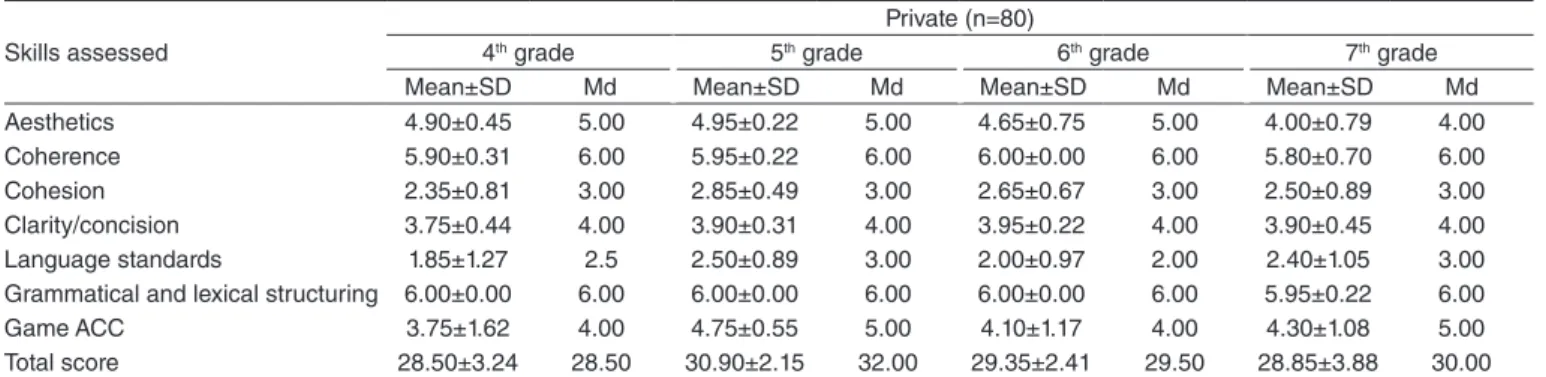
Tables 3 and 4 expose the descriptive measures of perfor-mances of students from public and private institutions in each of the assessed skills.
Figure 1 depicts the comparison of total score (overall performance) between school grades, with signiicant differ-ence between the fourth and sixth grades in public schools and between the fourth and ifth grades in private schools. Measures “d” in Table 5 point large (greater than 0.80) or too large effect size (greater than 1.30) between school grades in both public and private schools.
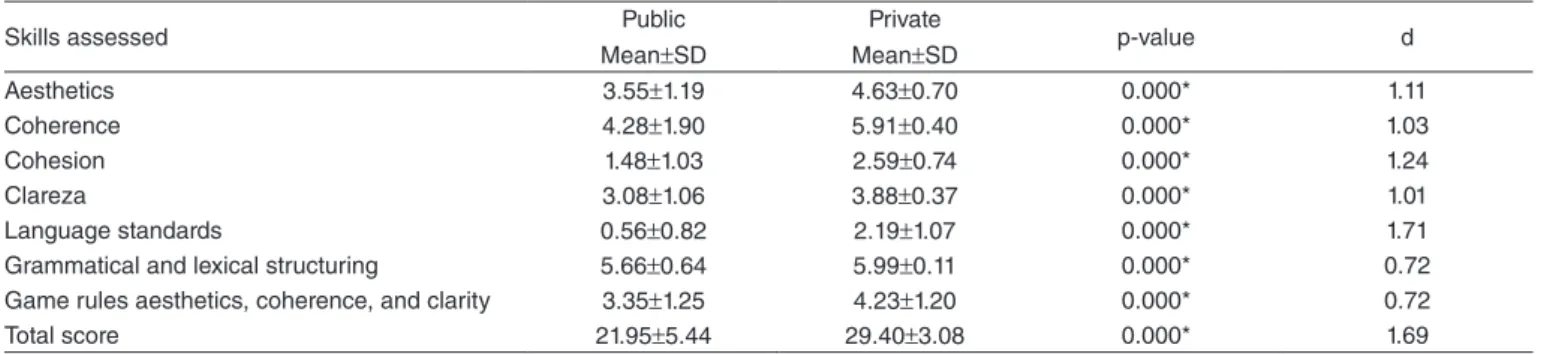
Comparing the two groups of each school, those from pri-vate institutions had better performances than those in public schools, with signiicant difference (Table 6). Measure “d” for skills evaluated based on the protocol pointed medium effect size for “grammatical/lexical structure” and “game rules”; as for the others, effect size was large (greater than 0.80) or too large (greater than 1.30).
DISCUSSION
Characteristics of texts
The characterization of texts by students can help Portuguese language elementary school teachers to check students’ text production and assist speech pathologists in the evaluation of texts by their patients. This study analyzed 480 texts written by 160 children from the fourth to seventh grade of basic edu-cation to establish a writing proile for students of private and public schools.
On the basis of the genres and their essential character-istics as to subject matter and compositional mode (struc-ture), the protocol (Appendix 1) was aimed at aesthetics, cohesion, coherence, clarity and concision, language stan-dards, grammatical structure, and some aspects of game rules description.
*In Portuguese language, nouns are either masculine or feminine, and it is usually
Table 1. Performances of students from public schools as to writing skills
Skills assessed
Public (n=80)
Mean±SD Median Minimum Maximum Lower Quartile
Upper Quartile
Quartile Range
Aesthetics 3.55±1.19 4.00 1.00 5.00 3.00 4.50 1.50
Coherence 4.28±1.90 5.00 0.00 6.00 3.00 6.00 3.00
Cohesion 1.48±1.03 1.00 0.00 3.00 1.00 2.00 1.00
Clarity/concision 3.08±1.06 3.00 1.00 4.00 2.50 4.00 1.50
Language standards 0.56±0.82 0.00 0.00 3.00 0.00 1.00 1.00
Grammatical and lexical structuring 5.66±0.64 6.00 3.00 6.00 5.00 6.00 1.00
Game ACC 3.35±1.25 4.00 0.00 5.00 3.00 4.00 1.00
Total score 21.95±5.44 23.00 6.00 31.00 18.00 26.00 8.00
Caption: Game ACC = Game rules aesthetics, coherence, and clarity; SD = standard deviation
Table 2. Performances of students from private schools as to writing skills
Caption: Game ACC = Game rules aesthetics, coherence, and clarity; SD = standard deviation
Skills assessed
Private (n=80)
Mean±SD Median Minimum Maximum Lower Quartile
Upper Quartile
Quartile Range
Aesthetics 4.63±0.70 5.00 3.00 5.00 4.50 5.00 0.50
Coherence 5.91±0.40 6.00 3.00 6.00 6.00 6.00 0.00
Cohesion 2.59±0.74 3.00 0.00 3.00 2.00 3.00 1.00
Clarity/concision 3.88±0.37 4.00 2.00 4.00 4.00 4.00 0.00
Language standards 2.1-±1.07 9 3.00 0.00 3.00 1.00 3.00 2.00
Grammatical and lexical structuring 5.99±0.11 6.00 5.00 6.00 6.00 6.00 0.00
Game ACC 4.23±1.20 5.00 0.00 5.00 4.00 5.00 1.00
Total score 29.40±3.08 31.00 17.00 32.00 28.00 32.00 4.00
Table 3. Mean, median, and standard deviation of students from the fourth to seventh grades in public school
Skills assessed
Public (n=80)
4th grade 5th grade 6th grade 7th grade
Mean±SD Md Mean±SD Md Mean±SD Md Mean±SD Md
Aesthetics 2.85±1.18 3.00 4.15±0.93 4.00 3.70±1.08 4.00 3.50±1.24 3.50 Coherence 4.25±2.07 5.00 3.85±2.28 5.00 4.90±1.33 5.50 4.10±1.74 4.00
Cohesion 0.75±0.85 1.00 1.30±0.92 1.00 2.05±0.89 2.00 1.80±1.01 1.50
Clarity/concision 2.60±0.94 3.00 3.10±1.07 3.00 3.65±0.59 4.00 2.95±1.32 4.00 Language standards 0.20±0.41 0.00 0.50±0.69 0.00 0.50±0.89 0.00 1.05±1.00 1.00 Grammatical and lexical structuring 5.55±0.83 6.00 5.60±0.68 6.00 5.85±0.37 6.00 5.65±0.59 6.00 Game ACC 2.75±1.59 3.00 3.25±1.12 3.00 4.15±0.59 4.00 3.25±1.16 4.00 *Total score 18.95±5.49 20.00 21.75±5.75 23.00 24.80±3.16 25.00 22.30±5.63 24.00 Caption: Md = median; SD = standard deviation; Game ACC = Game rules aesthetics, coherence, and clarity
Table 4. Mean, median, and standard deviation students from the fourth to seventh grades in private school
Skills assessed
Private (n=80)
4th grade 5th grade 6th grade 7th grade
Mean±SD Md Mean±SD Md Mean±SD Md Mean±SD Md
Aesthetics 4.90±0.45 5.00 4.95±0.22 5.00 4.65±0.75 5.00 4.00±0.79 4.00 Coherence 5.90±0.31 6.00 5.95±0.22 6.00 6.00±0.00 6.00 5.80±0.70 6.00
Cohesion 2.35±0.81 3.00 2.85±0.49 3.00 2.65±0.67 3.00 2.50±0.89 3.00
Veriication of aesthetics was aimed at the abilities of students to express a readable text without erasures and with adequate visual structuring (margin, paragraphs, capital letters). Mean values of children from public schools show that at least three of the ive items are met, and, in private schools, at least four (Tables 1 and 2). Aesthetics is essential for the understanding and visual organization of a text(18).
When analyzing qualitatively the items related to aesthet-ics, public school students showed little aptitude with the use of paragraphs; most of them wrote their text in a single para-graph, although they could develop the main idea with coher-ence. The expectation was that everyone mastered this aspect because such text rule is taught to students in the early years of schooling(19). The separation into paragraphs facilitates the
reader’s understanding and organizes the text(20).
Coherence was also investigated in texts, considering pre-sentation of central idea and chained ideas, relationship between title and content, adequacy to the proposal, arguments, and language level compatible with school year. For a text to be coherent, it must present a logical and harmonious relation-ship between ideas, which must be ordered and interconnected clearly, thus forming a unit in which the parts make sense(1).
Students of private schools (Table 2) had median values equal to the total value of the item (6.0), and those of public schools
(Table 1), had values close to it (5.0). Coherence is relevant in PCNs(19) because the school prioritizes and emphasizes the
ability to organize ideas; thus, the good performance of stu-dents seems to result from it.
Cohesion is one of the constitutive principles of text pro-duction that is expressed through language features, giv-ing it continuity, sequence, and a meangiv-ing(16,21). Although an
incoherent text can be the result of misuse of the elements of cohesion, because a grammatical or lexical error impedes the understanding of the text, cohesion and coherence are different aspects. Half of the students in private schools used cohesive elements (Table 2) regardless of their school year (Table 4). In the public school (Table 3), students meet, on average, one item in the fourth and ifth grades, with improvement in two items in the sixth grade. These students wrote their texts, in some cases, in a single paragraph, which impaired the cohe-sive chain.
Clarity and concision were veriied as related to the use of appropriate vocabulary, complete sentences, and absence of repeated information and words. Clarity and objectivity are important aspects in any text and must meet the principle of linguistic economy: to use few words to inform the maximum(2).
A competent writing implies selection of words and appropri-ate use of grammar(3). Most students of all grades in the private
Table 5. Effect size in overall performance (total score) between school years in both types of school
Effect size (d) – small: 0.20; medium: 0.50; large: 0.80; very large: 1.30
Comparsion between grades
Effect size (d)
Public (n=20)
Private (n=20)
4thx5th 0.50 0.87
4thx6th 1.31 0.30
4thx7th 0.75 0.10
5thx6th 0.66 0.68
5thx7th 0.10 0.65
6thx7th 0.55 0.15
35
30
25
20
Public
Private 15
10
5
0
4th 5th 6th 7th
Significant statistical difference between grades in public school: 4x6 (p=0.0110). Significant statistical difference between grades in private school: 4x5 (p=0.0142).
Figure 1. Comparison of total scores by level of education in private and public schools
Table 6. Comparison of mean scores and effect size in public and private school students
Skills assessed Public
Mean±SD
Private
Mean±SD p-value d
Aesthetics 3.55±1.19 4.63±0.70 0.000* 1.11
Coherence 4.28±1.90 5.91±0.40 0.000* 1.03
Cohesion 1.48±1.03 2.59±0.74 0.000* 1.24
Clareza 3.08±1.06 3.88±0.37 0.000* 1.01
Language standards 0.56±0.82 2.19±1.07 0.000* 1.71
Grammatical and lexical structuring 5.66±0.64 5.99±0.11 0.000* 0.72 Game rules aesthetics, coherence, and clarity 3.35±1.25 4.23±1.20 0.000* 0.72
Total score 21.95±5.44 29.40±3.08 0.000* 1.69
*Significant result in comparison between groups (Mann-Whitney test). Effect size (d) – small: 0.20; medium: 0.50; large: 0.80; very large: 1.30
school wrote texts comprising these characteristics (Table 2). In the public school (Table 1), such ability was consolidated in half the students of the sixth and seventh grades (median of both years = 4.00). Failure to use referential cohesion, that is, not using other words to refer to a same referent (synonyms or pronouns), was the item that most impaired clarity and conci-sion of the texts.
In the protocol used for this study, language standards involved spelling, punctuation, and accentuation, which were veriied as a whole, without classiication of misspellings. Analysis of distribution of results per school year indicated that the median in the fourth to sixth grades was zero, reach-ing 1.00 in the seventh grade (Table 3). In private schools, performance improves every year, but, unlike other skills, the median reaches 3.00 (maximum score) only in the ifth and seventh grades (Table 4).
The poor performance of public school students as to language standards compared to those from private school (Table 6) may relect the method adopted for the construction and consolida-tion of reading and writing skills: constructivism. The concept of constructivist adopted in pedagogy assumes that once learn-ers are part of an environment that provides and motivates them to literacy acquisition, they can develop such skills by them-selves. The teacher’s role is to observe the student, investigate their prior knowledge, and try to present them various elements so that they build their own knowledge(22). Corrections in
spell-ing, accentuation, and punctuation are considered indirect and, therefore, pushed into second place.
The analysis of the grammatical and lexical structure showed that this aspect is consolidated in schools. In the early school years, teaching is focused on graph-phonetic correspondence, but with the advancement of education, the focus changes to the development of more advanced skills such as producing complex sentences(4,5). Although students make use of informal
written language in social networks (abbreviations, misuse of agreement rules), this seems not to inluence the grammatical structure of formal writing.
The PCNs(19) place great emphasis on instructional texts
when addressing text genres, whose purpose is to instruct, ori-ent about something. This ability was therefore included in the study protocol. As for the ability to describe game rules, the students from the private school had similar performances in different grades (Table 4). Medians for all school grades were between 4.00 and 5.00 points.
Medians of public school students showed that half of stu-dents in the sixth and seventh grades scored 1 point above those scored by students in the fourth and ifth grades. We raise the hypothesis that this difference occurs because students from the fourth grade in public institutions have not acquired the habit of reading game manuals. The insertion of oral genres in school routine from the early years can avoid dificulties stu-dents face when dealing with situations that require them to write manuals or similar texts(16).
As to the total score of public school students, from the sixth grade on their overall performance meets 75% of the protocol, indicating that the skills assessed by the instrument are not consolidated in the early years. Figure 1
shows a tendency to progress from fourth to sixth grades, but the comparison between grades showed no statistical dif-ference, except between fourth and sixth grades, with very large effect size (Table 5).
Half the students of the private school were very close to total score, 31 (Table 2), and of them, 75% reached 28 (more than 85% of the protocol). Students performed well in most aspects evaluated, suggesting that skills comprised by the protocol are consolidated from the fourth year on. The com-parison between grades showed no difference either, except between the fourth and ifth grades (Figure 1), with large effect size (Table 5).
Students in the ifth grade of the private school had better performance. According to PCNs(19), different writing standards
for text production are consolidated in this period, closing a stage of basic education. In the sixth and seventh grades, new content is inserted and students go through a period of gram-matical restructuring, which may destabilize the knowledge of other content. On the other hand, there was a decrease in overall performance of students in the seventh grade (Table 4), but it could be limited to this study group, which did not show motivation and interest in producing the texts. Writing a text requires effort, so one can conceive new ideas and, therefore, it demands involvement(23). Thus, motivation must always
be considered when analyzing text productions, particularly among adolescents.
Comparison between schools
Individualized characterization of students’ performance in public and private schools was essential so that data did not provide false values for the sample of students evaluated within a general framework.
Comparison between performances of students from public and private institutions was signiicantly different in all aspects (Table 6), with better performance of students from the private institution. The effect size (d) pointed out that being in private school is relevant compared to being in public schools in most aspects evaluated, and this medium effect is only aimed to language standards and grammatical and lexical structuring. Exploring the teaching quality gap between private and public network schools in the irst phase of basic education, França and Gonçalves(24) reported a mean difference of 0.9 standard
devia-tion between networks, and an increasing difference according to socioeconomic status of students’ families and to the aver-age salaries paid to teachers.
The main instruments for assessing the quality of edu-cation in Brazil — the National System of Basic Eduedu-cation Evaluation (SAEB), National High School Exam (ENEM), School Performance Evaluation System of the State of São Paulo (SARESP) — showed a huge difference between pub-lic and private schools in all States(25). The distance between
59th position in science, and 53th to 55th position in language
studies(26).
Not only different scores, these numbers indicate differ-ent levels of knowledge in reading, mathematics, and science. At the age of 15, students from private schools can read a text and extract its main idea, identifying contradictory arguments. Public network students, on the other hand, can only under-stand explicit information and are not able to reckon the most important passages. There are exceptions, but they are a small set of excellence islands.
Many factors may have contributed for this difference, including the number of students in class, inappropriate mate-rial, physical structure, and working conditions of teachers(27).
Discussing these factors is not a purpose of our study, but rather pointing out that when assessing writing skills, the variable type of school should be considered.
All 160 students in this study do not relect the perfor-mance of Brazilian schools, but provide a sample of their behavior when producing texts. Working with texts remains a challenge in the classroom; greater challenge is to assess these tasks considering the cultural and social diversity of the country. A limitation of this study was the fact that we did not carry out an analysis of text production by students from various regions of the country.
CONCLUSION
Most children in private schools present consolidated skills in different grades, but most of those from public schools show this consolidation from the sixth grade on. Performances of private school students were superior to those of public schools in all grades, with signiicant differ-ence. There is a tendency to enhance general performance among students from fourth to sixth grades of public schools, but those from private schools present a quite similar overall performance in all grades.
The features observed in text production of students with-out learning dificulties can serve as parameter for analyses of texts by children with learning complaint in clinical practice, and also indicate factors that may be revised and improved as to teaching methodology in writing aiming at a quality pub-lic education.
*MAGS was responsible for data collection, organization and treatment, literature review, and discussion of results; SRVH conceived the study design, oriented data analysis, helped in literature review, and was responsible for the discussion of results and writing of the paper.
REFERENCES
1. Geraldi JW. Da redação à produção de textos. In: Chiappini L,
organizador. Aprender e ensinar com textos. São Paulo: Cortez; 1997. p. 17-24.
2. Rodrigues MAN, Silva RCMP. Análise das condições de produção de escrita no ensino médio. Linguasagem. 2010;13:1-11.
3. Graham S, Schwartz S, MacArthur C. Effects of goal setting and procedural facilitation on the revising behavior and writing performance of students with writing and learning problems. J Educ Psychol. 1995;87(2):230-40.
4. Gersten R, Baker S. Teaching expressive writing to students with learning disabilities: a meta-analysis. Elementary School Journal. 2001;101(3):251-72.
5. Silva AC. O impacto da revisão na qualidade de composições de crianças do 4º ano de escolaridade. Psicol Relex Crit. 2013;26(1):177-83. 6. Carvalho CAF, Ávila CRB, Chiari BM. Níveis de compreensão de leitura
em escolares. Pró-Fono R Atual Cient. 2009;21(3):207-12.
7. Kida ASB, Chiari BM, Ávila CRB. Escala de leitura: proposta de avaliação das competências leitoras. Rev Soc Bras Fonoaudiol. 2010;15(4):546-53.
8. Capellini SA, Oliveira AM, Cuetos F. PROLEC: Provas de avaliação dos processos de leitura. 2ª edição. São Paulo: Casa do Psicólogo; 2012. 9. Dellisa PRR, Navas ALGP. Avaliação do desempenho de leitura em
estudantes do 3º ao 7º anos, com diferentes tipos de texto. CoDAS. 2013;25(4):342-50.
10. Salles JF, Parente MAMP. Avaliação da leitura e escrita de palavras em crianças de 2ª série: abordagem neuropsicológica cognitiva. Psicol Relex Crit. 2007;20(2):220-8.
11. Pietri E. Ensino da escrita na escola: processos e rupturas. Cadernos de Educação. 2010;37:133-60.
12. Suassuna L, Bezerra MB. Avaliação da produção escrita e desenvolvimento de sequências didáticas. Est Aval Educ. 2010;21(47):611-28.
13. Santos LW, Riche RC, Teixeira CS. Análise e produção de textos. São Paulo: Contexto; 2012.
14. Forte LK, Scarpa ML, Kubota, RS. Apet – Análise da produção escrita de textos. 1ª edição. São José dos Campos: Pulso Editorial; 2014. 15. Stein LM. Teste de Desempenho Escolar: manual para aplicação e
interpretação. 1ª edição. São Paulo: Casa do Psicólogo; 1994. 16. Marcushi LA. Gêneros textuais: deinição e funcionalidade. In: Dionísio
AP, Machado AR, Bezerra MA, organizadores. Gêneros textuais e ensino. 3ª edição. Rio de Janeiro: Lucerna; 2003. p. 19-36.
17. Cohen, J.Statistical Power Analysis for the Behavioral Sciences. 2nd
edition. Hillsdale: Lawrence Erlbaum; 1988.
18. Cinel NCB. Disgraia - prováveis causas dos distúrbios e estratégias para a correção da escrita. Revista do Professor. 2003;19(74):19-25. 19. Brasil. Secretaria de Educação Fundamental. Parâmetros Curriculares
Nacionais: introdução aos parâmetros curriculares nacionais. MEC/SEF; 1998. 126 p.
20. Garcia OM. Comunicação em prosa moderna: aprenda a escrever aprendendo a pensar. 27ª edição. Rio de Janeiro: Fundação Getúlio Vargas; 2010. 548 p.
21. Koch IGV. A Coesão textual. 22ª edição. São Paulo: Contexto; 2012. 22. Macedo L. O construtivismo e sua função educacional. Educação &
Realidade. 1993;18(1):25-31.
23. Herrera AS. Produção textual no ensino fundamental e médio: da motivação à avaliação [dissertação]. Maringá: Universidade Estadual de Maringá – Programa de Pós-Graduação em Linguística Aplicada; 2000. 24. França MTA, Gonçalves FO. Provisão pública e privada de Educação
fundamentais: diferenças de qualidade medidas por meio de escore de propensão. Econ Apl. 2010;14(4):373-90.
25. Brasil. Câmara dos Deputados. Grupo de trabalho alfabetização infantil: os novos caminhos - relatório inal. 2ª edição; 2007. 180 p.
26. INEP. Instituto Nacional de Estudos e Pesquisas Educacionais Anísio Teixeira [Internet]. Pisa. [cited 2014 Jun 3]. Available from: http://portal. inep.gov.br/pisa-programa-internacional-de-avaliacao-de-alunos 27. Machado NJ. Qualidade da educação: cinco lembretes e uma lembrança.
APPENDIX 1
PROTOCOLO DE ANÁLISE DE PRODUÇÃO TEXTUAL Elaborado por Santos MAG e Hage SRV
Nome: _________________________________________________________________________________________________________ Idade: ______________________ Data de nascimento: _______________ Data da realização da avaliação: ______________________ Ano: _______________________ Escola pública ( ) privada ( ) Nome: ____________________________________________________ Repetência: ( ) Não ( ) Sim Qual ano? ______________________________________________________________________________
Habilidades avaliadas
Estética - narrativa e bilhete/carta
Letra legível Sim = 1 Não = 0
Sem rasuras Sim = 1 Não = 0
Margens regulares Sim = 1 Não = 0
Utilização de parágrafos Sim = 1 Não = 0
Utilização de letra maiúscula Sim = 1 Não = 0
Total (5)
Coerência - narrativa e bilhete/carta
Ideia central Sim = 1 Não = 0
Relação entre o título e o conteúdo Sim = 1 Não = 0
Ideias encadeadas Sim = 1 Não = 0
Argumentos adequados Sim = 1 Não = 0
Adequação a proposta Sim = 1 Não = 0
Nível de linguagem adequada ao ano Sim = 1 Não = 0
Total (6)
Coesão - narrativa e bilhete/carta
Utiliza elementos de ligação entre as partes da frase Sim = 1 Não = 0 Utiliza elementos de ligação entre frases e parágrafos Sim = 1 Não = 0
Sem repetição inadequada de palavras Sim = 1 Não = 0
Total (3)
Clareza e concisão - narrativa e bilhete/carta
Faz uso de palavras com sentido apropriado Sim = 1 Não = 0
Frases completas Sim = 1 Não = 0
Ausência de informações repetidas Sim = 1 Não = 0
Uso de vocábulos sinônimos, pronomes (sem repetição de palavras) Sim = 1 Não = 0 Total (4)
Norma culta - narrativa e bilhete/carta
Ortografia correta Sim= 1 Não = 0
Acentuação completa Sim = 1 Não = 0
Utiliza as pontuações adequadas Sim = 1 Não = 0
Total (3)
Estruturação gramatical e lexical – narrativa e bilhete/carta
Períodos simples Sim = 1 Não = 0
Períodos compostos Sim = 1 Não = 0
Concordância verbal Sim = 1 Não = 0
Concordância nominal Sim = 1 Não = 0
Uso de pronomes Sim = 1 Não = 0
Uso de advérbios Sim = 1 Não = 0
Total (6)
Estética, coerência e clareza - descrição da brincadeira ou jogo
Utiliza parágrafos ou marcadores para descrever Sim = 1 Não = 0
Utiliza pontuações Sim = 1 Não = 0
Ideias encadeadas Sim = 1 Não = 0
Ausência de informações repetidas Sim = 1 Não = 0
Uso de vocábulos sinônimos, pronomes (sem repetição de palavras) Sim = 1 Não = 0 Total (5)
Instruções verbais 4°. e 5°. Anos
Narrativa: escolha uma das imagens abaixo. Após escolher, você deve contar uma história ou relatar um acontecimento sobre a imagem. Seu trabalho deverá ter título, começo, meio e fim.
Bilhete: escolha uma pessoa (amigo, mãe, pai, primo) para escrever um bilhete. Você pode deixar um recado para ela ou convidá-la para assistir um filme, brincar, jogar, andar de bicicleta ou outro convite que desejar.
6°. e 7°. Anos
Narrativa: observe a imagem. Se você já foi ao cinema, escreva um texto contando como foi, que filme assistiu, qual as sensações, o que você lembrar e quiser contar. Se ainda não foi, conte sobre um filme que assistiu na TV. Seu trabalho deverá ter título, começo, meio e fim.
Carta: neste trabalho você deverá escrever uma carta contando para uma pessoa (amigo, primo, tio) sobre uma viagem, sua cidade, sua família ou sobre um sonho que você deseja realizar.
Para todos os anos: do 4°. ao 7°.
Regras de jogo ou brincadeira: você já participou de algum tipo de brincadeira como amarelinha, pique-esconde, ou jogou o jogo da velha, xadrez, futebol, queima? Pense em alguma brincadeira ou jogo de sua preferência e escreva no mínimo cinco regras da atividade que você escolher.