CASE REPORT
Rare association of cutaneous vasculitis, IgA
nephro-pathy and antiphospholipid antibody syndrome with
tuberculous lymphadenitis
Roberto Bueno Filho,IAlberto Pinto Cordeiro,IFlavia Tremeschin de Almeida,IICatarina Shaletich,IIIRoberto Silva Costa,III Ana Maria F. RoselinoI
IUniversity of Sa˜o Paulo, School of Medicine of Ribeira˜o Preto, Department of Medical Clinics, Division of Dermatology, Ribeira˜o Preto/SP, Brazil. IIUniversity of Sa˜o Paulo, School of Medicine of Ribeira˜o Preto, Department of Medical Clinics, Division of Dermatology, Biomedical, Laboratory of Molecular Biology, Ribeira˜o Preto/SP, Brazil.IIIUniversity of Sa˜o Paulo, School of Medicine of Ribeira˜o Preto, Hospital of Clinics, Department of Pathology, Ribeira˜o Preto/SP, Brazil.
Email: [email protected] Tel.: 55 16 3602-2447
INTRODUCTION
Mycobacterium tuberculosisinfections can be associated with several immune mechanisms. Some of these mechanisms, such as vasculitis associated with tuberculosis, are rare and can challenge dermatologists when making differential diagnoses. The association between pulmonary tuberculosis (Tb) and vasculitis was first described by Parish and Rhodes (1) in 1967. These associations fall into three main types: pulmonary Tb/ cutaneous leukocytoclastic vasculitis (CLV), pulmonary Tb/ Henoch-Scho¨nlein purpura (HSP) and pulmonary Tb/vasculi-tis secondary to rifampicin (2-7). The existence of circulating immune complexes in pulmonary Tb has been demonstrated, and the levels of these complexes are related to disease activity. The mechanism of vascular damage is attributed to immune complexes rather than to direct damage caused by M. tuberculosis(8,9). Another differential diagnosis is CLV due to rifampicin therapy (7). In cases of Tb-related vasculitis, skin lesions usually improve following the administration of a specific Tb treatment; an anti-inflammatory therapy is not required (2-5,10). Immune complexes are also responsible for renal injury, which is associated with increased levels of immunoglobulins (mainly IgA against the A-60 antigen ofM. tuberculosis), and mesangial deposition, which leads to the activation of the alternative complement and lecithin pathways, resulting in glomerular damage (IgA nephropathy) (11). Finally, Tb is associated with the development of anti-phospholipid antibody syndrome (APS) by inducing the production of auto-antibodies (18,19). The association of tuberculous lymphadeni-tis, CLV, IgA nephropathy and APS in a single patient has not been reported yet.
CASE DESCRIPTION
A 45-year-old woman from Ribeira˜o Preto (northeastern region of Sa˜o Paulo State, Brazil) presented to our clinic with painful necrotic lesions on both feet, mainly on the toes,
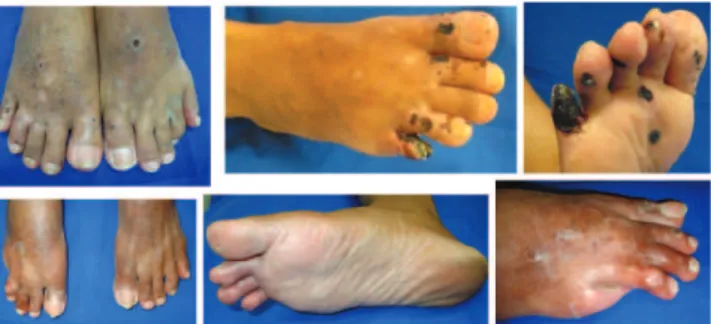
which had recently increased in number and size. She had a history of headaches and seizures, an ischemic stroke five years earlier (resulting in facial motor sequelae) and five pregnancies, which consisted of four normal deliveries and one abortion at 22 years of age. On examination, there were cervical adenomegalies with bulky and coalescing lymph nodes (the largest measuring 3 cm in diameter) and crusted lesions on the dorsal feet and tips of the toes with purulent exudates and interdigital maceration (Figure 1). The periph-eral sensitivity test yielded normal results. Laboratory tests showed hypochromic anemia with microcytosis (hemoglo-bin: 11.0 g/dL; NR: 12.0-15.5 g/dL), increased inflammatory activity (ESR: 30 mm/1st hour; NR: ,10 mm/1st hour; C-reactive protein: 3.46 mg/dL; NR: up to 0.5 mg/dL; alpha1-acid glycoprotein: 156 mg/dL; NR: 50-120 mg/dL), increased levels of immunoglobulins (IgA: 1,070 mg/dL; NR: 134-297 mg/dl; IgG: 1,900 mg/dL; NR: 770-1,510 mg/dl; IgM: 222 mg/dL; NR: 67-208 mg/dl), positive autoantibo-dies (antinucleolar antibody (ANA)-positive 1:100 with nucleolar pattern; lupus anticoagulant (PIL and dRVVT)-positive; anticardiolipin IgG: 14.9 GPL/mL (weak positive); NR: up to 14.0 GPL/ml; p-ANCA-positive), urinary dis-orders (microscopic hematuria: 25-30 RBCs/field; NR: 3-5 RBCs/field; urinary erythrocytes: 90% total dysmorphic cells, 19% acanthocytes; NR: up 4% acanthocytes; proteinuria: 255 mg/24 h; NR: up to 150 mg/24 h), and intradermal reaction test positive for Tb (PPD: 45 mm with necrosis). Cervical, thoracic and abdominal computed tomographies showed cervical adenomegaly (up to 1.8 cm in length) with central necrosis, a left axillary 2.3-cm lymph node, and several retroperitoneal lymph nodes (up to 0.9 cm in length). A cranial MRI showed a cerebral infarction on the left parietal region and lacunar infarctions in the region of capsular nuclei. Histopathology showed the following: (1) cervical lymph node - chronic granulomatous lymphadenitis with caseous necrosis; (2) fifth left toe - focal granulomatous in addition to leukocytoclastic vasculitis and direct immuno-fluorescence (DIF) strongly positive for anti-fibrinogen serum (3+) on capillary walls; and (3) renal biopsy - focal and segmental sclerosis with mild focal and chronic tubulointer-stitial damage, characterized by mesangial deposition of IgA on DIF, which may correspond to primary IgA nephropathy (Berger’s Disease) or Henoch-Scho¨nlein purpura (Figure 2).
Copyrightß2012CLINICS– This is an Open Access article distributed under the terms of the Creative Commons Attribution Non-Commercial License (http:// creativecommons.org/licenses/by-nc/3.0/) which permits unrestricted non-commercial use, distribution, and reproduction in any medium, provided the original work is properly cited.
No potential conflict of interest was reported.
CLINICS 2012;67(12):1497-1500 DOI:10.6061/clinics/2012(12)24
PCR with DNA that was extracted from paraffin blocks of lymph node and skin biopsies confirmedMycobacteriumsp. only in the lymph node (Figure 3). The final diagnosis consisted of Tb lymphadenitis, CLV, primary IgA nephro-pathy and APS. Ciprofloxacin (500 mg) was prescribed twice per day for ten days, and Fluconazole (150 mg) was prescribed once per week for eight weeks for the secondary infection and interdigital maceration on the feet. Thereafter, aspirin (200 mg daily) and warfarin (for antic-oagulation) were prescribed. The patient was evaluated by physicians in the Departments of Neurology, Ophthalmology, Nephrology and Infectious Diseases. Tb treatment was initiated with RIPE (rifampicin, isoniazid, pyrazinamide and ethambutol). Because an adverse drug reaction to pyrazinamide was observed, administration of this medication was suspended. Because of the worsening necrosis on her toes, the patient’s left fifth toe was amputated with no complications. The patient finished the Tb treatment, which was followed by weight recovery,
normalization of lymph node size, absence of new vasculitic lesions and significant improvement of previous skin lesions. ANA and PIL were negative, but glomerular hematuria and proteinuria remained positive.
DISCUSSION
There are few reported cases of an association between Tb and CLV (nine cases) and Tb and IgA nephropathy (six cases) (2-6,13,14). Only 10% of CLV cases are attributed to
Figure 1 - Clinical presentation of a patient with cutaneous
vasculitis. The upper figures show progressive necrotic lesions on the dorsal feet, mainly on the toes. The lower figures show the amputation of the left fifth toe and the improvement of vasculitic skin lesions following RIPE treatment.
Figure 2 -Histopathology of lymph node (A), skin (B) and kidney (C) biopsies. A. Chronic granulomatous lymphadenitis with caseous
necrosis without microorganisms (magnification: 20x and 40x) B. Leukocytoclastic and focal granulomatous vasculitis (objectives: 20x and 40x) C. Renal biopsy contained 13 glomeruli, 12 normal and one with a focal segmental lesion. DIF showed diffuse and global mesangial deposits of IgA (objective: 40x).
Figure 3 - 2% agarose gel. PCR was performed with specific
primers forMycobacteriumsp. (17), whose amplicon is 383 bp.
Columns: 1 and 7, 100-bp marker; 2, negative control (without DNA); 3, paraffin biopsy of skin vasculitis; 4, paraffin sample of a
cervical lymph node; 5, culture of M. aviumcomplex; and 6,
culture ofM. tuberculosis. PCR was positive forM. tuberculosis
culture and the cervical lymph node (site of infection) and negative for the skin (hypersensitivity vasculitis).
Vasculitis and Tuberculosis
Filho RB et al. CLINICS 2012;67(12):1497-1500
drugs and infections, and 61% are considered idiopathic cases. Considering the existence of circulating immune complexes in pulmonary Tb and the relationship between immune complex levels and disease activity, the damage mechanism that has been proposed for this type of vasculitis is the deposition of immune complexes that are formed by antibodies against antigens of the bacterium on the vascular wall rather than direct aggression by the bacterium (8,9). Up to 56% of Tb patients have circulating immune complexes, and there is evidence of increased immunoglobulin levels in these patients, mainly IgA and IgG, as was observed in our patient. These immunoglobu-lins are produced against the A-60 antigen of the mycobacterium, leading to the formation of immune complexes (11).
Another differential diagnosis is the onset of vasculitis following rifampicin therapy, as demonstrated in some case reports, where CLV occurred due to this medication (7). However, our patient had skin lesions before using this drug. In cases of Tb-related vasculitis, skin lesions improve with RIPE treatment alone; no specific anti-inflammatory therapy is required (2-7,10,15).
In 1985, Cohen and Rosenstein (12) described a case of an association between Tb and IgA nephropathy in which renal involvement improved after Tb treatment. In this case, HSP needed to be considered. HSP is a type of systemic vasculitis that is more common in children, and both renal involve-ment, defined as IgA nephropathy, and palpable purpura appear in 50% of cases (6,13,14). Some specialists defend the theory that Berger’s disease is a restricted form of HSP, and there have been five reported cases of HSP associated with Tb. However, our patient presented with CLV with anti-fibrinogen, not IgA, deposition in the capillary walls, which rules out a diagnosis of HSP.
In addition, PCR with primers specific toMycobacterium
(17) was performed in cervical lymph node and skin samples, which confirmed the etiology of Mycobacterium
sp. in the lymph node sample but not in the skin sample. The DNA that was extracted from the paraffin skin sample was amplified with keratin primers, confirming its integrity (data not shown). These results strongly suggest a hyper-sensitivity form of CLV.
None of the case reports of Tb associated with CLV or Tb associated with IgA nephropathy in the literature included descriptions of positive autoantibodies. In our patient, ANA, p-ANCA and lupus anticoagulant (PIL and dRVVT) tests were positive, and there was a prior medical history of ischemic stroke (confirmed by MRI). These findings reinforce the diagnosis of an autoimmune disease and lead us to a diagnosis of APS secondary to Tb.
The production of anti-phospholipid antibodies (aPLs) could have either an autoimmune or infectious origin. The latter origin does not involve anti-b2-glycoprotein I
(anti-b2GPI) activity and usually does not cause thrombosis. However, there have been recently described cases of lepromatous leprosy patients with genetically determined anti-b2GPI activity followed by thrombosis (18). By indu-cing a specific cellular immune response and secondary antibody production (as noted by the strong positive PPD and increased immunoglobulin levels), tuberculosis stimu-lates the production of autoantibodies (including aPLs) and procoagulant factors, such as plasma fibrinogen (factor I), factor VIII and D-dimers. Thus, M. tuberculosis can be
considered an etiologic factor in aPL production and the triggering of APS (19).
In the literature, there is a single report of concomitant CLV, Sweet syndrome, cutaneous polyarteritis nodosa and cervical adenopathy caused by M. fortuitum (20). The association of Tb, focal granulomatous, CLV and IgA nephropathy in a single patient has not been reported. This case is complex, demonstrating rare manifestations of an endemic disease in Brazil, and serves as a warning to dermatologists to be cautious in the differential diagnosis of patients with vasculitic presentations.
AUTHOR CONTRIBUTIONS
Bueno Filho R contributed to the writing, literature review, data interpretation, and data and picture collection and was clinically responsible for the patient. Cordeiro AP contributed to the collection of pictures and data and was clinically responsible for the patient. Almeida FT was involved in data collection and was responsible for the PCR experiment. Shaletich C was involved in the review and data interpretation processes. Costa RS was involved in the review, data interpretation, and writing processes. Roselino AM was involved in the review, writing, and data interpretation processes and was the coordinator of the Granulomatous Skin Diseases Clinic and coordinator of the Biomolecular Laboratory of Dermatology.
REFERENCES
1. Parish WE, Rhodes EL. Bacterial antigens and aggregated gamma globulin in the lesions of nodular vasculitis. Br J Dermatol. 1967;79(3):131-47.
2. Ekenstam E, Callen JP. Cutaneous leukocytoclastic vasculitis. Clinical and laboratory features of 82 patients seen in private practice. Arch Dermatol. 1984;120(4):484-9, http://dx.doi.org/10.1001/archderm.1984.016504000660 14.
3. Kim HM, Park YB, Maeng HY, Lee SK. Cutaneous leukocytoclastic vasculitis with cervical tuberculous lymphadenitis: a case report and literature review. Rheumatol Int. 2006;26(12):1154-7, http://dx.doi.org/ 10.1007/s00296-006-0152-1.
4. Sais G, Vidaller A, Jucgla` A, Peyrı´ J. Tuberculous lymphadenitis presenting with cutaneous leucocytoclastic vasculitis. Clin Exp Dermatol. 1996;21(1):65-6, http://dx.doi.org/10.1111/j.1365-2230.1996.tb00018.x. 5. Carvalho M, Dominoni RL, Senchechen D, Fernandes AF, Burigo IP,
Doubrawa E. Cutaneous leukocytoclastic vasculitis accompanied by pulmonary tuberculosis. J Bras Pneumol. 2008;34(9):745-8.
6. Han BG, Choi SO, Shin SJ, Kim HY, Jung SH, Lee KH. A case of Henoch-Scho¨nlein purpura in disseminated tuberculosis. Korean J Intern Med. 1995;10(1):54-9.
7. Iredale JP, Sankaran R, Wathen CG. Cutaneous vasculitis associated with rifampicin therapy. Chest. 1989;96(1):215-6, http://dx.doi.org/10.1378/ chest.96.1.215.
8. Johnson NMcI, McNicol MW, Burton Kee EJ, Mowbray JF. Circulating immune complexes in tuberculosis. Thorax. 1981;36(8):610-7, http://dx. doi.org/10.1136/thx.36.8.610.
9. Brostoff J. Immune complexes in the spectrum of tuberculosis. Tubercle. 1981;62(3):169-73, http://dx.doi.org/10.1016/0041-3879(81)90002-7. 10. Chan CH, Chong YW, Sun AJ, Hoheisel GB. Cutaneous vasculitis associated
with tuberculosis and its treatment. Tubercle. 1990;71(4):297-300. 11. Alifano M, Sofia M, Mormile M, Micco A, Mormile AF, Del Pezzo M,
et al. IgA immune response against the mycobacterial antigen A60 in patients with active pulmonary tuberculosis. Respiration. 1996;63(5):292-7, http://dx.doi.org/10.1159/000196563.
12. Berger J. IgA glomerular deposits in renal disease. Transplant Proc. 1969;1(4):939-44.
13. De Siati L, Paroli M, Ferri C, Muda AO, Bruno G, Barnaba V. IgA Nephropathy and Pulmonary Tuberculosis. Ann Diagn Pathol. 1999; 3(5):300-3, http://dx.doi.org/10.1016/S1092-9134(99)80026-4.
14. Cohen AJ, Rosenstein ED. IgA nephropathy associated with dissemi-nated tuberculosis. Arch Intern Med 1985;145(3):554-6, http://dx.doi. org/10.1001/archinte.1985.00360030206036.
15. Jennette JC, Falk RJ. Small vessels vasculitis. N Engl J Med. 1997;337(21):1512-23.
16. Singh SP, Misra GC, Prusty PK, Das RK. Tubercular lymphadenitis with purpura. J Indian Med Assoc 1986;84(8):247-9.
17. Brisson-Noel A, Aznar C, Chureau C, Nguyen S, Pierre C, Bartoli M, et al. Diagnosis of tuberculosis by DNA amplification in clinical practice
CLINICS 2012;67(12):1497-1500 Vasculitis and Tuberculosis
Filho RB et al.
evaluation. Lancet 1991;338(8763):364-6, http://dx.doi.org/10.1016/ 0140-6736(91)90492-8.
18. Brochado MJ, Figueiredo JF, Mendes-Junior CT, Louzada-Junior P, Kim OM, Roselino AM. Correlation between beta-2-glycoprotein I gene polymorphism and anti-beta-2 glycoprotein I antibodies in patients with multibacillary leprosy. Arch Dermatol Res. 2010;302(8):583-91, http:// dx.doi.org/10.1007/s00403-010-1032-9.
19. Naithani R, Agrawal N, Choudhary VP. Deep venous thrombosis associated with tuberculosis. Blood Coagul Fibrinolysis. 2007;18(4):377-80, http://dx.doi.org/10.1097/MBC.0b013e3280d942b4.
20. Chen HH, Hsiao CH, Chiu HC. Successive development of cutaneous polyarteritis nodosa, leucocytoclastic vasculitis and Sweet’s syndrome in a patient with cervical lymphadenitis caused by Mycobacterium fortuitum. Br J Dermatol. 2004;151(5):1096-100.
Vasculitis and Tuberculosis
Filho RB et al. CLINICS 2012;67(12):1497-1500