POST-HARVEST QUALITY OF FRESH-MARKETED
TOMATOES AS A FUNCTION OF HARVEST PERIODS
Marcos David Ferreira1*; André Toshiro Oshima Franco2; Ricardo Freitas Kasper3; Antonio Carlos Oliveira Ferraz1; Sylvio Luiz Honório1; Marcelo Tavares4
1
UNICAMP/FEAGRI - Faculdade de Engenharia Agrícola, C.P. 6011 - 13083-875 - Campinas, SP - Brasil. 2
UNICAMP/FEA - Faculdade de Engenharia de Alimentos, C.P. 6121 - 13081-970 - Campinas, SP - Brasil. 3
UFSCar/CCA - Centro de Ciências Agrárias, C.P. 153 - 13600-970 - Araras, SP - Brasil. 4
UFU - Faculdade de Matemática, Av. João Naves de Avila, 2160 - 38408-100 - Uberlândia, MG - Brasil. *Corresponding author <[email protected]>
ABSTRACT: Losses on tomato business chain start at harvest, a two-months period. At the beginning of the harvest, fruits concentrate at the basal part of the plant, then in the middle, and finally at the top, and undergo changes in diameter and maturity indexes as harvest progresses. The aim of this work was to evaluate the impact of handling at three different periods: (I) 15 days, (II) 30 days, and (III) 45 days after the beginning of harvest. Tomatoes were ordinarily grown and harvested in to bamboo baskets, and transferred to plastics boxes. Fruits were classified according to ripening stage and diameter, and evaluated for mechanical damage and external defects caused by harvesting procedures. The time required for the harvest operation was measured; damage to fruits (%) and weight loss (%), caused either in the field and/or during the harvesting process, were taken into consideration and related to the final quality of fruit after storage for 21 days. The same methodology was used all through the production and harvest cycle. The highest % fruit damage occurred during period II, a longer harvest time than the other two periods. Fruits not submitted to handling showed lower weight loss than handled fruits. Fruits harvested in period II and stored for 21 days showed higher losses due to mechanical injury.
Key words: Lycopersicon esculentum, losses, post-harvest, mechanical injury
QUALIDADE DO TOMATE DE MESA EM FUNÇÃO
DA ÉPOCA DE COLHEITA
RESUMO: As perdas na cadeia produtiva do tomate de mesa iniciam-se no campo durante a colheita, a qual ocorre por cerca de dois meses. No inicio da colheita frutos concentram-se na parte basal da planta, posteriormente na região mediana e finalizam na parte superior. Frutos durante o período de colheita apresentam alterações quanto ao diâmetro e estádio de maturidade. O objetivo deste trabalho foi avaliar o efeito do manuseio durante a colheita na qualidade do tomate de mesa, cultivar ‘Fanny’ após 15, 30 e 45 dias, depois de iniciada a colheita. Tomates foram colhidos no sistema tradicional, utilizando-se de uma cesta de bambu e transferidos para caixas plásticas. Foi realizada uma classificação para o estádio de maturação e diâmetro e avaliação para danos físicos e defeitos externos nos frutos colhidos. O tempo necessário para colheita foi mensurado. Para avaliação da qualidade dos frutos foram considerados: perda de peso (%), incidência de danos físicos (%) originados no processo de colheita e originados em campo. Estes resultados foram relacionados à qualidade final dos frutos após armazenagem por 21 dias. A mesma metodologia foi utilizada nas três diferentes épocas. Os maiores valores em danos físicos (%) obtidos na etapa de colheita foram na segunda época, juntamente com um maior tempo para realização desta colheita. Nas três épocas, frutos não submetidos ao manuseio apresentaram menor perda de peso. Após armazenamento por 21 dias, frutos obtidos na segunda época demonstram maiores perdas devido a danos físicos do que as demais épocas.
Palavras-chave: Lycopersicon esculentum, perdas, pós-colheita, danos físicos
INTRODUCTION
Post-harvest losses in horticultural fruit crops are mainly related to handling, from harvest to retail. Losses are caused by mechanical injuries, inadequate storage, unsuitable handling and transport, and on-display time in the retail market (CEAGESP, 2002). These losses may result in up to US$ 0.012 cost increase per kilogram (FNP
Consultoria & Comércio, 2001). Changes in tomatoes quality can be of mechanical, physiological, or pathologi-cal nature (Mohsenin, 1986).
me-tabolism (Galvis Vanegas, 1987), flavor and smell (Moretti & Sargent, 2000; Sargent et al., 1997), and firm-ness (Jackman et al., 1990; Kader et al., 1978). Physical damages may also significantly affect chemical and physi-cal composition of the pericarp and locular tissue in to-matoes.
The incidence and severity of physical, internal damages to fruits depend on the impact energy, number of impacts, cultivar, and ripening stage, and is cumula-tive during post-harvest handling practices (Sargent et al., 1992). Therefore, the various fruit handling steps, from the field to the consumer, must be carefully coordinated and integrated to maximize produce quality (Sargent et al., 1992).
The use of measurements to determine internal bruising from impacts has proved suitable to evaluate in-juries in fruits (Chen & Yazdani, 1991; Sargent et al., 1992; Moretti et al., 1998). However, these evaluations have been carried out in the laboratory only. The aim of this work was to characterize and evaluate the processes currently used for harvesting fresh-marketed tomatoes at 15 (I), 30 (II), and 45 (III) days after the beginning of harvest, with regard to (1) maturity stage, diameter, physi-cal damages and defects appearing during harvest and cultivation, and time required to carry out the harvest op-eration; and (2) evaluation of the influence of harvest at different periods on quality characteristics of fresh-mar-keted tomatoes, such as weight loss (%), quantity of physical damages (%), and final quality after storage for 21 days. Based on this information, recommendations for interventions needed to improve harvesting system and development of harvesting equipment could be issued.
MATERIAL AND METHODS
Tomato fruits, ‘Fanny’ cultivar harvested in Estiva Gerbi, State of São Paulo, Brazil (46o53’ W; and 22o19’ S), mean annual temperature 19.6°C and annual precipitation of 1,565 mm, after growing on a Typic Hapludox, traditional planting system over bamboo stakes, under furrow irrigation, spaced 1.00 m between rows and 0.50 m between plants. Fruits were harvested by an experienced harvester to bamboo baskets (40 cm length; 25 cm height; and 20 cm width) and later trans-ferred to plastic boxes (55 cm length; 30 cm height; and 35 cm width) which were placed on the main planting car-rier. The harvest of three plastic boxes was defined as a standard for the evaluations.
The fruits were classified in the field at three dif-ferent harvesting periods: initial (I), middle (II), and fi-nal (III) (15, 30, and 45 days, respectively), in relation to fruit diameter, maturity stage, and physical damages and defects observed. Evaluations were made along the three harvesting periods at the same place, but with dif-ferent numbers of plants.
Harvesting boxes contained an average 170 fruits each. In period I, 502 plants were required to fill the three boxes; in period II, 315 plants; and 130 plants were needed in period III, reflecting variations in concentra-tion of fruits per plant during the crop cycle. A digital caliper rule was used to measure transversal fruit diam-eter. To evaluate maturity stage and physical damage and defects at harvest time, the Normas e Padrões de Classificação para Tomate de Mesa (Classification Rules and Standards for Table Tomato) (CEAGESP, 2000) were used as a reference. In relation to defects, fruits were clas-sified according to the following rating scale: (1) with-out physical damage; (2) light external surface physical damage; (3) serious external physical damage, caused by insects, fruit borer, or bamboo boxes stakes; (4) deformed fruit; (5) stained fruit, showing viral disease. The time required to harvest was measured using chronometers, comprising the harvest of the three plastic boxes.
To measure the effect of harvest periods on fruit quality during storage samples of 40 fruits at the salad stage (CEAGESP, 2000) were taken from each box (rep-licates), and the same number of fruits were taken directly from the plant at the same maturity stage. These fruits were transported to the laboratory, individually wrapped in foam inside cardboard packages, and stored at 20oC and 60% relative humidity for 21 days. Weight loss (%), external physical damages (%), and final quality after storage were assessed. Weight loss was determined by the percent relation between initial and final weight, using fruits from both origins (field and harvest), every three days, from the harvest day to the end of the 21-day stor-age period.
The external areas corresponding to physical damage were delimited using a black permanent marker, fruits being marked two days after harvest. Based on the Normas e Padrões de Classificação (Classification Rules and Standards) (CEAGESP, 2000), physical damages were identified and divided in two categories: those caused during crop cycle and those resulting from the har-vest process. Physical damages caused in the field are those derived from abrasion against bamboo stakes and tying tape, insects attacks, and physiological and nutri-tional disorders. Physical damages resulting from the har-vesting process were identified as those derived from compression of the fruits against the harvesting basket and/or plastic box, impact of the fruit when falling into the plastic box and/or harvesting basket, fingernail mark-ings or fingerprints, and compression of the fruits pe-duncle against each other.
considering the fruit as a sphere (Mohsenin, 1986), and using the following formula: external area of the fruit = 4 × 3.1415 × R2 (R = radius), with the result expressed as a percentage. To measure final quality after storage for 21 days, fruits were evaluated based on the following scale: (0) fruit suitable for consumption; (1) discarded be-cause of surface physical damage; (2) discarded bebe-cause of serious external physical damage; (3) discarded be-cause of physical damage and associated rotten areas; (4) discarded because of rottenness; (5) discarded because of excessive water loss.
The comparisons between different harvest peri-ods for data on weight loss and physical damages in the plant and in the field were made based on Student’s t test (α = 0.05) The proportions-difference statistical test
(Bussab & Morettin, 2002) was used to compare quality evaluation after storage, by comparing harvest periods and fruits submitted or not to the harvest stage.
RESULTS AND DISCUSSION
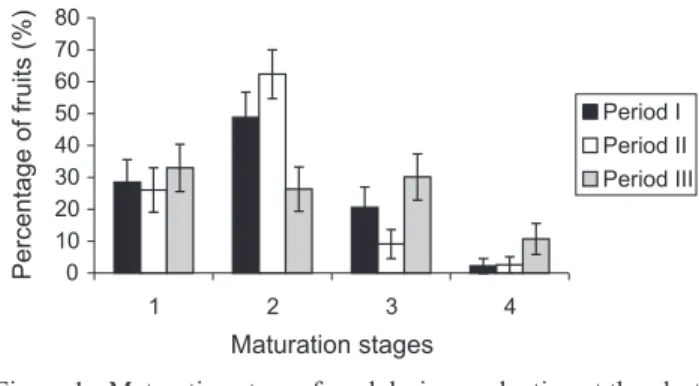
In the maturity stage characterization of fruits at harvest, a higher concentration (62.39%) of fruits at stage 2 (salad) was observed in the second harvesting period, differently from the other periods, with values of 48.80% (period I) and 26.28% (period III) (Figure 1). However, a high concentration of fruits (above 25%) at the green stage occurred in all harvesting periods. However, fruits harvested at the green stage could be unripe, compromis-ing the quality of the final product (Caliman et al., 2003). In the last harvesting period (III), a considerable concen-tration of fruits at stage 3 (colored, 30.10%) and 4 (red, 10.67%) was recorded. Tomatoes at more advanced ma-turity stages are more sensitive to physical damages than at the green stage (Halsey, 1955). These maturity stage differences could be related to temperature variations in the field, since the optimal temperature range to promote synthesis of the pigment lycopene, responsible for the in-tense-red color of fruits is 24oC-28oC (Melo, 1993). How-ever, during the rainy period (spring-summer), with high
temperature and humidity, more serious phytosanitary problems may occur, resulting in lower productivity and low fruit quality (Sediyama et al., 2003). The highest mean temperatures in the field occurred in period III, and could have influenced maturity stage. In periods I and II, the mean temperatures registered were 28.2oC (maximum) and 14.6oC (minimum). In period III, the average maxi-mum temperature was 33oC, with a mean minimum tem-perature 19.5oC.
In period III there was a higher concentration (35.43%) of fruits with smaller diameter (50-60 mm), and a smaller proportion (13.52%) of fruits with greater di-ameters (70-80 mm), when compared with the other pe-riods (Figure 2). Fruits with smaller diameters are more frequent in the last harvesting period, possibly because the loss in plant vigor, a common phenomenon at the end of the tomato crop cycle.
In period I, 54.92% of the fruits did not show any type of physical damage, followed by 24.30% in period III and 21.30% in period II (Figure 3). However, a greater concentration of light physical damages (52.86%) oc-curred in period II, differently from period I (31.29%) and period III (27.43%). This greater increase in physical damages was later detected in the laboratory. There was a higher percentage (14.70%) of serious damages in
pe-0 10 20 30 40 50 60 70 80
1 2 3 4
Maturation stages
Period I Period II Period III
Percentage
of
fruits
(%)
Figure 1 - Maturation stages found during evaluation at the plastic box harvest stage (mean of 520 fruits). Stage 1: green; stage 2: salad; stage 3: colored; stage 4: red (CEAGESP, 2000).
Figure 2 - Diameter of fruits evaluated at the harvest stage (mean of 520 fruits).
0 10 20 30 40 50 60
<50 50-60 60-70 70-80 >80
Period I Period II Period III
Percentage
of
fruits
(%)
Fruit diameter (mm)
Figure 3 - Evaluation for physical damage during harvest in tomato fruits. The rating scale adopted was (1) without physical damage; (2) light external surface physical damage; (3) serious external physical damage, caused by insects, fruit borer, or by the bamboo stake; (4) deformed fruit; (5) stained fruit, showing virus disease.
0.00 10.00 20.00 30.00 40.00 50.00 60.00 70.00
1 2 3 4 5
Period I Period II Period III
Percentage
of
fruits
(%)
riod III, caused mainly by insects, followed by period I (12.70%) and period II (6.31%). An increase in the per-centage of deformed fruits during the crop cycle was ob-served, with values of 1.09% in period I, 7.62% in period II, and 5.52% in period III. An increase in the incidence of viral diseases during the crop cycle was also observed. Initially, the presence of insect damage was not detected in period I; however, a 14% increase occurred in period II, reaching 26.29% in period III. The longer plant re-mained exposed to field conditions, the higher the percent-age of plants attacked by virus diseases (Lopes et al., 2003). An increase in the percentage of physical dam-ages in the field was observed during laboratory evalua-tions (Table 1). Those damages occurred during crop de-velopment, caused in general by the tape used to tie the plants, and by bamboo stakes and insects. The highest percentage of incidence of physical damage was found during period III, and the lowest was found in period I. This higher incidence of physical damages the end could be related to longer exposure of the fruits during period III. The highest incidence of physical damage recorded at the harvest stage occurred during period II (30 days after the beginning of harvest), being different from those in period III (45 days), but not differing from those in the first period (15 days) (Table 1). Variations in the per-centage of incidence of physical damage occurred in the field and at harvest (Sargent et al., 1999). A desirable trait for tomatoes with indeterminate growth habit, used pref-erentially for fresh market consumption, is to begin fruit ripening from the base of the plant toward the end stem (Caliman et al., 2003). During harvest in period II, con-sidered an intermediate stage, those higher values of physical damage could refer to the existence of fruits at a higher concentration in the middle part of the plant, but also at the base and top regions. Therefore, when under that situation, the fruit was more exposed to impact forces at harvest. More time was spent at harvest in period II (Table 2), in spite of a smaller number o plants required to fill the three boxes in comparison with period I, con-firming the previous assertion.
Non-handled fruits showed smaller weight loss than the ones that were handled (Table 3). Although sig-nificant, this weight loss difference was small, in some cases smaller than 0.5%. Excessive handling caused fruit stress, which could be related to an increase in the meta-bolic activity of fruits, thus explaining their greater weight loss (Galvis Vanegas, 1987). Weight loss measurements were done only at the harvest stage, and values increased until the product reached the consumer. Weight loss is cumulative along post-harvest, and may be as high as 7% in the traditional system, measured from the harvest stage until retail (Ferreira et al., 2003).
In the evaluation for final quality after storage for 21 days, considerable percentages of fruits suitable for Table 1 - Evaluation for physical damage caused in the field and during harvest on cultivar “Fanny” tomato fruits, during
three periods: 15 (Stage I), 30 (Stage II), and 45 days (Stage III) after the beginning of harvest.
a Means from plots
b Coefficient of variation in plots
c Comparisons made based on Student’s t test (P < 0.05) l a c i s y h P f o e g a t n e c r e P d l e i F -e g a m a
D C. V.
l a c i s y h P f o e g a t n e c r e P t s e v r a H -e g a m a
D C. V. (%)
s d o i r e p t s e v r a
H I 0.12a 266.58b 1.32* 100.18**
I
I 1.18 133.21 1.59 94.54
I I
I 1.46 119.03 1.16 119.25
s n o s i r a p m o
C c I ×II * n.s
I I I ×
I * n.s
I I I × I
I n.s *
t s e v r a H s d o i r e
p Plant C.V. Harvest C.V. Significance
c -%
-I 3.27a 30.04b 3.73 35.78 *
I
I 4.15 12.19 4.56 14.30 *
I I
I 3.53 19.29 4.00 24.08 *
Table 3 - Weight loss between tomatoes submitted to the harvesting process and tomatoes removed from the plant after storage for 15 days at room temperature in three periods: 15 (I), 30 (II), and 45 days (III) after the beginning of harvest.
aTreatment means.
bCoefficient of variation in plots.
cComparisons made based on Student’s t test (P < 0.05). d
o i r e
P Time toharvest Numberofplants
I 23' 502
I
I 36' 315
I I
I 18' 130
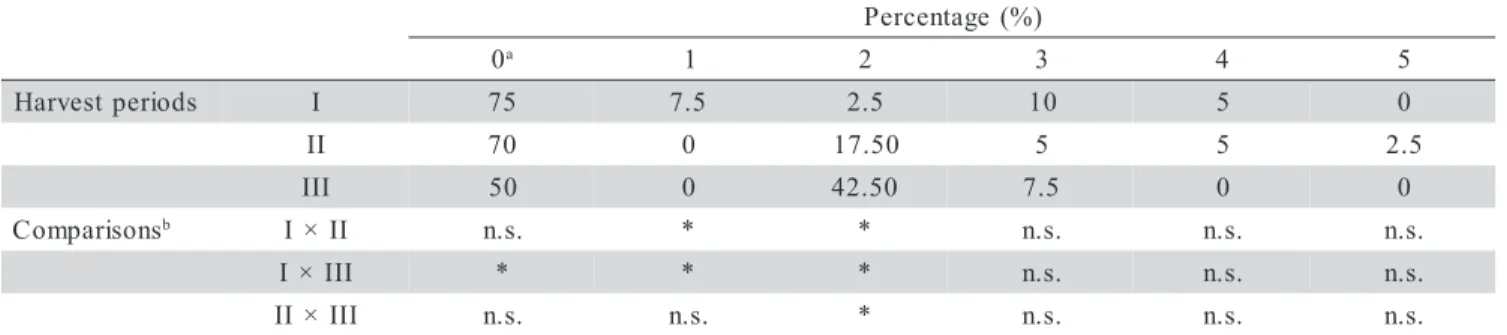
consumption were observed in fruits removed directly from the plant (Table 4), with values of 75, 70, and 50% for periods I, II, and III, respectively. This high percent-age of fruits suitable for consumption could also have been related to the fact that the product was not handled, in addition to the use of cultivar “Fanny”, known for its extended shelf life. Period III showed the highest percent-age of fruits discarded for serious physical dampercent-age (42.5%), differently from the other periods; this value could also be related to a greater exposure of plants to cultivation.
This situation is totally different in harvested fruits after storage for 21 days. The number of fruits suit-able for consumption was higher in period I (57.50%), when compared with periods II (40.83%) and III (42.02%) (Table 5); differences can be noted between the first period and the others, but not between the second and third periods. A higher number of fruits discarded for serious external physical damage was observed in period II (38.3%), being superior to periods III (30.26%) and I (6.67%). These damages are in general caused by com-pression inside the harvest boxes or in the plastic bas-kets, and are in agreement with those diagnosed by
mea-s d o i r e p t s e v r a
H 0 1 2 3 4 5
I 57.50* 13.33 6.67 12.50 10 0
I
I 40.83 2.52 38.33 9.17 7.5 1.67
I I
I 42.02 2.52 30.26 1.68 16.80 6.72
I I ×
I 0.0088* 0.0015 0.00002 n.s. n.s. n.s.
I I I ×
I 0.0152 0.0015 0.00007 0.0008 n.s. 0.0032
I I I × I
I n.s. n.s. n.s. 0.0094 0.0259 0.0491
Table 5 - Evaluation for quality of fruits after storage for 21 days at a temperature of 20oC, based on a scale from 0-5,
considering (0) fruit suitable for consumption; (1) discarded because of surface physical damage; (2) discarded because of serious external physical damage; (3) discarded because of physical damage and rot in association; (4) discarded because of rot; (5) discarded because of water loss (dry).
*Probability values (z) lower than 0.05 indicate that the difference between proportions is significant (Bussab & Morettin, 2002).
) % ( e g a t n e c r e P
0a 1 2 3 4 5
s d o i r e p t s e v r a
H I 75 7.5 2.5 10 5 0
I
I 70 0 17.50 5 5 2.5
I I
I 50 0 42.50 7.5 0 0
s n o s i r a p m o
C b I×II n.s. * * n.s. n.s. n.s.
I I I ×
I * * * n.s. n.s. n.s.
I I I × I
I n.s. n.s. * n.s. n.s. n.s.
Table 4 - Evaluation for the quality of fruits harvested directly in the field after storage for 21 days at a temperature of 20oC.
aScale from 0-5, considering (0) fruit suitable for consumption; (1) discarded because of surface physical damage (2) discarded because of external physical damage; (3) discarded because of physical damage and associated rottenness; (4) discarded because of rottenness; (5) discarded because of excessive water loss.
bComparisons made using the proportions difference test (Bussab & Morettin, 2002), where probability values (z) lower than 0.05 (*)
indicate that the difference between proportions is significant, and probability values (z) higher than 0.05 indicate that the difference between proportions is non-significant (n.s.).
surement of the external area using a planimeter (Table 1), where the higher incidence of physical damage also occurred in period II. However, the number of fruits dis-carded by rottenness associated or not to physical dam-age was higher in period III.
CONCLUSION
Received October 21, 2003 Accepted August 25, 2005
ACKNOWLEDGEMENTS
To Fundação de Amparo à Pesquisa do Estado de São Paulo, FAPESP, and to the owner and employees of the MALLMANN Co., Mogi-Guaçu, SP, Brazil.
REFERENCES
BUSSAB, W.O.; MORETTIN, P. Estatística básica. 5.ed. São Paulo: Ed. Saraiva, 2002. 321p.
CALIMAN, F.R.B.; SILVA, D.J.H.; SEDIYAMA, M.A.N. Tomate para mesa: colheita, classificação e embalagem. Informe Agropecuário, v.24, p.128-126, 2003.
CEAGESP. Classificação de tomate. Programa Horti&Fruti. São Paulo, 2000. 3p.
CEAGESP. Diga não ao desperdício. Disponível em: <http:// www.ceagesp.com.br>. Acessoem: 15 jul. 2002.
CHEN, P.; YAZDANI, R. Prediction of apple bruising due to impact on different surfaces. Transactions of the ASAE, v.34, p.956-961, 1991. FERREIRA, M.D.; FRANCO, T.O.A.; FERRAZ, A.C.O.; CORTEZ, L.A.B.; CAMARGO, G.G.T.; SHU, A.T. Qualidade do tomate de mesa cv. ‘Débora’ em diferentes etapas na pós-colheita em sistema tradicional utilizando-se caixa K.In: CONGRESSO BRASILEIRO DE OLERICULTURA, 43., Recife, 2003. Anais. Recife: Sociedade de Olericultura do Brasil, 2003.
FLUCK, R.C.; HALSEY, L.H. Impact forces and tomato bruising. Florida Agricultural Experiment Station Journal Series, n. 5109, p.239-242, 1973.
FNP Consultoria & Comércio. Agrianual 2002. Anuário da Agricultura Brasileira, São Paulo, 2001. 536p.
GALVIS-VANEGAS, J.A. Fisiologia pós-colheita de tomate (Lycopersicon esculentum Mill) cultivar Ângela. Campinas: UNICAMP, FEA, 1987. 123p. (Dissertação – Mestrado).
HALSEY, L.H. Preliminary studies of bruising of “turning” and “pink” tomatoes caused by handling practices. Proceedings of the Florida State Horticultural Society, v.68, p.240-243, 1955.
JACKMAN, R.L.; MARANGONI, A.G.; STANLEY, D.W. Measurement of tomato fruit firmness. HortScience, v.25, p.781-783, 1990. KADER, A.A.; MORRIS, L.L.; CHEN, P. Evaluation of two objective
methods and a subjective rating scale for measuring tomato fruit firmness.
Journal of the American Society for Horticultural Science, v.103, p.70-73, 1978.
LOPES, C.A.; REIS, A.; ÁVILA, A.C. Principais doenças do tomate para mesa causadas por fungos, bactérias e vírus. Informe Agropecuário,
v.24, p.66-78, 2003.
MELO, P.C.T. Efeitos adversos de fatores ambientais na produção de tomate.
Informe Técnico Asgrow, p.1-6, 1993.
MOHSENIN, N.N. Physical properties of plant and animal materials.
New York: Gordon Beach Science Publishers, 1986. v.1, 841p. MORETTI, C.L.; SARGENT, S.A. Alteração de sabor e aroma em tomates
causado por impacto. Scientia Agricola, v.57, p.385-388, 2000. MORETTI, C.L.; SARGENT, S.A.; HUBER, D.J.; GALBO, A.G.;
PUSCHMANN, R. Chemical composition and physical properties of pericarp, locule, and placental tissues of tomatoes with internal bruising.
Journal of the American Society for Horticultural Science, v.123, p.656-600, 1998.
SARGENT, S.A.; BRECHT, J.K.; ZOELLNER, J.J. Sensitivity of tomatoes at mature-green and breaker ripeness stages to internal bruising. Journal of the American Society for Horticultural Science, v.117, p.119-123, 1992.
SARGENT, S.A.; MAUL, F.S.; MORETTI, C.L.; SIMS, C.A. Harvest maturity, storage temperature and internal bruising affect tomato flavor.
Proceedings of the Florida Tomato Institute, v.2, p.22-24, 1997. SARGENT, S.A.; RITENOUR, M.A.; BRECHT, J.K. Handling, cooling
and sanitation techniques for maintaining post-harvest quality. Gainesville: University of Florida, Sciences, 1999. 27p.