ABSTRACT:Olive (Olea europaea L.) production in the world has been made by using many cultivars, and the genetic uniformity of commercial cultivars is important for standard olive oil and table olive production. The genetic variation among and within commonly cultivated olive cultivars in Turkey was analyzed using SSR markers. A total of 135 leaf samples were collected from 11 commonly cultivated olive cultivars from 11 provinces in four geographical regions of Turkey. Seven SSR primer pairs generated 46 SSR markers, and the number of SSR markers per primer pair ranged from 4 (UDO-14) to 9 (GAPU-89) with an average of 6.57. This high level of SSR polymorphism suggests that olive production in Turkey has been made using genetically diverse olive cultivars and this high level of genetic variation is probably due to the location of Turkey in the center of the origin of olive. The UPGMA dendrogram, developed to visualize the estimated genetic relationships among the 135 samples, demonstrated that the clustering of ol-ive cultivars was not based on geographical regions of cultivation. Presence of genetic variation was detected within a nationwide grown Turkish olive cultivar, called ‘Gemlik’. Olive growers suc-cessfully discriminated olive cultivars with distinct morphological and pomological characters. However, there was some confusion about the identification of cultivars with similar phenotypic traits. To prevent misidentification of olive cultivars and to minimize intra-cultivar variation, certi-fied propagation materials which were characterized using DNA based molecular markers should be used during the establishment of new olive orchards.
Keywords: Olea europaea L., microsatellite, intra-varietal variation, synonyms, simple sequence repeats
Received June 17, 2011 Accepted January 10, 2012
Uludag University/Faculty of Agriculture – Dept. of Horticulture – 16059 – Görükle, Bursa – Turkey. *Corresponding author <[email protected]>
Edited by: Antonio Costa de Oliveira
Assessment of inter- and intra-cultivar variations in olive using SSR markers
Ahmet Ipek*, Erdogan Barut, Hatice Gulen, Meryem Ipek
Introduction
Olive (Olea europaea L.) is the only species of the genus, Olea cultivated in the Mediterranean basin, and its domestication goes back to 6,000 years in the area bordering the east coast of the Mediterranean Sea (Sensi et al., 2003). Olive production in the Mediterranean ba-sin accounts for more than 95 % of world’s olive produc-tion (FAO, 2008). Located on the northeastern coast of the Mediterranean Sea, Turkey is a major olive-produc-ing country. Olives originated from the coast of Eastern Mediterranean Sea (Zohary and Spegiel-Roy, 1975) and, to date, more than 1250 cultivars have been used world-wide for olive production (Bartolini et al., 1997). Most of these cultivars are present in countries located in the Mediterranean basin (Sarri et al., 2006). The presence of 87 local olive cultivars has been documented in Turkey (http://www.zae.gov.tr; last accessed March 15th, 2011).
Cultivar identification of olives has been based on morphological and phenological characteristics (Fabbri et al.,1995). Traditionally, fruit characteristics have been used for the identification of olive cultivars (Besnard et al., 2001). However, it is impossible to use fruit charac-teristics for seedlings in nurseries or for young trees in orchards due to the juvenility. In addition, fruit charac-teristics can be easily affected by environmental factors and alternate bearing. Moreover, the continuous inter-change of plant materials among the different olive-pro-ducing regions and the simultaneous presence of local and patchy-distributed cultivars with ambiguous nam-ing have complicated the identification of olive cultivars
in Turkey. Morphological and pomological characteris-tics of common Turkish olive cultivars were previously determined by Canozer (1991). Genetic variation among some Turkish olive cultivars was analyzed using DNA based molecular markers (Owen et al., 2005; Ozkaya et al., 2006; Ercisli et al., 2009; Ipek et al., 2009).
Standardized olive oil and table olive production for better marketing can be made possible by the identi-fication of superior genotypes which were adapted to the major olive-producing regions. In this respect, analyses of intra- and inter-cultivar variations can be helpful for the determination of standard olive cultivars for each olive-producing region in Turkey. In addition, determi-nation of genetic variation within a cultivar or among olive cultivars can be useful data for future breeding programs. Therefore, the objectives of this study were to determine the genetic uniformity of the commercially important olive cultivars grown in the Aegean, Mediter-ranean, Southeastern Anatolia and Southwestern Mar-mara Regions of Turkey and to assess genetic relation-ship among these olive cultivars using simple sequence repeats (SSR) DNA markers.
Materials and Methods
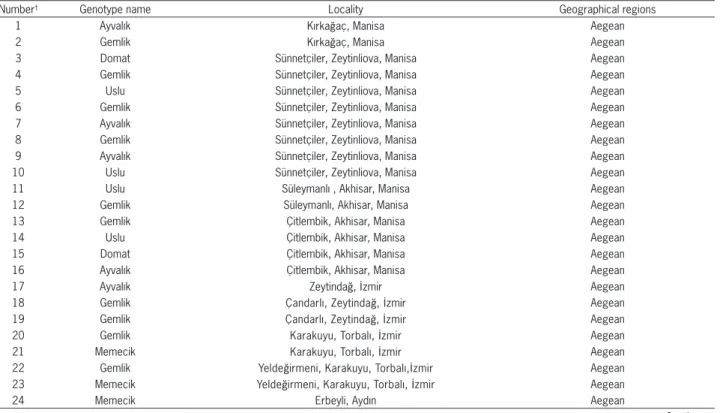
Southwest-Table 1 – List of samples and the locality where leaf samples were collected.
Number† Genotype name Locality Geographical regions
1 Ayvalık Kırkağaç, Manisa Aegean
2 Gemlik Kırkağaç, Manisa Aegean
3 Domat Sünnetçiler, Zeytinliova, Manisa Aegean
4 Gemlik Sünnetçiler, Zeytinliova, Manisa Aegean
5 Uslu Sünnetçiler, Zeytinliova, Manisa Aegean
6 Gemlik Sünnetçiler, Zeytinliova, Manisa Aegean
7 Ayvalık Sünnetçiler, Zeytinliova, Manisa Aegean
8 Gemlik Sünnetçiler, Zeytinliova, Manisa Aegean
9 Ayvalık Sünnetçiler, Zeytinliova, Manisa Aegean
10 Uslu Sünnetçiler, Zeytinliova, Manisa Aegean
11 Uslu Süleymanlı , Akhisar, Manisa Aegean
12 Gemlik Süleymanlı, Akhisar, Manisa Aegean
13 Gemlik Çitlembik, Akhisar, Manisa Aegean
14 Uslu Çitlembik, Akhisar, Manisa Aegean
15 Domat Çitlembik, Akhisar, Manisa Aegean
16 Ayvalık Çitlembik, Akhisar, Manisa Aegean
17 Ayvalık Zeytindağ, İzmir Aegean
18 Gemlik Çandarlı, Zeytindağ, İzmir Aegean
19 Gemlik Çandarlı, Zeytindağ, İzmir Aegean
20 Gemlik Karakuyu, Torbalı, İzmir Aegean
21 Memecik Karakuyu, Torbalı, İzmir Aegean
22 Gemlik Yeldeğirmeni, Karakuyu, Torbalı,İzmir Aegean
23 Memecik Yeldeğirmeni, Karakuyu, Torbalı, İzmir Aegean
24 Memecik Erbeyli, Aydın Aegean
Continue... ern Marmara Regions of Turkey (Table 1; Figure 1).
The names of the cultivars given by the growers were recorded and the morphological characteristics of the sampled trees were compared with morphological characteristics of major olive cultivars described by Canozer (1991).
Preparation of DNA samples: DNA samples were ex-tracted from 100 mg of lyophilized and powdered leaf samples using a modified CTAB method described by Futterer et al. (1995). The concentration of each DNA sample was measured using a Qubit Fluorometer (Invit-rogen, Carlsbad, CA, USA) and adjusted to 20 ng µL–1 for
further analysis.
SSR analysis: Seven previously developed SSR primer pairs were used for the amplification of SSR markers in this study (Table 2). Each 20 µL polymerase chain reac-tion (PCR) mixture for the amplificareac-tion of SSR markers consisted of 1.0 U Taq DNA polymerase (Fermentas, Hanover, MD, USA) with supplied reaction buffer at 1 × concentration, 0.25 µM of each primer, dNTPs at 0.25 mM each, and 50 ng template DNA. The thermal cycling conditions were as follows: 2 min at 94 °C; 10 cycles of 45 sec at 94 °C, 1 min at 65 °C (annealing tem-perature was reduced 1 °C after every cycle), and 1 min and 30 sec at 72 °C; 35 cycles of 45 s at 94 °C, 1 min at 55 °C, and 1 min and 30 s at 72 °C; and a final ex-tension step of 5 min at 72 °C. An Applied Biosystems Thermal Cycler was used for these reactions. The PCR
products were separated in 4 % high-resolution agarose in 1 × Tris-borate (TBE) buffer. The gels were stained with ethidium bromide (0.5 mg mL–1) (Sigma, St Louis,
MO, USA) and photographed.
Data analysis: Each SSR marker was scored as pres-ent (1) or abspres-ent (0) because the allelic constitutions of these SSR markers were not known in the studied plant materials. Genetic distance (GD) matrices were calculated using the Nei and Li (1979) coefficient. A UPGMA dendrogram was developed using TREECON for Windows software (Van de Peer and De Wachter, 1994). Data were bootstrapped 2,000 X to test the reli-ability and robustness of the phenogram. Heterozy-gosity expected (He) and heterozyHeterozy-gosity observed (Ho) were calculated according to the method of Levene (1949) using POPGEN32 software v.1.31 (Yeh et al., 1997).
Results and Discussion
SSR polymorphisms among olive cultivars
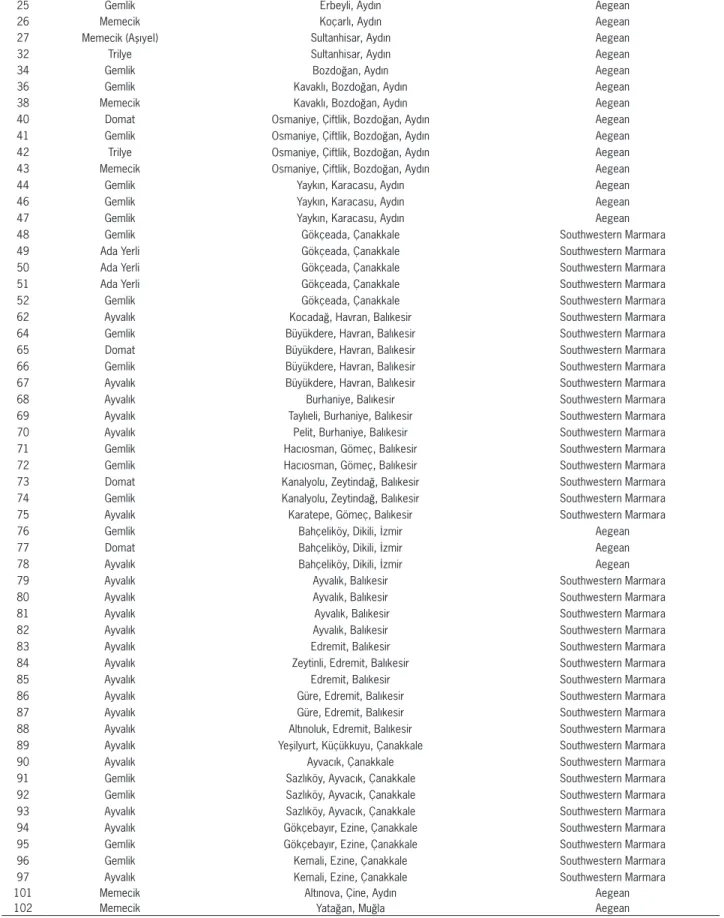
Table 1 – Continuation.
25 Gemlik Erbeyli, Aydın Aegean
26 Memecik Koçarlı, Aydın Aegean
27 Memecik (Așıyel) Sultanhisar, Aydın Aegean
32 Trilye Sultanhisar, Aydın Aegean
34 Gemlik Bozdoğan, Aydın Aegean
36 Gemlik Kavaklı, Bozdoğan, Aydın Aegean
38 Memecik Kavaklı, Bozdoğan, Aydın Aegean
40 Domat Osmaniye, Çiftlik, Bozdoğan, Aydın Aegean
41 Gemlik Osmaniye, Çiftlik, Bozdoğan, Aydın Aegean
42 Trilye Osmaniye, Çiftlik, Bozdoğan, Aydın Aegean
43 Memecik Osmaniye, Çiftlik, Bozdoğan, Aydın Aegean
44 Gemlik Yaykın, Karacasu, Aydın Aegean
46 Gemlik Yaykın, Karacasu, Aydın Aegean
47 Gemlik Yaykın, Karacasu, Aydın Aegean
48 Gemlik Gökçeada, Çanakkale Southwestern Marmara
49 Ada Yerli Gökçeada, Çanakkale Southwestern Marmara
50 Ada Yerli Gökçeada, Çanakkale Southwestern Marmara
51 Ada Yerli Gökçeada, Çanakkale Southwestern Marmara
52 Gemlik Gökçeada, Çanakkale Southwestern Marmara
62 Ayvalık Kocadağ, Havran, Balıkesir Southwestern Marmara
64 Gemlik Büyükdere, Havran, Balıkesir Southwestern Marmara
65 Domat Büyükdere, Havran, Balıkesir Southwestern Marmara
66 Gemlik Büyükdere, Havran, Balıkesir Southwestern Marmara
67 Ayvalık Büyükdere, Havran, Balıkesir Southwestern Marmara
68 Ayvalık Burhaniye, Balıkesir Southwestern Marmara
69 Ayvalık Taylıeli, Burhaniye, Balıkesir Southwestern Marmara
70 Ayvalık Pelit, Burhaniye, Balıkesir Southwestern Marmara
71 Gemlik Hacıosman, Gömeç, Balıkesir Southwestern Marmara
72 Gemlik Hacıosman, Gömeç, Balıkesir Southwestern Marmara
73 Domat Kanalyolu, Zeytindağ, Balıkesir Southwestern Marmara
74 Gemlik Kanalyolu, Zeytindağ, Balıkesir Southwestern Marmara
75 Ayvalık Karatepe, Gömeç, Balıkesir Southwestern Marmara
76 Gemlik Bahçeliköy, Dikili, İzmir Aegean
77 Domat Bahçeliköy, Dikili, İzmir Aegean
78 Ayvalık Bahçeliköy, Dikili, İzmir Aegean
79 Ayvalık Ayvalık, Balıkesir Southwestern Marmara
80 Ayvalık Ayvalık, Balıkesir Southwestern Marmara
81 Ayvalık Ayvalık, Balıkesir Southwestern Marmara
82 Ayvalık Ayvalık, Balıkesir Southwestern Marmara
83 Ayvalık Edremit, Balıkesir Southwestern Marmara
84 Ayvalık Zeytinli, Edremit, Balıkesir Southwestern Marmara
85 Ayvalık Edremit, Balıkesir Southwestern Marmara
86 Ayvalık Güre, Edremit, Balıkesir Southwestern Marmara
87 Ayvalık Güre, Edremit, Balıkesir Southwestern Marmara
88 Ayvalık Altınoluk, Edremit, Balıkesir Southwestern Marmara
89 Ayvalık Yeșilyurt, Küçükkuyu, Çanakkale Southwestern Marmara
90 Ayvalık Ayvacık, Çanakkale Southwestern Marmara
91 Gemlik Sazlıköy, Ayvacık, Çanakkale Southwestern Marmara
92 Gemlik Sazlıköy, Ayvacık, Çanakkale Southwestern Marmara
93 Ayvalık Sazlıköy, Ayvacık, Çanakkale Southwestern Marmara
94 Ayvalık Gökçebayır, Ezine, Çanakkale Southwestern Marmara
95 Gemlik Gökçebayır, Ezine, Çanakkale Southwestern Marmara
96 Gemlik Kemali, Ezine, Çanakkale Southwestern Marmara
97 Ayvalık Kemali, Ezine, Çanakkale Southwestern Marmara
101 Memecik Altınova, Çine, Aydın Aegean
102 Memecik Yatağan, Muğla Aegean
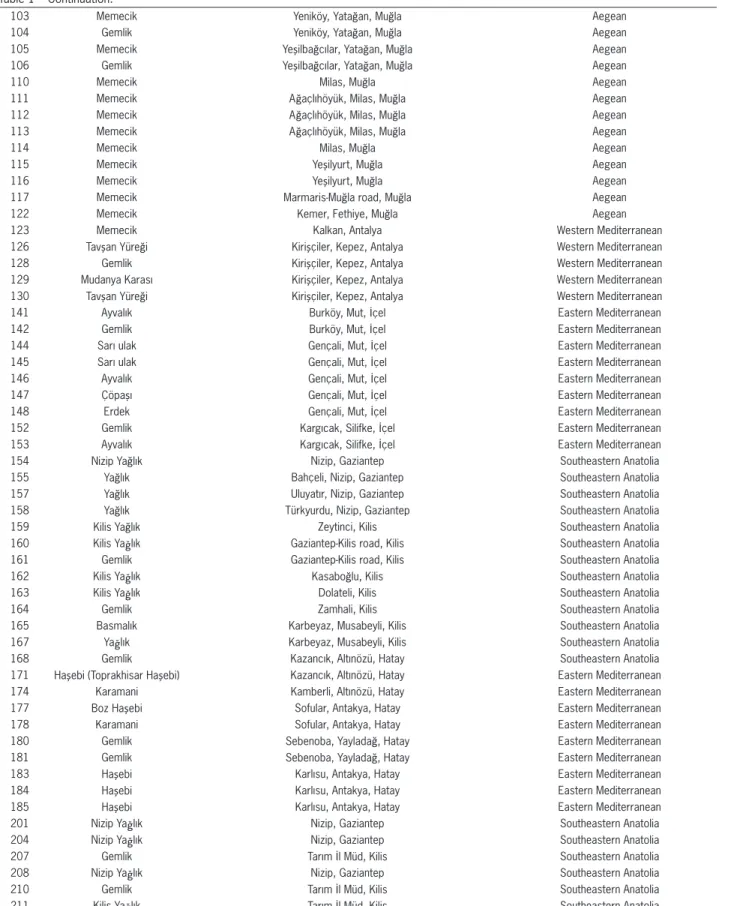
Table 1 – Continuation.
103 Memecik Yeniköy, Yatağan, Muğla Aegean
104 Gemlik Yeniköy, Yatağan, Muğla Aegean
105 Memecik Yeșilbağcılar, Yatağan, Muğla Aegean
106 Gemlik Yeșilbağcılar, Yatağan, Muğla Aegean
110 Memecik Milas, Muğla Aegean
111 Memecik Ağaçlıhöyük, Milas, Muğla Aegean
112 Memecik Ağaçlıhöyük, Milas, Muğla Aegean
113 Memecik Ağaçlıhöyük, Milas, Muğla Aegean
114 Memecik Milas, Muğla Aegean
115 Memecik Yeșilyurt, Muğla Aegean
116 Memecik Yeșilyurt, Muğla Aegean
117 Memecik Marmaris-Muğla road, Muğla Aegean
122 Memecik Kemer, Fethiye, Muğla Aegean
123 Memecik Kalkan, Antalya Western Mediterranean
126 Tavșan Yüreği Kirișçiler, Kepez, Antalya Western Mediterranean
128 Gemlik Kirișçiler, Kepez, Antalya Western Mediterranean
129 Mudanya Karası Kirișçiler, Kepez, Antalya Western Mediterranean
130 Tavșan Yüreği Kirișçiler, Kepez, Antalya Western Mediterranean
141 Ayvalık Burköy, Mut, İçel Eastern Mediterranean
142 Gemlik Burköy, Mut, İçel Eastern Mediterranean
144 Sarı ulak Gençali, Mut, İçel Eastern Mediterranean
145 Sarı ulak Gençali, Mut, İçel Eastern Mediterranean
146 Ayvalık Gençali, Mut, İçel Eastern Mediterranean
147 Çöpașı Gençali, Mut, İçel Eastern Mediterranean
148 Erdek Gençali, Mut, İçel Eastern Mediterranean
152 Gemlik Kargıcak, Silifke, İçel Eastern Mediterranean
153 Ayvalık Kargıcak, Silifke, İçel Eastern Mediterranean
154 Nizip Yağlık Nizip, Gaziantep Southeastern Anatolia
155 Yağlık Bahçeli, Nizip, Gaziantep Southeastern Anatolia
157 Yağlık Uluyatır, Nizip, Gaziantep Southeastern Anatolia
158 Yağlık Türkyurdu, Nizip, Gaziantep Southeastern Anatolia
159 Kilis Yağlık Zeytinci, Kilis Southeastern Anatolia
160 Kilis Yağlık Gaziantep-Kilis road, Kilis Southeastern Anatolia
161 Gemlik Gaziantep-Kilis road, Kilis Southeastern Anatolia
162 Kilis Yağlık Kasaboğlu, Kilis Southeastern Anatolia
163 Kilis Yağlık Dolateli, Kilis Southeastern Anatolia
164 Gemlik Zamhali, Kilis Southeastern Anatolia
165 Basmalık Karbeyaz, Musabeyli, Kilis Southeastern Anatolia
167 Yağlık Karbeyaz, Musabeyli, Kilis Southeastern Anatolia
168 Gemlik Kazancık, Altınözü, Hatay Southeastern Anatolia
171 Hașebi (Toprakhisar Hașebi) Kazancık, Altınözü, Hatay Eastern Mediterranean
174 Karamani Kamberli, Altınözü, Hatay Eastern Mediterranean
177 Boz Hașebi Sofular, Antakya, Hatay Eastern Mediterranean
178 Karamani Sofular, Antakya, Hatay Eastern Mediterranean
180 Gemlik Sebenoba, Yayladağ, Hatay Eastern Mediterranean
181 Gemlik Sebenoba, Yayladağ, Hatay Eastern Mediterranean
183 Hașebi Karlısu, Antakya, Hatay Eastern Mediterranean
184 Hașebi Karlısu, Antakya, Hatay Eastern Mediterranean
185 Hașebi Karlısu, Antakya, Hatay Eastern Mediterranean
201 Nizip Yağlık Nizip, Gaziantep Southeastern Anatolia
204 Nizip Yağlık Nizip, Gaziantep Southeastern Anatolia
207 Gemlik Tarım İl Müd, Kilis Southeastern Anatolia
208 Nizip Yağlık Nizip, Gaziantep Southeastern Anatolia
210 Gemlik Tarım İl Müd, Kilis Southeastern Anatolia
211 Kilis Yağlık Tarım İl Müd, Kilis Southeastern Anatolia
The names in parentheses are synonyms given by the local growers; †a number was given to each sample to prevent confusion because more than one sample was
Figure 1 – Map of Turkey showing the provinces where leaf samples were collected. Çanakkale and Balıkesir are in the Southwestern Marmara Region, Aydın, İzmir, Manisa and Muğla are in the Aegean Region, Antalya is in the Western Mediterranean Region, İçel and Hatay are in the Eastern Mediterranean Region, and Gaziantep and Kilis are in the Southeastern Anatolia Region. The part of Turkey shown on the map is located between 36°00’ and 42°00’ N, and between 26°00’ and 38°00’ E.
Table 2 – List of SSR primers and number of their polymorphic alleles.
SSR primer pairs* No of SSR markers He Ho
DCA-04 6 0.64 0.47
DCA-09 5 0.55 0.71
DCA-11 7 0.77 0.99
DCA-16 8 0.77 0.96
DCA-17 7 0.62 0.89
GAPU-89 9 0.82 0.83
UDO99-14 4 0.54 0.13
Mean 6.57 0.67 0.71
*DCA, GAPU and UDO99 primers were developed by Sefc et al. (2000), Carriero et al. (2002) and Cipriani et al. (2002), respectively; He is expected Heterozygosity; Ho is observed Heterozygosity.
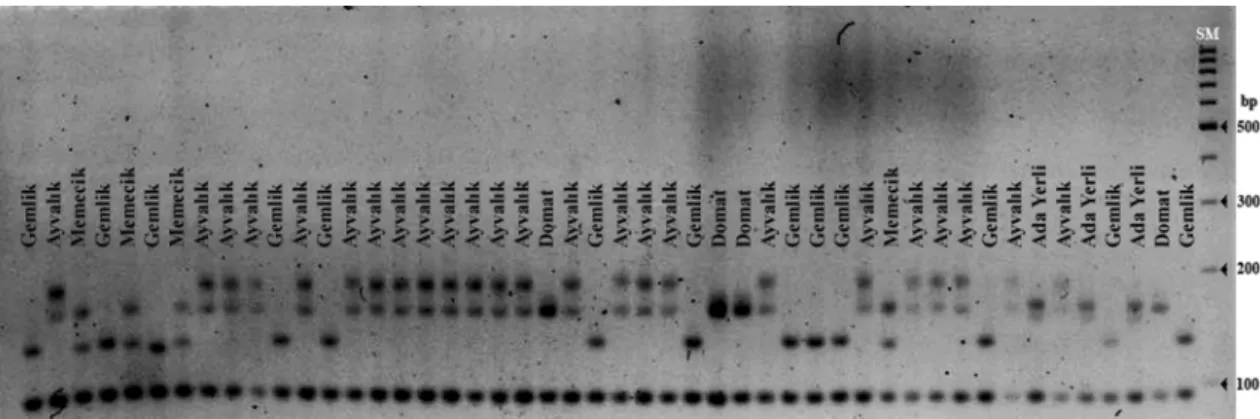
Figure 2 – High-resolution agarose gel picture showing alleles of the DCA-04 SSR marker in 48 samples. SM is a DNA molecular weight marker.
While the use of polyacrylamide gel is a labor-intensive task, DNA analysis systems with fluorescent labeling are high-cost analysis systems and may not be available to every investigator. In this study, we selected 7 SSR primer pairs that can be used with high-resolution agarose gel electrophoresis (4 % high-resolution agarose) to detect SSR polymorphisms among olive genotypes. The level of polymorphism detected in this study is comparable to that in previous studies of Cipriani et al. (2002) and Gomes et al. (2008). High-resolution agarose gel to detect SSR polymorphisms in olive can be used in future studies without losing the discriminating power of the SSR marker system. The use of high-resolution agarose gels to detect SSR polymorphisms can decrease cost and labor significantly and it is readily applicable because agarose gel electrophoresis is available to almost all molecular biology laboratories.
Although the amount of polymorphism detect-ed by DNA markers depends on genetic relationships among the analysed genotypes, the high level of SSR polymorphism in olives was reported by this and previ-ous studies (Baldoni et al., 2009; Carriero et al., 2002; Gomes et al., 2008; Ipek et al., 2009; Muzzalupo et al., 2010; Sarri et al., 2006). The high level of polymorphism in the alleles of SSR markers in this study confirms that genetically diverse olive cultivars have been used for ol-ive production in Turkey. The location of Turkey in the center of origin of the olive plant can explain the high level of genetic variation among olive cultivars in this country. This high level of genetic variation can be useful for olive-breeding programs. However, using genetically divers olive cultivars for table olive and olive oil produc-tion can pose a problem for standardizaproduc-tion because the quality of table olive and olive oil depends largely on the genotype (Sanz-Cortés et al., 2003).
Genetic relationship among olive cultivars
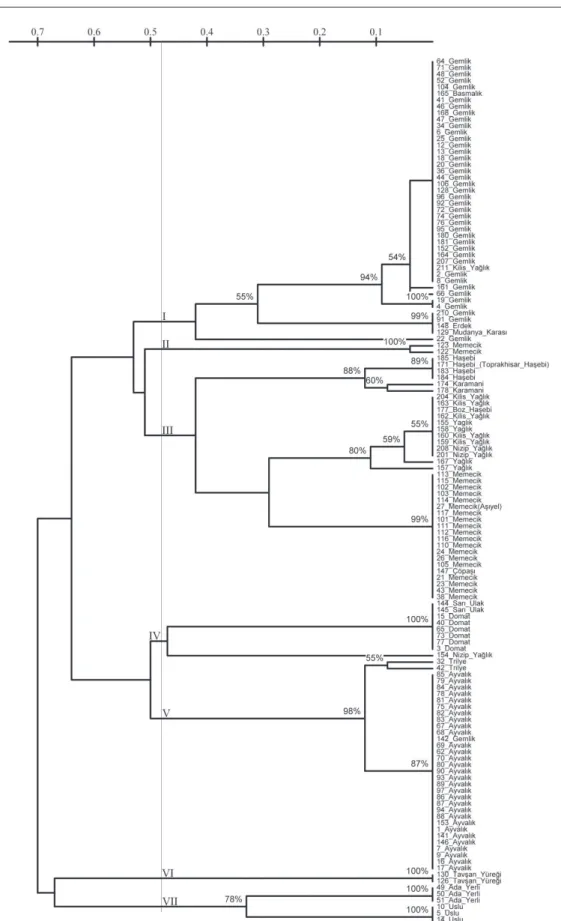
A UPGMA dendrogram demonstrating the es-timated genetic relationship among 135 samples was constructed using Nei and Li’s (1979) distance matrix with 2,000 X bootstrapping (Figure 3). The highest ge-netic distance was 84 % between the cultivars ‘Ayvalık’ and ‘Tav an Yüreği’.According to the dendrogram, there were 22 genotypes among the 135 samples with unique SSR marker profiles because more than one sample were collected for some cultivars to assess intra-cultivar varia-tion (Table 1). A total of seven groups were identified at the average dissimilarity level of 48 % (Figure 3).
Although ‘Gemlik’ is the most common olive culti-var in the Southern Marmara Region (Ipek et al., 2009), this cultivar has been grown in all provinces where the leaf samples of this study were collected (Table 1; Figure 1). The samples of ‘Gemlik’ were placed in Group I (Fig-ure 3). Although they were clustered in the same Group, samples, #161 and #66 had one and samples, #19 and #4 had two different SSR alleles from the cultivar ‘Gemlik’. Because these samples differed from ‘Gemlik’ by one or two SSR alleles, the source of this type of variation
could be an accumulation of somatic mutations. In an-other study, Muzzalopo et al. (2010) analyzed intra culti-var culti-variability in three major Italian olive culticulti-vars and found intra cultivar variability in ‘Carolea’. Muzzalopo et al. (2010) indicated that the variation among the plants of ‘Carolea’ was probably due to the somatic mutations occurring in the different branches of mother plants.
Two other ‘Gemlik’ samples were clustered in a subgroup of the Group I with ‘Erdek’ and ‘Mudanya Karası’ (Figure 3). The names, ‘Erdek’ and ‘Mudanya Karası’, suggest that these genotypes were obtained from the towns of ‘Mudanya’ and ‘Erdek’ in the South-ern Marmara Region where ‘Gemlik’ has been widely grown (Ipek et al., 2009). Similarly, samples #91 and #210 were also obtained from the Southern Marmara Region. The name, ‘Gemlik’ was probably given to these samples by growers due to the origin of repropa-gation materials, although they are genetically distinct. In addition, two other genotypes (#22 and #142) col-lected from the provinces of Izmir and İçel (Table 1) were called ‘Gemlik’, but the SSR analysis indicated that they were genetically different (Figure 3). This re-sult indicates that genetically different olive genotypes may be called ‘Gemlik’ in different olive production regions in Turkey probably due to the nationwide popu-larity of this cultivar. On the other hand, samples, #165 and #211 were called ‘Kilis Yağlık’ and ‘Basmalık’, re-spectively by olive growers although they had an iden-tical SSR marker profile as ‘Gemlik’ (Figure 3). This result shows that they were also misidentified by grow-ers or nurseries. In a previous study, Ipek et al. (2009) analyzed the variation within the cultivars of ‘Gemlik’ grown in the Southern Marmara Region and reported that about 8 % of the plants analyzed had different SSR profiles from the cultivar, ‘Gemlik’.
The second subgroup of the Group III contained another popular olive cultivar, ‘Sarı Ha ebi’, grown in the province of Hatay in the Eastern Mediterranean Re-gion of Turkey (Canozer, 1991; Table 1; Figures 1; 3). This cultivar is also called ‘Ha ebi’ locally. Although another sample was identified as ‘Sarı Ha ebi’ in the region, it had an identical SSR marker profile to ‘Nizip Yağlık’, ‘Ki-lis Yağlık’ and ‘Yağlık’ cultivars in another cluster. This genotype was also misidentified by olive growers as ‘Sarı Ha ebi’. ‘Karamani’ is another common cultivar grown in the same region, and two samples of this cultivar were placed in another cluster in the same Group (Figure 3).
The third subgroup in Group III contained a com-mon olive cultivar called ‘Memecik’, grown for both ol-ive oil and table olol-ive production in the Aegean Region of Turkey (Canozer 1991; Table 1; Figure 1). Samples of ‘Memecik’ were clustered together by sharing identical SSR marker profiles (Figure 3). Three other genotypes were collected as ‘Memecik’ in the same region, but they had different SSR marker profiles. Another geno-type, called ‘Çöpa ı’, shared the same SSR marker pro-file with ‘Memecik’, suggesting that this genotype was probably ‘Memecik’.
‘Sarı Ulak’ and ‘Domat’ are two other standard Turkish olive cultivars grown for table olive production (Canozer, 1991). While ‘Sarı Ulak’ is a common cultivar of the provinces in the Eastern Mediterranean Region, ‘Domat’ is largely grown in the Aegean Region of Turkey (Figure 1). In this study, samples of ‘Domat’ were col-lected from different locations in the Manisa province in the Aegean Region, and samples of ‘Sarı Ulak’ were obtained from the İçel province in the Eastern Mediter-ranean Region (Table 1). Samples of both ‘Sarı Ulak’ and ‘Domat’ were clustered together in Group IV and shared identical SSR marker profiles in this study (Figure 3). In a previous study, Owen et al. (2005) analyzed genetic relationship among Turkish olive cultivars kept in Ol-ive Research Institute in İzmir using AFLP markers and they found that ‘Sarı Ulak’ and ‘Domat’ were distinctly related with low genetic similarity. On the other hand, they shared identical SSR markers in this study suggest-ing that there is confusion about the identification of these cultivars by olive growers.
‘Ayvalık’ (Edremit Yağlık) is one of the most com-mon olive cultivars grown for olive oil production in the Aegean Region of Turkey (Canozer, 1991). In this study, 31 samples from this cultivar were collected from Manisa, İzmir, Balıkesir and Çanakkale provinces (Table 1). All samples of ‘Ayvalık’ were clustered together in Group V by sharing 100 % of SSR makers, which suggested that there was no variation within this cultivar. Three other samples were given different names (Trilye, Gemlik), but these samples had identical SSR marker profiles as ‘Ayvalık’, indicating that some plants of this cultivar were also misidentified by olive growers (Figure 3).
‘Tav an Yüreği’ is another local olive cultivar in the Western Mediterranean Region of Turkey. Two sam-ples of this cultivar were collected from the province of
Antalya (Table 1; Figure 1), and these samples were clus-tered in Group VI and had identical SSR profiles (Figure 3). In another study, Ozkaya et al. (2009) found the cul-tivars, ‘Tav an Yüreği’ and ‘Memecik’ as being geneti-cally the same, by sharing 100 % of their RAPD markers. ‘Tav an Yüreği’ and ‘Memecik’ were found by Owen et al. (2005) to be genetically distinct cultivars with low genetic similarity as in our current study (Figure 3). However, Ozkaya et al. (2009) did not comment about these genetically and phenotypically distinct olive culti-vars that had identical RAPD profiles in their study.
‘Uslu’ is an important olive cultivar grown for table olive production in the Aegean Region of Turkey. Four leaf samples of this cultivar were collected in dif-ferent locations in the province of Manisa, and for this region all samples were placed ina subgroup of Group VII and shared 100 % of their SSR markers (Table 1; Figure 3). ‘Ada Yerli’ is a local olive cultivar grown on Gökçeada Island in the Aegean Sea, and three samples of this cultivar were collected, which were clustered to-gether in the other subgroup of Group VII by sharing identical SSR marker profile.
Turkish olive cultivars were not clustered based on their locations of cultivation. For example, ‘Memecik’ from the Aegean Region was closely clustered with the olive cultivars from the Southeastern Anatolia Region in Group III (Figure 3). Similar results have been reported in other studies where olive genotypes from different countries were clustered closely in a group, suggesting that the grouping of olive genotypes was not based on geographical origin (Besnard et al., 2001; Ipek et al., 2009). Owen et al. (2005) were able to place olive cul-tivars from Middle East and Turkey to one broad group and olive cultivars from Greece to another broad group although there was no clear separation between Turk-ish and Greek cultivars. On the other hand, Sarri et al. (2006) found limited grouping on the basis of geographic origin and grouped olive cultivars as eastern, central and western Mediterranean populations. These results suggest that olive genotypes have been freely exchanged among growers within a country or among collectors in different countries for centuries without proper passport information.
Although cultivar identification by growers or nurseries in Turkey was correct for most of the samples, there was some confusion about the discrimination of olive culti-vars with similar phenotypic traits. Therefore, certified repropagation materials characterized with DNA-based molecular markers should be used during the establish-ment of new olive orchards.
Acknowledgements
To MARMARABIRLIK (Agricultural Sales Coop-eratives and Associations) for their financial support.
References
Baldoni, L.; Cultrera, N.G.; Mariotti, R.; Ricciolini, C.; Arcioni, S.; Vendramin, G.G.; Buonamici, A.; Porceddu, A.; Sarri, V.; Ojeda, M.A.; Trujillo, I.; Rallo, L.; Belaj, A.; Perri, E.; Salimonti, A.; Muzzalupo, I.; Casagrande, A.; Lain, O.; Messina, R.; Testolin, R. 2009. A consensus list of microsatellite markers for olive genotyping. Molecular Breeding 24: 213–231.
Bartolini, G.; Prevost, G.; Messeri, C.; Carignani, G. 1997. Olive germplasm: cultivars and world-wide collections. FAO. Available at: http://apps3.fao.org/wiews/olive/oliv.jsp [Accessed Apr. 27, 2010]
Besnard, G.; Breton, C.; Baradat, P.; Khadari, B.; Bervillé, A. 2001. Cultivar identification in olive based on RAPD markers. Journal of the American Society for Horticultural Science 126: 668–675.
Canözer, Ö. 1991. Catalog of Standard Olive Cultivars. Ministry of Turkish Agriculture and Rural Affairs, Ankara, Turkey. (Publication of the Ministry of Turkish Agriculture and Rural Affairs, 16).
Carriero, F.; Fontanazza, G.; Cellini, F.; Giorio, G. 2002. Identification of simple sequence repeats (SSRs) in olive (Olea europaea L.). Theoretical and Applied Genetics 104: 301–307. Cipriani, G.; Marrazzo, M.T.; Marconi, R.; Cimato, A.; Testolin,
R. 2002. Microsatellite markers isolated in olive (Olea europaea L.) are suitable for individual fingerprinting and reveal polymorphism within ancient cultivars. Theoretical and Applied Genetics 104: 223–228.
Ercisli, S.; Barut, E.; Ipek, A. 2009. Molecular characterization of olive cultivars using amplified fragment length polymorphism markers. Genetics and Molecular Research 8: 414–419.
Fabbri, A.; Hormaza, J.I.; Polito, V.S. 1995. Random amplified polymorphic DNA analysis of olive (Olea europaea L) cultivars. Journal of the American Society for Horticultural Science 120: 538–542.
Food and Agriculture Organization [FAO]. 2008. Agricultural Statistics of the Food and Agriculture Organization of the United Nations. Available at: http://www.FAO.org [Accessed Feb. 07, 2011]
Futterer, J.; Gisel, A.; Iglesias, V.; Kloti, A.; Kost, B.; Mittelsten-Scheid, O.; Neuhaus, G.; Neuhaus-Url, G.; Schrott, M.; Shillito, R.; Spangenberg, G.; Wang, Z.Y. 1995. Standard molecular techniques for the analysis of transgenic plants. p. 215–218. In: Potrykus, I.; Spangenberg, G., eds. Gene transfer to plants. Springer-Verlag, New York, USA.
Gomes, S.; Martins-Lopes, P.; Lima-Brito, J.; Meirinhos, J.; Lopes, J.; Martins, A.; Guedes-Pinto, H. 2008. Evidence for clonal variation in ‘Verdeal-Transmontana’ olive using RAPD, ISSR and SSR markers. Journal of Horticultural Science and Biotechnology 83: 395–400. Ipek, A.; Barut, E.; Gulen, H.; Oz, A.T.; Tangu, N.A.; Ipek, M.
2009. SSR analysis demonstrates that olive production in the southern Marmara region in Turkey uses a single genotype. Genetics and Molecular Research 8: 1264–1272.
Levene, H. 1949. On a matching problem arising in genetics. Annals of Mathematical Statatistics 20: 91–94.
Muzzalupo, I.; Chiappettac, A.; Benincasaa, C.; Perri, E. 2010. Intra-cultivar variability of three major olive cultivars grown in different areas of central-southern Italy and studied using microsatellite markers. Scientia Horticulturae 126: 324–329. Nei, M.; Li, W.H. 1979. Mathematical model for studying genetic
variation in terms of restriction endonucleases. Proceedings of the National Academy of Sciences of the United States of America 76: 5269–5273.
Owen, C.A.; Bita, E-C.; Banilas, G.; Hajjar, S.E.; Sellianakis, V.; Aksoy, U.; Hepaksoy, S.; Chamoun, R.; Talhook, S.N.; Metzidakis, I.; Hatzopoulos, P.; Kalaitzis, P. 2005. AFLP reveals structural details of genetic diversity within cultivated olive germplasm from the Eastern Mediterranean. Theoretical and Applied Genetics 110: 1169–1176.
Ozkaya, M.T.; Cakir, E.; Gokbayrak, Z.; Ercan, H.; Taksin, N. 2006. Morphological and molecular characterization of Derik Halhali olive (Olea europaea L.) accessions grown in Derik–Mardin province of Turkey. Scientia Horticulturae 108: 205–209. Ozkaya, M.T.; Ergulen, E.; Ulger, S.; Ozilbey, N. 2009. Molecular
Characterization of Some Selected Wild Olive (Olea oleaster L.) Ecotypes Grown in Turkey. Journal of Agricultural Sciences 15: 14–19.
Sanz-Corte’s, F.; Parfitt, D.E.; Romero, C.; Struss, D.; Lla´cer, G.; Badenes, M.L. 2003. Intraspecific olive diversity assessed with AFLP. Plant Breeding 122: 173–177.
Sarri, V.; Baldoni, L.; Porceddu, A.; Cultrera, N.G.M.; Contento, A.; Frediani, M.; Belaj, A.; Trujillo, I.; Cionini, P.G. 2006. Microsatellite markers are powerful tools for discriminating among olive cultivars and assigning them to geographically defined populations. Genome 49: 1606–1615.
Sefc, K.M.; Lopes, S.; Mendonça, D.; Dos Santos, M.R.; Machado, M.L.D.; Machado, A.D. 2000. Identification of microsatellite loci in olive (Olea europaea) and their characterization in Italian and Iberian olive trees. Molecular Ecology 9: 1171–1173. Sensi, E.; Vignani, R.; Scali, M.; Masi, E.; Cresti, M. 2003. DNA
fingerprinting and genetic relatedness among cultivated varieties of Olea europaea L estimated by AFLP analysis. Scientia Horticulturae 97: 379–388.
Van de Peer, Y.; De Wachter, R. 1994. TREECON for Windows: a software package for the construction and drawing of evolutionary trees for the Microsoft Windows environment. Computer Applications in the Biosciences 10: 569–570 Yeh, F.C.; Yang, R.C.; Boyle, T.B.J.; Ye, Z.H.; Mao, J.X. 1997.
POPGENE the user-friendly shareware for population genetic analysis molecular biology and biotechnology Available at: http://wwwualbertaca/~fyeh/ [Accessed Apr. 27, 2010] Zohary, M.; Spegiel-Roy, P. 1975. Beginnings of fruit growing in