ABSTRACT
Ecophysiological responses of plants are useful for monitoring the success of ecological restoration projects that target species conservation. In this study we evaluated the ecophysiological traits of individuals of Chamaecrista semaphora from a natural population and from a site under restoration. Water potential and chlorophyll a fluorescence parameters were measured both in adult and young plants of the two populations. No difference in water potential was found between sites, but individuals in the restored site had higher water potential at predawn. Adults in the natural site presented lower daily values of potential quantum yield, indicating the occurrence of photoinhibition. Individuals in the restored site also presented higher maximum relative electron transport rate (ETRMAX). No difference was found in leaf carbon isotope discrimination values (13C) between plants growing in restored and natural sites, suggesting similar water use efficiency. These results indicate that C. semaphora individuals in the restored site had similar or better photosynthetic and water economy perfor-mances than individuals at the natural site. Methodologies traditionally employed to assess stress response of plants, such as chlorophyll a fluorescence and procedures used to evaluate the efficiency of water use, allowed us to verify the success of restoration procedures using an endangered species.
Keywords: chlorophyll fluorescence, ecological restoration, endangered species, plant performance, rupestrian grasslands
1 Departamento de Biologia Geral, Instituto de Ciências Biológicas, Universidade Federal de Minas Gerais, 31270-901, Belo Horizonte, MG, Brazil 2 Núcleo de Ecologia e Desenvolvimento Ambiental de Macaé, Universidade Federal do Rio de Janeiro, P.O. Box 119331, Rio de Janeiro, RJ, Brazil 3 Department of Biology, Stanford University, Stanford CA 94040, USA
4 Departamento de Botânica, Instituto de Ciências Biológicas, Universidade Federal de Minas Gerais, 31270-901, Belo Horizonte, MG, Brazil * Corresponding author: [email protected]
Ecophysiological performance of a threatened shrub
under restored and natural conditions in a harsh
tropical mountaintop environment
Silvana A. B. Castro1*, Camila E. M. Sá1, Fabiana A. Mourão1, Heitor M. Duarte2, G. Wilson Fernandes1,3 and José P. Lemos-Filho4
Received: July 8, 2015 Accepted: September 29, 2015
Introduction
Rupestrian grassland, one of the physiognomies of the Cerrado biome (Savannah), is a mosaic of grassland types or habitats with scattered shrubs and trees growing among rocky outcrops at elevations between 900 m and 1200 m, mainly in the Espinhaço mountain range (Giulietti et al. 1997). This physiognomy is especially important for plant conservation programs because it includes most of the endangered plant species of the Cerrado (Giulietti et
Silvana A. B. Castro, Camila E. M. Sá, Fabiana A. Mourão, Heitor M. Duarte, G. Wilson Fernandes and José P. Lemos-Filho
not only restore the unique ecological mechanisms and evolutionary processes present in such a tropical mon-tane region, but could also serve as a barrier to biological invasion.
The environments of quartzitic rupestrian grasslands are characterized by the predominance of shallow acidic soils with low nutrient availability, high luminosity, and a seasonal climate with a well defined dry season (Ri-beiro & Fernandes 2000; Fernandes et al. 2014). Due to these environmental characteristics, water deficit and excessive light could place limitations on photosynthetic performance, especially during the dry season when drought is a common phenomenon. The few field studies performed with rupestrian plant species indicate limita-tions in gas exchange during the dry season (e.g. Lemos-Filho & Mendonça-Lemos-Filho 2000; Morales et al. 2015). A decline in stomatal conductance coupled with an osmotic adjustment in response to water stress was observed in an experimental study with Lavoisiera campos-portoana, an endemic species of rupestrian grasslands (França et al. 2012). Although Lüttge et al. (1998), Lemos-Filho & Mendonça-Filho (2000) recorded damage to photosystem II (PSII) in some species under excessive light in the natu-ral environment of the rupestrian grassland, although no significant photoinhibition was observed in some species of Velloziaceae even during the dry season (Lüttge et al. 2007; Morales et al. 2014). The limited ecophysiological data, in contrast to the high species richness of rupestrian grasslands, indicates the need for additional study in or-der to identify strategies that can lead to the use of more species in restoration programs, as well as to understand their physiological behavior under the current scenario of climate change.
The stressful conditions of rupestrian grasslands can adversely affect the success of restoration of degraded areas. Generally neglected in restoration studies, the evaluation of ecophysiological traits can be useful in determining the success of a target plant species, as well as the efficiency of restoration procedures, since the physiological responses can provide more information about adaptation than the usual procedures based on population metrics (Cooke & Suski 2008). We evaluate ecophysiological traits related to water economy (water potential and leaf carbon isotope discrimination) and photosynthetic performance (through measures of chlo-rophyll a fluorescence) in adult and juvenile plants of
Chamaecrista semaphora (Fabaceae). This woody legume is a micro-endemic species found adjacent to highway MG 10 (Silva & Dillenburg 2007), where it was propagated by seed and used in a pilot restoration program. We evaluated the same physiological traits of plants grow-ing in this restored site with those of plants growgrow-ing in a natural site. We addressed two main questions: 1) Do young and adult individual plants growing in the restored site exhibit water status and carbon isotope
discrimina-tion similar those of individuals in a natural site? 2) Is photosynthetic performance, assessed from chlorophyll
a fluorescence measurements, similar between the two sites? Similar or better ecophysiological performance of plants of the restoration site compared to those of the natural site would indicate that the technique of using an endangered species in the restoration of a degraded area of rupestrian grassland was successful.
Materials and Methods
Study Area
The study was carried out during three consecutive days of the dry season (August of 2008) in two sites in rupestrian grasslands of Serra do Cipó (MG), southeastern Brazil. The sites included a natural site (19º16’47.5’’S-43º35’28.1’’W), and in a restored site (19º16’26.7’’S-43º35’41.7’’W) and at Vellozia Reserve. According to Köp-pen’s classification, the climate in the region corresponds to Cwb, tropical highlands, with well-defined wet and dry seasons. Mean annual precipitation reaches 1500 mm and mean annual temperature varies between 17.4 and 19.8°C (Madeira & Fernandes 1999).
The species and restoration procedures
Chamaecrista semaphora H. S. Irwin and Barneby (Fabaceae) (Fig. 1) is a perennial leguminous shrub endemic to the high altitude montane grasslands and rocky outcrops of Serra do Cipó, Minas Gerais, Brazil, where only two population patches exist separated ca. 4 km from each other (Madeira & Fernandes 1999; Silva & Dillenburg 2007). Due to its endemism and degree of threat, C. semaphora is included in the official list of endangered species of the state of Minas Gerais (http://www.biodiversitas.org.br).
During the first two months after planting, the individual plants were irrigated using conventional sprinklers at 10-day intervals, after which the plants were subjected to natural conditions.
Ecophysiological measurements were taken of adult and young plants of the restored and natural sites at the end of dry season (August 2008). Five young and five adult individuals were randomly selected for ecophysiological measurements in the restored site, while four young and five adults were randomly selected from the natural site (quartzitic rocky outcrops). Adult individuals were identi-fied by the presence of reproductive structures and were ca. 1.0 m high, while young individuals were between 0.4 and 0.5 m high. The two areas are approximately 1km apart along highway MG 010.
Environmental data
Sensors for the measurement of temperature, relative humidity and photosyntheticaly active photon flux density (PPFD), coupled to a Datalogger LI-COR Model LI-1400 (Li-Cor, Lincoln, Nebraska, USA), were installed in both sites. The vapor pressure deficit (VPD) was calculated using the measured temperature and relative humidity values. The instantaneous incident light on leaves was measured
using a quantum sensor coupled to a LI-189 light meter (Li-Cor, Lincoln, Nebraska, USA). Leaf temperature was measured using a Ni-CrNi thermocouple of the leaf-clip holder model 2030-B (H. Walz, Effeltrich, Germany) pressed on the lower leaf surface.
Water status and carbon isotope composition
As an indicator of the water status of plants, the water potential was measured using a pressure chamber (PMS, Covalis, Oregon, USA). Measurements were taken before dawn (between 5h00m - 6h00m), in the morning (9h00m - 10h00m), at noon (11h30m - 12h30m), in the afternoon (14h30m - 15h30m), and at sunset (around 18h00m), in mature leaves collected from terminal branches of each individual plant.
In order to compare the long time performance of plants in relation to water stress, leaf carbon isotope dis-crimination was evaluated. For this purpose, mature leaves from four adult and four young individuals from each site were used for the carbon stable isotope composition (13C)
analysis. Samples were dried in a forced-air circulating oven at 50 ºC and ground. The material was placed in a cryogenic mill (Freezer/Mill 6750 Certiprep, Metuchen, NJ, USA) for 3 minutes at maximum rotation. Samples
Silvana A. B. Castro, Camila E. M. Sá, Fabiana A. Mourão, Heitor M. Duarte, G. Wilson Fernandes and José P. Lemos-Filho
were analyzed with a Delta-S mass spectrometer (Finni-gan MAT, Bremen, Germany) using 50 μg of leaf. Data are presented in the delta notation (‰) = {(Rsample/ Rstandard) - 1} x 1000, where: Rsample and Rstandard are the isotope ratio (13C/12C) of the sample and standard
(Pee Dee belemnite).
Pigments contents and photosynthetic
performance
Mature, healthy sun-exposed leaf samples were col-lected for analysis of photosynthetic pigments. Leaf discs of known area (0.5 cm2) were used for pigment extraction
using 80% acetone. Chlorophyll and carotenoid contents were quantified using equations described by Lichtenthaler & Wellburn (1983).
Photosynthetic performance was evaluated by chlorophyll fluorescence measurements using a Pulse-Amplitude-Modulation fluorometer, Mini-PAM (H. Walz, Effeltrich, Germany) equipped with a 2030-B leaf-clip holder (Bilger et al. 1995). The potential quantum yield of PSII was calculated as Fv/Fm (Fv = Fm – F0), measured at predawn and during the day after 30 minutes of adapta-tion to darkness. Fv is the variable fluorescence of a leaf adapted to darkness, Fm is the maximum fluorescence of a leaf adapted to darkness after the saturating light pulse and F0 is the basal level of fluorescence production by leaves adapted to darkness. The effective quantum yield of photosystem II (PSII) (ΔF/Fm’) was calculated as (Fm’- F)/Fm’ (Genty et al. 1989), where F is the fluo-rescence produced by samples adapted to light and Fm’ is the maximum fluorescence production obtained by sample exposure to a saturating light pulse in addition to the environmental light. Non-photochemical quenching (NPQ) was obtained according Bilger & Björkman (1990) as NPQ = (Fm - Fm’)/Fm’. The measurements were done just before the evaluation of the plant’s water potential. During measurements, care was taken to maintain con-stant environmental conditions such as foliar angle and shade. Also, in the morning, light response curves were obtained using the Mini-PAM internal program where the actinic light increases by eight steps every 30 sec-onds in pre-programmed light levels. Apparent electron transport rates (ETR) were calculated as 0.5 x ΔF/Fm’ x PPFD. This calculation assumes an equal partitioning of excitation energy between the two photosystems (Genty
et al. 1990). The PPFD incidence was measured with the quantum micro sensor of the leaf-clip holder calibrated of the against a LI-COR sensor model 190 (Li-Cor, Lin-coln, Nebraska, USA). Light dependence of ETR and ΔF/ Fm’were used to extract the cardinal points according Rascher et al. (2000). The extracted points were: ETR at light saturation (ETRMax); PPFD at 90% and 50% of ETRMax (PPFD90%, PPFD50%); ΔF/Fm’at ETRMax (ΔF/Fm’Sat) and ΔF/ Fm’at 50% of ETRMax (ΔF/Fm’50%).
Statistical analysis
After testing for normality, a one-way Analysis of Variance (ANOVA) followed by a Tukey test were used to compare adult and young individuals growing in the natural and the restored site. The t-test was used to compare the water potential, Fv/Fm and ΔF/Fm’ values of each measurement during the day between restored and natural sites. NPQ data were analysed using a Kruskal-Wallis test. Statistical analyses were carried out using the software packages GraphPad Prism 5.0 and Sigma Plot 10.0.
Figure 3. Daily course of the water potential (w) of adult (A) and young individuals (B) of Chamaecrista semaphora growing in the natural (filled symbols) and restored (open symbols) sites. Data expressed as mean ± SE of five replicates each of young and adults of the restored site, and four replicates of young and five replicates of adults of the natural site.
Silvana A. B. Castro, Camila E. M. Sá, Fabiana A. Mourão, Heitor M. Duarte, G. Wilson Fernandes and José P. Lemos-Filho
Results
Environmental conditions were similar in the two sites for the three days when the chlorophyll fluorescence measurements were made so the data were grouped into a single curve (Fig. 2). The maximum PPFD was 1785 μmol m-2 s-1, the temperature varied from 13°C to a maximum of
28°C at 1PM, when the higher VPD values were recorded (between 2 and 2.8 KPa).
Young and adult individuals in the restored site had water potential values (w) similar to those of individuals in the natural site at midday (Fig. 3A-B). However, predawn measurements of adult individuals showed a significant difference between restored (mean w = -0.53 ± 0.06 MPa) and natural sites (mean w = -0.80 ± 0.19) (t-test = 2.996,
df = 7, p = 0.0172; Fig. 3A). Such a difference was also found between young individuals of the restored site (mean w = -0.847 ± 0.085 MPa) and the natural site (mean w = -1.195 ± 0.093 MPa) (t-test = 3.649 df = 7, p = 0.0082; Fig. 3B).
The incident light on the leaf blade was higher during the morning in adults in the restored and natural site (Fig. 4A-B), except for juvenile C. semaphora in the natural site (Fig. 4A). The leaf incident PPFD decreased at midday and remained low during the evening as compared with the morning values. Leaf temperature in the morning and midday was higher in individuals inhabiting the natural site (Fig. 4C-D), with values ca. 2-4oC higher than air
temperature (Fig. 2B).
Individuals from both the restored and natural site had quantum potential yield (Fv/Fm) values ca. 0.8 at predawn (Fig. 5A-B). A decline of Fv/Fm was observed in all
viduals in the morning, although the decline was sharper for adult individuals of the natural site (t-test = 3.628, df = 8, p = 0.0067; Fig. 5A). Reduction in Fv/Fm values was also observed in young individuals but no statistically significant differences were detected between sites (Fig. 5B). Low values of effective quantum yield of PSII (ΔF/ Fm’) were observed during the morning and these values increased during the day (Fig. 5C). The ΔF/Fm’ values at morning were significantly lower for the adult individuals of the natural site (t-test= 3.177, df = 7, p = 0.0155; Fig. 5C). However, young individuals of the natural site had higher ΔF/Fm’ values (t-test = 6.904, df = 7, p = 0.0002; Fig. 5D). This result can be explained by the lower incident light in the morning on the leaves of young plants grow-ing in the natural site (Fig. 4C). The NPQ values were very similar between sites (Fig. 5E-F), except during the morn-ing when young individuals of the restored site had higher values (Kruskal-Wallis Test H= 5.000, p = 0.025; Fig. 5F).
The analysis of light dependence curves indicates significant differences in ETRMax, PPFD90%, andPPFD50% of adult and young individuals (Tab. 1). Young individu-als of the restored site had higher ETRMax values followed
by adult individuals of the restored site (F3,16 = 9.266, p = 0.015). They also presented higher values of PPFD90% (F3,16 = 5.682, p = 0.0104), and PPFD50% (F3,16 = 9.693, p = 0.0013). However, no statistically significant differences for ΔF/Fm’Sat (F3,16 = 0.1917, p = 0.900) and ΔF/Fm’50% (F3,16 = 0.6175, p = 0.6159) were found.
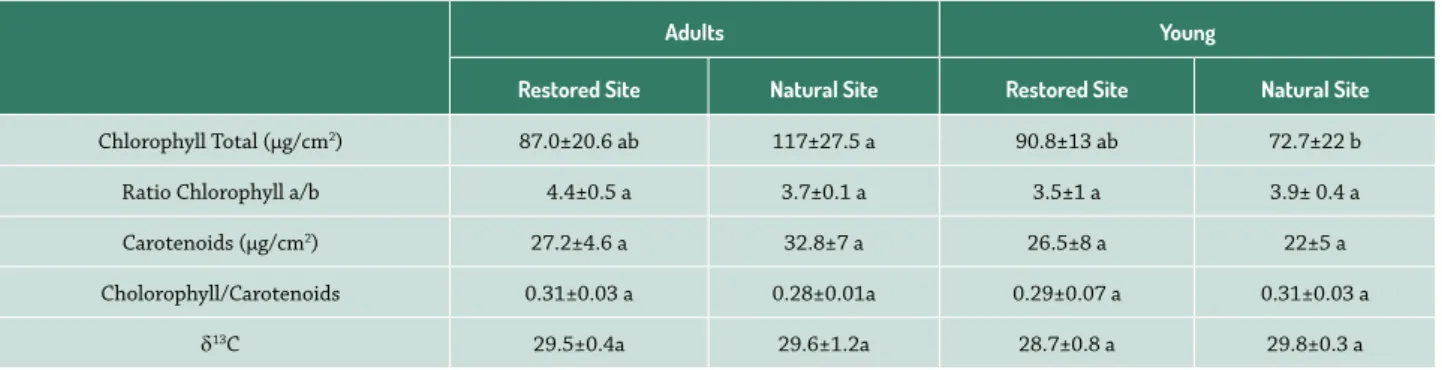
Regarding leaf pigments, there were significant differ-ences in total chlorophyll (F3,18 = 3.426, p = 0.0446; Tab. 2), with lower values being recorded for young individuals of the natural site. There were no statistically significant dif-ferences in carotenoid content, chlorophyll a/b ratio, and carotenoids/total chlorophyll ratio. Leaf carbon isotope compositions (13C) did not differ statistically between
individuals of the natural and restored sites (F3,15 = 1.708, p= 0.2183; Tab. 2).
Discussion
Individuals of C. semaphora growing in the restored site presented similar or better photosynthetic and water economy performances in comparison to individuals growing in the natural site. Improvements to the physical
Table 1. Chlorophyll fluorescence parameters extracted from light dependence curves of adults and young individuals of Chamaecrista semaphora in natural and restored site. ETRMax (maximum apparent electron transport rates); PPFD90%, and PPFD50% (Photosynthetic photon flux density at 90% and 50% of ETRMax);
ΔF/Fm’sat (ΔF/Fm’at ETRMax) and ΔF/Fm’50% (ΔF/Fm’at 50% of ETRMax). Data expressed as mean ± SE of five replicates to young and adults in restored site, and
four replicates to young and five adults in natural site.
Adults Young
Restored Site Natural Site Restored Site Natural Site
ETRMax 110.80±38 b 84.50±30 b 164.20±19 a 77.50±21 b PPFD90% 712.50±177 b 524±256 b 1040±293 a 490.80±105 b
PPFD50% 215±52 b 160±26 b 343 ±26 a 152±28 b
ΔF/Fm’Sat 0.34±0.04 a 0.38±0.08 a 0.36±0.05 a 0.35±0.09 a
ΔF/Fm’50% 0.57±0.07 a 0.60±0.07 a 0.54±0.05 a 0.56±0.07 a
a Different letters indicate significant differences between means (One-way ANOVA followed by Tukey test, p < 0.05).
Table 2. Mean values of pigment and Carbon isotopic composition (13C) in leaves of adults and young individuals of Chamaecrista semaphora in natural and
restored areas. Data expressed as mean ± SE of five replicates to young and adults in restored site, and four replicates to young and five adults in natural site.
Adults Young
Restored Site Natural Site Restored Site Natural Site
Chlorophyll Total (μg/cm2) 87.0±20.6 ab 117±27.5 a 90.8±13 ab 72.7±22 b
Ratio Chlorophyll a/b 4.4±0.5 a 3.7±0.1 a 3.5±1 a 3.9± 0.4 a Carotenoids (μg/cm2) 27.2±4.6 a 32.8±7 a 26.5±8 a 22±5 a
Cholorophyll/Carotenoids 0.31±0.03 a 0.28±0.01a 0.29±0.07 a 0.31±0.03 a
Silvana A. B. Castro, Camila E. M. Sá, Fabiana A. Mourão, Heitor M. Duarte, G. Wilson Fernandes and José P. Lemos-Filho
properties and fertility of the soil and the provisioning of irrigation after planting may have improved habitat quality and thus environmental conditions at the restored site, hence resulting in higher plant physiological performance. These conditions may have been retained even over the years since the beginning of the experiment. The favorable response to stressor factors indicated by the high values of predawn water potential and high values of ETRMAX are in accordance with the visible success of C. semaphora
individuals in the restored site. At the restored site, plants produced viable seeds that resulted in vigorous young individuals who settled around the parent plants.
A recent study with Vellozia gigantea in the same region led by Morales et al. (2014) reported that differences in leaf contents of tocopherols and tocotrienols depend on plant size. However, the authors did not find differences in Fv/Fm values or in stomata conductance between taller and smaller individuals. In another study taking into ac-count plant size, Lüttge et al. (2007) verified that taller species of Velloziaceae had higher intrinsic photosyn-thetic capacity as revealed by chlorophyll fluorescence parameters extracted from light curves. Our data for
C. semaphora indicate that plant size does not affect most of the evaluated physiological traits. There were no statisti-cally significant differences in pigment contents and 13C
values, as well as no differences for most of the chlorophyll fluorescence parameters extracted from light dependence curves, between adult and young individuals growing in the restored or natural site.
The water potential (w) at predawn observed for adult and young C. semaphora plants in the restored site were higher than those recorded for plants growing in the natu-ral site (Fig. 3). The values of w at predawn and midday were very close to the values described for Cerrado trees during the dry season (Goldstein et al. 2008; Rossatto et al. 2013a; b). However, these values are higher than those obtained for some non-desiccation tolerant species of the rupestrian grassland during the dry season at predawn and midday (approximately -1.0 MPa and -1.8 MPa), re-spectively (Alcantara et al. 2015). These values were also higher than those described for two out of three woody species from a granitic rock outcrop (Silva & Dillenburg 2007). The higher values of w mainly at predawn for plants of the restoration site may be a consequence of the improvement in soil conditions due to the addition of manure, which increased water availability. In contrast, the natural site has a thin layer of soil in rock crevices with low water retention capacity.
Plants exhibit several mechanisms to control water loss is situations of water stress. Stomata regulation is one of the most critical responses to water stress. A low stomata conductance and a low ratio of intercellular to ambient CO2 can result in low isotope discrimination in relation to the atmospheric CO2 and consequently promote higher
13C values (Farquhar& Hubick. 1989). Even though the
individuals from the restored site exhibited higher values of predawn w as compared to individuals from the natural site, there was no difference for the 13C values between
individuals from the two sites. According to Ehleringer & Cooper (1988), 13C values allow an integrated long-term
estimation of the intrinsic water use efficiency (WUE). This explains why C. semaphora plants inhabiting the site under restoration showed similar WUE to those from the natural site.
The quantum potential yield values (Fv/Fm) re-corded during predawn indicates the absence of chronic damage to PSII (Björkman & Demmig 1987) in plants of both sites. The lowest Fv/Fm and ΔF/Fm’ values and the highest NPQ values were recorded at morning, notably for adult individuals growing in the natural environment with a midday recovery (Fig. 5). These results can be explained by the vertical tilt angle of the leaves of C. semaphora (Fig. 1), which result in more in-cident light during in the morning (Fig. 4A). In vertical leaves a smaller fraction of leaf surface area is exposed to the sun at midday and light interception is reduced, thereby avoiding excess irradiance and, thus, photoin-hibition (Valladares & Niinemets 2007). This reversible photoinhibition process was consistently observed in several species of the Brazilian Cerrado (Mattos 1998; Franco & Lüttge 2002). Non-photochemical processes for energy dispersion in the PSII act as mechanisms to reduce photoinhibition during a period of higher light intensity. The NPQ values recorded in C. semaphora were higher than those found by Franco et al. (2007) for some Cerrado plant species, but similar to those reported by Mattos et al. (1997) at noon for species in coastal sandy areas (Restinga) and rock outcrops in Brazil. The recovery of Fv/Fm values during the afternoon and the absence of chronic photoinhibition are indicative of the effectiveness of mechanisms that dissipate excess light in plants growing in both sites. The favorable perfor-mance of adult and young plants in the restored site detected by fluorescence measurements was confirmed by chlorophyll pigment data. There was no difference in pigments between adult individuals in the restored site and the natural site, but young individuals from the restored site had higher total chlorophyll as compared to their counterpart of the natural site.
differences in the light environment. Adult and young
C. semaphora individuals in the restored site would be subject to less shading than the plants of the natural environment. Their sunny environment notwithstand-ing, adult and young individuals in the restored site had less variation in leaf and air temperatures. In the natural site on the other hand, individuals had leaf tempera-ture values 2-4°C above the air temperatempera-ture. A higher transpiration rate will result in a cooler leaf; hence the higher values of leaf temperature could be interpreted as a consequence of a more stressful environment in the natural rocky outcrops that limits transpiration. In summary, these ecophysiological data reported in this study indicate that the restoration process favored positive photosynthetic performance of the endangered species C. semaphora, enabling its establishment, sur-vival and reproduction.
Acknowledgements
We are grateful to the Postgraduate Program “Ecologia, Conservação e Manejo da Vida Silvestre/UFMG”, and to the “Reserva Natural Vellozia” for logistical support. We also are grateful to the Stable Isotope Laboratory from UNESP/Botucatu for the 13C analysis. This work was
supported by FAPEMIG, CNPq, and CAPES.
References
Alcantara S, Mello-Silva R, Teodoro GS, Drequeceler K, Ackerly DD, Oliveira RS.2015. Carbon assimilation and habitat segregation in resurrection plants: a comparison betweendesiccation- and non-desiccation-tolerant species ofNeotropical Velloziaceae (Pandanales). Functional Ecology (in press). DOI: 10.1111/1365-2435.12462.
Barbosa NU, Fernandes GW, Carneiro AAM, Junior LAC. 2010. Distribu-tion of non-native invasive species and soil properties in proximity to paved roads and unpaved roads in a quartzitic mountainous grassland of southeastern Brazil (rupestrian fields). Biological Invasions 12: 3745-3755.
Bilger W, Björkman O. 1990. Role of the xanthophyll cycle in photopro-tection elucidated by measurements of light-induced absorbance changes, fluorescence and photosynthesis in Hedera canariensis. Photosynthesis Research 25: 173-185.
Bilger W, Schreiber U, Bock M. 1995. Determination of the quantum efficiency of photosystem II and non-photochemical quenching of chlorophyll fluorescence in the field. Oecologia 102: 425-432. Björkman O, Demmig B. 1987. Photon yield of O2 evolution and
chloro-phyll fluorescence characteristics at 77K among vascular plants of diverse origin. Planta 170: 489-504.
Cooke SJ, Suski CD. 2008. Ecological Restoration and Physiology: An Overdue Integration. BioScience 58: 957-968.
Ehleringer JR, Cooper TA. 1988. Correlations between carbon isotope ratio and microhabitat in desert plants. Oecologia 76: 562-566. Farquhar GD, Hubick KT. 1989. Carbon isotope discrimination and
photosynthesis. Annual Review of Plant Physiology 40: 503-537. Fernandes GW, Barbosa NPU, Negreiros D, Paglia AP. 2014. Challenges
for the conservation of vanishing megadiverse rupestrian grasslands. Natureza & Conservação 12: 162-165.
Fernandes GW, Santos R, Barbosa NPU, Almeida HA, Carvalho VA, Angrisano PA. 2015. Ocorrência de plantas não nativas e exóticas em áreas restauradas de campos rupestres. Planta Daninha (in press). DOI: 10.1590/S0100-83582015000300009.
França MGC, Prados LMZ, Lemos-Filho JP, Ranieri BD, Vale FHA. 2012. Morphophysiological differences in leaves of Lavoisiera campos-portoana (Melastomataceae) enhance higher drought tolerance in water shortage events. Journal of Plant Research 125: 85-92. Franco AC, Lüttge U. 2002. Midday depression in savanna trees:
coordinated adjustments in photochemical efficiency, photores-piration, CO2 assimilation and water use efficiency. Oecologia 131: 356-365.
Franco AC, Matsubara S, Orthen B. 2007. Photoinhibition, carotenoid composition and the co-regulation of photochemical and non-pho-tochemical quenching in neotropical savanna trees. Tree Physiology 27: 717-725.
Genty B, Briantais JM, Baker NR. 1989. The relationship between the quantum yield of photosynthetic electron transport and quenching of chlorophyll fluorescence. Biochimica et Biophysica Acta 990: 87-92.
Genty B, Harbinson J, Baker, RN. 1990. Relative quantum efficiencies of the two photosystems of leaves in photorespiratory and non-photo-respiratory conditions. Plant Physiology and Biochemistry 28: 1-10. Giulietti AM, Pirani JR, Harley RM. 1997. Espinhaço range region,
eastern Brazil. In: Davis SDn Heywood VH, Herrera-MacBryde O, Villa-Lobos J, Hamilton AC. (eds.) Centres of plant diversity: a guide and strategy for their conservation. Vol. 3. Cambridge, WWF/ IUCN. p. 397-404.
Goldstein G, Meinzer FC, Bucci SJ, Scholz FG, Franco AC, Hoffmann WA. 2008. Water economy of Neotropical savanna trees: six paradigms revisited. Tree Physiology 28: 395-404.
Lemos-Filho JP, Mendonça-Filho, CV. 2000. Seasonal changes in the water status of three Woody legumes from the Atlantic forest, Caratinga, Brazil. Journal of Tropical Ecology 16: 21-32.
Lichtenthaler HK, Wellburn AR. 1983. Determinations of total carot-enoids and chlorophylls a and b of leaf extracts in different solvents. Biochemical Society Transactions 11: 591-592.
Lüttge U, Mundayatan H, Fernandes GW, et al. 1998. Photosynthesis of mistletoes in relation to their hosts at various sites in tropical Brazil. Trees 12: 167-174.
Lüttge U, Duarte HM, Scarano FR, et al. 2007. Physiological ecology of photosynthesis of five sympatric species of Velloziaceae in the rupes-trian fields of Serra do Cipó, Minas Gerais, Brazil. Flora 202: 637-646. Madeira JA, Fernandes GW. 1999. Reproductive phenology of sympatric taxa of Chamaecrista (Leguminosae) in Serra do Cipó, Brazil. Journal of Tropical Ecology 15: 463-479.
Mattos EA. 1998. Perspectives in comparative ecophysiology of some Brazilian vegetation types: leaf CO2 and H2O exchange, chlorophyll a fluorescence and carbon isotope discrimination In: Scarano FR, Franco AC. (eds.) Ecophysiological strategies of xerophytic and amphibious plants in the neotropics. Oecologia Brasiliensis. Rio de Janeiro, PPGE-UFRJ. p. 1-22.
Mattos EA, Grams TEE, Ball E. et al. 1997. Diurnal patterns of chlorophyll a fluorescence and stomatal conductance in several species of coastal vegetation in southeastern Brazil. Trees 11: 363-369.
Morales M, Garcia QS, Bosch SM. 2015. Ecophysiological response to seasonal variations in water availability in the arborescent, endemic plant Vellozia gigantea. Tree Physiology 35: 253-265.
Morales M, Garcia QS, Silva AIS, Silva MC, Bosch SM. 2014. Tocotrienols in Vellozia gigantea leaves: occurrence and modulation by seasonal and plant size effects. Planta 240: 437-446.
Rascher U, Liebig M, Lüttge U. 2000. Evaluation of instant light-res-ponse curves of chlorophyll fluorescence parameters obtained with a portable chlorophyll fluorometer on site in the field. Plant, Cell & Environment 23: 1397-1405.
Silvana A. B. Castro, Camila E. M. Sá, Fabiana A. Mourão, Heitor M. Duarte, G. Wilson Fernandes and José P. Lemos-Filho
Rossatto DR, Hoffmann WA, Silva LCR, Haridasan M, Sternberg LSL, Franco AC. 2013a. Seasonal variation in leaf traits between congene-ric savanna and forest trees in Central Brazil: implications for forest expansion into savanna. Trees 27: 1139-1150.
Rossatto DR, Sternberg LSL, Franco AC. 2013b. The partitioning of water uptake between growth forms in a Neotropical savanna: do herbs exploit a third water source niche? Plant Biology 15: 84-92.
Silva LGR, Dillenburg LR. 2007. Water relations of tree species growing in a rock outcrop in the Itapuã State Park. Revista Brasileira de Botânica 30: 703-711.