DOI: htp://dx.doi.org/10.21168/rbrh.v21n2.p429-438
Isabela Claret Torres, Rodrigo Silva Lemos e Antônio Pereira Magalhães Junior
Departamento de geograia do instituto de geociências da Universidade Federal de Minas Gerais, Belo Horizonte MG, Brasil [email protected]; [email protected]; [email protected]
Recebido: 20/10/2015- Revisado: 22/12/2015- Aceito: 11/02/2016
ABSTRACT
Southeastern Brazil is experiencing severe water scarcity because of low rainfall and ineficient water resource management. As a consequence, water sup
-ply companies have begun discussing potential solutions to this problem. One proposed solution is creation of new public water sup-ply reservoirs. Recently, managers from municipalities in the metropolitan region of Belo Horizonte, along with sanitation companies, have begun to focus their attention on the Rio Taquaraçu. The Taquaraçu lies in the Rio das Velhas Basin and displays both good water quantity and quality within the Belo Horizonte metropolitan area. The Taquaraçu is a tributary of the Rio das Velhas, and it was proposed that the Taquaraçu waters dilute pollutant concentrations entering the Rio das Velhas, thereby improving downstream water quality. This study evaluated statistically the impact of the Rio Taquaraçu on water quality in the Rio das Velhas. For this analysis, we used data collected between 1997 and 2015 from sampling points established by the Minas Gerais Estate Institute of Water Management(IGAM) in the Rio Vermelho, in the Rio Taquaraçu, and in upstream and downstream sites (the Rio Taquaraçu input) of the Rio das Velhas. Box-plots were created for water quality variables and a Principal Component Analysis (PCA) was run for periods referred to as “dry” and “wet.” Despite receiving sewage releases from cities in its watershed, the Rio Taquaraçu maintains good water quality. Nevertheless, our results indicate that inlow from the Rio Taquaraçu is insuficient to mitigate the poor water quality of the Rio das Velhas.
Keywords: Water management. Water scarcity. Metropolitan Region of Belo Horizonte. Taquaraçu River. Water quality.
Devido ao atual estado de escassez hídrica na região sudeste do Brasil, resultante não apenas do baixo índice pluviométrico, mas também da gestão ineiciente dos recursos hídricos no país, as companhias de abastecimento vem discutindo soluções para esse problema. Entre as soluções possíveis está a criação de novos reservatórios para o abastecimento público. Nesse sentido, o rio Taquaraçu tem sido alvo de atenção dos gestores municipais e de saneamento da Região Metropolitana de Belo Horizonte por ser um dos rios da Bacia Hidrográica do rio das Velhas com água de melhor estado qualitativo e quantitativo. Sendo um aluente direto do rio das Velhas aventa-se para a possibilidade que suas águas ajudam a diluir a concentração de poluentes com consequente melhora de sua qualidade de água. Portanto, este trabalho visa avaliar, por meio de testes estatísticos, se o rio Taquaraçu interfere de forma positiva para a melhora da qualidade de água do rio das Velhas. Nas análises foi utilizado o banco de dados do Instituto Mineiro das Águas (IGAM), no período de 1997 a 2015, de pontos localizados no rio Vermelho, no rio Taquaraçu e no rio das Velhas. Foram criados gráicos Box Plots e realizada a Análise de Componentes Principais (PCA) para os períodos denominados de seca e chuva. Os resultados demonstraram, que apesar de receber lançamentos de esgotos de várias cidades do seu entorno, o rio Taquaraçu apresenta boa qualidade de água. Entretanto, os resultados dos PCAs indicaram que o rio Taquaraçu não altera a já atestada má qualidade das águas do rio das Velhas.
Palavras Chave: Gestão de recursos hídricos. Escassez hídrica. Região Metropolitana de Belo Horizonte. Rio Taquaruçu. Qualidade da água.
Inluence of the Rio Taquaraçu in the water quality of the Rio das Velhas: subsidies
for relections of the case of water shortage in Belo Horizonte metropolitan region –
MG, Brazil
Inluência do Rio Taquaraçu na qualidade da água do Rio das Velhas: subsídios às relexões sobre o quadro
de escassez hídrica na região metropolitana de Belo Horizonte – MG, Brasil
INTRODUCTION
Models and management initiatives of water resources based on the continuous increase in water supply are being in-creasingly discussed and questioned in Brazil. The water scarcity that affects the country’s southeastern region between 2013 and 2015 indicates that the causes are not onlythe low rainfall rates, but are also related to a historical process of problems that arisedthe gaps and deiciencies of the water resources management panorama.
In the metropolitan areas of Brazil, the water resources management focuses on sanitation in order to maintain and increase the water supply, especially for urban and industrial uses, and also for wastewater dilution. However, the traditional model of urban expansion was not sensitive to the environmental aspects of the watersheds, creating a context of hard population concentration, pollution and scarcity of water both in quantity and in quality. The human impacts often result in degradation of the water quality sources, compromising their environmental functions and increasing the challenges of supply andaccess to water, as well asto managediferent and conlitant uses of water (TUCCI, 2008; BROWN et al 2008.).
In this sense, the water sourcesand their watersheds are not adequately protected in land-use models existing in the metropolitan areas, such as the metropolitan region of Belo
Horizonte (RMBH). In the search for solutions to increase wa-ter availability and reducing conlicts over water use, sanitation sector in Brazil it is commonly based on the increase of the water supply, mainly from the strategy of damsconstruction. This has been one of the solutions suggested by the Minas Geraissanitation company (COPASA) to try to improve the current situation of water scarcity in RMBH.
COPASA uses four main water sources to supply most of the RMBH municipalitiesinto two integrated systems. The Rio das Velhas Integrated System is based in the Bela Famawater abstraction source, while the Rio ParaopebaIntegrated System presents water abstraction points in Manso and Serra Azulrivers, as well as Vargem das Flores dam. The Bela Famaabstraction system serves about 60% of the Belo Horizonte urban de-mands. As has no signiicant reservation, it depends directly on the amount of water available in the Rio das Velhasto serve approximately 1.8 million people.
Due to the release of domestic and industrial efluents, as well as to surface runoff diffuse pollution from urban and rural areas, the Rio das Velhas water quality has undergone an intense process of degradation (BARRETO et al. 2011). The Rio das Velhas basinhas about 29.000 square kilometers. The impacts of theurban and industrial activities concentrated in the RMBH affect hundreds of kilometers downstream. Many municipalities receive these negative externalities of which they are not causative.
The Rio das Velhaswater sources are particularly fragile
D
Figure 1: RMBH, Bela Fama water abstraction and Rio Taquaraçu watershed
to human pressures associated to the various anthropic uses in theupstream watershed, especially the mining and urban uses. Moreover, the increasing water demands force more management strategies to enhance water supply. These challenges became more critical in relative low precipitations rates periods as 2013-2015. In this sense, COPASA has the intention of building a dam in the Rio Taquaraçu near its mouth in the Rio das Velhas, S eek-ing to ensure the water supply in the RMBH. COPASA wants also to rely on a new water source to increase regional water supplies and attend the greatest water demand areas, especially the RMBH north region. Especially in a period of regional water scarcity (2013-2015), the RioTaquaraçu has been given attention from RMBH sanitation and municipal managers, especially by the fact that it is a Rio das Velhas tributary with good water quality and quantity. Its watershed is fully inserted in RMBH (Figure 1) andthe main springs are located in the Caeté city, crossing the municipalities of Nova União and Taquaraçu de Minas before lowing into the Rio das Velhasin Santa Luzia city. It is formed by the sub-basins of Rio Vermelho, Rio Ribeiro Bonito (Caeté), Rio Preto (Nova União) and Rio do Peixe (Taquaraçu de Minas). The watershed is formed also by small watercourses located in rural areas of Jaboticatubas municipality, with 796.81 Km2 of total area.
Despite receiving the input of domestic sewage in all the cities of the watershed, the Rio Taquaraçu waters are considered of good quality, showing, according to the Minas Gerais Estate Institute of Water Management (IGAM), an IQA with index “Good” next to itsoutfall in theRio das Velhas (PROJETO MANUELZÃO, 2015). A relative good quanti-tative and qualitative state of watersmakes the Rio Taquaraçu (in the report of the GOS AMBIENTAL, 2014, held for the Watershed Committee of the Rio das Velhas) to be considered a major contributor to the Rio das Velhas. Increasing the Rio das Velhas lows mainstream and contributing to the dilution of pollutants, the Rio Taquaraçu can therefore assist in the raising of the water quality state of the Rio das Velhas downstream of the conluence.
From the aforementioned context, the study aims to investigate the hypothesis that the Rio Taquaraçu effectively contributes to improving the water quality of the Rio das Velhas, adopting as base procedure, the statistical treatment of parame-ters of water quality data of both watercourses. The results can contribute to the assessment of the possible impacts of a future damming in the Rio Taquaraçuto the water quality in the Rio das Velhas, and can help the debate and the decision-making on water demmand for public supply in RMBH.
Rio das Velhas as a water supply source for the RMBH The RMBH has a relevant economic centrality and services to the state of Minas Gerais. It is the third largest metropolitan area in Brazil, consisting of 34 municipalities and housing more than 5 million inhabitants (UFMG, 2011). In hydrographic terms, the RMBH is inserted into three units of Planning and Water Resources Management (UPGRH.): the basins of the Rio das Velhas, the Rio Paraopeba and Rio Pará. Belo Horizonte is fully inserted in the Rio das Velhasbasin, as well as most of the regional population. Belo Horizonte and the RMBH have had different sources of water supply, but with the increase of the population concentration, especially since the 1970s, new sources are now required. Over time, these sources have materialized in two integrated high-volume systems: the Rio das Velhas Integrated System and the Rio Paraopeba Integrated System. Other com-plementary smaller proportions systems serve to the rest of the RMBH population. The Rio das Velhas water supply system works since 1973, in a catchment of about 6m³ of water per second. It serves approximately 2,200,000 inhabitants of Belo Horizonte, Nova Lima, Raposos, Santa Luzia and Sabará municipalities. The water takeout is the supericial type, with direct water intake in the Rio das Velhas, being situated in Bela Fama, municipality of Nova Lima / MG. As SEMAD (2013) states: “The system had its law granting water use ground to the low of 8,771 m³/s, anticipating increased demand, but now, according to informed, the electrical system of the Rio das Velhas system is able to support a pickup in, maximum of 7,6 m³/s, is already provided for their suitability”. (SEMAD, 2013). This adjustment would involve a new uptake value which corresponds to about 95% of Q7/10. This scenario is quite negative considering the grantable maximum of 30% of Q7/10, required by law. To make matters worse, there are many other water demands upstream of Bela Fama, especially mining and other catchmentsfor public supply, as the one carried out by the Autonomous Water and Sewage System of Itabirito municipality (SEMAD, 2013). The water takeout volumes that are expected to be raised, can greatly compromise the environmental quality of river downstream, drastically reducing the water available for the maintenance of aquatic ecosystems (Figure 2).
Figure 2 - Rio das Velhas downstream to the Bela Fama water abstraction point; October 2014
Source - CBH Rio das Velhas, 2014
are also the two worst Rio das Velhascontributors in terms of quality. They have very high concentrations of organic matter and heavy metals, as well as low levels of oxygen, directly reducing the water quality of the Rio das Velhas, especially during the dry season. According to the Master Plan for Water Resources (PDRH) of the Rio das Velhas, the city of Belo Horizonte generates a remainingbiochemical oxygen demand (BOD) load greater than 128,000 kg/day (CBH Rio das Velhas, 2014, page 520)
The Rio das Velhas as a metropolitan water supply suf-fers thus strong environmental pressures and impacts upstream of theBela Fama system and downstream of the conluence with the Arrudas and Onça streams. In addition to the qualitative impacts, the lows are reduced as there is no return of the most abstracted waters, especially in drought periods.
TECHNIQUES AND PROCEDURES
The work was carried out on the basis of water quality monitoring data conducted by IGAM between 1997 and 2015. The data used refer to the following sampling points (Figure 3): 1 – Rio Vermelho downstream of the municipality of Nova União (BV 133); 2 – Rio Taquaraçunear its conluence with the Rio das Velhas (BV 135); 3 – Rio das Velhas downstream of Ribeirão da Mata creek; Rio das Velhas upstream of the conluence with the Rio Taquaraçu (BV 153); 4 –Rio das Velhasnext to Raul Soares
Bridge in Lagoa Santa, downstream of the conluence with the Rio Taquaraçu (BV137). The numbering 1 to 4 was adopted for statistical analysis and for the Box-plot graphs.
The IGAM data were collected during the dry season (June to September), rainy season (November to February) and intermediate period (October to May). For the analysis was considered only the data of the irst two, since the interim periods have missing data. Of the 49 parameters analyzed by IGAM were selected 17 related to water quality. This selection was necessary due to factors such as lack of data, low-frequen-cy of analysis, high frequen data, low-frequen-cy of data with values below the detection limit and no data for all the points considered. These factors could adversely affect the statistical analysis leading to unreliable results.
The selected parameters indicate impacts derived from human activities such as pollution by toxic (total arsenic and the total cyanide), contamination by nutrients (total phosphorus, ammonia and nitrates), organic contamination (biochemical oxygen demand and chemical oxygen demand), presence of ions in solution (total dissolved solids and electrical conducti-vity), bacteriological contamination (total and fecal coliforms), presence of cyanobacteria, alkalinity or acidity (pH), changes in water clarity (turbidity, total suspended solids), algae density (chlorophyll-a) and oxygenation of water (dissolved oxygen).
Being different periods due to the large difference in rainfall and lows, periods of rain and drought were analyzed
mum and minimum parameters of the data were used for the construction of Box-plots. To check the relationship between the parameters and between selected sampling points multivariate analysiswas performed. Multivariate analyzes (i.e. grouping and sorting) allows the evaluation of large amounts of data in order to describe its structure and quantify the degree of association between variables and objects. Ordering is a set of techniques by which variables or samples are positioned in relation to one or more axes, such that their positions provide the maximum information about similarities (VALENTIN 1995). The ordering principle is to sim-plify, condense and represent synthetically vast data sets, hoping that ecological interrelationships become clearer (VALENTIN, 1995). Among the sorting techniques, Principal Component Analysis (PCA) is one of the most widespreadmethod, because it allows structuring a set of multivariate data whose probability distribution need not be known (JOLLIFFE, 1986 PLA, 1986). Therefore, to investigate the relationship between the sampling points based on the evaluated parameters aPCA was conduc-ted. The positioning of the sampling points in relation to the parameters selected by the PCA could indicate that the waters of the Rio Taquaraçu improves the water quality of the Rio das Velhas. Statistical analyses and Box-plot were performed using Statistica version 7.1 for Windows (STAT SOFT INC. 2006). The Box-plot of the parametersare presented in Appendix 1.
RESULTS AND DISCUSSION
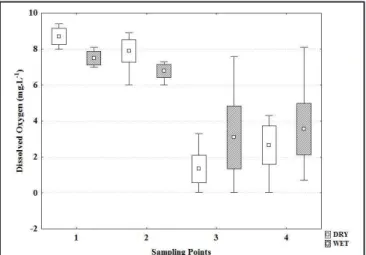
In relation to the selected parameters there was a sig-niicant variation in the sample size. It was analyzed 18 samples for point 1 (Rio Vermelho), 35 to point 2 (Rio Taquaraçu), 89 to the point 3 (Rio das Velhas, upstream) and 89 to section 4 (Rio das Velhas, downstream). Figures 4 to 6 show de Box-plot for selected variables in the four sampling points. The Box -plot of the remained variables are shown in Appendix 1. In the Box-plotthe mean, standard deviation, and maximum and minimum values for “dry” and “rainy” seasoncan be observed. The standard deviation how the parameter varied among the selected sampling points.
Except for arsenic, nitrate, chlorophyll-a, cyanobacteria, suspended solids, dissolved oxygen, turbidity and pH, all others parameters had the highest mean values in the “dry” period than in the “rainy” periodfor sampling points 3 and 4 (Figures 4, 5 and 6 and Appendix 1). This indicates a higher concentration of the parameters in the lower volume of water of the rivers. Suspended solids and turbidity showed higher values in the rainy season (Appendix 1). This was expected due to increased runoff and higher amount of solid particles input to the rivers. This result may also indicate that the riverbanks are poorly protected. The dissolved oxygen showed higher values in points 1 and 2 and lower in point’s 3 and 4 (Figure 4). This demonstrates the good oxygenation of the Rio Vermelho and Rio Taquara-çuwaters. Moreover, the results show that the Rio das Velhaswater has low oxygenation, which may be harmful to aquatic biota.
The chlorophyll-adata indicates low density of algae in Vermelho and Taquaraçurivers (Figure 5). However, both
upstream as downstream of the Rio das Velhas showed high concentration of chlorophyll-a, indicating high density of algae (Figure 5). The high density of cyanobacteria in the Rio das Velhas should be a warning, as these organisms are able to produce toxins harmful to aquatic biota or humans and animals that have contact with its waters (Figure 6). An important factor to be noted is the presence of cyanobacteria in the Rio Taqua-raçu (Figure 6). Despite the low current densities, this situation may change with the continued input of domestic wastewater.
Figure 4 - Box-plot Dissolved Oxygen concentration
Figure 5 - Box-plot of Chlorophyll-a concentration
environment for the development of cyanobacteria that could even form blooms (JARDIM et al. 2008). According to Sant’ana et al. (2006) the cyanobacterial blooms are characterized by the signiicant increase in its density with the potential to produce toxins. In Caxias do Sul, south region of Brazil, Ribeiro et al. (2005) reported that damming processes lead the environment before oligotrophic (with low nutrient concentrations) to present mesotrophic conditions (increased concentration of nutrients), with a consequent signiicant increase in phytoplankton density. The presence of cyanobacteria in the Rio Taquaraçumay com-promise the public supply due to changes in the water color and odor and the possibility of the cyanotoxins presence.
Figure 6 - Box-plotCyanobacteria densities
Except for the dissolved oxygen, all the others water quality parameters had higher mean values in the Rio das Ve-lhas compared with the other two rivers, both upstream and downstream of the conluence. This indicates that Vermelho and Taquaraçu rivers have a better water quality than the already stablished low water quality of the Rio das Velhas. According to Normative Resolution No. 20, of June 24, 1997, of the State Council for Environmental Policy of Minas Gerais (COPAM / MG) the Vermelho and Taquaraçu rivers are class 1 and the Rio das Velhas is class 3, in the sampling points of this work. Signiicant differences were not observed between the mean values of the selected parameters in points upstream and downstream of the conluence, indicating that there is not an improvement in water quality of theRio das Velhas with the input of the Taquaraçu River waters.
The PCA results are shown in the Figure 7 for the “wet”season, and in the Figure 9 for the “dry” season. The fecal coliforms, chlorophyll-aand cyanobacteriadata were not considered in this analysis due to the signiicant missing data.
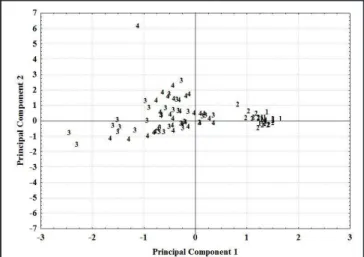
Regarding the “wet” season, 59.4% of the total data variability was explained by the two axes. Axis 1, with 36.6% of the total variability, selected the cyanide, electrical conductivity, biochemical oxygen demand (BOD), total phosphorus (Total P) and total dissolved solids (TSD) and in opposition to these parameters dissolved oxygen (DO) was placed. Axis 2, with 22.8% of the total variability, selected total suspended solids (TSS) and turbidity (Figure 7). The order of the sampling points
shows two distinct groups (Figure 8). One is located in the OD position with the Vermelho and Taquaraçurivers reinforcing the data obtained with the Box-plot, indicating well-oxygenated waters. The points of the Rio das Velhas, both upstream as downstream of the conluence, were jointly plotted with the other parameters, especially selected by PCA, indicating their high concentrations in these sampling points. There was no clear separation of the upstream and downstream conluence points, indicating again that the waters of the Rio Taquaraçudo not interfere signiicantly in the water quality of the Rio das Velhas.
Figures 7 and 9 show the data from the “wet” and “dry” season, respectively TSS, DO, EC (Electrical conductivity), Total P, TDS (Total Dissolved Solids), BOD (Biochemical Oxygen Demand) and COD (Chemical Oxygen Demand).
Figure 7 - PCA loadings for the “wet” season
Figure 8 shows the plot of sampling points based on the results of the PCA (1 –Rio Vermelho, 2 –Rio Taquaraçu 3 –Rio das Velhas upstream the conluence with Rio Taquaraçu, 4 –Rio das Velhas downstream the conluence.
Figure 8 - Plot of the sampling points based on the results of PCA for the “wet” season
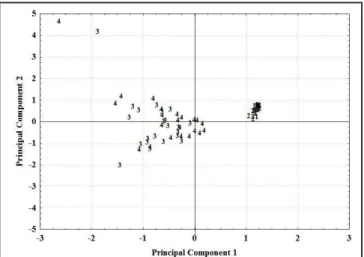
variability of the data was explained by the two axes. Axis 1, with 54.9% of the variability, selected total cyanide, total coliforms, electrical conductivity, BOD, COD, total P, ammonia,TDS, and opposite to those, the OD was placed. Axis 2, with 16.5% of the total variability, selected the turbidity as the only parameter explaining the variability of the data (Figure 9). The plot of the points of the “dry”season followed the same pattern observed for the “wet” season, with Vermelho and Taquaraçu rivers in the position of the OD and the points of the Rio das Velhas located in the position of the other parameters selected by the two axes (Figure 10). Again there was no separation between the points upstream and downstream of the conluence, showing that the water quality is similar and reinforcing that the Rio Taquaraçu waters does not improve the water quality of the Rio das Velhas.
Figure 9 - PCA results for the “dry” season
Figure 10 - Plot of the sampling points in relation to the results of the PCA for the “dry” season
FINAL CONSIDERATIONS
Through the statistical analysis this study has stablished that the Rio Taquaraçu, despite receiving efluents along its wa-tershed, has good quality water by regional standards. However,
this state does not improve the Rio das Velhasquality. Downs-tream of the conluence, the Rio das Velhas watershows the same features of upstream, with a signiicant bad water quality derived primarily from urban and industrial efluents. Despite a positive inluence has not been veriied, we must remember that the relatively high quality of the Rio Taquaraçuwater draws attention to serve as a new source to meet the demands of public supply of the RMBH, especially in the recent period of water shortage. However, the hypothesis of building a dam in the Rio Taquaraçu should be carefully discussed and studied in the light of the planning of land use and sanitation framework of the basin. Receiving sediment and pollutants along its cour-se, a future lentic body is likely to be marked by siltation, high concentrations of nutrients and algal blooms. Again it should be emphasized that the creation of new water sources to supply urban demands should not be decided in unlinked mode of territorial and environmental management processes in different spacial involved.
ACKNOWLEDGEMENTS
The authors thank CAPES for PNPD scholarship Post-Doctor Isabela C. Torres and the CAPES / SOCIAL DEMAND doctoral scholarshipfor Rodrigo S. Lemos.
REFERENCES
BARRETO, P.S.; LEMOS, R.S.; SEPÚLVEDA, R. Envolvimento e Sensibilização das Comunidades a partir da Recuperação de Nascentes e Matas Ciliares na Bacia do Rio Taquaraçu, 2011. Disponível em: http://www.cbhvelhas.org.br/images/ projetos%20SCBH/PROJ%20TAQUARACU_FINAL.pdf. Acesso em 08/06/2015.
BROWN, R; KEATH, N; WONG, T. Transitioning to water sensitive cities: historical, current and future transition states. In: International conference on urban drainage, 11th, Anais. Edinburgh. 2008.
CBH RIO DAS VELHAS. Atualização do Plano Diretor de Recursos Hídricos, produto 02a. Disponível em www.cbhvelhas. org.br/planodiretor Acesso em: 28/09/2015.
ESTEVES, F. A. Fundamentos de limnologia. 3 ed. Interciência, Rio de Janeiro, Brasil, 2011. 602p.
GOS AMBIENTAL. Recomposição de Matas Ciliares Degradadas e Manutenção Florestal na Bacia do Rio Taquaraçu. 2014. Disponível em: http://cbhvelhas.org.br/images/subcomites/projetos/ taquaracu/relatorio_de_campo_01_compactado.pdf. Acesso em: 08/06/2015.
JOLLIFFE, I. T. Principal Componente Analysis. New York: Brillinger, etc, 1986. (Springer Series in Statistics).
M.M.; CERQUEIRA,D.; GIANI, A. Cyanobacteria blooms in waters of river intake areas in Minas Gerais Brazil, during the dry season of 2007. Contingency Plants. In: SIMPÓSIO ÍTALO BRASILEIRO DE ENGENHARIA SANITÁRIA E AMBIENTAL, 9., 2008, Florença, Itália. 2008.
PLA, L.E. Analisis multivariado: metodo de componentes principales.
Washington: Chesneau. (Coleccion de Monograias Cientiicas), 1986.
PROJETO MANUELZÃO. Contrastes entre municípios caracterizam a bacia do Taquaraçu. 2015. Disponível em: http://www.manuelzao. ufmg.br/expedicao/imprensa/boletins/boletim7.htm Último acesso em 08/06/2015 Acesso em: 08/06/2015.
RIBEIRO, L.H.L.; BRANDIMARTE, A.L.; KISHI, R.T. Formation of the Salto Caxias Reservoir (PR): an approach on the eutrophication process. Acta Limnologica Brasiliensia, São Carlos, v.17, n.2, p.155, 2005.
SANT’ANNA, C.L.; AZEVEDO, M.T.P.; AGUJARO, L.F.; CARVALHO, M.C.; CARVALHO, L.R.; SOUZA, R.C.R. Manual ilustrado para identiicação e contagem de cianobactérias planctônicas de águas continentais brasileiras. Rio de Janeiro: Editora Interciência, 2006. 58 p.
SANT’ANNA, C.L.; MELCHER, S.S.; CARVALHO, M.C.; GELMEGO, M.P.; AZEVEDO, M.T.P. Planktic Cyanobacteria from upper Tietê basin reservoirs, SP, Brazil. Rev. bras. Bot., v. 30, n. 1, 2007.
SEMAD - SECRETARIA DE MEIO AMBIENTE E DESENVOLVIMENTO SUSTENTÁVEL. Parecer único Nº 321/2013 – licença de operação corretiva ETA Rio das Velhas. Minas Gerais. Disponível em: http://www.semad.mg.gov. br/images/stories/URCS_SupramCentral/RioVelhas/70/ copasa-00138-1992-002-2011.pdf, Acesso em 28/09/2015.
TUCCI, C.E.M. Águas urbanas. Estudos avançados, v. 22, n. 63, p. 97-112, 2008.
UFMG - Universidade Federal de Minas Gerais. Plano Diretor de Desenvolvimento Integrado da Região Metropolitana de Belo Horizonte. Belo Horizonte, 2011. Disponível em http://www.rmbh.org.br/ repositorio/todos-documentos Acesso em: 28/09/2015.
VALENTIN, J.L. Agrupamento e Ordenação. In: Oecologia
Brasiliensis, Rio de Janeiro: Perez-Neto. 1995, v. 2. p. 27-55.
Contribuição dos autores
Isabela Claret Torres: tratamento e análise estatística dos dados de qualidade da água; elaboração dos gráicos, interpretação e discussão dos resultados; redação e revisão do texto.
Rodrigo Lemos: redação e revisão do texto; interpretação e discussão dos resultados;
APPENDIX 1
Box-plotof the values of Total Arsenic (mg.L-1),Total Cyanide (mg.L-1), Ammonia (mg.L-1), Nitrate (mg.L-1), Total Phosphorus (mg.L-1), pH, Biochemical Oxygem
Demand (mg.L-1), Chemical Oxygem Demand (mg.L-1) in the sampling (1 – Vermelho River, 2 – Taquaraçu River, 3 – das Velhas River upstream and 4 – das Velhas
Box-plotof the values of Fecal Coliforms (NMP.100mL-1), Total Coliform (NMP.100mL-1), Electrical Conductivitie (µS.cm-1), Turbidity (UNT),Total Dissolved Solids
(mg.L-1),Total Suspended Solids (mg.L-1)in the sampling points (1 – Vermelho River, 2 – Taquaraçu River, 3 – das Velhas River upstream and 4 – das VelhasRiver