INFORMATION MANAGEMENT AND MEDIATION IN A DIGITAL
REFERENCE SERVICE FOCUSED IN SOCIAL SCIENCES
María Cecilia Corda
Instituto de Investigaciones en Humanidades y Ciencias Sociales Facultad de Humanidades y Ciencias de la Educación
Universidad Nacional de La Plata (UNLP) Directora de la Biblioteca de Ciencias Sociales “Enzo Faletto”
FLACSO - Sede Académica Argentina Argentina
ABSTRACT
This paper investigates the current relationship between information management and information mediation along with the digital reference service through a case study which took place in an academic library. The concept of information mediation is herein analyzed, since a conceptual examination provides elements that will help people to comprehend and evaluate the concerned service. The information professional plays a very important role in the mediation aforementioned, which may be directly or indirectly; consciously or unconsciously; by himself/herself or plurally; individually or inserted into a group – in all such manners that mediator facilitates the acquisition of information, fully or partially satisfying a user’s need of all sorts of knowledge. Meanwhile, we here approach information management from a scope that points out a description over performed activities concerned to policies and procedures put into effect until the service evaluation by proposing a criterion for such point. Finally, we outline a few actions to be implemented in long-term perspective, which goal is to continually ameliorate such assistance, taking in account the human factor.
Keywords: Information Mediation; Digital Reference Service; New Technologies;
Information Management; Academic Libraries; Social Sciences.
1 INTRODUCTION
In this work we regard information management as the organization of data and information that are incorporated to a kind of media structure, comprising since the printed book until the Internet (VALENTIM, 2002). This point of view can be complemented by another one in Ponjuán Dante’s book (2004, p.17-18, emphasis added), who states that information management:
[…] is a process whereby basic resources (economic, physical, human, and material) are obtained, unfolded or used to manage information into and on the behalf of the society to which it is in service of. Its basic aspect is the management of the lifecycle
of that resource and takes place at all kinds of organization […] the information management process must be systemically evaluated according to different facets, and mastering its properties allows it to be employed in any organization.
It is in the context that the notion of information management underlines, which in itself is not only linked to the reference service, it encompasses all activities that are carried out by an information manager of all sorts and based in various frameworks. Information mediation is clearly observable on the interaction with a user upon a search for information directed to the system.
2 DIGITAL REFERENCE SERVICE
Given the technological advances that have been happening since the middle of last century, passing through telex, fax and, later, by e-mail, chat, Web and video conferencing, it is concretized this passage from the ‘traditional’ to the ‘digital’ in the libraries and documentation centers.
In the context of this work, and in order to avoid the terminological ambivalence, it is adopted the definition proposed by Merlo Vega (2009a, p.583), who holds that the digital reference is: "[…] a service offered by information centers, where the communication with users is done through telematic networks and in which the data or documents are available electronically. The digital reference is a professional, telematic and electronic service".
In another of his articles, extending his point of view, the author adds that:
elements that define the digital reference, we highlight the following: they are services provided by libraries or information centers; definitely they are information services; they answer queries which respond the questions asked by users; they happen completely online, from Internet; they are based on technologies for both communication with the users and for the resolution of queries (MERLO VEGA, 2009b, p.590).
The implementation of the digital reference service brings arranged the following advantages: a) temporal and geographic access unrestricted; b) an anonymous character of query; c) offering of a printed version of the negotiation of the question; d) an informal and spontaneous character of the e-mail, chat or the web in relation to other means used long ago, as the letter.
However, certain disadvantages that must be considered also arise: security and confidentiality problems; difficulties to conduct the interview1; limited access to email, chat or Internet; software and interoperability limitations; possibility to ignore an information search, a situation unlikely to be feasible in communicating face to face or by telephone; risk of losing messages, or malfunctioning of the servers or that the user stop interacting and do not negotiate anymore to the question.
These issues must be complemented with the suggestions that since the beginning of the appearance of these modalities in the reference service, were done by Deegan (2000) in relation to: 1) relying on a software that works 24 hours per day; 2) not finding that we can predict all the problems; 3) convening a group of information professionals to opine on the development of software related to content and design; 4) disseminating the new service among the users and maintain a control; and 5) undertaking an analysis of the impact generated among them.
in an interview with distance are absent, except in the experiments conducted by videoconference or video cameras, not usual among analyzed group in this article.
From one of the best-known experiments on the subject of the distance reference, Abels (1996) concludes that the most effective way to resolve the interview is through the use of products and forms designed a priori which order in a systematic and logical way the dialogue among the librarian and the user. This is the most efficient way related to the number of messages exchanged, as the proposal about these protocols and forms includes several areas of data: user identification, thematic data (main theme and related aspects) economic data (costs if any, payment forms, number of accounts, etc.), complementary data (time constraints, language/s of preference, amount of reference in the response, other sources already consulted, formats of information presentation, etc.).
In all the moment, throughout this process, the librarian accomplishes what in the context of this work is conceived as mediation of information in the mark of the management process referred. Then it becomes necessary to specify what it is about exactly.
3 MEDIATION OF INFORMATION IN THE REFERENCE SERVICE
The mediation – understood as the reason for the work of the librarianship profession –, among the users and the information sources in their print or digital version (ALMEIDA JÚNIOR, 2002) is the responsibility of the reference librarian, who adds value to the process of information transferring. This value is enshrined in the processes that he conducts of search, categorization, prioritization, filtering, translation and communication of answers offered to the user in order to satisfy their demand of information.
standardization in the bibliographic description and in the use of documental languages; control of quality of information available on e-books, e-journal, etc.; tools that systematize the information on the network; friendly and accessible interfaces to the users and fundamentally stability on the information gathered through pages and portals the Internet. To this they are added the possibilities of communication offered by technology, which are redesigned to the user with its alternation between the face and the remote. All these circumstances make the librarian perform a new reflection on their tasks, the methods of carrying them and the mediations they promote.
The mediation of information is all action of interference accomplished by this information professional, directly or indirectly, consciously or unconsciously, singular or plurally, individually or collectively, which allows the appropriation of information that satisfies, fully or partially, a need of information from the user (ALMEIDA JÚNIOR, 2009, p.92).
This process, necessary to clarify, is of social-historical type, therefore, it is not neutral, as they are involved the explicit and tacit knowledge of people who interact in the social relation, in the cultural, political, educational, economic context, in which both the librarian and the user are immersed. Therefore, it would be absurd to conceive this linkage as neutral or impartial, something that is not possible in the human interaction in a social context.
The professional challenge is transiting through the tenuous border between the interference that the mediation assumes and the one that assumes the manipulation, being the first the one that demonstrates reducing their risks and consequences (ALMEIDA JÚNIOR, 2009, p.94). The interference that implies the mediation opposes itself to the idea of isolation or passivity. The library or the documentation center is not an isolated space, distant and free from interferences. All the social information in one form or another, influence or demand attitudes and changes both in the informational space, as for those who work in it, besides the services offered and implemented there (ALMEIDA JÚNIOR, 2007, p.32-34).
The FLACSO is an international organization created by United Nations Educational, Scientific and Cultural Organization (UNESCO), in 1957, dedicated to research and to graduate education in the field of Social Sciences. The headquarters in Argentina2 appears in 1974. From the Law nº 24.300 of 1994, it is empowered to offer postgraduate courses within the national university system in Argentina.
The Library started its activities in 1979, coming to the present with a collection of 16,000 volumes, 6,000 documents and research reports, 800 master's theses and doctoral degrees, 470 collections of printed magazines, access through subscription to databases of international journals with full text, and access to the Biblioteca Electrónica del Ministerio de Ciencia, Tecnología e Innovación Productiva. The Library of FLACSO also collaborates with the initiative of cooperative repository in level of network in Latin America, FLACSO Andes, with its collection of digital theses (BERMÚDEZ ARBOLEDA; CORDA, 2012).
It is dedicated to providing services and products to two groups of users: the internal and the external ones. The first group is composed by: teachers, researchers, administrative and technical staff, fellows and students. The second group is composed by any person outside the institution, and that does not fit into the categories described above. In general, it is about teachers, students from other educational institutions (e.g. Universidad de Buenos Aires, Universidad Católica Argentina, Universidad Nacional de La Plata etc., and students of secondary level or higher) or employees, advisors, ministries researchers, private companies or research institutes dependent on the Consejo Nacional de Investigaciones Científicas y Tecnológicas of the Instituto Nacional de Tecnología Agropecuaria, or foundations, research centers, among others.
2012). With the passing of time and the experience developed, it was being prepared a document that currently takes the form of a policy that is being reviewed / updated as it becomes necessary.
The service in matter contemplates two ways of communication:
a) Form of bibliographic search on the website of the library
Consists of a structured form, in which the user guides himself, helping him to delimitate his request for information. The steps are as follows:
1 Enter the Library website: http://www.flacso.org.ar/biblioteca;
2 Clicking the Services and Products:
http://www.flacso.org.ar/biblioteca_contenidos.php?ID=9;
3 Insert in the form the data to the bibliographic search, at the end of the
webpage;
4 Insert the contact data and the bibliographic search correctly; all the
mandatory fields marked with an asterisk must be completed.
b) E-mail
The library users, both internal and external, can also perform their queries directly through the Library e-mail: [email protected].
a possible objectivity. Neither one nor the other, the conception of the mediation of information accomplished by the librarianship professional suggest thinking about an active subject in the social process, with all that this implies: his experience, his knowledge, his ideas, his assumptions that come into play with the search conducted by such user. Besides the attendance guidelines expressed in the mentioned policy of service analyzed here, the indicators developed for the evaluation of the same or the technological tools with which you can count on, you cannot avoid this human factor and the social relation established in the information seeking, the one which gives support to the research and to the presence and distance teaching in the field of Social Sciences at FLACSO.
Based on the accumulated experience and in the data that could be systematized, according to the possibilities of the software available, it is observed that most of the thematic bibliographic searches requested come from external users, while the questions of author/title, the production of articles, lectures, etc., are almost equivalent between the searches performed by internal and external users. The interlibrary loan service, absorbed in this activity is for the exclusive use of internal users in the same way that the provision of information to access to the databases of international journals by subscriptions (e.g. EBSCO, JSTOR, etc.). There is a considerable amount of questions about administrative issues which was tried to decline, with the availability of information on the website, in the blog of the Library3
necessary to trace material or to the recurrence to libraries and documentation centers of the area. For this it was set an agenda of contact in order to facilitate this task.
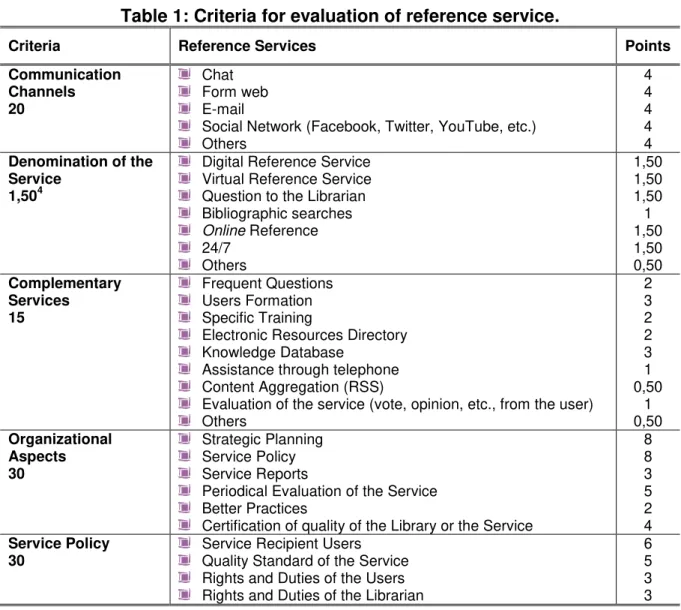
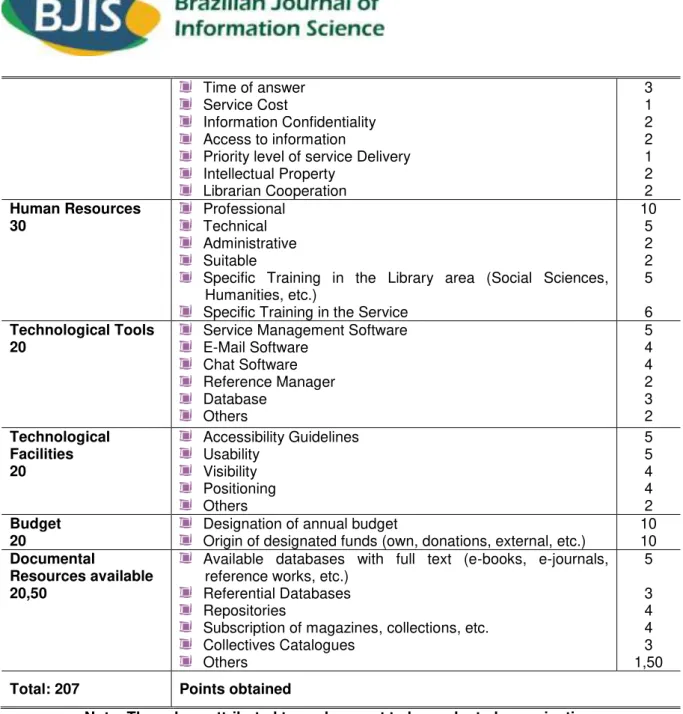
The criteria for evaluation of reference service have been analyzed extensively by Pommerantz (2003, 2008), Pommerantz and Luo (2006), Pommerantz, Mon and MacClure (2008) and Pinto and Manso (2012). Nevertheless, considering the context of this particular job, they are necessary a few parameters adapted to the own reality. To the continuing, evaluation criteria are sketched based on the above considerations, the ones which are not intended to be conclusive, but useful for the management of this service, being possible to be converted into benefit of other libraries in the area which they serve.
Table 1: Criteria for evaluation of reference service.
Criteria Reference Services Points
Communication Channels 20 Chat Form web E-mail
Social Network (Facebook, Twitter, YouTube, etc.) Others 4 4 4 4 4 Denomination of the
Service 1,504
Digital Reference Service Virtual Reference Service Question to the Librarian Bibliographic searches
Online Reference 24/7 Others 1,50 1,50 1,50 1 1,50 1,50 0,50 Complementary Services 15 Frequent Questions Users Formation Specific Training
Electronic Resources Directory Knowledge Database
Assistance through telephone Content Aggregation (RSS)
Evaluation of the service (vote, opinion, etc., from the user) Others 2 3 2 2 3 1 0,50 1 0,50 Organizational Aspects 30 Strategic Planning Service Policy Service Reports
Periodical Evaluation of the Service Better Practices
Certification of quality of the Library or the Service
8 8 3 5 2 4 Service Policy 30
Service Recipient Users
Quality Standard of the Service Rights and Duties of the Users Rights and Duties of the Librarian
Time of answer Service Cost
Information Confidentiality Access to information
Priority level of service Delivery Intellectual Property Librarian Cooperation 3 1 2 2 1 2 2 Human Resources 30 Professional Technical Administrative Suitable
Specific Training in the Library area (Social Sciences, Humanities, etc.)
Specific Training in the Service
10 5 2 2 5 6 Technological Tools 20
Service Management Software E-Mail Software Chat Software Reference Manager Database Others 5 4 4 2 3 2 Technological Facilities 20 Accessibility Guidelines Usability Visibility Positioning Others 5 5 4 4 2 Budget 20
Designation of annual budget
Origin of designated funds (own, donations, external, etc.) 10 10
Documental
Resources available 20,50
Available databases with full text (e-books, e-journals, reference works, etc.)
Referential Databases Repositories
Subscription of magazines, collections, etc. Collectives Catalogues Others 5 3 4 4 3 1,50
Total: 207 Points obtained
Note: The values attributed to each aspect to be evaluated are orienting.
Table 2: Application of the criterion digital reference service analyzed.
Criteria Reference Services Points
Channels of Communication 20
Result of the item: 12
Chat Form web E-mail
Social Network (Facebook, Twitter, YouTube, etc.) Others 0 4 4 4 0 Service Denomination 1,50
Result of item: 1
Digital Reference Service Virtual Reference Service Question to the Librarian Bibliographic Searches OnlineReference 24/7 Others 0 0 0 1 0 0 0
Service 15
Results of item: 6,50
Users Formation Specific Training
Electronic Resources Directory Knowledge Database
Assistance through telephone Aggregation of contents (RSS)
Evaluation of service (vote, opinion, etc., from the user Others 1 1 1 1 0 0 0 0,50 Organizative Aspects 30
Results of item: 15
Strategic Planning Service Policy Service Reports
Periodical Evaluation of the Service Better Practices
Certification of quality of the Library or the service
4 8 1 1 1 0 Service Policy 30
Results do item: 30
Recipient Users of the Service Quality Standard of the Service Rights and Duties of the User Rights and Duties of the Librarian Time of Answer
Service Cost
Confidentiality of information Access to information
Priority Level of Service Delivery Intellectual Property Librarian Cooperation 6 5 3 3 3 1 2 2 1 2 2 Human Resources 30
Results of item: 21
Professional Technical Administrative Suitable
Specific Training in the Library area e (ex.: Social Science, Humans, etc.)
Specific Training in service
10 0 0 0 5 6 Technological Tools 20
Results of item: 9
Management Service Software E-mail Software Chat Software Reference Manager Database Others 0 4 0 0 3 2 Technological Facilities 20
Results of item: 4
Accessibility Guidelines Usability Visibility Positioning Others 0 1 2 1 0 Budget 20
Results of item: 10
Designation of annual budget
Origin of designated funds (own, donations, 5 5
Documental
Resources available 20
Results of item: 17
Available databases with full text (e-books, e-journals, reference works, etc.)
Referential Databases Repositories
Subscription of magazines, collections, etc. Collectives Catalogues Others 5 3 4 1 3 1
Despite relying on these data is useful, you should not leave aside the use of other methods of qualitative methodology in order to capture the subjective face of this service. The interview in its different modalities, the focal group, the evaluation with experienced users, among others, Borrego Huerta (1999), Linares Columbié (2000) and Hernandez Salazar (2008), will collaborate on the complementation of this trend to the compilation of data as a means of obtaining a broader view of the impact that the digital reference service generates in the user community. In the case of FLACSO, among many indicators that stand out, is the one of quantity of responses offered in the service within one month. Added to this is the amount of responses grouped by thematic areas or topics, which allows observing the interests of users. But these data are not sufficient to get an idea of the scope of service; this is only a very partial perspective, being necessary to use other indicators that complement them as well as the qualitative assessments aforementioned.
5 CONCLUSIONS
Speed, ubiquity, interaction, collections still hybrid that contain support of all kinds, mediator professionals: the digital reference service receives queries of several kinds, which are performed by users, who routinely employ devices through which their queries are materialized. The possibilities of the Internet opened this way of being connected from anywhere at any time. However, the technological fascination, the immediacy of communication, the informative sphere that explodes in the cyberspace undermines the reflection about the mediation of the information professional. There is more talk of innovations about the equipment, software, information resources than the human factor that is definitely the essence of this service.
using varied resources in different formats and supports, finally, a series of improvements that would make it more efficient, though not more interactive, as the communicative face definitely human, was the leitmotif of the service and this has never lost sight of it.
REFERENCES
ABELS, E. G. The e-mail reference interview. Reference Quarterly, v.35, n.3,
p.345-358, 1996.
ALMEIDA JÚNIOR, O. F. Mediação da informação: discutindo a atuação do bibliotecário. In: ENCONTRO DE DOCENTES DE ESCOLAS DE
BIBLIOTECONOMIA E CIÊNCIA DA INFORMAÇÃO DO MERCOSUL, 5., Londrina.
Anais... Londrina, 2002.
ALMEIDA JÚNIOR, O. F. Mediação da informação: ampliando o conceito de disseminação. In: Encuentro de Educadores e Investigadores en Bibliotecología, Archivología, Ciencias de la Información y de la Documentación de Iberoamérica y el Caribe (EDIBCIC), 7., Marília. Anais… Marília, 2006.
ALMEIDA JÚNIOR, O. F. Mediação e informação. In: GARCÍA MARCO, F. J. (Ed.).
Avances y perspectivas en sistemas de información y documentación en el entorno digital. Zaragoza: Universidad de Zaragoza, 2007. p.27-35
ALMEIDA JÚNIOR, O. F. Mediação da informação e múltiplas linguagens. Pesquisa Brasileira em Ciência da Informação, v.2, n.2, p.89-103, 2009.
AMERICAN Library Association (ALA)/Reference and User Services Association (RUSA). Draft guidelines for implementing and maintaining virtual reference services. 2004. Available:
<http://www.ala.org/rusa/resources/guidelines/virtrefguidelines>. Access: Oct. 20, 2012.
AMERICAN Library Association (ALA)/Reference and User Services Association (RUSA). Definitions of reference. 2008. Available:
<http://www.ala.org/rusa/resources/guidelines/definitionsreference>. Access: Oct. 20, 2012.
BERMÚDEZ ARBOLEDA, P.; CORDA, M. C. Tesis de maestrías y doctorados de la Red FLACSO en acceso abierto: la experiencia cooperativa del repositorio
BOPP, R.; SMITH, L. S. Introducción general al servicio de consulta. México:
UNAM, Alfagrama, 2000.
BORREGO HUERTA, A. La investigación cualitativa y sus aplicaciones en biblioteconomía y documentación. Revista Española de Documentación Científica, v.22, n.2, p.139-157, 1999.
DEEGAN, E. Conducting the reference interview by e-mail and the intranet. In: SPECIAL LIBRARIES ASSOCIATION ANNUAL CONFERENCE, Virginia.
Proceedings… Virginia, 2000.
FALCATO, P.; LÓPEZ, A. I.; ARAUJO, J. F. Directrices para las transacciones de referencia en la biblioteca del Instituto Nacional de Tecnología Industrial.
Información, Cultura y Sociedad, n.10, p.67-82, 2004.
FALCATO, P. Sistema de ayuda para la redacción de mensajes en un servicio de referencia por correo electrónico. Información, Cultura y Sociedad, n.13, p.11-28,
2005.
FLACSO. Sede Académica Argentina. Procedimientos del servicio de referencia digital, última actualización. Buenos Aires: 2012.
FRITCH, J. W.; MANDERNACK, S. B. The emerging reference paradigm: a vision of reference services in a complex information environment. Library Trends, v.50, n.2,
p.286-308, 2001.
HERNÁNDEZ SALAZAR, P. (Coord.). Métodos cualitativos para estudiar a los usuarios de información. México: UNAM/CUIB, 2008.
IFLA. Recomendaciones para el servicio de referencia digital. 2004. Available:
<http://archive.ifla.org/VII/s36/pubs/drg03.htm>. Access: Oct. 20, 2012.
LINARES COLUMBIÉ, R. Las investigaciones cuantitativas y cualitativas en ciencia de la información: algunas consideraciones. FORINF@: Revista Iberoamericana de
Usuarios de Información, v.1, p.11-14, 2000.
MERLO VEGA, J. A. El servicio bibliotecario de referencia. Anales de Documentación, v.3, p.93-126, 2000.
MERLO VEGA, J. A. Servicios de referencia para una sociedad digital. El Profesional de la Información, v.18, n.6, p.581-586 2009a.
MERLO VEGA, J. A. Referencia digital: concepto, tecnologías e implementación en centros de información. El Profesional de la Información, v.18, n.6, p.589-599,
PINTO, M.; MANSO, R. A. Virtual reference services: defining the criteria and indicators to evaluate them. The Electronic Library, v.30, n.1, p.51-69, 2012.
POMMERANTZ, J. Integrating digital reference service into the digital library environment. In: LANKES, R. D.; NICHOLSON, S.; GOODRUM, A. (Eds.). The digital reference research agenda. Chicago: Association of College and Research
Libraries, 2003. p.23-47
POMMERANTZ, J. Evaluation on line reference services. Bulletin of the American Society for Information Science and Technology, v.34, n.2, p.15-19, 2008.
POMMERANTZ, J.; LUO, L. Motivations and uses: evaluating virtual reference
service from the user’s perspective. Library and Information Science Research,
v.28, n.3, p.350-373, 2006.
POMMERANTZ, J.; MON, L.; MCCLURE, R. Evaluating remote reference service: a practical guide to problems and solutions. Portal: Libraries and the Academy, v.8,
n.1, p.15-30, 2008.
PONJUÁN DANTE, G. Gestión de la información: dimensiones e
implementación para el éxito organizacional. Rosario: Nuevo Parhadigma, 2004.
SÁNCHEZ REMÓN, D. El servicio de referencia virtual en la gestión de información.
ACIMED, v.11, n.2, 2003.
SLOAN, B. Service perspectives for the digital library remote reference services.
Library Trends, v.47, n.1, p.117-141, 1998.
VALENTIM, M. L. P. Inteligência competitiva em organizações: dado, informação e conhecimento. DataGramaZero, Rio de Janeiro, v.3., n.4, p.1-13, ago. 2002.
Available: <http://www.dgz.org.br/ago02/Art_02.htm>. Access: Oct. 20, 2012.
NOTES
1 It should be clarified that the interview process comprises the following steps: a) Introduction and
state of the situation; b) Negotiation of the question from closed or open questions that the librarian apply; c) Summary of information obtained; d) search in catalogs and information sources; e) Communication of the responses to the user; f) Confirmation of satisfaction from the user (SLOAN, 1998, p.128). A more detailed development of the issue can be found in the work of Merlo Vega (2000).
2 Website: <http://www.flacso.org.ar>.
3 Website: <http://www.biblioenzofaletto.blogspot.com>.
4 In this case, the denominations are treated as equivalent and refer clearly to the same service, so it
María Cecilia Corda
Instituto de Investigaciones en Humanidades y Ciencias Sociales (UNLP-CONICET)
Facultad de Humanidades y Ciencias de la Educación (FaHCE) Universidad Nacional de La Plata (UNLP)
La Plata, Calle 48 e/6 y 7, 8º piso CP: 1900 - Argentina
E-mail: [email protected]
Directora de la Biblioteca de Ciencias Sociales “Enzo Faletto” FLACSO - Sede Académica Argentina
Ciudad Autónoma de Buenos Aires Ayacucho 555
CP: 1026 – Argentina