Alcohol consumption and factors associated with binge drinking
among female university students of health area
Consumo de álcool e fatores associados ao binge drinking entre universitárias da área de saúde
Consumo de alcohol y factores asociados al binge drinking entre las universitarias de la salud
Ana Karina Rocha Hora Mendonça1
Carla Viviane Freitas de Jesus1
Maria Bernadete Galrão de Almeida Figueiredo1
Daisy Pereira Valido1
Marco Antonio Prado Nunes2
Sonia Oliveira Lima1
1. Universidade Tiradentes. Aracaju, Sergipe, Brazil.
2. Universidade Federal de Sergipe. Aracaju, Sergipe, Brazil.
Corresponding author:
Ana Karina Rocha Hora Mendonça. E-mail: [email protected]
Submited on 06/16/2017. Accepted on 10/20/2017.
DOI: 10.1590/2177-9465-EAN-2017-0096
A
bstrActObjective: To evaluate the pattern of alcohol consumption and the prevalence and factors associated with binge drinking among university students of health-related courses in Aracaju, Sergipe, Brazil. Methods: A cross-sectional study was performed of 865 female students from two universities in the Brazilian Northeast. The instruments used were the AUDIT and a questionnaire used to collect sociodemographic data. The chi-square test and logistic regression were used, with statistical signiicance set at p-value < 0.05. Results: Risky alcohol consumption was evidenced in 16.4%, while the prevalence of binge drinking was 48.0%. Binge drinking was strongly associated with drunk driving (OR = 12.24) and living in a conlicting family environment (OR = 6.33). Binge drinking was a constant in students who engaged in ights, those who had problems with the law and among smokers. Conclusion: The high prevalence of risky alcohol consumption, binge drinking and the association of these with risky behaviors in students serve to guide future public policies on prevention.
Keywords: Alcohol Drinking; Women's Health; Students; Health Care.
r
esumoObjetivo: Avaliar o padrão de consumo alcoólico e a prevalência e fatores associados ao binge drinking entre universitárias da área de saúde em Aracaju/SE. Métodos: Estudo transversal com 865 estudantes do sexo feminino de duas universidades do Nordeste brasileiro. Os instrumentos foram o AUDIT e um questionário com características sociodemográicas. Empregou-se Qui-quadrado e regressão logística, com nível de signiicância de 0,05. Resultados: O consumo de risco foi evidenciado em 16,4%, enquanto a prevalência do binge drinking foi de 48,0%, e esteve mais fortemente associada com dirigir alcoolizada (OR = 12,24) e conviver em ambiente familiar conlituoso (OR = 6,33). O binge drinking foi constante entre as alunas que se envolveram em brigas com agressão física, problemas com a lei e entre tabagistas. Conclusão: A elevada prevalência do consumo de risco, binge drinking e a associação destes com comportamentos de risco entre as acadêmicas servem para orientar futuras políticas públicas preventivas.
Palavras-chave: Consumo de Bebidas Alcoólicas; Saúde da mulher; Estudantes; Atenção à Saúde.
r
esumenObjetivo: Evaluar el patrón de consumo de alcohol, la prevalencia y los factores asociados al binge drinking entre estudiantes universitarias en el área de salud en Aracaju/SE. Métodos: Estudio transversal con 865 mujeres estudiantes de dos universidades del Nordeste brasileño. Los instrumentos fueron el AUDIT y las características sociodemograicas. Se utilizó la Chi-cuadrada y regresión logística, con nivel de signiicancia de 0,05. Resultados: El patrón de consumo de riesgo se muestra en el 16,4%, mientras que la prevalencia del binge drinking fue de 48,0% y fue también más fuertemente asociada con conducir en estado etílico (OR = 12,24) y vida familia conlictiva (OR = 6,33). La borrachera fue constante entre las estudiantes que participaron en peleas con agresión física o problemas con la ley y entre las fumadoras. Conclusión: La alta prevalencia de consumo de riesgo, binge drinking y su asociación con comportamientos de riesgos entre académicas sirven para orientar las futuras políticas públicas preventivas.
INTRODUCTION
Of the psychoactive substances, alcohol is the most consumed in the world with young people who start university life presenting a signiicant increase in consumption.1 The greater
autonomy and freedom of their acts allied to the independence gained by coming of age and, in many cases, associated with the fact that they have moved far away from their relatives, make university students exposed to alcohol consumption.2,3 In
addition, the commemorative events they most often organize are associated with the consumption of alcoholic beverages that, in addition to impairing the academic performance of these individuals, can expose them to risky behavior such as drinking and driving, involvement in aggression, ights and road traic accidents.4
In this context, the abusive use of alcohol by young people, including university students, is an important public health problem, as it represents a risk of injuries, including disability and death, of the user and of other members of society.5,6 Studies
have shown a high prevalence of acute alcohol abuse, also called binge drinking or heavy episodic drinking, among young people.7-10 This pattern of risky alcohol consumption can be
characterized by the consumption of large amounts of alcohol, that is, four or more doses of alcoholic beverages for women and ive or more doses for men, on a single occasion regardless of the frequency of this consumption. In terms of alcoholic blood concentration, this is the equivalent to approximately 80 mg/dL (0.08%) in the adult individual.11
Women are more vulnerable to the use of alcoholic bever-ages compared to men due to their lower weight and higher proportion of body fat, as well as the lower hepatic metabolism of alcohol. Thus, women reach higher blood alcohol concentrations than men for the same amount of alcohol ingested.12 A recent
national representative survey found that women, especially younger women, are an at-risk population group for alcohol consumption and that they are drinking more noxiously.13
An alcohol consumption practice, which is even more dangerous for the individual's physical and mental health and that is common in young people, is acute alcohol intoxication inherent after the ingestion of ten or more doses of alcohol over a short period of time categorized as extreme levels of binge drinking.9
In Brazil, there is a shortage of epidemiological studies related to the consumption of alcoholic beverages and the practice of binge drinking, even at extreme levels.
In addition to binge drinking, the harmful use of alcohol and chronic alcohol dependence stand out as common practices of alcohol consumption. An acute and transient state of disturbance of consciousness and/or cognition due to alcohol intoxication occurs with binge drinking. Harmful or abusive use of alcohol can cause physical and psychic complications deined as a drinking pattern that harms and is a risk to health with social and economic consequences for the individual, the people around and society in general. Chronic alcoholism or dependence syndrome is
characterized by a set of behavioral, cognitive and physiological phenomena that develop after repeated consumption of alcoholic beverages.1
Among students of health area, the excessive consumption of alcohol deserves more attention, since this factor may negatively inluence their future professional practice regarding their diagnostic and therapeutic skills. Furthermore, these future professionals will be role models for their patients in relation to the prevention of disease and promotion of good health.14
Alcohol abuse, albeit occasional, is a complex issue in respect to its economic, social and individual dimensions, and so it is necessary to have deep knowledge of this problem in order to design measures to prevent and control abuse of this drug.15
The objective of this research was to evaluate the pattern of alcohol consumption and the prevalence and factors associated with binge drinking of university students in health area in Aracaju, Sergipe, Brazil.
METHODS
An observational, cross-sectional, prospective and analytical study with a quantitative approach was carried out in Aracaju in the Brazilian Northeast. The population of Aracaju, the state capital of Sergipe, is approximately 571,149 inhabitants16 with
this city being the main urban and university center of the state. This research was carried out in two higher education institutions classiied as universities in the state, one public and the other private. In order to select which of the nine health area would be evaluated, a random draw was made with equal probabilities for all the courses. Thus, the study population was made up of students from undergraduate courses in medicine, dentistry, nursing, physiotherapy and nutrition. In the next sample selection stage, the classes of the irst and second-to-last academic years of each evaluated course were chosen in order to reduce the variability of the sample in relation to the theoretical-scientiic knowledge acquired by the students during graduation.
During the data collection period, from December 2015 to April 2016, the archives of the two institutions had 1178 female students regularly enrolled in the said academic years of the courses in question. A conservative prevalence of 50%, margin of error of 5% and 95% conidence interval were estimated. The minimum sample calculated using Pocock's formula17 was 1049
female university students.
The inclusion criteria for the sample were female students, aged 18 years or more present in the classroom at the time of data collection.
The data collection instruments were two structured and self-administered questionnaires. The Brazilian version of the Alcohol Use Disorders Identiication Test (AUDIT), a questionnaire developed by the World Health Organization (WHO) was used to evaluate dependency, that is, the pattern of alcohol consumption. This questionnaire is composed of ten questions related to alcohol consumption and is used to evaluate alcohol consumption over the previous 12 months. It is recommended that any individual with an AUDIT score greater than or equal to eight is considered an at-risk alcohol consumer. Zero to seven points is classiied as abstinence or low-risk consumption, from 8 to 15 points as a pattern of risky consumption, from 16 to 19 points as a pattern of harmful use and 20 points or more as possible alcohol dependence.18
Furthermore, a questionnaire was used with self-reported information on independent variables to investigate the sociodemographic characteristics of the female university students. These variables included age, marital status, physical activity, smoking, religion, paid work, course and academic year, family environment, age of irst alcohol consumption, parents' permissiveness to alcohol use, drunk driving, accepting a ride with a drunk driver, use of energy drinks, involvement in ights, illicit and controlled drugs and inluence of advertising campaigns for alcoholic beverages. This questionnaire also contained indicators related to the dependent variable, binge drinking, and was capable of characterizing the individual as to the diferent levels of binge drinking according to the number of doses ingested (four, 10 or 15) and the time spent drinking these doses. The questionnaire was adapted from the VI National Survey on the Use of Psychotropic Drugs among Elementary and Middle School Students of Public and Private Education Networks in the 27 Brazilian State Capitals in 2010.19
Thirty female university students from health area not in-cluded in the main study participated in a pilot test in order to identify doubts regarding the completion of the instruments.
Systematized data were entered in a spreadsheet of the Statistical Package for the Social Sciences (SPSS) software version 16.0. The descriptive analysis of qualitative variables included frequencies and percentages and the means and standard deviations (SD) are reported for quantitative variables. The variable 'binge drinking' was dichotomized as yes and no. The chi-square test was used to test the association between binge drinking and the independent variables. At this stage, to evaluate the magnitude of the associations, variables with
p-value < 0.10 were included in multivariate logistic regression analysis. Statistically significant values were considered when the p-value was < 0.05. The independent variables of religion and housing were dichotomized for inclusion in logistic regression models.
This research was approved on November 12, 2015, by the Research Ethics Committee of Tiradentes University (UNIT) (# 1.383.959). All participants signed Informed Consent Forms.
RESULTS
Of the population sample of 1049 students enrolled in the irst and second-to-last academic years of health area, 137 students were excluded as 102 were under 18 years old and 35 refused to participate. Thus, 865 (82.5%) female university students participated in the study, 217 (25.1%) from the state university and 648 (74.9%) from the private university. In relation to the time of studying, 470 (54.3%) attended the irst academic year, while 395 (45.7%) attended the penultimate academic year. Most participants were from the nursing and nutrition courses: 282 (32.6%) and 266 (30.8%) students, respectively.
The mean age of the students was 21.97 years (SD = 4.43). Most students (93.1%) were single, Catholics (68.8%), regularly attended religious services (72.1%), lived with parents or relatives (74.4%), non-smokers (99.2%) and did not do paid work (82.2%). Moreover, 51.6% practiced physical activities (Table 1).
Table 1.
Sociodemographic proile and life habits of female
students (n = 865) on health area in two universiies in the
state capital of Sergipe - Brazil, 2015-2016
Characterisic
N
%
Marital status
Single
800
93.1
Married
59
6.9
Religion
Catholic
590
68.8
Spiritualist
69
8.0
Evangelical
126
14.7
Others
73
8.5
Frequent worshiper
Yes
621
72.1
No
240
27.9
Residence
Parents/Relaives
643
74.4
Student accommodaion
43
5.0
Alone
87
10.1
Others
91
10.5
Paid work
Yes
154
17.8
No
710
82.2
Physical acivity
Yes
446
51.6
No
418
48.4
Smoker
Yes
7
0.8
It was observed that 814 students (95.0%) lived in a quiet family environment and that 845 (98.5%) had not been physically assaulted by an adult member of the family in the previous month. The prevalence of alcohol consumption by the parents of students was 52.6% (n = 451). More than half (54.8%) of the parents of the students who drank alcohol were permissive to the consumption of alcohol by their daughters. Of the female university students who reported consuming alcoholic beverages, 34% (n = 236) used to do so together with energy drinks. Other risk behaviors, such as driving under the inluence of alcohol and taking a ride with a drunk driver were denied by 92.2% and 79.7% of the total number of students interviewed, respectively. Over 90% of students denied involvement in ights or the use of other illicit or controlled drugs.
Just over half of the students (50.2%) reported that they found advertising campaigns on alcoholic beverages attractive and 82% of them (n = 708) denied the desire to consume alcohol as a result of the television media.
The prevalence of alcohol consumption at least once in the students' lives was 79.7% (n = 689) with the mean age of experimentation being 16.03 years (SD = 2.46). Among the students who consumed alcoholic beverages, commercial establishments were the most cited places where they acquired alcohol (89.1%). In 71.5% of the cases, the drink was initially ofered by friends and in 16.5%, by relatives. In the previous 12 months, alcohol was consumed by 65.9% (n = 566) of the students showing the current use of alcohol.
According to the AUDIT classiication, 723 students (83.6%) were classiied as abstinent or low-risk consumers, while 142 (16.4%) had problematic use of alcohol and were classiied as risky consumers (Table 2).
Table 2.
AUDIT classiicaion of female students (n = 865)
on health area in two universiies in the state capital of
Sergipe - Brazil, 2015-2016
AUDIT
N
%
Absinent/low-risk consumer
723
83.6
At-risk consumer
119
13.8
Harmful alcohol use
11
1.3
Possible alcoholic dependence
12
1.4
Table 3.
Reported pracice of diferent levels of binge
drinking by female students (n = 865) on health area in
two universiies in the state capital of Sergipe - Brazil,
2015-2016
Binge drinking
N
%
≥ 4 doses
374
48.0
≥ 10 doses
115
13.4
≥ 15 doses
47
5.5
Binge drinking was reported by 48.0% (n = 374) of the interviewed students not including the 9.2% (n = 80) of the participants who reported not remembering to have ever done this in their lifetimes (Table 3). This table also shows the prevalence of extreme levels of binge drinking, characterized by the consumption of 10 or more doses in a short time interval.
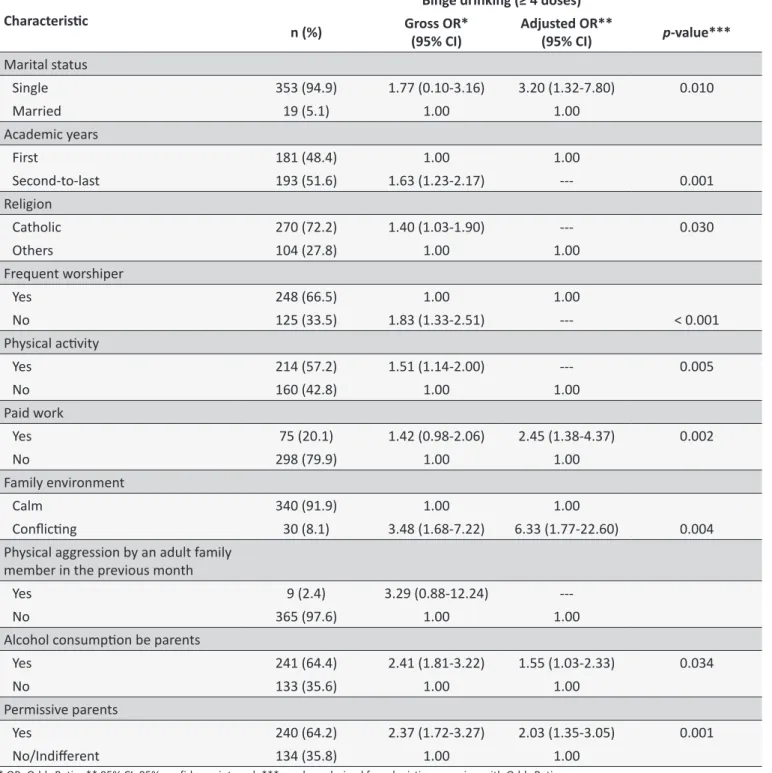
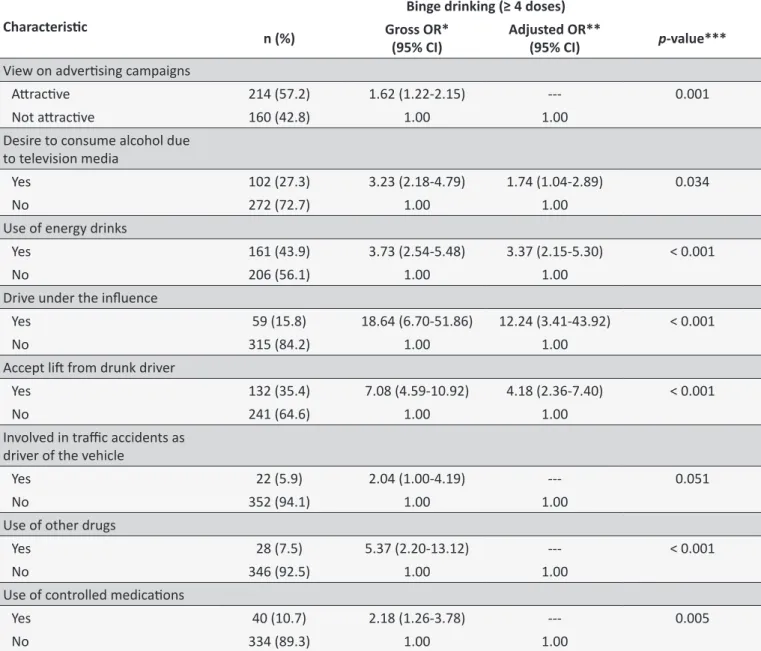
According to the analysis of multivariate logistic regression, several factors are signiicantly associated with binge drinking, that is, four or more doses of alcoholic beverages. These factors included marital status, paid work, family environment, alcohol
consumption by parents, parents' permissiveness of students' alcohol consumption, desire to consume alcohol due to television advertisements, alcohol use associated with energy drinks, drunk driving and accepting a ride with a drunk driver (Tables 4 and 5). The multivariate analyzes presented in Tables 4 and 5 show that drunk driving and living in a conlicting family environment reported by the students were the variables that had the strongest correlations with binge drinking of four or more doses of alcohol in the two calculated models.
All students who reported involvement in physical aggres-sion or problems with the law (n = 12), as well as those who reported smoking (n = 6) practiced binge drinking (four or more doses of alcohol).
DISCUSSION
Alcohol is the most commonly used psychotropic substance among Brazilian female university students and the excessive consumption of this drug causes several health problems, as well as social and economic problems for the country.20 A study
comparing alcohol consumption between the sexes and the expectation of drinking of female university students in health area in Ribeirão Preto, revealed a high prevalence of binge drinking, regardless of the sex of the individual.21 In this study,
the prevalence of alcohol consumption by students at least once in their lifetime was 79.7%. This was similar to the rates observed among students of health area in the State University of Montes Claros, MG (74.9%),4 among students aged 13 to 17 years in
public schools in Uberlândia, MG (80.9%)22 and in Mexican
medical students aged 17 to 25 years (71.9%).5 Prevalences
of approximately 90% were found for alcohol use in the lives of university students in 27 Brazilian state capitals,23 in students
of health sciences colleges in Maceió, Alagoas,24 and among
medical students from the state of Minas Gerais.25 These data
show the high consumption of alcohol among young students of both sexes, including university students of health sciences area. Alcohol consumption in this population deserves special attention due to the functions these individuals will have with their patients after graduation such as transmitting their knowledge about health care and often serving as an example of conduct.
Table 4.
Logisic regression model adjusted for the general characterisics associated with binge drinking by female
students (n = 374) on health area in two universiies in the state capital of Sergipe - Brazil, 2015-2016
Characterisic
n (%)
Gross OR*
Binge drinking (≥ 4 doses)
(95% CI)
Adjusted OR**
(95% CI)
p
-value***
Marital status
Single
353 (94.9)
1.77 (0.10-3.16)
3.20 (1.32-7.80)
0.010
Married
19 (5.1)
1.00
1.00
Academic years
First
181 (48.4)
1.00
1.00
Second-to-last
193 (51.6)
1.63 (1.23-2.17)
---
0.001
Religion
Catholic
270 (72.2)
1.40 (1.03-1.90)
---
0.030
Others
104 (27.8)
1.00
1.00
Frequent worshiper
Yes
248 (66.5)
1.00
1.00
No
125 (33.5)
1.83 (1.33-2.51)
---
< 0.001
Physical acivity
Yes
214 (57.2)
1.51 (1.14-2.00)
---
0.005
No
160 (42.8)
1.00
1.00
Paid work
Yes
75 (20.1)
1.42 (0.98-2.06)
2.45 (1.38-4.37)
0.002
No
298 (79.9)
1.00
1.00
Family environment
Calm
340 (91.9)
1.00
1.00
Conlicing
30 (8.1)
3.48 (1.68-7.22)
6.33 (1.77-22.60)
0.004
Physical aggression by an adult family
member in the previous month
Yes
9 (2.4)
3.29 (0.88-12.24)
---No
365 (97.6)
1.00
1.00
Alcohol consumpion be parents
Yes
241 (64.4)
2.41 (1.81-3.22)
1.55 (1.03-2.33)
0.034
No
133 (35.6)
1.00
1.00
Permissive parents
Yes
240 (64.2)
2.37 (1.72-3.27)
2.03 (1.35-3.05)
0.001
No/Indiferent
134 (35.8)
1.00
1.00
* OR: Odds Raio; ** 95% CI: 95% conidence interval; *** p-value - derived from logisic regression with Odds Raio.
university students also detected early ages for experimenting alcoholic drinks5,14,24,25 as well as a positive correlation between
binge drinking and the start of alcohol use before entering higher education.25 Research carried out among female university
stu-dents from the south of the country found that more than 90% of those who consumed alcoholic beverages, started drinking before entering university.20 This fact draws attention to the need
to implement educational and preventive measures starting at high school in an attempt to reduce the problem of alcohol con-sumption at an early age.
Table 5.
Logisic regression model adjusted for contextual factors associated with binge drinking by female students
(n = 374) on health area in two universiies in the state capital of Sergipe - Brazil, 2015-2016
Characterisic
n (%)
Gross OR*
Binge drinking (≥ 4 doses)
(95% CI)
Adjusted OR**
(95% CI)
p
-value***
View on adverising campaigns
Atracive
214 (57.2)
1.62 (1.22-2.15)
---
0.001
Not atracive
160 (42.8)
1.00
1.00
Desire to consume alcohol due
to television media
Yes
102 (27.3)
3.23 (2.18-4.79)
1.74 (1.04-2.89)
0.034
No
272 (72.7)
1.00
1.00
Use of energy drinks
Yes
161 (43.9)
3.73 (2.54-5.48)
3.37 (2.15-5.30)
< 0.001
No
206 (56.1)
1.00
1.00
Drive under the inluence
Yes
59 (15.8)
18.64 (6.70-51.86)
12.24 (3.41-43.92)
< 0.001
No
315 (84.2)
1.00
1.00
Accept lit from drunk driver
Yes
132 (35.4)
7.08 (4.59-10.92)
4.18 (2.36-7.40)
< 0.001
No
241 (64.6)
1.00
1.00
Involved in traic accidents as
driver of the vehicle
Yes
22 (5.9)
2.04 (1.00-4.19)
---
0.051
No
352 (94.1)
1.00
1.00
Use of other drugs
Yes
28 (7.5)
5.37 (2.20-13.12)
---
< 0.001
No
346 (92.5)
1.00
1.00
Use of controlled medicaions
Yes
40 (10.7)
2.18 (1.26-3.78)
---
0.005
No
334 (89.3)
1.00
1.00
* OR: Odds Raio; ** 95% CI: 95% conidence interval; *** p-value - derived from logisic regression with Odds Raio.
university students in Minas Gerais, obtained similar results to the current study: 36.4% of abstinence and 63.6% of alcohol consumption among medical students26 and 71.5% of regular
alcohol consumption among health sciences students.8 In
Mexico, medical students also presented a prevalence of alcohol consumption (62.3%)5 similar to that observed here in Aracaju.
Among students from the State University of Santa Cruz, in Ilhéus, Bahia27 also in the Brazilian Northeast, the prevalence
of drinking alcoholic beverages was lower (41.3%) than in the current study; the diference of these results is probably due to the use of a diferent instrument to measure alcohol consumption. Although these studies were carried out with students from areas related to healthcare and disease, there was a high prevalence
of alcohol consumption even though they know the harmful efects of alcohol.
With regard to the pattern of alcohol consumption, 16.4% of female university students were classiied as at-risk consumers and 83.6% as abstinent or low-risk consumers. Research conducted with medical students in the southeast of Brazil found 25.2% of at-risk alcohol consumers and 74.8% of abstinent or low-risk consumers.26 The highest percentage of alcohol
consumption at problematic levels was found in Mexican medical students (46.0%).5 In the latter two studies, the prevalence of
the negative afect of the misuse of alcoholic beverages on the vulnerability of women, there is an urgent need for interventions and educational measures that address the inappropriate use of alcohol and its deleterious efects in the university context. Moreover, support groups should be formed for students who are using alcohol in a problematic way.
In the present investigation, the practice of binge drinking was identiied in 374 (48.0%) students. National and international literature deals with high prevalences of binge drinking among female university students.10,21,23 In studies carried out with
university students on health area in the northern region of Minas Gerais State, binge drinking was observed in approximately 15% of the participants4,8 however the instrument used by these two
surveys to measure binge drinking difered from that used in the present study. A representative national survey among university students pointed out the existence of a tendency of women to increase alcohol consumption.23 This may be due to the incessant
search for gender equality promoted by postmodernity, which has reduced discrimination and increased social acceptance of the consumption of alcohol by women. These results show the exposure of this population group to binge drinking and the importance of developing targeted preventive programs that reduce social and health impairment.
This study revealed that at least once in their lifetimes, 13.4% of female university students drank ten or more doses as binge drinking and that 5.5% had ingested ifteen or more doses of alcohol within a short time interval. A study of a representative sample of high school students in the United States, with a mean age of 18 years, found prevalences of 10.5% of binge drinkers who had ingested ten or more doses and 5.6% who had ingested 15 or more doses9 similar to the results found here in Aracaju.
These data show that binge drinking is practiced at high levels by a signiicant proportion of students of both high schools and colleges. This situation is of concern because of the negative consequences of accidents and injuries caused by binge drinking and the possibility of long-term health problems.
In relation to the family, a possible factor inluencing the use of drugs among adolescents,28,29 this study found that a
large number of the students' parents were permissive to the use of alcohol (54.8%) and consumed alcoholic beverages themselves (52.6%). According to the adjusted logistic regression analysis of this study, a correlation was observed between binge drinking both with parents' permissiveness to female university students' alcohol consumption (OR = 2.03) and their own alcohol consumption (OR = 1.55). This parental behavior may be related to the high prevalence of alcohol consumption of these young women who, in addition to their parents' example and the permissive family environment, also have greater freedom and lack of supervision in the university environment.
The current research found that the great majority of the students (95.0%) reported living in a quiet family environment. Of those living in an environment of family conlict, 75.0% reported
having practiced binge drinking, demonstrating the existence of a strong correlation between this type of environment and the acute abuse of alcoholic beverages by these young women (OR = 6.33). Similarly, risky alcohol use among adolescent students from Uberlândia, MG was associated with conlict within the family environment of these individuals.22 Studies indicate that
most families of adolescent substance abusers and addicts have characteristics such as family ties in conlict, lack of closeness between family members, lack of a well-deined hierarchy and parents who do not give a positive example in respect to drug use.28 These results show that family dysfunctions inluence
alcohol consumption, especially in the adolescent and academic phases. Because it is a modiiable risk factor, adequate guidance to strengthen family relationships and to change the less liberal attitudes of parents regarding the use of alcohol by their children may reduce disorders caused by the misuse of this drug among young people.
Of the total number of students evaluated in this study, slightly more than half (50.2%) reported that they found advertisements for alcoholic beverages attractive, while the majority (82.0%) reported that they did not feel like drinking alcohol after watching ads. According to the adjusted logistic regression analysis, students who wished to consume alcohol as a result of television media had a 1.74 times greater chance of binge drinking compared to students who denied the desire to drink alcohol after seeing commercials. The association between feeling the desire to drink after watching advertisements for alcoholic beverages and alcohol use in life was observed in a survey of 638 teenagers from a Brazilian countryside city.22
The literature points to the existence of a causal relationship between advertising and alcohol consumption, since interest in the advertisement increases the desire and the intention to buy alcohol.30 The fact that the word 'drug' is rarely used for alcohol
facilitates its acceptance and advertising through commercials that aim to associate the product with appealing images and happy and enjoyable situations.31 It is believed that regulations
directed against unrestrained freedom of this type of media could reduce the inadequate consumption of alcohol within society and especially by the young during their development phase.
A low prevalence of smoking was detected (0.8%) in this study, which corroborates the indings of studies with female university students from the northeastern region of Brazil.27,32
Among the female students who reported smoking, binge drinking was a constant. Health promotion campaigns, such as public anti-smoking policies, increase quality of life and reduce health risks related to its determinants and conditions.33 The
Although most of the students in the sample (82.2%) did not have paid work and the average age of experimentation was less than 18 years of age, 89.1% of them reported buying alcoholic beverages at retail outlets. Thus, it is assumed that there is a disrespect for the law that prohibits the sale of alcoholic beverages to underage persons and that their parents or guardians may be contributing inancially to the purchase of drink. According to the adjusted logistic regression analysis, binge drinking was more common in students who had paid work (OR = 2.45) compared to those who did not work, as well as in single students (OR = 3.20) compared to married women. The inancial autonomy of female university students revealed a positive association with binge drinking, although a high percentage of students who were economically dependent on their parents also drank alcohol regularly. Therefore, it is probable that better family inancial control can reduce the use of alcoholic beverages among individuals in this age group.
Most of the students who reported the use of alcohol together with energy drinks (78.5%) drank heavily (OR = 3.37). Research carried out with female university students showed that energy drinks increase the desire to consume alcohol, as well as their susceptibility to binge drinking34 and alcohol dependence.35
It is necessary that preventive measures that address the use of alcohol among young people, also alert to the dangerous association of energy drinks, an indiscriminate practice.
In this research, all students who reported involvement in ights or in problems with the law practiced binge drinking. Other research with female university students of health area also showed an association between binge drinking and violent situations.4,8 In the present study, binge drinkers presented higher
chances for other risk behaviors too, such as drunk driving (OR = 12.24) and taking a ride with a drunk driver (OR = 4.18). Research with university students from 27 Brazilian state capitals warns that the consumption of more alcohol doses increases the probability of engaging in risky road traic behavior.23 The
neuromotor changes caused by alcohol-induced euphoria, reduce attention, distort the perception of velocity and cause diiculty in discerning distinct lights.36 Binge drinking leads to
the risk of car accidents and violence,1 which can result in the
loss of life or incidents that lead to temporary or permanent debilitating sequelae at young ages and thus this constitutes a major public health problem.
This study presented limitations because most of the participants did not complete the Brazilian Association of Advertisers/Brazilian Association of Market Institutes (ABIPEME) questionnaire used to measure the individual's socioeconomic status. It is also possible that there was underreporting of alcohol abuse inherent to the fear of exposing this habit, which probably did not interfere in the results obtained due to the large sample size used in this study. The data of this research will allow comparisons with those of future studies that should evaluate
female university students submitted to brief educational intervention strategies against excessive alcohol consumption, such as the Brief Alcohol Screening and Intervention for College Students (BASICS) intervention.37
CONCLUSIONS
In the city of Aracaju, in the period evaluated, the experi-mentation of alcoholic beverages by female university students on health area occurred at early ages and high prevalences of alcohol consumption and binge drinking were observed.
The results of this study indicated that single students, smokers and those with paid jobs are more likely to binge drink.
Factors that inluenced binge drinking among female uni -versity students are commercial advertisements that encourage the consumption of alcoholic beverages and family environ-ments marked by conlict, permissive parents and parents who consumer alcoholic beverages.
Signiicant risky behaviors associated with binge drinking in this population group are correlated to physical aggression and problems with the law, the use of energy drinks in association with alcohol, drunk driving and accepting a lift with a drunk driver.
Alcohol consumption among adolescents who have not entered higher education, since they reported experimentation while they were still underage, and while in the academic world, require healthcare measures. The implementation of programs that educate students about the physical and psychosocial damage caused by the problematic use of alcohol can guide them in the responsible consumption of alcoholic beverages.
REFERENCES
1. World Health Organization. Global status report on alcohol and health 2014. Geneva: World Health Organization; 2014. 392 p.
2. Baumgarten LZ, Gomes VLO, Fonseca AD. Consumo alcoólico entre universitários(as) da área da saúde da Universidade Federal do Rio Grande/RS: subsídios para enfermagem. Esc Anna Nery [Internet]. Sep 2012; [cited 2017 Mar 20]; 16(3):530-5. Available from: http://www.scielo.br/scielo.php?script=sci_arttext&pid=S1414-81452012000300015&lng=en&nrm=iso&tlng=pt
3. Haas AL, Smith SK, Kagan K, Jacob T. Pre-college pregaming: practices, risk factors, and relationship to other indices of problematic drinking during the transition from high school to college. Psychol Addict Behav [Internet]. 2012 Dec; [cited 2017 Mar 20]; 26(4):931-8. Available from: http://www.ncbi.nlm.nih.gov/pubmed/23088409. DOI: 10.1037/ a0029765
4. Cardoso FM, Barbosa HA, Costa FM, Vieira MA, Caldeira AP. Fatores associados à prática do binge drinking entre estudantes da área da saúde. Rev CEFAC [Internet]. 2015 Mar/Apr; [cited 2017 Mar 20];17(2):475-84. Available from: http://www.scielo.br/scielo. php?script=sci_arttext&pid=S1516-18462015000200475&lng=pt&nr m=iso&tlng=en
6. Gonçalves PD, Cunha PJ, Malbergier A, do Amaral RA, de Oliveira LG, Yang JJ, et al. The association between low alcohol use and traic risk behaviors among Brazilian college students. Alcohol [Internet]. 2012 Nov; [cited 2017 Mar 20]; 46(7):673-9. Available from: https://www.ncbi. nlm.nih.gov/pubmed/22921955. DOI: 10.1016/j.alcohol.2012.08.002 7. Chavez PR, Nelson DE, Naimi TS, Brewer RD. Impact of a new
gender-speciic deinition for binge drinking on prevalence estimates for women. Am J Prev Med [Internet]. 2011 Apr; [cited 2017 Mar 20]; 40(4):468-71. Available from: http://www.ncbi.nlm.nih.gov/pubmed/21406282. DOI: 10.1016/j.amepre.2010.12.008
8. Nunes JM, Campolina LR, Vieira MA, Caldeira AP. Consumo de bebidas alcoólicas e prática do binge drinking entre acadêmicos da área da saúde. Rev Psiquiatr Clín [Internet]. 2012; [cited 2017 Mar 20]; 39(3):94-9. Available from: http://www.scielo.br/scielo.php?script=sci_ arttext&pid=S0101-60832012000300005&lng=pt&nrm=iso&tlng=en 9. Patrick ME, Schulenberg JE, Martz ME, Maggs JL, O'Malley PM,
Johnston LD. Extreme binge drinking among 12th-grade students in the United States: prevalence and predictors. JAMA Pediatr [Internet]. 2013 Nov; [cited 2017 Mar 20]; 167(11):1019-25. Available from: http://www.ncbi.nlm.nih.gov/pubmed/24042318. DOI: 10.1001/ jamapediatrics.2013.2392
10. Tavolacci MP, Boerg E, Richard L, Meyrignac G, Dechelotte P, Ladner J. Prevalence of binge drinking and associated behaviours among 3286 college students in France. BMC Public Health [Internet]. 2016 Feb; [cited 2017 Mar 20]; 16:178. Available from: http://www.ncbi.nlm.nih. gov/pubmed/26905284. DOI: 10.1186/s12889-016-2863-x
11. National Institute on Alcohol Abuse and Alcoholism (NIAAA). Helping patients who drink too much: a clinician's guide. Bethesda: NIAAA; 2005. 40 p.
12. Boyle P, Bofetta P, Lowenfels AB, Burns H, Brawley O, Zatonski W, et al. Alcohol: Science, Policy and Public Health. Oxford: Oxford University Press; 2013. 448 p.
13. Laranjeira R, org. II Levantamento Nacional de Álcool e Drogas (LENAD). São Paulo: Instituto Nacional de Ciência e Tecnologia para Políticas Públicas do Álcool e Outras Drogas (INPAD)/UNIFESP; 2014. 85 p. 14. Picolotto E, Libardoni LFC, Migott AMB, Geib LTC. Prevalência e fatores
associados com o consumo de substâncias psicoativas por acadêmicos de enfermagem da Universidade de Passo Fundo. Ciên Saúde Coletiva [Internet]. May 2010; [cited 2017 Mar 20]; 15(3):645-54. Available from: http://www.scielo.br/scielo.php?script=sci_arttext&pid=S1413-81232010000300006&lng=pt&nrm=iso&tlng=pt
15. Monteiro CFS, Araújo TME, Sousa CMM, Martins MCC, Silva LLL. Adolescentes e o uso de drogas ilícitas: um estudo transversal. Rev Enferm UERJ [Internet]. 2012 Jul/Sep; [cited 2017 Nov 14]; 20(3):344-8. Available from: http://www.e-publicacoes.uerj.br/index.php/ enfermagemuerj/article/view/4105
16. Instituto Brasileiro de Geograia e Estatística (IBGE) (BR). Brasil. 2016 [cited 2017 Mar 20]. Available from: http://cod.ibge.gov.br/5NZ 17. Pocock SJ. Clinical Trials. A Practical Approach. Chichester: Wiley; 1996.
288 p.
18. Babor T, Higgins-Biddle JC, Saunders JB, Monteiro MG. The Alcohol Use Disorders Identiication Test: Guidelines for use in primary care. Geneva: World Health Organization. [Internet]. 2001; [cited 2017 Mar 20]; p. 1-40. Available from: http://www.talkingalcohol.com/iles/pdfs/ WHO_audit.pdf. DOI: 10.1177/0269881110393051
19. Carlini ELA, Noto AR, Sanchez ZVM, Carlini CMA, Locatelli DP, Abeid LR, et al. VI Levantamento Nacional sobre o Consumo de Drogas Psicotrópicas entre Estudantes do Ensino Fundamental e Médio das redes pública e privada de ensino nas 27 Capitais Brasileiras - 2010. São Paulo: Centro Brasileiro de Informações sobre Drogas Psicotrópicas- CEBRID/UNIFESP/SENAD; 2010. 506 p.
20. Ramis TR, Mielke GI, Habeyche EC, Oliz MM, Azevedo MR, Hallal PC. Tabagismo e consumo de álcool em estudantes universitários: prevalência e fatores associados. Rev Bras Epidemiol [Internet]. 2012 Jun; [cited 2017 Mar 20]; 15(2):376-85. Available from: http://www. scielosp.org/scielo.php?script=sci_arttext&pid=S1415-790X2012000 200015&lng=pt&nrm=iso&tlng=pt
21. Fachin A, Furtado EF. Uso de álcool e expectativas do beber entre universitários: uma análise das diferenças entre os sexos. Psicol Teor Pesq [Internet]. 2013 Oct/Dec; [cited 2017 Mar 20]; 29(4):421-8. Available from: http://www.scielo.br/scielo.php?script=sci_arttext&pid =S0102-37722013000400008
22. Reis TG, Oliveira LCM. Padrão de consumo de álcool e fatores associados entre adolescentes estudantes de escolas públicas em município do interior brasileiro. Rev Bras Epidemiol [Internet]. 2015 Jan/ Mar; [cited 2017 Mar 20]; 18(1):13-24. Available from: http://www.scielo. br/scielo.php?script=sci_arttext&pid=S1415-790X2015000100013&ln g=pt&nrm=iso&tlng=en
23. Andrade AG, Duarte PCAV, Oliveira LG. I Levantamento nacional sobre o uso de álcool, tabaco e outras drogas entre universitários das 27 capitais brasileiras. Brasília: Secretaria Nacional de Políticas sobre Drogas - SENAD/FMUSP; 2010. 284 p.
24. Pedrosa AAS, Camacho LAB, Passos SRL, Oliveira RVC. Consumo de álcool entre estudantes universitários. Cad Saúde Pública [Internet]. 2011 Aug; [cited 2017 Mar 20]; 27(8):1611-21. Available from: http:// www.scielosp.org/scielo.php?script=sci_arttext&pid=S0102-311X201 1000800016&lng=pt&nrm=iso&tlng=pt
25. Carneiro EB, Braga RT, Silva LFD, Nogueira MC. Fatores associados a beber pesado episódico entre estudantes de medicina. Rev Bras Educ Med [Internet]. 2012 Oct/Dec; [cited 2017 Mar 20]; 36(4):524-30. Available from: http://www.scielo.br/scielo.php?script=sci_ arttext&pid=S0100-55022012000600011&lng=pt&nrm=iso&tlng=en 26. Rocha LA, Lopes ACFMM, Martelli DRB, Lima VB, Martelli-Júnior H.
Consumo de álcool entre estudantes de faculdades de Medicina de Minas Gerais, Brasil. Rev Bras Educ Med [Internet]. 2011 Jul/Sep; [cited 2017 Mar 20]; 35(3):369-75. Available from: http://www.scielo.br/scielo. php?script=sci_arttext&pid=S0100-55022011000300010&lng=pt&nrm =iso&tlng=pt
27. De Sousa TF, José HPM, Barbosa AR. Condutas negativas à saúde em estudantes universitários brasileiros. Ciênc Saude Coletiva [Internet]. 2013 Dec; [cited 2017 Mar 20]; 18(12):3563-75. Available from: http:// www.scopus.com/inward/record.url?eid=2-s2.0-84888158719&partne rID=40&md5=96f6e074c8bfeadb1921aca09f79992b
28. Guimarães ABP, Hochgraf PB, Brasiliano S, Ingberman YK. Aspectos familiares de meninas adolescentes dependentes de álcool e drogas. Rev Psiquiatr Clín [Internet]. 2009; [cited 2017 Mar 20]; 36(2):69-74. Available from: http://www.scielo.br/scielo.php?script=sci_ arttext&pid=S0101-60832009000200005&lng=pt&nrm=iso&tlng=pt 29. Cavalcante MBPT, Alves MDS, Barroso MGT. Adolescência, álcool e
drogas: uma revisão na perspectiva da promoção da saúde. Esc Anna Nery Rev Enferm [Internet]. 2008 Sep; [cited 2017 Mar 20]; 12(3):555-9. Available from: http://www.scielo.br/pdf/ean/v12n3/v12n3a24 30. Pinsky I, El Jundi SARJ. O impacto da publicidade de bebidas alcoólicas
sobre o consumo entre jovens: revisão da literatura internacional. Rev Bras Psiquiatr [Internet]. 2008 Dec; [cited 2017 Mar 20]; 30(4):362-74. Available from: http://www.scielo.br/scielo.php?script=sci_ arttext&pid=S1516-44462008000400012&lng=pt&nrm=iso&tlng=en 31. Acselrad G, Karam ML, David HMSL, Alarcon S, Pfeil FMC, Andrade
CSGCD. Consumo de Bebidas Alcoólicas no Brasil: Estudo com base em fontes secundárias. Rio de Janeiro: Faculdade Latinoamericana de Ciências Sociais; 2012. 162 p.
32. Granville-Garcia AF, Sarmento DJS, Santos JA, Pinto TA, Sousa RV, Cavalcanti AL. Smoking among undergraduate students in the area of health. Ciênc Saúde Coletiva [Internet]. 2012 Feb; [cited 2017 Mar 20]; 17(2):389-96. Available from: http://www.scielosp.org/scielo. php?script=sci_arttext&pid=S1413-81232012000200013&lng=en&nr m=iso&tlng=en. DOI: 10.1590/S1413-81232012000200013
33. Ministério da Saúde (BR). Secretaria de Vigilância em Saúde, Secretaria de Atenção à Saúde. Política Nacional de Promoção da Saúde. 3ª ed. Brasília (DF): Ministério da Saúde; 2010.
35. Marczinski CA, Fillmore MT, Henges AL, Ramsey MA, Young CR. Mixing an energy drink with an alcoholic beverage increases motivation for more alcohol in college students. Alcohol Clin Exp Res [Internet]. 2013 Feb; [cited 2017 Mar 20]; 37(2):276-83. Available from: http:// www.ncbi.nlm.nih.gov/pubmed/22724427. DOI: 10.1111/j.1530-0277.2012.01868.x
36. Moura EC, Malta DC, Morais Neto OL, Penna GO, Temporão JG. Direção de veículos motorizados após consumo abusivo de bebidas alcoólicas, Brasil, 2006 a 2009. Rev Saúde Pública [Internet]. 2009 Oct; [cited 2017 Mar 20]; 43(5):891-4. Available from: http://www.scielo.br/ scielo.php?script=sci_arttext&pid=S0034-89102009000500021&lng =pt&nrm=iso&tlng=en