ORIGINAL
RES
EAR
CH
Correspondence to: Arthur de Sá Ferreira – Praça das Nações 34, 3º andar – CEP 21041-010 – Bonsucesso (RJ), Brazil – E-mail: [email protected], [email protected] Presentation: June 2013 – Accepted for publication: Aug. 2014 – Financing source: Fundação Carlos Chagas Filho de Amparo à Pesquisa no Estado do Rio de Janeiro (FAPERJ) by program APQ1 (E-26/110.450/2012) – Conflict of interests: nothing to declare.
ABSTRACT | This study systematically reviewed the
six-minute walk test (6MWT) for assessment of functional capacity of adults with hypertension subjected or not to physical rehabilitation, focusing in walked distance (6MWD) and blood pressure. A literature search was conducted in PubMed, SciELO, LILACS, PEDro, Cochrane, Redalyc, and national journals of physiotherapy using the keywords “hipertensão” (hypertension) and “teste de caminhada de seis minutos” (six-minute walk test) without language or period constraints. Six studies were included: one case-control, one clinical trial, two quasi-experimental and two series of cases. Results from cross-sectional studies suggest preservation of the 6MWD in the mild stage of hyperten-sion, whereas significant lower values in the more severe stage of hypertension or in the presence of comorbidities. Longitudinal studies suggest that the 6MWT is sensitive to the increase in functional capacity due to adaptations from physical rehabilitation programs. Two major limitations compromise the external validity of the included studies: samples with specific phenotypes (same sex; same hyper-tension stage; narrow age group) and the small sample size (range 8 to 32). The low methodological quality rein-forces the need for researches with larger samples and different phenotypes of hypertension.
Keywords | Hypertension; Rehabilitation; Review Literature as Topic.
Functional capacity in adults with hypertension
as assessed by the six-minute walk distance test:
systematic review
Capacidade funcional de adultos com hipertensão avaliada pelo teste de caminhada de
seis minutos: revisão sistemática
Capacidad funcional de adultos con hipertensión evaluada por el test de caminada de
seis minutos: revisión sistemática
Rodrigo de Assis Ramos1, Arthur de Sá Ferreira1
Study conducted at the Centro Universitário Augusto Motta (UNISUAM) – Rio de Janeiro (RJ), Brazil.
1Graduate Program in Rehabilitation Sciences, UNISUAM – Rio de Janeiro (RJ), Brazil.
RESUMO | Este trabalho revisou sistematicamente os estu-dos sobre teste de caminhada de seis minutos (TC6) para avaliação da capacidade funcional de adultos com hiper-tensão submetidos ou não à reabilitação física, com foco na distância caminhada (DC6) e pressão arterial. Uma busca na literatura foi conduzida no PubMed, SciELO, LILACS, PEDro, Cochrane, Redalyc e em periódicos nacionais de fisioterapia com as palavras-chave “hipertensão” (hypertension) e “teste de caminhada de seis minutos” (six-minute walk test) sem restrição de idioma e período. Foram incluídos um estudo caso-controle, um ensaio clínico, dois quase-experimentais e duas séries de casos. Os estudos seccionais sugerem pre-servação da DC6 nos estágios leves da hipertensão, mas reduções significativas nos estágios mais graves e/ou na presença de comorbidades. Os estudos longitudinais suge-rem que o TC6 é sensível ao aumento da capacidade fun-cional em razão das adaptações oriundas dos programas de reabilitação física. Duas importantes limitações compro-metem a validade externa dos estudos incluídos: amostras com fenótipos específicos (mesmo sexo; mesmo estágio de HAS; faixa etária estreita) e pequeno tamanho amostral (entre 8 e 32 participantes). A baixa qualidade metodológica dos estudos reforça a necessidade de pesquisas com amostras maiores e espectro mais amplo de fenótipos de hipertensão.
INTRODUCTION
he systemic arterial hypertension is a public health issue with a prevalence estimated at 3.3% in 2010, in
Brazil1. High blood pressure increases death risk due
to cardiovascular diseases (CDD)2 and is associated
with blood functional anatomy adjustments that result in injuries of target-organs like heart, kidneys, and
brain2. Blood remodeling also happens in the
muscu-loskeletal vessels3, which individually compromises its
function and globally results in functional limitation of
the hypertensive adult4. Functional capacity
investiga-tion may contribute for comprehending hypertension limitations, as well as for determining the efects of interventions and planning of strategies aimed at pre-venting disabilities due to injuries in the target-organs. Among the methods of functional capacity evaluation
in hypertensive subjects5-10, the six-minute walking test
(6MWD) is applied due to its simplicity and easy use11,12.
he 6MWD assesses the tolerance to self-limited exer-cise and is similar to daily life activities (DLAs),
there-fore it becomes clinically attractive9,11,12. he American
horacic Society (ATS) stablished indications, safety
measures and procedures to apply the 6MWD13. he
distance walked during the 6MWD (DW6) is used as a closure for the evaluation of adjustments from physi-cal rehabilitation protocols and for the study of factors associated with functional capacity in absolute values or percentages cited in equations obtained from the healthy
population13,14. However, it is not clear if the 6MWD
is an indicator of functional incapacity in hypertension and if it captures adjustments performed at physical
rehabilitation programs. herefore, this paper system-atically reviewed studies on the 6MWD to assess the functional capacity of adults with high blood pressure submitted, or not, to physical rehabilitation focused on the 6DW and blood pressure (BP).
METHODOLOGY
A systematic review15 was conducted in free electronic
databases like PubMed, Scielo, LILACS, PEDro, Cochrane and Redalyc using the keywords
“hyper-tension” (hipertensão) and “six-minute walking test”
(teste de caminhada de seis minutos) without language and
time constraints. Additional research was conducted in sites of Brazilian journals about physical therapy (Revista Brasileira de Fisioterapia; Revista Fisioterapia e
Pesquisa; Revista Fisioterapia em Movimento). he last
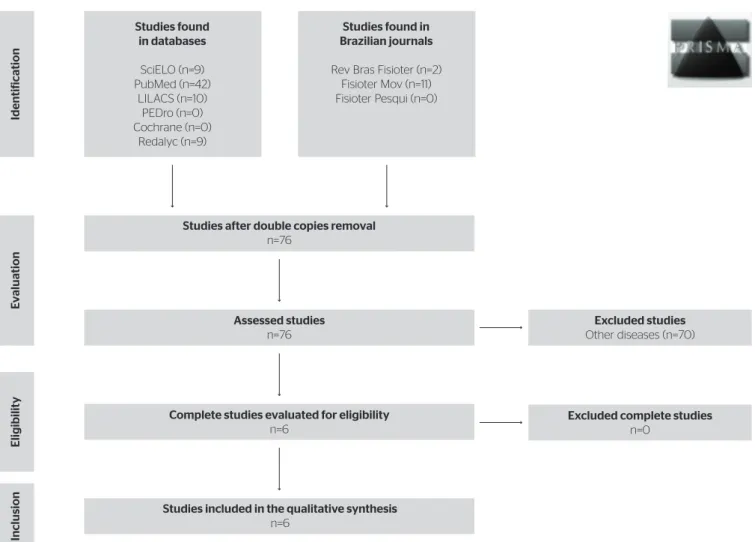
research was done on April 2013 (Figure 1).
Abstracts from the identiied articles were exam-ined as to the inclusion criteria: articles (originals), outline (all except review), target population (>18 years old; both genders), diagnosis (systemic arterial hyper-tension, with or without comorbidities), intervention (none; physical rehabilitation), and observation or intervention outcomes (6DW; systolic and diastolic BP). Double copies between the referred basis and studies about other diseases (e.g. pulmonary arterial hypertension) were excluded.
After completely reading the included studies, the following information were gotten: outline; samples
RESUMEN | Eso trabajo revisó sistemáticamente los estudios
referentes al test de caminada de seis minutos (TC6) para eva-luación de la capacidad funcional de adultos con hipertensión que fueron o no sometidos a la rehabilitación física, con foco en la distancia caminada (DC6) y en la presión arterial. Una bús-queda en la literatura fue conducida en PubMed, SciELO, LILACS, PEDro, Cochrane, Redalyc y en periódicos brasileños de fisio-terapia con las palabras clave “hipertensión” (hypertension) y “test de caminada de seis minutos” (six-minute walking test) sin restricciones de lengua y periodo. Fueron inclusos uno estudio caso-control, un ensayo clínico, dos casi-experimentales y dos reportos de casos. Los estudios transversales sugieren preser-vación de la DC6 en los estadios leves de la hipertensión, pero
reducciones significativas en los estadios más severos y/o en la presencia de comorbidades. Los estudios longitudinales sugie-ren que el TC6 es sensible al aumento de la capacidad funcional porque hay adaptaciones advenidas de programas de rehabi-litación física. Dos importantes limitaciones comprometen la validad externa de los estudios: muestras con fenotipos espe-cíficos (mismo sexo; mismo estadio de HAS; edad estrecha) y pequeño tamaño de la muestra (entre 8 y 32 participantes). La baja cualidad metodológica de los estudios resalta la necesi-dad de investigaciones con muestras mayores y espectro más amplio de fenotipos de hipertensión.
(case and control groups if applicable); clinical char-acteristics; systolic and diastolic BP values (baseline and post-intervention if applicable); absolute values of 6DW (in meters); and assumed 6DW values (in the percentages and equations used). Incomplete pieces of information were achieved by mailing the authors, whenever it was possible. Data were typed in an elec-tronic spreadsheet with automatic control of data vali-dation with regard to consistence, which is available upon request to the authors.
he methodological quality of studies was assessed
by bias criteria16: selection, performance, detection,
dis-cord, and report. Quality was ranked as low/inaccurate/ high risk of bias (low risk: “Yes”; high risk: “No”; other cases: “Inaccurate”). Studies were classiied in three lev-els: low risk of bias (all items = “low risk”), high risk (at least one item = “high risk”) and inaccurate (at least one item = “inaccurate risk”). All procedures were indepen-dently performed by two examiners, and disagreements were solved by mutual agreement.
RESULTS
Seventy-six articles were found and six of them were
included in this study: one case-control study17, one clinical
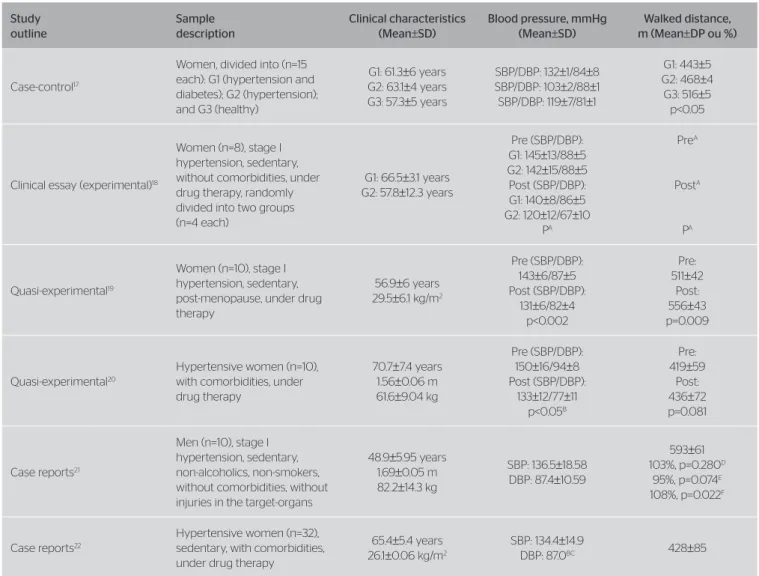
essay18, two quasi-experimental19,20, and two case reports21,22
(Table 1). he sample size varied from eight in the clinical
essay18 to 45 subjects in the case-control study17. Studies
analyzed patients grouped per gender, hypertension stage, and/or age range. Most studies followed integrally or
par-tially all recommendations from the ATS13 for the 6MWD.
Two studies18,21 calculated the predicted distance with
ref-erence equations for the healthy population23-25. All
stud-ies included reported the use of drug therapy for hyper-tension and good tolerance to the 6MWD, and none of them reported side efects of the 6MWD.
Characteristics of the Studies
Ribeiro et al.17 compared the functional capacity of
hypertensive and diabetic (G1), hypertensive (G2) and
Figure 1. Study flowchart
Studies found in databases
SciELO (n=9) PubMed (n=42)
LILACS (n=10) PEDro (n=0) Cochrane (n=0)
Redalyc (n=9)
Studies after double copies removal
n=76
Assessed studies
n=76
Excluded studies
Other diseases (n=70)
Excluded complete studies
n=0
Complete studies evaluated for eligibility
n=6
Studies included in the qualitative synthesis
n=6
Studies found in Brazilian journals
Rev Bras Fisioter (n=2) Fisioter Mov (n=11) Fisioter Pesqui (n=0)
Identific
ation
E
v
aluation
Eligibilit
y
healthy (G3) women. he 6MWD was applied twice
according to the ATS13 recommendations with
one-hour interval between the repetitions. Signiicantly higher values in the second 6MWD (p<0.05) were seen in all groups. It was observed a signiicant diference between the three groups (G1<G2<G3; p<0.05). Values of systolic (SBP) and diastolic (DBP) BP and of heart frequency (HF) showed signiicant increases after the 6MWD (p<0.05), which conirms the characteristics of safety and sub-maximum test.
Accyoli e Piotto18 analyzed the cardiovascular
adap-tations induced by a cardiac rehabilitation program in hypertensive sedentary women. Voluntaries were randomly assigned into two groups, and undergone a program con-ducted in a therapeutic pool (G1) and on the loor (G2) during eight weeks, twice a week, for an hour. 6MWD
was performed satisfying ATS requirements13. Although
the study mentions using a prediction equation23, the
6DW numerical results and predicted values were not presented. here was a signiicant decrease in the SBP (p=0.034) and DBP (p=0.020), therefore there may have been a good result of the physical exercise to control BP.
Lima et al.19 investigated the result of a 12-week
aerobic training in the functional capacity and in con-trolling BP of stage I hypertensive, sedentary and going through menopause women. The rehabilitation pro-gram consisted of aerobic activity of moderate intensity (warming, stretching, walking, stretching and relaxing) for 50 minutes. 6MWD was performed following ATS
protocol13. he study showed an increase of the 6DW
(p=0.009) after practice period and decrease of BP val-ues (p=0.033), therefore the aerobic training may con-tribute for hemodynamic and functional improvement.
Souza et al.20 analyzed the correlation between
func-tional capacity and quality of life of women who have undergone an enduring and self-stretching training
Table 1. Studies about functional capacity of hypertensive adults with the six-minute walking test
Study outline
Sample description
Clinical characteristics (Mean±SD)
Blood pressure, mmHg (Mean±SD)
Walked distance, m (Mean±DP ou %)
Case-control17
Women, divided into (n=15 each): G1 (hypertension and diabetes); G2 (hypertension); and G3 (healthy)
G1: 61.3±6 years G2: 63.1±4 years G3: 57.3±5 years
SBP/DBP: 132±1/84±8 SBP/DBP: 103±2/88±1 SBP/DBP: 119±7/81±1
G1: 443±5 G2: 468±4 G3: 516±5 p<0.05
Clinical essay (experimental)18
Women (n=8), stage I hypertension, sedentary, without comorbidities, under drug therapy, randomly divided into two groups (n=4 each)
G1: 66.5±3.1 years G2: 57.8±12.3 years
Pre (SBP/DBP): G1: 145±13/88±5 G2: 142±15/88±5 Post (SBP/DBP): G1: 140±8/86±5 G2: 120±12/67±10
PA
PreA
PostA
PA
Quasi-experimental19
Women (n=10), stage I hypertension, sedentary, post-menopause, under drug therapy
56.9±6 years 29.5±6.1 kg/m2
Pre (SBP/DBP): 143±6/87±5 Post (SBP/DBP):
131±6/82±4 p<0.002
Pre: 511±42
Post: 556±43 p=0.009
Quasi-experimental20
Hypertensive women (n=10), with comorbidities, under drug therapy
70.7±7.4 years 1.56±0.06 m 61.6±9.04 kg
Pre (SBP/DBP): 150±16/94±8 Post (SBP/DBP):
133±12/77±11 p<0.05B
Pre: 419±59
Post: 436±72 p=0.081
Case reports21
Men (n=10), stage I hypertension, sedentary, non-alcoholics, non-smokers, without comorbidities, without injuries in the target-organs
48.9±5.95 years 1.69±0.05 m 82.2±14.3 kg
SBP: 136.5±18.58 DBP: 87.4±10.59
593±61 103%, p=0.280D
95%, p=0.074E
108%, p=0.022F
Case reports22
Hypertensive women (n=32), sedentary, with comorbidities, under drug therapy
65.4±5.4 years 26.1±0.06 kg/m2
SBP: 134.4±14.9
DBP: 87.0BC 428±85
A: Non-presented data. B: Data reported by the authors. C: Median. D: Predicted by Enright and Sherril23 equation. E: Predicted by Troosters et al.24 equation. F: Predicted by Enright et al.25 equation. SBP: systolic
program for ten weeks. The women performed the
6MWD according to ATS recommendations13, and
quality of life was assessed by the SF36 questionnaire. It was seen a decrease of BP values after the training period (p<0.05), but there was no signiicant increase in the 6DW (p=0.081) nor in the functional capacity domain of the SF36 (p=0.72). Authors suggest a mod-erate positive correlation between 6DW and SF36 domains that express the functional capacity.
Costa et al.21 tested the association between BP,
per-ceived efort index (PEI) and 6DW in men at hyper-tension stage I. he 6MWD was performed according to ATS (2002) and the predicted 6DW was calculated
by three equations23-25. Results showed 6DW predicted
by Enright et al.25 equation signiicantly overestimated
(p=0.022), but there were no signiicant diferences
according to other equations23,24.
Pedrosa and Holanda22 tested the correlation between
two-minute stationery gait test (2SGT), timed up and go test (TUG) and 6MWD. Aged hypertensive women were assessed without hormonal replacement for meno-pause. he study did not report if the ATS
recommenda-tions were followed13. Participants performed three tests
with a ten-minute break. All chosen women performed
the tests without intercurrences. Signiicant correlations between 6DW and TUG (r=-0.59; p<0.001) and between 6DW and 2SGT (r=-0.66; p<0.001) suggested a relation between cardiovascular resistance and functional mobility.
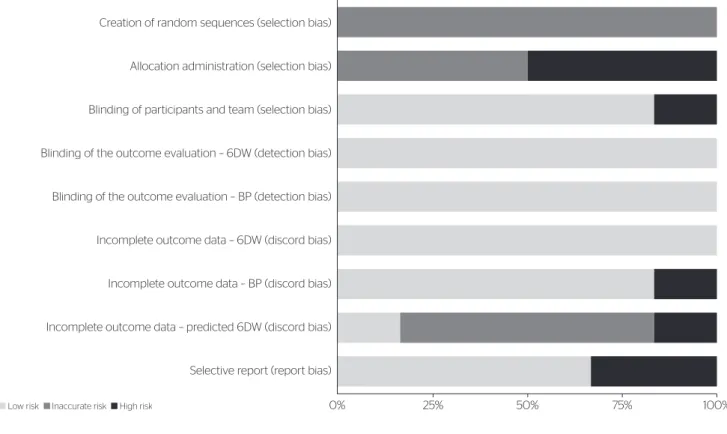
Bias risk analysis can be seen in Figure 2. It was seen a high bias risk of selection in the longitudinal studies due to the insuicient or absent randomization description. Other studies present high risk for outcome bias because they do not present all outcome data. he majority of studies presented inaccurate bias risk due to lack of description of methods.
DISCUSSION
his paper systematically reviewed studies about 6MWD to evaluate the functional capacity of adults with high blood pressure who had been or had not been submit-ted to physical rehabilitation. he sectional studies suggest that in light hypertension stages, there is no signiicant alteration in the functional capacity as
eval-uated by the 6MWD22, but signiicant decreases can
be seen in more severe stages and/or in the presence
Figure 2. Bias risk in the included studies
Creation of random sequences (selection bias)
Allocation administration (selection bias)
Blinding of participants and team (selection bias)
Blinding of the outcome evaluation – 6DW (detection bias)
Blinding of the outcome evaluation – BP (detection bias)
Incomplete outcome data – 6DW (discord bias)
Incomplete outcome data – BP (discord bias)
Incomplete outcome data – predicted 6DW (discord bias)
Selective report (report bias)
0%
of comorbidities17,22. On the other hand, longitudinal
studies suggest that 6MWD is sensitive to the increase of functional capacity due to the adjustments from
physical rehabilitation programs18-20. Two studies18,20
calculated the predicted 6DW, but only one21 reported
the predicted values using international equations23-25.
his review also identiied the high or inaccurate bias risk in most analyzed criteria.
he high or inaccurate bias risk in the included stud-ies is not uncommon in systematic reviews, but it com-promises authors’ inferences on the results of the studies
alone or collectively26. Two important methodological
limitations were common in the reviewed studies and contributed for the bias risk: approach of speciic phe-notypes (same gender, same hypertension stage, narrow age range) and small sample size. he study of popu-lation subgroups is justiied due to the group’s higher homogenization because of the varied phenotype of hypertension, but it also characterizes an spectrum
bias27 that, when combined to the small sample size,
limits even more the external validity of these studies. Another interesting point is the identiication of only Brazilian studies. Although both the quantity of lon-gitudinal studies and also sectional ones in adults with CDD have been increasing all around the world, most international studies include patients with heart fail-ure (associated or not with hypertension) or pulmonary
arterial hypertension12,14, which explains the reduced
amount of studies included in the qualitative analysis. he predicted 6DW was highly overestimated by
one25 among three23-25 international equations used
in one included study21. Brazilian equations of 6DW
prediction in a healthy adult population28-30 were not
available at the time of Costa et al.21 study, and they
should be irstly analyzed in future studies due to the
regional diferences in 6DW31.
It should be emphasized that the development of a systematic review does not overcome the outline prob-lems of the included studies, which is one of their main
limitations32. However, following international
recom-mendations15 for its accomplishment minimize the
sub-jectivity of results and its impact on the interpretations
of the included studies32. Given the high prevalence of
hypertension in the adult Brazilian population1 and its
association with functional disability4, new studies with
more representative samples (wide spectrum of pheno-types) should be carried out in order to determine the reference values of 6MWD in hypertensive adults to use in the physical rehabilitation and to ind factors associ-ated with 6DW in such population.
CONCLUSIONS
he functional capacity may be decreased in more severe stages of hypertension and/or in the presence of comor-bidities. 6MWD seems sensitive to the increase of func-tional capacity resulting from physical rehabilitation programs in hypertensive patients. Low methodologi-cal quality of studies reinforces the need of researches with bigger samples and a wider spectrum of hyperten-sion phenotypes.
REFERENCES
1. Ministério da Saúde. Secretaria executiva. Datasus. Informações de saúde. Indicadores de fatores de risco e proteção. [Citado 17 maio 2013]. Disponível em: http://datasus.saude.gov.br/.
2. Mancia G, Backer G, Dominiczak A, Cifkova R, Fagard R, Germano G,
et al. Management of Arterial Hypertension of the European Society
of Hypertension; European Society of Cardiology. The Task Force for the Management of Arterial Hypertension of the European Society of Hypertension (ESH) and of the European Society of Cardiology (ESC). J Hypertens. 2007;25(6):1105-87.
3. Hernández N, Torres SH, Finol HJ, Vera O. Capillary changes in skeletal muscle of patients with essential hypertension. Anat Record. 1999;256(4):425-32.
4. Hajjar I, Lackland DT, Cupples LA, Lipsitz LA. Association between concurrent and remote blood pressure and disability in older adults. Hypertension. 2007;50(6):1026-32.
5. Katz S, Ford AB, Moskowitz RW, Jackson BA, Jafe MW. Studies of illness in the aged. The index of ADL: a standardized measure of biological and psychosocial function. JAMA. 1963;185(12):914-9. 6. Nagi SZ. Congruency in medical and self-assessment of disability. IMS
Ind Med Surg. 1969;38(3):27-36.
7. Balady GJ, Arena R, Sietsema K, Myers J, Coke L, Fletcher GF, Forman D, et al. Clinician’s Guide to cardiopulmonary exercise test in adults: a scientific statement from the American Heart Association. Circulation. 2010;122(2):191-225.
8. McGavin CR, Gupta SP, McHardy GJ. Twelve-minute walking test for assessing disability in chronic bronchitis. Br Med J. 1976;1(6013):822-3. 9. Butland RJ, Pang J, Gross ER, Woodcock AA, Geddes DM. Two-, six-,
and twelve-minute walking distance tests in respiratory disease. Br Med J. 1982;284(6329):1607-8.
10. Gusmão JL, Mion Jr D, Pierin AMG. Health-related quality of life and blood pressure control in hypertensive patients with and without complications. Clinics. 2009;64(7):619-29.
11. Guyatt GH, Sullivan MJ, Thompson PJ, Fallen EL, Pugsley SO, Taylor
DW, et al. The 6-minute walk: a new measure of exercise capacity in
patients with chronic heart failure. Can Med Assoc J. 1985;132(8):919-23. 12. Solway S, Brooks D, Lacasse Y, Thoimas S. A qualitative systematic
overview of the measurement properties of functional walk tests used in the cardiorespiratory domain. Chest. 2001;119(1):256-70. 13. ATS Committee on Proficiency Standards for Clinical Pulmonary
14. Papathanasiou JV, Ilieva E, Marinov B. Six-minute waling test: an efective and necessary tool in modern cardiac rehabilitation. Hellenic J Cardiol. 2013;54(2):126-30.
15. Moher D, Liberati A, Tetzlaf J, Altman DG; PRISMA Group (2009). Preferred reporting items for systematic reviews and meta-analyses: the PRISMA statement. Ann Intern Med. 2009;151(4):264-9.
16. Higgins JPT, Green S. Cochrane handbook for systematic reviews of interventions, version 5.1.0 2009 [updated March 2011]. The Cochrane Collaboration. [Citado 17 maio 2013]. Disponível em: http://handbook. cochrane.org/
17. Ribeiro A, Younes C, Mayer D, Fréz AR, Riedi C. Teste de caminhada de seis minutos para avaliação de mulheres com fatores de risco cardiovascular. Fisioter Mov. 2011;24(4):713-9.
18. Accyoli MF, Piotto RF. Efeito de um programa de reabilitação cardíaca – fase III realizado em piscina terapêutica e no solo, em mulheres hipertensas. Rev Inst Ciênc Saúde. 2007;25(2):141-6. 19. Lima MMO, Britto RR, Baião EA, Alves GS, Abreu CDG, Parreira VF.
Exercício aeróbico no controle da hipertensão arterial na pós-menopausa. Fisioter Mov. 2011;24(1):23-31.
20. Souza JF, Nogueira IDB, Lira MJL, Silva EC, Ferreira GMH, Nogueira PAMS. Correlação entre capacidade funcional e qualidade de vida em idosas hipertensas submetidas a treinamento resistido. ConScientiae Saúde. 2011;10(2):312-8.
21. Costa HS, Martins AMB, Quirino FC, Severino G, Novais LD, Lima MMO. Capacidade funcional em homens hipertensos ela distância caminhada e correlação com valores preditos. Fisioter Mov. 2009;22(4):557-64. 22. Pedrosa R, Holanda G. Correlação entre os testes da caminhada,
marcha estacionária e TUG em hipertensas idosas. Rev Bras Fisioter. 2009;13(3):252-6.
23. Enright PL, Sherrill DL. Reference equations for the six-minute walk in healthy adults. Am J Respir Crit Care Med. 1998;158(5):1384-7.
24. Troosters T, Gosselink R, Decramer M. Six minute walking distance in healthy elderly subjects. Eur Respir J. 1999;14(2):270-4.
25. Enright PL, McBurnie MA, Bittner V, Tracy RP, McNamara R, Arnold A,
et al. The 6-minute walk test - a quick measure of functional status in
elderly adults. Chest. 2003;123(2):387-98.
26. Garg AX, Hackam D, Tonelli M. Systematic review and meta-analysis: When one study is just not enough. Clin J Am Soc Nephrol. 2008;3(1):253-60.
27. Willis BH. Spectrum bias – why clinicians need to be cautions when applying diagnostic test studies. Fam Pract. 2008;25(5):390-6. 28. Iwama AM, Andrade GN, Shima P, Tanni SE, Godoy I, Dourado
VZ. The six- minute walk test and body weight-walk distance product in healthy Brazilian subjects. Braz J Med Biol Res. 2009;42(11):1080-5.
29. Dourado VZ, Vidotto MC, Guerra RLF. Equações de referência para os testes de caminhada de campo em adultos saudáveis. J Bras Pneumol. 2011;37(5):607-14.
30. Soares MR, Pereira CAC. Teste de caminhada de seis minutos: valores de referência para adultos saudáveis no Brasil. J Bras Pneumol. 2011;37(5):576-83.
31. Casanova C, Celli BR, Barria P, Casas A, Cote C, de Torres JP, et al. The 6-min walk distance in healthy subjects: reference standards from seven countries. Eur Respir J. 2010;37(1):150-6.
32. Higgins JPT, Altman DG, Gotzsche PC, Jüni P, Moher D, Oxman AD,
et al. The Cochrane Collaboration’s tool for assessing risk of bias in