Long Latency Auditory Evoked Potential in Term
and Premature Infants
Dayane Domeneghini Didoné
1Michele Vargas Garcia
1Aron Ferreira da Silveira
21Fonoaudiology, Universidade Federal de Santa Maria, Santa Maria,
RS, Brazil
2Department of Morphology, Universidade Federal de Santa Maria,
Santa Maria, RS, Brazil
Int Arch Otorhinolaryngol 2014;18:16–20.
Address for correspondence Dayane Domeneghini Didoné, Mestre em Distúrbios da Comunicação Humana pela, Fonoaudiologia, Universidade Federal de Santa Maria, Rua João Goulart, Bairro: Camobi, Santa Maria, RS 97105-220, Brazil (e-mail: [email protected]).
Introduction
Hearing electrophysiology is related to objective examinations. These examinations can measure the auditory electrophysio-logic hearing thresholds and can be used in newborn and older infants who do not cooperate in behavioral evaluations. The most often applied electrophysiologic examinations in new-borns are the brainstem auditory evoked potential (BAEP) and the auditory steady state responses (ASSR), which aim at determining the electrophysiologic hearing thresholds.
The auditory hearing thresholds are significant during linguistic development, but also the integrity and proper characteristics of the central structures should be observed. Thus, some authors have used the auditory evoked long latency potentials to evaluate the auditory processing.
Cortical potentials allow objective assessment of cognitive abilities of attention, memory, and discrimination of sounds.1 Therefore, ascertaining the integrity and functionality of the central structures complements the diagnosis of auditory processing disorders.
Keywords
►
evoked potentials
auditory
►
prematurity
►
newborn
Abstract
Introduction
The research in long latency auditory evokes potentials (LLAEP) in
newborns is recent because of the cortical structure maturation, but studies note
that these potentials may be evidenced at this age and could be considered as indicators
of cognitive development.
Purpose
To research the exogenous potentials in term and premature infants during
their
fi
rst month of life.
Materials and Methods
The sample consisted of 25 newborns, 15 term and 10
premature infants. The infants with gestational age under 37 weeks were considered
premature. To evaluate the cortical potentials, the infants remained in natural sleep. The
LLAEPs were researched binaurally, through insertion earphones, with frequent /ba/ and
rare /ga/ speech stimuli in the intensity of 80 dB HL (decibel hearing level). The frequent
stimuli presented a total of 80% of the presentations, and the rare, 20%. The data were
statistically analyzed.
Results
The average gestational age of the term infants was 38.9 weeks (
1.3) and
for the premature group, 33.9 weeks (
1.6). It was possible to observe only the
potentials P1 and N1 in both groups, but there was no statistically signi
fi
cant difference
for the latencies of the components P1 and N1 (
p
>
0.05) between the groups.
Conclusion
It was possible to observe the exogenous components P1 and N1 of the
cortical potentials in both term and preterm newborns of no more than 1 month of age.
However, there was no difference between the groups.
received
August 21, 2013
accepted after revision
September 4, 2013
DOI http://dx.doi.org/ 10.1055/s-0033-1358658.
ISSN 1809-9777.
Copyright © 2014 by Thieme Publicações Ltda, Rio de Janeiro, Brazil
The research about auditory evoked long latency poten-tials in newborns is a recent and controversial subject, because of the maturation of the cortical structures. However, some studies have already noted that these potentials may be evidenced during childhood. They are considered as meas-urers of cognitive development, mainly in preterm infants, who present risks for auditory processing disorders.2–4Some studies verified that children with altered cortical potentials during the neonatal period could present linguistic alterations.5
The auditory evoked long latency potentials reflect the electrical activity from the peripheral auditory system to the central auditory pathway. They aim at verifying the auditory information processing in cortical level and in function of time.6
The waves positive 1 (P1), negative 1 (N1), positive 2 (P2), negative 2 (N2), and positive 3 (P3) are part of the auditory evoked long latency potentials. They are subdivided into exogenous sensory evoked potentials (P1, N1, P2, N2), which are influenced by the physical characteristics of the stimulus, such as intensity, duration, and frequency, and endogenous sensory evoked potential (P3), predominantly influenced by events related to cognitive skills.7
In adults, it is possible to evaluate exogenous and endoge-nous potentials. The criteria of normality in relation to cognitive skills are verified from the latency of these compo-nents. Normality criteria are described in the literature.8 Thus, significant increases in latency indicate functional or anatomical alteration of these potential generating sites, reflecting cognitive abilities.
However, care must be taken in interpreting these results, because these potentials cannot be used alone to diagnose central nervous system diseases. The behavioral assessment of auditory processing and even imaging are essential for interpreting thefindings.
In babies, is possible to evaluate exogenous potentials (P1, N1, P2, and N2) because these potentials represent the cortical ability of detecting acoustic stimulus and do not depend on the individual’s attention.
Regarding the exogenous components, some authors be-lieve that the component P1 originates from the Heschl gyrus or from the area of secondary auditory; the component N1 originates from the frontal lobe, although the generating areas of that component are not clear; the component P2 originates from the anterior superior temporal gyrus; and the component N2 arises next to the supratemporal regions, including the frontal cortex.2
From that and from the necessity of knowing the charac-teristics of auditory evoked long latency potentials in neo-nates, this study aimed at researching the exogenous potential in term and preterm born infants during theirfirst month of life, as well as comparing the latency among the groups.
Methods
This research is part of a project called“Metabolismo oxidativo e maturação das vias auditivas em prematuros,”registered in the
ethics committee from Universidade Federal de Santa Maria, Santa Maria, RS, Brazil, no. 05704712.8.0000.5346. This is a transversal, prospective, contemporary, and comparative study. The evaluations of the research were performed at the hearing electrophysiology sector at Hospital Universitário de Santa Maria (HUSM). Only babies participated in this study. Their parents or representatives, after receiving information about the purposes and methodology of the research, agreed with the procedures to be performed and signed the informed consent form.
The sample consisted of 25 newborns, 15 term (control group) and 10 preterm (study group) infants, male and female, who had the newborn hearing screening (NHS) at HUSM during their first month of life. The infants were considered as premature when the gestational age was less than 37 weeks, according to the classification by the World Health Organization (1974).9
The inclusion criteria were the following:
• Term-born infants (control group) of 37 weeks’gestational age or more, without risk factors for hearing loss, with transient-evoked otoacoustic emissions (TEOAE) in both ears and eyelid closure-enhanced reflex in the NHS
• Preterm-born infants (study group) of 37 weeks’ gesta-tional age or less, with and without risk factors for hearing loss, with TEOAE in both ears in the NHS, with or without eyelid closure-enhanced reflex
The TEOAEs were researched in both ears with nonlinear stimulation and a window of 20 milliseconds, with frequen-cies of 1,000, 1,500, 2,000, 3,000, and 4,000 Hz and with approximated intensity of 80 dB SPL (decibel sound pressure level). The TEOAEs were considered when the signal-to-noise ratio was greater or equal to 3 dB for the frequency of 1,000 Hz, and 6 dB for the other frequencies, in at least three of the five researched frequencies. The TEOAE registration happened in silence, with the equipment Intelligent Hearing Systems (IHS), SmartTrOAE system (IHS Miami, USA).
The eyelid closure-enhanced reflex was researched through an instrument called“multiple bells,”with90 dB SPL of intensity. It must be reinforced that the TEOAE research had the purpose of excluding newborns with co-chlear hearing loss. The acoustic impedance measurements were also performed to exclude newborn with changes conductive.10 Auditory evoked long latency potentials re-search used the IHS equipment, Smart EP system, with two channels.
For electrophysiologic evaluation, the infants remained in natural sleep in the lap of the representative. It was not possible to evaluate the infants while they were awake, because their movement altered the electrical stability of the examination and the trustworthiness of the responses.
The auditory evoked long latency potentials were researched binaurally, through insertion phones, with frequent /ba/ and rare /ga/ speech stimulation, with rarefaction click polarity, trapezoi-dal envelope, 10,000-μsec rise/fall, 50,000-μsec duration, 80-dB HL intensity. The frequent stimulations were 80% (120 stimuli) of the presentation and the rare stimulations were 20% (30 stimuli). The stimuli were presented randomly. The presentation rate was one stimulus per second, into the range recommended by McPherson et al,11and the interval among the stimuli was 1 second, according to Polich.12To make the examinations reliable, traces were replicated.
In evaluation of the auditory evoked long latency poten-tials, factors considered were presence or absence of the components P1, N1, P2, and N2 in the traces, which corre-spond to the frequent stimulations (syllable /ba/) as well as their latencies.
The data were organized in worksheets, in the program Microsoft Excel (IHS, Miami, USA), and they were analyzed statistically through the program Statistical Package for Social Sciences. (IBM, USA), version 17.0 for Windows. The Studentt test was used to compare the averages in paired samples, and to compare independent samples, the Wilcoxon and Mann–Whitney tests were used. The results were considered as significant whenp<0.05, with confi -dence interval of 95%.
Results
The average gestational age for the group of term infants was 38 weeks (1.3), and the same average for the group of premature infants was 33 weeks (1.6). The age average in the evaluation moment was 9.9 days for the term group and 9.1 days for the premature group. The difference between the gestational age and the corrected age between the groups was statistically significant. The descriptive analyses related to the ages are described in►Table 1.
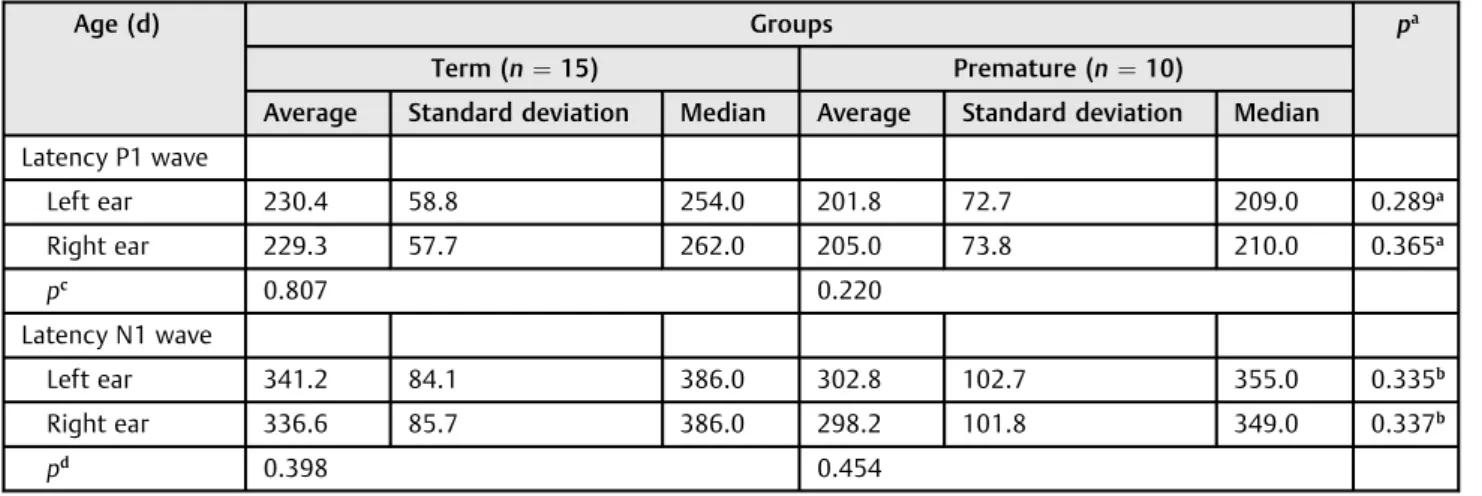
In our study, it was possible to observe a high peak of230 milliseconds for the control group and peak of201 milli-seconds for the study group, and high deflection of 341 milliseconds for the control group and 302 milliseconds for the study group. They were called P1 and N1, respectively. The component P2 was observed in only one term infant (peak of 270 milliseconds) and in two premature infants (peak of 290 milliseconds). They were not statistically analyzed.
There was no statistically significant difference in latencies of the components P1 and N1, for the right ear and for the left
ear, between the studied groups. There was also no statisti-cally significant difference between the term and premature born infants in the latencies of the components P1 and N1.
The intra- and intergroup results are described in►Table 2.
Discussion
The research about auditory evoked long latency potentials in newborns is a recent and controversial subject, because of the maturation of the cortical structures. However, some studies have already noted that those potentials may be evidenced during childhood,2–4,13–16 as most synaptic modifications occur in thefirst years of life. Thus, the cortical auditory potentials may be useful to predict possible cognitive and language disorders.
This study showed the exogenous components of the cortical auditory potentials in newborns, agreeing with other studies.2,3,13–15The exogenous components are cortical re-sponses for the detection of the acoustic stimulation, so do not depend on attention skills. For this reason, it can be used in neonates.
Our study observed a high peak (20 milliseconds) for the control group and peak of201 milliseconds for the study group, and there was high deflection, around 341 millisec-onds for the control group and 302 millisecmillisec-onds for the study group. The peak and the deflection are named P1 and N1, respectively, because we believe that the positive peak and the deflection may correspond to those potentials, therefore, with increased latencies, because of immaturity of cortical structures.
The existence of high peak and high deflection in traces of newborns no more than 1 month old agrees with other studies.2,13,15However, those authors called the components P2 and N2, different from the denomination used in this research (P1 and N1), possibly because of the latencies of the potentials. In those studies, the high peak was around 300 milliseconds and the deflection was around 600 milliseconds. The P2 and N2 components have the highest latencies. Another author also mentioned the denomination of the infants’potentials, observing that it is variable in literature.2 Other research also used the latency of the potentials, naming them P100, N250, and P450, which does not correspond to the nomenclature used for adults.15
In this study, there was no statistically significant differ-ence between the latencies of the components P1 and N1
Table 1 Descriptive measurements for gestational age and corrected age, according to the group
Age (d) Groups pa
Term (n¼15) Premature (n¼10)
Average Standard deviation Median Average Standard deviation Median
Gestational 38.9 1.3 39.0 33.9 1.6 34.0 <0.001a
Corrected 9.9 11.3 2.0 15.7 9.1 18.0 0.186b
aStudent
ttest for the independent groups. bMann
between the groups of term and preterm infants. Those results are different from the results found by other authors.13 According to those authors, the peak200 milliseconds (P1) presented statistically significant difference between the groups. However, the results found in our study agree with other research,3in which the latency of the P1 components was similar in the group of term and preterm infants. The same authors warn that prematurity associated with absence of cortical potentials may be a risk factor for further cognitive alterations.
The optimum state of the infants during the examination is still debated in literature, because some studies evaluated neonates when they were sleeping, others evaluated awake children, and some studies did it in both ways. Nevertheless, authors noted no differences in the traces of the cortical potentials for both ways of evaluation.2
Active sleep is part of REM sleep, and it is defined as a state of newborns with closed eyes, with irregular breathing, and without strong movements. This sleep state may be identified by observing infants’behavior.17Other research mentioned that the evoked auditory potentials may be obtained with newborns during active sleep,18when the morphology of the waves is similar to the vigil state, which makes the examina-tion useful, without the necessity of responses by the chil-dren. Some authors also noted that there are no differences in the encephalogram of newborns during active sleep and during alert state.19 For this reason, the auditory evoked long latency potentials may be evaluated when the baby is sleeping, which makes the examination useful.
In this study, it was possible to obtain results with new-borns in natural sleep, as other studies have done.14,15,18It is highlighted that in those studies the evaluation in natural sleep was performed only with neonates of no more than 1 month of age. The other babies were evaluated while in vigil state.
Application of cortical potentials in babies is recent and controversial, mainly because of the maturation of the corti-cal structures and because of the state of the neonates during
the evaluation. In addition, the denomination of the poten-tials in infants is diverse in the literature. Thus, more research is necessary to make this examination useful to predict possible cortical alteration in newborns and, as a conse-quence, to become an evaluation of precocious detection of cognitive and language disorders.
Conclusion
It was possible to observe the exogenous components P1 and N1of the cortical auditory potentials in newborns of no more than 1 month of age, in term and in preterm infants.
The research about auditory evoked long latency potentials in newborns is recent. More studies in this area are necessary to understand the characteristics of those potentials in new-borns and young children and to use those potentials in the future to predict cognitive and linguistic disorders.
References
1 Cóser MJS, Cóser PL, Pedroso FS, Rigon R, Cioqueta E. P300 auditory evoked potential latency in elderly. Braz J Otorhinolaryngol 2010; 76(3):287–293
2 Kushnerenko EV. Maturation of the cortical auditory event related brain potentials in infancy [dissertation]. Helsinki, Finland: Uni-versity of Helsinki, Department of Psychology; 2003
3 Fellman V, Kushnerenko E, Mikkola K, Ceponiene R, Leipala J, Naatanen R. Atypical auditory event-related potentials in preterm infants during thefirst year of life: a possible sign of cognitive dysfunction? Pediatr Res 2004;56(2):291–297
4 Choudhury N, Benasich AA. Maturation of auditory evoked po-tentials from 6 to 48 months: prediction to 3 and 4 year language and cognitive abilities. Clin Neurophysiol 2011;122(2):320–338 5 Molfese DL, Molfese VJ. Discrimination of language skills atfive
years-of-age using event-related potentials recorded at birth. Dev Neuropsychol 1997;13(2):135–156
6 Reis ACMBR, Frizzo ACF. Potencial Evocado Auditivo de Longa Latência. In: Bevilacqua MC, Martinez MAN, Balen AS, Pupu AC, Reis ACMB, Frota S, eds. Tratado de Audiologia. São Paulo, Brasil: Santos; 2011:231–260
Table 2 Comparison of the latencies by the components P1 and N1 for the right ear and for the left ear, according to the groups
Age (d) Groups pa
Term (n¼15) Premature (n¼10)
Average Standard deviation Median Average Standard deviation Median
Latency P1 wave
Left ear 230.4 58.8 254.0 201.8 72.7 209.0 0.289a
Right ear 229.3 57.7 262.0 205.0 73.8 210.0 0.365a
pc 0.807 0.220
Latency N1 wave
Left ear 341.2 84.1 386.0 302.8 102.7 355.0 0.335b
Right ear 336.6 85.7 386.0 298.2 101.8 349.0 0.337b
pd 0.398 0.454
aStudent
ttest for the independent groups. bMann
–Whitney test. cStudent
7 Duarte JL, Alvarenga KF, Banhara MR, et al. P300-long-latency auditory evoked potential in normal hearing subjects: simulta-neous recording value in Fz and Cz. Braz J Otorhinolaryngol 2009; 75(2):231–236
8 Kraus N, Mcgee T. Potenciais auditivos evocaados de longa latên-cia. In: Katz J, ed. Tratado de Audiologia Clínica. 4ª ed. São Paulo, Brasil: Manoele; 2002:403–420
9 World Health Organization Scientist Group on Health Statistics Methodology Related to Perinatal Events. Who, Genebra, 1974, p. 32. In: Costa SMB, Costa Filho AO, eds. O estudo dos potenciais evocados acusticamente de tronco cerebral em recém-nascidos pré-termo. Braz J Otorhinolaryngol 1998;64(3):231–238 10 Jerger J. Clinical experience with impedance audiometry. Arch
Otolaryngol 1970;92(4):311–324
11 McPherson DL, Ballachanda BB, Kaf W. Middle and long latency evoked potential. In: Roeser RJ, Valente M, Dunn HH, eds. Audiology: Diagnosis. New York, NY: Thieme; 2008:443–477 12 Polich J. P300 in clinical applications: meaning, method and
measurement. Am J EEG Technol 1991;31:201–231
13 Pasman JW, Rotteveel JJ, de Graaf R, Stegeman DF, Visco YM. The effect of preterm birth on brainstem, middle latency and cortical
auditory evoked responses (BMC AERs). Early Hum Dev 1992; 31(2):113–129
14 Kushnerenko E, Ceponiene R, Balan P, Fellman V, Huotilaine M, Näätäne R. Maturation of the auditory event-related potentials during thefirst year of life. Neuroreport 2002;13(1):47–51 15 Wunderlich JL, Cone-Wesson BK, Shepherd R. Maturation of the
cortical auditory evoked potential in infants and young children. Hear Res 2006;212(1–2):185–202
16 Ceponiene R, Shestakova A, Balan P, Alku P, Yiaguchi K, Näätänen R. Children’s auditory event-related potentials index sound complexity and“speechness.”. Int J Neurosci 2001;109(3–4): 245–260
17 Khan RL, Raya JP, Nunes ML. Avaliação do estado comportamental durante o sono em recém-nascidos. J Epilepsy Clin Neurophysiol 2009;15(1):25–29
18 Cheour M, Leppänen PH, Kraus N. Mismatch negativity (MMN) as a tool for investigating auditory discrimination and sensory memory in infants and children. Clin Neurophysiol 2000; 111(1):4–16