Evaluation of female overactive bladder using urodynamics:
relationship with female voiding dysfunction
_______________________________________________
Kang Jun Cho
1, Hyo Sin Kim
1, Jun Sung Koh
1, Joon Chul Kim
11 Department of Urology, The Catholic University of Korea, Bucheon St. Mary’s Hospital, Bucheon, Korea
ABSTRACT
ARTICLE
INFO
______________________________________________________________ ______________________
Purpose: To investigate the role of urodynamic study (UDS) in female patients with overactive bladder (OAB) analyzing the relationship between OAB symptoms and female voiding dysfunction (FVD).
Materials and Methods: We analyzed the clinical and urodynamic data of 163 wo-men with OAB symptoms. OAB symptoms were categorized as dry and wet. FVD was described as detrusor underactivity (DUA), which was defined as a maximum flow rate (Qmax) of ≤15mL/s associated with a detrusor pressure at Qmax (PdetQmax) of ≤20cmH2O, along with bladder outlet obstruction (BOO), which was defined as a Qmax of ≤15mL/s with a PdetQmax of >20cmH2O. Clinical and urodynamic results were compared between patients with dry and wet symptoms and between those with and without FVD.
Results: 78 (47.9%) had dry, and 85 (52.1%) had wet symptoms. The entire group had a relatively low Qmax (15.1±6.6mL/s) and relatively high number of BOO (42.9%, 70/163) and DUA (8.6%, 14/163). A significantly higher number of patients with wet symptoms had detrusor overactivity compared to those with dry, as detected by the UDS (p<0.05). No significant differences were found in BOO and DUA number between dry and wet groups. Further, the international prostate symptom score did not different significantly between patients with and without FVD.
Conclusion: A significant number of women with OAB had voiding dysfunction. However, the OAB symptoms themselves were not useful for predicting the presen-ce of FVD. Therefore, UDS may be nepresen-cessary for accurate diagnosis in women with OAB symptoms.
Key words:
Urinary Bladder, Overactive; Urodynamics; Urination Disorders
Int Braz J Urol. 2015; 41: 722-8
_____________________
Submitted for publication: April 25, 2014
_____________________
Accepted after revision: September 16, 2014
INTRODUCTION
Overactive bladder (OAB), a symptomatic condition with urgency as the main symptom, is similar or more prevalent in women, and its ove-rall prevalence increases with age (1, 2). Thus, with the current ageing society, concerns about OAB are rife. The initial work-up for diagnosis of lower urinary tract symptoms (LUTS) including urgency
procedu-re for LUTS, it is common practice to administer conservative treatment and oral pharmacothera-py for OAB without further investigation using UDS. This is because the response to antimuscari-nic therapy does not differ between OAB patients with and without urodynamic diagnosis (4). UDS is usually considered when primary treatment for OAB fails, because UDS is expensive, time consu-ming, invasive, and sometimes inaccurate, and it is not considered to influence treatment strategy substantially (5). However, the opinions on this matter are greatly contrasting: some researchers believe that UDS is mandatory for diagnosis and treatment among women with OAB symptoms, be-cause diagnosis based on urinary symptoms alone would lead to under-diagnosis of detrusor overac-tivity (DO) (6). In addition, female voiding dys-function (FVD), which is represented by voiding and post-micturition symptoms in women, may coexist with storage symptoms (7), and pressure/ flow studies may be required for the diagnosis of this condition. In some reviews of UDS, more than 90% of women with BOO had OAB symptoms as-sociated with obstruction (8, 9). Thus, the role of UDS in the initial diagnosis of OAB in women re-mains controversial.
In this study, we investigated the role of UDS in the diagnosis of women with OAB symp-toms analyzing the relationship between OAB symptoms and FVD by using UDS.
MATERIALS AND METHODS
Female patients aged ≥20 years with OAB symptoms, ≥3 points on the 5-point urinary sen-sation scale (10), and frequent urination (≥8 voi-ds/24 h) who had undergone UDS were retrospec-tively enrolled. Those who complained of stress urinary incontinence and had diabetes mellitus, neurogenic causes, symptomatic or recurrent uri-nary tract infection, uriuri-nary tract calculus, his-tory of pelvic irradiation or bladder cancer, in-terstitial cystitis, stage 2 or greater pelvic organ prolapse, clinically significant BOO, history of agents acting on the cholinergic or sympathe-tic nervous system which were given for bladder problems and prior pelvic surgery were excluded. The OAB symptoms presented were categorized
as dry or wet using the 5-point urinary sensation scale. Symptoms with 3 or 4 points were OAB dry, while those with 5 points were OAB wet.
All the women underwent clinical eva-luation, including complete history recording, physical examination, a 3-day bladder diary, and international prostate symptom score (IPSS), 5-point urinary sensation scale.
UDS was performed with a 6-Fr dual-lu-men vesical catheter and a 12-Fr rectal ballo-on catheter, and the bladder was filled with 30– 50mL/min saline with the patient in the sitting position. Prior to the examination, patients were asked to void, at which point the maximum flow rate (Qmax) in the sitting position, voiding volu-me, and postvoid residual urine volume (PVR) after catheterization were recorded. During bla-dder filling, the patients were instructed simply to report their sensations to the examiner. The presence of DO, defined as either spontaneous or provoked involuntary detrusor contractions with urgency during the filling phase of base-line cystometry (11), and total bladder capacity were recorded during filling cystometry. Detrusor pressure at the maximum flow rate (PdetQmax) in the voiding phase and maximum urethral closure pressure were also recorded by urethral pressu-re profile. Many fpressu-ree flows had to be abandoned because the voided volumes were too small (less than 100mL); therefore, we conducted pressure flow studies and selected the tracing with the hi-ghest Qmax for each patient.
FVD was described as detrusor unde-ractivity (DUA) and BOO. DUA was defined as a Qmax of ≤15mL/s together with a PdetQmax of
≤20cmH2O in the UDS. BOO was defined as a Qmax of ≤15mL/s with a PdetQmax of >20cmH2O in the UDS. The clinical characteristics and UDS results were compared between the dry and wet symptom groups, and the clinical characteristics and UDS parameters were also examined in relation to the presence of FVD.
RESULTS
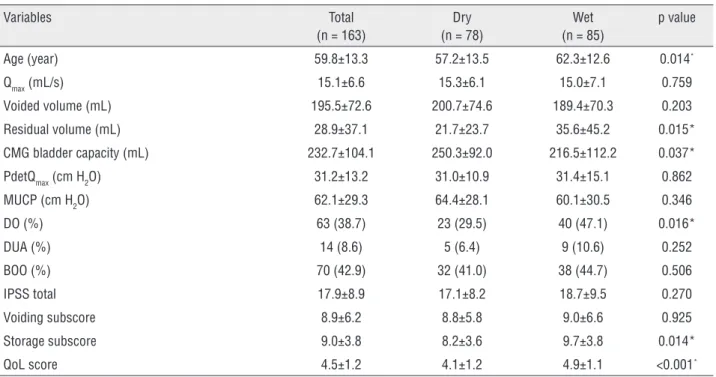
A total of 163 female patients with OAB symptoms were enrolled in the study. Of them, 78 women (47.9%; 78/163) experienced only urgency (OAB dry), while 85 women (52.1%; 85/163) experienced OAB wet symptoms. The average age of the entire group was 59.8±13.3 years (range, 27–86 years), and the mean age was higher in the wet symptom group than in the dry one (p <0.05) (Table-1).
Table-1 also shows a comparison of the cli-nical characteristics and urodynamic parameters between the dry and wet symptom groups. No sig-nificant differences were found in the Qmax, voided volume, PdetQmax and maximum urethral closure pressure. The PVR was higher in the wet symptom group than in the dry one, although the mean values of PVR were within the normal ranges. Maximum bladder capacity in UDS was lower in the wet symp-tom group than in the dry group. Although signifi-cant differences were found in the presence of DO via UDS, no significant differences were found in
the prevalence of concurrent BOO and DUA between the groups. The storage symptom subscore and QoL score of the IPSS were higher for the wet symptom group than in the dry one.
Analysis in relation to the presence of FVD showed that the Qmax, voided volume, and total bladder capacity were significantly lower, but PVR was significantly higher, in the FVD group than in the group without FVD. However, the total IPSS and individual subscores did not significantly di-ffer between the groups (Table-2).
DISCUSSION
In this study, we found that more than half the women with OAB symptoms coexisted with voiding dysfunction by UDS, although categori-zing the OAB symptoms on the basis of urgency along with urinary incontinence and IPSS was uninformative with regard to voiding dysfunction. Thus, UDS plays an important role in the diag-nosis of female patients with OAB symptoms in terms of the presence of voiding dysfunction.
Table 1 - Comparison of clinical characteristics and urodynamic parameters between patients with dry and wet OAB symptoms.
Variables Total
(n = 163)
Dry (n = 78)
Wet (n = 85)
p value
Age (year) 59.8±13.3 57.2±13.5 62.3±12.6 0.014*
Qmax (mL/s) 15.1±6.6 15.3±6.1 15.0±7.1 0.759
Voided volume (mL) 195.5±72.6 200.7±74.6 189.4±70.3 0.203
Residual volume (mL) 28.9±37.1 21.7±23.7 35.6±45.2 0.015*
CMG bladder capacity (mL) 232.7±104.1 250.3±92.0 216.5±112.2 0.037*
PdetQmax (cm H2O) 31.2±13.2 31.0±10.9 31.4±15.1 0.862
MUCP (cm H2O) 62.1±29.3 64.4±28.1 60.1±30.5 0.346
DO (%) 63 (38.7) 23 (29.5) 40 (47.1) 0.016*
DUA (%) 14 (8.6) 5 (6.4) 9 (10.6) 0.252
BOO (%) 70 (42.9) 32 (41.0) 38 (44.7) 0.506
IPSS total 17.9±8.9 17.1±8.2 18.7±9.5 0.270
Voiding subscore 8.9±6.2 8.8±5.8 9.0±6.6 0.925
Storage subscore 9.0±3.8 8.2±3.6 9.7±3.8 0.014*
QoL score 4.5±1.2 4.1±1.2 4.9±1.1 <0.001*
DO has been considered one of major charac-teristic of OAB, and OAB symptoms are believed to be indicative of a subsequent finding of DO on UDS. However, discordance between OAB and DO has also been reported. Digesu et al. (6) found that only 54% of women with OAB had DO on UDS, and 27% of the women with a diagnosis of DO on UDS had OAB symptoms. According to their report, because symp-tomatic diagnosis of OAB did not correlate with the urodynamic diagnosis of DO, symptomatic diagnosis of OAB alone was not recommendable for women with LUTS. In our study, only 38.7% (63/163) of the women with OAB symptoms had DO on UDS. When OAB symptoms were categorized by urgency urina-ry incontinence, DO was found significantly more frequently in the OAB wet group than in the OAB dry group (47.1% vs. 29.5%). Nevertheless, urgency incontinence was found to be suggestive of a high probability of DO among women with OAB symp-toms, although DO does not affect the choice of and response to treatment among OAB patients. Nitti et al. (12) showed that the response to an-timuscarinic therapy in patients with OAB symp-toms was independent of the urodynamic diagno-sis of DO. Therefore, we did not focus on DO in this UDS; instead, we focused on FVD.
According to our urodynamic analy-sis, the women with OAB symptoms, of avera-ge aavera-ge 60 years, had a mean voided volume of 195.5±72.6mL and Qmax of 15.1±6.6mL/s. Flow rates are affected by voided volume, age, body mass index, urethral resistance, detrusor contrac-tility, and psychological inhibition, among other factors; in particular, voided volume has a positi-ve effect, while age has a negatipositi-ve effect on flow rate (13). In healthy postmenopausal continent women without DO, the Qmax was 23mL/s in free uroflowmetry and 18mL/s in the pressure flow study (14). Blaivas et al. (15) reported a Qmax va-lue of 24.4mL/s and a voided volume of 250mL among women with an average age of 67 years who showed normal urodynamic results. Thus, the Qmax for the OAB patients in the present study was lower than that reported previously for he-althy women. Although we did not extensively examine the factors that affect Qmax, the relative-ly low voided volume due to frequent urination and voiding dysfunction might have resulted in the low Qmax observed in this study.
There are no generally accepted urodyna-mic criteria for the diagnosis of BOO in women as there are in men. Using a combined cut-off
va-Table 2 - Comparison of clinical characteristics and urodynamic parameters between women with OAB symptoms with and without FVD.
No FVD (n = 77 ) FVD (n = 86) p value
Age (y) 58.2±13.1 61.3±13.3 0.130
Qmax (mL/s) 20.5±5.2 10.3±2.9 <0.001*
Voided volume (mL) 214.2±70.9 170.4±67.7 <0.001*
Residual volume (mL) 22.8±28.2 34.4±42.9 0.043*
CMG bladder capacity (mL) 261.9±91.1 206.4±108.4 0.001*
PdetQmax (cm H2O) 30.2±11.2 32.0±14.7 0.377
MUCP (cm H2O) 62.6±30.4 61.7±28.5 0.852
IPSS total 16.7±8.3 19.0±9.2 0.101
Voiding subscore 8.0±5.8 9.6±6.4 0.110
Storage subscore 8.6±3.9 9.3±3.5 0.213
QoL score 4.3±1.2 4.6±1.1 0.164
lue of Qmax ≤15mL/s and PdetQmax >20cmH2O for diagnosis of BOO in women, Chassagne et al. (16) reported a sensitivity of 74.3% and a specificity of 91.1% and that was the best cut-off values pre-dicting BOO. With these criteria, the prevalence of BOO was 42.9% (70/163) in the women with OAB symptoms in our study. Although the reported prevalence of BOO in women varies widely becau-se of the lack of standard diagnostic definitions or criteria, its prevalence has been estimated to be between 2.7% and 29% (17). Thus, the number of women with OAB symptoms who had BOO in the present study exceeded the normal range conside-rably. It may be affected by enrollment of women with OAB symptoms, not normal. When compa-red to a population of women without voiding symptoms, women with OAB might have a higher rate of BOO. Women with BOO complain of not only obstructive symptoms but also storage symp-toms (18). Kayigil et al. (19) reported that BOO was more frequent in individuals with idiopathic detrusor overactivity than in the control group, although they used a different cut-off value for BOO from us. According to their study, some wo-men with BOO reported storage symptoms as the primary complaint. In that respect, UDS can pro-vide essential information for the differentiation of BOO from OAB.
The prevalence of DUA in women with OAB symptoms was 8.6% (14/163) in the present study. DUA is a contraction of reduced strength and/or duration, which results in prolonged blad-der emptying and/or a failure to achieve complete bladder emptying within a normal time span (11). DUA may be caused by neuropathies, pelvic sur-gery, or drug treatments, but it is most often idio-pathic. Cucchi et al. (20) reported that idiopathic DUA was found in nearly 3% adult females. Al-though the specific prevalence of DUA is unkno-wn and varies widely depending on the diagnostic criteria, it seemed to be relatively high in the pre-sent study. Women with DUA usually have a high PVR and complain of obstructive symptoms (20). However, some of them have storage symptoms as the primary complaint. Without UDS, an exact diagnosis cannot be made in this situation.
The proportion of women with wet and dry OAB symptoms was almost the same in the
pre-sent study. Considering that the mean age of the patients in this study was about 60 years, this re-sult regarding the OAB symptoms is similar to that reported previously (21, 22). The mean age of the women in the wet symptom group exceeded that of the women in the dry group, which correspon-ds to the observation that the prevalence of wet symptoms increases significantly with advancing age (21). Chung et al. (23) evaluated urodynamic parameters in OAB subtypes and used an urgency severity scale. They reported that the mean cysto-metric bladder capacity was lower and PVR was higher in patients with wet symptoms than in tho-se with dry symptoms, although the mean Qmax did not differ significantly between the 2 groups. The present study showed the same results. Patients with wet symptoms showed relative high PVR, although it was mostly within the normal range (less than 100mL). This means that the presence of urgency and incontinence can help predict PVR. However, the frequency of BOO or DUA did not differ significantly between the 2 groups, and FVD could not be predicted on the basis of urgency--incontinence. Therefore UDS was required to de-termine the presence of FVD.
investigate the natural history or response to tre-atment in FVD group because of the retrospective characteristic of the study.
The present study has some limitations. The first is its retrospective nature and the lack of a control group. In practice, conducting UDSs for normal subjects is difficult, thus we could not compared the UDS of control. We set large exclu-sion criteria to evaluate OAB symptoms which do not related to the neurologic or anatomical factors that could be diagnosed or supposed without UDS. Thus only 163 patients could be enrolled in this study. Further, although we used a cut-off value for the UDS-based diagnosis of FVD, there is a lack of established urodynamic criteria for the diagno-sis of FVD at present. In the future, prospective studies with a larger number of subjects are nee-ded to provide more information about the role of UDS in the diagnosis of FVD in patients with OAB symptoms, with a special focus on impact upon the management of female OAB patients.
CONCLUSIONS
A significant number of women with OAB symptoms had voiding dysfunction but only OAB symptoms are not enough to predict the presence of FVD. Therefore, UDS may be necessary for ac-curate diagnosis in women with OAB symptoms.
ABBREVIATIONS
OAB = overactive bladder
LUTS = lower urinary tract symptoms
UDS = urodynamic study
BOO = bladder outlet obstruction
DO = detrusor overactivity
FVD = female voiding dysfunction
IPSS = international prostate symptom score
Qmax = maximum flow rate
PVR = postvoid residual urine volume
PdetQmax = detrusor pressure at the maximum flow rate
DUA = detrusor underactivity
CONFLICT OF INTEREST
None declared.
REFERENCES
1. Irwin DE, Milsom I, Hunskaar S, Reilly K, Kopp Z, Herschorn S, et al. Population-based survey of urinary incontinence, overactive bladder, and other lower urinary tract symptoms in five countries: results of the EPIC study. Eur Urol.2006;50:1306-14; discussion 1314-5.
2. Yoo ES, Kim BS, Kim DY, Oh SJ, Kim JC. The impact of overactive bladder on health-related quality of life, sexual life and psychological health in Korea. Int Neurourol J. 2011;15:143-51.
3. Eckhardt MD, van Venrooij GE, Boon TA. Symptoms, prostate volume, and urodynamic findings in elderly male volunteers without and with LUTS and in patients with LUTS suggestive of benign prostatic hyperplasia. Urology. 2001;58:966-71. 4. Malone-Lee J, Henshaw DJ, Cummings K. Urodynamic
verification of an overactive bladder is not a prerequisite for antimuscarinic treatment response. BJU Int. 2003;92:415-7. 5. Malone-Lee JG, Al-Buheissi S. Does urodynamic verification
of overactive bladder determine treatment success? Results from a randomized placebo-controlled study. BJU Int. 2009;103:931-7.
6. Digesu GA, Khullar V, Cardozo L, Salvatore S. Overactive bladder symptoms: do we need urodynamics? Neurourol Urodyn.2003;22:105-8. Erratum in: Neurourol Urodyn. 2003;22:356.
7. Robinson D, Staskin D, Laterza RM, Koelbl H. Defining female voiding dysfunction: ICI-RS 2011. Neurourol Urodyn. 2012;31:313-6.
8. Groutz A, Blaivas JG, Chaikin DC. Bladder outlet obstruction in women: definition and characteristics. Neurourol Urodyn. 2000;19:213-20.
9. Kuo HC. Videourodynamic characteristics and lower urinary tract symptoms of female bladder outlet obstruction. Urology. 2005;66:1005-9.
10. Coyne KS, Margolis MK, Hsieh R, Vats V, Chapple CR. Validation of the urinary sensation scale (USS). Neurourol Urodyn. 2011;30:360-5.
11. Abrams P, Cardozo L, Fall M, Griffiths D, Rosier P, Ulmsten U, et al. Standardisation Sub-Committee of the International Continence Society. The standardisation of terminology in lower urinary tract function: report from the standardisation sub-committee of the International Continence Society. Urology. 2003;61:37-49.
12. Nitti VW, Rovner ES, Bavendam T. Response to fesoterodine in patients with an overactive bladder and urgency urinary incontinence is independent of the urodynamic finding of detrusor overactivity. BJU Int. 2010;105:1268-75.
14. Pfisterer MH, Griffiths DJ, Rosenberg L, Schaefer W, Resnick NM. Parameters of bladder function in pre-, peri-, and postmenopausal continent women without detrusor overactivity. Neurourol Urodyn. 2007;26:356-61.
15. Blaivas JG, Groutz A. Bladder outlet obstruction nomogram for women with lower urinary tract symptomatology. Neurourol Urodyn. 2000;19:553-64.
16. Chassagne S, Bernier PA, Haab F, Roehrborn CG, Reisch JS, Zimmern PE. Proposed cutoff values to define bladder outlet obstruction in women. Urology. 1998;51:408-11.
17. Patel R, Nitti V. Bladder outlet obstruction in women: prevalence, recognition, and management. Curr Urol Rep. 2001;2:379-87.
18. Massey JA, Abrams PH. Obstructed voiding in the female. Br J Urol. 1988;61:36-9.
19. Kayigil O, Metin A, Atmaca AF. Obstructive urodynamic findings in idiopathic detrusor overactivity. Int Urol Nephrol. 2007;39:445-8.
20. Cucchi A, Quaglini S, Rovereto B. Development of idiopathic detrusor underactivity in women: from isolated decrease in contraction velocity to obvious impairment of voiding function. Urology. 2008;71:844-8.
21. Hung MJ, Ho ES, Shen PS, Sun MJ, Lin AT, Chen GD; Taiwan OAB Club. Urgency is the core symptom of female overactive bladder syndrome, as demonstrated by a statistical analysis. J Urol. 2006;176:636-40.
22. Stewart WF, Van Rooyen JB, Cundiff GW, Abrams P, Herzog AR, Corey R, et al. Prevalence and burden of overactive bladder in the United States. World J Urol. 2003;20:327-36. 23. Chung SD, Liao CH, Chen YC, Kuo HC. Urgency severity
scale could predict urodynamic detrusor overactivity in patients with overactive bladder syndrome. Neurourol Urodyn. 2011;30:1300-4.
24. Hsiao SM, Lin HH, Kuo HC. International Prostate Symptom Score for assessing lower urinary tract dysfunction in women. Int Urogynecol J. 2013;24:263-7.
_______________________ Correspondence address: Joon Chul Kim, MD, PhD Department of Urology The Catholic University of Korea, Bucheon St. Mary’s