2013 Nov.-Dec.;21(6):1298-305 DOI: 10.1590/0104-1169.3072.2367
www.eerp.usp.br/rlae
Copyright © 2013 Revista Latino-Americana de Enfermagem
This is an Open Access article distributed under the terms of the Creative Commons Attribution Non-Commercial License (CC BY-NC).
This license lets others distribute, remix, tweak, and build upon your work non-commercially, and although their new works must also acknowledge you and be non-commercial, they don’t have to license their derivative works on the same terms.
Corresponding Author:
Andrea Prochnow Av. Osvaldo Cruz, 847 Bairro: Nossa Senhora das Dores CEP: 97095-470, Santa Maria, RS, Brasil E-mail: [email protected]
Andrea Prochnow
1Tânia Solange Bosi de Souza Magnago
2Janete de Souza Urbanetto
3Carmem Lúcia Colomé Beck
4Suzinara Beatriz Soares de Lima
2Patrícia Bitencourt Toscani Greco
51 MSc, RN.
2 PhD, Adjunct Professor, Departamento de Enfermagem, Universidade Federal de Santa Maria, Santa Maria, RS, Brazil.
3 PhD, Adjunct Professor, Faculdade de Enfermagem, Fisioterapia e Nutrição, Pontifícia Universidade Católica do Rio Grande do Sul, Porto Alegre,
RS, Brazil.
4 PhD, Associate Professor, Departamento de Enfermagem, Universidade Federal de Santa Maria, Santa Maria, RS, Brazil. 5 MSc, RN, Prefeitura Municipal de Santiago, Santiago, RS, Brazil.
Objective: to evaluate the association between psychological demands, control over the work and the reduction of work ability of nursing professionals. Method: this cross-sectional study involved 498 nursing professionals of a university hospital in the State of Rio Grande do Sul, Brazil. Data collection was carried out in 2009 using the Brazilian versions of the Work Ability Index and Job Stress Scale, with logistic regression models used for the data analysis. Results: the prevalence of 43.3% for reduced work ability and 29.7% for high-strain in the job (high psychological demand and low control) were observed. The chances for professionals presenting reduced work ability under high-strain were higher and significant when compared to those classified as being under low-strain, even after adjusting for potential confounders, except for age and gender. Conclusion: a high prevalence of reduced work ability was observed. This evidence indicates the need for investigation and detailed analysis of the psychosocial aspects of the professionals with regard to the health/disease process of nursing professionals.
Descriptors: Work; Nursing; Work Capacity Evaluation; Occupational Health; Stress, Psychological; Occupational Diseases.
Prochnow A, Magnago TSBS, Urbanetto JS, Beck CLC, Lima SBS, Greco PBT.
Introduction
Work ability is a condition resulting from the combination of the work environment and the lifestyle of the worker, inluenced by factors such as sociodemographic characteristics, lifestyle and the intrinsic aspects of the activity performed(1-2). Its
concept is based on both the individual perceptions regarding the demands of the work, as well as coping with them(2). In the mid 1980’s, with the intention of
creating an instrument for evaluating work ability, Finnish researchers developed the Work Ability Index (WAI). This evaluation is very important, since the work, as well as possibly exerting a positive inluence in that it promotes professional recognition, can also lead to psychological distress when the employees submit to the constraint conferred by it(1).
Considering Nursing, it can be said that the work process constituted inside the health practices is complementary, interdependent and collective(3-4). This
form of organization presents a technical division of labor, in which the actions are hierarchized by complexity of concept and implementation, which requires different skills for the management of the various instruments and methods(4). It is also essential to consider that
nursing work in general presents some characteristics inherent to the profession, such as often working in situations of critical illness, on the border of life and death, which make it a profession in which the workers are susceptible to stress and illness(5-6). Many of these
situations can be related to the psychosocial aspects of the work, speciically the psychological demands and control over the work activities(7).
The psychosocial dimension of the work has attracted the attention of scholars throughout the last four decades and theoretical and methodological proposals have been drawn up from the perspective of presenting investigative models. Among the theoretical frameworks that evaluate these aspects, there is the Demand/Control Model (DCM)(7). This is a
two-dimensional model that relates two psychosocial aspects in the work environment to the risk of illness, the psychological demands and control the worker has over the work(7). The psychological demands dimension
refers to pressures, such as time/speed in performing the activity and conlict between contradictory demands. The control dimension relates to the possibility of the worker making use of their intellectual abilities and having suficient authority to decide how and when to carry out the activities(7-8).
The DCM is a theoretical and methodological model that proposes an evaluation of the work environment from the combination of high and low levels of these two dimensions, conigured as four speciic work situations that suggest different risks to health. These are, high-strain jobs (combination of high psychological
demands and low control – highest risk category); active jobs (high demand and high control); low-strain jobs (low demand and high control – lowest risk category) and passive jobs (low demand and low control)(7).
Thus, the interaction between high psychological demands and low job control of the workers regarding the activities they perform conigures as a situation of high-strain in the job, with the result of occupational
stress(7). Given that stress is harmful to people’s
health and can inluence the individual’s ability to perform the work, investigating the elements that this triggers, as well as their consequences, can provide support that will assist in planning actions of health promotion, maintenance or the restoration of the work ability, for the physical and mental well-being of the worker.
To support this study a search was conducted, in May 2013, in databases Latin American Health Science Literature (LILACS) and Medical Literature Analysis and Retrieval System Online (MEDLINE) using the following descriptors: “evaluation of work ability” and “psychological stress” and “physiological stress”. Two Brazilians articles were located that concomitantly used the DCM and the WAI(9-10). Of
these, one(10), developed with workers from a bus
transportation company, showed a positive association between stress and a reduction in the work ability. The other(9), with nursing staff, showed no association in
this relationship.
With the aim of deepening our understanding of this relationship, the present study was proposed with the following guiding question: is there an association between psychological demands, control over the work, and reduced work ability in nursing staff of a university hospital in Rio Grande do Sul, Brazil?
Rev. Latino-Am. Enfermagem 2013 Nov.-Dec.;21(6):1298-305.
Methods
This epidemiological cross-sectional study was performed at the University Hospital of Santa Maria (HUSM), located in the Central-West Region of Rio Grande do Sul, Brazil. The study population consisted of 592 nursing staff (nurses, technicians and auxiliary nurses). All members of the permanent staff (employed through public examinations) were included, and those who were absent or on sick leave during the collection period were excluded. Data collection took place between September and December 2009, during the working hours of the study participants, and was performed by certiied research assistants. A questionnaire was used containing questions about sociodemographic data (gender, age, education, race, marital status), employment data (function, work shift, working hours, additional employment), the psychosocial dimensions (psychological demands and work control) and questions that evaluate the Work Ability Index (WAI).
The psychosocial dimensions (exposure) were evaluated using the Job Stress Scale (JSS)(8), which is
the reduced version of the Job Content Questionnaire (JCQ)(7) translated and validated for Portuguese. In this
scale, the scores for psychological demand and control were obtained through the sum of the points assigned to each question, ranging 5-20 points and 6-24 points, respectively(8). According to these scores, both the
psychological demand variable and the control variable
were dichotomized into “low demand”, “high demand” and “low control”, and “high control”, using the mean score as the cutoff point. From these two dichotomized dimensions four groups were constructed: low-strain, active job, passive job, and high-strain. The Cronbach’s alpha coeficients for psychological demand and control were 0.72 and 0.55, respectively. During the analyzes three reference categories were considered: low psychological demand, low control and the low-strain
quadrant.
The work ability (outcome) was evaluated using the Brazilian version(2) of the WAI. The WAI is calculated
based on the answers of the workers to questions concerning work demands, health status, and physical, mental and social capacities. The score for the WAI ranges from 7 to 49 points(2). The result depicts the
concept the worker has of his/her work ability: poor, moderate, good or excellent work ability(2). For the
bivariate and multivariate analyses the work ability was dichotomized into reduced (poor and moderate) and good (good and excellent) abilities.
The data were entered in the Epi-Info®, version 6.4
program, with independent double entry. After checking for errors and inconsistencies, the data analysis was performed using the PASW Statistics® (Predictive
Analytics Software from SPSS Inc., Chicago – USA) version 18.0 for Windows. Bivariate analyzes were performed to check the association between exposure and outcome with each of the covariates studied. The chi-square test was used to check whether the associations found presented statistical signiicance (p<0.05). In the bivariate analyzes, the covariates shown to be potential confounding factors (associated with both the exposure and the outcome) were: gender, age, education, function and, time in the job. For the selection of the potential confounding variables, a signiicance level of 25% (p≤0.25) was established. Binary logistic regression models (Enter method) were run with all these variables. The variables were removed from the models when p values of >25% were presented.
To verify the adequacy of the regression models, the Hosmer-Lemeshow Test(11) was used. In this test, the
values range from zero (0) to 1, with values closer to 1, showing better adequacy of the model(11). The measure
of association used was the Odds Ratio (OR), with a 95% conidence interval. The project was approved by the Research Ethics Committee of the Universidade Federal de Santa Maria – UFSM/RS (CAAE: 0070.0.243.
000-09) on 23/06/2009. The participants signed the Terms of Free Prior Informed Consent, and were informed of the voluntary nature of their participation in the study.
Results
Of the total of 592 individuals, 498 (84%) nursing staff participated in the study. The 94 (16%) losses resulted from refusals to participate. The sociodemographic proile indicates that 437 (87.8%) nursing staff were female, 425 (85.3%) self-reported white race, 163 (32.7%) aged 47 to 69 years, mean 41.3 years (±8.9 years, minimum age 24 and maximum 69 years), and that 129 (36.5%) of the technicians/ auxiliary nurses had completed undergraduate courses and 32 (9.1%) postgraduate courses.
Prochnow A, Magnago TSBS, Urbanetto JS, Beck CLC, Lima SBS, Greco PBT.
nightshift, 311 (62.4%) had a workload of 36 hours per week and 89 (17.9%) had other employment.
With regard to the evaluation of the WAI, 206 (41.4%) workers presented good work ability; 187 (37.6%) moderate ability; 76 (15.3%) excellent ability; and 29 (5.7%) poor work ability. The prevalence of workers with reduced work ability (low and moderate ability), in the period evaluated, was 43.3%.
When analyzing the work ability of the nursing staff according to the sociodemographic variables, it was shown that 200 (45.8%) female workers and 83 (50.9%) aged ≥47 years presented reduced work ability (p<0.05). In relation to the work variables, it was found that 53 (36.8%) nurses, 163 (46%), technicians/ auxiliary nurses, 127 (44.3%) nightshift workers, 111 (46.8%) with more than 14 years in the job and 185 (45.2%) who had no other employment presented reduced work ability (p>0.05).
The frequency of workers in the four quadrants of the DCM was as follows: 103 (20.7%) in low-strain, 98 (19.7%) in passive job, 149 (29.9%) in active job and
148 (29.7%) in high-strain. It was found that the female workers, married, aged ≥37 years, who had completed high school or an undergraduate course presented higher frequencies in the high-strain quadrant (p<0.001).
When evaluating the work variables, it was observed that among the 76 (56.8%) nurses the frequencies were higher in the active job quadrant, and, among the 127 (35.9%) technicians and auxiliary nurses, the frequencies were higher in the high-strain quadrant (p<0.001). Among the workers who worked on the dayshift, the high-strain quadrant was highlighted (N=66; 31.3%) followed by the active job quadrant (N=65; 30.8%); nightshift workers had higher frequencies in the active job quadrant (N=84; 29.3%), followed by the high-strain quadrant (N=82; 28.6%). Among the 31 (34.8%) workers who reported other employment the active job quadrant was predominant and for the 126 (30.8%) who reported having only one job, there were higher frequencies in the high-strain quadrant, as was also the case for the 67 (28.3%) workers with 14 or more years in the job.
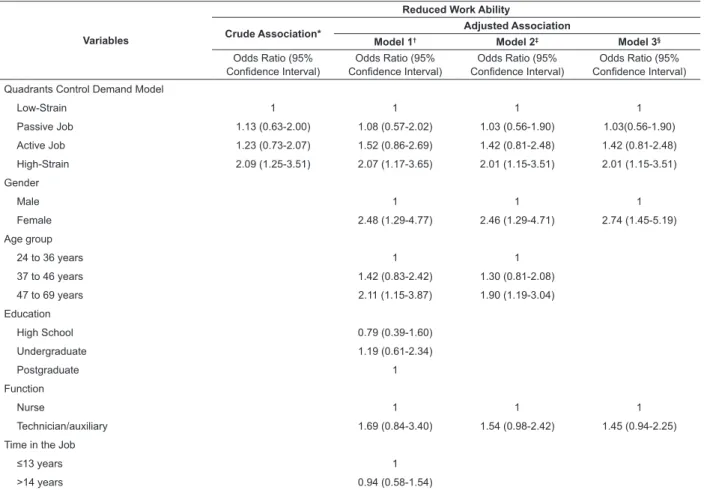
Table 1 - Crude and adjusted associations between the quadrants of the DCM and reduced work ability in nursing staff. Santa Maria, RS, Brazil, 2009
*Hosmer and Lemeshow Test=1.00; †Hosmer and Lemeshow Test=0.375; ‡Hosmer and Lemeshow Test=0.564; §Hosmer and Lemeshow Test=0.171
Variables
Reduced Work Ability
Crude Association* Adjusted Association
Model 1† Model 2‡ Model 3§
Odds Ratio (95%
Conidence Interval)
Odds Ratio (95%
Conidence Interval)
Odds Ratio (95%
Conidence Interval)
Odds Ratio (95%
Conidence Interval) Quadrants Control Demand Model
Low-Strain 1 1 1 1
Passive Job 1.13 (0.63-2.00) 1.08 (0.57-2.02) 1.03 (0.56-1.90) 1.03(0.56-1.90)
Active Job 1.23 (0.73-2.07) 1.52 (0.86-2.69) 1.42 (0.81-2.48) 1.42 (0.81-2.48)
High-Strain 2.09 (1.25-3.51) 2.07 (1.17-3.65) 2.01 (1.15-3.51) 2.01 (1.15-3.51)
Gender
Male 1 1 1
Female 2.48 (1.29-4.77) 2.46 (1.29-4.71) 2.74 (1.45-5.19)
Age group
24 to 36 years 1 1
37 to 46 years 1.42 (0.83-2.42) 1.30 (0.81-2.08)
47 to 69 years 2.11 (1.15-3.87) 1.90 (1.19-3.04)
Education
High School 0.79 (0.39-1.60)
Undergraduate 1.19 (0.61-2.34)
Postgraduate 1
Function
Nurse 1 1 1
Technician/auxiliary 1.69 (0.84-3.40) 1.54 (0.98-2.42) 1.45 (0.94-2.25)
Time in the Job
≤13 years 1
Rev. Latino-Am. Enfermagem 2013 Nov.-Dec.;21(6):1298-305.
Model 2 was the one that best explained the association between high-strain and reduced work ability(11). The chances of the workers presenting
reduced work ability remain in the high-strain group (OR=2.01; 95%CI =1.15-3.51), even after adjusting for the potential confounding variables, except for gender and age.
Discussion
The results of this study indicate that nursing staff subjected to high-strain in the workplace are more likely to be classiied with reduced work ability, when compared to those under low-strain, even after adjusting for function. The age and gender of the employees were not confounding factors, i.e., these variables were associated with the reduction of the WAI.
The work process in a hospital environment, especially in teaching institutions, demands important attributions, since the severity and complexity of the inpatients of large reference hospitals impose the need to deal with sophisticated equipment, and perform complex procedures and constant clinical evaluations with immediate decision making. According to the DCM(7), the objective work environment leads to the
perceived psychological environment, which in turn produces affective and behavioral responses that can result in illness (physical or mental). In this case, such demands may inluence the work ability of the professionals. However, the association found in this study differs from results shown in other studies: one(12),
conducted in a public hospital in São Paulo with the nursing staff, and another(9), with nurses in a hospital
group in Porto Alegre/Rio Grande do Sul, showed no statistically signiicant association between high-strain and reduced nursing work ability.
Despite the divergence of results, it is important to relect on the high percentage of workers in this study classiied in the high-strain quadrant. According to the DCM, workers subjected to high demands or psychological pressure in their work combined with low control or low decision making power to cope with them are more susceptible to the risk of illness due to psychological deterioration(7). In this sense, the results
of this study showed that to be a technician/auxiliary nurse, to have been in the job for 14 years or more and to have completed high school or an undergraduate degree are conditions that can lead to the development of stress, given that these workers were classiied in the high-strain quadrant (p<0.05). These results
corroborate those of another study(13), performed in an
emergency room of a hospital in the South of Brazil, in which it was found that to be a technician/auxiliary nurse, with more than 15 years in the job, and to have low social support cause a greater chance of having high deterioration.
Regarding the classiication of the nursing staff in the quadrants of the DCM in relation to age, the studies are not consensual. One study(14) conducted in a public
hospital in Salvador/Bahia concluded that younger individuals, aged up to 35 years, were found in the high-strain quadrant (p=0.395). Another study(13)
evidenced a higher frequency in the passive job quadrant for all the age groups evaluated (p=0.654). In this study, it was shown that younger workers (24-36 years) were found in higher frequency in the active job quadrant, and those 37 years of age or more,
in the high-strain quadrant, suggesting that, as the worker ages the demands of the job on these workers may also increase or be perceived by them as raised. This situation may have direct effects on health and productivity(7).
Taking into account that the factors that lead to decreased work ability are more frequently observed in workers who are around 45 years of age(2), it was observed
that 83 (50.9%) workers aged ≥47 years presented signiicantly reduced work ability. Accordingly, when considering that the workers today, remain longer in the labor market, it is essential that measures regarding attention to their health are implemented, aiming for active aging of these workers and the maintenance of their work ability(1).
Regarding the function, the predominance of nurses in the active job quadrant corroborates other studies(6,9,14-15). Nurses have more autonomy to make
decisions, to control their own activities, and to use their skills. In this regard, it was noted that the nurses have been making efforts to develop an autonomous professional practice, being aware that changes in their professional practice are needed, as well as further scientiic knowledge and the incorporation of this into their actions(16).
The fact that the technicians/auxiliary nurses ind themselves in the high-strain followed by the passive job quadrants should be viewed carefully because,
according to the theoretical framework adopted in this article, these are the situations most harmful to health that carry the greater risk of illness(7). This hypothesis is
Prochnow A, Magnago TSBS, Urbanetto JS, Beck CLC, Lima SBS, Greco PBT.
work ability (p=0.059). Inherent characteristics of these workers, such as daily routines and repetitive tasks can result in a lack of interest in the work.
Furthermore, the deicit of employees that many Brazilian health institutions face, coupled with high demand from patients and care dependency sometimes causes workers to develop their activities under time pressure, with low concentration levels and interruption of tasks, since there is a high overload of activities.
It must be take into account that a signiicant percentage (45.6%, N=161) of technicians and auxiliary nurses in the institution studied hold a degree (undergraduate and postgraduate), which is more than is required for the position. This is due to the fact that the institution has a Jobs and Salaries Plan that encourages qualiication, resulting in increases in salary. However, there is no change in the employment contract, therefore they can not perform activities of higher qualiications, which they have the ability to exercise. This situation may be contributing to this functional category being in the high-strain and passive job quadrants. In this context, to perform a task short of their qualiication may cause the worker to experience feelings of unworthiness, uselessness and disqualiication(17). Therefore, the hospital management
has a key role with regard to the training of workers who remain in the function, even after the pursuit of a higher level of education/qualiication. It is up to the management to develop valorization strategies for these workers, beyond the increase in remuneration, so that that this higher qualiication will also result in greater autonomy in the work process.
In the evaluation of the working shift, 66 (31.3%) of the workers who performed their activities on the dayshift presented a higher percentage in the high-strain quadrant when compared to the nightshift workers. It is believed that this result refers to the speciic characteristics of the ield of study: during the morning and afternoon, large numbers of people transit through the hospital (doctors, healthcare area students, companions), as well as this being the time for visiting. All these factors, added to speciic routine nursing activities that are developed during the daytime, such as hygiene, dressing changes, preparation and transportation of patients, guidance provided for patients and families, and hospitalizations and discharges, contribute to the predominance of workers in this quadrant. However, despite being in the quadrant of increased risk, they have a higher percentage of good/excellent work ability (p=0.645).
The investigation of the factors that contribute to the classiication of workers of this shift in the higher risk of illness quadrant, as well as the adoption of measures that mitigate or eliminate these risks is of great importance in order to maintain their functional capacity.
Unlike another study(13) which indicated that
workers who are only employed in the institution studied presented a greater percentage in the passive job followed by the low-strain (p=0.361) quadrants, in the present study, in addition to the prevalence in the high-strain quadrant, 185 (45.2%) of them were classiied as having reduced work ability. One possible explanation for this result may be related to the fact that many workers are not limited to only working the weekly contracted hours. Often the performance of overtime, which may be responsible for the overload of these workers, is carried out during the days and shifts in which they should be off work. Another factor to consider is related to the large number of workers who seek professional qualiication, which causes many professionals to dedicate what should be their rest periods to studying. These aspects, not investigated in this study, deserve further study, as this is a common reality in Brazilian hospitals.
Accordingly, the results of a study(18) which aimed
to analyze factors associated with workload and the professional work period and the total work period (professional + home) in nursing professionals revealed that there was a signiicant association between long professional work periods and reports of lack of time for rest and leisure. Although there are dificulties in establishing a safe limit for the duration of the periods due to the variety of conditions involved, it is known that long working hours involve direct effects, such as a reduction in the time available for other activities, increased exposure to the demands, and risks in the work(18).
Knowing that workers in the high-strain quadrant are more susceptible to stress and, consequently, decreases in the work ability, the results of this study indicate that intervention measures for health promotion of the worker and maintenance of their functional capacity should be adopted and active. The ideal job is one that represents a state of relaxation bought about by conditions with low psychological demand and high levels of control (low-strain)(7). However, in looking
Rev. Latino-Am. Enfermagem 2013 Nov.-Dec.;21(6):1298-305.
the freedom to participate in the small activities, such as coffee breaks and other social activities with co-workers also needs to be considered(7). In addition,
investments in maintaining the functional ability lead to positive results, not only for the worker, who may have an independent and active life(2), but also for the
whole management process.
Conclusion
The results of this study conirm the research hypothesis, since they indicate that nursing workers exposed to high-strain in their work, have reduced work ability after adjusting for function. Age and gender were associated with reduced work ability. The evidence points to the need for investigation and detailed analysis of the psychosocial aspects related to the health/disease process of nursing staff and indicates some factors that may be contributing to the reduction in work ability, and, more broadly, to the emergence of future injuries to the health of these workers.
Due to Nursing being a profession that involves daily contact with highly stressful situations which may in the long run, reverberate in the health of workers, as well as due to the shared and complementary work process that leads to the reduction of autonomy and decision making (mainly in technicians/auxiliary nurses), it is necessary to rethink the quotidian practices in the healthcare work in the hospital context. The inclusion of measures to alleviate job strain and, consequently, reduce the psychological demands should be considered, as it is not always possible to increase the decision power/autonomy of the worker. These aspects may contribute to the reestablishment and maintenance of good/excellent work ability.
Investments in better working conditions, in all the life stages of the worker, will have repercussions not only in their health, but in the work, as this will result in fewer temporary and permanent absences. The impossibility of predicting cause and effect (cross-sectional studies) is one of the limitations of the study, as well as not including the absent workers, especially those absent due to illness, as there may be an effect bias for the healthy worker.
References
1. Hilleshein EF, Souza LM, Lautert L, Paz AA, Catalan VM, Teixeira MG, et al. Capacidade para o trabalho de enfermeiros de um hospital universitário. Rev Gaúcha Enferm. 2011;32(3):509-15.
2. Tuomi K, Ilmarinen J, Jahkola A, Katajarinne L, Tulkki A. Índice de Capacidade para o Trabalho. Helsinki: Instituto de Saúde Ocupacional; 2005.
3. Lunardi VL, Lunardi WD Filho, Schwengher AL, Silva CRA. Processo de trabalho em enfermagem/ saúde no Sistema Único de Saúde. Enfermagem Foco. 2010;1(2):73-6.
4. Capella BB, Leopardi MT. Teoria sociohumanista. In: Leopardi MT. Teorias em enfermagem: instrumentos para a prática. Florianópolis: Papa-livro; 1999. p. 187-92.
5. Greco PBT, Magnago TSBS, Prochnow A, Beck CLC, Tavares JP. Utilização do Modelo manda-Controle de Karasek na América Latina: uma pesquisa bibliográfica. Rev Enferm UFSM. 2011;1(2):272-81.
6. Magnago TSBS, Lisboa MTL, Griep RH, Kirchhof ALC, Guido LA. Psychosocial Aspects of Work and Musculoskeletal Disorders in Nursing Workers. Rev. Latino-Am. Enfermagem. 2010;18(3):429-35.
7. Karasek RA, Theörell T. Healthy work-stress, productivity, and the reconstruction of working life. New York: Basic Books; 1990.
8. Alves MGM, Chor D, Faerstein E, Lopes CS, Werneck GL. Versão resumida da “job stress scale”: adaptação para o português. Rev Saúde Pública. 2004; 38(2):164-71.
9. Negeliskii C, Lautert L. Occupational Stress and Work Capacity of Nurses of a Hospital Group. Rev. Latino-Am. Enfermagem. 2011;19(3):606-13.
10. Sampaio RF, Coelho CM, Barbosa FB, Mancini MC, Parreira VF. Work ability and stress in a bus transportation company in Belo Horizonte, Brazil. Ciênc Saúde Coletiva. 2009;14(1):287-96.
11. Hosmer DW, Lemeshow S. Applied Logistic Regression. New York: Wiley; 2000.
12. Fischer FM, Borges NS, Rotenberg L, Latorre MRDO, Soares NS, Rosa PLFS, et al. A (in)capacidade para o trabalho em trabalhadores de enfermagem.. Rev Bras Med Trab. 2005;3(2):97-103.
13. Urbanetto JS, Silva PC, Hoffmeister E, Negri BS, Costa BEP, Figueiredo CEP. Workplace stress in nursing workers from an emergency hospital: Job Stress Scale analysis. Rev. Latino-Am. Enfermagem. 2011; 19(5):1122-31.
14. Araújo TM, Aquino E, Menezes G, Santos CO, Aguiar L. Aspectos Psicossociais do trabalho e distúrbios psíquicos entre trabalhadoras de enfermagem. Rev Saúde Pública. 2003;37(4):424-33.
Prochnow A, Magnago TSBS, Urbanetto JS, Beck CLC, Lima SBS, Greco PBT.
Received: Dec. 20th 2012
Accepted: Aug. 21st 2013
e características sociodemográficas relacionadas à presença de distúrbios psíquicos menores em trabalhadores de enfermagem. Texto Contexto Enferm. 2009;18(2):215-23.
16. Fentanes LRC, Hermann AP, Chama RC, Lacerda MR. Autonomia profissional do enfermeiro: revisão integrativa. Cogitare Enferm. 2011;16(3):530-5.
17. Dejours C. A Loucura do trabalho. São Paulo: Cortez –Oboré; 2003.