DOI: 10.4301/S1807-17752013000100001
_____________________________________________________________________________________ Manuscript first received/Recebido em 27/12/2011 Manuscript accepted/Aprovado em: 15/08/2012 Address for correspondence / Endereço para correspondência:
Rui Filipe Cerqueira Quaresma, Management Department – School of Social Sciences – University of Évora, PhD in Management, University of Seville, Spain, Assistant Professor of e-business and e-government, operations management and entrepreneurship and innovation in the Management Department, School of Social Sciences, University of Évora. Researcher in the Center for Advanced Studies in Management and Economics (CEFAGE-UE)
Management Department – School of Social Sciences – Universidade de Évora Largo dos Colegiais, 2, 7000-803 Évora (Portugal) Phone: (+351) 266 740 892; Fax: (+351) 266 740 807 E-mail: [email protected]
Sílvia Paula Rosa da Silva, Center for Computing Systems – Instituto Politécnico Tomar (IPT) Master in Management, University of Évora, Portugal Computer Technician, in the Center for Computing Systems, Instituto Politécnico de Tomar, Portugal E-mail: [email protected]
Cristina Galamba Marreiros, Management Department – School of Social Sciences – University of Évora PhD in Marketing, University of Newcastle, United Kingdom Assistant Professor of Marketing and Consumer Behavior in the Management Department, School of Social Sciences, University of Évora. Researcher in the Center for Advanced Studies in Management and Economics (CEFAGE-UE) E-mail: [email protected]
E-MAIL USAGE PRACTICES IN AN ORGANIZATIONAL
CONTEXT: A STUDY WITH PORTUGUESE WORKERS
Rui Filipe Cerqueira Quaresma
University of Évora/Center for Advanced Studies in Management and Economics, PortugalSílvia Paula Rosa da Silva
Instituto Politécnico de Tomar (IPT), Portugal
Cristina Galamba Marreiros
University of Évora/Center for Advanced Studies in Management and Economics, Portugal
____________________________________________________________________________
ABSTRACT
Nowadays, e-mail is one of the most used information and communication technologies by organizations; it can streamline processes and transactions, facilitate information exchange, increase the quality, speed and productivity of the employees and strengthen relationships with stakeholders. This paper empirically examines the use of e-mail in an organizational context, using a sample of the Portuguese population with an active e-mail account assigned by the employer. The results show that most users have what is considered appropriate behavior; however, some situations that may indicate problems for organizations were also identified.
Keywords: E-Mail, Users, Behaviors
1. INTRODUCTION
world, marked by uncertainty and by contingency, organizations are required to implement a permanent modernization process, which can enable them to increase productivity and improve the quality of their products and / or services.
In the last decade, the three traditional primary production factors that defined the productive potential of the economic system - land, labor and capital - were displaced by information. It is information that helps to create markets for new products, establishes shopping trends, identifies needs, suggests different approaches to advertising and creates new jobs (Holtz, 1999). Nowadays, the key resource that an organization cannot live without is organized, relevant and easy to access information, in order to meet the ongoing demands of the market, of the public and of employees and, thus, the very success of organizations.
Information and communication technologies (ICTs) play an important role in the mentioned modernization process that organizations must develop, and are critical in managing information and communication. A good example of these ICTs is the e-mail system, a communication tool that allows information flow and sharing, in large quantities and simultaneously to multiple recipients, regardless of where they are, almost instantaneously at reduced costs. When e-mail is provided to employees by the organization, it is assumed as a working tool and should be only used for the work related tasks and activities that are set by those employees (Instituto de Tecnologias de Informação na Justiça [ITIJ], 2008).
E-mail success and popularity has led to a large daily traffic of messages sent and received (Whittaker & Sidner, 1996). Consequently, the widespread use of this communication tool can be a daily problem for all the people who, in their professional or personal life, use it, given the large volume of information exchanged and that they need to manage.
In addition to the increasing number of messages that are exchanged daily, e-mail can be a vehicle for malicious content or for directing users to fraudulent and unsafe websites. In organizations this problem is reflected not only in computer network security and, therefore, the security of its data, but also in the time that employees spend with e-mail, including the management of incoming and outgoing messages (writing new messages, reading, replying, forwarding, archiving, deleting / removing, organizing messages into folders, printing, etc.) (Mano & Mesch, 2010).
E-mail has been the topic of several studies and compared with other types of communication, e.g. face-to-face, in what regards its social and communication aspects (Whittaker & Sidner, 1996). However, there still is a need to better understand the practice of e-mailing, so that organizations can really benefit from the use their employees make of this tool. As stated by Weber (2004), we still lack a deeper understanding of the impact of e-mail on our lives.
2. LITERATURE REVIEW
Nowadays, it is common for people and organizations to work in different geographic locations, communicating via electronic media for producing projects, generating innovation, tackling complex organizational problems, proposing new organizational strategies, creating new services, and even managing projects and organizations (Rego, 2007). This author argues that electronic communication contributes to the increase of communications, as it allows sharing great volumes of information with customers, suppliers and employees very quickly. Rego (2007) also states that many of those communications would never exist if it were not for the development of electronic media.
Because information is vital to improving organizational performance both academics and managers entered the world of "the information revolution" (Freeman & Louca, 1999). Among other themes, they are interested in how employees contribute to organizational success through the interpretation and use of information to improve skills and organizational performance, and how information strengthens the connection between firm and employee performance (Landauer, 1995).
In the communication between organizations, employees plays a vital role in the business success, as much more than only an information system, it represents the fundamental process of exchanging ideas, experiences, influences, projects and knowledge that support teamwork and employee participation (Sousa, 2005). With the current level of business complexity and market unpredictability, there is a great difficulty in processing and providing relevant and organized information, quickly and efficiently. Therefore, organizations are demanding, urgently, good applications for information and communication strategic management.
The need for efficient and low cost communication mechanisms, to share information and knowledge (Figallo & Rhine, 2002; Weick, 1995), generates greater interaction through electronic means (Gupta, Karimi, & Somers, 2000), which may improve management processes by improving inter-departmental communication (Lucas, 1998; Olson & Lucas, 1982). Studies of communication through e-mail has raised interest and questions about the adequacy and effectiveness of electronic messages for information management; yet, little is known about the effects of e-mail on work performance (Mano & Mesch, 2010).
It is clear that information and knowledge are difficult to manage and organize (Storey & Quintas, 2001), and instant forms of spreading information, such as e-mail, may have both functional and dysfunctional effects on the performance and well-being of employees (Taylor, Fieldman, & Altman, 2008). Thus, the characteristics of the receivers may hinder an improved performance, since some may not be sufficiently "engaged" or "experts" to require a constant flow of information. However, for others, a slow flow of information may increase the stress at work, especially when the tasks performed require the participation of others or cannot be completed until a reply is obtained (Belloti, Ducheneaut, Howard, Smith, & Grinter, 2005).
The efforts of organizations to provide to employees technological tools that increase work efficiency are not new. The growing needs for communication imply a higher level of and a more intense exchange of knowledge, which also implies a higher level of and a more intense information exchange (Mano & Mesch, 2010). The process of information exchange has been facilitated by the use of e-mail. The quick access to new and up-to-date news, procedures, tools and notifications, contributes to a greater reliance on e-mail. The easy access to the information flow enabled by e-mail has led to consider it as an important tool to increase work performance. Both academics and professionals have studied whether these tools are free from risk or, at least, do not generate "collateral damages" (Jackson, Dawson, & Wilson, 2003).
3. METHODOLOGY
The study´s population consists of the Portuguese working population that uses e-mail at work and has assigned an ee-mail account by the employer. Since the population under study is not registered, a non-probabilistic accidental sampling procedure was employed. Responses were registered until what was considered an acceptable sample size for data analysis. An online questionnaire was implemented to characterize e-mail practices in the work context. The questionnaire was online between September and November 2009, and was publicized via e-mail.
In order to compare our results with Fallows´ (2002) research, the questionnaire, divided into 3 sections, was mostly composed of questions developed in that study:
- Section I - Use of E-Mail - sought to gather information on management practices and use of e-mail. The first question in this section was a filter question, to ensure that only respondents with an e-mail account provided by the employer replied to the questionnaire. After the screening questions, nine single choice questions about e-mail management were introduced. In the questions about the use of ee-mail, a set of unordered statements was used in order to assess aspects related to: e-mail organization, private use of e-mail, security and privacy, and e-mail utilization behaviors.
- Section II - Comments or Suggestions - had only an open question, not mandatory, which allowed respondents to make suggestions, explanations or other comments they deemed pertinent.
4. ANALYSIS OF THE RESULTS
In this section we present and discuss the results obtained in the study. We begin with a brief characterization of the respondents, after which we analyze how they manage and use e-mail in a work context.
4.1 Sample description
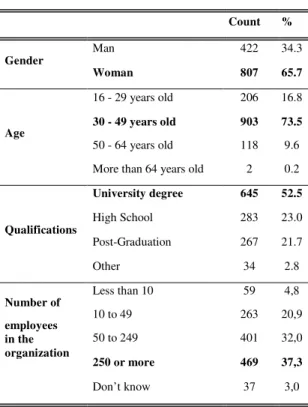
A total of 1,305 respondents completed the questionnaire, of which 76 were excluded, 54 because they declared not to have an e-mail account assigned by the organization and the others for not confirming the existence of e-mail in their organization. Thus, 1,229 respondents were analyzed, mostly women from 30 to 49 years old. As can be seen in Table I, the majority of the respondents have a university degree (diploma or bachelor degree) and most work for organizations with 250 employees or more.
With regard to age, the distribution of our respondents is similar to that of the Fallows’ study, since most respondents also belong to the age group from 30 to 49 years old. The sample is also comparable in qualifications – in both cases most respondents have a university degree. So, it can be said that although ours was not a statistically representative sample of the population, the study´s respondents are suitable study elements of the population: they have an age distribution similar to that of the employed population in Portugal (Instituto Nacional de Estatística [INE], 2011), and a level of education higher than the average of the Portuguese population, indicating a higher sensitivity and preparation to answer questions related to the use of e-mail.
TABLE I. SAMPLE DESCRIPTION
Count %
Gender
Man 422 34.3
Woman 807 65.7
Age
16 - 29 years old 206 16.8
30 - 49 years old 903 73.5
50 - 64 years old 118 9.6
More than 64 years old 2 0.2
Qualifications
University degree 645 52.5
High School 283 23.0
Post-Graduation 267 21.7
Other 34 2.8
Number of
employees in the organization
Less than 10 59 4,8
10 to 49 263 20,9
50 to 249 401 32,0
250 or more 469 37,3
4.2 E-mail management
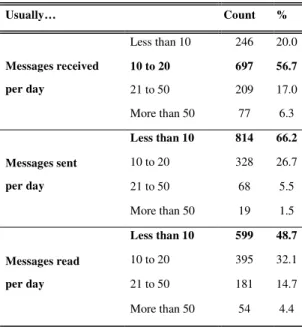
Regarding the number of messages received, sent and read daily (Table II), it is worth noting that the number of incoming messages exceeds the number of messages sent and read. The justification for this difference may be related to the fact that some of the messages received are spam, so they need not to be read or answered. In the study by Fallows (2002) this phenomenon was also revealed, that is, also in the U.S. in 2002 the number of messages received exceeded the number of messages sent.
TABLE II. E-MAIL RECEIVED, SENT AND READ
Usually… Count %
Messages received
per day
Less than 10 246 20.0
10 to 20 697 56.7
21 to 50 209 17.0
More than 50 77 6.3
Messages sent
per day
Less than 10 814 66.2
10 to 20 328 26.7
21 to 50 68 5.5
More than 50 19 1.5
Messages read
per day
Less than 10 599 48.7
10 to 20 395 32.1
21 to 50 181 14.7
More than 50 54 4.4
In relation to time consumed with e-mail daily, 54.2% of respondents spend approximately 15 minutes per day with e-mail, 30.7% approximately 1 hour, 7.2% approximately 2 hours, and 7.9% over 2 hours. In the study by Fallows (2002), 50% of American workers reported spending less than 1 hour daily with e-mail and 23% only 15 minutes. Comparing these figures with those of our study, we can say that, on average, Portuguese respondents spend less time than Americans with e-mail. This difference can be explained by the fact that the levels of digital literacy are different in the two countries – it is normal that in countries like the United States, where there is a higher percentage of "knowledge workers", the time devoted to e-mail is higher than in other countries.
TABLE III. NUMBER AND AGE OF MESSAGES AND NUMBER OF FOLDERS
Count %
Number of messages in the Inbox folder
Less than 10 213 17.3
10 to 50 303 24.7
51 to 100 134 10.9
More than 100 579 47.1
Number of
e-mail folders
Less than 5 289 23.5
5 to 20 772 62.9
21 to 50 111 9.0
More than 50 57 4.6
Oldest message in the Inbox
1 month 465 37.8
6 month 171 13.9
More than 6 months 202 16.4
Since the beginning 391 31.8
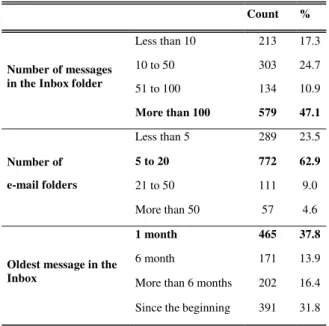
The data show that 47.1% of respondents have more than 100 messages in the "Inbox" folder, a situation which reveals that most respondents do not have habits and / or knowledge for managing and archiving e-mail messages. This conclusion is supported by the fact that, as previously mentioned, 76.7% of respondents receive only up to 20 e-mail messages per day (see Table II). According to Whittaker & Sidner (1996), one of the major problems in the management of e-mail messages lies in knowing which of the existing folders is most suitable for storing a message, or, failing that, how to label a new folder to store it, so to make the process to access previously saved messages easy, fast and intuitive. This problem may actually be the reason why the respondents do not "clean up" their inbox.
Most participants in this study (62.9%) have created between 5 and 20 folders in their e-mail software. These numbers seem to conflict with the fact that most of the respondents have more than 50 messages in the "Inbox". That is, the creation of multiple folders should allow easy filing of messages, thereby avoiding its accumulation in the inbox. This contradiction may be explained by the fact that the "classification" of many messages can be difficult to the point that respondents do not move them to their specific folders, which later might hinder a prompt location of the message.
With regard to the oldest e-mail message in the "Inbox", 37.8% of respondents have messages in that folder received in the previous month. According to Whittaker & Sidner (1996), a technique used to keep the e-mail organized is to keep the inbox empty. From the results we can confirm that the behavior of respondents, in this respect, is divided: approximately 32% admit not to "cleaning" the inbox, and approximately 38% report that the messages in their inbox are only a month old or less.
the management of e-mail by the respondents. Whatever the explanation, the potential of e-mail is limited by these users’ practices and organizations should consider solutions for enabling a better management of e-mail by its employees.
The time required to reply to e-mail messages was another question to respondents. To reply on the same day is the option for 56.6% of respondents; 38.6% declared to reply after 1 to 2 days, 4.1% after 3 to 7 days. The answers replying after more than 7 days and not replying via e-mail have residual values – 0.3% each.
The behavior of most respondents agrees with what is referred by Whittaker & Sidner (1996) as a good strategy for managing e-mail, since replying on the same day, when a message is received, avoids duplication of efforts in reading the message and thinking about the response. In this respect American workers are quicker to respond, as Fallows (2002) found that 44% reply immediately and 38% by the end of the day. Another interesting difference lies in the 3% of American workers who never reply to e-mail messages (in our study, only 0.3%). These differences may be explained, as already noted, by the highest percentage of "knowledge workers" in the U.S.
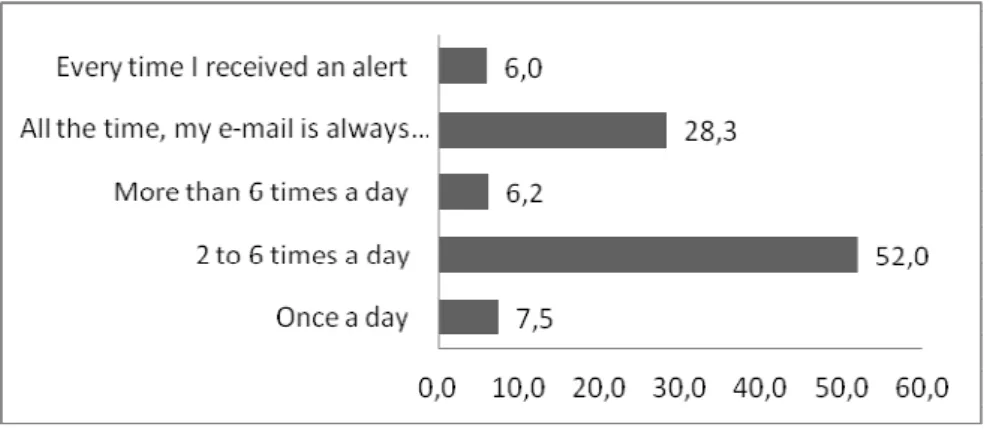
The number of times that respondents check their e-mail during the day was another question to participants. The data show that most respondents, 52.0%, check e-mail 2 to 6 times a day (see Figure 1).
Figure 1. Daily frequency of e-mail checking
Fallows (2002) found that most American workers (88%) check their e-mail at least once a day, and most of them (70%) check it several times a day. Despite the differences in values, we can consider that the verification of e-mail, for Portuguese workers, is not a priority in relation to other activities, since most respondents check the e-mail only 1 to 6 times per day. Still, we highlight the 28.3% of respondents who have the e-mail software always open and the 6.0% who check the mail every time they receive an alert – behaviors criticized as not being the most appropriate (Robbins, 2004). In fact, depending on the responsibilities they have on the organization, this course of action can be viewed as a disruption and hence a loss of productive time.
4.3 E-mail users’ behavior
This section presents the results of 25 questions that sought to characterize the behaviors of the respondents regarding the use of organizational e-mail. The statements, as already mentioned, were presented in a non-organized manner and intended to assess behaviors related to: organization practices (7), private use (7), security and privacy (4) and usage behavior (7).
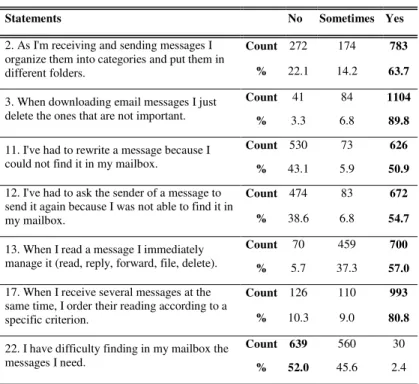
messages, as they do an immediate initial message screening, reading the subject and / or deleting the messages, and a subsequent storage in specific folders. However, some difficulties in classifying messages and their storage into specific folders can also be noted. This conclusion is supported by the answers of the majority of respondents to questions 11, 12 and 22.
TABLE IV. E-MAIL ORGANIZATION PRACTICES
Statements No Sometimes Yes
2. As I'm receiving and sending messages I organize them into categories and put them in different folders.
Count 272 174 783
% 22.1 14.2 63.7
3. When downloading email messages I just delete the ones that are not important.
Count 41 84 1104
% 3.3 6.8 89.8
11. I've had to rewrite a message because I could not find it in my mailbox.
Count 530 73 626
% 43.1 5.9 50.9
12. I've had to ask the sender of a message to send it again because I was not able to find it in my mailbox.
Count 474 83 672
% 38.6 6.8 54.7
13. When I read a message I immediately manage it (read, reply, forward, file, delete).
Count 70 459 700
% 5.7 37.3 57.0
17. When I receive several messages at the same time, I order their reading according to a specific criterion.
Count 126 110 993
% 10.3 9.0 80.8
22. I have difficulty finding in my mailbox the messages I need.
Count 639 560 30
% 52.0 45.6 2.4
TABLE V. PRIVATE USE OF WORK E-MAIL
Statements No Sometimes Yes
4. I give my e-mail address only for business purposes
Count 665 75 489
% 54.1 6.1 39.8
8. I've been warned or reproached at work because of my e-mail use.
Count 1211 7 11
% 98.5 0.6 0.9
9. I've been involved in disciplinary or judicial process because of my e-mail use.
Count 1223 4 2
% 99.5 0.3 0.2
18I forward e-mail messages that promise luck, wealth or other benefits to those who do not break the chain.
Count 1131 74 24
% 92.0 6.0 2.0
19. I forward e-mail messages seeking
philanthropic support with the intention of helping people.
Count 896 230 103
% 72.9 18.7 8.4
20. I forward e-mail messages containing jokes, texts, images, videos or PowerPoint presentations, of varied content to colleagues and friends.
Count 349 734 146
% 28.4 59.7 11.9
23. I exchange e-mail messages about private or family issues.
Count 384 190 655
% 31.2 15.5 53.3
Comparing these results with the study by Fallows (2002) some noteworthy differences can be found: 53% of the American workers indicated that almost all incoming messages were work related and 58% declared that almost all posts they do are work related. These data reveals safer behaviors on the part of American workers, perhaps because of their greater knowledge on the use and management of e-mail in a work context.
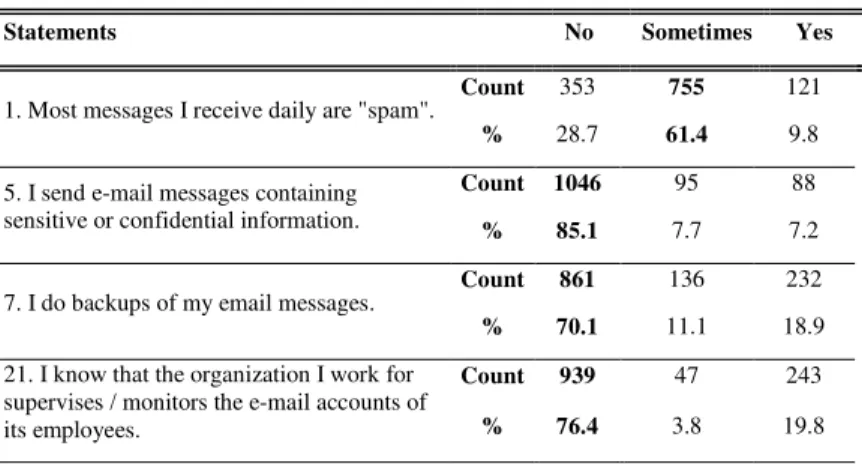
In Table VI we can see the distribution of opinions on the statements related to e-mail security and privacy. The results indicate a slightly dissonant behavior: the majority of respondents do not send e-mail messages with important information, which shows some concern with sensitive data and prevents organizations from being exposed to avoidable risks. However, most respondents do not backup their e-mail folders. While performing backups does not mean full warranty of information, the truth of the matter is that the lack of backups of important information is a major cause of information loss inside organizations.
TABLE VI. E-MAIL SECURITY AND PRIVACY PRACTICES
Statements No Sometimes Yes
1. Most messages I receive daily are "spam". Count 353 755 121 % 28.7 61.4 9.8
5. I send e-mail messages containing sensitive or confidential information.
Count 1046 95 88
% 85.1 7.7 7.2
7. I do backups of my email messages. Count 861 136 232
% 70.1 11.1 18.9
21. I know that the organization I work for supervises / monitors the e-mail accounts of its employees.
Count 939 47 243
Still on the theme of security and privacy, it is worth noting that the majority of respondents had no knowledge about enforcement or monitoring actions on their e-mail accounts implemented by their organizations. Equally significant is the fact that most respondents "sometimes" receive "spam" messages, which show some weaknesses in the organizations´ e-mail security systems, namely the absence of an adequate system for filtering external e-mail messages.
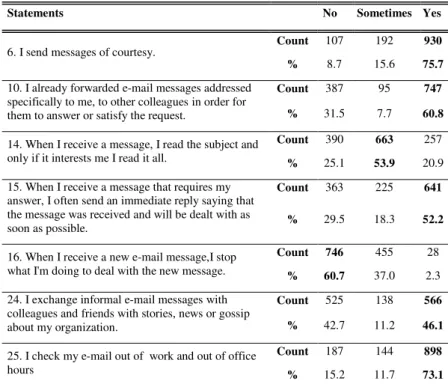
Table VII summarizes the results concerning the statements related to e-mail usage behaviors.
TABLE VII. E-MAIL USAGE BEHAVIORS
Statements No Sometimes Yes
6. I send messages of courtesy. Count 107 192 930 % 8.7 15.6 75.7
10. I already forwarded e-mail messages addressed specifically to me, to other colleagues in order for them to answer or satisfy the request.
Count 387 95 747
% 31.5 7.7 60.8
14. When I receive a message, I read the subject and only if it interests me I read it all.
Count 390 663 257
% 25.1 53.9 20.9
15. When I receive a message that requires my answer, I often send an immediate reply saying that the message was received and will be dealt with as soon as possible.
Count 363 225 641
% 29.5 18.3 52.2
16. When I receive a new e-mail message,I stop what I'm doing to deal with the new message.
Count 746 455 28
% 60.7 37.0 2.3
24. I exchange informal e-mail messages with colleagues and friends with stories, news or gossip about my organization.
Count 525 138 566
% 42.7 11.2 46.1
25. I check my e-mail out of work and out of office hours
Count 187 144 898
% 15.2 11.7 73.1
The analysis of the results in the previous table allows us to identify some problematic behaviors (Weber, 2004):
•The majority of respondents send courtesy messages and, when they receive messages that require an answer, they have a habit of immediately replying to acknowledge message reception and inform about a reply as soon as possible. Weber (2004) recognizes these behaviors as indicative of a lack of knowledge about the costs associated with sending and receiving e-mail messages, and of an impulsive attitude that disregards reading, understanding and developing appropriate answers to e-mails, in favor of speed of response. This type of messages, in a context of a large influx of information, can become excessive and disruptive.
•There is a high percentage of respondents who admitted checking e-mail out of work. With some exceptions, this behavior can also be considered problematic and is defined by Weber (2004) as "an obsessive feeling with e-mail", that happens when users are no longer able to "turn off" from the e-mail and live dependent on it. However, this behavior may be acceptable, depending on the users´ function and position in the organization.
organization. This is a somewhat controversial topic because, although this exchange of information could be both personal and work related, it is always informal messages that are exchanged with some personal interest in mind or to meet the needs of social coexistence. These behaviors can either help or hinder the organization’s goals; hence, they cannot neglect this informal communication among its employees. This negative feature of e-mail is also mentioned in Fallows’ (2002) research.
It should also be noted that the majority of respondents says that when they receive a new e-mail message they do not interrupt what they are doing to deal with it. This behavior is regarded as a good e-mail usage practice (Robbins, 2004), in that, with few exceptions, the e-mail management should not be a priority over other work-related tasks.
5. CONCLUSIONS
There are not many known studies and theories on e-mail management and usage in the work context. In functional terms, the benefits of this communication tool rise from the fact that it allows for distance information exchange. The speed, low cost, simplicity, convenience, organization, usability and ability to attach information and share it simultaneously with different people are known advantages of electronic mail (Greenberg & Baron, 1997; Monteiro, 1997; Rego, 2007; Silva, 2008; Turban, McLean, & Wetherbe, 2004; Vaz, 2006).
The study´s results presented on this paper allow highlighting various aspects of the way e-mail is used in the work context. Electronic mail is as important as any other means of communication such as fax, paper mail, phone, etc., consequently the same attention should be given to it. Therefore, users must read it regularly and decide what to do with the messages (delete, archive and / or reply).
Most respondents demonstrate behaviors considered as the most appropriate for the proper management of e-mail: delete unimportant posts immediately after downloading them; order the reading of messages according to some criteria; after reading decide immediately what to do with the messages; respond to requests by e-mail on the same day; and organize incoming read messages by categories, moving them into different folders.
However, respondents also demonstrate difficulty organizing their work e-mail messages. Most respondents declared that they do not backup e-mail messages and, although they created 5 to 20 folders to store e-mail messages, they sometimes find it difficult to locate the messages they need. Most participants assume that they already had to rewrite or ask the sender to forward messages because they could not find a specific post in the mailbox. Therefore, it can be concluded that most users have difficulty finding or accessing their e-mail messages.
messages in the "Inbox", which confirms the conclusion that respondents have some difficulty classifying messages and / or store them in the right folders.
Time spent with e-mail can influence either positively or negatively the organization’s results. On the one hand, e-mail decreases the time required for information flow; on the other hand, e-mail also increases the volume of available information that has to be considered by the organization’s employees. In our study most respondents declared to spend only about 15 minutes a day dealing with e-mail. This fact, coupled with the circumstance that only a small percentage of respondents spends more than an hour a day handling e-mail, seems to indicate that, in most cases, the time used with e-mail does not constitute a threat to the completion of other work tasks. This conclusion is corroborated by the evidence that the majority of respondents declare not to interrupt other activities to deal with new incoming messages, and check the e-mail only 1 to 6 times a day.
In what regards sending and receiving messages containing confidential information or legal or contractual implications, most respondents demonstrate behaviors considered as the most suitable: they do not automatically redirect chain e-mail messages, do not send e-e-mail messages containing sensitive or confidential information; and do not forward philanthropic request messages. However, most admit that sometimes they forward messages containing jokes, images, video or graphical presentations of varied content, to colleagues or friends, and most admit that they disclose their work e-mail address for private purposes and that they exchange e-mail messages containing private issues.
To know e-mail users´ behavior is important both to achieve excellent results in organizations (as stated by Weber, 2004), and to identify external threats. It is therefore crucial that all parties involved, organizations and employees alike, are aware of the risks they face when using this communication tool. The appropriate e-mail usage practices should be explicitly defined, otherwise the organization´s results might be negatively and definitively affected.
The results of this study indicate – in line with the conclusions of Fallows (2002) – that despite the management and use of e-mail in the work context do not seem to constitute a threat to the productivity, security and privacy of organizations, in most cases there is room for improvement and for actions that might enhance the usefulness of this tool. Specifically, most users have some difficulty organizing the information received through this medium and a significant proportion of them still has behaviors that may put at risk the organization’s safety and privacy. These problems must be taken into account by organizations because without any intervention and with the anticipated increase in the use of e-mail in work contexts, they can become a real threat for many organizations.
REFERENCES
Belloti, V., Ducheneaut, N., Howard, M., Smith, I. & Grinter, R. E. (2005). Quality versus Quantity: E-mail centric task management and its relation with overload. Human Computer Interaction, 20, 80-138.
Fallows, D. (2002). Email at Work. (P. I. Project, Ed.) Retrived from: http://www.pewinternet.org/~/media//Files/Reports/2002/PIP_Work_Email_Report.pdf. pdf
Figallo, C., & Rhine, N. (2002). Building the knowledge management network: Best practices, tools, and techniques for putting conversation to work. Wiley.
Freeman, C., & Louca, F. (1999). As times goes by: From the industrial revolutions to the information revolution. Oxford University Press.
Greenberg, J., & Baron, A. R. (1997). Behavior in Organizations (6th edition). Prentice-Hall.
Gupta, Y. P., Karimi, J., & Somers, T. M. (2000). Study on the usage of computer and communication technologies for telecommuting. IEEE Transactions on Engineering Management, 47, 26-39.
Hogg, C. (2000). Internet and E-mail Use and Abuse. Short Run, Exeter. Holtz, S. (1999). Public Relations on the net. New York: Amacom.
Ingham, J. (2003). E-mail overload in the UK workplace. Aslib Proceedings, 55, 166-180.
INE (2011). Resultados do Inquérito ao Emprego relativos ao 1º trimestre de 2011 com
a adopção da nova metodologia. Retrieved from:
http://www.ine.pt/xportal/xmain?xpid=INE&xpgid=ine_destaques&DESTAQUESdest_ boui=107450480&DESTAQUESmodo=2
ITIJ (2008). Normas de Utilização do Correio Electrónico. Retrieved from: http://trib.no.sapo.pt/descargas/Normas_email.pdf
Jackson, T., Dawson, R., & Wilson, D. (2003). Understanding e-mail interaction increases organizational productivity. Communications of the ACM, 48, 80-84.
Landauer, T. (1995). The trouble with computers: usefulness, tsabiluty and productivity. Cambridge, MA: MIT Press.
Lewis, D. (1999). Information overload: Practical strategies for surviving in today’s workplace. Penguin Books.
Lucas, W. (1998). Effects of e-mail on the organization. European Management Journal, 16, 18-29.
Mano, R. S., & Mesch, G. S. (2010). E-mail characteristics, work performance and distress. Computers in Human Beavior, 26, 61-69.
Monteiro, M. (1997). A Internet nas Instituições de Ensino Superior. Biblioteca da Universidade Fernando Pessoa.
Rego, A. (2007). Comunicação Pessoal e Organizacional - Teoria e Prática (1ª edição). Lisboa: Edições Sílabo.
Robbins, S. (2004). Harvard Business School Working Knowledge. Retrived from: http://hbswk.hbs.edu/archive/4438.html
Romm, C., & Pliskin, N. (1999). The office tyrant – Social control through e-mail.
Information Technology & People, 12, 27-43.
Silva, L. M. (2008). E-mail: Guia Prático do correio-electrónico com Gmail, Microsoft Outlook e Windows Mail (1ª edição). Lisboa: Centro Altântico.
Sousa, S. (2005). Tecnologias de Informação – O que são? Para que servem? (5.ª ed.).
FCA – Editora de Informática.
Sproull, L., & Kiesler, S. (1991). Connetion: New ways of working in the networked organization. Cambridge, MA: MIT Press.
Storey, J., & Quintas, P. (2001). Knowledge management and HRM. Human resource management: A critical text. Thomson Learning (339-363).
Taylor, H., Fieldman, G., & Altman, Y. (2008). E-mail at work: A cause for concern? The implications of the new communication technologies for health, wellbeing and productivity at work. Journal of Organizational Transformation and Social Change, 5, 159-173.
Turban, E., McLean, E., & Wetherbe, J. C. (2004). Tecnologia da Informação para Gestão - Transformando os Negócios na Economia Digital (3ª edição). Bookman Companhia Editora.
Vaz, I. (2006). Utilizar a Internet Depressa & Bem- 9ª edição Actualizada e Aumentada. Lisboa: FCA Editora Informática.
Weber, R. (2004). Editor's Comments - The Grim Reaper: The Curse of E-Mail. MIS Quarterly, 28, iii-xiii.
Weick, K. (1995). Sense making in organizations. Thousands Oaks, CA: Sage.
Whittaker, S., & Sidner, C. (1996). Email overload: exploring personal information management of email". Conference on Human Factors and Computing Systems, (276-283). Vancouver, BC.