Factors associated with packed red blood cell
transfusions in premature infants in an intensive
care unit
Fatores associados à transfusão de concentrado de hemácias em
prematuros de uma unidade de terapia intensiva
INTRODUCTION
Anemia occurs frequently in premature infants, which makes this population prone to transfusion treatments.(1) Packed red blood cells are the most frequently administered blood products to newborns, and these transfusions are generally necessary in two situations: 1) to guarantee adequate tissue oxygenation during intensive care treatment and 2) to treat signiicantly symptomatic anemia.(2)
he repercussions of transfusions and the adoption of policies to reduce blood transfusions have become enormous challenges because more premature newborns survive anemia.(1) Preterm infants with gestational ages <30 weeks, birth weights <1,000 g, or severe infectious diseases are candidates for blood transfusions.(3)
Several reasons may underlie the occurrence of anemia in premature infants. The time to cut the umbilical cord in the delivery room determines the newborn’s hematocrit. Delays in the clamping of the umbilical cord increases the blood volume shortly after birth, which improves
Brunnella Alcantara Chagas de Freitas1,2, Sylvia
do Carmo Castro Franceschini2
1. Department of Medicine and Nursing, Universidade Federal de Viçosa - UFV - Viçosa (MG), Brazil.
2. Department of Nutrition and Health, Universidade Federal de Viçosa - UFV - Viçosa (MG), Brazil.
ABSTRACT
Objective: his study analyzed the factors that are associated with the need for packed red blood cell transfusions in premature infants in a neonatal intensive care unit.
Methods: his study is a cross-sectional study of secondary data from premature infants who were admitted to a neonatal intensive care unit between 2008 and 2010. Premature infants with low birth weight were included. Packed red blood cell transfusion was the dependent variable. Pearson’s Chi-square or Fisher’s exact tests were used for data analysis, and the median, minimum, and maximum values were calculated. Prevalence ratios were calculated using the Poisson regression and Pearson correlation coeicient. Linear regression analyses were performed. P < 0.05 was considered to be signiicant.
Results: We examined 254 premature infants, and 39.4% of this sample received packed red blood cells. Transfusions were 70% less prevalent in premature infants who were born at ≥32 weeks of gestation, and 191% more prevalent in infants who exhibited late-onset neonatal sepsis. he number of transfusions per patient was negatively correlated with gestational age and positively correlated with late-onset neonatal sepsis. A gestational age <32 weeks and late-onset neonatal sepsis explained 45% of the transfusions (p<0.0001).
Conclusions: Premature infants with a gestational age <32 weeks and who developed late-onset neonatal sepsis exhibited a greater need for packed red blood cell transfusions.
Keywords: Infant, premature; Erythrocyte transfusion; Intensive care, neonatal; Sepsis
This study was conducted at the Department of Nutrition and Health and in the Department of Medicine and Nursing, Universidade Federal de Viçosa -UFV - Viçosa (MG), Brazil.
Conflicts of Interest: None. Submitted on June 24, 2012 Accepted on August 13, 2012
Corresponding author:
Brunnella Alcantara Chagas de Freitas Departamento de Medicina e Enfermagem, Universidade Federal de Viçosa
hematological indices.(4,5) Other factors that exacerbate anemia include blood loss due to bleeding or blood collection, reduced red blood cell production due to nutritional deficits, inflammation, low erythropoietin levels, and increased hemolysis.(6,7)
he risk-beneit ratio for transfusion treatment in premature infants is actively being investigated. Transfusions remain an important intervention, despite a recent trend to decrease transfusion use.(8)
Restrictive hemoglobin (Hb) limits and/or low hematocrit thresholds decreases the number of transfusions in premature infants.(8-11)
his study evaluated the factors that are associated with the need for packed red blood cell transfusions in premature infants in a neonatal intensive care unit.
METHODS
We conducted a cross-sectional study of secondary data from premature infants who were admitted to a neonatal intensive care unit (NICU) at Hospital São Sebastião (HSS) in Viçosa (state of Minas Gerais, Brazil) from January 1, 2008 to December 31, 2010. he data were obtained from medical records using a semi-structured form that was created for the study. he Human Research Ethics Committee of the Universidade Federal de Viçosa (UFV) approved the study (protocol number 063/2011/ CEPH), and no consent was required.
Viçosa is a Brazilian city with an estimated population of 72,244 inhabitants. HSS is a referral hospital for high-risk pregnancy care, and its NICU opened in 2004. he NICU cares for patients from the hospital and the micro- and macro-regions of Viçosa. he NICU has served a total of 1,059 patients, including 70% of premature infants, as of December 2010.
All premature infant patients with low birth weight were included. Packed red blood cell transfusion was the dependent variable and consisted of two categories: “yes” and “no.” he number of transfusions performed was also recorded.
A volume of 15 mL/kg bodyweight for each transfusion is routinely used in the NICU. Hb values and the patient’s clinical case are also analyzed. Generally, a premature infant is transfused if any of the following conditions are observed: a) hypovolemic shock associated with acute blood loss; b) hematocrit levels between 30 and 35% or Hb concentrations between 10 and 12 g/dL while using oxygen at a concentration greater than 35% or in nasal CPAP (continuous airway positive pressure)
with mechanical ventilation and an average airway
pressure ≥6 cmH2O in which transfusions will improve tissue oxygenation; c) hematocrit between 20 and 30% or Hb between 6 and 10 g/dL using CPAP mechanical ventilation with an average airway pressure <6 cmH2O or required for surgery; d) hematocrit <20% or Hb <6 g/ dL; e) in the presence of frequent apnea requiring bag-valve-mask ventilation, symptomatic anemia (with <10 g/ kg weight gain per day, full caloric intake and tachycardia of >180 beats per minute for more than 24 hours) and lethargy; f ) if undergoing surgery.(1,11,12)
We deined gestational age (GA) as the best estimate from early gestation ultrasound (<20 weeks), the date of the mother’s last period, obstetric observance and clinical exam using the New Ballard method.(13-15) GA was analyzed as a quantitative and qualitative variable, which was divided into two groups at 32 weeks. Birth weight (BW) was divided into two groups using 1,500 g as a cutof value.(16,17)
Late-onset sepsis was deined as occurring after the irst 48 hours of life according to the NICU criteria used during the study period and recommended by the National Health Surveillance Agency (Agência Nacional de Vigilância Sanitária - ANVISA).(18,19) Clinical sepsis was deined as the presence of at least one of the clinical criteria (e.g., apnea, bradycardia, thermal instability, food intolerance, worsening respiratory discomfort, glucose intolerance, hemodynamic instability, or hypoactivity/lethargy) associated with all of the following criteria: a) complete blood counts with alterations in ≥ three parameters and/or changed C-reactive protein; b) blood culture not performed or negative; c) absence of evidence of infection at another site; and d) antimicrobial therapy that was initiated by the attending doctor.(19) Bacteriologically conirmed sepsis was deined as a positive blood culture from a single blood collection of at least 1 mL.(20)
Other analyzed variables were categorized as “yes” or “no”: Cesarean birth, birth at another institution, Apgar <7 at 5 minutes of life, small for gestational age (SGA, where BW is less than the 10 percentile on the Lubchenco curve),(21) restricted intrauterine growth (RIG, which is deined as a decreased fetal growth rate documented by at least two fetal growth measurements that is not a synonym of SGA),(22-24) multiple birth, pulmonary hemorrhage, bronchopulmonary dysplasia (BPD),(25,26) persistence of the arterial canal (PAC),(25) severe peri-intraventricular
hemorrhage (PIVH, grade III or IV),(27) late-onset
Statistical analysis
he sample size was calculated in Stat Calc from Epi-Info 7.0 using a prevalence of 50%, a conidence interval of 95% (95% CI), and a sampling error of 5%. A total of 253 patients were required for the present study.
he Kolmogorov-Smirnov test was performed, and we calculated the medians and maximum and minimum values for the quantitative values. Only BW was normally distributed. We used the Pearson’s Chi-square or Fisher’s exact test for qualitative variables. Bivariate analyses between the dependent and independent variables were performed using the prevalence ratios (PR) that were calculated via Poisson regression as a measurement of efect.(30) Variables with a p-value <0.20 were included in the multivariate analysis, and variables with a p-value <0.05 were maintained in the inal model. he Pearson correlation coeicient was calculated, and we performed simple and multivariate linear regressions between the variables that remained in the inal Poisson regression model and the dependent variable. P <0.05 was considered signiicant. We used the Statistical Package for the Social Sciences (SPSS) version 17.0 and Stata version 9.0 programs for all analyses.
RESULTS
A total of 502 patients were admitted to the studied unit from 2008-2010. A 12% loss was observed because the patient records could not be found. herefore, the study population included 254 premature infants with low BW, and 100 (39.4%) of these patients required at least one packed red blood cell transfusion.
he study population exhibited a median BW of 1,490 g (520-2,490 g), GA of 32.1 weeks (23.0-36.5 weeks), and a 5-minute Apgar of 9.0 (2.0-10.0). Patients received a median of 5.0 days (0.5-73 days) of mechanical ventilation and spent 19.0 days (0.5-119.0 days) in the hospital. hirty-nine patients (15.3%) died, and 41% (n=16) of these patients required at least one packed red blood cell transfusion, which was not diferent between groups (p=0.818). Survivors spent a median of 22.0 days (5.0-119.0 days) in the hospital and exhibited a corrected age of 35.6 weeks (29.6-47.1 weeks) at discharge.
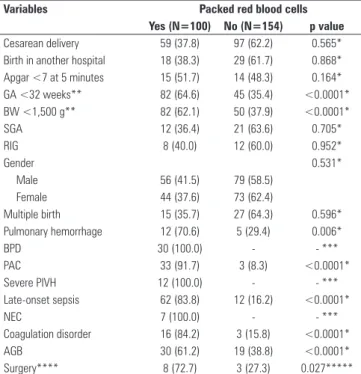
he dependent variable, “packed red blood cell transfusion”, was analyzed using several characteristics of the premature infants. Cesarean birth, Apgar <7 at 5 minutes, birth in another hospital, SGA, RIG, gender, and multiple births were not diferent between patients who received packed red blood cell transfusions and patients who did not receive transfusions (p>0.05). However, “GA <32 weeks”, “BW <1,500 g”, “PAC”, “late-onset sepsis”,
“coagulation disorder”, and “AGB” signiicantly afected the studied outcome (p<0.05). All premature infants with BPD, severe PIVH, and NEC received transfusions. hese data are presented in table 1.
Table 1 - Characteristics of the premature infants by need for packed red blood cell transfusions
Variables Packed red blood cells Yes (N=100) No (N=154) p value
Cesarean delivery 59 (37.8) 97 (62.2) 0.565*
Birth in another hospital 18 (38.3) 29 (61.7) 0.868*
Apgar <7 at 5 minutes 15 (51.7) 14 (48.3) 0.164*
GA <32 weeks** 82 (64.6) 45 (35.4) <0.0001*
BW <1,500 g** 82 (62.1) 50 (37.9) <0.0001*
SGA 12 (36.4) 21 (63.6) 0.705*
RIG 8 (40.0) 12 (60.0) 0.952*
Gender 0.531*
Male 56 (41.5) 79 (58.5)
Female 44 (37.6) 73 (62.4)
Multiple birth 15 (35.7) 27 (64.3) 0.596*
Pulmonary hemorrhage 12 (70.6) 5 (29.4) 0.006*
BPD 30 (100.0) - - ***
PAC 33 (91.7) 3 (8.3) <0.0001*
Severe PIVH 12 (100.0) - - ***
Late-onset sepsis 62 (83.8) 12 (16.2) <0.0001*
NEC 7 (100.0) - - ***
Coagulation disorder 16 (84.2) 3 (15.8) <0.0001*
AGB 30 (61.2) 19 (38.8) <0.0001*
Surgery**** 8 (72.7) 3 (27.3) 0.027*****
GA - gestational age, BW - birth weight, SGA - small gestational age, RIG - restricted intrauterine growth, BPD - broncopulmonary dysplasia, PAC - persistence of the arterial canal, Severe PIVH - severe peri-intraventricular hemorrhage (grade III or IV), NEC - necrotizing enterocolitis, AGB - acute gastrointestinal bleeding. The results are expressed as number of patients (percentage). Percentage refers to the total of valid responses, not including absent data. * P-value from the Pearson Chi-square test, ** GA <32 weeks and BW<1,500 g were set as cutoffs, *** not calculated due a frequency of zero in two groups, ****surgical procedures were performed on 11 patients. Eight of these 11 patients received packed red blood cell transfusions, laparotomy (N=4), hepatic biopsy (N=1), ventricular puncture (N=1), tracheotomy (N=1), inguinal hernia repair (N=1). The other patients underwent chest drainage, ***** p value from the Fisher’s exact test.
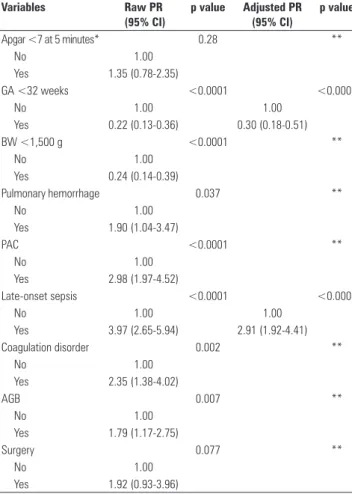
Multivariate analysis of variables with a p <0.20 was performed (Table 2). GA <32 weeks and late-onset neonatal sepsis remained signiicant (p<0.05). Packed red blood cell transfusions were 70% less prevalent in premature infants who were older than ≥32 weeks and 191% more prevalent in premature infants with late-onset neonatal sepsis.
A median of 2.0 transfusions per patient was observed in the study population (1.0-8.0). he number of packed red blood cell doses per patient for the “GA <32 weeks” and “late-onset neonatal sepsis” variables was analyzed.
We calculated the Pearson correlation coeicient between the number of transfusions and the “AG” and “late-onset neonatal sepsis” Variables. AG was negatively correlated with the number of transfusions (r=-0.5162; p<0.0001), and late-onset sepsis was positively correlated (r=0.5779; p<0.0001). Simple linear regression for these variables conirmed a functional relationship for AG (R2= 0.266; β=-0.516; p <0.0001) and late-onset neonatal sepsis (R2=0.334; β=0.577; p <0.0001).
he “AG” and “late-onset neonatal sepsis” variables remained signiicant after multivariate linear regression (both p <0.0001), and these variables explained 45% of the number of transfusions performed (R2=0.453) (Table 3).
DISCUSSION
he present study demonstrated that a higher number of packed red blood cell transfusions were performed in premature infants with a GA <32 weeks and with late-onset neonatal sepsis. Freitas et al.(31) recently observed that the highest occurrence of late-onset sepsis was correlated with younger gestational ages. Anemia is multifactorial in severe infections due to the inhibition of erythropoiesis, hemolysis and blood loss.(32) Several cytokines, such as interleukin 6 (IL-6) and tumor necrosis factor-alpha (TNFα), are present in sepsis and NEC during inlammation, and these cytokines cooperatively inhibit erythropoiesis.(33) hese premature infants are more likely to require packed red blood cell transfusions.(32) herefore, the identiication of risk factors and the implementation of strategies to reduce late-onset sepsis, including hand washing, nutrition, skin care, respiratory treatment, and vascular access, are required.(31,34,35)
All of the premature infants that developed BPD, severe PIVH, and NEC received transfusions, despite exclusion from the regression model. his result may be explained by the young gestational ages at these morbidities occur and the increased clinical severity due to inlammation and blood loss.(32,33) he association between severe sickness and the need for transfusion has been described previously. Premature infants with gestational ages <30 weeks and birth weights <1,000 g who have contracted a severe infectious disease are blood transfusion candidates.(3,32)
he regression model only explained 45% of the performed transfusions, but anemia in premature infants is exacerbated by several factors, including blood loss due to bleeding or blood collections, reduced red blood cell production due to nutritional deicits, inlammation, or low erythropoietin levels, and increased hemolysis.(6)
he rapid somatic growth of premature infants and consequent increase in blood volume, the lower blood cell half-life, blood loss, and low endogenous erythropoietin levels contribute to anemia. herefore, premature infants more rapidly reach lower hematocrit levels than term infants. However, blood transfusions in neonates using adult blood cells favors tissue oxygenation, which prevents erythropoietin stimulation.(1)
Blood loss for laboratory test collections is especially important because the transfused blood volume is directly proportional to the volume collected.
Low-Table 2 - Bivariate and multivariate analyses between the variables included in the model for the outcome of packed red blood cell transfusion
Variables Raw PR (95% CI)
p value Adjusted PR (95% CI)
p value
Apgar <7 at 5 minutes* 0.28 **
No 1.00
Yes 1.35 (0.78-2.35)
GA <32 weeks <0.0001 <0.0001
No 1.00 1.00
Yes 0.22 (0.13-0.36) 0.30 (0.18-0.51)
BW <1,500 g <0.0001 **
No 1.00
Yes 0.24 (0.14-0.39)
Pulmonary hemorrhage 0.037 **
No 1.00
Yes 1.90 (1.04-3.47)
PAC <0.0001 **
No 1.00
Yes 2.98 (1.97-4.52)
Late-onset sepsis <0.0001 <0.0001
No 1.00 1.00
Yes 3.97 (2.65-5.94) 2.91 (1.92-4.41)
Coagulation disorder 0.002 **
No 1.00
Yes 2.35 (1.38-4.02)
AGB 0.007 **
No 1.00
Yes 1.79 (1.17-2.75)
Surgery 0.077 **
No 1.00
Yes 1.92 (0.93-3.96)
PR - prevalence ratio, 95% CI - 95% confidence interval, GA - gestational age, BW - birth weight, PAC - persistent arterial canal, AGB - acute gastrointestinal bleeding. * Not included in the multivariate analysis due to a p-value >0.20, ** variables that were not maintained in the multivariate model.
Table 3 - Multivariate linear regression analysis between the number of packed blood cell doses and the “gestational age” and “late-onset sepsis variables”
Variables Coefficient β Coefficient B p value
Gestational age -0.365 -0.181 <0.0001
Late-onset sepsis 0.457 1.577 <0.0001
volume protocols efectively reduce blood loss-induced anemia. Laboratory tracking of anemia using micro-hematocrit requires a lower volume of blood for analysis, and it is an efective measurement.(1,5,7)
A delay in the clamping of the umbilical cord in premature infants who do not require resuscitation in the delivery room and the maintenance of iron stores may decrease the need for red blood cell transfusions.(4,34) he data in the present study were analyzed prior to the successful implementation of the aforementioned practices in our hospital in 2011. A meta-analysis by Rabe et al.(35) demonstrated that delayed clamping lowered the number of transfusions, which support a change in obstetric practices.(36)
A meta-analysis by Ohlsson and Aher(37) revealed that the early administration of recombinant erythropoietin reduces the need for red blood cell transfusions, but these small reductions are of limited clinical importance. However, a signiicant increase in the incidence of retinopathy of prematurity (ROP) was observed. hese authors concluded that the limited beneits of recombinant erythropoietin, the increased risk for ROP, and the lack of evidence supporting its role as a neuroprotector preclude the recommendation of this treatment.
Several studies have evaluated the most restrictive transfusion practices.(10) Venâncio et al. demonstrated a reduced need for transfusions in premature infants with very low birth weights.(9) Kirpalani et al.(38) evaluated premature infants with a gestational age less than 31 weeks and very low birth weight and demonstrated a small reduction in the number of transfusions in the group with more restrictive practices compared to the more liberal practices without altering death or survival outcomes for BPD, severe retinopathy or cerebral lesions.
Transfusions remain an important intervention to save the lives of neonatal patients.(8) However, the use of only Hb and/or hematocrit levels is insuicient, and clinical criteria, such as apnea, tachycardia, insuicient weight gain, need for oxygen supplementation, lethargy, and several comorbidities (BPD and cardiac dysfunction), should also be examined.(11,36)
Many uncertainties exist regarding the long-term outcomes of transfusions,(9,10,39) but recent studies of premature infants at school age and during adolescence have demonstrated reduced cerebral volume and worse psychomotor performance in infants who received more liberal transfusions (i.e., with higher hematocrit levels).(40,41)
he limitations of this study include its cross-sectional and retrospective nature, which prohibits the establishment of causal relationships and only allows the study of correlations. Retrospective studies are susceptible to information biases. he absence of data on the volume of blood collected for tests and the time of cord clamping is also limiting. Actions to reduce the correlation between anemia in prematurity and other factors, such as strategies for control of infections, measures to reduce blood loss, well-established criteria to indicate transfusions, and delayed clamping of the umbilical cord in premature infants that do not require resuscitation in the delivery room, should be promoted and evaluated.
CONCLUSIONS
Premature infants with a GA <32 weeks who develop late-onset neonatal sepsis exhibited the greatest need for packed red blood cell transfusions.
RESUMO
Objetivo: Analisar os fatores associados à necessidade de transfusões de concentrados de hemácias em prematuros de uma unidade de terapia intensiva neonatal.
Métodos: Estudo transversal de dados secundários de pre-maturos admitidos em unidade de terapia intensiva neonatal entre 2008 e 2010. Foram incluídos prematuros com baixo peso ao nascimento. A transfusão de concentrado de hemá-cias foi considerada a variável dependente. Empregaram-se os testes do qui-quadrado de Pearson ou exato de Fisher, e calcularam-se as medianas e os valores mínimos e máximos. Calcularam-se razões de prevalências pela regressão de Poisson e o coeiciente de correlação de Pearson. Realizaram-se análises de regressão linear. Considerou-se signiicante p<0,05.
Resultados: Estudaram-se 254 prematuros e 39,4% rece-beram concentrado de hemácias. As transfusões foram 70% menos prevalentes entre os prematuros com idades gestacio-nais ≥32 semanas e 191% mais prevalentes naqueles acome-tidos por sepse neonatal tardia. O número de transfusões por paciente apresentou correlação negativa com a idade cional e positiva com a sepse neonatal tardia. A idade gesta-cional <32 semanas e a sepse neonatal tardia explicaram 45% das transfusões realizadas (p<0,0001).
Conclusões: Os prematuros com idade gestacional <32 semanas e os que evoluíram com sepse neonatal tardia apre-sentaram maior necessidade de transfusões de concentrados de hemácias.
REFERENCES
1. Valete CO, Barbosa AD. Atualização sobre transfusão sanguínea e a anemia do prematuro. Pediatria (São Paulo). 2010;32(1):37-42.
2. Murray NA, Roberts IA. Neonatal transfusion practice. Arch Dis Child Fetal Neonatal Ed. 2004;89(2):F101-7.
3. Zuppa AA, Mazzotta M, Maragliano G, Girlando P, Florio MG, Tortorolo G. [Anemia of prematurity: risk factors influencing red cell transfusions]. Minerva Pediatr. 1995;47(1-2):13-8. Italian.
4. McDonald SJ, Middleton P. Effect of timing of umbilical cord clamping of term infants on maternal and neonatal outcomes. Cochrane Database Syst Rev. 2008;(2):CD004074.
5. Chopard MR, Magalhães M, Bruniera P. Deficiência de ferro no feto e no recém-nascido. Rev Bras Hematol Hemoter. 2010;32(Suppl 2):32-7. 6. McLellan SA, McClelland DB, Walsh TS. Anaemia and red blood cell
transfusion in the critically ill patient. Blood Rev. 2003;17(4):195-208. 7. Brasil. Ministério da Saúde. Secretaria de Atenção à Saúde. Departamento
de Ações Programáticas e Estratégicas. Atenção à saúde do recém-nascido: guia para os profissionais de saúde. Brasília: Ministério da Saúde; 2011. (Série A. Normas e Manuais Técnicas).
8. Nunes dos Santos AM, Trindade CEP. Red blood cell transfusions in the neonate. Neoreviews. 2011;12(1):e13-9.
9. Venâncio JP, Santos AM, Guinsburg R, Peres Cde A, Shinzato AR, Lora MI. Strict guideline reduces the need for RBC transfusions in premature infants. J Trop Pediatr. 2007;53(2):78-82.
10. Morley SL. Red blood cell transfusions in acute paediatrics. Arch Dis Child Educ Pract Ed. 2009;94(3):65-73. Review.
11. Red blood cell transfusions in newborn infants: Revised guidelines. Paediatr Child Health. 2002;7(8):553-66.
12. Shannon KM, Keith JF 3rd, Mentzer WC, Ehrenkranz RA, Brown MS, Widness JA, et al. Recombinant human erythropoietin stimulates erythropoiesis and reduces erythrocyte transfusions in very low birth weight preterm infants. Pediatrics. 1995;95(1):1-8.
13. Rego MA, França E, Rausch MC, organizadoras. Manual de orientações para comitês de prevenção do óbito fetal e infantil. Belo Horizonte: Secretaria de Estado de Saúde; 2004. [citado 2011 Set 21]; Disponível em: http://200.198.43.10:8080/ses/politicas_de_saude/viva-vida/comites/ Manual%20de%20Orientacoes%20para%20Comites%20de%20 Prevencao%20do%20Obito%20Fetal%20e%20Infantil.pdf
14. Rego MA, Franca EB, Travassos AP, Barros FC. Assessment of the profile of births and deaths in a referral hospital. J Pediatr (Rio J). 2010;86(4):295-302.
15. Ballard JL, Khoury JC, Wedig K, Wang l, Eilers-Walsman BL, Lipp R. New Ballard Score, expanded to include extremely premature infants. J Pediatr. 1991;119(3):417-23.
16. Minas Gerais. Secretaria de Estado da Saúde. Assistência hospitalar ao neonato. 2a ed. Belo Horizonte: Secretaria de Estado da Saúde; 2008. 17. Behrman RE, Butler AS, editors. Preterm birth: causes, consequences,
and prevention. Washington, D.C.: The National Academies Press; 2007. Available from: http://www.nap.edu/catalog/11622.html.
18. Pessoa-Silva CL, Richtmann R, Calil R, Santos RM, Costa ML, Frota AC, et al. Healthcare-associated infections among neonates in Brazil. Infect Control Hosp Epidemiol. 2004;25(9):772-7.
19. Agência Nacional de Vigilância Sanitária - ANVISA. Neonatologia: critérios nacionais de Infecção relacionadas à assistência à saúde. Brasília (DF): ANVISA; 2008.
20. Sarkar S, Bhagat I, DeCristofaro JD, Wiswell TE, Spitzer AR. A study of the role of multiple site blood cultures in the evaluation of neonatal sepsis. J Perinatol. 2006;26(1):18-22.
21. Lubchenco LO, Hansman C, Dressler M, Boyd E. Intrauterine growth as estimated from liveborn birth-weight data at 24 to 42 weeks of gestation. Pediatrics. 1963;32:793-800.
22. Silveira RC, Procianoy RS. Crescimento nos primeiros anos de vida de recém-nascidos de muito baixo peso. In: Procianoy RS, Leone CR. Programa de Atualização em Neonatologia - PRORN. Porto Alegre: Artmed; 2003. p. 160.
23. Thureen PJ. The neonatologist’s dilemma: catch-up growth or beneficial undernutrition in very low birth weight infants-what are optimal growth rates? J Pediatr Gastroenterol Nutr. 2007;45 Suppl 3:S152-4. Erratum in J Pediatr Gastroenterol Nutr. 2009;48(1):121-2.
24. Moreira ME, Méio MD, Morsch DS. Crescimento e neurodesenvolvimento a médio e longo prazos do recém-nascido com crescimento intrauterino restrito. In: Programa de Atualização em Neonatologia - PRORN. Porto Alegre: Artmed; 2010. p. 9-37.
25. Minas Gerais. Secretaria de Estado da Saúde. Assistência hospitalar ao neonato. 2a ed. Belo Horizonte: Secretaria de Estado da Saúde; 2005. 26. Fanaroff AA, Hack M, Walsh MC. The NICHD neonatal research network:
changes in practice and outcomes during the first 15 years. Semin Perinatol. 2003;27(4):281-7.
27. Papile LA, Burstein J, Burstein R, Koffler H. Incidence and evolution of subependymal and intraventricular hemorrhage: a study of infants with birth weights less than 1,500 gm. J Pediatr. 1978;92(4):529-34. 28. Bell MJ. Neonatal necrotizing enterocolitis. N Engl J Med. 1978;298(5):281-2. 29. Kliegman RM, Walsh MC. Neonatal necrotizing enterocolitis:
pathogenesis, classification, and spectrum of illness. Curr Probl Pediatr. 1987;17(4):213-88.
30. Barros AJ, Hirakata VN. Alternatives for logistic regression in cross-sectional studies: an empirical comparison of models that directly estimate the prevalence ratio. BMC Med Res Methodol. 2003;3:21. 31. Freitas BA, Peloso M, Manella LD, Franceschini SC, Longo GZ, Gomes AP,
et al. Sepse tardia em pré-termos de uma unidade de terapia intensiva neonatal: análise de três anos. Rev Bras Ter Intensiva. 2012;24(1):79-85. 32. Kling PJ, Hutter JJ. Hematologic abnormalities in severe neonatal
necrotizing enterocolitis: 25 years later. J Perinatol. 2003;23(7):523-30. 33. Brown MS, Keith JF 3rd. Comparison between two and five doses a
week of recombinant human erythropoietin for anemia of prematurity: a randomized trial. Pediatrics. 1999;104(2 Pt 1):210-5.
34. Venâncio SI, Levy RB, Saldiva SR, Mondini L, Alves MC, Leung SL. Efeitos do clampeamento tardio do cordão umbilical sobre os níveis de hemoglobina e ferritina em lactentes aos três meses de vida. Cad Saúde Pública. 2008;24 Suppl 2:S323-31.
35. Rabe H, Reynolds G, Diaz-Rossello J. Early versus delayed umbilical cord clamping in preterm infants. Cochrane Database Syst Rev. 2004;(4):CD003248.
36. Luban NL. Management of anemia in the newborn. Early Hum Dev. 2008;84(8):493-8.
37. Ohlsson A, Aher SM. Early erythropoietin for preventing red blood cell transfusion in preterm and/or low birth weight infants. Cochrane Database Syst Rev. 2006;(3):CD004863.
38. Kirpalani H, Whyte RK, Andersen C, Asztalos EV, Heddle N, Blajchman MA, et al. The Premature Infants in Need of Transfusion (PINT) study: a randomized, controlled trial of a restrictive (low) versus liberal (high) transfusion threshold for extremely low birth weight infants. J Pediatr. 2006;149(3):301-7.
39. Crowley M, Kirpalani H. A rational approach to red blood cell transfusion in the neonatal ICU. Curr Opin Pediatr. 2010;22(2):151-7
40. McCoy TE, Conrad AL, Richman LC, Lindgren SD, Nopoulos PC, Bell EF. Neurocognitive profiles of preterm infants randomly assigned to lower or higher hematocrit thresholds for transfusion. Child Neuropsychol. 2011;17(4):347-67.