Rev Bras M ed Esporte _ Vol. 12, Nº 5 – Set/Out , 2006
215e
1. Professor Titular. Disciplina de M edicina do Esporte. Universidade doRio Grande do Sul, Porto Alegre, RS.
2. Pesquisador. Serviço de Traumatologia. Hospital de Clínicas de Porto Alegre. Universidade do Rio Grande do Sul, Porto Alegre, RS. 3. M estre em Endocrinologia. Serviço de Endocrinologia. Hospital de
Clí-nicas de Porto Alegre. Universidade do Rio Grande do Sul, RS. 4. Doutorando da Faculdade de M edicina. Universidade Luterana do
Bra-sil, Canoas, RS.
Received in 7 / 5 / 06. Final version received in 3 / 8 / 06. Approved in 24 / 8 / 06. Correspondence to: Eduardo Henrique De Rose, Rua Felipe Becker, 95 – Bairro Três Figueiras – 91330-250 – Porto Alegre, RS. E-mail: ehderose@ terra.com.br
Referred use of medication and dietary supplements
in athletes selected for doping control in the
South-American Games
Eduardo Henrique De Rose1, M arta Goldman Feder2, Paulo Rodrigo Pedroso3 and André Zanette Guimarães4
O
RIGINALA
RTICLEKeyw ords: Games. Athletes. Use of medication. Dietary supplements. Doping.
ENGLISH VERSION
ABSTRACT
The objective of the present study w as to describe the preva-lence of medicine and dietary supplements use in athlete w ho par-ticipated in the mandatory doping controls of the VII South Ameri-can Sports Games, w hich took place in four Brazilian cities. One issue considering the doping control and relative to substances used in the days that preceded the competition w as statistically analyzed. The authors analyzed data collected from 234 athletes of 25 sports participating in the Games, being these athletes 136 males and 98 females, distributed among the 13 participating countries. According to the questionnaire conducted in the doping control, 44% athletes informed some substances used up to three days before the competition. The medications w ere classified into non-steroidal anti inflammatory (NSAI) (24.8% ), analgesics (15.9% ), antibiotics (4.3% ), cold medicine (3% ) and other medicines (19.3% ). M oreover, 50% of athletes reported the use of dietetic supple-ments, being this group divided into vitamins (39.7% ), minerals (21.9% ), amino acids (18.9% ) and other substances (13.3% ). The authors concluded that there w as an overuse of antiinflammatory and analgesic medication in many sports modalities, w hich raises a concern in terms of control of symptoms of the athletes in com-petitions. Besides that, there w as an important use of dietary sup-plements w ithout specific indication. Such fact may cause an even-t ual adverse analyeven-t ical f inding in even-t he coneven-t rol of doping by contamination or manipulation.
INTRODUCTION
The South-American Sports Games began in 1978, in La Paz, Bolivia and their seventh edition w as held in Brazil, in the cities of Curitiba, São Paulo, Rio de Janeiro and Belém do Pará. In this event, the anti-doping control of athletes w as conducted by the M edical Commission of the South-American Sports Organization (ODES-UR), according to recommendation by the Antidoping International Code of the World Antidoping Agency (WADA)(1), randomly
select-ed among the participant athletes. One of the topics answ erselect-ed by the athletes during this procedure, according to the Brazilian Olym-pic Committee standards (COB)(2), w as concerning the used
med-ication in the last three days. The analysis of this topic enabled the elaboration of the present study.
The information included in the Doping Control Form w as ana-lyzed concerning medication and dietary supplements in order to evaluate the use profile of the main South-American athletes present in this competition. The know ledge of this reality allow s us to obtain an idea about w hich needs the athletes may have and w hich benefits they aim to reach.
The national literature simply mentions a few studies of this nature. Barros Neto(3) called attention to the excessive use of
phar-macological ergogenic agents, w hich completely clashes w ith the athletes’ nutritional needs and the evidence published in the litera-ture. In a guideline by the Brazilian Society of Sports M edicine about this topic, Carvalho et al.(4) describe the excessive use of dietary
supplements in our country, w ithout medical prescription and w ith health risks.
In the international panorama, several authors observed the high use of supplements by the athletes, not advising such procedure (5-7). Analyzing the use of this kind of product by high level athletes,
Burke(8) calls attention to the possibility of adverse analytical
re-sults occurrence in the doping control, due to the lack of quality control and eventual deficiencies on the label of these products. He also mentions that this fact exclusively occurs by athletes’ er-ror and in that case, the sports directors should not forgive them. Specifically in international sports events, and as consequence of the WADA recommendation(9), studies w ere conducted w ith
con-trolled athletes in the Sidney Olympic Games and later published by Corrigan and Kazlauskas(10). A research w as ordered by the
In-ternational Olympic Committee (COI) due to the high percentage of supplements used by the athletes in these Olympic Games. It w as conducted w ith 634 dietary supplements from 13 different countries in the Institute of Biochemistry of Colony, by Geyer et al.(11), using the same technique previously proposed by this
au-thor(12). His aim w as to verify the presence or not of pro-hormones
(especially testosterone and nandrolone) w hich could cause ad-verse analytical results in the antidoping control. It is w orth men-tioning that a study previous to the Sydney’s, despite not being published, had already been conducted in our continent by D’An-gelo(13) in the Pan-American Games in M ar del Plata, Argentina, in
1995.
The use of supplements, as evidenced in previous reference(9),
may cause adverse analytical result in the doping control due to eventual contamination of these products, once their producers do not have to completely declare their composition. M oreover, they do not follow in their majority the ideal techniques for produc-tion of substances in laboratory, internaproduc-tionally know n as “ Good M anufacturing Practices” (GM P).
M AIN OBJECTIVE
216e
Rev Bras M ed Esporte _ Vol. 12, Nº 5 – Set/Out, 2006Brazilian cities through analysis of the answ er to the topic: used medication in the last three days.
M ATERIAL AND M ETHOD
The data collected in 242 doping controls performed in 234 ath-letes from 25 sports, w ith a total of 33 modalities participant in the VII South-American Games w ere analyzed. These athletes w ere divided in 136 male participants and 98 female ones, distributed among the 13 participant countries, being 11 from South America (Argentina, Bolivia, Brazil, Chile, Ecuador, Guiana, Paraguay, Peru, Suriname, Uruguay and Venezuela), 1 from Central America (Pana-ma) and 1 from the Dutch Caribbean (Aruba).
The sample consisted of athletes selected among the partici-pants, being composed by individual or team gold, silver and bronze medalists. Athletes w ho w ere randomly selected through a raffle or delegation on the behalf of the competition’s technical deputy participated as w ell.
The data collection w as conducted by a group of Brazilian spe-cialists in doping control, trained w ithin the international standards proposed by the WADA, and the Doping Control Forms filled out w ith information demanded from the selected athletes. Such form consists of three copies: the first one goes to the Games Organi-zation Committee; the second, w ith no athlete’s identification, goes to the Doping Control Laboratory; and the third one is handed to the athlete.
The data bank of this study w as built through the typing of the answ er to the topic: previous medication on the original form, and an electronic spread sheet w hich divided the athletes in sex, coun-try, medication and dietary supplements w as devised.
The medication w as divided in the follow ing five categories: non-steroid anti-inflammatories (NSAIs), analgesics, antibiotics, cold medicine and others. In this last item all the range of medication that w as only scarcely mentioned w as included, such as oral con-traceptives and laxatives. In order to correctly classify the medica-tion of the pharmaceuticals from the remaining participant coun-tries, specialists in Sports M edicine from these places w ere consulted.
The dietary supplements w ere divided in four follow ing catego-ries: vitamins, minerals, amino acids and others. In this last cate-gory w ere basically considered the isotonics and carbon hydrates. In the tw o divisions the substances w ere most frequently found in the previous studies by Corrigan et al.(10) and D’Angelo et al.(13).
This data bank w as submitted to statistical analysis by SPSS in its 11 version and the M icrosoft Excel. The results w ere demon-strated through descriptive statistics in frequencies and percent-ages.
RESULTS
The distribution of the athletes w ho w ere part of this sample is presented as follow ing: 63,63% w ere gold medalists, 23,13% w ere silver medalists, 7,85 w ere bronze medalists and 13,22% w ere randomly chosen This distribution is presented in figure 1.
It w as confirmed that in the 234 athletes from several coun-tries, 95 (44% ) different kinds of medication w ere taken immedi-ately before or at the moment of the competition. These kinds w ere classified as follow ing: 58 (24,8% ) of NSAIs, 37 (15,9% ) of analgesics, 10 (4,3% ) of antibiotics, 7 (3% ) of cold medication and 45 (19,3) of other medication. Figure 2 show s the percentage dis-tribution in the medication group proposed by the authors.
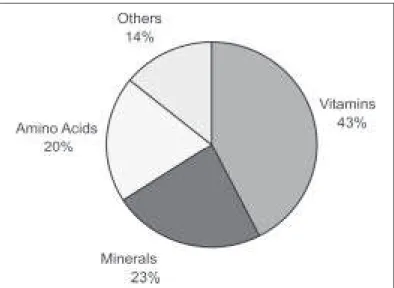
Use of dietary supplements w as reported in 117 athletes, (50% ) of the studied sample. Reportedly, in this group 93 (39.7% ) took vitamins, 51 (21,9% ) took minerals, 44 (18,9% ) took amino acids and 31 (13,3% ) other substances. Figure 3 show s the percentage distribution in the supplements group proposed by the authors.
Figure 1 – Distribution of doping controls in the participant athletes
Figure 2 – Percentage distribution for medication in the sample
Figure 3 – Percentage distribution for supplements in the sample
Rev Bras M ed Esporte _ Vol. 12, Nº 5 – Set/Out , 2006
217e
DISCUSSION
The authors chose the category classification according to the description in materials and methods once they understand that in each of the groups (medication and supplements), the subdivisions reflect the athlete’s consumption reality.
The most w idely used medication kinds w ere the ones from the NSAIs class, expressing a tendency observed in medical practice, w hich is the need of lesions treatment derived from training for competition. The analgesics class w as the second most w idely used and corroborates the previous explanation.
The concern lies on the fact that should there be a need of use of this medication, medically prescribed or self-medicated, there should also concomitantly be a lesion/suffering condition for the athlete w hen competing. One should question w hether this fact occurs by training excess; by the w ay the training is performed; by physiological w eakness situations; or by other variables w hich could be altered, determining higher use of these examples of medica-tion. It is important to highlight that the sample mainly consists of athletes w inners in their competitions, w hich implies a high de-gree of performance.
The most used dietary supplements w ere the vitamins, follow ed by minerals, expressing as w ell a culture of high consumption, once there is no specific literature indicating the use of these substanc-es.
The authors believe that the indiscriminated use of supplements, also show n in previous studies, may cause in the future an increase of adverse analytical results in the doping control, through the ath-lete’s misinformation on the product he/she is taking. Unfortunate-ly, since the product’s origin may be unclear, there is not
preven-tion in terms of intenpreven-tional manipulapreven-tion or industrial contamina-tions in the processing of these substances. It is know n that some companies produce several kinds of products w ithout ideal stan-dardized technical regulations for the production of these substanc-es in their laboratorisubstanc-es.
It is possible that the athlete omits some information concern-ing medication effectively used in the data collected by the dopconcern-ing control specialist. Due to this fact, the use of pharmaceutics and supplements may occasionally be higher than the mentioned, w hich w e certainly consider as one of the limitations of the present arti-cle, once the athletes do not have to inform all the truth at the control moment.
CONCLUSION
The authors conclude that there is an exaggerated use of anti-inflammatories and analgesics in several sports modalities, distrib-uted in several South-American countries, due to the concern in terms of symptomatology control of the athletes in competitions. The excessive use of dietary supplements does not present indi-cation in the literature and may lead to an eventual adverse analyt-ical result in the doping control.
The results reflect a behavior pattern similar to the ones verified in other studies conducted by several authors in international com-petitions in w hich high level athletes participated.
All the authors declared there is not any potential conflict of inter-ests regarding this article.
1. WADA-AM A. World Anti-Doping Code (Version 3). M ontreal: WADA, 2003. 2. De Rose EH, Feder M G, Bento RM , Aquino Neto FR. Informações sobre o uso
de medicamentos no esporte. 4ª ed. Rio de Janeiro: COB, 2004.
3. Barros Neto TL. A controvérsia dos agentes ergogênicos: estamos subestiman-do os efeitos naturais da atividade física? Arq Bras Ensubestiman-docrinol M etab. 2001; 45(2):121-2.
4. Carvalho T, Rodrigues T, M eyer F, Lancha Jr AH, De Rose EH. M odificações dietéticas, reposição hídrica, suplementos alimentares e drogas: comprovação de ação ergogênica e potenciais riscos para a saúde. Rev Bras M ed Esporte. 2003; 8(2):43-56.
5. Sobal J, M arquart LF. Vitamin / mineral supplements use among athletes: a re-view of the literature. Int J Sport Nutr. 1994;4:320-4.
6. Rosen O, Sudgat-Borgen J, M aehlum S. Supplement use and nutritional habits in Norw egian elite athletes. Scand J M ed Sci Sports. 1999;9:28-35.
REFERENCES
7. Burke LM , Read RSD. Dietary supplements in sport. Sports M ed. 1993;15:43-65.
8. Burke LM . Positive drug test from supplements. Sports Sci. 2000;4(3):1-5. 9. WADA-AM A. Independent observers report Olympic Summer Games 2000.
M ontreal: WADA, 2001.
10. Corrigan B, Kazlauskas R. M edication use in athletes selected for doping control at the Sydney Olympics (2000). Clin J Sport M ed. 2003;13(1): 33-40. 11. Geyer H, Parr M K, M areck-Engelke U, Schrader Y, Schänzer W. Analysis of
non-hormonal nutritional supplements for anabolic-androgenic steroids – Results of an international study. Int J Sports M ed. 2004;25:124-9.
12. Geyer H, Henze M K, M areck-Engelke U, Wagner A, Schänzer W. Positive dop-ingfälle mit Norandrosteron durch verunreinigte Nahrungsergänzungsmittel. Dtsch Z Sportmed. 2000;51,11:378-82.