DOI: 10.1590/0004-282X20160084
CLINICAL SCALES, CRITERIA AND TOOLS
Translation and cross cultural adaptation of
the Pediatric Motor Activity Log-Revised scale
Tradução e adaptação transcultural da escala
Pediatric Motor Activity Log-Revised
Gabriela da Silva Matuti1, Juliana Firmo dos Santos1, Ana Carolina Rodrigues da Silva1,2, Rafael Eras-Garcia1,
Gitendra Uswatte3,4, Edward Taub3,4
Cerebral palsy (CP) describes a group of disorders of move-ment and posture that are attributed to a non-progressive disor-der in the immature brain and often limit functional activities1.
Children with spastic hemiplegia, which is one type of CP,
can experience diiculty in using the afected upper limb (AUL)
– the limb contralateral to the lesion – because of poor selec-tive motor control, muscle weakness, a stereotyped posture, and
sensory deicits. hese diiculties make attempts to use the AUL
less frequent, and favor compensatory strategies in which the
unafected limb is used to perform functional activities. his can
culminate in a cycle that results in decreased cortical
representa-tion of the afected segment because of disuse, thus developing
the phenomenon known as “learned nonuse”2.
Traditionally, the functionality of the AUL has been evalu -ated by observing motor performance during tests conducted
in the clinic. However, the use of the AUL in this context of
-ten fails to relect how the child actually performs in the real
world3,4. he relationship between performance assessed by
tests in the clinic environment and the spontaneous use of the
AUL outside the therapeutic setting has not been established.
Clinic-based tests do not take into consideration the
phenom-enon of learned nonuse, and therefore the efects of rehabilita -tion on everyday func-tion are not properly evaluated3,4.
A standardized instrument developed speciically to evalu
-ate the function and spontaneous use of the AUL in children aged 2–8 years with CP is the Pediatric Motor Activity Log
1 Associação de Assistência à Criança Deiciente (AACD), Grupo de Pesquisa em Terapia de Contensão Induzida (TCI), São Paulo SP, Brasil; 2 Universidade Federal de São Paulo, Ciências da Saúde, São Paulo SP, Brasil;
3 University of Alabama at Birmingham, Constraint Induced Therapy (CIT) Research Group, Alabama, USA; 4 University of Alabama at Birmingham, Psychology Department, Alabama, USA.
Correspondence: Gabriela da Silva Matuti; Rua Lourdes Lopes Sanches, 300; 07190-033 Guarulhos SP, Brasil; E-mail: [email protected]
Conflict of interest: There is no conlict of interest to declare.
Received 02 October 2015; Received in inal form 18 December 2015; Accepted 16 May 2016.
ABSTRACT
The standardized instrument developed to assess the use of the affected upper limb in children with cerebral palsy (CP) is the Pediatric Motor Activity Log Revised (PMAL-R). Objectives: To translate PMAL-R and adapt for the Brazilian culture; analyze the reliability and the internal consistency of the Brazilian version. Method: Translation of PMAL-R to the Portuguese-Brazil and back translation. The back-translated version was revised by the authors of the scale. The inal version was administered to a sample of 24 patients with spastic hemiparesis CP between 2–8 years. Results: The reliability intra and inter-rater were suitable (how often = 0.97 and 0.98, how well = 0.98 and 0.99 respectively) and so the internal consistency (0.98). Conclusion: The Brazilian version of PMAL-R has adequate internal consistency, reliability intra and inter raters and can be used to assess the spontaneous use of the upper limb of children with CP type spastic hemiparesis, aged 2–8 years.
Keywords: cerebral palsy; upper extremity; activities of daily living; evaluation.
RESUMO
A Pediatric Motor Activity Log-Revised (PMAL-R) é um instrumento padronizado desenvolvido para avaliar o uso do membro superior afetado em crianças com paralisia cerebral (PC). Objetivos: Traduzir a PMAL-R e fazer sua adaptação transcultural para o Português do Brasil; analisar a coniabilidade e a consistência interna da versão brasileira. Métodos: Tradução e retrotradução da PMAL-R. A versão retrotraduzida foi revista pelos autores da escala; a versão inal foi administrada a uma amostra de 24 pacientes com PC do tipo hemiparesia espástica entre 2–8 anos. Resultados:
Adequada coniabilidade intra e inter-avaliadores (frequência = 0,97 e 0,98, qualidade = 0,98 e 0,99, respectivamente), assim como a consistência interna (0,98). Conclusão: A versão brasileira da PMAL-R apresenta consistência interna e coniabilidade intra e inter examinadores adequadas, sendo válida para avaliar o uso espontâneo do membro superior de crianças com PC do tipo hemiparesia espástica, com idade entre 2–8 anos.
(PMAL)5,6. Taub and co-workers adapted the PMAL in 2004
from the Motor Activity Log, which was developed for adult
patients who had experienced a stroke.6 he protocol of the
PMAL is the same as for the adult Motor Activity Log, except
for three departures: (1) the point of reference for evaluating
the function of the more-afected arm is the less-afected arm,
rather than the same arm before brain injury; (2) on items that can include a wide variety of tasks, such as Item 17 (“push large
object across loor”), the tester notes the particular activity as
-sessed when administering the test for the irst time, and asks about that speciic activity on subsequent administrations;
and (3) the primary caregivers of the child being treated are questioned, rather than the patient him/herself7.
he PMAL is administered as a structured interview that
is completed by the child’s parents or caregivers. Respondents
rate “how often” (HO) and “how well” (HW) the AUL is moved in 22 diferent activities. Both subscales range from 0 to 5: on the HO subscale, 0 = no use, 1 = too rarely, 2 = rarely, 3 = sometimes, 4 = often, and 5 = normal; and on the HW sub
-scale, 0 = no use, 1 = very poor, 2 = poor, 3 = moderate, 4 = almost normal, and 5 = normal.7 he PMAL is an important tool for
evaluating children with CP because the functional activities
re-lect the neurologic and psychomotor acquisitions expected for
the age group, and the tool contains a variety of bimanual, uni-manual, basic, and instrumental activities that are performed in the real world (i.e., outside the therapeutic setting)7.
In 2012, Uswatte et al. analyzed the test–retest reliabil
-ity and convergent valid-ity of a revised version of the PMAL, the PMAL-R, in children with CP with upper-extremity hemi
-paresis. he study examined a sample of 60 children aged 2–8 years old, and the PMAL-R showed good test–retest reliability (r = 0.89) and internal consistency (Cronbach’s alpha = 0.93), with convergent validation supported by a strong correlation between the PMAL-Rand spontaneous use of the AUL on the Pediatric Arm Function Test (r[53] = 0.5, p < 0.01). herefore, the PMAL-R is a suitable test for this population7.
here are no instruments developed or adapted for Brazilian Portuguese to assess the function and spontane
-ous use of the AUL outside the therapeutic environment for children with spastic hemiparesis. herefore, the purposes
of this study were to translate and cross-culturally adapt the
PMAL-R, and to analyze the reliability and internal consis
-tency of this Brazilian Portuguese adaptation.
METHOD
he study design was submitted to and approved by the Ethics Commission of the Associação de Assistência à Criança Deiciente, São Paulo, Brazil (authorization no. 14182118).
Participants were recruited according to the following in-clusion and exin-clusion criteria.
Inclusion criteria were: (1) a diagnosis of CP with spas-tic hemiparesis; (2) ages 2–8 years; (3) presence of an active
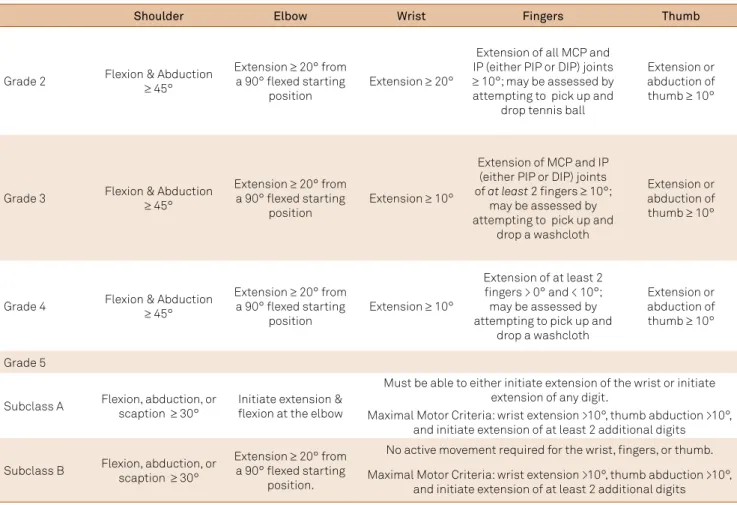
range of motion of the AUL, according to the grade table
(Table 1)8; (4) parent or caregiver with adequate cognition
(able to understand a numeric score) and who could com-plete the questionnaire on two separate occasions; and (5) parent or caregiver agreement and signed consent. Data were excluded if the parent or caregiver did not complete the ques-tionnaire on two occasions.
Translation of the instrument
he PMAL-R was translated into Brazilian Portuguese
by two bilingual translators whose native language was Portuguese. Translations were performed independently
to obtain a more appropriate translated version9,10. he re
-searchers then analyzed the two translated versions and
the original English version and participated in a
compara-tive discussion in order to obtain a single, inal version in the Portuguese language (version consensus, Version 1 [V1]).
V1 was back-translated by two further qualiied transla -tors, whose original language was English (the language of the original instrument) and who had no prior knowledge of
the intent or concepts of the material. he back-translators performed this process independently. he back-translations
were then subjected to a comparative analysis among the re-searchers regarding the two back-translated versions and the
original, to obtain a single, inal version in English language (version consensus, Version 2 [V2]).
V2 was sent to the original authors of the PMAL-R for cor
-rection. he authors did not change any items in this version,
but made some suggestions on how to apply one item
(point-ing a igure – the authors recommended that it was in a book).
Semantic analysis by a judging committee
According to Pasquali, the aim of this step is to assess
whether the terms used in the items are understandable, and whether they are suitable for the population under evalua-tion with respect to the motor activities performed by this
age group11. To this end, two groups were selected: 15
judg-es from a low stratum (i.e., people from the ield of physi
-cal rehabilitation who were unaware of the PMAL-R) and
15 from a high stratum (i.e., people in the ield of pediatric
physical rehabilitation with prior knowledge of the original
PMAL-R)11. Items that were understood by fewer than 80% of
participants (( U
U + NU X100) (where U is the number of items
that were understandable by the lower stratum and NU is the
number of items that were not understandable) were
candi-dates for cross-cultural adaptation. he lower stratum, in this
case, represented the target population (i.e., parents or
care-givers) with no knowledge of the PMAL-R12.
Although the original authors of the PMAL-R were not
asked to correct V1 (i.e., PMAL-R Brazilian Portuguese) it was
Inter- and intra-rater reliability
V1 was submitted for analysis by the committee of
judg-es and changed based on their suggjudg-estions; the inal version was called the PMAL-R Brazil. he PMAL-R was tested in a population of 24 caregivers to analyze its clinimetric proper -ties (intra- and inter-rater reliability, and internal
consisten-cy). he sample size was selected according Terwee and col
-leagues, who suggested that a sample of 4–10 subjects should
be screened for each variable13, and taking into account that
the PMAL-R has two variables (HO and HW).
Each parent or caregiver underwent two identical PMAL-R Brazil interviews conducted by two diferent evaluators (A and B) on the same day, with 40 minutes between each interview. After 7 days, the PMAL-R Brazil was repeated with each care
-giver, with the interview conducted by evaluator A only7,14,15.
Each evaluator had been trained at the University of Alabama at Birmingham (AL, USA) and followed the manual for the original PMAL-R7,15. All participants signed a consent form.
Each caregiver was irst given an introduction regarding
the purpose of the evaluation and instructions on how to
an-swer the questions. he evaluators then asked the caregivers about how often and how well their child used the AUL to perform the tasks listed in the PMAL-R Brazil, with reference
to the previous week.
Statistical analysis
The normality of the data was tested and confirmed
us-ing the Kolmogorov–Smirnov test, and data are presented
as mean ± standard deviation. Descriptive statistical
anal-ysis was used for demographic and clinical characteriza
-tion of the patients. The paired Student t test was used to compare the two dependent samples. The intraclass cor-relation coefficient (ICC) was used to measure reliability,
and is presented with a 95% confidence interval. For the ICC, reliability was characterized as good (score 0.80–1.0), moderate (0.60–0.79), or poor (< 0.60). Cronbach’s al -pha was used to evaluate the internal consistency of the
PMAL-R Brazil. SPSS 19.0 (Chicago, IL, USA) was used for
statistical analysis16,17,18.
RESULTS
he demographic characteristics of the sample (N = 24)
are described in Table 2.
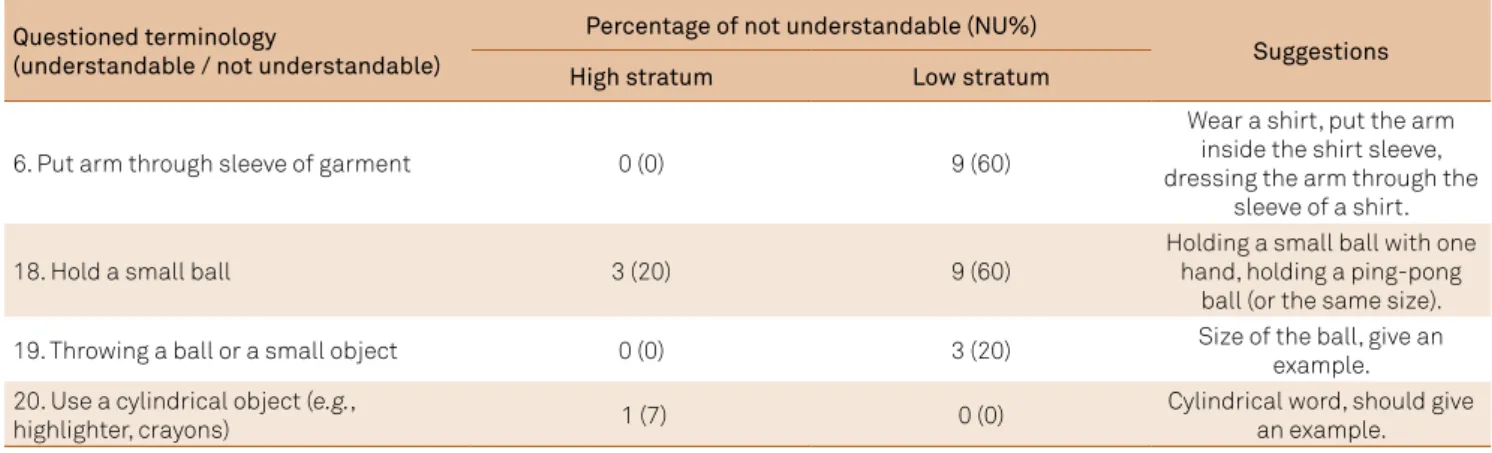
In the semantic analysis, the committee of judges asked
questions about the meaning of four of the items. Although
Item 6 (“passing his arm through the sleeve of a garment”) was understood by all judges in the high stratum, it was not
Table 1. University Alabama at Birmingham (UAB) Constraint Induced Therapy (CIT) Research Group Grade Table – Active Range of Motion.
Shoulder Elbow Wrist Fingers Thumb
Grade 2 Flexion & Abduction ≥ 45°
Extension ≥ 20° from a 90° lexed starting
position
Extension ≥ 20°
Extension of all MCP and IP (either PIP or DIP) joints ≥ 10°; may be assessed by attempting to pick up and
drop tennis ball
Extension or abduction of thumb ≥ 10°
Grade 3 Flexion & Abduction ≥ 45°
Extension ≥ 20° from a 90° lexed starting
position
Extension ≥ 10°
Extension of MCP and IP (either PIP or DIP) joints of at least 2 ingers ≥ 10°;
may be assessed by attempting to pick up and
drop a washcloth
Extension or abduction of thumb ≥ 10°
Grade 4 Flexion & Abduction ≥ 45°
Extension ≥ 20° from a 90° lexed starting
position
Extension ≥ 10°
Extension of at least 2 ingers > 0° and < 10°; may be assessed by attempting to pick up and
drop a washcloth
Extension or abduction of thumb ≥ 10°
Grade 5
Subclass A Flexion, abduction, or scaption ≥ 30° Initiate extension & lexion at the elbow
Must be able to either initiate extension of the wrist or initiate extension of any digit.
Maximal Motor Criteria: wrist extension >10°, thumb abduction >10°, and initiate extension of at least 2 additional digits
Subclass B Flexion, abduction, or scaption ≥ 30°
Extension ≥ 20° from a 90° lexed starting
position.
No active movement required for the wrist, ingers, or thumb.
Maximal Motor Criteria: wrist extension >10°, thumb abduction >10°, and initiate extension of at least 2 additional digits
understood by nine participants in the low stratum. his was
mainly due to the formulation of the question, which was
not speciic about the length of the sleeve (Table 3). hree
participants in the high stratum and nine in the low stratum were confused by Item 18 (“holding a small ball”), in
particu-lar about the size of the ball. For Item 19 (“throwing a ball
or other object”), three participants of the low stratum asked
about the size of the object to be thrown. For Item 20 (“using
a cylindrical object–a pen, pencil, or crayon”), only one par-ticipant, in the high stratum, pointed to the word “cylindri-cal” as a possible generator of doubt, and suggested the use of examples that were already in the question (Table 3).
With regard to the suitability of the items for the age group
being tested, only Item 14 (“Use the arm to move down – drag, crawl”) was scored as not suitable (by ive participants in the high stratum). hey reported that the target population (chil
-dren aged 2–8 years old with hemiparesis) did not realize that
this activity was intended to be ambulatory.
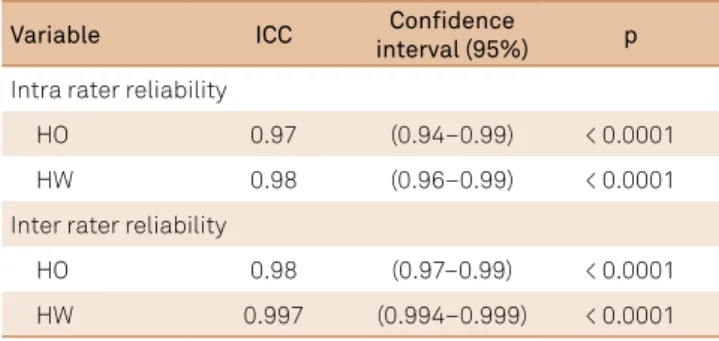
Both intra-rater reliability (with a mean interval of 7 days) and inter-rater reliability were excellent (ICC = 0.97–0.98 and 0.98–0.99, respectively) (Table 4). Internal consistency was
also excellent (Cronbach’s alpha = 0.97 for the HO subscale and 0.98 for the HW subscale).
DISCUSSION
The World Health Organization recommends the
translation and cross-cultural adaptation of existing in-struments of evaluation, because this improves commu-nication between researchers and permits comparison of
data obtained internationally9,12. Furthermore, the use of
validated instruments increases confidence in the
mea-surements obtained9.
When adapting an instrument to a new country or cul-ture, it is important to use a method that maintains equiv-alence between the original and translated versions, while at the same time making any cross-cultural adaptations
re-quired. Furthermore, the psychometric properties of the
adapted instrument must be tested9,12.
he PMAL-R assesses the functional use of the AUL in the
real world, and is conducted via a structured interview using
an evaluation script. his tool has demonstrated good stabil -ity, reliabil-ity, and validity5,7.
In 2013, Rickards et al. conducted a study to iden -tify the relationship between white-matter integrity and
the corticospinal path in AUL function before and after
constraint-induced movement therapy (CIMT) in children with CP with spastic hemiparesis. The authors observed a significant association between fractional anisotropy values of the corticospinal tract and pretreatment spinal motor function, with similar findings in relation to the
PMAL-R. Patients with more lesions in the corticospinal
path (resulting in disruption or dysplasia) showed worse
results on the pretreatment PMAL-R compared with pa
-tients without lesions, indicating that the PMAL-R was
sensitive enough to identify a clinical alteration that
cor-related with structural change19.
Also in 2013, Sterling et al. conducted a piece of research
that aimed to compare demonstrated gains in motor and
Table 2. Demographic characteristics of patients evaluated for reliability study (mean ± standard deviation).
Variable Patients (n = 24)
Age (years) 5.0 ± 1.7
Age (months) 66.2 ± 20.6
Gender n (%)
Male 10 (41.7)
Female 14 (58.3)
Topographic diagnosis
Left 14 (58.3)
Right 10 (41.7)
Motor degrees n (%)
2 12 (50)
3 12 (50)
Table 3. Terminology questions, percentage of non-understandable items and suggestions.
Questioned terminology
(understandable / not understandable)
Percentage of not understandable (NU%)
Suggestions
High stratum Low stratum
6. Put arm through sleeve of garment 0 (0) 9 (60)
Wear a shirt, put the arm inside the shirt sleeve, dressing the arm through the
sleeve of a shirt.
18. Hold a small ball 3 (20) 9 (60)
Holding a small ball with one hand, holding a ping-pong
ball (or the same size).
19. Throwing a ball or a small object 0 (0) 3 (20) Size of the ball, give an
example. 20. Use a cylindrical object (e.g.,
highlighter, crayons) 1 (7) 0 (0)
functional evaluations with changes in brain gray matter
using functional magnetic resonance imaging. he study
showed that brain structural changes were largely
accompa-nied by changes in the spontaneous use of the AUL in real life, as measured with the PMAL-R20.
In the current study, the PMAL-R underwent the trans
-lation steps9 described above. In addition, an analysis of
the linguistic and conceptual equivalence (semantic anal-ysis) of the items was conducted. The conceptual
equiva-lence is analyzed considering the translated term is rel -evant according to the culture in which the instrument is
applied (appropriate or not appropriate). Linguistic equiv -alence (semantics) involves verifying whether the ques-tions have kept the same meaning in the translation as in the original language, as well as ensuring that the words and terminology are clear, and that the sentences can be easily understood11,14.
The semantic analysis tested the language from the
point of view of two different groups (i.e., high and low
strata). The high stratum included rehabilitation profes-sionals with experience in pediatric neurology and who had been trained in the application of the questionnaire in its original English version. The low stratum aimed to verify whether the items would be understood by the tar-get population (parents and/or caregivers), and was com-posed of rehabilitation professionals who had no experi-ence in pediatric neurology and no previous contact with
the PMAL-R.
he analysis determined that of the 22 questions in the PMAL-R Brazil, the terminology of four was questioned by the reviewers. he items selected for change were Item 6
(“passing his arm through the sleeve of a garment”) and Item 18 (“holding a small ball”), because these were
under-stood by only 40% of the low stratum. We changed Item 6 to
“put his arm through the sleeve of a T-shirt” because this
re-lected the motor activity desired in the item; the score was
considered to be normal when the child performed a full el-bow extension to wear the T-shirt.
he terminology of Item 18 was not changed. An ex -ample suggested by the lower stratum and the authors of
the PMAL-R was that the size of the ball should be equal
to a ping-pong ball, with this already exempliied in the question:“Holding a small ball, the size of a ping-pong ball.”
With respect to the suitability of the questions for the age of the patients, only Item 14 (“use the arm to move down – drag, crawl”) was felt to be inadequate. This
question was deemed to be suitable by only 67% of the
high stratum. They reported that the target audience (patients aged 2–8 years with hemiparesis) would not at-tempt this activity because they were already
ambulat-ing. In 2004, Tieman and colleagues analyzed the motor skills of patients with CP using the Gross Motor Function Classification System and found that only 1–2% of indi -viduals in grades I and II (similar to the present study
sam-ple) crawled in the evaluation, because they already walk21.
Therefore, this item was discussed with the original
au-thors of the PMAL-R and replaced with “use the arm to
move on the ground – drag or crawl to grab objects under-neath the furniture.”
Studies of CIMT in children aged 2–8 years have demon -strated that children can acquire new motor programs after such therapy. In younger children (around 2 years), it has been demonstrated that crawling (a motor activity that is unusual for children with hemiparesis) can be acquired af-ter CIMT, and is incorporated into the lives of these patients
both as displacement and to explore the environment22,23.
In the current study, there were no statistical dif-ferences in the mean scores on the two domains of the
PMAL-R Brazil between two interviews conducted with
the same rater on the same day, with two different
ex-aminers. The PMAL-R Brazil also demonstrated excellent
internal consistency.
he function of an individual can be measured using the International Classiication of Functioning, Disability and Health (ICF), which is divided into three areas: body struc
-ture, activity, and participation. he activity domain is sub -divided into a capacity assessment, which shows what the individual can do, and a performance evaluation, which looks at what the individual actually does on a day-to-day basis, at home and in the community. Despite this, most as-sessments for children with CP are limited with respect to the evaluation of performance by being performed in a con-trolled environment; although ability of the child is
mea-sured, this does not relect the performance of the child out -side the therapeutic environment21,24.
he current results suggest that the PMAL-R Brazil can be included in routine AUL assessments of patients with CP. he PMAL-R Brazil is a reliable way to evaluate the performance of these individuals and thus meet the demands of the ICF.
In conclusion, this study has demonstrated the reliability
of the Brazilian version of the PMAL-R. hrough our analysis
of reproducibility and internal consistency, we can conclude
that the PMAL-R Brazil is appropriate for the routine assess
-ment of the AUL of patients with CP with spastic hemiparesis
aged 2–8 years old.
Table 4. Intra e Inter rater reliability.
ICC: intraclass correlation coeficient; p: signiicance level; HO: how often; HW: how well.
Variable ICC Conidence
interval (95%) p
Intra rater reliability
HO 0.97 (0.94–0.99) < 0.0001
HW 0.98 (0.96–0.99) < 0.0001
Inter rater reliability
HO 0.98 (0.97–0.99) < 0.0001
References
1. Rosenbaum P, Paneth N, Leviton A, Goldstein M, Bax M, Damiano D. A report: deinition and classiication of cerebral palsy April 2006. Dev Med Child Neurol. 2006;49(Suppl 109):8-14. doi:10.1111/j.1469-8749.2007.tb12610.x
2. Hoare BJ, Imms C, Rawicki HB, Carey L. Modiied constraint-induced movement therapy or bimanual occupational therapy following injection of Botulinum toxin-A to improve bimanual performance in young children with hemiplegic cerebral palsy: a randomised controlled trial methods paper. BMC Neurol. 2010;10(1):58. doi:10.1186/1471-2377-10-58 3. Saliba VA, Magalhães LC, Faria CDCM, Laurentino GEC, Cassiano JG,
Teixeira-Salmela LF. [Cross-cultural adaptation and analysis of the psychometric properties of the Brazilian version of the Motor Activity Log]. Rev Panam Salud Publica. 2011;30(3):262-71. Portuguese. doi:10.1590/S1020-49892011000900011
4. Morris DM, Taub E, Mark VW. Constraint-induced movement therapy: characterizing the intervention protocol. Eura Medicophys. 2006;42(3):257-68.
5. Wallen M, Bundy A, Pont K, Ziviani J. Psychometric properties of the Pediatric Motor Activity Log used for children with cerebral palsy. Dev Med Child Neurol. 2009;51(3):200-8. doi:10.1111/j.1469-8749.2008.03157.x
6. Taub E, Ramey SL, DeLuca S, Echols K. Eficacy of constraint-induced movement therapy for children with cerebral palsy with asymmetric motor impairment. Pediatrics. 2004;113(2):305-12. doi:10.1542/peds.113.2.305
7. Uswatte G, Taub E, Grifin A, Vogtle L, Rowe J, Barman J. The pediatric motor activity log-revised: assessing real-world arm use in children with cerebral palsy. Rehabil Psychol. 2012;57(2):149-58. doi:10.1037/a0028516 8. Taub E, Uswatte G, Mark VW, Morris DM, Barman J, Bowman MH et al.
Method for enhancing real-world use of a more affected arm in chronic stroke: transfer package of constraint induced movement therapy. Stroke. 2013;44(5):1383-8. doi:10.1161/STROKEAHA.111.000559 9. Gjersing L, Caplehorn JRM, Clausen T. Cross-cultural adaptation
of research instruments: language, setting, time and statistical considerations. BMC Med Res Methodol. 2010;10(1):13. doi:10.1186/1471-2288-10-13
10. Beaton DE, Bombardier C, Guillemin F, Ferraz MB. Guidelines for the process of cross-cultural adaptation of self-report measures. Spine. 2000;25(24):3186-91. doi:10.1097/00007632-200012150-00014 11. Pasquali L. Princípios de elaboração de escalas psicológicas. Rev
Psiq Clín. 1998;25:206-13.
12. Hiratuka E, Matsukura TS, Pfeifer L. Cross-cultural adaptation of the Gross Motor Function Classiication System into
Brazilian-Portuguese (GMFCS). Rev Bras Fisioter. 2010;14(6):537-44. doi:10.1590/S1413-35552010000600013
13. Terwee CB, Bot SDM, Boer MR, Windt DAWM, Knol DL, Dekker J et al. Quality criteria were proposed for measurement properties of health status questionnaires. J Clin Epidemiol. 2007;60(1):34-42. doi:10.1016/j.jclinepi.2006.03.012
14. Ferreira PL, Marques FB. Avaliação psicométrica e adaptação cultural e linguística de instrumentos de medicação em saúde: princípios metodológicos gerais. Coimbra: Centro de Estudos e Investigação em Saúde da Universidade de Coimbra; 1998. 15. Taub E, Grifin A, Uswatte G. Pediatric upper extremity motor activity
log: revised (PMAL) manual. Birmingham: Pediatric CI Therapy Research Group; 2012.
16. Linacre JM. Investigating rating scale category utility. J Outcome Meas. 1993;3(2):103-22.
17. Atkinson G, Nevill AM. Statistical methods for assessing measurement error (reliability) in variables relevant to sports medicine. Sports Med. 1998;26(4):217-38. doi:10.2165/00007256-199826040-00002
18. Bland JM, Altman DG. Statistical methods for assessing
agreement between two methods of clinical measurement. Lancet. 1986;1(8476):307-10. doi:10.1016/S0140-6736(86)90837-8 19. Rickards T, Sterling C, Taub E, Perkins-Hu C, Gauthier LV, Graham
M et al. Diffusion tensor imaging study of the response to constraint-induced movement therapy of children with hemiparetic cerebral palsy and adults with chronic stroke. Arch Phys Med Rehabil. 2014;95(3):506-14.e1. doi:10.1016/j.apmr.2013.08.245 20. Sterling C, Taub E, Davis D, Rickards T, Gauthier LV, Grifin A et al.
Structural neuroplastic change after constraint-induced movement therapy in children with cerebral palsy. Pediatrics. 2013;31(5):1664-9. doi:10.1542/peds.2012-2051
21. Tieman BL, Palisano RJ, Gracely EJ, Rosenbaum PL. Gross motor capability and performance of mobility in children with cerebral palsy: a comparison across, home, school, and outdoors/community settings. Phys Ther. 2004;84(5):419-29.
22. DeLucca SC, Echols K, Ramey SL, Taub E. Pediatric constraint-induced movement therapy for a young child with cerebral palsy: two episodes of care. Physical Therapy. 2003;83(11):1003-13.
23. Taub E, Grifin A, Nick J, Gammons K, Uswatte G, Law CR. Pediatric CI therapy for stroke-induced hemiparesis in young children. Dev Neurorehabil. 2007;10(1):3-18. doi:10.1080/13638490601151836 24. Uswatte G, Taub E, Grifin A, Rowe J, Vogtle L, Barman