Faculdade de Medicina de Lisboa
Mailing address: J. Braz Nogueira. Campo Grande, 28 - 13o - 1700 Lisbon, Portugal
J. Braz Nogueira
Lisbon, Portugal
Left Ventricular Hypertrophy in Systemic Hypertension.
Benefits of its Reversal
The complex problem of left ventricular hypertrophy (LVH) related to systemic arterial hypertension (H) has motivated several experimental, clinical and epidemiological studies. Because LVH is an important predisposing factor for heart failure 1 and because it is physiopathologically related to ischemic heart disease and ventricular arrhyth-mias, hypertensive left ventricular hypertrophy is an impor-tant common point for the study of several heart diseases.
LVH and Cardiovascular Risk
LVH is usually considered a response to pressure overload and to increase in ventricular wall stress and, therefore, is a compensatory mechanism that allows main-tenance of normal cardiac function. However, several studies have demonstrated an increase in cardiovascular morbidity and mortality when H is followed by LVH, diagnosed by the electrocardiogram (EKG) or by echocar-diography. It has been demonstrated that LVH is a more important risk factor than blood pressure (BP) level, age, high levels of cholesterol or coronary artery disease 2,3. The incidence of arrhythmias, especially ventricular arrhy-thmias, is also increased in the presence of LVH 4.
Recently, it has been demonstrated that an increased index of concentric hypertrophy (detected by echocar-diography), even in the presence of a normal mass index (concentric remodeling of the LV), indicated a higher risk than that observed in the presence of H without this abnormality in ventricular geometry 5. It has also been demonstrated that LVH is a risk factor independent of coexistent coronary artery disease or ventricular dysfunction 6.
This well documented worse prognosis in hyper-tensive patients with LVH has lead to reduction in cardiac hypertrophy, not just BP levels, being considered one of the most important objectives of hypotensive therapy. Therefore, several studies investigating the capacity of some drugs to promote hypertrophy reversal have been developed. The positive influence of this reversal on systolic and diastolic function has also been analyzed.
Reversal of the LVH and its influential factors
The work by Sen et al 7,8 in laboratory animals demons-trated the possibility of preventing and even reversing hypertrophy with medical therapy.Later, it was shown that there were drugs that could control the BP but did not reverse the hypertrophy, such as vasodilators like hydra-lazine and minoxidil. According to these authors, the inability of these drugs to reverse hypertrophy might be related to a reflex sympathetic stimulation 9.
It was also shown that, in spontaneously hyperten-sive rats (SHR), existing structural abnormalities in the hypertrophic heart might be influenced by age, duration of hypertension and its severity and duration and extension of hypertrophy. Hypertrophy was more sustained and its reversion more difficult when therapy was used to treat older animals 10, 11.
The development of LVH in rats with renovascular hypertension is closely related to the degree of elevation in BP, while reversal of hypertrophy, either after therapy with drugs or surgery, is linearly related to the reduction in blood pressure levels 12,13.
In contrast with these findings, in the SHR these relationships are not present. These facts highlight the heterogeneity of the cardiac response in different types of hypertension and the difficulty that may occur in the correct interpretation of more or less precocious and more or less complete reversal of the cardiac hypertrophy, if these facts are not taken into consideration 14 .
Structural reversal takes place gradually. The milder the decrease in BP levels, the longer the duration of the elevated BP and/or the more genetically reinforced the structural factor is, the slower and less complete is the reversal 15.
Another important factor is that mass reduction to normal levels does not mean that the ventricle is absolutely normal in its structure and composition 16.
A fundamental work was done by Fouad et al 18 , who demonstrated that the capacity of methyldopa to reduce LVH during a 24-36 week period was independent of the BP level control, as had already been shown in laboratory animals.
Several studies have also failed to find any relation-ship between the degree of BP lowering obtained with therapy and mass variation 19-21.
While some authors have found it more difficult to obtain reversal of hypertrophy in older hypertensive pa-tients and/or when the disease has been more prolonged, which confirms findings in laboratory animals 22, Tarazi and Fouad mention that, neither age nor duration of hyper-tension, could justify the differences in response to therapy and that the level of mass reversal related more closely to the mean value of daily BP than to a value casually measured 23. In general, we can say that reversal has definitely been shown to occur with neuroadrenergic inhibitors, with most beta-blockers, with the majority of calcium antagonists and with angiotensin-converting enzyme inhibitors. As for diuretics and direct arterial vasodilators, most studies do not show significant reversal of hypertrophy when these drugs are used in isolation, which probably relates to the stimulation of the sympathetic and/or renin-angiotensin system caused by these agents.
Three recent meta-analyses 24-26 about reversal of LVH support these facts, suggesting that angiotensin-conver-ting enzyme inhibitors are the drugs that most consistently lead to reversal of the LVH. Several studies have also shown the influence of the antihypertensive therapy on reversal of LVH, which confirms the efficacy of the drugs that interfere with the neuro-adrenergic and the renin-angiotensin systems 26,28,29 (fig. 1).
Recent works have demonstrated the efficacy of the angiotensin II receptor antagonists that, like angiotensin-converting enzyme inhibitors, can normalize the pattern of isomyosin (in experimental animals), leading to regression of interstitial fibrosis and decreasing the enhanced expres-sion of the proto-oncogene c-fos, which seems to have a major role in induction and progression of LVH 29.
Ventricular function after regression of the LVH
When one studies LVH regression with hypotensive drugs, it is important to also analyze its impact on left ventricular function, as already mentioned.
Systolic function
Several studies about the echocardiographic eva-luation of LVH reversal have shown that systolic function does not deteriorate with reversal and its index is kept normal. The fact that a significant negative correlation re-mains between end-systolic stress and fractional shor-tening, before and after reversal of hypertrophy, and that several points remain within the limits of a 95% confidence interval of the normal correlation, supports the finding that
there is no deterioration in contractility with reversal of hypertrophy. Trimarco et al 30, in a recently published work, showed that, after LVH regression with nifedipine or enalapril, the regression line for the correlation between end-systolic stress and fractional shortening showed an increase in its slope, simulating what is seen in normoten-sive patients or in hypertennormoten-sive patients without hyper-trophy. According to these authors, these results suggest that reversal of hypertrophy sensitizes the pump function to the changes in afterload thus normalizing the relationship between afterload and left ventricular systolic function.
In patients with severe hypertension 26,27 we have shown that there is no deterioration in systolic function with LVH reversal, and indexes used to evaluate inotropism remain normal or even show mild increase. An end-systolic stress kept in the normal range may have contributed to these findings.
The relationship between fractional shortening and end-systolic stress, a good contractility index, was identical to that obtained in a control group of normotensive patients 26, 27 (fig. 2), which confirmed normal systolic function.
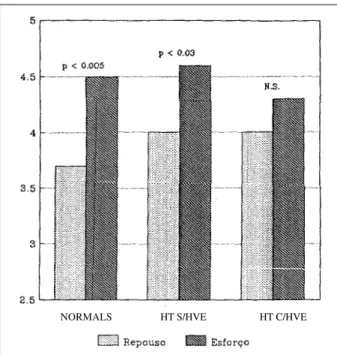
We also observed 27,28 that hypertensive patients who had normal values of mass index, concentric hypertrophy and left ventricular wall thickness at the end of the follow-up period, reacted to the sudden increase in stress secon-dary to isometric exercise like normotensive patients do: significant increase in cardiac output and in the contracti-lity index and no variation in peripheral resistance. In hypertensive patients who showed no echocardiographic reversal of hypertrophy, isometric exercise caused a significant increase in peripheral resistance, without changes in cardiac output or in inotropism 27,28 (fig. 3). Hypertensive patients, therefore, have a higher vascular reactivity to isometric exercise and a lower inotropic cardiac reserve. These findings are similar to that which has been previously found by others either during dynamic or isometric exercise or after cessation of antihypertensive therapy and consequent increase in blood pressure.
Diastolic function
Studies are contradictory when it comes to
ning whether diastolic function, which is abnormal in hypertension even before development of hypertrophy, can return to normal levels after reversal of hypertrophy.
Inouye et al 31, after prescribing diuretics, beta-blo-ckers and calcium antagonists for four months, could not demonstrate an improvement in diastolic function in study patients. Smith et al 32, on the other hand, showed a sig-nificant increase in filling velocity in hypertensive patients treated with nifedipine, but only in those who had shown ventricular mass regression.
Curiously, White et al 33 have recently observed that, after LV mass regression (by decrease of the wall thickness), in the sequence of therapy with metoprolol in hypertensive patients who had not previously undergone treatment, there was significant improvement in the early diastolic filling of the ventricle. These authors emphasize the fact that the absence of previous treatment was important in explaining the observed improvement in these patients.
Trimarco et al 34 and Habib et al 35 confirmed these findings and emphasize the importance of reversal of LVH and blood pressure control in improving diastolic function. In our studies 27,28, we observed no significant chan-ges in diastolic function parameters (fig. 4), which remained clearly abnormal. This might be explained by previous therapy (most patients had been hypertensive for several years), that might have already lead to some regression and structural remodeling and thus failed to show improvement with previous therapy, or by the coexistence of coronary artery disease or of no regression of interstitial fibrosis.
Some studies have suggested that regression of hypertrophy might even increase the percentage of fibrosis and thus make the ventricle less compliant 36.Philips et al 37 showed that, in well controlled hypertensive patients, diastolic function remains abnormal and does not correlate with blood pressure level, duration of hypertension, age or LVH indexes. Drugs that interfere with the renin-angio-tensin-aldosterone system seem to be the most effective in promoting regression of the interstitial and perivascular fibrosis 29,38.
Therefore, there can be no regression at all of the connective tissue, or it can regress in larger or smaller degrees, or even occur later on, which may or may not lead to improvement in diastolic function. The influence of different drugs on the regression of hypertrophy of myocardial cells and on contractile proteins, as well as their influence on abnormal function and/or structure of the coronary vessels and consequent changes in coronary artery reserve, can also explain the variability in functional response of the ventricles in patients who experience regression of hypertrophy.
Fig. 2 - Superposition of several points in the correlation fractional shortening-end-systolic stress line of regression, at a 95% confidence interval, between hypertensive and normotensive patients 27, 28.
Fig. 3 – Variation on the contractile index (stress/I. systolic volume) according to isometric exercise.
NORMALS HT S/HVE HT C/HVE
Fig. 4 – Variation on the isovolumic relaxation time and on the EF slope of the anterior mitral valve leaflet with adequate control of the blood pressure and regression of the hy-pertrophy obtained at the end of the follow-up period (accelerated hypertension) 27,28.
1. Kannel WJ, Castelli WP, McNamara PM, et al. Role of blood pressure in the development of congestive heart failure: the Framingham Study.N Eng J Med 1972; 187: 781-7.
2. Kannel WJ. Prevalence and natural history of electrocardiographic left ventricular hypertension. Am J Med 1983; 75(suppl 3A): 4-18.
3. Casale PN, Devereux RB, Milner M, et al. Value of echocardiographic measu-rement of left ventricular mass in predicting cardiovascular morbid events in hypertensive men. Ann. Intern Med 1986; 105: 173-8.
4. Levy D, Anderson KM, Savage DDd, et al. Risk of ventricular arrythmias in left ventricular hypertrophy: the Framingham Heart Study. Am J Cardiol 1987; 60: 560-5.
5. Koren MJ, Devereux RN, Savage DD, Laragh JH.- Relation of left ventricular mass and geometry to morbidity and mortality in uncomplicated essential hyper-tension. Ann Intern Med 1991; 114: 345-52.
6. Cooper RS, Simmons BE, Casttaner A, Santhaman V, Ghali J, Mar M. Left ventricular hypertrophy is associated with worse survival independent of ventricular function and number of coronary arteries severly narrowed. Am J Cardiol 1990; 65: 441-5.
7. Sen S, Tarazi RC, Khairallah PA, Bumpus FM. Cardiac hyperthrophy in spontaneously hypertensive rats. Circ Res 1974; 35: 775-81.
8. Sen S, Tarazi RC, Bumpus FM. Biochemical changes associated with develop-ment and reversal of cardiac hypertrophy in spontaneously hypertensive rats. Cardiovasc Res 1976; 10: 254-61.
9. Sen S, Tarazi RC, Bumpus FM. Cardiac hypertrophy and antihypertensive therapy.Cardiovasc Res 1977; 11: 427-33.
10. Tomanek RJ, Hovanec JM. The effects of long-term pressure overload and aging on the myocardium. J Mol Cell Cardiol 1981; 13: 471-89.
11. Tomanek RJ. Selective effects of methyldopa on myocardial cell components independent of cell size in normotensive and genetically hypertensive rats. Hypertension 1982; 4: 499-506.
12. Saragoça MA, Tarazi RC. Left ventricular hypertrophy in rats with renovascular hypertension - alterations in cardiac function and adrenergic response. Hypertension 1981; 3(suppl II): II-171-II-6.
13. Kobayashi K, Tarazi RC. Effect of nitrendipine on coronary flow and ventricular hypertrophy in hypertension. Hypertension 1983; 5(suppl III): H-45-H51. 14. Kazda S, Garthof B, Thomas G. Prevention or regression of cardiac hypertrophy.
In: Lichten PR (ed.) - Symposium - New Therapy of Ischemic Heart Disease and Hypertension. Amsterdam: Excerpta Medica, 1986: 435-44.
References
Benefits of regression of hypertrophy
Benefits of hypertrophy reversal can be evaluated by observing the degree of improvement in cardiac function (systolic and diastolic), improvement in coronary artery circulation, improvement in arrhythmias and, most of all, decrease in cardiovascular morbidity and mortality.
Although there is no definite answer to the question “Is regression of hypertrophy beneficial?”, we can con-clude, after everything that has been described, that with the use of some drugs, hypertrophy reversal can show a real benefit. It has been shown that it can normalize dias-tolic function and keep it normal and, at the same time, improve systolic function 30, 33-35. Improvement or even nor-malization of the coronary artery reserve39 and a decrease in the incidence of arrhythmias 40,41 can also occur with rever-sal of hypertrophy.
It was demonstrated in animal studies that reversal of hypertrophy can occur with renin-angiotensin enzyme inhibitors or with angiotensin AT1 receptor antagonists and this was followed by a decrease in mortality 42. A recently published work by Kannel’s group (Framingham Study)
supports this opinion by the detection of a decrease in cardiovascular risk in men, observed only in hypertensive patients who showed a decrease of LVH on EKG (voltage criteria), but not in those where this decrease had not been observed or in whom voltage had even increased 43.
Muiesen et al 44 also observed, in a recent echocardio-graphic study, those hypertensive patients with regression of hypertrophy had lower cardiovascular morbidity and mortality. However, echocardiographic studies, involving a larger number of patients, are still necessary.
In conclusion, it is not only possible to induce re-gression of hypertrophy by the use of antihypertensive drugs but also very desirable. This is especially true when drugs are used that act not only in the muscular content promoting regression of the myocyte hypertrophy and thus normalizing the isomyosin pattern and regulating existing metabolic changes, but also promote regression of the perivascular and interstitial fibrosis and coronary artery reserve normalization. This action on the three levels of the myocardium can definitely contribute to prevention or improvement of myocardial ischemia and prevent evolution of hypertensive heart disease to an end-stage heart failure.
15. Folkow B. Thestructural cardiovascular fator in primary hypertension - Pressure dependence and genetic reinforcement. J Hypertens 1986; 4(suppl 3): S-51-S-6. 16. Tarazi RC, Frohlich ED. Is reversal of cardiac hypertrophy a desirable goal of
antihypertensive therapy ? Circulation 1987; 75(suppl I): I-113-I-17. 17. Schlant RC, Felner JM, Heymesfield SB, et al. Echocardiographic studies of left
ventricular anatomy and function in essential hypertension. Cardiovasc Med 1977; 2: 477-91.
18. Fouad FM, Nakashima Y, Tarazi RC, Salcedo EE. Reversal of left ventricular hypertrophy in hypertensive patients treated with methyldopa. Lack of association with blood pressure control. Am J Cardiol 1982; 49:795-801. 19. Nakashima Y, Fouad FM, Tarazi RC. Regression of left ventricular hypertrophy
from systemic hypertension by enalapril. Am J Cardiol 1984; 53: 1044-9. 20. Dal Palu C, Pessina AC, Pagnan A, et al. Effects of captopril on left ventricular
mass and function in hypertensive patients and in the rat. Postgraduate Medical J 1986; 62(suppl I): 85-9.
21. Szlachcic J, Tubau JF,Vollmer C, Massie BM. Effect of diltiazem on left ventricular mass and diastolic filling in mild to moderate hypertension. Am J Cardiol 1989; 63: 198-201.
22. LundgrenY, Weiss L. Cardiovascular design after “reversal” of long-standing renal hypertension in rats. Clin Sci 1979; 57: 195-215.
23. Tarazi RC, Fouad FM. Reversal of cardiac hypertrophy in humans. Hypertension 1984; 6(suppl III): III-140-III-6.
24. Dahlof B, Pennert K, Hansson L. Reversal of left ventricular hypertrophy in hypertensive patients: A metaanalysis of 109 treatment studies. Am J Hypertens 1992; : 95-110.
25. Cruickshank J, Lewis J, Moore V, Dodd C. Reversibility of left ventricular hypertrophy by differing types of antihypertensive therapy. J Hum Hypertens 1992; 6: 85-90.
26. Schmieder RE, Martus P, Klingbeil A. “Reversal of left ventricular hypertrophy in essential hypertension, A meta-analysis of randomized double-blind studies” JAMA 1996; 75: 1507-13.
27. Braz Nogueira J. Hipertensão arterial acelerada. Análise da evolução da cardiopatia hipertensiva e das repercussões nos outros órgãos-alvo. Disser-tação de Doutoramento. Lisboa, 1990.
28. Braz Nogueira J. Regressão medicamentosa da cardiopatia hipertensiva. Rev Interno 1991; 3(supl A): A57-A-68.
37. Phillips RA, Coplan NL, Krakoff LR, et al. Doppler echocardiographic analysis of left ventricular filling in treated hypertensive patients. J Am Coll Cardiol 1987; 9: 312-22.
38. Brilla CG, Janicki JS, Weber KT. “Cardioreparative effects of lisinopril in ratis with genetic hypertension and left ventricular hypertrophy”. Circulation 1991; 83: 1771-9.
39. Motz W, Vogt M, Scheler S, Strauer BE: “Pharmacotherapeutic effects of anti-hypertensive agents on myocardium and coronary arteries in hypertension”. Eur Heart 1992; 13(suppl D): 100-6.
40. Pahor M, Bernabi R, Sgadari A, et al. “Enalapril prevents cardiac fibrosis and arrhythmias in hypertensive rats”. Hypertension 1991; 18: 148-57. 41. Kohya T, Yokoshiki H, Tohse N, et al. “Regression of left ventricular
hypertro-phy prevents ischemia-induced lethal arrhythmias. Benefitial effect of angiotensin II blockade”. Circ Res 1995; 76: 892-9.
42. Bruckschlegel G, Holmer SR, Jandeleit K, et al. “Blockade of the renin-angiotensin system in cardiac pressure-overload hypertrophy in rats”. Hypertens 1995; 25: 250-9.
43. Levy D, Salomon M, D’Agostino RB, Belanger AJ, Kannel WB.Prognostic implications of baseline electrocardiographic features and their serial changes in subjects with left ventricular hypertrophy. Circulation 1994; 90: 1786-93. 44. Muiesan ML, Salvetti M, Rizzoni D, Castellano M, Donato F, Agabiti-Rosei.
“Association of change in left ventricular mass with prognosis during long-term antihypertensive treatment”. J Hypertens 1995; 13: 1091-95.
inhibits the intracellular signaling pathway of stretch-mediated cardiomyocyte hypertrophy in vitro. Circulation 1994; 89: 2204-11.
30. Trimarco B, DeLuca N, Ricciardelli B, et al. Cardiacfunction in systemic hypertension before and after reversal of left ventricular hypertrophy. Am J Cardiol 1988; 62: 745-50.
31 Inouye IK, Massie BM, Loge D, Simpson P, Tubau JF. Failure of antihypertensive therapy with diuretic, beta-blokingg drugs to consistently reverse left ventricular diastolic filling abnormalities. Am J Cardiol 1984; 53: 1583-7. 32. Smith VE, White WB, Meeran MK, Karimeddini MK. Improved left ventricular
filling accompanies reduced left ventricular mass during therapy of essential hypertension. J Am Coll Cardiol 1986; 8: 1449-54.
33. White WB, Schulman P, Kerimeddini MK, Smith V-E. Regression of left ventricular mass is accompanied by improvement in rapid left ventricular filling following antihypertensive therapy with metoprolol. Am Heart J 1989; 34. Trimarco B, DeLuca N, Rosiello G, et al. Improvement of diastolic function after
reversal of left ventricular hypertrophy induced by long-term antihypertensive treatment with tertatolol.Am J Cardiol 1989; 64: 745-51.