ARTICLE
Axis instrumentation: surgical results
Instrumentação do áxis: resultados cirúrgicos
Andrei F. Joaquim1, Enrico Ghizoni1, Diogo V. Anderle2, Evandro de Oliveira3, Helder Tedeschi3
Many pathological conditions, such as trauma, degen-erative, inflammatory and neoplastic diseases, or even congenital malformations, can lead to segmental instabil-ity in the upper cervical spine, requiring fixation proce-dures to maintain or restore stability1-5. Due to the unique
anatomy of the axis, the second cervical vertebra, achiev-ing segmental stability surgically can be challengachiev-ing at times. Although they are less complex procedures, wiring techniques have a high rate of nonunion6-8, leading to an
in-complete immobilization9,10, sometimes requiring the use
of an external orthosis postoperatively. Trying to improve the quality of the stabilization and the arthrodesis rate, a
large number of axis screws fixation techniques were de-scribed, biomechanically more efficient and stronger than wiring techniques11,12.
he use of pedicular screws in the axis was irst described by Goel A. and Laheri V. in 1994. his is probably the tech-nique that ofers the strongest ixation13. However, in up to
20% of the cases, it can be inadvisable due pedicles size limi-tations or a vertebral artery located medially14,15.
Another important technique is the use of pars interartic-ularis screws, also known as isthmus screws. his technique is similar to that described for transarticular C1-2 screws, but it’s based on smaller length screws that do not transgress the
1Assistant Neurosurgeon, Universidade Estadual de Campinas (UNICAMP), Campinas SP, Brazil; 2Neurosurgeon, Santa Casa de Amparo, Amparo SP, Brazil;
3Assistant Professor, Neurosurgery Division, UNICAMP, Campinas SP, Brazil.
Correspondence: Andrei F. Joaquim; Rua Antônio Lapa 280 / 5° andar / sala 506 / Edifício América Cambuí; 13025-240 Campinas SP - Brasil; E-mail: [email protected]
Conflict of interest: There is no conlict of interest to declare.
Received 28 January 2012; Received in inal form 22 June 2012; Accepted 29 June 2012
ABSTRACT
Objective: Evaluate the surgical results of axis screw instrumentation. Methods: Retrospective evaluation of the clinical and radiological data of patients submitted to axis ixation using screws. Results: Seventeen patients were surgically treated. The mean age was 41.8 years (range: 12–73). Spinal cord trauma was the most common cause of instability (8 patients – 47%). Bilateral axis ixation was performed in all cases, except one, with laminar screw (total of 33 axis screws). Seven patients (41.1%) underwent bilateral pars screws; laminar screws were used in six cases and pedicular screws were used in two. In two cases, we performed a hybrid construction (laminar + pars and pedicle + pars). There was no neurological worsening or death, nor complications directly related to use axis screws. Conclusion: Axis instrumentation was effective and safe, regardless of the technique used for stabilization. Based on our learnt experience, we proposed an algorithm to choose the best technique for axis screw ixation.
Key words: axis, instrumentation, pedicle, pars, laminar, bone screws.
RESUMO
Objetivo: Avaliar os resultados cirúrgicos da instrumentação com parafusos do áxis. Métodos: Avaliação retrospectiva de dados clínicos e radiológicos de pacientes submetidos à instrumentação com parafusos do áxis. Resultados: Dezessete pacientes foram tratados cirurgicamente. A média de idade foi de 41,8 anos (faixa: 12–73 anos). Trauma na coluna foi a causa mais comum de instabilidade (8 casos – 47%). Fixação bilateral do áxis foi realizada em todos os casos, exceto em um, com parafuso de lâmina (total de 33 parafusos). Em sete pacientes (41,1%), foram usados parafusos de pars; em seis, parafusos de lâmina; e em dois, de pedículos. Em dois casos, foi utilizada uma combinação de técnicas (pars + lâmina e pars + pedículo). Não houve piora neurológica nem complicações diretas em decorrência do uso dos parafusos. Conclusão: A instrumentação do áxis foi eicaz e segura independentemente da técnica escolhida para estabilização. Com base em nossa experiência, foi proposto um algoritmo para auxílio na escolha da melhor técnica a ser empregada.
C1-2 facet joint16. he risk of vertebral artery injury, although
rare, exists and can be catastrophic.
he third axis screw ixation technique described in the spinal literature is the insertion of laminar screws, that can be used in patients who did not require a laminectomy and have a prohibitive pedicle or pars anatomy16,17.
We present our clinical results in a series of patients that underwent axis screw instrumentation, discussing surgical nuances of the technique used. Based on our experience, we proposed an algorithm for helping surgeons to choose the best technique for axis screw instrumentation.
METHODS
A retrospective evaluation of a personal series (AFJ) of patients that underwent axis stabilization with screws from January 2009 to December 2011 was performed. Inclusion cri-teria: patients that underwent surgery that included C2 ixa-tion with screws. Exclusion criteria: patients that did not con-sent with the participation in this study during the follow-up. All the patients consent with the participation in this study.
Clinical data assessed includes: age, sex, follow-up, surgi-cal indication, surgisurgi-cal complications and neurologisurgi-cal status. Radiological data was used to assess the technique of ixation used, screw misplaced and late radiological complications.
Considering the surgical technique used, it is important to mention that there are diferent trajectories for the screw insertion. In case of pedicle screws, the entry point is just lat-eral to the superior margin of the lamina, towards the top of the pars16. he trajectory for drilling the C2 pedicle is about 20
degrees up and 15–25 degrees medially16. he inal direction
is also very dependent on any rotational variations noted on preoperative CT scans. For C2 pars screws, the starting point is selected in the medial half of the inferior facet of C2 (2 mm up and 2 mm in), in the pars’ direction, guided by lateral luo-roscopy image, generally in a cranial and slightly medial di-rection, similar to the transarticular C1-2 screw technique16.
RESULTS
Seventeen patients enrolled in this study. Mean age was 41.8 years-old (range from 12 to 73 years-old). Ten patients were men (58.8%) and seven (41.1%) were women. he mean follow-up was 9.56 months (range 2-24; median 7.5 months). One pa-tient lost follow-up immediately after hospital discharge.
Eight patients (47%) required stabilization to treat insta-bility secondary to spinal trauma, followed by three cases of congenital craniocervical malformation (17.6%), two cases of tumor (one spinal metastasis and one giant cell tumor) and two cases of cervical myelopathy involving the axis (11.7%). We also have one case of rheumatoid arthritis leading to C1-2
instability and a postlaminectomy kyphosis after late resec-tion of an extradural giant schwannoma tumor (5.8%).
Nine patients (52.9%) required concomitant C1 fusion using lateral mass screws, ive cases (29.4%) underwent an occipitocervical fusion, and three cases (17.6%) had subaxial cervical decompression and fusion with lateral mass screws.
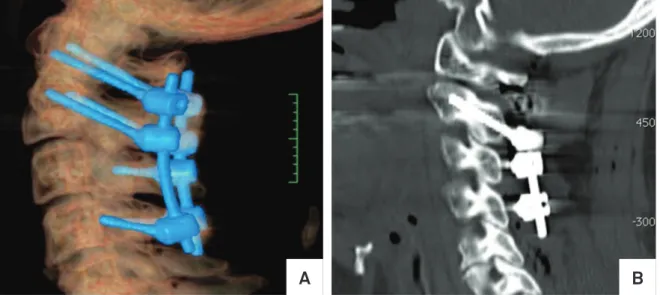
he summary of the clinical data of the seventeen cases is presented in Table 1 and case examples are shown in Figs 1 to 5. In all but one cases, a bilateral C2 instrumentation was performed, with a total of 33 screws used. In seven cases (41.1%), we used bilateral pars screws; laminar screws were used in ive cases (29.4%), and pedicular screws were used in two (11.7%) (Table 2). In two cases, we performed a hy-brid construction with laminar and pars screws, and the oth-er with pedicle and pars screws. In the patient with C1-2 in-stability secondary to rheumatoid arthritis, because of total destruction of the right C1 lateral mass, we performed a uni-lateral left side C1 uni-lateral mass – C2 laminar screw ixation.
All the patients that were neurologically intact before sur-gery remained intact after the procedure (ten cases). he sev-en patisev-ents who had some neurological deicit before surgery had signiicant improvement after the procedure in muscu-lar strength or gait ability (patients 7, 8, 9, 11, 14, 15 and 16).
Regarding C1 instrumentation performed in nine cases with lateral mass screws, in three cases there were some de-gree of C1 subluxation over C2, reduced after rod insertion. In ive cases, the C2 ganglion was resected to improve the vi-sualization of the C1 lateral mass. he patients in this group had transitory paresthesias and hypoesthesia in the nerve territory, but they did not need medicamentous therapy. However, two of the four patients in which the C2 nerve roots were preserved developed postoperative neuropathic occipi-tal pain that required clinical treatment.
In all patients we used autologous iliac crest as bone graft. In one case, we had a supericial infection in the site where the graft was harvested.
here was no neurological worsening or death in this series, nor complications related directly to the use of axis screws. he most common complication was supericial wound infection in three cases (17.6%), all of them in occipi-tal-cervical fusions.
DISCUSSION
Since many anatomical variations can be found in the axis, it is necessary that the surgeon knows how to perform all the diferent techniques of ixation. As a general rule, in patients with an adequate pedicle size (greater than 4 mm and without a medially located vertebral artery), one can choose the pedicle screw ixation, with the screw reach-ing the axis body19. he use of pars screws, although also
associated with some risk of vertebral artery injury19, can be
safely used in almost all cases as long as the posterior margin of the vertebral body, viewed with the intraoperative lateral luoroscopy, is not reached. Regarding the fact that the trans-verse foramen, where the vertebral artery can be injured, is positioned lateral to the axis body, we have used 16 milli-meter screws in the pars, regardless of the medial or lateral n Sex Age Group Ethiology Surgery Infecction Follow-up (months)
1 M 16 Trauma Odontoid type II fracture
C1 lateral mass screws and C2 pedicular
screws
No 18
2 M 46 Trauma Odontoid type II fracture C1 lateral mass screws
and C2 pars screws No 7
3 F 34 Trauma Odontoid type II fracture
C1 lateral mass screws, C2 pars screw and C3
lateral mass screw
Supericial wound infection at the iliac crest
4
4 M 48 Trauma Transverse ligament injury
C1 lateral mass screws and C2 laminar and
pars screws
No 9
5 M 70 Neoplasia Odontoid pathological fracture
C1 lateral mass screws, C2 pedicle and lateral
mass in C3- 4
No 6
6 F 37 Trauma Transverse ligament injury C1 lateral mass screws
and C2 laminar screws No 16
7 F 41 Neoplasia
Instability after C3-4-5 corpectomy to treat a giant
cell tumor and posterior spinal cord compression*
Occipital screws, C2 pars screws, lateral mass C5-7-T1-2
Supericial surgical wound
infection
24
8 M 60 Congenital Basilar invagination*
Occipital ixation with wiring and C2 pars screws and C3 lateral
mass
Supericial surgical wound
infection
17
9 F 12 Congenital Os odontoideum*
Occipital ixation with screws and C2 laminar
screws
No 6
10 M 36 Trauma C2 fracture and C1-2 subluxation
Lateral mass screws at C1, C2 pars and C3
lateral mass
No 2
11 M 71 Degenerative Revision surgery for anterior C2-3-4 ixation*
C2 pars screws, and
C3-4 lateral mass No 10
12 M 20 Trauma Lateral mass C1 fracture and
TL injury Occipito-C2 pars-C3 No 6 13 M 24 Trauma Odontoid fracture C1-C2 laminar screws No –
14 F 73 Degenerative Cervical myelopathy
C2 laminar (bilateral)-C4-5-6 Right
and C6 (Left)
No 10
15 M 47 Congenital Basilar invagination Occipito-C2 laminar-C3 Supericial
wound infection 8
16 F 45 Post-laminectomy
kyphosis Cervical schwannoma
C2 pedicle and
pars-C3-4-5- 6 No 6
17 F 31 Inlammatory
(Rheumatoid arthritis) Ligament transverse injury
C1 lateral mass with C2 laminar unilateral left
side
No 4
Patient 7 – had an arthrodesis review due to breaking of one occipital rod. We took it out, maintained the C2 ixation as the only point of cranial ixation. The patient had a very good clinical improvement, restarting ambulation after surgery, without the severe preoperative pain, even after removing the occipital plate. Patient 14 – the proposal surgery was a C3-6 decompression without included C2. During the surgical procedure, due to a severe osteoporotic bone, we had problems with the left C3-4-5 lateral masses. Once we did not have an adequate study of the C2 anatomy and we need a more cranial ixation point, we used C2 laminar screws.
Patient 15 – we had a strong dificult in contour the occipital rod with the direction of the C2 laminar screws and the C3 lateral mass screws. Based on this case, we did not use laminar screws in the middle of any construction since that.
Patient 17 – the right C1 lateral mass was destroyed. We performed an unilateral C1-2 ixation with autologous bone graft. The patient improved completely from her cervical neck pain (four months follow-up).
Fig 1. A C1-C2 fusion for treatment of an odontoid type II fracture. Bilateral C2 pars screws were used, with C1 lateral mass screws.
A
B
Fig 2. A C1-C2 fusion for treatment of a traumatic injury in substance of the transverse ligament, with C1-C2 instability. A hybrid construction was used with laminar and pars screws. (A) Sagittal CT scan reconstruction and (B) axial CT scan showing a right C2 pars screws and a left C2 laminar screw.
A
B
Fig 3. An occipitocervical fusion after traction for treatment of a basilar impression. Bilateral C2 pars screws were used, with Wackenheim clivus baseline changed from 93o preoperatively (A) for 127o at the post operatory (B and C). The patient improved of
all his neurological symptoms with a solid ixation.
Technique n Percentage
Pars 7 41.1
Lamina 5 29.4
Pedicle 2 16.6
Lamina and pars 1 5.8
Pedicle and pars 1 5.8 Lamina (unilateral) 1 5.8 Table 2. Distribution of the 11 patients with axis
instrumentation according to the surgical technique used.
position of the vertebral artery, just making sure we did not trespass the posterior limit of the axis body. his is the rea-son for the large number of pars screws used in this series (13 out of 22 screws). Corroborating our results, Hoh et al., after evaluation of 50 CT scan reconstructions of adult indi-viduals, reported that 14 mm pars screws could be used in almost 99% of the cases, if the correct trajectory of insertion was respected19.
Concerning the eicacy of the techniques, in a biome-chanical cadaveric study of 11 fresh frozen specimens, inser-tional torque and pull-out strength were measured in initial and salvage procedures. he authors suggested that pedicle screws provide the strongest ixation for both initial and salvage applications (p<0.0001). If they should fail, lamina screws appear to provide stronger and more reproducible ixation than pars screws20.
In a retrospective clinical study of Parker et al., they re-vised 167 patients (313 screws) that underwent a posterior cervical arthrodesis with C2 pedicular screws or, when an-atomically precluded, had laminar screws placed21. he
au-thors divided the groups in axial (C1-2 or C1-2-3) and subax-ial. hey reported that, in both groups, 11 (7%) of the pedicle Fig 5. A C1-C4 stabilization for treatment of an odontoid pathological fracture. We use long bilateral C2 pedicular screws.
A
B
Fig 4. A complex occipitocervico-thoracic fusion for treatment of a giant cell tumor surgically treated previously by an anterior approach (three level corpectomy). Note that we used bilateral C2 pars screws.
screws breached the pedicle (none of them required acute revision) versus only 2 (1.3%) of the laminar screws (one of
them required acute revision) (p=0.018). A higher incidence of pseudoarthrosis in the laminar group was reported, re-quiring reoperation in 4 patients (6.1%) versus no patient
re-operated in the pedicle group (p<0.05), but just in subaxial constructions, after one year postoperative. No case of axial fusion in both groups required surgery review for pseudoar-throsis. hey concluded that both techniques were very ef-fective and safe in both axial (C1-2 and C1-2-3) and subaxial constructions, with a small durability for translaminar fusion in the subaxial spine.
In one of our cases, an occipit-C2-3 ixation was per-formed (patient 15). In this case, we chose to use laminar screws in C2. We have an important diicult in rod contour-ing, even using poliaxial screws, once the screws directions were completely diferent. Based on this case, we do not rec-ommend using C2 laminar screws when this level is not the most caudal or rostral of the construction.
When large ixation is required, as in cervicothoracic ixa-tion stopping at C2, we tried to use pedicle screws because they have the stronger purchase. However, we emphasized that the use of C2 pedicle screws is the most demanding and risky tech-nique, justifying our small rate of its utilization in this series.
Although we do not use this technique for axis ixation in any case in this series because of surgeon’s personal pref-erence (AFJ) in using C1 lateral mass screws, C1-2 transar-ticular screw ixation to stabilize C1 and C2 is widely used and described in literature22. Even though technically more
challenged, requiring a CT angiogram study before its use to visualize the vertebral artery course in the C1-2 region, bio-mechanical studies suggest that this construction provides the highest level of stability in this region22.
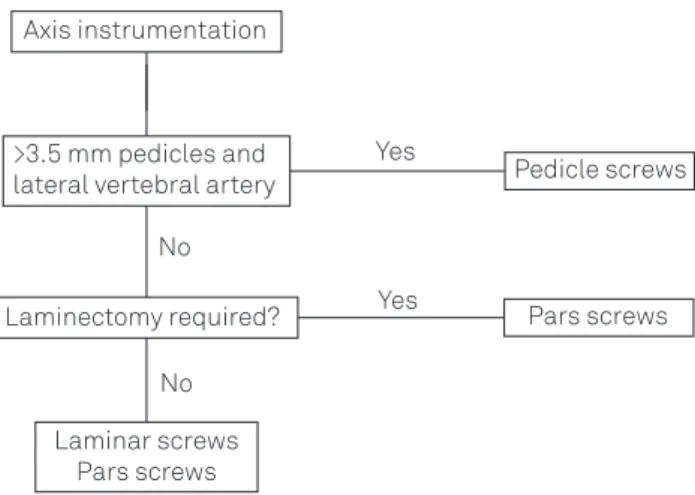
Based on our literature review and learnt experience, we suggest the algorithm presented in Fig 6 to choose the best technique for axis ixation. It’s important to mention that, even though pars screws was the most common technique used in this series, after a learning curve period, we try to use pedicle screws in selected patients with good anatomical proile when a more strong ixation is needed.
In conclusion, axis instrumentation was safe and ei-cient in our series, regardless of the technique used for sta-bilization. he choice of the technique must be based on the anatomical peculiarities of each patient and on sur-geon’s preference. Whenever it’s possible, pedicle screws provide the stronger ixation. In this series, the use of pars screws was also safe and eicient. Laminar screws can be an option, considering its use when the ixation stops at the level of the axis.
Fig 6. Algorithm proposed for chosen the best axis screw instrumentation technique. No No Axis instrumentation Yes Pars screws Laminectomy required? Pedicle screws Yes
>3.5 mm pedicles and lateral vertebral artery
Laminar screws Pars screws
1. Joaquim AF, Patel AP. Occipito cervical trauma: evaluation, classiication and treatment. Contemp Spine Surg 2010;11:1-5. 2. Joaquim AF, Patel AP. C1 and C2 spine trauma: evaluation,
classiication and treatment. Contemp Spine Surg 2010;11:1-7. 3. Joaquim AF, Patel AP. Occipito cervical trauma: evaluation,
classiication and treatment. Contemp Neurosurg 2010;32:1-6. 4. Joaquim AF, Ghizoni E, Rubino PA, et al. Lateral mass screws ixation
of the atlas: surgical technique and anatomy. World Neurosurg 2010;74:395-399.
5. Mudo ML, Amantéa AV, Cavalheiro S, Joaquim AF. Intraoperative radiological visualization of the occipito-cervical transition and upper cervical spine: technical note. Coluna/Columna 2009;8:197-199. 6. Farey ID, Nadkarni S, Smith N. Modiied Gallie technique versus
transarticular screw ixation in C1–C2 fusion. Clin Orthop Relat Res 1999;359:126-135.
7. Dickman CA, Sonntag VK. Posterior C1–C2 transarticular screw ixation for atlantoaxial arthrodesis. Neurosurgery 1998;43:275-280. 8. Coyne TJ, Fehlings MG, Wallace MC, Bernstein M, Tator CH. C1-C2
posterior cervical fusion: long-term evaluation of results and eficacy. Neurosurgery1995;37:688-692.
9. Crisco JJ 3rd, Panjabi MM, Oda T, Grob D, Dvorak J. Bone graft translation of four upper cervical spine ixation techniques in a cadaveric model. J Orthop Res1991;9:835-846.
10. Grob D, Crisco JJ 3rd, Panjabi MM, Wang P, Dvorak J. Biomechanical evaluation of four different posterior atlantoaxial ixation techniques. Spine1992;17:480-490.
11. Henriques T, Cunningham BW, Olerud C, et al. Biomechanical comparison of ive different atlantoaxial posterior ixation techniques. Spine2000;25:2877-2883.
12. Melcher RP, Puttlitz CM, Kleinstueck FS, Lotz JC, Harms J, Bradford DS. Biomechanical testing of posterior atlantoaxial ixation techniques. Spine2002;27:2435-2440.
13. Goel A, Laheri V. Plate and screw ixation for atlanto-axial subluxation. Acta Neurochir (Wien)1994;129:47-53.
14. Mandel IM, Kambach BJ, Petersilge CA, Johnstone B, Yoo JU. Morphologic considerations of C2 isthmus dimensions for the placement of transarticular screws. Spine 2000;25:1542-1547. 15. Igarashi T, Kikuchi S, Sato K, Kayama S, Otani K. Anatomic study of the
axis for surgical planning of transarticular screw ixation. Clin Orthop Relat Res 2003;408:162-166.
16. Yanni DS, Perin NI. Fixation of the axis. Neurosurgery. 2010;66:147-152. 17. Wright NM. Posterior C2 ixation using bilateral, crossing C2
laminar screws: case series and technical note. J Spinal Disord Tech 2004;17:158-162.
18. Ebraheim NA, Fow J, Xu R, Yeasting RA. The location of the pedicle and pars interarticularis in the axis. Spine 2001;26:E34-37.
10. Hoh DJ, Liu CY, Wang MY. A radiographic computed tomography-based study to determine the ideal entry point, trajectory, and length for safe ixation using C-2 pars interarticularis screws. J Neurosurg Spine 2010;12:602-612.
20. Lehman RA, Dmitriev AE, Helgeson MD, Sasso RC, Kuklo TR, Riew KD. Salvage of C2 pedicle and pars screws using the intralaminar technique: a biomechanical analysis. Spine 2008;33:960-965. 21. Parker SL, McGirt MJ, Garcés-Ambrossi GL, et al. Translaminar
versus pedicle screw ixation of C2: comparison of surgical morbidity and accuracy of 313 consecutive screws. Neurosurgery. 2009;64: 343-348.