Surubim-do-Paraíba oocytes viability after being exposed to different cryoprotectants
Viabilidade de oócitos de surubim do Paraíba após exposição a diferentes crioprotetores
Taís da Silva Lopes1* Eduardo Antônio Sanches2 Danilo Caneppele3 Elizabeth Romagosa1 ISSNe 1678-4596
INTRODUCTION
Studies on cryopreservation of fish eggs
and embryos have shown low survival rates for a short period of time after chilling to subzero temperatures, which remains a problem to be solved (ZHANG et al., 2007). Published researches with efforts to develop cryopreservation of these cells have become less frequent. Nevertheless, other studies point that the use of chilled storage is possible at least in cold-water species: it improves storage time in comparison with
room or natural water temperature (e.g. 10- 12°C for salmonids) (BOBE & LABBÉ,2010). Conversely, for warm-water species, such as tropical species, chilled eggs storage is considered an even greater challenge, as they normally reproduce at temperatures above 22°C (ROMAGOSA, 2008).
For this reason, cryoprotectants are
necessary for the cryopreservation of tropical fish
gametes. Cryoprotectants (CPAs) are substances characterized by their ability to reduce the cryoinjury of biological materials during freezing. CPAs can be
1Instituto de Pesca, Agência Paulista de Tecnologia dos Agronegócios (APTA), Secretaria de Agricultura e Abastecimento (SAA), Av. Francisco Matarazzo, 455, Água Branca, 05001-970, São Paulo, SP, Brasil. *Corresponding author: [email protected].
2Universidade Estadual Paulista Júlio de Mesquita Filho (UNESP), Centro de Aquicultura (CAUNESP), Curso de Engenharia de Pesca. Campus Experimental de Registro (CERe). Registro, SP, Brazil..
3Estação de Hidrobiologia e Aquicultura da CESP, Paraibuna, SP, Brasil.
ABSTRACT: To know the non-toxic cryoprotectants to fish oocytes is of extreme importance for tests that aim to increase oocyte resistance
to cold, thus allowing more advanced studies in cryopreservation. Therefore, commonly used cryoprotectants such as methanol, dimethyl sulfoxide, ethylene glycol, propylene glycol, sucrose and fructose were studied. Immature oocytes from the initial to vitelogenic (diameter <1.7 mm) and mature (diameter >1.8 mm) stages of Steindachneridion parahybae were evaluated. Four distinct experiments were performed, three using immature oocytes and one using oocytes at the mature stage. For each oocyte stage, the best maintenance solution to be used: Hank or 50% L15 and; viability after baths for 30min (room temperature) at cryoprotectant concentrations ranging from 0.25 to 4M were evaluated. Different tests were used to evaluate oocyte viability: in vitro maturation followed by observation of germinal vesicle breakdown (only for immature oocytes), Trypan Blue staining (all stages) and fertilization and hatching rates (mature stage only). Results showed that the toxic effect of cryoprotectants on oocytes generally increases with increasing concentrations. Sensitivity of oocytes to cryoprotectants increases according to the stage of development, with mature oocytes being more sensitive. Sucrose, fructose, methanol, propylene glycol and dimethyl sulfoxide can be used as cryoprotectants for S. parahybae oocytes.
Key words: fish reproduction, fish oocytes, toxicity, concentrations of cryoprotecntants, Steindachneridion parahybae.
RESUMO: Conhecer os crioprotetores não tóxicos aos oócitos de peixes é de extrema importância para testes que visam aumentar a
resis-tência dos oócitos ao frio, permitindo, assim, estudos mais avançados em criopreservação. Desta forma, crioprotetores comumente utilizados como o metanol, dimetil sulfóxido, etilenoglicol, propilenoglicol, sacarose e frutose foram estudados. Os oócitos imaturos, nos estágios inicial até vitelogênico (diâmetro <1,7mm), e maduros (diâmetro >1,8mm) de Steindachneridion parahybae foram avaliados. Quatro experimentos
distintos foram realizados, sendo três destes utilizando oócitos imaturos, e um usando oócitos no estágio maduro. Para cada estágio oocitários
foram avaliados, considerando qual a melhor solução de manutenção a ser utilizada: Hank ou 50% L15 e; viabilidade após banhos por 30min (temperatura ambiente) em concentrações de crioprotetores, variando de 0,25 a 4M. Diferentes testes foram utilizados para avaliar a viabili-dade dos oócitos: maturação in vitro seguido por observação da quebra da vesícula germinativa (somente para oócitos imaturos), coloração por Azul de Tripan (todos os estágios) e taxas de fertilização e eclosão (somente no estágio maduro). Os resultados mostraram que o efeito tóxico dos crioprotetores em oócitos geralmente crescem com o aumento das concentrações. A sensibilidade dos oócitos a crioprotetores
au-mentam de acordo com o estágio de desenvolvimento, com oócitos maduros sendo mais sensíveis. Sacarose, frutose, metanol, propileno glicol
e dimetil sulfóxido podem ser usados como crioprotetores para oócitos de S. parahybae.
Palavras-chave: reprodução de peixe, oócitos de peixes, toxicidade, concentrações de crioprotetores, Steindachneridion parahybae.
toxic for cells themselves. Hence, determining the effect
of cryoprotectans on oocytes is one of the first steps in
freezing protocol design. Cryoprotectant must be able to permeate the oocyte membranes with low toxicity. There are two major categories of cryoprotectant agents: (a) permeable cryoprotectants, e.g. methanol, ethylene glycol (EG), dimethyl sulfoxide (DMSO), propylene glycol (PG), which are low-molecular weight chemicals and can penetrate the cell membrane – internal; and (b) impermeable cryoprotectants, e.g. sucrose, fructose and other sugars, which are high molecular weight agents and cannot enter the cell – external (PLACHINTA et al., 2004; ZHANG et al., 2007).
The basis for the effects of cryoprotectants is not simply osmotic, but due to direct biochemical injury, which can be: inactivation or denaturation
of specific enzymes, disruption of transmembrane
ionic pumps, or other related perturbation of cellular structure and function by implication. The last ones are most likely due to the direct interaction between cryoprotectants, proteins and biological membranes (ZHANG et al., 2007).
Steindachneridion parahybae
(STEINDACHNER, 1877) (Siluriformes: Pimelodidae),
an endemic gray catfish known as surubim-do-Paraíba,
from the Paraíba do Sul river basin (GARAVELLO, 2005), is currently on the red list of Brazilian fauna threatened with extinction (MMA, 2008; IBGE, 2014)
due to over-fishing and environmental pollution.
Consequently, the cryopreservation of germ cells of this
fish is an important action for the conservation of their
genetic material and production in captivity. However, before studying cryopreservation we need to know which solutions have the ability to protect cells at low temperatures and that are not toxic at the same time. SANCHES et al. (2014) studied the effect of temperature and time on the storage of fresh S. parahybae oocytes, in order to understand the mechanism of viability loss and to develop methods to ensure gamete longevity. These authors reported that
the artificial fertilization is recommended immediately
after oocytes collection, and if storage is necessary fresh oocyte should be conducted at temperatures between 17 and 20°C, for a maximum of 80 minutes. However, in order to storage oocytes for longer periods of time, the aim of this study was investigated the toxic effect of cryoprotectants on S. parahybae oocytes, so that they could withstand very low temperatures.
MATERIALS AND METHODS
The experiment was conducted at the Hydrobiology and Aquaculture Station of
the CESP (São Paulo Energy Company), in the
town of Paraibuna, SP, Brazil (23◦24’54’’S; 45◦35’52’’W), using broodfish originating
from induced reproduction performed with wild specimens at the same station (F1). The fish were kept in two earthen ponds (200 m2) with concrete
walls and a sandy bottom, at the density of one fish/m2, and received extruded commercial feed
for carnivorous fish with 40% crude protein at a rate of 5% biomass/week, offered twice-daily, at 8 am and 4 pm, three days per week.
Broodfish were selected in the pond during the reproductive period (Jan/2015, Dec/2015 and Oct-Dec/2016). The selected broodfish were transferred to the laboratory, weighed and kept into aquaria (500-L) equipped with aeration. Afterwards, they were either sacrificed (so that immature oocytes could be collected) or hormonally induced (~24 h). In order to collect mature oocytes, the females were hormonally induced by injections of crude carp pituitary extract (CCPE) diluted in saline solution (0.9% NaCl), in two dosages (0.5 and 5.0 mg CCPE/kg), at an interval of 12 hours (CANEPPELE et al., 2009).In total, twelve surubim-do-Paraíba females were used, from which nine were sacrificed for the immature oocytes collection (Experiments 1, 2 and 3), and the other three were hormonally induced for the mature oocytes collection (Experiment 4).
The mature oocytes were collected only when they could be easily released after gentle abdominal pressure. Gametes were collected after abdominal massage performed from head to tail (by stripping). The males were not hormonally induced, but the semen was used to estimate the fertilization rates. Then, the males were stripped 15 minutes before the female was stripped to obtain mature oocytes (SANCHES et al., 2013).
Effects of cryoprotectant toxicity were tested in oocytes at different stages. A pool of oocytes in the early stages of development (I to III)
was used without separation of each specific stage
of oocyte development, named immature oocytes, with diameter <1.7mm; or using mature oocytes (non-fertilized eggs), with diameter > 1.8mm.
In general, two maintenance solutions (to which the oocytes were submitted immediately after
collection) were tested: Hank’s (0.137M NaCl, 5.4
in which CPAs were prepared at different concentrations, and where the oocytes remained immersed for 30 minutes. Oocytes (30-50) were put into each well of the 6-well culture plates. Excessive maintenance solution was removed and 5ml CPA solution was added. Thus, four experiments were carried out:
(1) Immature oocytes (diameter
<1.7mm) in CPAs prepared in Hank’s solution:
sucrose, methanol and ethylene glycol (EG).
Controls: Negative, with Hank’s solution, and
Positive, only water;
(2) Immature oocytes (diameter <1.7mm) with the same CPAs, but prepared in 50% L15 solution. Controls: Negative, with 50% L15 solution, and Positive, only water;
(3) Immature oocytes (diameter <1.7mm)
in CPAs prepared in both Hank’s and 50% L15
solutions: fructose, propylene glycol (PG) and dimethyl sulfoxide (DMSO). Controls: Hank, only in Hank or L15, with 50% L15 solution;
(4) Mature oocyte (non-fertilized eggs)
in CPAs prepared in both Hank’s and 50% L15
solutions: sucrose, methanol and EG. Negative controls, with the oocytes only in Hank (Hank) or
50% L15 solution (L15); and Positive Control with incubation immediately after fertilization.
Concentration of each cryoprotectant tested and all details can be seen in Figure 1.
After incubation in CPAs, oocytes were immediately rinsed twice with maintenance solutions and shortly after they were submitted to different tests to assess oocyte viability. TB staining was used to observe membrane integrity for both immature and mature stages, and for this the oocytes passed through bath in 0.4% Trypan blue (Gibco, Life Technologies, São Paulo, Brazil) for
five minutes; and in vitro maturation was followed by observation of germinative vesicle breakdown (GVBD), on which only immature oocytes were incubated in solution containing 50% L15, 1µg. mL-1 DPH (17α-Hydroxy-20β-dihydroprogesterone
- Ref. P6285, Sigma-Aldrich, São Paulo, Brazil) and 1mg.mL L-1 gentamicin (Ref. G1264,
Sigma-Aldrich, São Paulo, Brazil),being keptfor 24 hours at 26±3°C, enough time for the migration of the central nucleus to cell periphery to occur, thus characterizing the germinative vesicle breakdown. In order to facilitate the visualization of migration
Figure 1 - Flow chart with all the details of the experimental tests (1, 2, 3 and 4) of toxicity of cryoprotectants to Steindachneridion
parahybae oocytes. A. Collection management of immature oocytes. Females were sacrificed, gonads were collected, and
oocytes were mechanically separated. B. Collection management of mature oocytes (unfertilized eggs). Females were hormonally induced (syringe) and extruded by stripping (hand) to obtain mature oocytes. TB- Trypan blue staining; GVBD-
or not, a clarifying solution containing acetic acid and methanol 70% at the proportion of 1:3 was used.
Mature oocytes also were analyzed according to their fertilization rate. For this, after leaving the baths in cryoprotectant solutions the oocytes were washed twice with the respective maintenance solution (Hank or 50% L15), afterwards fresh semen was added (86.0% motility rate and 98.3µm s-1 curvilinear velocity), and
water was also added to initiate the hydration and fertilization processes. In order to certify that the eggs were fertilized, embryo development was followed until about 10 hours after fertilization. At this moment, blastoporous closure occurs and only fertilized eggs are able to continue the development, being possible to visualize and count the number of live and unhatched embryos (whitish or white and opaque). Hatching rate was compared to fertilization rate, and similarly the percentage of (normal and deformed) larvae was counted from the Hatching rate; i.e., from the total of hatched embryos which percentage was from normal or deformed larvae, as used by LOPES et al. (2015).
Trypan blue (TB) staining, GVBD, fertilization and hatching rates were submitted to a one-factor analysis of variance (one-way ANOVA) at 5% significance level. Combination of
cryoprotectant and concentration was considered a factor. Six replicates for each treatment and control were used. In the case of a significant
effect, Duncan’s test for the comparison of means
was applied at the same level of significance. Statistical analysis was performed by the software Statistica 9.0. Assumptions were confirmed on the residues as suggested by MYERS (1990) and QUINN & KEOUGH (2002). For the fourth experiment, correlation coefficient was calculated between the variables TB and Fertilization rate.
RESULTS
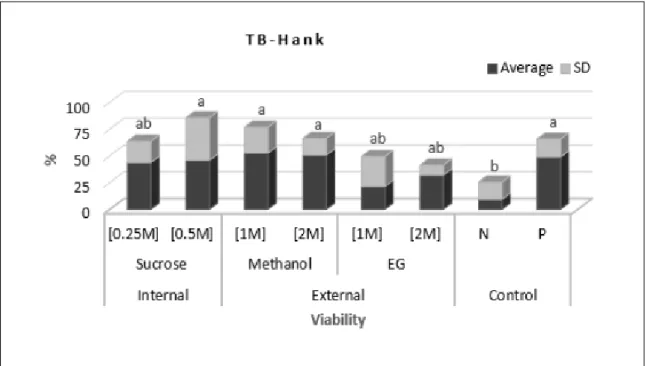
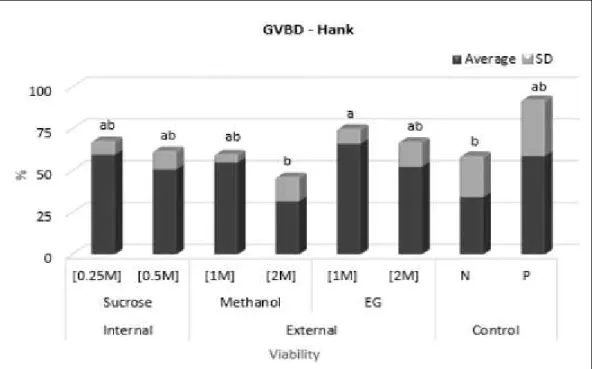
Effect of the cryoprotectants sucrose, methanol and ethylene glycol on the viability of S. parahybae oocytes was verified in the first and second experiments. The first results showed that the toxicity of the cryoprotectants sucrose and methanol increased at greater concentration using two viability assessment methods; the cryoprotectants used at different concentrations did not differ statistically from the Positive Control and presented viability statistically superior to Negative Control by Trypan Blue test, except for ethylene glycol 2M (Figure2). As for the vesicle
Figure 2 - Viability by Trypan Blue staining, TB of the Steindachneridion parahybae immature oocytes submitted to different
breakdown test, ethylene glycol 1M showed the highest viability, not statistically different from the other treatments, except for the Negative Control and methanol 2M (Figure 3). Consequently, for oocytes with diameter down to 1.7mm, initial - vitellogenic stages, all the cryoprotectants tested could be used at
different concentrations with Hank’s solution.
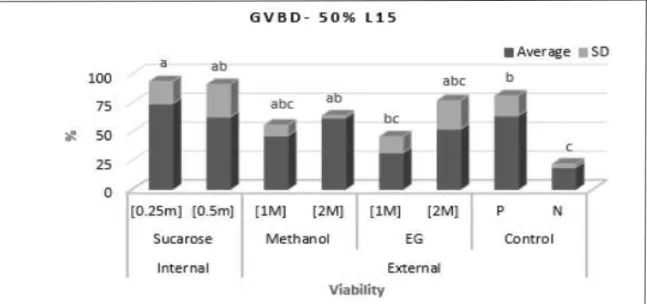
For the second tests, on which the CPAs were prepared in 50% L15 solution, there was lower viability (TB test) for all treatments when compared with the Positive Control (P<0.05) (Figure 4). Conversely, when viability was assessed by the GVBD test, sucrose was shown to be the least toxic cryoprotectant, followed by methanol, at different concentrations (Figure 5).
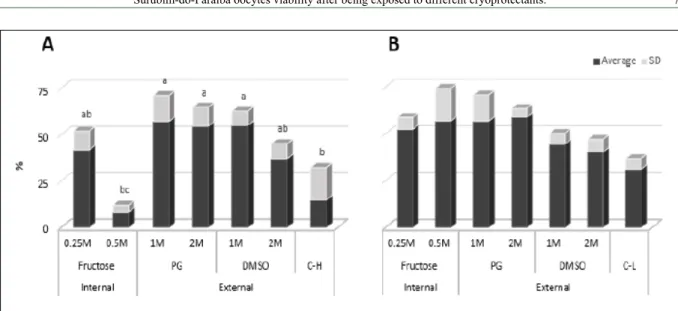
The maintenance solutions were not a problem in the third experiment, because with both Hank and 50% L15 the CPAs showed better results than controls (Figure 6). This is more evident in Hank´s solution; we can see that only the highest concentration of fructose is not recommended (Figure 6A).
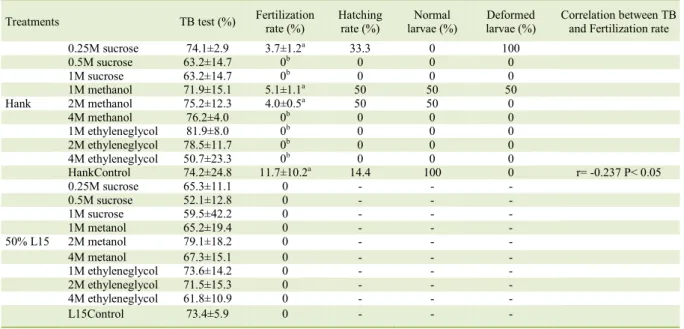
In the fourth experiment, with mature oocytes of S. Parahybae, the results showed there
were no differences among treatments with Hank’s
or 50% L15 solution at different concentrations of CPAs (Table 1). However, for the Fertilization
rates only Hank’s solution can be used; in such
case, the toxic effect of the cryoprotectants sucrose and methanol increased at higher concentrations compared to the Positive Control group; ethylene glycol is not recommended for mature oocytes of
this species. With regard to Hatching rates, we
could see that with sucrose 0.25M only deformed larvae were reported; with methanol 1M there was 50% of hatching rate in relation to fertilization, and from this hatching percentage,50% were deformed larvae; for 2M concentration, only deformed larvae were observed. There was a negative correlation between TB and Fertilization rates (r = -0.237) (P < 0.05).
DISCUSSION
Studies on cryoprotectant toxicity are based on two main effects: chemical reaction with cells before cryopreservation; and osmotic stress caused by freezing solution. However, the toxicity
Figure 3 - Viability by in vitro incubation, GVBD (germinal vesicle breakdown) of the Steindachneridion parahybae
immature oocytes submitted to different concentrations of cryoprotectants using Hank’s solution: 0.25M, 0.5M sucrose; 1M, 2M methanol and; 1M, 2M EG (ethylene glycol). P (positive) - only water; N (negative) -Hank’s
of the different substances used has not been seen as one of the biggest concerns of cryobiology, especially in slow chilling protocols, on which the concentrations used are relatively low. On the other hand, those concentrations increase relatively
in vitrification protocols, emphasizing the need to
understand the toxic effect of the agents used. In order to assess toxicity, the colligative properties of the solutions used must be considered, which
correspond to the cell permeability of each cryoprotectant and the effect on osmolarity even before the procedure of cryopreservation (CHIAN & QUIIN, 2010). Thus, the viability of oocytes after being exposed to cryoprotectants at different concentrations was investigated by more than one method (TB, GVBD, Fertilization and Hatching rates), because there is a methodology that is best applied for each stage of oocyte development and
Figure 4 - Viability by Trypan Blue staining, TB of the Steindachneridion parahybae immature oocytes submitted to different concentrations of cryoprotectants using 50% L15 solution: 0.25M, 0.5M sucrose; 1M, 2M methanol and; 1M, 2M EG (ethylene glycol). P (positive) - only water; N (negative) - 50% L15 solution. SD- Standard deviation.
making assumptions based on one single test is too risky (PLACHINTA et al., 2004).
In the present study, the effect of cryoprotectants at different stages of oocyte development (pool from the initial to vitelogenic; or mature stage) was studied. In most studies with
oocyte cryopreservation using zebrafish, the authors
tested both initial stages (TSAI et al., 2009a, 2009b) and mature oocytes, or unfertilized eggs (ISAYEVA et al., 2004; PLACHINTA et al., 2004); although, the vitelogenic stage (III) was the most researched (GUAN et al., 2008; 2010; ZHANG et al., 2008; SEKI et al., 2011; GODOY et al., 2013). However, before testing all stages in cryopreservation, it is important to investigate the toxicity of possible cryoprotectants for each stage of development.
The TB method may not be ideal, since it only assesses membrane damage as opposed to whole cell physiological status, but it is the only one that can be used for all oocyte stages (PLACHINTA et al., 2004; ZHANG et al., 2007), which is very important to compare the sensitivity: stages versus cryoprotectant options. So far, the TB tests have shown that the best maintenance solution for the initial stages is Hank, and the most suitable cryoprotectants for these stages are sucrose and fructose, at low concentrations, for external protection, and methanol, PG and DMSO for intracellular action. Mature oocytes are highly
sensitive to the cryoprotectants tested, and this is not shown by TB method, but by Fertilization and
Hatching rates. In this case, TB is not an efficient method, confirmed by the negative correlation with
Fertilization rate.
The fertilization and hatching rates are the
most practical and efficient to assess oocyte viability, commonly used in fish culture as productivity indexes.
However, they can only be applied to unfertilized eggs and require the presence of viable semen right after the end of the experimental assays, so that fertilization may occur (BOBE & LABBÉ, 2010). Based on the results reported for these tests, we can verify that the mature oocytes showed low viability to the substances tested, according to the procedures used for viability analysis, suggesting the need for the use of more tests that certify the viability of these oocytes. Moreover, the choice of the maintenance
solution seems to be even more specific, because Hank’s solution was the only one that succeeded.
Learning more about these cryoprotectants which showed better results is necessary so we can understand them better. It is also important to test new cryoprotectants with the same characteristics. Methanol has properties that are common among short-chain alcohols, such as the ability to lower the phase transition temperature of the lipid membrane; and this mechanism of protection reported positive
results for the cryopreservation of fish embryos
(LOPES et al., 2012, 2015). Solutions of PG promoted small and amorphous ice formation due to their high viscosity at temperatures below zero. Besides, they also provide a lower amount of remaining intracellular water, and this characteristic is important to avoid the formation of intracellular ice crystals (TSAI 2009a).
DMSO has the ability to act in a homogeneous formation of ice crystals and reduce the temperature of transition between the bilayer/non-bilayer lipid, which preserves the interaction with membrane proteins at low temperatures (SOLOCINSKI et al., 2017). Nevertheless, its toxic effects should be taken into account, since they can induce cell differentiation, as well as change the structure of macromolecules, according to concentration and temperature (YU & QUINN, 1994). In spite of that, it seems to be the most promising internal cryoprotectant among the ones tested. EG, despite being commonly used as an anti-freeze for presenting a low freezing point (CHIAN & QUINN, 2010), was the agent with the highest toxicity to the oocytes.
Among the external cryoprotectants, sucrose is widely used and can be associated with intracellular cryoprotectants. It induces dehydration and osmotic
shrinkage of the cells; therefore, lowering the risk of intracellular ice crystallization (PLACHINTA et al., 2004). Using fructose is not very common in cryopreservation assays, but when associated with sucrose it has the ability to delay the crystallization rate by reducing the time of ice crystals nucleation (ARVANITOYANNIS, 2009). In other words, fructose may be used as a cryoprotectant agent with impermeable effect on the cells, because it has presented lower toxicity at low concentrations. Therefore; it is an alternative to compose cryoprotectant solutions since both sugars tested exhibit higher toxicity at high concentrations. To
know the specific properties of each substance and how
they can promote cryoprotection (chilling curve, storage time and temperature) are of extremely importance,
allied to its specific toxic effect for each type of
cells. Thus, we believe that the combination of these cryoprotectants at lower concentrations might result in a desirable effect of protection of the cells against the cold, without toxic action.
Mature oocytes were shown to be more sensitive to cryoprotectant toxicity, mainly when 50% L15 solution was used: there was neither Fertilization nor Hatching rates, which happened because this solution, with 50% water, might have provided rapid undesirable
Table 1 - Viability by TB (Trypan Blue) test (%); Fertilization rate (%); Hatching rate (%); Normal larvae (%); Deformed larvae (%) and Correlation between TB and Fertilization rate of Steindachneridion parahybae mature oocytes submitted to cryoprotectants using both maintenance solutions: Hank and 50% L15. The cryoprotectant concentrations were: 0.25M, 0.5M 1M sucrose; 1M, 2M,
4M methanol and; 1M, 2M 4M propylene glycol. Hank Control, using only Hank’s solution and; L15 Control, using only 50%
L15 solution. Average±Standard deviation. There was no statistical difference between the treatments for TB test. Different letters show statistical differences between the treatments for Fertilization rate.
Treatments TB test (%) Fertilization rate (%)
Hatching rate (%)
Normal larvae (%)
Deformed larvae (%)
Correlation between TB and Fertilization rate
0.25M sucrose 74.1±2.9 3.7±1.2a 33.3 0 100
0.5M sucrose 63.2±14.7 0b 0 0 0
1M sucrose 63.2±14.7 0b 0 0 0
1M methanol 71.9±15.1 5.1±1.1a 50 50 50
Hank 2M methanol 75.2±12.3 4.0±0.5a 50 50 0
4M methanol 76.2±4.0 0b 0 0 0
1M ethyleneglycol 81.9±8.0 0b 0 0 0
2M ethyleneglycol 78.5±11.7 0b 0 0 0
4M ethyleneglycol 50.7±23.3 0b 0 0 0
HankControl 74.2±24.8 11.7±10.2a 14.4 100 0 r= -0.237 P< 0.05
0.25M sucrose 65.3±11.1 0 - - -
0.5M sucrose 52.1±12.8 0 - - -
1M sucrose 59.5±42.2 0 - - -
1M metanol 65.2±19.4 0 - - -
50% L15 2M metanol 79.1±18.2 0 - - -
4M metanol 67.3±15.1 0 - - -
1M ethyleneglycol 73.6±14.2 0 - - -
2M ethyleneglycol 71.5±15.3 0 - - -
4M ethyleneglycol 61.8±10.9 0 - - -
hydration of the oocytes. In the first study on cryoprotectant
toxicity, PLACHINTA et al. (2004) argued that immature
oocytes of teleost fish were much more permeable to water
and solutes than mature eggs. Moreover, immature oocytes were much less hydrated than the mature ones. Mature eggs are sensitive to the conditions of their surrounding environment and may spontaneously develop cortical
reaction in the absence of sperm cells, due to the influence
of factors such as physical contact, hypotonicity of the medium and the presence of certain compounds. This explained why the control also showed lower Fertilization rate in the present study.
We can conclude that the oocyte stage most
sensitive to cryoprotectants is the mature stage for S. parahybae. Initial oocytes seem to be the most promising ones for the resistance to cryoprotectants, because they are less susceptible to the toxicity of cryoprotectants and maintenance solutions. Among the cryoprotectants tested, EG was the one with the highest toxic effect, providing low
oocyte viability when in Hank’s solution. Both sucrose and
fructose may be used to compose cryoprotectant solutions, but at low concentrations, so that is why the combination of both of them is recommended. Methanol, PG and DMSO may be used to compose cryoprotectant solutions due to their favorable characteristics at low temperatures and also for appearing to be less aggressive to initial oocytes.
ACKNOWLEDGEMENTS
The authors would like to thank the Fundação de Amparo à Pesquisa do Estado de São Paulo (FAPESP), process
number 2014/21215-8 for financial support, and the Hydrology and
Aquaculture Station of CESP in Paraibuna, São Paulo, Brazil, for
providing the fish specimens, employees, and infrastructure.
CONFLICTS OF INTEREST
The authors declare no conflict of interest. The founding sponsors had no role in the design of the study; in the collection, analyses, or interpretation of data; in the writing of the manuscript, and in the decision to publish the results.
REFERENCES
ARVANITOYANNIS, I.S. Physico-chemical studies on a wide composition range of low moinsture glucose-fructose mixtures: rates of crystallisation. International.Journal of Food Science Technology, v. 44, p. 197-205,2009.Available from: <http:// onlinelibrary.wiley.com/doi/10.1111/j.1365-2621.2008.01740.x/ abstract>.Accessed: Sep. 19, 2017. doi: 10.1111/j.1365-2621.2008.01740.x.
BOBE, J.; LABBÉ, C. Egg and sperm quality in fish. General Comparative
Endocrinology, v. 165, p. 535-548, 2010.Available from:<http://www. sciencedirect.com/science/article/pii/S0016648009000756>. Accessed: Sep. 19, 2017. doi: 10. 10.1016/j.ygcen.2009.02.011.
CANEPPELE, D.; et al. Induced spawning of the endangered Neotropical species Steindachneridion parahybae (Siluriformes:
Pimelodidae). Neotropical Ichthyology, v. 7, p. 759-762,2009. Available from: <http://www.scielo.br/scielo.php?script=sci_artte xt&pid=S1679-62252009000400026>. Accessed: Sep. 19, 2017. doi: 10.1590/S1679-62252009000400026.
CHIAN, R.C. Cryobiology: an overview. In: CHIAN, R.C. AND QUINN, P. Fertility Cryopreservation. Cambridge University Press: New York, 2010. Cap. 1, p.1-10.
GARAVELLO., JC. Revision of genus Steindachneridion (Siluriformes: Pimelodidae). Neotropical Ichthyology, v. 3, p. 607-623, 2005.Available from: <http://www.scielo.br/scielo. php?script=sci_arttext&pid=S1679-62252005000400018>. Accessed: Sep. 19, 2017. doi: 10.1590/S1679-62252005000400018.
GODOY, L.C; et al. A study on the vitrification of stage III zebrafish
(Danio rerio) ovarian follicles. Cryobiology, v. 67, p. 347-354,
2013. Accessed: Jan. 6, 2018. doi: 10.1016/j.cryobiol.2013.10.002.
GUAN, M.; et al. Cryopreservation of zebrafish (Danio rerio)
oocytes using improved controlled slow cooling protocols.
Cryobiology, v. 56, p. 204-208, 2008.Accessed: Jan. 6, 2018. doi:10.1016/j.cryobiol.2008.03.001.
GUAN, M.; et al. Cryopreservation of zebrafish (Danio rerio)
oocytes by vitrification. CryoLetters, v. 31, p. 230-238, 2010.
Accessed: Jan. 6, 2018. Available from: < https://www.ncbi.nlm. nih.gov/pubmed/20919452>.
HONJI, R.M. Controle do eixo hipotálamo-hipófise-gônadas do
surubim-do-Paraíba Steindachneridion parahybae (Siluriformes: Pimelodidae) em relação ao ciclo reprodutivo e à reprodução induzida em cativeiro.2011. 328f. Tese (Doutorado). Universidade de São Paulo.
IBGE - Instituto Brasileiro de Geografia e Estatística. Produção
da pecuária Municipal. Rio de Janeiro. 2014, v.42, p.1-39.
ISAYEVA, A. et al. Studies on chilling sensitivity of zebrafish
(Danio rerio) oocytes. Cryobiology, v. 49, p. 114-122, 2004.
Available from: <http://www.sciencedirect.com/science/article/pii/ S0011224004000896>. Accessed: Sep. 19, 2017. doi: 10.1016/j. cryobiol.2004.05.005.
LOPES, T.S.; et al. Chilling of Steindachneridion parahybae (siluriformes: pimelodidae) embryos. Theriogenolgy, v. 84, p. 538-544,2015. Available from: <https://www.ncbi.nlm.nih.gov/pubmed/25989879>. Accessed: Sep. 19, 2017. doi:10.1016/j.theriogenology.2015.04.005.
LOPES, T.S.; et al. Chilling curves for Piaractus mesopotamicus
(Holmberg, 1887) embryos stored at −8°C. Zygote, v. 1,
p. 1-6,2012. Available from: <https://www.cambridge.org/ core/journals/zygote/article/chilling-curves-for-piaractus-mesopotamicus-holmberg-1887-embryos-stored-at-8c/02F77E7 3E946A41FD57D1F069941F3B2#>. Accessed: Sep. 19, 2017. doi:10.1017/S0967199412000020.
MMA - Ministério do Meio Ambiente. Livro Vermelho da Fauna Brasileira Ameaçada de Extinção. Brasília.2008.
MYERS, R.H. Classical and Modern Regression with Applications. Duxbury Press: Belmont. 1990.
PLACHINTA, M; et al. Studies on cryoprotectant toxicity to zebrafish (Danio
rerio) oocytes. Cryo-Letters, v. 25, p. 415-424, 2004. Available from: <https://
QUINN, G.P.; KEOUGH, M.J. Experimental Design and Data Analysis for Biologists. Cambridge University Press, New York, 2002.
SANCHES, E.A.; et al. Sperm motility parameters for
Steindachneridion parahybae based on open-source software.
Journal Applied Ichthyology, v. 29, p. 1114–1122,2013. Available from: <http://onlinelibrary.wiley.com/doi/10.1111/jai.12165/ abstract>. Accessed: Sep. 19, 2017. doi:10.1111/jai.12165.
SANCHES, E.A.; et al. Storage of Steindachneridion
parahybae oocytes at different temperatures. Animal Reproduction Science, v. 151, p. 262-268,2014. Available from: <http://www.sciencedirect.com/science/article/ pii/S0378432014003029>. Accessed: Sep. 19, 2017. doi:10.1016/j.anireprosci.2014.09.022.
SEKI, S.; et al. Cryobiological properties of immature zebrafish
oocytes assessed by their ability to be fertilized and develop into hatching embryos. Cryobiology, v. 62, p. 8-14, 2011. Accessed: Jan. 6, 2018. doi: 10.1016/j.cryobiol.2010.11.003.
TSAI, S.; et al. Development of cryopreservation protocols
for early stage zebrafish (Danio rerio) ovarian follicles using
controlled slow cooling. Theriogenology, v. 71, p. 1226-1233,
2009a. Available from:<http://www.sciencedirect.com/science/ article/pii/S0093691X09000557>. Accessed: Sep. 19, 2017. doi:10.1016/j.theriogenology.2009.01.014.
TSAI, S.; et al. Studies on chilling sensitivity of early stage
zebrafish (Danio rerio) ovarian follicles. Cryobiology, v.58, p.
279-286, 2009b. Available from: <http://www.sciencedirect.com/ science/article/pii/S0011224009000108>. Accessed: Sep. 19, 2017. doi:0.1016/j.cryobiol.2009.02.002.
YU, Z.W.; QUINN, J. Dimethyl Sulphoxide: A review of its applications
in cell biology. Bioscience Reproduction, v. 14, p. 259-281, 1994. Available from: https://www.ncbi.nlm.nih.gov/pubmed/7620078. Accessed: Sep. 19, 2017.
ZHANG, T.; et al. Low-temperature preservation of fish gonad
cell and oocytes. In: BABIN, P.J.; CERDÀ, J.; LUBZENS, E. The fish oocyte: from basic studies to biotechnological
applications. Springer: Dordrecht, Netherlands, p.411-436,2007.
ZHANG, T.; et al. Cathepsin activities and membrane integrity
of zebrafish (Danio rerio) oocytes after freezing to -196° C using