Evaluation of association of
DRD2 Taq
IA and
-141C InsDel
polymorphisms
with food intake and anthropometric data in children at the first stages of
development
Vanessa Feistauer
1, Márcia R. Vitolo
2, Paula D. B. Campagnolo
3, Vanessa S. Mattevi
1,4and Silvana
Almeida
1,41
Laboratório de Biologia Molecular, Programa de Pós-Graduação em Biociências, Universidade Federal de
Ciências da Saúde de Porto Alegre, Porto Alegre, RS, Brazil.
2
Departamento de Saúde Coletiva, Universidade Federal de Ciências da Saúde de Porto Alegre, Porto
Alegre, RS, Brazil.
3Curso de Nutrição, Universidade do Vale do Rio dos Sinos, São Leopoldo, RS, Brazil.
4Departamento de Ciências Básicas da Saúde, Universidade Federal de Ciências da Saúde de Porto Alegre,
Porto Alegre, RS, Brazil.
Abstract
The reward sensation after food intake may be different between individuals and variants in genes related to the dopaminergic system may indicate a different response in people exposed to the same environmental factors. This study investigated the association ofTaqIA (rs1800497) and -141C InsDel (rs1799732) variants in DRD2/ANKK1 gene with food intake and adiposity parameters in a cohort of children. The sample consisted of 270 children followed until 7 to 8 years old. DNA was extracted from blood and polymorphisms were detected by PCR-RFLP analysis. Food intake and nutritional status were compared among individuals with different SNP genotypes. Children carrying theA1 allele (TaqIA) had higher energy of lipid dense foods (LDF) when compared with A2/A2 homozygous children at 7 to 8 years old (GLMp=0.004; Mann Whitney p=0.005). No association was detected with -141C Ins/Del polymor-phism. To our knowledge, this is the first association study of theDRD2 TaqIA and -141C Ins/Del polymorphism with food intake and anthropometric parameters in children.DRD2 TaqIA polymorphism has been associated with a re-duction in D2dopamine receptor availability. Therefore, the differences observed in LDF intake in our sample may oc-cur as an effort to compensate the hypodopaminergic functioning.
Keywords: Child obesity, DRD2 polymorphisms, food intake. Received: July 4, 2017; Accepted: January 9, 2018.
Introduction
The prevalence of childhood overweight and obesity had a dramatic increase between 1990 and 2010, rising from 4.2% to 6.7%, and it is estimated that in 2020 the rate will be 9.1%, or approximately 60 million children (de Onis et al., 2010). The obesity prevalence in developed countries is twice higher than in developing countries. However, most of the affected children (35 million) live in developing countries (de Oniset al., 2010). Moreover, the relative in-crease rate of obesity in recent decades was higher in devel-oping countries (+65%) than in developed countries (+48%) (de Oniset al., 2010; Oggioniet al., 2014). Obese children are more likely to become obese adults, and have
higher risk of developing coronary heart diseases and other related diseases, which diminish life expectancy (Must, 1996; Rossner, 1998; Berenson, 2012). Insulin resistance, metabolic syndrome, and type 2 diabetes are also conse-quences of childhood obesity (Guptaet al., 2012).
Some factors contribute to overweight and obesity, such as low physical activity, high intake of high fat and sugar foods, change from the rural lifestyle to the urban, sociocultural factors, age, gender, and genetic factors (Popkin, 2006; Guptaet al., 2012; Oggioniet al., 2014). The sensation of reward after food intake, especially of pal-atable foods, may be different among individuals and might cause different amounts of food ingestion (Berridgeet al., 2010). The dopaminergic system regulates food intake through a reward system, and although its function in eating disorders is poorly understood, it is known that the use of dopamine D2receptors agonists decreases food intake in
rats (Terryet al., 1995). A study that analyzed images via DOI: http://dx.doi.org/10.1590/1678-4685-GMB-2017-0202
Send correspondence to Silvana Almeida. Departamento de Ciên-cias Básicas da Saúde, Universidade Federal de CiênCiên-cias da Saú-de Saú-de Porto Alegre, Rua Sarmento Leite, 245, 90050-170 Porto Alegre, RS, Brazil. E-mail: [email protected]
Positron Emission Tomography (PET) scans shows that obese individuals have low concentration of striatal D2 do-pamine receptors as a mechanism of downregulation due to high levels of dopamine, indicating that the reduction of these receptors could be associated with an addictive be-havior also observed in drug users (Wanget al., 2001). DRD2/ANKK1gene polymorphisms alter the density of do-pamine receptors, and thus may explain the different food intake levels in individuals exposed to the same environ-mental factors (Stelzelet al., 2010).
Several studies have associated the TaqIA (rs1800497) polymorphism with obesity, body mass index (BMI), and food intake (Barnardet al., 2009; Winkleret al., 2012; Cameronet al., 2013; Carpenteret al., 2013). How-ever, to our knowledge, there is no study linking the-141C Ins/Del(rs1799732) polymorphism to obesity, although it was associated with other pathologies such as alcoholism and schizophrenia (Jonsson et al., 1999a; Johann et al., 2005; Lafuenteet al., 2008a,b). Therefore, the objective of the present study was to analyze the association ofTaqIA and-141C Ins/Delpolymorphisms with adiposity parame-ters and food intake of children.
Materials and Methods
Subjects
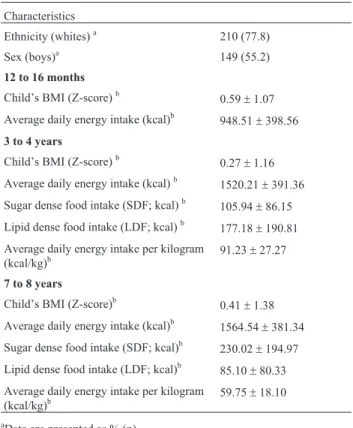
The sample consisted of 270 children followed until 7 to 8 years old on average. The nutritional and anthropomet-rics data were collected at 12 to 16 months, 3 to 4 and 7 to 8 years. The children included in the present study partici-pated in a randomized controlled trial of dietary counseling on breast feeding and diet during the first year of life. The trial consisted of 500 children, randomized in a control or intervention group, of which mothers received a dietary ad-vice about breastfeeding and complementary feeding dur-ing home visits in children’s first year of life. This dietary advice was based on the “Ten steps to Healthy Feeding”, a Brazilian national health policy for primary care, supported by World Health Organization (2006). More information of the first phase of the study can be found elsewhere (Vitolo et al., 2010), but in Table 1 we described the main charac-teristics of the sample. A substantial reduction of the sam-ple occurred throughout the study and the main reason for the losses was the inability to locate the participants’ homes, usually due to the family moving to another city. Other reasons for losses were refusal to continue and chil-dren or maternal death. This intervention was not the pri-mary objective of the present research and the participation in the intervention or control group was used as a confound-ing factor in statistical analyses.
Ethnicity was defined by the interviewer by skin color (i.e., whites and non-whites). More details of the traits studied are described elsewhere (Galvão, 2012; Louzadaet al., 2012; Fontanaet al., 2015; Mirandaet al., 2015). This study was conducted according to the guidelines of the
Declaration of Helsinki. The study protocol was approved by the Ethics Committee of the Universidade Federal de Ciências da Saúde de Porto Alegre (n. 286/06), and all par-ticipants provided written informed consent before com-mencing the study.
Nutritional status assessment
At 12 to 26 months, children were weighted using a portable digital scale (Techline, São Paulo, Brazil) and length was measured by an infant stadiometer (Serwital Inc, Porto Alegre, Brazil). At 3 to 4 and 7 to 8 years, chil-dren were weighted using a digital scale (Techline), and height was measured using a stadiometer (SECA, Ham-burg, Germany). BMI was calculated [weight (kg)/height2(m2)], and the values were transformed into Z-scores.
Dietary data assessment
One 24-hour dietary recall was collected for each child at 12 to 16 months, and two 24-hour dietary recalls, on two nonconsecutive days, were collected for each child at the ages of 3 to 4 and 7 to 8 years. The 24-hour dietary recall was carried out by a trained undergraduate nutrition stu-dent, and the child’s food intake was recorded on the day before the last home visit. A food portion measurement de-vice and the common household measures (e.g. teaspoons, tablespoons, cups) were used to quantify portion sizes.
Table 1- Main characteristics of the sample.
Characteristics
Ethnicity (whites)a 210 (77.8)
Sex (boys)a 149 (55.2)
12 to 16 months
Child’s BMI (Z-score)b 0.59±1.07
Average daily energy intake (kcal)b
948.51±398.56
3 to 4 years
Child’s BMI (Z-score)b
0.27±1.16
Average daily energy intake (kcal)b
1520.21±391.36
Sugar dense food intake (SDF; kcal)b 105.94±86.15
Lipid dense food intake (LDF; kcal)b 177.18±190.81
Average daily energy intake per kilogram (kcal/kg)b
91.23±27.27
7 to 8 years
Child’s BMI (Z-score)b 0.41±1.38
Average daily energy intake (kcal)b
1564.54±381.34
Sugar dense food intake (SDF; kcal)b
230.02±194.97
Lipid dense food intake (LDF; kcal)b 85.10±80.33
Average daily energy intake per kilogram (kcal/kg)b
59.75±18.10
aData are presented as % (n).
bData are presented as mean
Dietary information was entered into the Nutrition Support Program software from the Escola Paulista de Medicina, Federal University of São Paulo, based on the United States Department of Agriculture chemical compo-sition tables. The energy intake was calculated using only one dietary recall or the average of two dietary recalls. The items listed in the response were classified as sugar-dense foods (SDF) if the percentage of simple carbohydrates was higher than 50% (e.g., soda, Jell-O, candies, and artificially flavored juice) and as lipid-dense foods (LDF) if there was more than 30% fat (e.g. fried pastries, cookies with fillings, cold cuts and sausages, fried foods, and chocolate).
DNA analyses
Blood samples for DNA extraction were collected in EDTA tubes (6 mL). Genomic DNA was extracted from peripheral blood leukocytes by the Lahiri and Nurnberger procedure (Lahiri and Nurnberger, 1991).DRD2/ANKK1 TaqIA (rs1800497) and -141C InsDel (rs1799732) polymorphisms were detected by PCR-RFLP analysis us-ing primer sequences and conditions described by Grandy et al.(1993) and Oharaet al.(1998), respectively. Primers sequences (IDT Coralville, IA, USA) were as follows: TaqIA, forward primer 5’- CACCTTCCTGAGTGTCAT CAA -3’ and reverse primer 5’-AGACAACTTGGCCAG CCGTG-3’; -141C InsDel, forward primer 5’-ACTGGC GAGCAGACGGTGAGG and reverse primer 5’-TGCGCGCGTGAGGCTGCCGGT. PCR products were digested separately with either TaqI (TaqIA polymor-phism) or MvaI (-141C InsDel polymorphism) enzyme (Fermentas, Glen Burnie, MD, USA), according to the manufacturer’s instructions. Genotypes were determined after electrophoresis in 2 or 3% agarose gels that had been stained with ethidium bromide. For the DRD2/ANKK1 TaqIA polymorphism, theCallele contains aTaqI restric-tion site and is designated as theA2allele, while theTallele is designated as theA1allele. For the-141C InsDel poly-morphism, the-141C*Insallele contains a restriction site forMvaI while the-141C*Delallele does not.
Statistical analyses
Allele frequencies were estimated by gene counting. A chi-square test for goodness-of-fit was used to determine whether the observed genotype frequency distributions agreed with those expected under Hardy-Weinberg equilib-rium. Linkage disequilibrium was estimated using the Ha-ploview software Version 4.2 (Broad Institute, Barrettet al., 2005).
Pearson’s chi-squared or Fisher’s Exact Test was used to compare genotype or allele frequencies between white and non-white children. Since the first publication of an association study with theTaqIA polymorphism (Blum et al., 1990), and because of the rare occurrence of theA1 allele, genotypes are normally grouped asA1allele pres-ence orA1allele carriers (A1/A1andA1/A2, n=102),versus
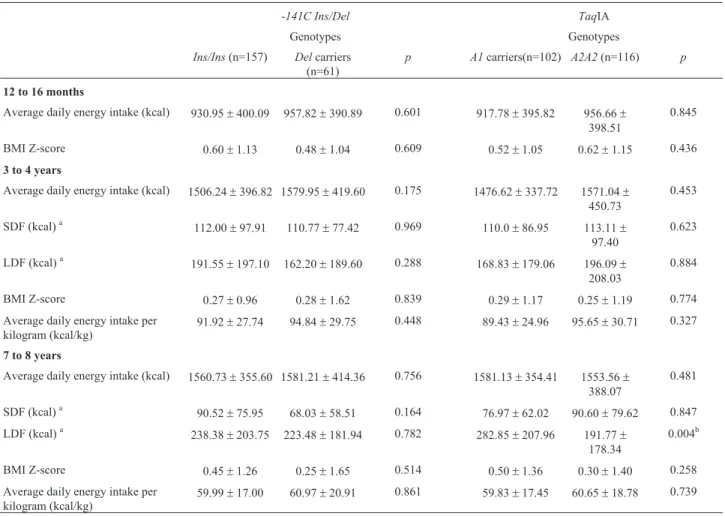
A2/A2 homozygotes (n=116). Similarly, due to low fre-quencies of theDelallele, genotypes of the-141C InsDel polymorphism were grouped byDelallele presence orDel allele carriers (Del/DelandIns/Del, n=61),versus Ins/Ins homozygotes (n=157). All data are presented as mean and standard deviation. Statistical analysis of SDF and LDF variables were performed on natural logarithm transformed data to normalize their distribution. This allowed including these variables in multivariate analysis; non-transformed values are shown in Table 2. Means of food intake (average daily energy intake, SDF, LDF and average daily energy in-take per kilogram) and adiposity (BMI Z-score) parameters were compared among genotype groups by a multivariate general linear model (GLM). The multivariate GLM was performed including all dependent continuous variables in one model, using the categorical variables (1) the control or intervention variable of the randomized trial, (2) sex, and (3) ethnicity as covariates, and genotypes of-141C InsDel (rs1799732) and TaqIA (rs1800497) polymorphisms as fixed factors (see Table 2). This first step of the analysis verified whether the group of dependent continuous vari-ables was significantly affected by the group of independ-ent categorical variables. Only LDF intake at 7 to 8 years old was associated with TaqIA polymorphism, and the covariates did not influence this dependent variable. There-fore, to test the association ofTaqIA polymorphism alone with LDF intake at 7 to 8 years, we performed a Mann-Whitney test. Ap-value of < 0.05 was considered signifi-cant. All tests and transformations were performed using the Statistical Package for Social Sciences, Version 20.0 (SPSS®, Chicago, IL, USA).
Results
This longitudinal survey sample was composed of 270 children, 149 (55.2%) boys and 121 (44.8%) girls, fol-lowed up from 12 to 16 months until 7 to 8 years old (Table 1). Minor allele frequencies (MAF) of theDRD2/ANKK1 gene variants observed in the sample were 0.14 ofDelallele of the-141C InsDel(rs1799732) polymorphism and 0.28 of A1allele of theTaqIA (rs1800497) polymorphism, which were intermediary to those described in the 1000 Genomes Project database for European (MAF 0.08 (Del) and 0.19 (A1)) and African (MAF 0.57 (Del) and 0.38 (A1)) popula-tions. All genotype frequencies in this sample were in agreement with those expected under the Hardy-Weinberg equilibrium. The two gene variants were not in linkage dis-equilibrium (D’=0.3, r=0).
ho-mozygous children at 7 to 8 years old (multivariate GLM p=0.004; Mann-Whitney testp=0.005). No association was detected amongDRD2 -141C Ins/Delpolymorphism with food intake and anthropometric parameters.
Discussion
The dopaminergic pathway has been associated with midbrain reward circuit activation (Rothet al., 2013), and individual differences in D2 receptor expression are
hy-pothesized to contribute to differences in motivated behav-iors, such as the motivation to eat (Gluskin and Mickey, 2016). Therefore, polymorphisms of the ANKK1/DRD2 gene are frequently associated with altered perception of food reward and weight gain (Arizaet al., 2012; Mulleret al., 2012; Rothet al., 2013).TaqIA is the most commonly tested polymorphism, and is characterized by a single nu-cleotide change [C(A2)/T(A1)] located downstream of the termination codon ofDRD2gene at theankyrin repeat and kinase domain containing 1(ANKK1)gene (Dubertret et al., 2004; Nevilleet al., 2004; Liet al., 2015; Ponceet al.,
2016). This SNP produces a Glu713-to-Lys (E713K) substitution in the ANKK1 amino acid sequence, at the eleventh ankyrin, which may alter the affinity of the ANKK1 protein and its substrate (Nevilleet al., 2004). It is not clear by which molecular mechanisms the ANKK1 pro-tein could be associated with the dopaminergic system and howANKK1polymorphic alleles would impact addiction vulnerability. However,ANKK1andDRD2genes belong to the same gene cluster, the NTAD cluster, an ancient clus-ter of which genes are apparently co-regulated and may have emerged when the central nervous system became more complex (Motaet al., 2012). Since genes of related function are sometimes found in the same cluster, it is pos-sible that ANKK1 is somehow involved in the dopaminergic reward processes via a signal transduction pathway (or other cellular response) (Nevilleet al., 2004). A fewin vitrostudies withANKK1gene mRNAs and pro-teins were able to show a potential connection between this gene and the dopaminergic system (Hoenickaet al., 2007; Garridoet al., 2011).
Table 2- Food intake and anthropometrics parameters according to polymorphisms inDRD2/ANKK1gene (-141C Ins/DelandTaqIA) in children at 1, 3 to 4, and 7 to 8 years old.
-141C Ins/Del TaqIA
Genotypes Genotypes
Ins/Ins(n=157) Delcarriers (n=61)
p A1carriers(n=102) A2A2(n=116) p
12 to 16 months
Average daily energy intake (kcal) 930.95±400.09 957.82±390.89 0.601 917.78±395.82 956.66±
398.51
0.845
BMI Z-score 0.60±1.13 0.48±1.04 0.609 0.52±1.05 0.62±1.15 0.436
3 to 4 years
Average daily energy intake (kcal) 1506.24±396.82 1579.95±419.60 0.175 1476.62±337.72 1571.04±
450.73
0.453
SDF (kcal)a 112.00±97.91 110.77±77.42 0.969 110.0±86.95 113.11±
97.40
0.623
LDF (kcal)a 191.55±197.10 162.20±189.60 0.288 168.83±179.06 196.09±
208.03
0.884
BMI Z-score 0.27±0.96 0.28±1.62 0.839 0.29±1.17 0.25±1.19 0.774
Average daily energy intake per kilogram (kcal/kg)
91.92±27.74 94.84±29.75 0.448 89.43±24.96 95.65±30.71 0.327
7 to 8 years
Average daily energy intake (kcal) 1560.73±355.60 1581.21±414.36 0.756 1581.13±354.41 1553.56±
388.07
0.481
SDF (kcal)a
90.52±75.95 68.03±58.51 0.164 76.97±62.02 90.60±79.62 0.847
LDF (kcal)a 238.38±203.75 223.48±181.94 0.782 282.85±207.96 191.77±
178.34
0.004b
BMI Z-score 0.45±1.26 0.25±1.65 0.514 0.50±1.36 0.30±1.40 0.258
Average daily energy intake per kilogram (kcal/kg)
59.99±17.00 60.97±20.91 0.861 59.83±17.45 60.65±18.78 0.739
Data are presented as mean±standard deviation.
In our sample, theA1allele (TaqIA rs1800497) was found associated with higher intake of LDF when com-pared with childrenA2/A2homozygous at 7 to 8 years. This allele has been associated with a reduction in D2receptor
availability (Pohjalainenet al., 1998; Ritchie and Noble, 2003; Eisensteinet al., 2016). Sticeet al.(2008) found that the dorsal striatum is less responsive to food reward in obese relative to lean individuals, probably because obese individuals have reduced D2receptor density that
compro-mises dopamine signaling. This hypodopaminergic func-tioning or reward deficiency syndrome may induce obese patients to overeat in an effort to compensate for this re-ward deficit; several studies are consistent with this theory (van Strienet al., 2010; Duran-Gonzalezet al., 2011; Win-kleret al., 2012; Cameronet al., 2013). van Strienet al. (2010) associated theA1allele with an increase in emo-tional eating in Dutch adolescents. TheA1allele was also most frequent in young obese Mexican-American subjects than in non-obese, as well as subjects with central-obesity versus subjects with no central-obesity (Duran-Gonzalezet al., 2011). Winkleret al.(2012) observed in an intervention study that carriers of theA1allele had a higher BMI at all time-points (baseline, after weight loss, and after weight maintenance), and showed less overall weight loss. Simi-larly, Cameronet al.(2013) observed that post-menopausal women carriers of theA1allele lost significantly less body weight and fat mass than women with theA2/A2genotype after undergoing an intervention-induced weight loss and increased carbohydrate intake. Some studies were not able to find any association of theDRD2 TaqIA polymorphism with adiposity parameters (Hardmanet al., 2014).
In the present study, no association was detected be-tweenDRD2 -141C Ins/Delpolymorphism with food in-take and anthropometric parameters, despite previous findings relatingDelcarriers of theDRD2 -141C Ins/Del polymorphism with higher D2receptor density (Jonssonet
al., 1999b). TheDRD2 -141C Ins/Delpolymorphism corre-sponds to a deletion of one cytosine from a run of two cytosines at position -141 of theDRD2gene (Arinami et al., 1997). This polymorphism has been associated with risk of schizophrenia in different populations (Arinamiet al., 1997; Oharaet al., 1998; Jonssonet al., 1999a; Himeiet al., 2002; Wuet al., 2005; Lafuenteet al., 2008a,b; Cor-deiroet al., 2009; Saizet al., 2010; Xiaoet al., 2013; Wang et al., 2016; Zhaoet al., 2016), as well as with weight gain (Lenczet al., 2010) and other responses due to schizophre-nia drug treatment (Lenczet al., 2006; Zhanget al., 2010). Associations have been described with propensity to alco-hol dependence in different populations (Ishiguroet al., 1998; Konishiet al., 2004a,b; Johannet al., 2005; Du and Wan, 2009; Prasadet al., 2010; Leeet al., 2013), suicide at-tempts (Sudaet al., 2009), psychiatric disorders (Kishidaet al., 2004; Ujikeet al., 2009; Lenceret al., 2014), different responses to medication and higher quit rates in smokers (Lermanet al., 2006). To the best of our knowledge, there is
no other study that associated the DRD2 -141C Ins/Del polymorphism with anthropometric parameters or food in-take.
The lack of associations in the two other phases of de-velopment (12 to 16 months and 3 to 4 years) may have oc-curred because children at these ages have restricted access to food, and depend on adults for meals, despite their own preferences. Notwithstanding, at 7 to 8 years, children have many opportunities to eat without parental supervision (Briefelet al., 2009), and the differences observed in LDF intake in our sample may have occurrred as an effort to compensate hypodopaminergic functioning.
Palatability is the induced sensitive response of foods that are usually rich in lipids and/or sugar (Cansell and Luquet, 2016). The sense of taste during food ingestion is the most important aspect in the decision to consume or avoid foods (Besnard, 2016). Contrary to sugar, oral fat perception was considered dependent only on its textural and olfactory cues, but recent identification of lipid-receptors in taste buds of both rodents and humans strongly suggests that lipids might also be perceived by the gusta-tory pathway (Besnard, 2016). Stimulation of taste buds triggers a signaling cascade leading to subsequent neuro-transmitter releases in different brain areas responsible for taste perception (e.g., anterior insula, frontal operculum, orbitofrontal cortex, and the mesolimbic system) (Besnard, 2016). The exchange between these areas results in infor-mation of the hedonic experience related to the food’s taste (Berridge, 1996). Therefore, not only sugar, but also lipids generate a hedonic experience, producing a positive rein-forcement that stimulates dopamine secretion in the brain (Salamone, 1994, Volkowet al., 2002), which is a stimulus associated with “wanting” (Berridgeet al., 2010). “Want-ing” is an incentive salience or motivation for reward trig-gered by reward-related cues, such as LDF (Berridgeet al., 2010). The attribution of incentive salience makes a cue and its reward more attractive, or more “wanted”, without being necessarily more “liked” (Berridge et al., 2010). Consistent with our findings, other studies of our group de-tected associations of palatable food intake with another polymorphism related to the dopaminergic system in chil-dren of the same cohort at 12 to 16 months and 3 to 4 years old (Galvãoet al., 2012; Fontanaet al., 2015). However, further research is needed to confirm the association of DRD2 TaqIA polymorphism with LDF intake and its po-tential mechanisms.
In summary, our results showed thatTaqIA polymor-phism may have an influence on the children’s eating be-havior, due to the presence of theA1allele associated with lower D2receptor density that may lead children to
nec-essary to replicate this findings in other populations and identify the mechanisms by which the dopaminergic sys-tem may influence food intake. Nevertheless, the investiga-tion of other polymorphisms in this and other genes of the dopaminergic system and their relation to food intake and anthropometric parameters may be interesting.
Acknowledgments
This work was supported by Conselho Nacional de Desenvolvimento Científico e Tecnológico (CNPq, Brazil; grant number 471186/2009-0), Fundação de Amparo a Pes-quisa do Estado do Rio Grande do Sul (FAPERGS, Brazil; grant number 070026-9), Programa de Bolsas CAPES and PIBIC/CNP, and PROAP-CAPES. The authors thank MSc. Ananda Galvão (in memoriam) for her crucial participation in this study.
References
Arinami T, Gao M, Hamaguchi H and Toru M (1997) A functional polymorphism in the promoter region of the dopamine D2 receptor gene is associated with schizophrenia. Hum Mol Genet 6:577-582.
Ariza M, Garolera M, Jurado M, Garcia-Garcia I, Hernan I, Sanchez-Garre C, Vernet-Vernet M, Sender-Palacios MJ, Marques-Iturria I , Pueyo R,et al.(2012) Dopamine genes (DRD2/ANKK1-TaqA1 and DRD4-7R) and executive function: their interaction with obesity. PLoS One 7:e41482. Barnard, ND, Noble EP, Ritchie T, Cohen J, Jenkins DJ, Turner-McGrievy G, Gloede L, Green AA and Ferdowsian H (2009) D2 dopamine receptor Taq1A polymorphism, body weight, and dietary intake in type 2 diabetes. Nutrition 25:58-65.
Barrett JC, Fry B, Maller J and Daly MJ (2005) Haploview: Anal-ysis and visualization of LD and haplotype maps. Bioinformatics 21:263-265.
Berenson GS (2012) Health consequences of obesity. Pediatr Blood Cancer 58:117-121.
Berridge KC (1996) Food reward: Brain substrates of wanting and liking. Neurosci Biobehav Rev 20:1-25.
Berridge KC, Ho CY, Richard JM and DiFeliceantonio DM (2010) The tempted brain eats: Pleasure and desire circuits in obesity and eating disorders. Brain Res 1350:43-64. Besnard P (2016) Lipids and obesity: Also a matter of taste? Rev
Endocr Metab Disord 17:159-170.
Blum K, Noble EP, Sheridan PJ, Montgomery A, Ritchie T, Jagadeeswaran P, Nogami H, Briggs AH and Cohn JB (1990) Allelic association of human dopamine D2 receptor gene in alcoholism. JAMA 263:2055-2060.
Briefel RR, Crepinsek MK, Cabili C, Wilson A and Gleason PM (2009) School food environments and practices affect di-etary behaviors of US public school children. J Am Diet Assoc 109(2 Suppl):S91-S107.
Cameron JD, Riou ME, Tesson F, Goldfield GS, Rabasa-Lhoret R, Brochu M and Doucet E (2013) The TaqIA RFLP is asso-ciated with attenuated intervention-induced body weight loss and increased carbohydrate intake in post-menopausal obese women. Appetite 60:111-116.
Cansell C and Luquet S (2016) Triglyceride sensing in the reward circuitry: A new insight in feeding behaviour regulation. Biochimie 120:75-80.
Carpenter CL, Wong AM, Li Z, Noble EP and Heber D (2013) As-sociation of dopamine D2 receptor and leptin receptor genes with clinically severe obesity. Obesity 21:E467-473. Cordeiro Q, Siqueira-Roberto J, Zung S and Vallada H (2009)
As-sociation between the DRD2-141C Insertion/Deletion poly-morphism and schizophrenia. Arq Neuropsiquiatr 67:191-194.
de Onis M, Blossner M and Borghi E (2010) Global prevalence and trends of overweight and obesity among preschool chil-dren. Am J Clin Nutr 92:1257-1264.
Du Y and Wan YJ (2009) The interaction of reward genes with en-vironmental factors in contribution to alcoholism in mexican americans. Alcohol Clin Exp Res 33:2103-2112.
Dubertret C, Gouya L, Hanoun N, Deybach JC, Ades J, Hamon M and Gorwood P (2004) The 3’ region of the DRD2 gene is involved in genetic susceptibility to schizophrenia. Schi-zophr Res 67:75-85.
Duran-Gonzalez J, Ortiz I, Gonzales E, Ruiz N, Ortiz M, Gonza-lez A, Sanchez EK, Curet E, Fisher-Hoch S, Rentfro A,et al.
(2011) Association study of candidate gene polymorphisms and obesity in a young Mexican-American population from South Texas. Arch Med Res 42:523-531.
Eisenstein SA, Bogdan R, Love-Gregory L, Corral-Frias NS, Koller JM, Black KJ, Moerlein SM, Perlmutter JS, Barch DMc and Hershey T (2016). Prediction of striatal D2 recep-tor binding by DRD2/ANKK1 TaqIA allele status. Synapse 70:418-431.
Fontana C, Vitolo MR, Campagnolo PD, Mattevi VS, Genro JP and Almeida S (2015) DRD4 and SLC6A3 gene poly-morphisms are associated with food intake and nutritional status in children in early stages of development. J Nutr Biochem 26: 1607-1612.
Galvão AC, Krüger RC, Campagnolo PDB, Mattevi VS, Vitolo MR and Almeida S (2012) Association of MAOA and COMT gene polymorphisms with palatable food intake in children. J Nutr Biochem 23:272 - 277.
Garrido E, Palomo T, Ponce G, Garcia-Consuegra I, Jimenez-Arriero MA and Hoenicka J (2011) The ANKK1 protein as-sociated with addictions has nuclear and cytoplasmic local-ization and shows a differential response of Ala239Thr to apomorphine. Neurotox Res 20:32-39.
Gluskin BS and Mickey BJ (2016) Genetic variation and dopa-mine D2 receptor availability: A systematic review and meta-analysis of human in vivo molecular imaging studies. Transl Psychiatry 6:e747.
Grandy DK, Zhang Y and Civelli O (1993) PCR detection of the TaqA RFLP at the DRD2 locus. Hum Mol Genet 2:2197. Gupta N, Goel K, Shah P and Misra A (2012) Childhood obesity
in developing countries: epidemiology, determinants, and prevention. Endocr Rev 33:48-70.
Hardman CA, Rogers PJ, Timpson NJ and Munafo MR (2014) Lack of association between DRD2 and OPRM1 genotypes and adiposity. Int J Obes 38:730-736.
Hoenicka J, Ponce G, Jimenez-Arriero MA, Ampuero I, Rodri-guez-Jimenez R, Rubio G, Aragues M, Ramos JA and Palo-mo T (2007) Association in alcoholic patients between psy-chopathic traits and the additive effect of allelic forms of the CNR1 and FAAH endocannabinoid genes, and the 3’ region of the DRD2 gene. Neurotox Res 11:51-60.
Ishiguro H, Arinami T, Saito T, Akazawa S, Enomoto M, Mi-tushio H, Fujishiro H, Tada K, Akimoto Y, Mifune H,et al.
(1998) Association study between the -141C Ins/Del and TaqI A polymorphisms of the dopamine D2 receptor gene and alcoholism. Alcohol Clin Exp Res 22:845-848. Johann M, Putzhammer A, Eichhammer P and Wodarz N (2005)
Association of the -141C Del variant of the dopamine D2 re-ceptor (DRD2) with positive family history and suicidality in German alcoholics. Am J Med Genet B Neuropsychiatr Genet 132B:46-49.
Jonsson EG, Nothen MM, Neidt H, Forslund K, Rylander G, Mattila-Evenden M, Asberg M, Propping P and Sedvall GC (1999a) Association between a promoter polymorphism in the dopamine D2 receptor gene and schizophrenia. Schi-zophr Res 40:31-36.
Jonsson EG, Nothen MM, Grunhage F, Farde L, Nakashima Y, Propping P and Sedvall GC (1999b) Polymorphisms in the dopamine D2 receptor gene and their relationships to striatal dopamine receptor density of healthy volunteers. Mol Psy-chiatry 4:290-296.
Kishida I, Kawanishi C, Furuno T, Kato D, Ishigami T and Kosaka K (2004) Association in Japanese patients between neuroleptic malignant syndrome and functional poly-morphisms of the dopamine D(2) receptor gene. Mol Psy-chiatry 9:293-298.
Konishi T, Calvillo M, Leng AS, Lin KM and Wan YJ (2004a) Polymorphisms of the dopamine D2 receptor, serotonin transporter, and GABA(A) receptor beta(3) subunit genes and alcoholism in Mexican-Americans. Alcohol 32:45-52. Konishi T, Luo HR, Calvillo M, Mayo MS, Lin KM and Wan YJ
(2004b) ADH1B*1, ADH1C*2, DRD2 (-141C Ins), and 5-HTTLPR are associated with alcoholism in Mexican American men living in Los Angeles. Alcohol Clin Exp Res 28:1145-1152.
Lafuente A, Bernardo M, Mas S, Crescenti A, Aparici M, Gasso P, Goti J, Sanchez V, Catalan R and Carne X (2008a) -141C Ins/Del polymorphism of the dopamine D2 receptor gene is associated with schizophrenia in a Spanish population. Psychiatr Genet 18:122-127.
Lafuente A, Bernardo M, Mas S, Crescenti A, Aparici M, Gasso P, Deulofeu R, Mane A, Catalan R and Carne X (2008b) Poly-morphism of dopamine D2 receptor (TaqIA, TaqIB, and-141C Ins/Del) and dopamine degradation enzyme (COMT G158A, A-278G) genes and extrapyramidal symptoms in patients with schizophrenia and bipolar disorders. Psychia-try Res 161:131-141.
Lahiri DK and Nurnberger Jr JI (1991) A rapid non-enzymatic method for the preparation of HMW DNA from blood for RFLP studies. Nucleic Acids Res 19:5444.
Lee SH, Lee BH, Lee JS, Chai YG, Choi MR, Han DM, Ji H, Jang GH, Shin HE and Choi IG (2013) The association of DRD2 -141C and ANKK1 TaqIA polymorphisms with alcohol de-pendence in Korean population classified by the Lesch typology. Alcohol Alcohol 48:426-432.
Lencer R, Bishop JR, Harris MS, Reilly JL, Patel S, Kittles R, Prasad KM, Nimgaonkar VL, Keshavan MS and Sweeney JA (2014) Association of variants in DRD2 and GRM3 with motor and cognitive function in first-episode psychosis. Eur Arch Psychiatry Clin Neurosci 264:345-355.
Lencz T, Robinson DG, Xu K, Ekholm J, Sevy S, Gunduz-Bruce H, Woerner MG, Kane JM, Goldman D and Malhotra AK (2006) DRD2 promoter region variation as a predictor of sustained response to antipsychotic medication in first-epi-sode schizophrenia patients. Am J Psychiatry 163:529-531. Lencz T, Robinson DG, Napolitano B, Sevy S, Kane JM, Goldman D and Malhotra AK (2010) DRD2 promoter re-gion variation predicts antipsychotic-induced weight gain in first episode schizophrenia. Pharmacogenet Genomics 20:569-572.
Lerman C, Jepson C, Wileyto EP, Epstein LH, Rukstalis M, Patterson F, Kaufmann V, Restine S, Hawk L, Niaura R,et al.(2006) Role of functional genetic variation in the dopa-mine D2 receptor (DRD2) in response to bupropion and nic-otine replacement therapy for tobacco dependence: results of two randomized clinical trials. Neuropsychopharmaco-logy 31:231-242.
Li H, Wang X, Zhou Y, Ni G, Su Q, Chen Z, Chen Z, Li J, Chen X, Hou X,et al.(2015) Association of LEPR and ANKK1 gene polymorphisms with weight gain in epilepsy patients receiv-ing valproic acid. Int J Neuropsychopharmacol 18:pyv021. Louzada ML, Campagnolo PD, Rauber F and Vitolo MR (2012)
Long-term effectiveness of maternal dietary counseling in a low-income population: A randomized field trial. Pediatrics 129:e1477-1484.
Miranda RC, Vetter SB, Genro JP, Campagnolo PD, Mattevi VS, Vitolo MR and Almeida S (2015) SLC6A14 and 5-HTR2C polymorphisms are associated with food intake and nutri-tional status in children. Clin Biochem 48:1277-1282. Mota NR, Araujo-Jr EV, Paixao-Cortes VR, Bortolini MC and
Bau CH (2012) Linking dopamine neurotransmission and neurogenesis: The evolutionary history of the NTAD (NCAM1-TTC12-ANKK1-DRD2) gene cluster. Genet Mol Biol 35:912-918.
Muller DJ, Zai CC, Sicard M, Remington E, Souza RP, Tiwari AK, Hwang R, Likhodi O, Shaikh S, Freeman N, et al.
(2012) Systematic analysis of dopamine receptor genes (DRD1-DRD5) in antipsychotic-induced weight gain. Phar-macogenomics J 12156-164.
Must A (1996) Morbidity and mortality associated with elevated body weight in children and adolescents. Am J Clin Nutr 63(3 Suppl):445S-447S.
Neville MJ, Johnstone EC and Walton RT (2004) Identification and characterization of ANKK1: a novel kinase gene closely linked to DRD2 on chromosome band 11q23.1. Hum Mutat 23:540-545.
Oggioni C, Lara J, Wells JC, Soroka K and Siervo M (2014) Shifts in population dietary patterns and physical inactivity as de-terminants of global trends in the prevalence of diabetes: An ecological analysis. Nutr Metab Cardiovasc Dis 24:1105-1111.
Pohjalainen T, Rinne JO, Nagren K, Lehikoinen P, Anttila K, Syvalahti RK and Hietala J (1998) The A1 allele of the hu-man D2 dopamine receptor gene predicts low D2 receptor availability in healthy volunteers. Mol Psychiatry 3:256-260.
Ponce G, Quinones-Lombrana A, Martin-Palanco MG, Rubio-Solsona E, Jimenez-Arriero MA, Palomo T and Hoenicka J (2016) The addiction-related gene Ankk1 is oppositely regu-lated by D1R- and D2R-like dopamine receptors. Neurotox Res 29:345-350.
Popkin BM (2006) Global nutrition dynamics: the world is shift-ing rapidly toward a diet linked with noncommunicable dis-eases. Am J Clin Nutr 84:289-298.
Prasad P, Ambekar A and Vaswani M (2010) Dopamine D2 re-ceptor polymorphisms and susceptibility to alcohol depend-ence in Indian males: A preliminary study. BMC Med Genet 11:24.
Ritchie T and Noble EP (2003) Association of seven poly-morphisms of the D2 dopamine receptor gene with brain re-ceptor-binding characteristics. Neurochem Res 28:73-82. Rossner S (1998) Childhood obesity and adulthood consequences.
Acta Paediatr 87:1-5.
Roth CL, Hinney A, Schur EA, Elfers CT and Reinehr T (2013) Association analyses for dopamine receptor gene poly-morphisms and weight status in a longitudinal analysis in obese children before and after lifestyle intervention. BMC Pediatr 13:197.
Saiz PA, Garcia-Portilla MP, Arango C, Morales B, Arias B, Corcoran P, Fernandez JM, Alvarez V, Coto E, Bascaran MT,et al.(2010) Genetic polymorphisms in the dopamine-2 receptor (DRD2), dopamine-3 receptor (DRD3), and dopa-mine transporter (SLC6A3) genes in schizophrenia: Data from an association study. Prog Neuropsychopharmacol Biol Psychiatry 34:26-31.
Salamone JD (1994) The involvement of nucleus accumbens do-pamine in appetitive and aversive motivation. Behav Brain Res 61:117-133.
Stelzel C, Basten U, Montag C, Reuter M and Fiebach CJ (2010) Frontostriatal involvement in task switching depends on ge-netic differences in d2 receptor density. J Neurosci 30:14205-14212.
Stice E, Spoor S, Bohon C and Small DM (2008) Relation be-tween obesity and blunted striatal response to food is moder-ated by TaqIA A1 allele. Science 322:449-452.
Suda A, Kawanishi C, Kishida I, Sato R, Yamada T, Nakagawa M, Hasegawa H, Kato D, Furuno T and Hirayasu Y (2009) Dopamine D2 receptor gene polymorphisms are associated with suicide attempt in the Japanese population. Neuro-psychobiology 59:130-134.
Terry P, Gilbert DB and Cooper SJ (1995) Dopamine receptor subtype agonists and feeding behavior. Obes Res 3 (Suppl 4):515S-523S.
Ujike H, Katsu T, Okahisa Y, Takaki M, Kodama M, Inada T, Uchimura N, Yamada M, Iwata N, Sora I,et al.(2009) Ge-netic variants of D2 but not D3 or D4 dopamine receptor gene are associated with rapid onset and poor prognosis of
methamphetamine psychosis. Prog Neuropsychopharmacol Biol Psychiatry 33:625-629.
van Strien T, Snoek HM, van der Zwaluw CS and Engels RC (2010) Parental control and the dopamine D2 receptor gene (DRD2) interaction on emotional eating in adolescence. Ap-petite 54:255-261.
Vitolo MR, Rauber F, Campagnolo PD, Feldens CA and Hoffman DJ (2010) Maternal dietary counseling in the first year of life is associated with a higher healthy eating index in childhood. J Nutr 140:2002-2007.
Volkow ND, Wang GJ, Fowler JS, Logan J, Jayne M, Franceschi D, Wong C, Gatley SJ, Gifford AN, Ding YS,et al.(2002) “Nonhedonic” food motivation in humans involves dopa-mine in the dorsal striatum and methylphenidate amplifies this effect. Synapse 44:175-180.
Wang GJ, Volkow ND, Logan J, Pappas NR, Wong CT, Zhu W, Netusil N and Fowler JS (2001) Brain dopamine and obe-sity. Lancet 357:354-357.
Wang Y, Liu L, Xin L, Fan D, Ding N, Hu Y, Cai G, Wang L, Xia Q, Li X,et al.(2016) The -141C Ins/Del and Taq1A poly-morphism in the dopamine D2 receptor gene may confer susceptibility to schizophrenia in Asian populations. J Clin Neurosci 30:1-7.
Winkler JK, Woehning A, Schultz JH, Brune M, Beaton N, Challa TD, Minkova S, Roeder E, Nawroth PP, Friederich HC,et al.(2012) TaqIA polymorphism in dopamine D2 receptor gene complicates weight maintenance in younger obese pa-tients. Nutrition 28:996-1001.
Wu S, Xing Q, Gao R, Li X, Gu N, Feng G and He L (2005) Re-sponse to chlorpromazine treatment may be associated with polymorphisms of the DRD2 gene in Chinese schizophrenic patients. Neurosci Lett 376: 1-4.
Xiao L, Shen T, Peng DH, Shu C, Jiang KD and Wang GH (2013) Functional -141C Ins/Del polymorphism in the dopamine D2 receptor gene promoter and schizophrenia in a Chinese Han population. J Int Med Res 41:1171-1178.
Zhang JP, Lencz T and Malhotra AK (2010) Dopamine D2 recep-tor genetic variation and clinical response to antipsychotic drug treatment: A meta-analysis. Am J Psychiatry 167:763–772.
Zhao X, Huang Y, Chen K, Li D, Han C and Kan Q (2016) -141C insertion/deletion polymorphism of the dopamine D2 recep-tor gene is associated with schizophrenia in Chinese Han population: Evidence from an ethnic group-specific meta-analysis. Asia Pac Psychiatry 8:189-198.
Internet Resources
World Health Organization (2006) The WHO Child Growth Stan-dards. from http://www.who.int/childgrowth/standards/en/.
Associate Editor: Angela M. Vianna-Morgante