UNIVERSITY OF ALGARVE
FACULTY OF ECONOMICS
INTERNSHIP IN REVENUE MANAGEMENT AT
PESTANA
SYLVIE RAMEIL
Internship
Master Degree in Tourism Economics and Regional
Development
Work made under the supervision of
Prof. Doutor Júlio Mendes
Dr. Pedro Andrade
i
INTERNSHIP IN REVENUE MANAGEMENT AT
PESTANA.
Work Authorship Declaration
I declare to be the author of this work, which is unique and unprecedented. Authors and works consulted are properly cited in the text and are included in the listing of references included.
Sylvie Rameil (Author’s Full Name)
(Signature)
Copyright © Copyright: Sylvie Rameil
The University of Algarve has the right, perpetual and without geographical boundaries, to archive and make public this work through printed copies reproduced in paper or digital form, or by any other means known or to be invented, to broadcast it through scientific repositories and allow its copy and distribution with educational or research purposes, non-commercial purposes, provided that credit is given to the author and Publisher.
ii RESUMO
Este relatório é composto por duas partes: revisão da literatura e descrição das atividades desenvolvidas durante o estágio no Grupo Pestana.
A revisão da literatura focalizou-se na aplicação de Revenue Management na indústria hoteleira. Foi analisado o enquadramento conceptual do Revenue Management e discutido o processo de recolha de informações úteis para a implementação prática do conceito, tanto em termos de aspetos técnicos como no que diz respeito à forma como as práticas inerentes são percebidas pelos potenciais clientes. A revisão da literatura identifica as condições do mercado que não são favoráveis aos hotéis como uma limitação para o uso de estratégias de gestão de receitas e realça as oportunidades que devem resultar de um melhor tratamento da informação baseado na experiência e na tecnologia. O estágio decorreu no departamento de Gestão das Receitas do Grupo Pestana e teve a duração de três meses. O Grupo Pestana é a maior cadeia de hotéis em Portugal e está estruturada em torno de três segmentos distintos: Hotéis Pestana, Pousadas de Portugal e “Luxury”. O estágio diz respeito apenas os dois primeiros segmentos. O objetivo do estágio foi desenvolver conhecimentos sobre a utilização das ferramentas necessárias para a gestão de receitas, perceber a necessidade de um gestor de canais, e entender as diferenças entre os dois segmentos estudados, Hotéis Pestana e Pousadas de Portugal. Tanto na revisão da literatura como no estágio foram identificadas várias dificuldades relativamente à realização de previsões seguras e à obtenção de informação de feedback. As soluções preconizadas realçam a importância cada vez maior da tecnologia neste processo de facilitação do desempenho do gestor de receitas nos hotéis.
iii ABSTRACT
The present work is composed of two parts: a literature review and the internship report. The literature review is focused on the application of Revenue Management to the hospitality industry. The priority is given to the collection of information useful to the professional practice of Revenue Management, which concerns both the technical aspect of performing Revenue Management and the comprehension of how Revenue Management practices are received by the potential customers. The review identifies the conditions of the market, who are not favorable to the hotels, to be a limitation to the use of Revenue Management strategies and stresses opportunities come from a better treatment of the information made possible by experience and technology.
The internship takes place in the Revenue Management department of Pestana Group for a duration of three months. Pestana Group is the largest hotel chain in Portugal. Its hotel activities included three segments: Hotel, Pousadas of Portugal and Luxury. The first two are presented in this report. The goal of the internship was to learn to use to tools necessary to Revenue Management, perceive the need for a channel manager, and understand the differences between the two branches Pestana Hotel and Pousadas of Portugal.
The review of the literature and the internship both point out the difficulties in obtaining accurate forecast and feedback information. The solutions found in the review of the literature and experienced during the internship was to rely more on technology to facilitate the role of the revenue manager.
iv General Index
FIGURE INDEX ... V TABLE INDEX... VI
CHAPTER 1: INTRODUCTION ... 1
CHAPTER 2: LITERATURE REVIEW ... 3
2.1. CONCEPTS AND GOALS OF REVENUE MANAGEMENT ... 3
2.1.1.Origin and definition of Revenue Management... 3
2.1.2.Application of the principles by the hotel industry ... 4
2.2. THE BUSINESS SIDE OF REVENUE MANAGEMENT ... 5
2.2.1.Forecasting methods... 6
2.2.2.Strategies and impact ... 7
2.3. THE CUSTOMER SIDE OF REVENUE MANAGEMENT ... 8
2.3.1.Perceived fairness ... 8
2.3.2.Management of demand ... 9
2.4. LIMITATIONS AND PERSPECTIVES ... 11
2.4.1.Limitations to the application of Revenue Management ... 11
2.4.2.Future of Revenue Management ... 12
2.5. CONCLUSION OF THE LITERATURE REVIEW ... 13
CHAPTER 3: THE INTERNSHIP ... 14
3.1. PRESENTATION OF THE COMPANY AND THE MISSION ... 15
3.1.1.Historical Development ... 15
3.1.2.Current organization ... 16
3.2. VALIDATION OF THE MISSION ... 19
3.2.1.Presentation of the mission ... 19
3.2.2.The mission and the professional project ... 20
3.2.3.The search for the internship ... 21
3.3. TOOLS USED TO PERFORM REVENUE MANAGEMENT ... 22
3.4. ACTIVITIES DURING THE INTERNSHIP ... 26
3.4.1.Management of inventory ... 26
3.4.2.Verification of Commissions ... 30
3.4.3.Price optimizations and promotional offers... 31
3.4.4.Reporting and weekly forecast meeting ... 33
3.5. DEVELOPMENTS ... 34
3.5.1.Two projects ... 34
3.5.2.Personal Growth ... 35
CHAPTER 4: CONCLUSION ... 38
v
FIGURE INDEX
Figure 1 Extracting reports from ORS 23
Figure 2 Example of Day by day files 24
Figure 3 Omnibees 25
Figure 4 Inventory management 29
Figure 5 Summary to send to agencies 30
Figure 6 Promotion 32
vi
TABLE INDEX
Table 1 Five conditions to apply Yield Management 3
Table 2 Localization of departments 17
1
CHAPTER 1: INTRODUCTION
The following report describes the activities carried out during the three months, full-time internship at Group Pestana. The purpose is to describe how Revenue Management (RM) is performed by two branches of Group Pestana: Pestana Hotels and Resorts and Pousadas of Portugal. The report is supported by a literature review on the topic of RM which focuses primarily on the practical aspects and aims to gather information which can be useful on the field. The objective of the internship report is to reflect on the experience from the perspective of a Master student in Tourism Economics.
RM has been a very active research topic since 1978, when the practice first appeared in the airline industry, under the name Yield Management. The emergence of RM was a consequence of the US Airline Deregulation Act. The deregulation act of 1978 stated that any airline could now “operate any route at any time with whichever fare they choose” (Guadix, Cortés, Onieva & Muñuzuri, 2010). These new opportunities led the scientific community to develop later on, a new management approach called RM.
The success of RM techniques as applied by the hotel industry became undeniable throught the 1990s as revenue gains over 6 percent were reported by hotels in North America, with a 2 to 5 percent attributed to RM practices. By the year 2000, RM had became an indispensable practice for most hotels over the world (Cross, Higbie & Cross, 2009). Yet to most readers, RM will seem like an obscure topic. The general public is little aware of the RM practices put in place by hotels. The side which the potential customer can see: the promotional offers, the special discounts, or the variations in prices over time; is only the tip of the iceberg.
When we first learned about RM and understood the importance it has for businesses nowadays was when Pedro Andrade, which would become the manager and supervisor for the internship, was invited as a guest speaker by PhD. Júlio Mendes for his class on Management of Tourism Organizations. The presentation picked our curiosity. To our ear, the depiction of RM as “selling the right room, to the right client, at the right price, on the right moment, and on the right channel” (Andrade, 2014) sounded like a challenge. The internship takes place in Alvor, Portugal under the supervision of Pedro Andrade (RM Director) for the hosting company, and Júlio Mendes (PhD. Professor of Marketing)
2 for the University of Algarve. For three months – August to October 2014, we were part of the two RM teams of Pestana Hotels and Resorts; and Pousadas of Portugal. The two teams practice RM under the direction of Group Pestana but with the variations inherent to the differences which exist between the two types of hotels.
This report is composed of four chapters. Chapter 2 is a review of the scientific literature on RM, starting with its outbreak in the airline industry, through its technical application for hotels, to the understanding of customer behavior. Chapter 3 focuses on the internship. It describes the environment of the internship and the internship experience. Finally, chapter 4 presents the main conclusions.
3
CHAPTER 2: LITERATURE REVIEW
2.1. Concepts and Goals of Revenue ManagementIn the literature, RM is defined as “delivering the right service to the right customer at the right time for the right price” (Hu Mei, 2013) (Heba Abdel Aziz, 2011) (Enz & Withiam, 2001). RM practices were first implemented by airlines in the 1970s under the name Yield Management (Cross, et al., 2009). In this part we explore the early days of RM in the airline industry and its necessary evolution to be used for property management.
2.1.1. Origin and definition of Revenue Management
Airline companies were the first to experiment with deeply discounted fares and to understand the risk of revenue dilution if customers who were willing to pay a higher price took advantage of these promotional offers. To control this risk, airlines developed two strategies. First, these deeply discounted seats typically carried restrictions to limit their availability. Second, the airlines also would limit the number of seats available to be sold at a discount (Cross, et al., 2009).
Yield Management strategies apply to the service industry when it meets the following five conditions: the offer has a limited capacity, the market can be segmented, future demand is uncertain, units of inventory are perishable and the business has the appropriate cost and pricing structure (Kimes, 2000). It is well suited for hotels because: the number of room is limited and cannot be extended in the mid-short term; the market can be segmented by: country, age, date of reservation, length of stay; future demand cannot be predicted accurately; rooms that go unsold one night are foregone; and the cost and pricing structure is characterized by high fixed cost with low variable cost and low margin on pricing. Table 1 Five conditions to apply Yield Management shows this comparison.
Table 1 Five conditions to apply Yield Management Conditions to implement YM Conditions in the hotel industry
Limited capacity Number of room is limited and cannot be extended in the mid-short term
M arket can be segmented Can be segmented by: country, age, date of reservation, length of stay, etc.
Future demand is uncertain Future demand cannot be predicted accurately
Units of inventory are perishable Rooms that go unsold one night are foregone
Appropriate cost and pricing structure High fixed cost with low variable cost and low margin on pricing
4 Enz & Withiam (2001) present the ideal outcome of RM as,
“…to match customers’ time and service characteristics to their willingness to pay – ensuring that the customer acquires the desired service at the desired time at an acceptable price, while the organization gains the maximum revenue possible given the customer and business characteristics.” (Enz & Withiam, 2001)
Supportive of the common definition of RM, the right service to the right customer at the right
time for the right price, Enz & Withiam (2001) propose to define the service “according to the
dimension of the service, how and when it is delivered, and how, when, and wether it is reserved”, the timing as encompassing both the timing of the service delivery and the timing of when the customer makes known the desire for the service, the price set according to a mix of “the timing of the service, the timing of the reservation, the type of service, or according to other rules that seem appropriate”, and the customer “according to demand characteristics relating to the service, the timing, and the price”.
The hospitality business was suited to beneficiate from the application of YM principles as invented by the airline industry. However, we see in the next part that the focus changes from yield to revenue to take into account the increase in complexity.
2.1.2. Application of the principles by the hotel industry
From its use in the airline industry to its use in hospitality business the definition of YM has evolved. It has moved from “maximizing yield or average daily rate to maximizing revenue” and gone further with the current focus being on property-wide profits rather than just room revenue (Anderson & Xie, 2010).
The first step to apply RM principles, say Enz & Withiam (2001), is to have a logical set of prices that make sense to the potential customers. To do so managers must know the demand elasticity of each rate class1. A change in price will initiate a change in demand for the service, and the decision model must take this into account. Competition and many other things will also affect demand. The decision maker cannot consider these creteria independently because they influence one another. Enz & Withiam (2001) conclude that the complex dynamic of pricing in the hospitality business creates the necessity to implement an effective and accurate
1 Rate class (as defined by Enz & Withiam (2001)): Groups the units to be sold (in this case the room nights)
5 information system. Guadix, et al. (2010) confirm the necessity for the hospitality industry to use technology management for its survival.
Cross, et al. (2009) explain that hotel’s RM had to differentiate itself from airlines because their activity is different, at least, on three aspects:
a) Hotel guests are less predictable than airline guests; b) Hotel sells are often blocked by group commitment; c) Hotels seek ancillary revenue from food and beverage.
Cross, et al. (2009) also illustrate how these differences add to the complexity of RM for hotels with this example: “accepting a guest for the last room on a Wednesday, even at the highest rate, could block a guest wishing to stay multiple nights”, therefore decreasing overall revenue. The complexity of applying RM to hospitality is in collecting the right information and, using it, producing the best strategy. The revenue manager must take into account the competitive environment, business specifications and customer behavior (Arate, Fraquelli & Viglia, 2012). In their study Arate, et al. (2012) observed that most hotels have set a dynamic pricing strategy; about 20% of the hotels studied changed their prices during the day immediately before the check in date and 46% and 71% of the hotels during the week before the respective check-in dates they studied. They demonstrate that hoteliers constantly monitor the local market, and react in a timely manner to demand shocks; that they look at competitors’ availability and adjust their pricing decisions accordingly. By observing that the price tends to increase when there is a scarcity of hotels available to book in a certain area they suggest strategic behavior, with hotels adapting optimal prices according to the competitor room availability.
Applying RM as became the norm in the hotel industry and, as a consequence, a self-centered strategy is no longer sufficient for hotels to thrive (Arate, et al., 2012).
2.2. The business side of Revenue Management
In 1988 Orkin writes the theoretical ground work of the tools deployed in RM application today. He indicates that properties’ need to focus on the following “four key areas” (Anderson & Xie, 2010):
- Forecasting,
- Systems and procedures,
- Strategy and tactical plans, - Feedback systems.
6
2.2.1. Forecasting methods
In 2014, after a review of the literature on forecasting Koupriouchina, Van der Rest & Schwartz (2014) observe that while there is a long tradition of high quality research in forecasting in tourism, the literature on forecasting for hotels is rather under developed.
Weatherford & Kimes (2003) point out the importance of accurate forecasts as they are the major input in most RM systems, underlying: “without accurate forecast, the rate and availability recommendations produced by the RM system may be highly inaccurate”. A RM system requires detailed forecasts including demand, price sensitivity, and cancellation probabilities (Koupriouchina, et al., 2014). Demand data forecasting methods can be classified in econometric models and time series. “Econometric models use exogenous variables, while time series models make no assumptions about external information and use only historical data for the variables themselves to predict future values” (Wu, Law & Jiang, 2010).
Guadix, et al (2010) present the time series models available. They make the distinction between the traditional forecasting techniques and advance booking models,
“Traditional forecasting techniques include moving average booking, exponential smoothing, or ARIMA time series models. […] Advance booking models predict customers pickup. They consider the incremental booking received during a certain interval. Hybrid models include regression.” (Guadix, et al., 2010)
There is no consensus of what would be the most accurate forecast, and furthermore, Koupriouchina, et al. (2014) emit a reserve regarding the significance of forecast evalution,
“Forecast evaluation, when considered at all, is in terms of statistical accuracy measures of point forecasts, and standard forecasting books do not discuss the decision making aspects. (Koupriouchina, et al., 2014)”
In the industry the lack of confidence in the forecasting methods is often compensated by a more intuitive procedure. For example, Cross, et al. (2009) observed a tendency in the industry to base the forecast on budgets. The pitfall of this method is that “human bias distorts budgets planning because budgets are too often built on hopes and expectations rather than objective assessment of the market place”. Another tendency observed by Koupriouchina, et al. (2014) is to compare computer generated forecast with manual forecasts “that is, predictions made by the hotel’s RM team”.
In addition to the selection of the forecasting method, other important questions must be addressed regarding procedures including the type of forecast (arrival or room nights), the level
7 of aggregation (total, by rate category, by length of stay, or combination), the type of data (constrained or unconstrained), the amount of data, the treatment of outliers, and the measurement of accuracy (Weatherford & Kimes, 2003). To apply control at the segment level, RM relies on, “accurate forecasts of demand by length of stay and rate category, that is, on forecast by segment.”
Koupriouchina, et al. (2014) give some insight on the purpose of forecast,
“In the real non-academic world, forecasts are made for a purpose and the relevant purpose in economics is to help decision makers improve their decisions. (Koupriouchina, et al., 2014)”
Lee (1990) found that a 10% increase in forecast accuracy in the airline industry lead to an increase in revenue by 0.5 – 3.0% on high demand flights.
2.2.2. Strategies and impact
Strategies used in RM include: pricing, promotional offers and methods for allocating the inventory. Feedback can come in many forms but always concerns the mesurement of performance.
Price discrimination is the key concept at the core of RM (Cross, et al., 2009) (Noone & Mattila, 2009). “A variable pricing structure allows for the use of discounted rates to stimulate demand for hotel rooms that would otherwise go unsold” (Noone & Mattila, 2009). Arate, et al. support that the hotel industry is an ideal field of application for the theory of RM, “usual price differentiation criteria are the physical attributes concerning service provision, reputation, and site specific attributes” (Arate, et al., 2012). RM’s pricing strategy differs from a discounting strategy because under the pricing strategy discounted prices are based on a set of rules known as rate fences2 (Cross, et al., 2009).
Koupriouchina, et al. (2014) identify the most common pricing and allocation tactics of RM to be:
a) The reservation of a portion of the capacity for higher value customers at a later date; b) Efficient price discrimination practices to extract as much of the consumer surplus as possible;
c) Overbooking policies to offset no shows, late cancelations, and early departures.”
2 Rate fence: In the hotel industry, any number of characteristics that are used to determine the rate for a room.
For example, a physical rate fence would involve the location of a room; a product-line rate fence would involve the class of service (concierge, ROH, etc.). (The Intrepid Traveler, 2015)
8 The many dimensions of booking decisions make it difficult to measure the impact of pricing. Price responsiveness must be measured at a particular location at a particular point in time if it is going to be accurate. Adding to the complexity, a guest’s willingness to pay varies as the arrival date approaches (Cross, et al., 2009). Cross, et al. (2009) report that “Marriott pioneered the development of a Revenue Opportunity Model (ROM) to measure the effectiveness of inventory controls.” A ROM evaluates the impact of RM decisions by comparing the actual decision to two scenarios : the “no control” scenario and the optimal revenue that could have been achieved. Dividing actual revenue by optimal revenue produces a “revenue opportunity index” that can be tracked over time and used to identify problems or opportunities.
Keeping in mind the old adage “when performance is measured, performance improves (Cross,
et al., 2009)” we understand that feedback comes in to reinforce the other areas of RM. The
application of RM strategies is unique to each situation. Strategic decisions are based on forecasts but also take into account a “human factor”. The ability to put it in place depends on the systems and procedures in place.
2.3. The customer side of Revenue Management
Enz & Withiam (2001) defined the strategic levers of yield management as 4-Cs: Calendar, Clock, Capacity and Cost; bound together by a fifth C: the customer. In this part we look further into customers’ behavior and responsiveness to change.
2.3.1. Perceived fairness
The growth of the internet as a channel of distribution in the last decade “has increased the hotels’ opportunities to discriminate clients, applying different prices on the online market over time (Arate, et al., 2012).” It has also changed customer’s awareness of RM pricing practices (Noone & Mattila, 2009).
Familiarity with RM pricing practices has been shown to influence customers’ perception of RM pricing. While customers unfamiliar with BAR3 pricing perceived nonblended rates as fairer, customers familiar with BAR pricing perceived no difference in fairness (Noone & Mattila, 2009). Noone & Mattila (2009) describe the Best Available Rate or BAR as:
“A term that as evolved in the domain of hotel room pricing […]. BAR is generally accepted to be the best non-qualified rate available on a given day. In other words
3 BAR: Best Available Rate (BAR) is defined as the lowest available unqualified rate, representing the fair market
9 if the customer did not qualify for a special rate they would be quoted the BAR rate (Noone & Mattila, 2009).”
The higher awareness of customer is a concern for hoteliers because clients are now more likely to behave strategically and take advantage of a decreasing price trend by “booking in advance and rescheduling later” (Arate, et al., 2012). Witnessing the evolution of customer behaviors, hoteliers and Online Travel Agencies4 (OTA) have put an end to the Last Minute Discount strategy (Cross, et al., 2009). The trend now is rather to fill the seats early with lower fares and have the “last-minutes seats (were) saved for passengers willing to pay much higher fares than existed before. (Cross, et al., 2009)”
A key matter to be considered when pricing is the extent of canniballization among rate classes, that is the number of high-price units that go unsold because buyers have taken advant age of a lower price.
Cross, et al. (2009) warn hotel businesses about the recently gained awareness of customers on these matters,
“The arbitrage opportunities that existed when hotels knew more than customers about price alternatives in the marketplace have evaporated. Consumers now have the benefit of knowing all competitive rates when shopping for a room.” (Cross, et
al., 2009)
So far in the hotel industry, price variations have not created any negative perceptions. Guadix,
et al. (2010) attribut it to the fact that the services hotels offer at different prices are well
differentiated. Hence, the customer perceives tangible differences in the service offered.
2.3.2. Management of demand
To optimize its prices and promotions a company needs to understand its clients (Enz & Withiam, 2001). This part shows some example of the methods used by RM to manage demand. Guadix, et al. (2010) present the different methods which can be used by reservation supervisor to decide wether to accept a guest requesting a room or not. The RM system they developed offers a set of possible strategies to make this decision:
a) The First-Come First-Serve rule, disregarding room distribution optimization, where who requests the room first gets the room;
b) The protection of room according to the optimal room distribution;
4 Online Travel Agencies (OTA): “OTA sites allow consumers to check live availability and pricing then book
travel products in real time through the OTA site (National Online Strategy Committee, 2011).” Examples include Booking.com and Expedia.
10 c) The nested method, a procedure to book rooms that considers higher fares and in turn utilizes the room reserved for the cheaper fare but charging the higher price with for only limitation the availability in the inventory.
Moreover, when the arrival date comes, the customer can potentially be a no show. To offset this problem hoteliers use several tactics such as: overbooking, cancellation penalities, or deposits (Enz & Withiam, 2001). Overbooking on reservations needs to be handled with care to avoid denying the service due to overbooking on the stay date (Anderson & Xie, 2010). When overbooking practices were set by airlines, the situation was different. Because all passengers were boarding at the same time, it was possible to ask for volunteers to give up their seets, and denied bording was relatively rare (Enz & Withiam, 2001).
Overbooking is largely use by airlines as a RM tool but presents more risks for hospitality business. As a result they have developed other policies to shift some of the responsibility for arrival uncertainty to the customer themselves, the most common of which is to request deposits to hold reservations or to take Non-refundable reservations. However, hoteliers have encontered sale difficulties when implementing these practices. Enz & Withiam (2001) explain that potential customers of hotels are faced with a larger offer of rooms than the potential customers of airline companies and therefore have the capacity to choose for the fully refundable reservations without compromising.
When asked to accept or reject a group reservations, RM will consider several factors. On the one hand, group reservations are an efficient strategy to fill the rooms, on the other hand “during high-occupancy times, accepting group business means deferring transient business5, which is
usually more lucrative” (Enz & Withiam, 2001). Hoteliers need to negotiate prices or refuse group reservations when it lowers there profitability. Hence, forecasting group business is particularly important (Enz & Withiam, 2001). In some cases, the hotel may lower its room revenue to accommodate a group, expecting higher revenues in auxiliary products (Guadix, et
al., 2010).
“An effective yield management strategy separates price-sensitive customer according to the time the service is rendered or a reservation is made.” (Enz & Withiam, 2001)
11
2.4. Limitations and perspectives
“Most hotels do not have sufficient marketing power to change room rates at will” (Enz & Withiam, 2001). In this part we review the limitations of RM and the opportunities of development through cooperation, specialization or technological improvement.
2.4.1. Limitations to the application of Revenue Management
From the review of the literature we identify three limitations to the application of RM for property management: the atomization of the market, the short reach of each actor and the uncertain outcome of RM strategies.
Enz & Withiam observe more variation in flight prices than in hotel reservations’ prices. They explain that hotel pricing is less flexible than airline pricing because potential customers generally have more choices available for accomodation than for flights. Because there are more alternatives, the risk of a downward spiral in prices is higher.
Another limitation is that “unlike the traditional industries, most hotels are not well-known” hence, they seek to cooperate with famous third party websites such as online tour operators. “The merchant model (also) led to erosion in the relationship between the hotels and their guests as people began to shop the third party site first.” (Guo, Ling, Dong & Liang, 2013)
Cross, et al. (2009) observe that under certain circumstances, a naïve application of the principle of RM that inventory predicted to be empty should be made available at the lower price can lead to a downward spiral in prices. They give the example of what happened post 9/11 when the market of leisure and travel shrunk. “Some hotels though that they could just drop rates as low as possible to attract people to the hotel. The fear of many in the business was a “race to the bottom”. Wu, et al. (2010) point out that “the recent global financial crisis and the threat of a worldwide H1N1 influenza epidemic have greatly affected the tourism and hospitality industries around the world” but that hotels reacted differently and could avoid the downward spiral of prices for the most part. (Wu, et al., 2010)
Guo, et al. (2013) state that because the market is becoming increasingly complex a cooperative behavior between the different actors is necessary to allow for sustainable planning and development.
12
2.4.2. Future of Revenue Management
Four areas for future development of RM emerge from the review of the literature: the technological improvement (Cross, et al., 2009), Process Management (Enz & Withiam, 2001), Customer-centric RM model, and Price Optimization (Cross, et al., 2009).
Progress in technology will allow for ever more automation, larger data bases and more detailed forecast; it will free revenue managers to think strategically (Cross, et al., 2009).
Process management can be for example examining ways to reduce changeover time. “Changeover time is the amount of time between customers, when planes are being cleaned and services or tables are being bussed and reset” (Enz & Withiam, 2001). Progress can be made in process management such as reducing service duration. Process management could make the room available earlier for the guest or give time for a higher quality service.
Cross, et al. (2009) predict that ultimately it should be possible to link all the revenue streams together so that you could start to measure revenue per available customer stream and see the potential for different customer segments. Because prices are becoming more and more transparent to the potential customer, hotels will need to consider customer price elasticity and not limit their strategy to matching competitors’ prices (Cross, et al., 2009).
Ultimately, technology and knowledge will make possible “promotions to fill off-peak periods or advertising campaigns with a more targeted message to narrow customer sets with known behavioral responses.” Cross, et al. (2009) predict the rise of a “vision of customer-centric RM to replace the long-standing inventory-centric approach.” This will mean “reaching out to the past customers in a personalized way with targeted packages that optimize their response.” Finally, Cross, et al. (2009) present Price Optimization as the next step in the evolution of RM. Price optimization marries an understanding of customer buying habits with market dynamics to predict what the customer is willing to pay in a wide variety of circumstances.” Price Optimization is the combination of advanced demand forecasts with elasticity effects while incorporating the competitive landscape. Cross, et al. (2009) conclude “One of the newer things in the RM field is a focus on profit as opposed to a focus solely on revenue.”
More than progress in the current application of RM, researchers foresee shifts in focus: from inventory centric to customer centric and from revenue optimization to profit optimization.
13
2.5. Conclusion of the literature review
The concept of RM can be expressed in one simple sentence, it is delivering the right service to the right customer at the right time for the right price, but its application to property management is complex.
First, Yield Management had to be adapted from the airline business to the hospitality business. The basic principle remained but RM needs to take into consideration the different conditions specific to hotel industry. We have, also, seen in the literature review that the application of RM is limited by the conditions of the market. The atomized market offers many alternatives to the potential clients and grants little power to the hotels. Moreover, most hotels are not well known by the general public, and therefore need to associate with travel agencies to gain visibility and reach further markets.
Second, the application of RM principals without proper consideration of the situation at hand may have negative consequences. Specifically, a naïve application of the principle of RM that inventory predicted to remain empty should be made available at a lower price, can lead to a downward spiral in prices and damage revenue on the long term. The review of the literature highlighted the importance of understanding and accurately predicting customer’s behavior, showing that being aware of customer’s response to change, such as the elasticity of demand, will allow revenue manager to make the right decisions.
As we conclude the review of the literature and make the transition to the internship report, we keep in mind that the practices of RM management, being enriched by research and practical experience, are in constant evolution. Researchers foresee that the improvement of technology, both hardware and software, and its progressive implementation on the field, will create new possibilities, which will fuel the change in focus that RM is undergoing.
14
CHAPTER 3: THE INTERNSHIP
This report continues with the presentation of the internship. Hopefully the report will show that the internship not only matches the requirement of the master degree but that it was a highly valuable experience.
We chose to complete our curriculum with an internship which combines both our interests: finance and tourism. The internship takes place in the RM department of the major hotel chain Pestana. The duration of the internship was of three months or 520 hours. It takes place from August to September which is the period of pick activity for hotels in the Algarve. Pestana is the largest hotel chain in the Portugal and continues to expand. In 2015, Pestana opened one more hotel in the Algarve. The RM team is a small team managing a large activity and taking on great responsibilities. We had the chance to learn from them and benefit from their experience.
Doing RM for a large hotel group like Pestana can be related to at least two fields of the Master: tourism and economics. Moreover, it gave me the chance to see in practice some of the teachings of the Master of Tourism Economics and Regional Development. For example, the subject of Tourism Economics had taught me, that demand is not fixe and can be created, a phenomenon which we could witness during the internship. The econometrics models applied to consumer behavior from Modeling Tourism Demand and Econometrics helped me conceptualize and sort through the information available to practice RM. We were also, better prepared to the use of challenging new software thanks to the subjects of Economic Impact of Tourism where we learned to use Eviews or sort through information of a data base as is the OECD.stat.
The practice of RM at a large scale is a complex and high stake activity. It requires the acquisition of a broad knowledge of the company and of the market conditions. The revenue manager needs to be able to gather and analyze information to take optimized decisions. Revenue manager is an important function which can make or break the success of the company. The practice of RM is highly technical but also largely based on assumptions, as confirmed by the literature review. For these reasons, the report contains a lot of background information: about the company, about the tools used for RM, and about the conditions of the market; which are necessary to give the full dimension of the internship. Please not as well, that not all responsibilities involved in the practice of RM can be assumed by an intern who is only
15 part of the team for a short period of time. Nonetheless, we were proactive and could get involved at least partly in all the activities that we described later in this report.
The third chapter of this work is focused entirely on the internship. We first present a brief historical of the company’s development and a review of its current organization. The core of the report narrates our tasks and projects. We also share about our learning and growth during the internship.
3.1. Presentation of the company and the mission
In this part we present the host company for our internship Pestana Group, from its creation in 1972 to the organization of the RM department in 2014.
3.1.1. Historical Development
The hotel group Pestana started with one hotel in 1972. The first hotel was ordered by Manuel Pestana when he returned to his native land of Madeira after becoming significantly wealthy in South Africa. Madeira is a Portuguese archipelago located in the North Atlantic Ocean. It includes the islands of Madeira, Porto Santo, and the Desertas. Today, Madeira is a popular year-round resort, being visited every year by over one million tourists. It was Manuel’s dream to bring wealth and recognition to Madeira. He believed that Madeira was a premium destination and therefore his hotel was designed to be a luxury hotel. Nowadays, the group manages ten units on the archipelago: 9 units in the Hotels segment and 1 in the Luxury segment.
Later in the 1990’s, under the supervision of Manuel’s son Dionísio Pestana, the group expanded in the Algarve (southern region of Portugal) and in Brazil. In the early 2000’s the group became fully global by expanding to South Africa, Cape Verde, Argentina, São Tomé e Príncipe and Venezuela. Pestana Group also secured a position of choice in Lisbon, Portugal’s capital with: 3 Hotels, 1 Luxury and 5 Pousadas. Over the years the group diversified its activities and also owns 15 Holiday Ownership units, 6 golf courses, 3 real estate ventures, two casinos, an air charter company and one tour operator.
Since 2003 Pestana is managing the Pousadas of Portugal chain “adding to its portfolio 44 unique properties located in converted monuments, palaces, convents and castles spread across the country.” (Pestana, 2012) Pousadas are buildings of exception, historic or culturally important, which have been converted in high standing hotels. They can be castles, palaces,
16 monastery or convent. These exceptional buildings “have been restored in order to maintain the elegance of a by-gone era whilst incorporating all modern conveniences.” The surroundings of these building are also outstanding. “These unique hotels are located […] in either historic cities such as Evora, a world heritage site, or in rural areas of outstanding natural beauty or interest such as Geres National Park.”6 Among the most successful Pousadas of the group we
count the castle of Obidos, where you can spend the night as king and queen in one of 17 rooms; also the Pousada Santa Marinha in Guimaraes. Also, recently opened but very promising, the Pousada of Serra da Estrela, Covilhã is located on the highest pic of Portugal.
The part of the activity managed by the RM team in Alvor is limited to the Hotels and Pousadas located in Portugal (including the islands).
3.1.2. Current organization
Before narrating the internship experience, we will provide back ground information about the organization of the company which will help the understanding. The repartition described in this part is in place since July 2013.
The Group Pestana counts over 100 properties and employs 7000 collaborators worldwide. In Portugal, the Group counts over 50 properties divided between three segments: Hotel, Pousadas of Portugal and Luxury. In this report, Hotel starting with a capital letter will stand for a unit of the Hotel segment, while hotel with a minuscule will mean an accommodation regardless of the segment. The administrative teams for Pestana Portugal are located in three different offices: the main office is in Lisbon, the other two are in Algarve and Madeira. In Alvor, Algarve’s office are the RM department, the account payable department, a small part of human resource department and the central of reservation for online reseller and travel agencies. The Luxury segment of Pestana is managed independently in Madeira and all the other departments are in Lisbon or in the hotels. Table 2 shows the repartition of responsibilities between the three offices.
17
Alvor Madeira Lisbon
Revenue Management The luxury segment is managed in Madeira, in complete independence from the other segments.
Accounting and finance
Account Payable Marketing and sales
Central of reservation – Travel agencies
Central of reservation – Direct clients
Human Resources
Table 2 Localization of departments
At times the distance between people working together is the cause of problems and can reduce efficiency but it is largely facilitated by technology. The communication between offices is done by phone or email or through the instant messenger Lync. There is no indication that the Group is working toward a one centralized office organization, in Lisbon for example. In fact, this repartition as one advantage, it is for the management teams to be close to more of the hotels of the Group. The office in Alvor is surrounded by four hotels of the Group and is also not far from the Pousada of Estoi. During the internship we had the chance to go and visit the Pestana Delfim with the rest of our team to sea for ourselves the different facilities of the hotel. Several administrative departments make the distinction between the three branches of the business: Hotels, Pousadas and Luxury. These departments, like it is the case for the RM department have a team dedicated to each branch. Table 3 points out some of the differences between Hotels and Pousada. Keep in mind that the goal here is not to be comprehensive but to help general understanding of why the two segments should be treated separately. Pousadas are smaller units than Hotels. They are a more specialized and less known product. They appeal to a different market segment. Clients do not have the same expectations or behavior patterns.
18
Pousadas Hotels
Number of rooms About 30 rooms A least 100 rooms
When the
reservations are made
Mostly within the last month before the stay
No distinct pattern
Length of stay Often 2 or 3 nights Minimum of one week
Channel of reservation
Mostly direct reservations: Pestana website, Pestana call center.
All channels: direct, travel agencies, OTA.
Objective of the stay Special occasion: wedding, anniversary etc.
Holidays and corporate
Promotional offers Seasonal, experience (Wine Season Package, Romantic Package etc.)
Seasonal and generalized to all units
Table 3 Differences between Pousada and Hotel segments
Other departments like the centrals of reservation consider the business activity globally. Hence, there is only one central of reservation for individual guests who wish to stay at one of the Pestana property, be it a Hotel, a Pousada or a Luxury property because from a reservation stand point the processes are similar, but it takes three RM departments with tailored processes. Actually, there are two centrals of reservation but for a different reason. Centrals of reservation are differentiated according to the market segment they cater: in Lisbon the central for individual clients and in Alvor for travel agencies. Reservations for group, over 10 people, are treated again separately.
The department of RM, where the internship takes place, consists of three teams working in parallel. Hotels’ and Pousadas’ RM teams are in Alvor and Luxury located is in Madeira. The Hotels RM department is managing revenues for 22 properties, the Pousadas of Portugal department 27 properties and the Luxury segment 4. The teams count three collaborators for Hotels and two for Pousadas, including the department directors. In fact, the director for Pousadas has his office in Lisbon and his one direct collaborator is in Alvor.
Group Pestana is a large hotel group whose component parts have been added successively over a short time period. Reorganizations are common at Pestana, always with the objective to fine the optimal organization which will allow for economies of scale while keeping a service of quality.
19
3.2. Validation of the mission
In this part we explain why this internship was an exceptional opportunity considering our background, the environment and our objectives.
3.2.1. Presentation of the mission
The goal of the internship is to understand the different components of RM. The main aspects of RM are: forecast, pricing and then feedback, we can also mention inventory management. The goal was also to see in practice how the principles of RM can be adapted to different business models (Hotels and Pousadas) and how RM relates to the other activities within the business (central of reservation, sales, website, properties) and outside the business (OTAs). According to the internship plan, defined conjointly with the internship supervisor, the internship is of duration of three months and is divided in two periods of one and a half month. “The first half will be concern with the RM activities of the brand Pousadas de Portugal – under the tutoring of Johann Pita, the second part will be to contribute to the RM of the brand Pestana Hotels – under the tutoring of Ricardo Floro.”
The internship plan defines four objectives:
“1. To understand the type of business of the Pestana Hotel Chain, and the need for Revenue Management
2. To be able to identify the major differences between the two brands
3. To have a general vision of the tools and systems used to: collect data, analyze the data, and prepare forecasts.
4. Understand the role of a Channel Manager”
We can see in the list of objectives a focus on observation and understanding. RM is complex, especially when applied on a large scale as it is the case at Pestana and the review of the literature as taught us that the appropriate use of its principles requires experience and vision.
Further, the internship plan tells us “activities will concern the all spectrum of tasks related to the use and analysis of tools and data within the department of RM.” The interpretation we made of this is that there was no limit to what we could do: we could take part in all activities of the department. We committed ourselves to show what we could do and fine our place in the team.
20 In retrospective, the team was very available to answer our questions and provide guidance. We enjoyed the freedom to explore what sparked our interest and spend time on projects.
3.2.2. The mission and the professional project
The internship is the conclusion of the Master of Tourism Economic and Regional Development (MTERD). This experience makes the transition between the university years and the start of a professional career.
To put things in perspective, we need to tell more about ourselves and our experience. We are French born and raised. We came to live in Portugal in July 2013 at the same time that we enrolled in the Master of Tourism Economics and Regional Development. We speak French and English and we are learning Portuguese as we go. In France, we went to Business School where we graduated in Business Administration. We specialized in finance and had several professional experiences during our studies, in both administrative and financial positions, including a gap year. We are well-traveled as we have worked or studied in five different countries (France, Ireland, USA, Netherlands and Spain). We are now living in Portugal. The Master of Tourism Economics and Regional Development is focused on tourism. It makes sense to study and work in tourism in the region of Algarve because tourism is currently the main source of revenue in the region. As described by Oliveira, et al (2013) “The Algarve has an area of 5412 km² with approximately 450 thousand inhabitants but receives and average of 7 million foreign tourists every year.” It also has the potential for luxury tourism.
This quote from Oliveira, et al (2013) gives an idea of the potential of the region, “Algarve is a tourist destination of worldwide excellence. It was considered two times the best worldwide golf destination in the last decade by the International Association of Golf Tour Operators (IAGTO, 2013).”
Being a foreigner leaving in Portugal for the first time (just over one year at the time of the internship) we aspired to seize every opportunity to learn more about the culture and ways of our host country. Working at Pestana was a big step in this direction. Indeed, Pestana is the largest hotel group in Portugal and has played an important part in the development of tourism in the country. The company has deep Portuguese roots as it was created in Madeira by a
madeirense (natural of Madeira in Portuguese) and in its expansion has shown a preference for
countries which have a certain affinity with Portuguese culture such as Mozambique, Brazil, and Cape Verde (Pestana, 2012).
21 Working for this company was also an interesting choice for more practical reasons. At the core of Pestana’s corporate culture is the belief the Portugal as the capacity to be a premium destination. This resonates with me because the potential of this region to be of worldwide excellence is also a conviction we have formed for ourselves during the course of the Master degree. Moreover, the company is well implanted in Algarve, with 13 properties, which makes doing the internship at Pestana a plus all around: the group is large and therefore is a potential employer in the future; the group is well known and therefore will make a positive impression on our future applications. Lastly, there is a lot we could learn by immersion in the environment of our internship, from language to culture.
Our two areas of study have been Business Administration and Tourism, this internship doing RM at Pestana was the perfect opportunity to combine and explore further both topics.
3.2.3. The search for the internship
In this part, we share about how we arrange the internship as the situation is particular and this might be useful information for future master students.
When looking for the internship we faced several difficulties. First it is important to say that concluding the Master with an internship is not the most common option elected by students of this Master, it is in fact rarely chosen. In our opinion, the reason for disregarding this option is that most students are foreigners and those who aren’t are already working full time. Difficulties we encountered were the lack of knowledge of the market and not speaking the language. Nonetheless, doing an internship here was the best suited option for us and also the one we could learn from the most.
To find the right internship we tried several ways: first we consulted job offers published on online job boards (NetEmprego, Sapo, Trovit, Turijobs) which gave me a general idea of the market. Later we went door to door to give our résumé to the surrounding hotels. It gave me chance to practice our presentation and adapt it to our audience. At last we turned to the university. Our teachers were responsive and helpful. The opportunity to do the present internship at Pestana rose when Pedro Andrade, the RM director at Pestana came to the university to give a presentation for our class. We exchanged contact information and sent our résumé. We were invited to do an internship at Pestana Group in RM.
22 Our determination led us to do the internship we were really hoping for, which combines our interests and is a great opportunity.
3.3. Tools used to perform Revenue Management
The first step to performing RM was to understand the tools which were available to the department. The tools play a large role in your ability to perform yield management. Indeed, you need the right tool to gather the right information, design the right strategy, implement it at the right time and make it available to the right clients or channels. As we have seen in the literature review more automatization will mean more time to truly perform RM.
At Pestana making processes easier thanks to technology is an ongoing process. Some of the aspects described in the review of the literature were not yet part of standard processes at the time of the internship. For example, the side of RM which consists of monitoring competition had not been explored yet. At least it was not part of the daily activities that we have observed. During the time of the internship, the possibility was explored to subscribe a third party offering this kind of service. Several propositions were presented to the team and tested.
The review of the literature also suggests that other companies use tailored software for budgeting and forecasting, allowing the comparison of forecast under different imposed conditions and feedback comparing forecast to actual results. In our experience at Pestana, most of the analysis is done with Excel. We present below the tools we used during our internship.
(1) Business Intelligence Software used together with MS Excel
The software used by the company for Business Intelligence is developed by Opera and comes in two applications: ORS (Opera Reservation System) and PMS (Property Management System). ORS and PMS are used to centralize all the information regarding the business. It is basically a database tailored for hospitality businesses. It contains and gives access to the reservations.
Within ORS and PMS environments, information such as total room availability, room types and rates can be set manually. It is used throughout the group by management and by executives, at the administrative offices and at the hotels. It contains information about the room’s distribution and whether or not the room as been cleaned or the guest as checked in. Once information is input, it is available to everyone who is granted access in real time. Moreover, all changes in price, promotion or availability made through the software are
23 synchronized almost instantly with the selling website of Pestana without any human intervention being required.
To make a simple distinction we can say that ORS is used mostly by the central of reservation and collaborators at the properties, while PMS is mostly used by the collaborators at the office. Also PMS is used mostly for the Pousada units. As a RM controller, to check an invoice we would use ORS but to make a price modification for one of the Pousadas we would use PMS. The two programs synchronize almost in real time but do not offer the same functions to the user.
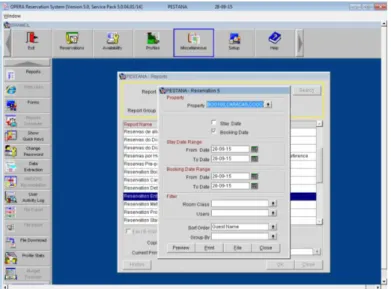
Figure 1 Extracting reports from ORS
The Business Intelligence software (ORS and PMS) allows us to retrieve punctual information in the form of reports, see Figure 1, but the functions available are too limited to have it perform analyses for us. To perform reporting the data had to be retrieved from the BI database through a pivot table in an Excel spreadsheet called a Cube (a pivot table connected to the data base). There are three Cubes: one for the Hotels, one for the Pousadas and one for the Luxury properties. The Cubes are very malleable, they allow us to retrieve and cross almost any information we need.
However, we could see two limitations to the Cubes:
- The amount of data they have to process makes them rather slow;
- The information they contain is updated daily. Once the cube is updated, the previous information is forgone. Which mean for example that you cannot make a chart of the level of forecast occupancy for a given date overtime, nor can you inquire what was the situation last year at the same period. This information has been written over every day since it was produced.
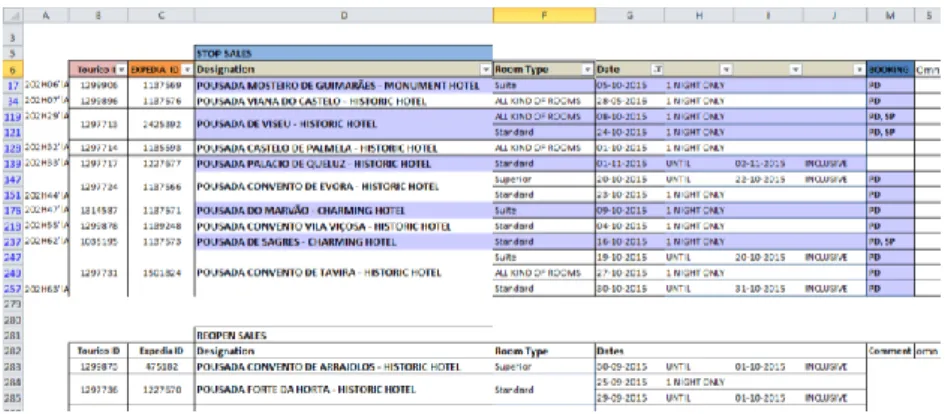
24 To solve these two problems, the team has found a solution long ago: the reporting processes are not base directly on the Cubes, they are based on other files which save the information available from the cube daily. These other files need to be updated and saved every day manually so it does take some time but it solves the problem. Figure 2 shows the layout and information of these files. We call those files Day by day. The reporting files get their source information from the Day by day files.
Figure 2 Example of Day by day files
Excel and Opera could be all the tools we used to manage prices, make stop sales and perform strategic analysis if the rooms were only sold through Pestana’s website. The RM of the direct sales, made via the Pestana website or via the direct client call-center could be managed fully with Excel and Opera.
It is the case that a large part of the sales is not made directly from the clients to the hotel group but by the client through a Travel Agencies to the hotel group. The synchronization with the resellers is not done with the Opera suite. It requires the intervention of other pieces of program.
(2) Omnibees
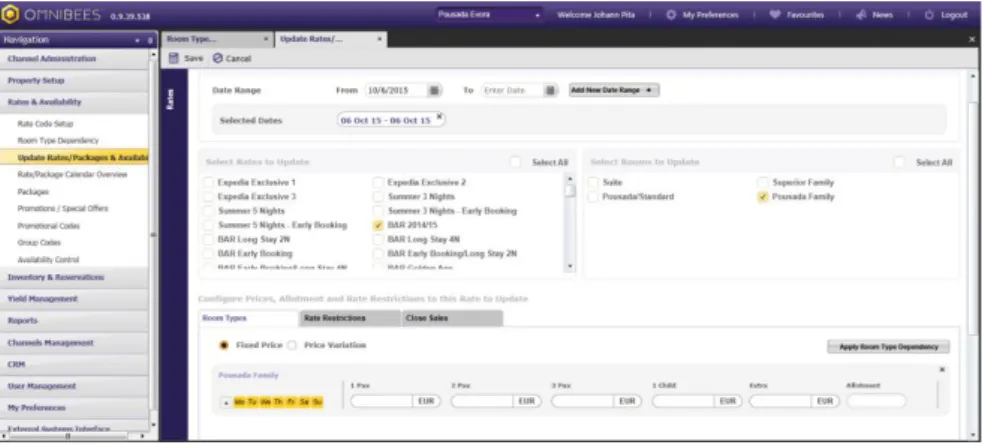
Omnibees is a channel manager. The synchronization of the prices and offers with the reseller is made through the Omnibees platform which is a third party website. Omnibees is a web based platform, which serves as a channel manager allowing us to “update rates and availability on all channels simultaneously” (Omnibees, 2015). In the RM department, Omnibees is used to update prices or close/open sales for all the subscribed agencies, see Figure 3. Omnibees seem to be popular as most Online Travel Agencies have subscribed.
25
Figure 3 Omnibees
As part of our internship in RM we spent 10 days in the central of reservation in Alvor which is the central for agencies and companies as opposed to the central in Lisbon which manages the direct reservations. During those 10 days at the central of reservations we could see that although the management of reservation is partially automated with Omnibees it still requires a lot of manual input.
Omnibees is used to synchronize information with most of the agencies but it is a paid service and agencies can choose to subscribe or not. Not all agencies are subscribed; therefore, there are more tools necessary to RM. Agencies which did not subscribe to Omnibees seem to be either the very large ones such as Expedia or very small ones. Those who do not use Omnibees need to be dealt with separately using either their specific extranet when they make one available or communication by emails, as we see in the next two points.
(3) Extranets of Online Travel Agencies
For the travel agencies who are not subscribed to Omnibees, the modifications need to be inputted on their individual extranet websites. We were explained that, before Omnibees became popular, going to each extranet and input the modifications manually was the primary method. It used to be the case that, each agency had its own business to business extranet. The revenue managers had to go to each website and enter the modifications. It was very time consuming to update prices back then. Thankfully, Omnibees and the other similar platforms are becoming the norm.
26
(4) Communication by email
The last method is to communicate all information by email which the agency will then process in its own w ay. Some of the partners are agencies “off-line”, which means they have no online presence; in this case the information about prices and promotion is communicated by email. At the time of the internship, those were all the tools made available to the department. The list is likely to extend in the short term as management was considering the implementation of a piece of software that gathers information about the competition’s offer in real time.
3.4. Activities during the internship
During the internship, we could take part in most activities of RM from inventory management to the weekly forecast meetings. Most of our time was spend working on RM for Pousadas of Portugal both for practical reason and because we thought it was a niche were we could try and learn a lot of things.
3.4.1. Management of inventory
A regular day in the office starts with the management of the inventory which consists in checking the occupancy level of the properties of the group for the time onward and making the dates which are outsold, or about to be, non-available for sale on the different channels. After the first month of internship we could complete the task we are about to describe, from the gathering of the information to the communication of the decisions with minimum supervision for the RM of the Pousada branch.
We first give some contextual information, then explain how the strategic decisions are made and conclude on the practical aspect of the activity.
(1) General information
The RM manager is managing inventory for 27 Pousadas. Most Pousadas are small properties with between 30 and 50 rooms, which mean they can quickly get sold out. The observed trend is that “most sales are made within one month before the date of stay” (Pita, 2014). However, a time period when a local event takes place or bank holiday can be booked very early. We also observe a rather short duration of stay with many one night or two nights stays at a Pousada.
27 We think that if you consider the number of properties, the many selling channels and the duration of stays you will understand that management of inventory can become a challenging activity. To make things worse, overbookings, should they happen, are more difficult to resolve than in the average hotel unit because each Pousada offers a unique experience and cannot be easily substituted for another hotel nearby.
Management of inventory is rendered more difficult by the exclusive allocation, under the terms of their contract with Pestana Group, of a certain number of rooms to certain travel agencies. In the business language those rooms are referred to as allotments. They are negotiated by the agencies along with the contracts. It means that an agency has rooms allocated to be sold exclusively by them. It can be 30 or 100 rooms in a large hotel or 2 to 3 in a smaller unit. These allocated rooms are not subject to stop sales and will remain available for the agency to sell until the inventory is released usually two days before the stay date.
Allotments make management of inventory increasingly complex because the revenue manager cannot take the risk to wait until the release to react if the rooms have not been sold. There is no guaranty that the agency will be able to sell the allocated rooms therefore waiting could result in a loss for Pestana. The rooms might be allocated exclusively to agencies but the agency will only pay for the rooms which will in fact accommodate their clients. Not offering those allocated rooms for sell on the other channels can potentially result in large opportunity costs. Some agencies have a high power of negotiation because they also schedule flights which bring the clients to the islands. Pestana runs several hotels in Madera and Acores. The majority of the clients for the hotels are British or German. The few companies which connect these countries to the islands can make or break a season depending on how many connections they decide to operate. There is a strong co-dependence between these airline/travel companies and the hotels which accommodate their clients.
The management of inventory is mainly concerned with closing and occasionally re-opening sales.
(2) When do we Stop Sales?
The order to stop selling is referred to as a Stop Sales, it can be an order to stop selling one type of room or all types. We can stop selling either because the hotel is predicted to be full or for strategic reasons.
28 The hotel is predicted to be full when the reservations accounted for in Opera, reach full or almost full capacity of the hotel. We, however, have to remember that reservations are not a warranty because they can be cancelled or the client can be a no-show when the date of the stay comes. On one hand not every reservation will turn into a stay, on the other hand, the quantity of reservation will most likely keep increasing after the stop sales has been communicated both because of delays in the synchronization with agencies and agreements with some of the agencies giving them the right to make reservations after the stop sales has been communicated. When the revenue manager takes a decision to stop sales or to keep sales open he has to take into consideration that the information available to him is not fully reliable. With certainty closing sales with 100% occupation for a period of high demand such as the summer month will result in overbookings.
Strategic reasons include delaying sales with the expectation of selling at a higher price or to a different market or to come back with a better offer. For example, you might expect sales to go up for Christmas but only open the sales once an offer including dinner and gala has been put together and the price of this offer has been negotiated with agencies. To avoid selling all the rooms before the offer could be organized the revenue manager can close the sales.
Other than closing the sales, the RM can also alter the price or create restrictions on the reservation such as a minimum number of nights.
(3) How do we do it?
We now look at how the inventory management is done in practice.
There is a process in place to collect the necessary information to take the decision. Although the forecast occupancy of the hotels is visible in ORS and PMS, we do not visualize it there for the purpose of managing inventory. We think it is done in Excel and not in Opera because we need to keep track of the actions taken.
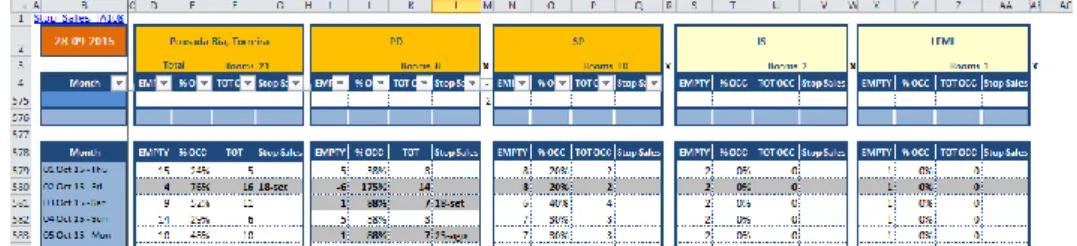
As you can see on Figure 4, the total occupancy appears first then the detail per room type (PD: Pousada or Standard, SP: Superior, JS: Junior Suite and LFML: Large Family Room), then below the column EMPTY gives the number or room style available, TOT the number of rooms occupied and % OCC the occupancy in percentage for the specific day. The date in the fourth column is the date when the stop sales was sent out. A date in the All type part means a stop