EDISON D. BIDONE1∗∗, LUCIANO LAYBAUER2∗, ZULEICA C. CASTILHOS1∗∗ and JOHN L. MADDOCK1∗∗
1Departamento de Geoquímica, Instituto de Química, Universidade Federal Fluminense
24020-007 Niterói, RJ, Brazil
2Universidade Federal do Rio Grande do Sul, 91501-970 Porto Alegre, RS, Brazil
Manuscript received on June 19, 2000; accepted for publication on February 12, 2001; presented byM. Formoso
ABSTRACT
The Camaquã Copper Mines (CCM) were the main sulphide deposit in Southern Brazil and have been in operation from last century to 1996. To evaluate water contamination and environmental risk increase by heavy metals from mining operations, two points on the João Dias Creek were sampled (Station 1, background area and Station 2, contaminated area). Mining activity increased the natural weakly heavy metal fluxes by approximately 5424 kg. (∼ 60%)of the total metal flux, 1542 kg. (∼ 49%)of dissolved and 3881 kg
(∼66%)of particulate metal flux. Total metal flux of anthropic origin was mostly due to Fe followed by Cu> Zn> Mn whereas Cd, As and Pb fluxes were negligible. The potential human health hazards and risk assessment related to daily intake of water from João Dias Creek are mostly due to Mn and should be of concern for the contaminated area. The ingestion of water from station 2 represents incremental risks of 130% and 59% respectively, considering the non-carcinogenic and the carcinogenic effects. The real increase of human health hazards may be greater than those related to the total concentrations since Mn and As dissolved concentrations were 5.5 and 2.0 higher than acceptable, respectively.
Key words:water contamination, environmental risk, heavy metals, copper mining.
INTRODUCTION
Recent research carried out in some rivers of the Rio Grande do Sul, the southermost brazilian state, showed significant loads of heavy metals transported by their waters (Baisch 1994, Travassos and Bidone 1995, Hatje et al. 1998). Large amounts of heavy metals were found to be related to mining activi-ties (Baisch 1994, Laybauer 1995, 1998, Laybauer and Bidone 1998a, 1998b) in areas whose
geol-Correspondence to: Luciano Laybauer E-mail: [email protected] ∗Curso de Pós-graduação em Geociências ∗∗E-mail: [email protected]
toxicity, special attention must be payed to sulphide mining facilities and the manifestations of their op-eration in water courses which drain them. These latter are the principal vectors which transfer poten-tial contaminants to adjacent areas as well as to the trophic chain.
In order to evaluate potential risk associated with heavy metal contamination arising from mining activities, of fluvial waters in the CCM area, three aspects are emphasised in this study. Firstly, given that the rock types in the CCM drainage basin and the soils originated from them, release significant amount of heavy metals into the river, the anthro-pogenic (from CCM mining facilities) and natural inputs of heavy metals are mixed all along the flu-vial waters. Therefore, given that the anthropogenic component of the metal concentrations could be masked by natural sources, special attention should be given to the separation of natural and anthro-pogenic heavy metal contents. Secondly, possible changes, due to mining activities, in the availability of metals in solid phases, sediment and suspended solids, should be identified and quantified. Even though quality criteria in the legislation refer to total metal concentrations in water, the dissolved fraction is certainly more easily available to biota than that associated with suspended particles and it is thus advisable to analyse the two fractions separately. Thirdly, the increment in risk potential which can be imputed to mining activities, compared to the risk potential which occurs naturally, should be quanti-fied, by comparison between the rivers influenced by mining activities and others in a non-impacted control area within the general study area.
The CCM area is very favourable for a case study using the proposed approach because the only anthropic activity which exists in the area is mining.
STUDY AREA
The study area lies between longitudes 52◦20′and 52◦30′W and latitudes 30◦50′and 31◦00′S, and it is situated about 300 km west of Porto Alegre, capital of the State of Rio Grande do Sul, Southern Brazil.
This region has a mesothermic temperate climate with 1450 mm mean annual precipitation and a mean
temperature around 18◦C (Laybauer 1995).
The CCM are presently being closed down but were the main copper mines of southern Brazil and have operated since the last century. The watershed where the mining operations took place has an area
of approximately 310 km2. The main drainage of
this basin is the João Dias Creek, which flows into the upper course of the Camaquã river. The Ca-maquã river is an important tributary to the Patos Lagoon, a very important Brazilian coastal lagoon system.
The CCM mined a sedimentary sequence of Neoproterozoic age, formed mainly by conglomer-ates, sandstones and siltites, with only minor an-desites. The copper ore occurs as sulphide veins and disseminated mineralization, mostly in conglomer-ates and sandstones of Neoproterozoic-Cambrian age (Laybauer 1995, Laybauer and Bidone 1998a). Mining was carried out using both underground and open pit operations. During the nineteen eighties, until the beginning of the nineties, when the present study was undertaken, the main mining operation was developed as an open pit. The principal envi-ronmental control device used was a tailings dam that received mine rejects and effluents with a large amount of suspended solids, including fine grains, from the ore dressing (crushing, milling and flota-tion), partially associated with waters arising from others mining operations (water pumping from un-derground and open pit mine) and with the leaching of stock and tailing piles. However, despite the ex-istence of this tailings dam, a large part of these rejects and effluents were dumped directly into João Dias Creek (Laybauer 1995, Laybauer and Bidone 1998a, 1998b).
MATERIALS AND METHODS
the highest exposure risk; conservative hypotheses may be assumed, and temporal peaks of pollution may also be used for assessment (Zapponi 1988). Virtually all environmental laws may be said to rest upon a single, generally unstated concept: negative default. By this it is meant that for any given envi-ronmental risk, we must assume the worst situation for the estimation of possible effects, so that we can assume that no effects worse than these can occur (Wilson 1991).
Water sampling was carried out during one week in december 93, a month characterized by low river water level in the region, and consequentely a period of low water dilution capacity. Two points on the João Dias Creek were sampled in this study. Station 1 represents the upstream control area or the natural background, and station 2 is situated down-stream from the region of mining activities, close to the mouth of João Dias Creek basin.
Water samples were collected in 1 litre polyethylene bottles and 250 mL of these samples were filtered through 0,45µm membranes to sepa-rate the dissolved elements, this procedure being the standard operationally defined classification, rather than a scientifically based absolute separation (Hall et al. 1996). Both non-filtered and filtered water
samples were preserved with HNO3 1:1 and kept
at 4◦C in polyethylene bottles until analysis. Sam-pling bottles, the filtration equipment and other glass and polyethylene wares were leached in a nitric acid bath and rinsed thoroughly with double-distilled deionised water prior to use (APHA 1985). Analy-ses of metals were carried out by FAAS (Cu, Zn, Mn and Fe), GFAAS (Pb, Cd and Al) and HGAAS (As) using a Perkin Elmer Model 2380 Atomic Absorp-tion Spectrophotometer with HGA 400 Graphite Furnace, AS 40 Autosampler and MHS-10 hydride generation system (Laybauer 1995). Procedural blanks were measured in all determinations.
The concentrations of heavy metals bound to particulate material were obtained by subtracting the element concentrations measured in filtered sam-ples from the total concentrations in non-filtered
water samples.
In order to separate natural heavy metals orig-inating from weathering of rocks and soils from those related to mining activities, we have employed the methodological approach originally proposed by Bidone in 1992 and subsequently tested in various case studies (Travassos and Bidone 1995, Laybauer 1995, Hatje et al. 1998, Laybauer and Bidone 1998a).
The estimated health hazard associated with human exposure to heavy metals in a mining-impacted site can be compared with that from a back-ground site by employing potential human health hazard assessment at a screening level (USEPA 1989). Although this assessment may be simplis-tic, it permits easy comparison between populations under different levels of exposure to a given pollu-tant or to different pollupollu-tants. Overall, this method allows the evaluation of differences between con-taminated and background areas, so that the toxi-cological – rather than simply statistical – signifi-cance of the contamination can be ascertained. A screening approach aims to identify potentially im-portant factors rapidly, pollutants or phenomena of the contaminated situation, to enable the elimination of those of lesser significance (IAEA 1990).
Two different approaches are used in the USEPA health risk assessment process, in order to characterize potential noncarcinogenic effects and potential carcinogenic effects (USEPA 1989). For noncarcinogenic substances, a Hazard Quotient (HQ) approach is used, which assumes that there is a level of exposure (i.e., RfD = Reference Dose) below which it is unlikely that even sensitive populations will experience adverse health effects. HQ is defined as the ratio of a single substance exposure level (E)
to a reference of dose (HQ = E.RfD-1). When HQ
may be concern for potencial health effects. It is belived that for carcinogenic substances there is es-sentially no level of exposure that does not pose a finite probability, however small, of generating a car-cinogenic response. It assumes that a small number of molecular events can evoke changes in a single cell that can lead to uncontrolled cellular prolifer-ation and eventually to a clinical state of disease. That is, no dose is thought to be risk-free. For these substances, there is a two part evaluation in which the substance is first assigned a weight-of-evidence classification and then a slope factor is calculated. The weight-of-evidence classification is representa-tive of the likehood that the agent is a human car-cinogen and it ranged from classes A to E. The slope factors are calculated only for highest potential car-cinogens, which are designated to class "A" , known human carcinogens and "B1" and "B2", probable hu-man carcinogens. The slope factor (SF) is a toxicity value that defines quantitatively the relationship be-tween dose and response. To characterize potential carcinogenic effects, probabilities that an individ-ual will develop cancer over a lifetime of exposure are estimated from projected intakes and slope fac-tor. Potential noncarcinogenic effects of carcino-genic substances were evaluated in this study where appropriate RfDs are available.
In this study, a single exposure pathway was considered, the ingestion of contaminated wa-ter. The estimated exposure level (E) was obtained by multiplication of mean heavy metals concentra-tions in the unfiltered samples (as determined by Brazilian environmental legislation, which follows USEPA norms) by the adult human ingestion rate (2L.d-1) and divided by 70 kg, considered as the hu-man adult average weight.
RESULTS AND DISCUSSION
Table I shows the basic experimentally obtained data used in this study.
Various distinct modifications in metal be-haviour can be observed in Table I, between the con-trol area (Station 1) and the mining impacted area
(Station 2): (i) Cu, Zn and Fe total, dissolved and particulate concentrations all increased (T, D and P) but the percentage of these metals in dissolved form (%D) decreased. (ii) Concentrations of As and Mn in all forms similarly increased but the fraction in dissolved form also increased. (iii) Cd was the unique element that showed reduction in total, dis-solved and particulate concentrations. (iv) Com-pared with the other metals, Pb and Al total concen-trations showed no appreciable change and, for this reason, aluminium was chosen as an indicator for material of natural origin.
Data for contaminant concentrations and phys-ical forms in water are given in Table I but the in-fluence of mining operations and these effects on the partitioning among phases can be shown more clearly by evaluating the fluxes, using the procedure defined below, which allows the separation of natu-ral and anthropic components.
This approach is based on the mass balance of heavy metal fluxes between river segments, consid-ering both the natural and anthropogenic compo-nents, using a natural tracer (Travassos and Bidone 1995, Laybauer 1995, Hatje et al. 1998, Laybauer and Bidone 1998a). This approach is synthesized in the following equation:
AC=
MeO−MeI
−
EiO−EiI
×
MeOB.EiOB−1
where:
AC = the anthropogenic component of the total
metal flux increase in the river segment,
MeO = the outflux of the metal from the river
segment considered,
MeI = the influx of the metal into the river segment considered,
MeO – MeI = the total metal flux increase (i.e.,
total metal balance) in the river segment,
EiO = the natural tracer outflux from the river
TABLE I
Discharges and heavy metal concentrations in the João Dias Creek.
Sampling Q Concentrations Cu Zn Cd As Pb Mn Fe Al
Station (m3/s) (µg.L−1)
Total (T)1 60 16 0.60 1.38 6.8 60 1150 19
Dissolved (D)2 47 12 0.25 0.65 3.8 20 370 2
1 0.2 Particulate (P)3 13 4 0.35 0.73 3.0 40 780 17
%Dissolved (%D)4 78 75 42 47 56 33 32 11
Total (T)1 179 128 0.31 2.20 7.7 160 2040 15
Dissolved (D)2 87 80 0.23 1.32 5.9 110 595 2
2 6.0 Particulate (P)3 92 48 0.08 0.88 1.8 50 1445 13
%Dissolved (%D)4 48 63 74 60 77 69 29 13
1total concentration in unfiltered samples (particulate form + dissolved form); 2dissolved concentration
(fraction< 0,45µm); 3concentration bound to suspended particulate material (fraction> 0,45µm); 4percentage of the total concentration in the dissolved form.
EiI = the natural tracer influx into the river segment considered,
EiO – EiI = the total tracer flux increase (i.e., total tracer balance) in the river segment,
MeOB = the metal outflow from the natural back-ground river segment,
EiOB = the natural tracer outflux from the natural background river segment.
The member of the equation[(EiO−EiI)×
(MeOB.EiOB−1)]corresponds to the natural com-ponent of the total metal flux increase in the river segment considered.
The mass balance calculations were performed considering steady state conditions.
The terms "metal influx" and "metal outflux" (in kg.week-1in this study) were estimated by multi-plying metal concentrations for three different forms (i.e., total metal or unfiltered water = particulate + dissolved; dissolved fraction and the fraction bounded to suspended particulate material), by the river water flow (Q) at the corresponding sampling stations.
This research used Al as the natural tracer, be-cause this element is always present in the same
abundance in the fluvial waters throughout the basin, with small standard deviation, and because the con-centrations of this element are homogeneously dis-tributed in all samples from the rocks, soils and uncontaminated sediments from João Dias Creek basin. Laybauer (1995) and Laybauer and Bidone (1998a) have used Pb for the same purpose in other evaluations carried out in this area.
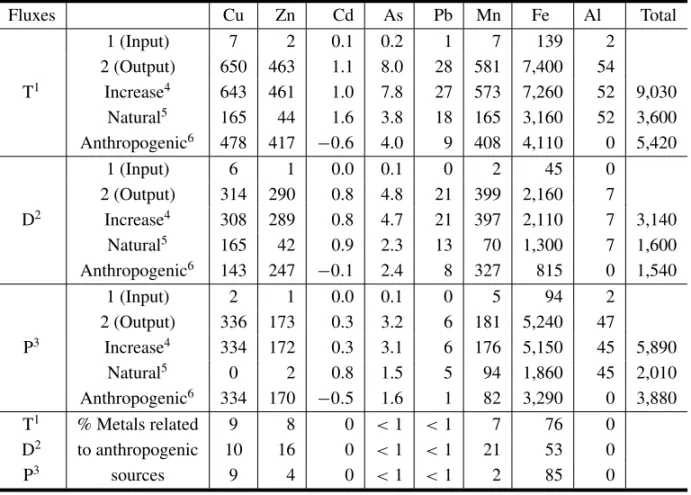
The mass balances of metal fluxes in the João Dias Creek are presented in Table II.
There are large anthropic components in the metal flux increases, both in particulate and dis-solved forms, which occur between the control sta-tion 1 and stasta-tion 2: 5424 kg.week-1, or about 60% of total metal flux (T), 1542 kg.week-1or about 49% of dissolved metal flux and 3881 kg.week-1or about 66% of particulate metal flux.
The percentage of the total anthropic metal flux (%Me Anthrop., Table II) related to the metals con-sidered in this study shows: Fe has the greatest
in-crease, followed by Cu > Zn > Mn. Anthropic
TABLE II
Mass balance of metal fluxes (kg.week-1) in the João Dias Creek in CCM drainage basin.
Fluxes Cu Zn Cd As Pb Mn Fe Al Total
1 (Input) 7 2 0.1 0.2 1 7 139 2
2 (Output) 650 463 1.1 8.0 28 581 7,400 54
T1 Increase4 643 461 1.0 7.8 27 573 7,260 52 9,030
Natural5 165 44 1.6 3.8 18 165 3,160 52 3,600
Anthropogenic6 478 417 −0.6 4.0 9 408 4,110 0 5,420
1 (Input) 6 1 0.0 0.1 0 2 45 0
2 (Output) 314 290 0.8 4.8 21 399 2,160 7
D2 Increase4 308 289 0.8 4.7 21 397 2,110 7 3,140
Natural5 165 42 0.9 2.3 13 70 1,300 7 1,600
Anthropogenic6 143 247 −0.1 2.4 8 327 815 0 1,540
1 (Input) 2 1 0.0 0.1 0 5 94 2
2 (Output) 336 173 0.3 3.2 6 181 5,240 47
P3 Increase4 334 172 0.3 3.1 6 176 5,150 45 5,890
Natural5 0 2 0.8 1.5 5 94 1,860 45 2,010
Anthropogenic6 334 170 −0.5 1.6 1 82 3,290 0 3,880
T1 % Metals related 9 8 0 <1 <1 7 76 0
D2 to anthropogenic 10 16 0 <1 <1 21 53 0
P3 sources 9 4 0 <1 <1 2 85 0
1T = total flux, considers the discharge at the sampling station and, the total concentration in unfiltered
samples (particulate form + dissolved form); 2D = dissolved flux, considers the discharge at the sampling station and, the concentration in the fraction< 0,45µm; 3P = particulate flux, considers the discharge at the sampling station and, the concentration bound to suspended particulate material (fraction>0,45µm); 4Difference between the output flux and the input flux in kg.week-1; 5Natural component of the flux increase; 6Antropogenic component of the flux increase.
The anthropogenic component increase in the total flux of metals in the João Dias Creek, nearly 5.4 ton.week-1, is large in both environmental and economic terms. For example, for copper alone, the operational losses accounted for as total anthro-pogenic increase in creek load are 478 kg.week-1, nearly a ton of copper every two weeks, without considering material retained in the tailing dam.
It is worth considering whether the fluxes in Table II are under- or overestimated by the normal-ization method employed for their calculation. Alu-minium is used as a measure of natural sources of
kg.week-1and 54.4 kg.week-1, rather than the ideal factor (30-fold). This result may underestimate the natural flux of metals and consequently overestimate the anthropic contributions to the increases in fluxes between the two stations. Obviously, the smaller the natural component (which is estimated from the alu-minium flux) of the increase between the stations, in the flux of a metal, the smaller will be the oversesti-mate in the anthropic component. A sensitivity test can be made by designating a value of 19µg.L−1for total aluminium concentrations at both stations. On this basis, the anthropic fluxes of (total) metals in Table II would be overestimated by 1% (Zn); 10% (Cu); 11% (Mn); 22% (Fe); 26% (As); 61% (Pb) and 92% (Cd).
In addition to the above observations, the data in Table II can be seen from the point of view of en-vironmental management of heavy metal contam-ination in the area, in terms of (the more usually employed) metal concentrations.
Given that the concentrations and fluxes of met-als at station 1 are of natural origin and the evaluation method proposed here essentially assumes steady state, i.e. the increase factor in flow rate between stations 1 and 2 is constant, the fluxes are necessar-ily directly (linearly) proportional to concentrations, so that the inverse of this is also true and the concen-trations must also have two separately determinable components, natural and anthropic. These can be used to evaluate the incremental risk to the environ-ment atributable to heavy metals originating from mining operations.
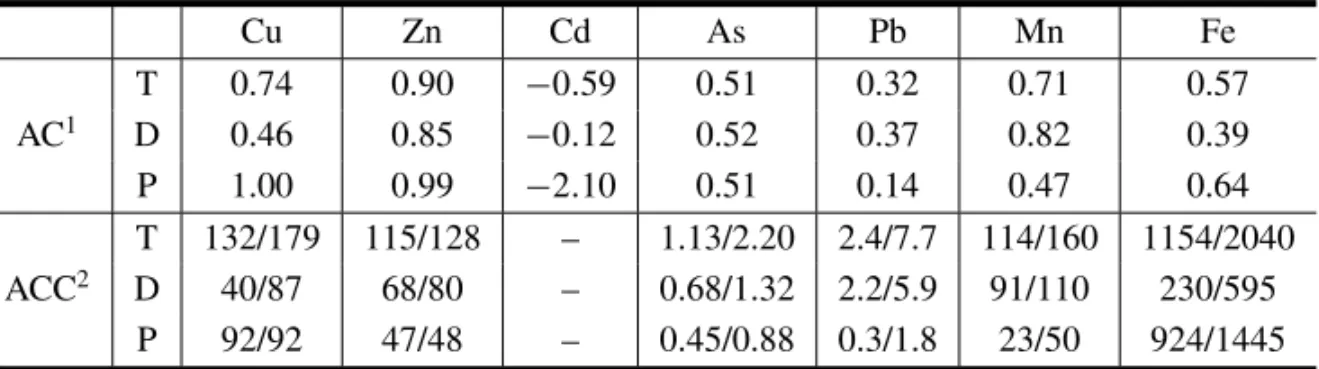
This approach can be expressed as follows: let AC = anthropogenic component of the metal flux increase / metal flux increase, then: ACC = anthro-pogenic component of the metal concentration at
station 2 = AC×metal concentration at station 2.
These data are presented in Table III.
These ACC data (anthropogenic component of the metal concentration) at station 2 are used to eval-uate the increment in environmental risk due to the mining operation.
Al, Fe, Pb and Cu are classified as
noncarcino-genic substances but sufficient data is not available to derive their reference doses, so that for these con-taminants it is not possible to estimate the hazard quotient for human health. However, their most important human toxicological effects can be re-marked. The ambient water quality criterion for Pb is recommended to be the same as the existing drinking water standard, which is 50µg.L−1. For Cu, there are the organoleptic data for controlling undesirable taste and odor quality of ambient water, the estimated limit level being 1 mg.L-1. Of course, organoleptic data have no demonstrated relationship to potential adverse human health effects. Table I shows that the total concentrations of Cu and Pb levels in water from both areas are around 10 times smaller than the above limits. No adverse effects of environmental exposure to Fe and Al have been conclusively demonstrated. As and Cd not only have reference doses but also slope factors have been de-fined. Arsenic is a recognized human carcinogen, Class "A" while Cd is a probable human carcinogen, Class "B1". However, it is also important to eval-uate the noncarcinogenic effects of contamination by these elements. For Mn, only noncarcinogenic effects can be evaluated, because it is classified as a Class D carcinogen, for which no slope factor is de-fined. Zn is considered noncarcinogenic and a RfD value is available.
Table IV presents potential human health haz-ards and risk assessment by heavy metals exposure by ingestion of water from the background and con-taminated sites. Table IV shows the slope factor val-ues (mg.Kg-1.d-1)-1and weight-of-evidence classifi-cation (class), for the carcinogenic substances and the reference dose (RfD) in mg.Kg-1.d-1 for non-carcinogenic effects, as well as, hazard quo-tient (HQ), hazard index (HI). The exposure levels (E in mg.kg-1.d-1) were calculated by multiplication of mean heavy metal concentrations in the unfiltered sample by the adult human ingestion rate (2L.d-1) and divided by 70 kg, considering the weight aver-age human adult.
TABLE III
Estimates of the anthropogenic component of metal concentrations in the João Dias Creek, down-stream from the CCM mining facilities (based on station 2 data).
Cu Zn Cd As Pb Mn Fe
T 0.74 0.90 −0.59 0.51 0.32 0.71 0.57
AC1 D 0.46 0.85 −0.12 0.52 0.37 0.82 0.39
P 1.00 0.99 −2.10 0.51 0.14 0.47 0.64
T 132/179 115/128 – 1.13/2.20 2.4/7.7 114/160 1154/2040
ACC2 D 40/87 68/80 – 0.68/1.32 2.2/5.9 91/110 230/595
P 92/92 47/48 – 0.45/0.88 0.3/1.8 23/50 924/1445
1AC = anthropogenic component of the metal flux increase divided by metal flux increase at station 2; 2ACC = anthropogenic component of the metal concentration at station 2 = AC×metal concentration
at station 2. The two values presented are ACC and measured concentration (µg.L-1).
TABLE IV
Potential human health hazard and risk assessment by heavy metals exposure by water ingestion from background and contaminated stations in the João Dias Creek.
Heavy Slope factor RfD Background area Contaminated area
metal (mg.kg-1.d-1)-1 (mg.kg-1.d-1) Station 1 Station 2
(Class) HQ1 Risk HQ1 Risk
As 1.5 (A) 3 E-04 0.13 5.9 E-05 0.21 9.4 E-05
Cd 1.8 E-03 (B1) 5 E-04 0.03 3.1 E-08 0.02 1.6 E-08
Mn (D) 5 E-03 0.34 0.91
Zn 3 E-01 <0.01 0.01
HI2 0.50 1.15
Risk 5.9 E-05 9.4 E-05
1HQ = hazard quotient (the ratio of a single substance exposure level over a specified time
period to a reference dose for that substance derived from a similar exposure period); 2HI = hazard index (the sum of more than one hazard quotient for multiple substances and/or multiple pathways).
effects, estimated for the background area (Station 1) is smaller than the unity, meaning no probable public health threat. However, for the contaminated area (Station 2), the HI estimated is higher than the unity. Thus, there may be concern for potencial hu-man health effects. Manganese seems to be the
prin-cipal component responsible for this, since its HQ is 0.91.
carcinogenic effects.
For the maximum protection of the human health from the potencial carcinogenic effects due to exposure of chemicals (e.g., Cd and As) in drink-ing water, the ambient water concentration should be zero, based on the non-threshold assumption for these chemicals. However, based on considerations of cost and technical feasability, lifetime risks of 10-6 to 10-4are considered acceptable for carcinogens in drinking water (Federal Register 1980, Kocher and Hoffmann 1991).
Concluding, health risks increase due to con-tamination by noncarcinogenic (mainly Mn) and carcinogenic (mainly As) substances are caused by the increases in concentrations, by factors of around 3 and 1.5 respectively (Table IV and Table I). The real increase may be greater because the dissolved concentrations of Mn and As increased more, by fac-tors around 5.5 and 2, respectively. This may mean that the amounts which are probably of anthropic origin and are probably bio-available, increased by 80%, for Mn, and 50%, for As (Table III).
CONCLUSIONS
Mining activity in CCM increase the total concen-trations of Cu, Zn, As, Mn and Fe in the water of João Dias Creek. Al and Pb practically showed no important changes and Cd concentration decreased from station 1 (unpolluted site) to station 2, under mining influence. Besides these increases, mining operations and their releases, produces changes in metal partitioning. The main differences observed from station 1 to station 2, were the following: (i) Cu, Zn and Fe total, dissolved and particulate con-centrations all increased but the percentage of these metals in dissolved form decreased; (ii) concentra-tions of As and Mn in all forms similarly increased but the fraction in dissolved form also increased.
Mining operations increases the natural metal fluxes, in both particulate and dissolved forms, in approximately 5,424 kg.week-1, or about 60% of to-tal meto-tal flux, 1,542 kg.week-1or about 49% of dis-solved metal flux and 3,881 kg.week-1or about 66%
of particulate metal flux. Fe flux was responsible for the greatest contribution to the total metal flux from anthropic origin, followed by Cu >Zn > Mn. Cd, As and Pb showed negligible anthropogenic fluxes. Potential human health hazards and risk assess-ment by heavy metals daily intake of water from CCM showed a hazard index (HI) smaller than the unity for the background area, indicating the absence of any probable public health threat. However, for the contaminated area (Station 2), the HI estimated is higher than the unity, and thus, potencial human health effects must be of concern. Mn is the princi-pal metal responsible for this effect. The ingestion of water from station 2 represents incremental risks of 130% and 59%, considering the noncarcinogenic and the carcinogenic effects, respectively. For the maximum protection of the human health from the potencial carcinogenic effects due to exposure of chemicals, especially Cd and As, in drinking wa-ter, the ambient water concentration should be zero, based on the non-threshold assumption for these chemicals. The potential human health hazards and risk assessment real increase may be greater than those related to the total concentrations, because the dissolved concentrations of Mn and As increased more, by factors of 5.5 and 2, respectively.
RESUMO
As Minas do Camaquã foram a principal jazida de
co-bre sulfetado do sul do Brasil. Sua explotação foi
rea-lizada desde o século passado até 1996. Para avaliar a
contaminação da água e o incremento do risco ambiental
por metais pesados, relacionados à atividade de
miner-ação, foram amostrados dois diferentes pontos do Arroio
João Dias (estação 1, nível de base natural da área e,
es-tação 2, área contaminada). A atividade de mineração
aumentou os fluxos semanais naturais de metais pesados
em aproximadamente 5424 kg(∼ 60%)de fluxo total, 1542 kg(∼49%)de fluxo da fração dissolvida e 3881 kg
(∼66%)de fluxo da fração particulada. O fluxo total de metais de origem antropogênica deve-se principalmente
potencial à saúde humana, relacionado à ingestão diária
de água do Arroio João Dias, indica que o risco deve-se,
principalmente, ao Mn na área contaminada. A ingestão
de água da estação 2 representa um incremento de risco
da ordem de 130% e 59%, considerando os efeitos não
carcinogênicos e carcinogênicos, respectivamente. O
in-cremento real de risco à saúde humana pode ser maior do
que aquele relacionado às concentrações totais, uma vez
que as concentrações de Mn e As dissolvidas foram 5,5 e
2 vezes maiores respectivamente, do que o aceitável.
Palavras-chave: contaminação aquática, risco
ambien-tal, metais pesados, mineração de cobre.
REFERENCES
APHA – American Public Health Association.
1985.Standard Methods for Examination of Water and Wastewater. 16 ed., Washington, 1268 p.
Baisch PRM.1994. Les oligo-elements metalliques du
systeme fluvio-lagunaire dos Patos (Bresil) – Flux et Devenir. Ph.D. Thesis. Université de Bordeaux I, Bordeaux, 229 p.
Drever JI.1982. The Geochemistry of Natural Waters.
Prentice-Hall, 388 p.
Federal Register.1980. Friday, November 28, v. 45,
nr. 231.
Förstner U and Wittmann GTW.1981. Metal
Pol-lution in the Aquatic Environment. 1.ed. Berlin: Springer-Verlag, 486 p.
Hall GEM, Bonham-Carter GF, Horowitz AJ, Lum
K, Lemieux C, Quemerais B and Garbarino JR.
1996. The effect of using 0,45µm filter membranes on “dissolved” element concentrations in natural wa-ters. App Geochem 11: 243-249.
Hatje V, Bidone ED and Maddock JL.1998.
Estima-tion of the natural and anthropogenic components of heavy metal fluxes in fresh water Sinos River, Rio Grande do Sul State, South Brazil. Environ Technol 19: 483-487.
IAEA – International Atomic Energy Agency.
1990. Evaluation of the Reliability of Predictions Made Using Environmental Transfer Models.Safety Series 100, Vienna.
Kocher DC and Hoffman FO.1991. Regulating
envi-ronmental carcinogens: where do we draw the line? Environ Sci Technol 25(12): 1987-1989.
Laybauer L.1995.Análise das transferências de metais
pesados em águas e sedimentos fluviais na região das Minas do Camaquã, RS, Master Science Thesis in Geosciences, Universidade Federal do Rio Grande do Sul, Porto Alegre, 164 p.
Laybauer L.1998. Incremento de metais pesados na
drenagem receptora de efluentes de mineração – Mi-nas do Camaquã, Sul do Brasil. RBRH 3(3): 29-36.
Laybauer L and Bidone ED.1998a. Mass Balance
Es-timation of Natural and Anthropogenic Heavy Metal Fluxes in Streams Near Camaquã Copper Mines, Rio Grande do Sul, Brazil. In: Environmental Geochem-istry in the Tropics,Wasserman JC, Silva-Filho EV and Villas-Boas R.(Eds), Berlin: Springer-Verlag,
p. 127-137.
Laybauer L and Bidone ED.1998b. Partição de metais
pesados em águas superficiais impactadas por mine-ração – Minas do Camaquã. Geochim Brasil 12(1/2): 55-62.
Travassos MP and Bidone ED.1995. Avaliação da
contaminação por metais pesados na bacia do Rio Caí-RS através de uma análise dinâmica. In: Desen-volvimento Sustentável dos Recursos Hídricos, 3(1): 205-211.
USEPA – United States Environmental
Protec-tion Agency. 1989. Risk assessment guidance for
superfund. human health evaluation manual. In-terim final. USEPA (ed.), Washington, 1, Cap. 4-8, part A.
Wilson AR.1991. Environmental Risk: Identification
and Management. Chelsea: Lewis Publishers, 431p.
Zapponi G.1988. Methods for the health component