Mestrado em Estatística
Professora Doutora Raquel Menezes
Doutora Ana Moreira
Trabalho realizado sob a orientação de
Acknowledgement
I thank my advisors, Professor Dr Raquel Menezes and Dr Ana Moreira for the trans-mission of their knowledge and for the support provided in the execution of this thesis. To all colleagues of Inovretail company, for all the help and advice, thank you very much.
To my girlfriend, Sara Ferreira, who accompanied me tirelessly along this route. Thank you for the encouragement, patience, love and understanding shown.
And my family, my big thank you.
Abstract
In the current economic context, retail has been confronted with a significant increase in competitiveness indicators that lead to the equation of optimization tools in the most diverse business processes, namely in stock management.
The definition of stock distribution is a key element for the management of a business in any retail segment. In the Fashion segment, this challenge is particularly sensitive to be managed, given the rapid product lifecycle, the high heterogeneity of the type of products between the various stores and the strong variability in demand for each of the products by consumers.
In this context, there is a strong potential of using predictive tools to support the decision of the business managers so that the management of the stock is conducted in a more quantitative way and less based on empirical knowledge, as it often occurs nowadays.
This project was focused on the problem of the first shipment of products to the stores, typically referred to as the allocation. Thus, to solve this problem we have proposed the development of algorithms in R language.
The solution developed was tested by an international fashion retailer, which, with the its application, obtained measurable gains by reaching days of in-store coverage of up to 3%, compared to the initial scenarios of traditional human decision making. The proposed approach has a Business Rules component, which will allow users to create a diversity of business restrictions, offering a more robust and flexible solution. This was confirmed by the first tests performed with actual retail data, which allowed us to conclude that some business constraints could, and should, be automatically included as algorithm defaults.
Keywords: Allocation; Fashion Retail; Stock Intelligence; Supply Chain iii
Resumo
No contexto económico atual, o retalho tem sido confrontado com um aumento sig-nificativo de indicadores de competitividade que levam a equacionar ferramentas de otimização nos mais diversos processos de negócio, nomeadamente na gestão de stock. A definição da distribuição de stock é um elemento chave para a gestão de um negócio em qualquer segmento de retalho. No segmento Fashion esse desafio é particularmente sensível de ser gerido, dado o rápido ciclo de vida dos produtos, a elevada heterogenei-dade da gama de produtos entre as várias lojas e a forte variabiliheterogenei-dade na procura de cada um dos produtos pelos consumidores.
Neste contexto há um forte potencial de utilização de ferramentas preditivas para su-portar a decisão dos gestores de negócio para que a gestão do stock seja conduzida de forma mais quantitativa e menos baseada em conhecimentos empíricos, tal como hoje em dia maioritariamente se verifica.
Este projeto foi debruçado no problema do primeiro envio de produtos para as lojas, a alocação. Deste modo, para solucionar este problema recorreu-se ao desenvolvimento de algoritmos em linguagem R.
A solução desenvolvida foi testada por um retalhista internacional de moda, no qual, com a aplicação da solução se obteve ganhos mensuráveis ao atingir dias de cobertura em loja de até menos 3% face aos cenários iniciais de decisões por decisão humana tradicional. A solução desenvolvida possui uma componente de Business Rules, a qual permitirá aos utilizadores criar uma diversidade de regras de negócio, oferecendo maior robustez à solução. Tal foi confirmado com os primeiros testes efetuados com dados reais de retalho, os quais nos permitiram concluir que algumas restrições do negócio poderiam e deveriam ser incluídos automaticamente como defaults do algoritmo.
Palavras-chave: Alocação; Retalho de Moda; Stock Inteligente; Cadeia de Abasteci-v
Contents
1 Introduction 1
1.1 Project Framework . . . 1
1.2 Motivation and Objective . . . 2
1.3 Problem Definition . . . 4
1.4 Thesis Structure . . . 5
2 Contextualization 7 2.1 Fashion Retail . . . 10
2.1.1 Supply Chain . . . 10
2.1.2 Supply Chain Management . . . 17
3 Related Work 21 3.1 State of the Art . . . 21
3.2 Business Process Model . . . 30
4 Allocation Plan - An Optimization Approach 35 4.1 Solution Description . . . 38
4.1.1 Use Case 1: Baseline . . . 40
4.1.2 Use case 2: Shipment at different phases than planned . . . 41
4.1.3 Use Case 3: Shipping Gap . . . 42
4.2 Additional Complexities of the Algorithm . . . 43
4.2.1 Coverage Stock . . . 44
4.2.2 Product Sequencing . . . 44
4.2.3 Stock Reserves . . . 45
4.2.4 Assortment Overwrite . . . 45 vii
4.2.5 Quantities Cap . . . 46
4.2.6 Gap-End . . . 46
4.2.7 Gap-Begin . . . 47
4.2.8 Allocation on Low Refreshness . . . 48
4.3 Metrics . . . 49 4.3.1 Stock Metrics . . . 51 4.3.2 Sales Metrics . . . 53 4.3.3 Business Performance . . . 53 5 Results 65 5.1 Exploratory Analysis . . . 65 5.2 Algorithm Results . . . 69 5.2.1 Parametrizations . . . 69 5.2.2 Algorithm Performance . . . 71
5.3 Business Perfomance Metrics . . . 75
List of Figures
1.1 Inovretail’s logo . . . 1
1.2 Allocation Project . . . 2
2.1 Portuguese Private Consumption Source: Oxford Economics . . . 7
2.2 Consumption in Retail Goods by Category Source: Oxford Economics . . . 8
2.3 Supply Chain . . . 11
2.4 Pre-Season of Supply Chain . . . 11
2.5 In-Season of Supply Chain . . . 14
3.1 Continuous Review System . . . 27
3.2 Periodic Review System . . . 28
3.3 Allocation Scheme . . . 31
3.4 Product Structure . . . 32
3.5 Season in Fashion Retail . . . 33
4.1 Process Diagram Allocation . . . 39
4.2 Use Case 1 - Forecast . . . 40
4.3 Use Case 2 - Forecast . . . 41
4.4 Use Case 3 - Forecast [Store 1] . . . 42
4.5 Use Case 3 - Forecast [Store 2] . . . 43
4.6 Stock Coverage . . . 44
4.7 Complexity Product Sequencing (Plan FIFO - First In First Out) . . . . 45
4.8 Complexity Cap in store 1 . . . 46
4.9 Complexity Force Allocation in End-Phase Proximity . . . 47
4.10 Complexity Allocation in Begin-Phase Proximity . . . 47 ix
4.11 Force Allocation on Low Refreshness . . . 48
4.12 Cases - Difference between Initial Plan and Executed Plan . . . 56
5.1 Monthly Sales History (Dresses & Shorts) . . . 66
5.2 Monthly Sales History (Polos & Pajamas) . . . 66
5.3 Weekly Stock History (SS16 Summer 2016) - SS17 (Spring-Summer 2017)) . . . 68
5.4 Coverage of Stock . . . 70
5.5 Gap - End . . . 71
5.6 Allocation in SS 18 - Products Category Shorts . . . 72
5.7 Allocation in SS 18 - Store . . . 74
5.8 Assortment Refreshness - Season SS 18 . . . 75
5.9 Allocation Execution By Store - Season SS 18 . . . 76
List of Tables
3.1 Summary Table . . . 29
4.1 Development Activities . . . 36
4.2 Summary table of the Complexities/Parametrizations . . . 49
4.3 Allocation - Assortment Refreshness . . . 53
4.4 Input’s - Percentage of Executation Plan Metric (Store) . . . 54
4.5 Input’s - Percentage of Executation Plan Metric (Product) . . . 54
4.6 Output Executation Plan Metrics . . . 55
4.7 Input’s Difference between Initial Plan and Allocation Executated -Case 1 . . . 56
4.8 Difference between Initial Plan and Allocation Executed - Case 1 . . . . 56
4.9 Input’s - Difference between Initial Plan and Allocation Executed - Case 2 57 4.10 Difference between Initial Plan and Executed Plan - Case 2 . . . 57
4.11 Input’s - Difference between Initial Plan and Allocation Executed - Case 3 57 4.12 Difference between Initial Plan and Executed Plan - Case 3 . . . 57
4.13 Output Difference between Initial Plan and Allocation Executed Metrics 58 4.14 Input’s - Percentage of Difference between Initial Plan and Allocation Execution . . . 59
4.15 Dataset - Difference Plan . . . 60
4.16 Dataset - Difference Plan Store . . . 60
4.17 Dataset - Executed Plan . . . 61
4.18 Dataset - Suggested Plan . . . 61
4.19 Output - Difference between Executed Plan and Suggested Plan . . . . 62
4.20 Input’s - Range Max . . . 63 xi
4.21 Output Range Max . . . 63
5.1 Summary of Monthly Sales History . . . 67
5.2 Summary Stocks . . . 68
5.3 Summary about Product Category . . . 69
5.4 Execution realized . . . 72
5.5 Comparison of allocation in SS 18 - Products Category Shorts . . . 73
5.6 Comparison of allocation in SS 18 - Store . . . 74
5.7 Difference between initial plan and allocation executed . . . 77
List of Abbreviations
ASC - Agile Supply Chain
CRBE - United States Commercial Real Estate Services CW - Central Warehouse
ETL - Extract Transform and Load FIFO - First In First Out
GSC - Global Supply Chain
Informa D&B - Informa Data Base JIT - Just In Time
QR - Quick Response R - Release
RRP - Recommended Retail Price SIT - Stock In Transit
SKU - Stock Keeping Unit SOH - Stock On Hand
SONAE IM - SONAE Investiment Management SOO - Stock On Order
SS - Spring-Summer UC - Use Case
Chapter 1
Introduction
1.1 Project Framework
The present thesis was done in a business environment, more specifically at Inovretail, with the purpose of obtaining the degree on Master in statistics.
Inovretail was founded in 2011 in the city of Porto. Since 2016 it has belonged to the SONAE IM group (SONAE Investment Management). The main objective of the company is to enable and maximizing their clients’ sales, thus turning into a high performance company specialized in retail. In order to do so, it resorts to technol-ogy, mathematical and statistical processes, developing prediction tools that allow the retailers to optimize the commercial actions in their stores.
Figure 1.1: Inovretail’s logo
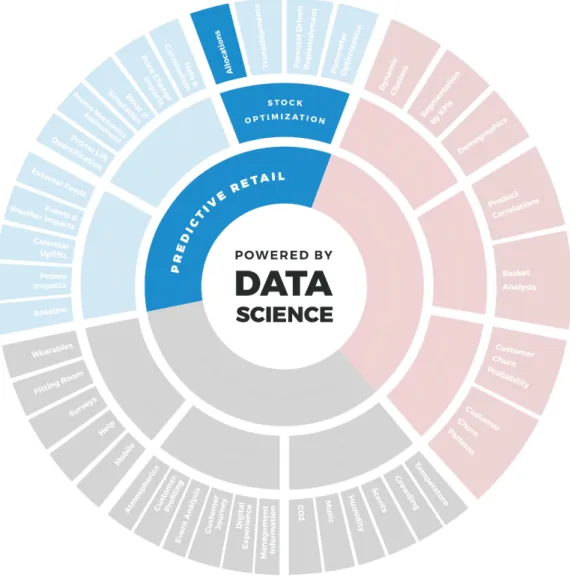
The theme of the thesis in question “Allocation” is inserted in the roadmap of the “Inovretail’s Data Science” team. This team is focused in countless challenges and projects, some of which are described in Figure 1.2. The allocation is inserted in the (group of projects) projects group of “stock optimization” in the “predictive retail” area.
Figure 1.2: Allocation Project
1.2 Motivation and Objective
When we make a purchase, we are far from imagining the gigantic machine that “feeds” the thousands of stores spread out across the country or even around the world. The operations of the Portuguese retailers are made of impressive numbers. The fleet of trucks that transports the products from the central storage to the stores travels more than two and a half million kilometres to make around one hundred thousand deliv-eries. As so, it is a complicated system with multiple variables and hundreds of steps and procedures that demand a complex articulation INESC-TEC (2016). Presently the
3
retail sector has come to know a new moment, with more well-informed and demand-ing customers that seek quality at the most competitive price. Takdemand-ing into account the decisive weight that clients and suppliers have in this area, companies seek to an-ticipate the market needs. So the need for creating and using an integrated solution with the purpose of releasing resources and diminishing the spending allocated to low value tasks is fundamental, thus allowing more availability for the creation of proximity relationship between customers and suppliers.
In a scenario marked by a strong competitiveness, in which the consumer has several options available to him, it is fundamental to satisfy its needs and expectations, or even to go beyond them for a continued success of a retail company ARTSOFT (n.d.). Technology has changed the way in which customers browse and shop. The technolog-ical advances have brought new channels and ways of contact, which forces companies to re-think their business strategies. In spite of all the variety of options, the customer wants to have the same experience, regardless of the means of selected purchase/con-tact, concept known as omni-channel. These forces, more than a simple change in the operational process of the company, a change in mind-set. The client is found under the focus of all the strategy Frankenthal (2017).
This thesis has, as a main motivation, the exploration of new ways of thinking in order to respond to the problem of allocation where the retail companies fight constantly. The allocation consists of the decision making of the first shipment of products of the new season, this problem is a problem of the supply chain. The concern with the ques-tion of allocaques-tion came as an answer to the change in the attitude of customers verified throughout the years. The theme has not been fully covered yet by the researchers, so there are still very few papers and research concerning this subject. Thusly the main objective of this thesis lies in the creation of a process/methodology that optimizes the allocation of products for the stores. After the development, the solution will be tested in a real environment (fashion retailer).
After its execution the potential gains will be monitored through the process applica-tion from the retail company doing the follow-up of the spring/summer 2018 season.
1.3 Problem Definition
Logistics have evolved at a very fast rate during the last few years. Some decades ago it wasn’t even mentioned in the long term plans of many companies. Nowadays, it is considered one of the most strategic and fundamental elements in all of these organizations, being one of the strongest sources in the creation of competitive advantages Waters (2003). One of the reasons is the fact that its concept has spread to an integrated function, called supply chain management, which is responsible for all of the optimization of the flow of goods and materials since its purchase from a supplier until its delivery at the final destination Tan (2001). All the major retail chains have great costs associated to the logistical operations. Due to the growing complexity in logistic operations, there is a growing demand for the optimization of each decision and each movement along the chain of supply in a way as to optimize the creation of value as a whole.
In this context, the first shipments of new articles/goods (allocation) towards the stores is one of the most crucial moments, given that it is at this time that stores receive the merchandise that they will be selling in the first instance, and where the first indicator of market sensitivity is set.
In fashion retail stores a considerable part of the articles has a short life span,
depending heavily on the season in which it is inserted. For this reason, the first
shipment becomes yet more preponderant, for there isn’t a lot of margin of adjustment in the distribution of the first shipments. Furthermore, to the final customer, the difference towards the competition is often not in the quality or price of the product, but in the capacity the store has of having the right product available, with all the desired colours and size variants.
It is necessary to optimize decisions in the chain of supply, since every week millions of decisions are associated with the shipment of merchandise, a process referred to as season planning. In this way, there is a greater susceptibility relative to the occurrence of errors since there is no scientific rigor. Supported on the allocations plan designed in the season planning phase. These decisions are made by operators, who take into account innumerable business and logistics rules which revolve and take part of the
5
chain of retail and the extensive quantity of data volume. Thusly these decisions make the allocation process slow and inefficient. These plans are set some time in advance (9 months in fashion) and when applied it may no longer fully match the needs /
characteristics of the market, customers and products. The fact that the decision
making involves a great number of operators makes the process even more complex. Another of the great challenges of this project consists in trying to keep products for a greater time in central storage so that they are only sent to stores at the right moment, meaning, when these have actual need for them. This challenge comes with the objective of optimizing transfers to the stores and by doing so reducing the costs of transfers. Furthermore, to optimize transfers the prevalence of products in the central storage may cause the product not to be sent, by impulse, to stores where there is less need than in others. This can help to avoid the problem of stalled stock in store warehouses (one of the retailer’s most worrying problems).
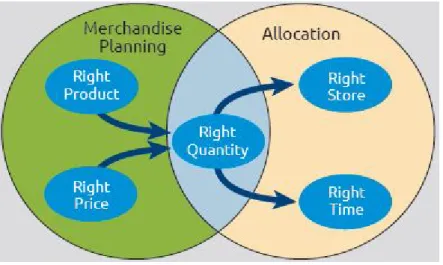
In conclusion, we will be creating an intelligent process that sends right product to the rigth store at they right quantity and right time, always taking in to account all previously explained considerations.
1.4 Thesis Structure
In addition to the introduction, this thesis contains 5 more chapters according to the evolution of the work over time.
In Chapter 2, a contextualisation of the problem is made revealing much of the fashion flap.
In Chapter 3, the related work is described, presenting the state of art, that is, a bibli-ography review on some of the articles that played an important role in the acquisition of knowledge for the realization of this thesis. It also presents more business concepts that served for a better understanding.
Chapter 4 presents the development of the solution. It starts with a description of the solution through the presentation of three use cases. Next, some features that were added to the solution are presented as well as the presentation of the metrics developed until now.
Chapter 5 presents and discusses the results obtained after the implementation of the solution.
Finally, Chapter 6 ends with presentation of main conclusions of the work developed and changes to be considered in future work.
Chapter 2
Contextualization
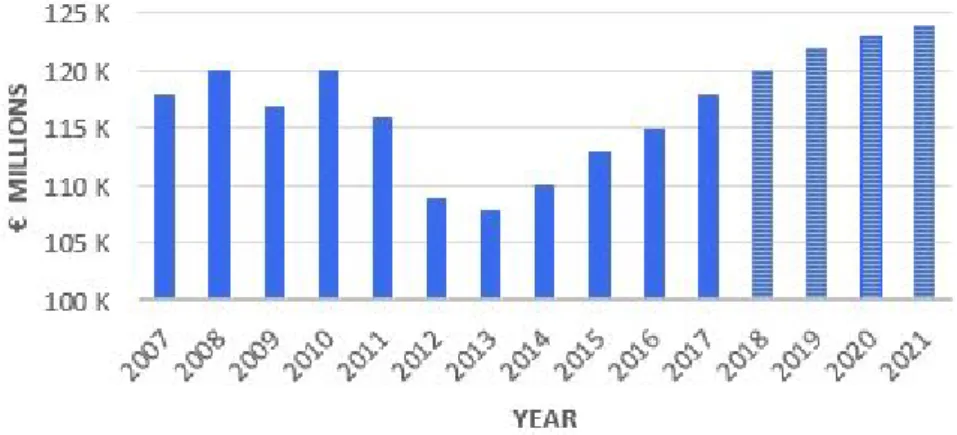
According to Wakefield (2018), in the last 15 years more than 6.7 thousand million euros of investment were channelled towards the retail sector, which corresponds to more than 50% of the total investments spent in commercial real-estate in Portugal. The same authors state that private consumption is one of the economic variables that best reflects the current state of the retail market. They further state that until 2008, this was one of the main growth enablers in the economy, having then been strongly affected by the following crisis, as can be seen in Figure 2.1.
Figure 2.1: Portuguese Private Consumption
Source: Oxford Economics
From the year 2014 onwards, economic recovery has been made felt through the increase in private consumption. In 2018 it is estimated that it will reach the millennium’s
maximum. During this year growth Portugal’s private consumption should match the European Union’s average at 2.2%, reflecting more moderate growths during the rest of the analysed period (Wakefield, 2018).
Figure 2.2: Consumption in Retail Goods by Category
Source: Oxford Economics
Through the analysis of Figure 2.2, we can see that there has been a change in purchase patterns which is demonstrated by comparing the distribution of retail goods consump-tion by category between 2007 (market peak), 2011 (year of the beginning of the crisis) and 2017.
The distribution of expenses in 2017 reflects a contraction in consumption in the "food service", "home living" and others, in opposition to the food and fashion sectors, that spent the same year getting a greater proportion of family income. The replacement of restaurant business expenses for a greater consumption of food goods is a natural effect of the crisis (Wakefield, 2018). We can see on Figure 2.2 that this indicator has stagnated, which reflects a structural change in habits.
The increase in fashion expenses between 2007 and 2017 is surprising, taking into ac-count that this category usually suffers during times of crisis. The strength of the retail operators in this sector as well as a great amount of offer from low-cost clothing chains
9
may explain this tendency. For a long time, we have been witnessing a change in sales policies from retailers, which catch the attention of consumers challenging them with very diversified promotions and discount (Wakefield, 2018).
At the end of December 2017, there were in Portugal about 62845 business entities dedicated to the retail sector. This sector represents around 13,6% of the total number of business entities, data sent by Informa D&B (DB, 2018). According to the statistics bulletin of 2018 published by the Banco de Portugal, the retail sector may be split between the trade of food, beverages and tobacco (44.84%) or the same of non-food products (55.16%). The fashion industry is inserted into the latter, representing about 7.30% of the total retail (Banco de Portugal, 2018).
The retail sector is in a constant state of change having its rhythm become more and more accelerated during the last few decades. The industry stopped having a dedi-cated focus on purchasing, meaning, reaching an ideal variety of products, to a broader approach, where the consumer is at the centre of all the spotlights. In other words, retailers dedicate a great percentage of their time trying to reach the ideal variety of products, always taking into account the consumer as its primary focus (Zentes et al., 2007). Nowadays, retailers face two major challenges regarding about management of the supply chain, an increase in competition and the greater expectations from con-sumers. These challenges are fuelled by five great tendencies: globalization; technology; sustainability and safety; recession and prosperity. They create an increasing pressure over retailers in order to maintain their success and to meet necessities from the con-sumers without increasing costs.
Given that the role of the consumer is increasingly important in the supply chain, the need to optimize retailers main actions becomes fundamental. For instance, selecting the width and depth of the product range, planograms for the shelves, the allocation are important aspects of the supply chain that retailers should be aware of (Hübner, 2011).
At the core of the issue is a planning paradigm, that synchronizes financial plans, store plans, mandatory product plans and product range plans in order to respond to the consumers need and to promote their loyalty. Therefore, the range of products can be personalised based on each store’s exclusive attributes and using those reaching an
ideal price for each product in such a way as to maximize sales (Hübner, 2011).
2.1 Fashion Retail
In the past two decades, deep changes have occurred in the fashion industry, on a global level, which originated an exponential increase in the complexity of the supply chain management. In developed countries, as well as in developing ones, companies are currently selling to the theoretical economic markets of perfect competition “business-to-consumer” and selling increasingly more to the global supply chains (Global Supply Chains – GSC) “business-to-business”, which are regulated by predominantly external and global companies (Kaplinsky, 2005).
According to Gereffi and Memedovic (2003), the production of fashion products has always been and shall continue to be an activity associated with intensive hand-labour and low requirements in investment capital. This sector is often linked to poorer coun-tries or developing ones. During the 70’s, 80’s and 90’s, there was a great number of companies that moved their factories to countries where labour work is cheaper. They moved, essentially, the productive tasks of less added value, in an attempt to main-tain or regain competitive advantages. In the 90’s, southeast Asia was the geographic area with the greater impact in this dynamic, including countries like China, India, Malaysia, the Philippines and Indonesia, among others. In order to maintain its com-petitiveness, the remaining retailers started doing their sourcing increasingly more in Asian and Eastern European countries (Jackson and Shaw, 2000; Bruce et al., 2004).
2.1.1 Supply Chain
In order to know all of the supply chain management it is important to firstly know a supply chain. Figure 2.3 illustrates the different stages of a typical supply chain of a retailer dedicated to the fashion sector.
11
Figure 2.3: Supply Chain
In the business retail sector, the supply chain is divided into two stages, pre-season and in-season, as illustrated by the previous figure. In the pre-season phase, we have stages like design and product production and then their shipment towards the warehouse. In the in-season phase, products are sent to the different stores arriving in this way to the consumers.
Pre-Season
Analysing in more detail the pre-season stage illustrated in Figure 2.4, we can see that designers are found at begin stage of the pre-season stage.
Figure 2.4: Pre-Season of Supply Chain
Along the times tasks dedicated to the pre-season phase have suffered several changes. In the past, suppliers outlined the collections with the creation of products and its
mak-ing hopmak-ing that in the end retailers would buy those products. With the information gathered from the points of sale, retailers started holding privileged information and decided to incorporate stages that were up until then performed by the manufacturers. In this way, retailers started to develop their own product creating competition against the manufacturers that naturally held product development teams. The supply chain in fashion retail has stopped being guided towards business and started being guided towards the final consumer. Thus, nowadays, the design task started being made by retailers which hire a series of designers, suppliers and manufacturers with the purpose of drawing, producing collections based on the information collected at the sale points. A current phase of pre-season in the supply chain starts by making studies about the previous collection and the target consumer. Following these studies, a new collection is designed. Thusly, the process starts with the elaboration of studies about the presented collections in fashion shows (trade shows) in the world’s main fashion capitals (Paris, Milan and New York), or with studies about the street tendencies, movies, sports and media events on a global scale. Next, the sketches are drawn by the designers according to previously placed studies.
Due to great geographic distances, intermediary companies have appeared between re-tailers and the manufacturers of clothing. Since production has shifted and is now spread among several different countries, the responsibility to explore to its maximum imported quotas was left to companies specializing in complex supply chain manage-ment.
Even faced with these difficulties, the economies resulting from cheap labour justified the effort and risk that retailers were subjecting themselves to. The search and compe-tition in developed countries demanded that the proposal of value had to be improved. The sourcing of articles in developing economies was the solution found by retailers in order to improve the offer through the reduction of sale prices to the public and simultaneously increase the levels of profitability.
Starting from a generalist division of articles between fashion and basic, we have been witnessing a separation in production with the first one being produced in a geographic location near the target markets, and the basic ones in places that are further away with longer lead-times but where you can get greater scale economies and consequently a
13
smaller price cost (Jackson and Shaw, 2000). In the same study, the authors also point out to an example of a fashion manufacturer that has hired 3 companies for the same product: one with a high lead-time (90 days) but with low costs in the Asian continent, one with a medium lead-time (21 days) and with average costs in Latin America, and a final one with a reduced lead-time (3 to 5 days) but with high costs in the target production market. Being that what normally happens is that in fashion, in the case of the product being a success, retailers will resort to the nearest place where they can manufacture more of the same.
In the last decade, we have been seeing a conflux of interests between retailers, who want to postpone the order as much as they can, and manufacturers who want to plan its production and anticipate the placement of orders as early as possible. In spite of retailers not wanting to compromise with purchase orders 25 to 40 weeks before the be-ginning of the collection, we have been noticing that they commit to a certain volume of production, meaning, they assure one manufacturer of the usage of a certain percentage of its production capabilities. Instead of buying the article beforehand, they buy the factory’s productive capability during a certain time of the year. This commitment has come to solve part of the problems manufacturers used to have, since in the first two months before the beginning of the collection they received numerous requests for or-ders and its production capacity was limiting the acceptance of these oror-ders. With the promise of the purchasing of the product, companies can plan the production before-hand and adjust its productive capacity, recurring frequently to outsourcing to other manufacturing companies in order to be able to respond to and quantities that exceed its installed capacity.
The last pre-season phase, that is, the last stage in sending the finalized products to central warehouse may compromise the consumer’s level of service, as logistics guaran-tees the moving of the product between several entities, throughout the chain of value, effectively, maintaining its integrity. Normally, these transportation costs represent in average about 1/3 of the cost of the supply chain (Pedro, 2015), with the possibility of rising up to 10% of the total cost of the product (Rodrigue Jean-Paul, 2017), depending on the context and some variables.
In-Season
Upon the product’s arrival at central warehouse and with the beginning of the season, the in-season of the supply chain stage begins, represented by Figure 2.5.
The orientation towards the final consumer that retailers brought to the supply chain has revealed flaws that until then had been undervalued in the supply chain. Since 1980, retailers have been struggling with the problem of the long lead-time (since the conception of the article until its placement in the store) and the risk associated with this. Aware of the current level of sophistication of the final consumer, its avidity for novelty and progress, the retailers know that the answer to the consumer’s solicitations is highly hampered with such a long lead-time which makes stocked articles become rapidly obsolete throughout the chain.
Figure 2.5: In-Season of Supply Chain
Fashion products are segmented according to the class of products that the retail chain focuses on. According to the different types of products that make up the retail chain, the procedures for sending them will be different. There are mainly three types of products:
15
• Fast fashion products – approximately 8-10 weeks of store life; • Seasonal products – approximately 24 weeks of store life; • Annual/permanent products – basic articles – available all year.
In a typical supply chain of the fashion industry, the in-season phase is divided into three stages, adjustment of the previously defined plans in the pre-season stage, the allocation process and lastly the replenishment process. Initially an adjustment to the planning is elaborated in the sense that there is a great deal of time between its elaboration (usually 9 months before) and the beginning of the season. During this time, there will have been delays in the production of articles so that they are not yet available in the central warehouse, or consumer preferences have changed, and consequently the order of shipment of the products needs to be adapted. Still, at this stage, some targets are adjusted that were also planned in the pre-season, such as future performance targets for sales, stock, and other financial metrics.
With the advances in technology retailers started processing information coming from their points of sale, realizing that the proposal of value made to the consumers should not be restricted to price. Retailers realized that the consumer valued other factors beyond price, normaly quality, level of service, uniqueness and novelty.
Allocation
With the elaboration of all the planning of the season done months before the begin-ning of the season, which typically happens a few weeks before the beginbegin-ning date of the season this is revised proceeding to some changes, it gives if the next step, the allocation. The allocation is the "first shipment of each product to each store". To do this, the allocation takes into account the quantities of products in each store and will then guide the delivery of the warehouse products to the stores according to the needs of the products. Therefore, the allocation is about making product-specific shipping decisions, that is, determining the products that need to be shipped to specific stores, depending on their needs. Moreover, the exact quantities for the shipment need to be calculated the just described supply chain process is the focus of this thesis.
prod-uct allocation to stores, Push and Pull distribution strategies, and the most applied strategy in this process is the first. In the case of a Push distribution strategy, the prod-ucts are allocated to the stores according to the historical demand for similar prodprod-ucts, the stock position of the warehouse and the stores. While the Pull strategy, product shipping orders are generated at the store level based on the search data collected at the point of sale terminals (Mcgraw, 2002).
As retail operations become more complex and information systems are more preva-lent, retailers opt for the Pull distribution strategy instead of Push. However, the Push strategy cannot be used by all retailers as it is difficult to predict sales for each store. This can only be achieved by implementing sophisticated technology in terms of software and hardware, which is often an expensive proposition. The retailer with less sophisticated forecasting and information systems prefers to use the Push strategy (Mcgraw, 2002).
The quantities allocated to each product and to each store are generally derived as the difference between the permanent stock level and the current stock level. This is termed as the amount retracted. The permanent stock level is the maximum stock level that should be stored in the store for that product (Mcgraw, 2002).
Allocation transfers that typically occur between the warehouse and the stores are per-formed on fixed days of the week or even during certain fixed periods. The delivery frequency of the warehouse is also predetermined, which facilitates an effective under-standing between the stores and the warehouse. Generally, products are shipped in packs, set of sizes and colours of the product in question, to avoid the lack of availabil-ity of the product to the preferences of the consumer.
The allocation process will still be explored in more depth in the next chapter.
Replenishment
After the products have been allocated to the stores, the Replenishment process comes in. This process has an objective to maintain the stock position with frequent deliveries of the warehouse to the stores until the end of the season, guaranteeing the level of service to consumers. After the previous allocation process has taken place, it is pos-sible to use more precise forecasts since the preferences of the consumers for season’s
17
products are already known. In this way, one may determine the correct replenishment to maintain an optimum flow of stock between the warehouse and the stores.
In the stock planning process, the ideal stock levels are established, which must be maintained to meet the expected levels of consumer services.
This process has two phases until a warehouse shipment to the warehouse is made. First, the security amount of a particular product is defined by the retailer. This amount allows the replenishment to be activated, in the event that the stock of a cer-tain product is less than that quantity, it is activated the replenishment of that product for the store in question. In a second phase, it is decided which is the maximum quan-tity that the retailer intends to have in the store. Therefore, the order quanquan-tity of the product will be the amount required for the current quantity to reach the maximum quantity defined for that product.
It is of great importance to mention that for many supply chains during the in-season phase one only gives the process of replenishment.
2.1.2 Supply Chain Management
The efficiency of a supply chain is a critical factor for the success of a company in the fashion retail business. According to Hines (2004), in specialized global retain, the ones that compete are the chains of supply and not the companies. Several approaches have been made in a way to improve the supply chain, following concepts like Just-In-Time (Bruce, Daly, and Towers, 2004), Agile Supply Chain (Christopher et al., 2004b; Bruce et al., 2004) and Quick Response systems (Giunipero et al., 2001; Fernie and Azuma 2004). It matters to define and be able to tell apart each of these concepts.
The Just-In-Time (JIT) concept was born in the production area, more specifically in the Toyota production line. This concept is also known as the Toyota Production System, and aims to reduce costs related to the supply chain, by satisfying the demand at any certain point, without creating an accumulation in stock at any point. It is a concept which is guided for business and cost reduction and not for the final consumer (Barnes and Lea-Greenwood, 2006). The implementation of the concept of JIT in a supply chain makes it more lean, meaning, a chain developed while paying attention to the reduction of any waste, including time and inventory, properly sized and levelled
in order to satisfy any existing needs.
The concept of Agile Supply Chain (ASC) is a concept that describes shorter supply chains, more flexible, and guided towards real demand in detriment of the predicted demand, typical approach of traditional supply chain management. An agile chain is capable of using market knowledge, to process it internally and managing to explore opportunities that may appear in volatile markets.
The Agile Supply Chains share updated information from the points of sale so that all of it is synchronized and so there is no need for intermediary inventories (buffers). This integration of information systems allows the shortening of response times and a more efficient usage of resources all throughout the chain.
Lastly the Quick Response (QR) is born in a time when the traditional markets of clothes production were losing margins and orders to emergent geographic regions with cheaper labour and access to raw materials with cheaper prices. The Quick Response has come to smooth the situation up, narrowing relationships between retailers and
manufacturers (Fernie and Azuma, 2004). It was considered by Christopher et al.
(2004a) as an evolution of the concepts of Supply Chain Management and Agile Supply Chain. This tool defends the concept of minimizing de volume of pre-season purchases, replacing them by more frequents points in times for making purchases, smaller in volume and in in-season regime so that the domestic products may reacquire competi-tiveness through the reduction of response times and flexibility.
Barnes and Lea-Greenwood (2006) defend that all three, JIT, ASC and QR, may be considered supply chain management concepts guided towards business and not to-wards the consumer.
Historically the power of the supply chain was found concentrated in the manufactur-ers, and as production shifted towards distant geographic areas the JIT application appeared with the purpose of alleviating inventories in the long supply chain. The power has thusly converged around retailers, who now had a broader range of suppli-ers for their sourcing. With the local manufactursuppli-ers losing their order numbsuppli-ers AGS and QR appeared, giving them a new competitive advantage based on the velocity of response. Nowadays, the power of the supply chain has shifted towards consumers, who have become more sophisticated and demanding, in constant change and progress.
19
Consequently, the concept of Fast Fashion has emerged, which does not preconize the use of JIT, AGS or QR, but the simultaneous action of the three.
Thus, the cross between the long and inflexible supply chain of the apparel industry, with the current state of the fashion sector, demanding with the rotation of store arti-cles and oriented to the massive customization of its products. This led to a deadlock leading to the creation of a series of different approaches focused on the management of the supply chain and guided leading to the previously mentioned concept.
Fast Fashion is a business strategy that seeks to reduce the processes involved in the purchase cycle and find inferior lead-times for the placing of articles in stores, in such a way as to satisfy the demand by the consumer at its maximum point. Just like Birtwistle et al. (2003) defends, the success of a company is dependent on its capability for being flexible both in design and in production, allowing a reaction to the latest trends.
According to Doeringer and Crean (2006), the key ingredients of the Fast Fashion con-cept are the capability of quickly identifying fashion trends and identifying potentially popular items, facilitating their availability in store before the appearance of other ten-dencies and/or other potential items.
In this way, it becomes easy to associate any of the supply chain management con-cepts previously covered (JIT, ASC, QR) to this business strategy. It is not intended to have an inventory throughout the chain, since it needs to be free to process any new items and any given time. We want the chain to be agile and free of waste and that its responses are fast and flexible, with reduced lead-times in the fashion articles which are clearly affected by the current tendencies. The concept of Fast Fashion is guided towards the consumer and subjugates to it the concepts guided for business. The impact on the supply chain of the Fast Fashion concept was identified by Barnes and Lea-Greenwood (2006):
• The power of retailers – retailers are not willing to hold in their warehouse large quantities of merchandise and demand that suppliers have deliveries that are more frequent, faster and in smaller quantities. These orders come closer and closer to the season to which they are concerned and the orders in season become more frequent;
• A change in partnerships and connections – there are two concurring demands imposed by retailers: there can be no delay from the supplier’s behalf and these must be able to deliver a great and modern variety of styles;
• Manufacturers under rising pressure – the manufacturers are under a great deal of pressure in order to become more flexible and fast when answering to the volatility of demand;
• Elimination of some of the stages in the supply chain – the development of the product and quality control suffer restructuring with the implementation of the Fast Fashion concept, becoming less bureaucratic, with simpler and more agile internal processes;
• The appearance of Fast Fashion manufacturing regions – according to a study car-ried out by Barnes and Lea-Greenwood (2006). Turkey has emerged as a great supplier of Fast Fashion due to its culture and due to its privileged geographic position inside Europe. Its ease of access to raw materials has given it a compet-itive advantage over the remaining geographic areas, as its lead-times are more reduced and their costs are inferior;
• Smaller volumes of production – with the volatility of demand and the willingness of retailers to refresh their stores with new products every week, large volume orders have ceased to exist;
• Logistic changes – the pressure on articles to arrive as fast as possible to stores, in parallel with technologic innovations and advances in transportation, have made air transport a recurring reality and shorter expedition times by sea.
Chapter 3
Related Work
3.1 State of the Art
The fundamental decision to be taken into account in stock management systems with two level (warehouse – stores) is the stock distribution of the central warehouse for each of the retail stores. Making more stock available at stores gives a higher level of service for customer demand, but this also raises the costs associated with logistics and stock transportation and increases the maintenance cost of the stock in the stores due to the shrinking of the available warehouse space, which is usually more expensive than that at the warehouse. Higher costs resulting from the transportation of additional items to the stores, may increase the value or reduce the margin. Furthermore, the immediate distribution of a great proportion of stock towards the stores increases the stock unbalance between stores, meaning, keeping additional stock in the warehouse allows offering an advantage, because the stock can be directed to the stores that need it the most. That may potentially reduce investments and overall stock costs. Mean-while the delays in the shipping, due to waiting for the right moment, may negatively affect the levels of service given to the client. These facts are horizontal to retail and are both present in the allocation process (first shipment) and in the replenishment process (later shipments).
The way in which stock is allocated in order to give response to the demand from the stores is a critical determinant in the complexity of the inventory models. The process of allocation affects the level of service and the stores costs, which places the challenge
on a high complexity level and most of the academic approaches uses approximations or a relaxing of the problems restrictions in order to obtain limits over the true costs and benefits, as will be presented next.
In 1984, Erkip argues that in a distribution chain inventory usually represents the largest share of the investment, so it is often necessary to identify the costs associated with it. He further went on to say that the solution involves minimizing costs through operations that control inventory levels, stock rotations, various logistic cost plots, in-ventory maintenance costs and the total cost of the logistics system. It also points out that the main decisions to be taken in the system as regards the inventory are: ordering, which refers to the replacement of a retailer’s warehouse from its suppliers; and allocation, the division of any inventory (and sometimes timing) withdrawn from the warehouse to the individual stores.
Most of the inventory control models are inspired by the work of Clark and Scarf, in which they assume the existence of only one shipment to the stores of the entire ware-house stock after shipment replacement, or then assume equal intervals of shipments to stores, Clark and Scarf (1960).
The concept of "inventory balance" was first introduced by Clark and Scarf (1960). In this work, the authors introduced the "echelon-stock" concept (sum of all the stocks of the system) and characterized the ideal stock policies in a series of systems with finite time horizon and without stock costs. The purpose of this work was to describe the moment when all stock in retailers is in the same quantile of demand, that is, at the same normalized level (the normalized retail inventory in a given interval is obtained by dividing the difference between its inventory level, and the average search range, by the standard deviation of the search range). In the case of identical retailers, the perfect "balance" means that the inventory level of each retailer is the same. In addition to their analysis of serial systems, Clark and Scarf also discussed how their approach can be modified to deal with tree systems, multi-branched systems, roughly, using the so-called "balance assumption".
The "balance assumption" assumes the authorization to the warehouse to make negative stock allocations for the retailers. Consequently, the risk-pooling effect of keeping stock in the central warehouse, for later use in stock equilibrium in retailers, disappears. This
23
also translates that only the sum of all stocks in the system, the "echelon stock", is of interest for the decision making of the order in the warehouse. They further concede that ideal stock allocation is achieved by examining the consequences only in the im-mediate future.This perspective reduces the complex multi-period allocation problem in a sequence of independent allocation problems over a single period. Later these results were generalized to an infinite time horizon by Federgruen and Zipkin (1984), for assembly systems by Rosling (1989), and for batch sorting by Chen (2000).
Later Axsäter, Marklund, and Silver (2002) show that "balance assumption" is less adequate in situations of long order cycles and large differences between retailers in terms of service requirements and demand characteristics, through the virtual alloca-tion of orders for retailers, first suggested by Graves (1996). Most of the existing stock allocation studies have assumed or examined types of balancing of the warehouse stock division, for example, the allocation assumption in Eppen (1981) and Federgruen and Zipkin (1984) and the run-out allocation rule in Jackson (1988).
The allocation assumption is based on the assumption that the order of entry is large enough that the same probability of stock out of stock can be reached at each warehouse or point of sale, ie in each allocation period there is enough stock to the warehouse dis-tributes the product in sufficient quantity ensuring that the probability of stockout in that same period is the same in all warehouses. For Eppen (1981), who instead of the policies (s, S) or (Q, r), made a centralized study of systems of fixed length order cycles, the warehouse order every m periods quantity enough to drive inventory position to a level of y.The order policy, previously mentioned, is a policy (m, y), where the length of the order cycle, m, is the focus of an optimization problem that includes consideration of fixed order costs. Both Eppen (1981) and Eppen (1981) restrict the warehouse to the role of a central ordering and shipping point with intermediaries, Central Warehouse (CW).
In the multi-step literature (Schwarz, 1989) two reasons for the existence of CW are identified. The first is transferring the risk of replacement time to the external sup-plier and second is the shift of risk to retailers through periodic rebalancing of retail inventories. Eppen (1981) call the first joint order effect ratio and the second deposit effect. Since the former does not require the CW to hold stock, while the deposit effect
requires. These effects are later commented upon by Fine and Graves (1988).
Jackson (1988) considers an extension of the Eppen model (1981) where the warehouse is allowed to have stock. The analysis focuses on a more elaborate allocation rule based on the runout period of the warehouse stock, which explicitly takes into account the risk-pooling benefits of keeping stock in the warehouse. This work proposes a policy called Ship-up-to-S policy, where the warehouse makes shipments to reestablish the stock position of each store to some pre-determined value, S, in each period for which the warehouse has sufficient stock. Erkip (1984) considers the configuration of the same problem as Jackson (1988) and proposes an alternative allocation scheme in which a fraction of the warehouse inventory is allocated at the beginning of the order cycle and the remainder is retained for an opportunity allocation at the end of the cycle.
Jönsson and Silver (1987) deal with a "depot less" system, analyzing the effect of allow-ing redistribution of retailer inventories through side shipments shortly before the last period of time in the order cycle. In a sense, its division of the entire order cycle into two different time periods is similar to the "two-step allocation" heuristic of Axsäter et al. (2002).
Two-step allocation policies are analyzed by Jackson and Muckstadt (1989) who ana-lyze these policies for systems with similar N-retailers (they consider that retailers are different, but still have identical cost parameters); with fixed intervals and the existence of back ordering, relating to the thought of Erkip (1984).
Its purpose is to investigate analytically the risk-pooling effect of keeping stock in the warehouse and conclude that given the balance of stock split that is withdrawn, the expected inventory level of the second stock balancing interval decreases with increas-ing of the amount of the first withdrawal interval.
With the Jönsson and Silver (1987) as a starting point, Schwarz (1989) analyzes the value of risk-pooling on the lead time of the external supplier and concludes that the value is particularly high in situations with significant variability of demand, long ware-house lead time and short lead times for retailers.
This paper identifies two ways in which the warehouse can be used for risk centraliza-tion. First, instead of allocating directly to individual retailers, the supplier sends the unallocated stock to the warehouse, where it is later allocated to the retailers, thus
25
centralizing the risk on the supplier’s lead time. This type of risk centralization does not require the warehouse to hold stocks. Second, the warehouse inventory can be used among the reinforcements of the system to "rebalance" inventories of retailers that may have become "unbalanced" due to variations in individual demand for them. This repositioning of risk-pooling is examined in McGavin, Schwarz, and Ward (1993), who consider a system with a warehouse and N-retailers identical and with lost sales. McGavin et al. (1993) studied the decisions of warehouse shipments and store allocation under the assumption of lost sales, that is, the approach that McGavin et al. (1993) model is a distribution system with identical stores,matching times at zero for the or-ders from the shops to the warehouse, a centralized control and periodic reposition in the central warehouse facility. These authors consider that general allocation of stock is based on four decisions: the number of shipments of stock from the warehouse (oppor-tunity for stores to allocate stock), the time between shipments, the shipped quantities and the division of stock sent to each store. The first three decisions are defined when the warehouse is resupplied and the last one depends on the level of stocks present in the stores. Their purpose was to minimize lost sales in store. The authors considered an approaches that model two distinct allocation phases to store. They tried to deter-mine the effective moment in time to allocate the stock, which would optimize their goal of those two instances together with the quantities to be allocated, in a way as to reach their goal. With the author’s developed work, they show that the best policy for allocation is that which balances the stores stock (meaning, that maximizes the store’s minimum stock). Still within this work, the authors have developed heuristic policies under the assumptions that the number of stores be infinitely large and that the store’s waiting time be zero. The heuristic policies that these consider for the process of allocation was the heuristic 50/25. This heuristic consisted that at the first instance 50% of the total stock is sent to the store and in the second shipment another 25% of the total stock is sent to the store. It must be pointed out that the 25% of the stock remaining would serve for posterior shipments after allocation (first shipment), meaning, “replenishment”. After the developed research, they came to the conclusion that the choice of the amount of stock to send to each store and the distribution of the stock are more important that the number of shipments.
In 1999, Ballou considered that much of the inventory management problems and, consequently, allocation decision processing problems are due to perishable products, because the demand for these is a sporadic event or a very unpredictable one. This problem may cause the continuity of inventory from a “season” to another due to the great uncertainty associated to the estimate of demand for these products. For such, this author defends that when the demand and the “lead time” for supply cannot be estimated with precision it is necessary to plan out a situation in which there will be no available stock in order to satisfy the need of the store’s clients. In order to con-trol these levels of stock, Ballou considered two systems for the first shipment process (allocation): continuous review and periodic review. The first continuously monitors the available quantities of each product, registering each transaction. The second one checks the quantities periodically, in certain days of the week or days of the month (Gonçalves, 2000).
In the continuous review system, also known as “Order Point” or “Level of Measure-ment” (s,S), the existing quantity is reviewed constantly. Whenever the stock is under a certain value s of a certain product category, an automatic shipment order is placed in order to restock the necessary quantity of that product category until its maximum value S. worth pointing out is that the shipment order is over new products referring to that product category. This system can also be called Min-Max (Ballou, 1999). For this type of policy, the risk is associated to the resupply period of the “lead-time” (L), creating a small need for having a greater quantity of reserve stock so as to pre-vent rupture while the resupply does not arrive (safety stock) (Gonçalves, 2000). The continuous review system is illustrated by figure 3.1.
27
Figure 3.1: Continuous Review System
Source: Supply Chain Strategy & Analytics, 2016
As to the system of periodic review, also known as Revision Period or “Level of Mea-surement” (R,s,S), this verifies the levels of stock at fixed time intervals, defined by R, the review period. If at the end of a time period R the available quantity of a certain category of products is inferior or equal to the minimum value s, the system generates a new order of a sufficient quantity of new items in that category in order to replace stock up to its filling level or maximum level S (Ballou, 1999), as is illustrated by figure 3.2.
Figure 3.2: Periodic Review System
Source: Supply Chain Strategy & Analytics, 2016
Ballou further points out that the choice between each of these systems depends of various requirements. In the continuous review systems, it is necessary for the stock to be continuously monitored, and that shipments can be placed at any time in order to mitigate stock-outs. Since products usually have shipment order placement in different time periods scale economies might be lost in the transportation, being so the author defends that this system should be used solely for products of great value. As for the periodic review system, this has advantages when there are a great number of products to be controlled, because orders are all made at the same time, thus reducing the shipment costs. Yet, there is a greater need for stock due to the fact that the stock level is not being continuously monitored, making it necessary to protect not only the supply lead time, but also the revision period in which orders are generated (Ballou, 1999).
For a better understanding of the literature review, the following table (table 3.1) was elaborated with a summary of the works considered most important in the area. This table was adapted from Caro and Gallien (2010).
29
Table 3.1: Summary Table
Decision Scope Time Horizon Shortage Model Stores Ordering Withdrawal Allocation Finite Infinite Backorder Lost Sales Identical Non-identical
Clark and Scarf (1960) • • • •
Eppen (1981) • • • • •
Federgruen and Zipkin (1984) • • • • •
Jönsson and Silver (1987) • • • • •
Jackson (1988) • • • • •
Schwarz (1989) • • • • • •
McGavin et al. (1993) • • • • •
Graves (1996) • • • • • •
Axsäter et al. (2002) • • • • • •
The solution proposed in this thesis aims at differentiating itself from the previously discussed ones by using at an optimization approach of multiple objectives (Multi Ob-jective Optimization), supported on two basilar methodologies: a demand driven and a business driven. Concerning the demand-driven method, and alike others, our proposal includes, an effective forecast of demand that includes, not only an inference of demand statistics, but its modelling through several steps, including the differentiated weight of the weather, promotional and calendar impacts. For the business driven methodology, it includes from the point of view of priority of items, restrictions, maximum devia-tions, and other conditions that differ from the previously introduced. This is clearly a framework that lacks tested and approved approaches in this ecosystem, notwithstand-ing the other observed limitations from a point of view of simplification of the problem that was witnessed in the remaining articles, and that is verified in the majority of the remaining researched bibliography.
A large majority of alternative allocation solutions in the market focus on allocation execution rather than prescriptive solutions of the nature in which it is inserted. This limitation is particularly relevant in the Fashion retail segment, with its reality of short product life cycles and strong demand variability, which tests the high differentiating level of the proposed solution and its innovative character.
To sum up, the proposed solution will have the capability to optimize the initial allo-cation plan by suggesting the rigth amount of product of product to push to the right store and at the rigth time.
3.2 Business Process Model
In order to be easier to understand the approach taken to solve the problem, it is nec-essary to know the fashion retail business adequately, thus presenting some concepts, rules and methods of how this sector currently operates.
As already mentioned, the approach adopted led to the creation of an intelligent and automated allocation system. For that, mathematical algorithms were used to tailor store-to-store allocation, channelling the stock flow according to factors such as avail-able sales space and store sales performance to ensure the right combination of items, styles, colours and sizes, avoiding overstock and avoiding the existence of stockout. By reducing costs and aligning stocks with the opportunity to sell each store, a retail allocation solution minimizes the time it takes to accurately allocate the product and maximize profit. To drastically reduce rebates and stock maintenance costs, the allo-cation system must provide forecasting and demand delivery methods across a wide variety of product types, using multiple sets of allocation and logistics rules. The sys-tem must employ analytical methods that can automate the allocation effort based on the available sales histories, the potential performance of individual stores, and the direct channels to consumers.
Knowing the rules of logistics and business that define a retail chain is extremely impor-tant, thus allowing to define choices and restrictions for the allocation process. These rules allow the capture and retention of customers and markets, the efficiency of op-erations management and the profitability of companies, resulting in large part from the combination of some factors that have been taking the competitive environment of companies much more demanding and complex.
Allocation decisions of a retailer are adjusted according to certain rules defined by them. Following are some business rules typically defined by retailers in the fashion industry:
• Restrict suggested quantities based on product and store properties;
For example: block the sending of basic clothes to stores in the district of Porto or block the sending of shorts to stores located in the region of Guarda.
31
For example: block the shipment of products with a margin lower than 30 % to stores located in the Azores or Madeira archipelago.
• Restrict suggested quantities based on store-space metrics;
For example: block the sending of more than 500 underwear units to stores with an area of less than 60 m2.
• Restrict suggested quantities based on weather facts;
For example: block the sending of knitwear with outside temperatures higher than 20ºC.
In addition to business rules, there are also logistic rules that condition the allocation, such as not sending more than 5000 units per week to a certain store. It should be noted that most of these rules will be taken into account and will form an integral part of the proposed solution, which will be discussed later in the next chapter. Figure 3.3 shows a diagram of the allocation process.
Figure 3.3: Allocation Scheme
The large of products is one of the characteristics important for the fashion retail sector. In fact, as fashion trends involve various styles and colours, and combinations of those, with variations in sizes, the range of products becomes enormous. Thus, the retailers typically develop a merchandizing structure in order to organize the entire range of products marketed. Figure 3.4 represents a typical retail structure of a fashion retailer. It should be noted that the market structure can differ from retailer to retailer, with
more or fewer levels.
Figure 3.4: Product Structure
In the product structure considered for the development of the solution, the department assumes the top of the same. This distinguishes the business that the retail chain is focused on, for example, food department, textile department, electronic department, among others. Since this project focuses on the fashion retail, the department of the retail chain is the textile department. The level of the marketing structure that is below the Department is the Business Unit. The business unit consists of the patent brand of the stores. Depending on the size of the retailer, the retailer may have several distinct brands operating in the same department. Next, is the Category, the product category of the store can be separated, for example, into women’s clothing, men’s clothing, among others. Subsequently, the next level of the article is the Typology, as illustrated by Figure 3.4. The product typology consists, for example, of the knitted sweater, among others. Next, ones finds the Base Unit level. The base unit of the product further characterizes the product, i.e. blue knitted sweater. Next is the Style level. Here is specified the colour, the texture, among others. Finally, the lowest level of the market structure is the SKU (Stock Keeping Unity). At this level, the size of
33
the product is specified in the context of fashion flap.
In the context of fashion, is added the concept of Pack is also important. The pack consists of the aggregation of SKU’s, for example, 1 article of size S; 2 articles of size M and 1 item of size L.
Typically, in fashion retail, the collection of a season is fragmented into small collections, which are sent to the stores at different times throughout the season. For example, in the spring-summer season 2018, the entire collection is fragmented into small collections based on the plans defined 9 months before the seasons, with some logic on the part of the retailer.
Still, in fashion retail, the season is divided into phases. Generally, the period of these is monthly and may vary from retailer to retailer. In each phase, the retailer still divides it into review cycles, with the usual duration of are week, as we can see in the example presented in Figure 3.5.
Figure 3.5: Season in Fashion Retail
In the illustrated example, the season in question has four phases, with each phase having four review cycles with the exception of the last phase that has only three review cycles.
Chapter 4
Allocation Plan - An Optimization
Approach
As can be seen in previous chapters, product allocation is a key competence for any retailer, particularly for the fashion industry. Thus, it is of great importance to create an intelligent and, most importantly, automated allocation system. This chapter will focus on developing a solution for the optimization of the initial allocation plan. This thesis aims to develop a specific model of automatic recommendations for stock allocations of new products to the stores of a fashion retailer. This allows you to bal-ance the planning component of the fashion collection with the consumer expectations of each of the product categories, combined with specific constraints or motivations of the business management teams. Only in this way it will be possible to build a solution with the flexibility to adapt to different realities of several customers in the area of fashion retail. The challenge in question assumes the use of optimization techniques (e.g. Integer Programming) in which sales expectations will be developed. Further-more, the identification of stock imbalances and, consequently, recommendations of the volume and nature of the allocations needs to be performed. From the point of view of the development of this component, we will elaborate the algorithm in R language because of the high flexibility and adaptability to the data science in general, and the optimization in particular.
Table 4.1 shows the main tasks that were part of the development of the proposed solution.