R E S E A R C H
Open Access
Perceived parenting and adolescents
’
adjustment
Joana Jaureguizar
1*, Elena Bernaras
2, Paola Bully
3and Maite Garaigordobil
4Abstract
Adolescence is an important developmental period that is characterised by heightened problems of adjustment. The aim of this study is to analyse adolescents’adjustment, and to explore the typologies and dimensions of parenting, and thus to determine the relationships between these factors. The sample comprised 1285 adolescent students aged 12 to 16 from the Basque Country (Spain). The students filled out the self-report of the Behavior Assessment System for Children (BASC) and the Parental Acceptance-Rejection/Control Questionnaire, (PARQ/Control). Differences by age were found in the adolescents’school maladjustment and parenting style perception. Moreover, perceptions of little
parental warmth were related to higher levels of clinical and school maladjustment, and the lower the parental control, the greater the clinical maladjustment. Finally, the results obtained revealed that the interaction between the mothers’ and fathers’parenting styles was significant only for clinical maladjustment; those students with neglectful mothers and authoritative fathers presented the highest level of clinical maladjustment, followed by other combinations of neglectful mothers. Furthermore, the students from neglectful and authoritarian families presented the highest levels of school maladjustment, without differences between neglectful and authoritarian or between indulgent and authoritative families.
Keywords:Adolescence, Parenting, Adjustment, Control, Warmth
Background
Adolescence is a developmental period between child-hood and adultchild-hood that is characterised by many phys-ical, psychological and social changes that require adaptation. This can be an opportunity to enhance de-velopment, but it can also highlight the vulnerabilities of the adolescent. Although most young people cope ad-equately with such changes, this developmental period is characterised by an increased presence of externalising and internalising problems (Donaldson, Gordon, Melvin, Barton, & Fitzgerald,2014; Merikangas et al.,2010).
Analysis of differences in adolescents’adjustment by sex reveals a tendency for boys to be less well adjusted to school, with more behavioural problems, more negative at-titudes toward teachers and lower levels of achievement (Holden,2002; Jaureguizar, Ibabe, & Strauss,2013; Lam et al.,2012). Girls, on the other hand, are less emotionally ad-justed and present more depression and anxiety (Thapar,
Collishaw, Pine, & Thapar,2012; Waite & Creswell,2014). Moreover, in respect of the age, increasing age has been as-sociated with higher prevalence of depression and anxiety (Zubrick et al.,2017), while externalising problems are gen-erally stable over the course of development (Li, Johnson, Musci, & Riley,2017).
Taking into account that adjustment problems in child-hood and adolescence might be related to psychiatric disorders in adulthood, many studies have emphasised the need to identify factors related to such adjustment problems (Fuentes, García, Gracia, & Lila, 2011; Gerard & Booth,
2015; Jaureguizar, Bernaras, Ibabe, & Sarasa,2012; Waite & Creswell,2014).
Although peers play a major role in socialisation during adolescence, the family is still an important source of support, reference and education. Moreover, parenting has long been identified as one of the most important influential factors in children’s and
adoles-cents’ psychosocial adjustment (Lengua & Kovacs,
2005; Rodríguez-Fernandez, Droguet, & Revuelta,
2012). Studies of parenting can be divided into two
main perspectives: research focused on dimensions of
* Correspondence:[email protected]
1Department of Developmental and Educational Psychology, Faculty of Education of Bilbao, University of the Basque Country (Spain), Barrio Sarriena s/n, 48940 Leioa, Spain
Full list of author information is available at the end of the article
parenting and research focused on typologies (Darling & Steinberg, 1993; O’Connor, 2002).
Two main dimensions of parenting behaviour have been studied: warmth and control. Warmth is defined as involve-ment and the expression of positive affect, regard and con-cern by parents and/or other primary caregivers (Rohner & Khaleque,2005). Studies have identified a significant link be-tween parental warmth and the positive adjustment of ado-lescents (Barber, Stolz, & Olsen,2005; Heider, Matschinger, Bernet, Alonso, & Angermeyer, 2006). In this respect, Rohner and Khaleque (2005) reported that up to 26% of the variability of children’s psychological adjustment could be accounted for by their perceptions of acceptance or rejection by the primary caregivers. By contrast, clinical and commu-nity studies have found that lower parental support is related to greater depression and anxiety among adolescents (Johnson & Greenberg,2013; Sheeber, Davis, Leve, Hops, & Tildesley,2007; Yap, Pilkington, Ryan, & Jorm,2014), lower academic performance (Gerard & Booth, 2015; Ratelle, Larose, Guay, & Senecal,2005), weaker self-esteem (Fuentes et al.,2011) and behavioural problems such as delinquency (Heaven, Newbury, & Mak,2004) or substance use (Calafat, García, Juan, Becoña, & Fernández-Hermida,2014).
Research findings on the influence of parental control on adolescents’adjustment have been less consistent (Heider et al.,2006; Kerr & Stattin,2000), probably due to the use of different conceptualisations of this construct, i.e. whether it is understood as behavioural or as psychological control. Behavioural control by parents is viewed as the extent to which they regulate or manage their children’s behaviour, for instance by insisting on compliance with rules, demands or directives (Rohner & Khaleque, 2003). Several studies have observed positive relationships between parental con-trol and adolescents’adjustment, due to the fact that such control implies knowledge of the child’s whereabouts, activ-ities and companions (Jacobson & Crockett,2000; Kerr & Stattin,2000). However, when behavioural control becomes over-strict, the consequences for adolescents’emotional ad-justment could be negative (Maccoby & Martin,1983). The second conceptualisation, that of psychological control, de-scribes intrusive parenting tactics (for example, guilt-induction or shaming) (Barber,1996) that keep adolescents emotionally dependent on their parents, thus controlling behaviour and limiting the development of autonomy (Reitz, Decovic, & Meijer,2006) and adjustment across cul-tures (Soenens, Park, Vansteenkiste, & Mouratidis,2012).
Studies of parenting typologies have traditionally adopted a two-dimensional framework (warmth or acceptance vs. control or strictness) with four types of parental socialisa-tion style: authoritative (high in warmth and control), au-thoritarian (high in control but low in warmth), indulgent (high in warmth but low in control) and neglectful (low in
warmth and in control) (Baumrind, 1991; Maccoby &
Martin,1983; Steinberg, Blatt-Eisengart, & Cauffman,2006).
Using this distinction between styles of socialisation, various studies have analysed the relationship between
these styles and children’s adjustment/maladjustment
coming to different conclusions. The neglectful style has been associated with problems of social adjustment (such as impulsivity, substance abuse, crime or child-to-parent violence) and of personal adjustment (such as low self-esteem, anxiety or depression) (Gámez-Guadix, Jaureguizar, Almendros, & Carrobles, 2012; Milevsky, Schlechter, Netter, & Keehn, 2007; Oliva, Parra, & Arranz, 2008; Steinberg, 2001). The authoritarian style, on the other hand, has been linked to emotional mal-adjustment (in the form of depression, low self-esteem or low self-confidence) (Garber, Robinson, & Valentiner,
1997). The indulgent style is associated with
psycho-social problems (substance abuse, antipsycho-social behaviour, etc.) (Adalbjarnardottir & Hafsteinsson, 2001; Steinberg et al.,2006), and the authoritative style with higher levels of psycho-social adjustment (better self-esteem, good ad-justment to school, satisfactory academic performance, psychological maturity and fewer behavioural problems)
(Baumrind, 1997; Im-Bolter, Zadeh, & Ling, 2013;
Kritzas & Grobler,2005; Pelegrina, García, & Casanova,
2002). However, many studies claim that equivalent out-comes are achieved in indulgent and authoritative fam-ilies, and even that children raised in indulgent families may present higher levels of adjustment (Calafat et al.,
2014; Esteve,2005; Gámez-Guadix et al.,2012; García & Gracia, 2009, 2010; López-Romero, Romero, & Villar,
2012). According to Musitu and García (2001), indulgent parents interact with their children as if they were ma-ture and capable of self-control, consult with them about important household decisions and avoid the use of im-position and coercive measures of control.
A final issue that should be taken into account in considering the literature about relationships between
parenting and adolescents’ adjustment is that of the
sex of the parents. The vast majority of studies on childhood and adolescent adjustment have focused on mother-children relationships, or on joint parenting. However, a few studies have considered these issues controlling by sex and have observed different effects
of maternal and paternal parenting on children’s
ad-justment (Hoeve, Dubas, Eichelsheim, van der Laan,
Smeenk, et al., 2009; McKinney, Donnelly, & Renk,
2008), although other studies have not found strong
differences in this respect (Sheeber et al., 2007). Taking into account previous work in this field, and given the lack of a single conclusion, the aim of
our study is to analyse adolescents’ adjustment, and
to explore the typologies and dimensions of parent-ing, and thus to determine the relationships be-tween these factors. The following hypotheses are proposed:
Hypothesis 1: Maladjustment is more likely to occur when adolescents perceive low levels of warmth and acceptance from their parents.
Hypothesis 2: Maladjustment is more likely to occur when adolescents perceive low levels of control and supervision from their parents.
Hypothesis 3: Maladjustment is more likely to occur when adolescents perceive an authoritarian parenting style.
Methods
Sample and procedure
The sample was obtained through convenience sampling (Coolican,1994). In order to obtain a heterogeneous sam-ple, we contacted both public and grant-assisted private schools and also made sure to include schools not only from the provincial capitals, but also from small towns and villages in the three provinces of the Basque Country (Spain). The sample consisted of 1285 adolescent students aged 12 to 16 years: 636 were girls (mean age = 13.73; SD = 1.59) and 649 were boys (mean age = 13.72; SD = 1.28).
Before contacting the schools, the procedure was reviewed by the Ethics Committee for Research with Human Beings at the University of the Basque Country, which gave its approval for the study to be carried out.
In face-to-face interviews with head teachers, we ex-plained the aims of the study, the procedures to be followed and the instrument to be used. Once a school had agreed to participate, the conditions were set for the students’ families to receive the informed consent docu-ments. Those families that allowed their children to take part returned the informed consent forms to the school, and we then proceeded to apply the instruments, which were applied in group format by members of the research team. The instructions for filling out the questionnaires were read aloud in the classroom and the students filled out the questionnaires in normal lesson time.
Measurement
Behavior assessment system for children and adolescents (BASC) (Reynolds & Kamphaus,1992, Spanish adaptation by González, Fernández, Pérez, & Santamaría,2004, in its self-report version for adolescents aged 12 to 18 (S3)
The S3 personality self-report is an inventory composed of 185 statements, to which respondents are required to answer ‘True’or ‘False’(for example,‘I hate school’; ‘No
one understands me’). Four global dimensions are
ob-tained from analysis of the replies made: personal adjust-ment, clinical maladjustadjust-ment, school maladjustment and index of emotional symptoms. In the present study, only the dimensions of clinical and school maladjustment were explored. Clinical maladjustment is characterised as a gen-eral index of the distress reflected in clinical disorders and problems of internalisation. School maladjustment, on the
other hand, is a measure of generalised maladjustment in this environment (negative attitudes toward school personnel and the structure of the educational process in general), which is often accompanied by academic difficul-ties. Three categorizations are obtained from the results: no maladjustment (Tscore< 60), at risk of maladjustment (Tscore 60–69) and clinically significant maladjustment (Tscore> 69). The Cronbach’s alpha scores for these two di-mensions were satisfactory, at 0.94 for clinical maladjust-ment and 0.83 for school maladjustmaladjust-ment.
Parental acceptance-rejection/control questionnaire (PARQ/ Control)-Spanish version (Rohner,1990)
Two scales of this questionnaire were used: the Warmth/Af-fection Scale(Rohner, Saavedra, & Granum, 1978) and the
Parental Control Scale(Rohner,1989; Rohner & Khaleque,
2003). The PARQ/Control, with its warmth/affection and control scales, assesses individual perceptions of warmth and parental control among children aged 7 years and over and adolescents. The warmth/affection and control scales consist of 20 and 13 items, respectively, to be assessed on a Likert scale of four possible answers:“Almost always true”, “Sometimes true”,“Rarely true”,“Almost never true”. Each item must be answered separately for the maternal and pa-ternal relationships, to differentiate the results obtained for the mother and father (or guardians). The warmth/affection scale evaluates adolescents’ perceptions of the love and affection received from their parents (or guardians): accept-ance of their personality, interest in their activities and well-being, enjoying free time together, ability to comfort, console, praise, embrace or express their love through words and actions. The parental control scale, on the other hand, evaluates adolescents’perceptions of the behavioural control (permissiveness or strict control) exercised by their parents or guardians. The vast majority of the questionnaire items refer to the behaviour of parents, rather than their at-titudes, to avoid possible difficulties in accounting for the relationship between attitudes and behaviour. The Cron-bach’s alpha scores for these two scales were satisfactory, at 0.94 for warmth/affection and 0.86 for parental control.
To obtain the four categories of parenting styles, the mothers’and fathers’scores for warmth and control were dichotomised (high vs. low) by the median (García & Gracia,
2010; Lamborn, Mounts, Steinberg, & Dornbusch, 1991), such that parent’s scoring low in warmth and control were classified as neglectful; low in warmth and high in control as authoritarian; high in warmth and low in control as in-dulgent; and high in warmth and control as authoritative.
Data analysis
(12-year-olds; 13- to14-(12-year-olds; and 15- to 16-year-olds) con-tingency tables, chi-square (χ2) and Cramer’sV(VCramer) as a measure of effect size in categorical variables and analysis of variance (ANOVA), post hoc tests of between-group comparisons (Tukey’s HSD; HSD) and Hedges’ g (g´) in quantitative variables were used. The same procedure was carried out to the analysis for the dimensions of warmth and control and parenting styles.
Next, a successive multivariate analysis of variance (MANOVA) was performed to test differences be-tween levels of clinical and school maladjustment among students with different levels of parental warmth and control and for authoritative, authoritar-ian, neglectful or indulgent parents. In light of the significant relation between adolescent age and par-enting style, analyses were also conducted both with, and without, age as covariate; because the results did not change when this covariate was included, only findings from analyses that age did not covariate are
reported. Follow-up univariate F tests were
per-formed within the variables that presented significant overall multivariate differences, and significant re-sults in the univariate tests were followed up with
Tukey’s HSD comparisons with Bonferroni’s
correc-tion between all possible pairs of means.
Results
Clinical and school maladjustment
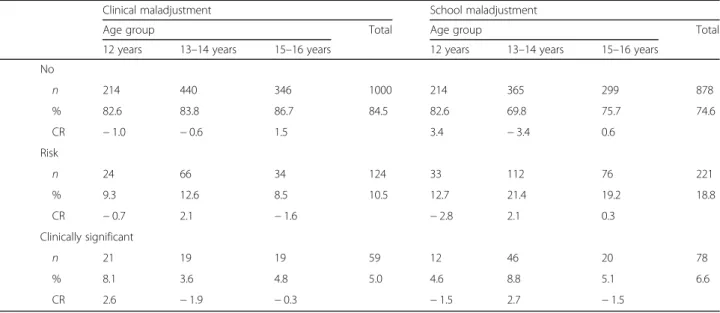
As severity levels of maladjustment is concerned, the
BASC-S3 results indicated that 5% (n= 59) of the
sample reported clinically significant clinical mal-adjustment, and a further 10.5% (n= 124) were at risk of clinical maladjustment. 6.6% (n= 78) of the sample reported clinically significant school maladjustment,
and a further 18.8% (n= 221) were considered to be
at risk. Severity of maladjustment did not vary as a function of adolescents’ sex [clinical: χ2 (2) = 3.32, p
= .19, VCramer= .05; school: χ2 (2) = 3.34, p= .18, V
Cra-mer= .05] but did vary as a function of adolescents’
age: in the younger adolescents group, there was a higher percentage than expected by chance who were in clinically significant clinical maladjustment category [χ2(4) = 11.45, p= .02,VCramer= .07] and in the middle adolescents group, the clinically significant school
maladjustment was more prevalent than expected [χ2
(4) = 17.65, p< .01,VCramer= .09] (see Table 1).
As regards clinical maladjustment, Fig. 1 shows
that as girls become older, they score higher in clin-ical maladjustment, but that boys present the oppos-ite trend. The results of the 2 × 3 ANOVA revealed no statistically significant main effects of sex [F (1,
1177) = 0.003, p= .96] or age [F (2, 1177) = 0.26, p
= .77], but the interaction between the two variables was significant [F (2, 1177) = 3.81, p= .02]. However, the differences between the six groups generated from the interaction between sex and age were so small that they were not statistically significant.
The same procedure was followed for school mal-adjustment. Sex, but with low effect size, [F(1, 1171) = 6.58, p= .01, Mmales= 53.40, SDmales= 10.26, Mfemales= 52.32, SDfemales= 9.82, g´= 0.11] and age [F (2, 1171) = 20.51, p< .001, M12 years= 50.14, SD12 years= 9.87, M13–
14 years= 54.65, SD13–14 years= 9.80, M15–16 years= 52.30, SD15–16 years= 10.09, g´12–14 years=−0.46, g´12–16 years= 0.21, g´13–16 years=−0.24] were statistically significant.
Their interaction variables were not significant [F (2, 1171) = 1.07, p= .34]. The 13–14 age group presented the highest levels of school maladjustment.
Table 1Relation between clinical and school maladjustment and age group
Clinical maladjustment School maladjustment
Age group Total Age group Total
12 years 13–14 years 15–16 years 12 years 13–14 years 15–16 years
No
n 214 440 346 1000 214 365 299 878
% 82.6 83.8 86.7 84.5 82.6 69.8 75.7 74.6
CR −1.0 −0.6 1.5 3.4 −3.4 0.6
Risk
n 24 66 34 124 33 112 76 221
% 9.3 12.6 8.5 10.5 12.7 21.4 19.2 18.8
CR −0.7 2.1 −1.6 −2.8 2.1 0.3
Clinically significant
n 21 19 19 59 12 46 20 78
% 8.1 3.6 4.8 5.0 4.6 8.8 5.1 6.6
CR 2.6 −1.9 −0.3 −1.5 2.7 −1.5
CRcorrected residuals
Parenting dimensions and styles
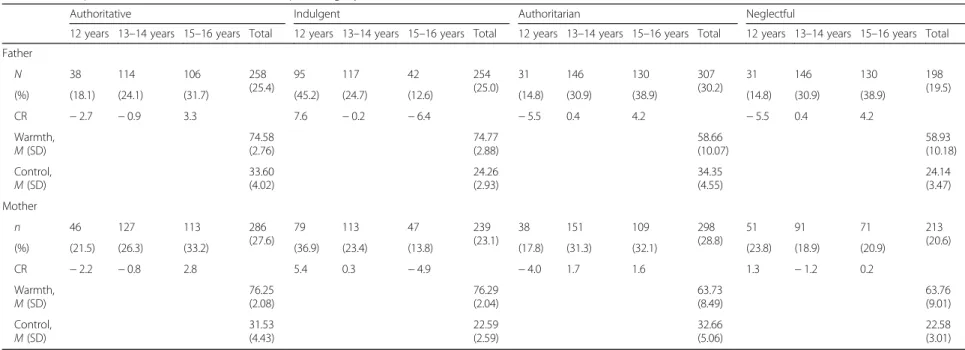
Although there were no significant differences between ad-olescents’perceptions of their mothers’and fathers’ parent-ing styles and dimensions [warmth: FFriedman (1) = 0.00;p = .999; control: FFriedman (1) = 0.21;p= .647; style:FFriedman (1) = 1.33;p= .251], Table2 shows the results for the par-enting styles and dimensions of fathers and mothers, separ-ately, as reported by the students in our study sample.
The analyses show that parenting style did not vary as a function of sex of adolescents [father:χ2(3) = 3.44,p=
0.33,VCramer= .06; mother:χ2(3) = 4.13, p= .25,VCramer = .06] but did vary as a function of adolescents’age, with younger adolescents relatively more likely to characterise their parents as indulgent and older adolescents rela-tively more likely to characterise them as authoritarian [father: χ2 (6) = 92.24, p< 0.01,VCramer= .22; mother: χ2
(6) = 50.68,p< .01,VCramer= .16].
Parenting and adolescents’maladjustment
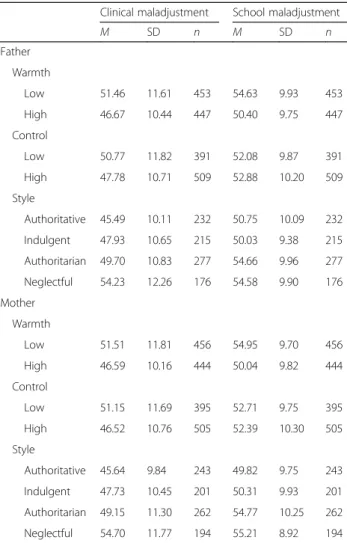
Descriptive analyses (Table3) and MANOVAs (Table4)
were performed to test differences between the levels of clinical and school maladjustment among adolescents with parents reported to have high/low warmth and con-trol and different parenting styles.
Parents’warmth and control and adolescents’ maladjustment
The interaction between fathers’warmth and control was not statistically significant; however, the main effects of
fa-thers’ warmth and control were significant. Follow-up
ANOVA revealed significant differences in clinical mal-adjustment depending on the father’s warmth and control. Adolescents whose fathers had low levels of warmth scored more highly in clinical maladjustment than those with fathers presenting high levels of warmth [HSD Bonfer-roni= 5.24, p< .001, g´= 0.43]. Similarly, students whose
fathers had low levels of control had higher levels of clin-ical maladjustment than those whose fathers had higher levels of control [HSDBonferroni= 3.55, p< .001, g´= 0.27]. ANOVAs also indicated that there were significant differ-ences in school maladjustment depending on the father’s warmth but there were no such differences with respect to control. Adolescents whose fathers presented low levels of warmth scored higher in school maladjustment than those whose fathers presented high levels of warmth [HSD Bonfer-roni= 4.5,p< .001,g´= 0.43].
As for the mothers, the results were similar: the main ef-fects of mothers’warmth and control were significant and the interaction between mothers’warmth and control was not significant. In this case, too, follow-up ANOVAs re-vealed significant differences in clinical maladjustment
de-pending on the mother’s warmth and control and
differences in school maladjustment depending only the
mother’s warmth. Adolescents whose mothers presented
low levels of warmth had higher levels of clinical maladjust-ment [HSDBonferroni= 5.15, p< .001, g´= 0.45] and school maladjustment [HSDBonferroni= 5.13, p< .001, g´= 0.50]. Higher levels of clinical maladjustment were also found among the adolescents whose mothers had low levels of control compared to those reporting high levels of maternal control [HSDBonferroni= 4.10,p< .001,g´= 0.41].
Parenting styles and adolescents’maladjustment
Table 2Descriptive results for fathers’and mothers’parenting styles and dimensions
Authoritative Indulgent Authoritarian Neglectful
12 years 13–14 years 15–16 years Total 12 years 13–14 years 15–16 years Total 12 years 13–14 years 15–16 years Total 12 years 13–14 years 15–16 years Total
Father
N 38 114 106 258
(25.4)
95 117 42 254
(25.0)
31 146 130 307
(30.2)
31 146 130 198
(19.5)
(%) (18.1) (24.1) (31.7) (45.2) (24.7) (12.6) (14.8) (30.9) (38.9) (14.8) (30.9) (38.9)
CR −2.7 −0.9 3.3 7.6 −0.2 −6.4 −5.5 0.4 4.2 −5.5 0.4 4.2
Warmth,
M(SD)
74.58 (2.76)
74.77 (2.88)
58.66 (10.07)
58.93 (10.18)
Control,
M(SD)
33.60 (4.02)
24.26 (2.93)
34.35 (4.55)
24.14 (3.47)
Mother
n 46 127 113 286
(27.6)
79 113 47 239
(23.1)
38 151 109 298
(28.8)
51 91 71 213
(20.6)
(%) (21.5) (26.3) (33.2) (36.9) (23.4) (13.8) (17.8) (31.3) (32.1) (23.8) (18.9) (20.9)
CR −2.2 −0.8 2.8 5.4 0.3 −4.9 −4.0 1.7 1.6 1.3 −1.2 0.2
Warmth,
M(SD)
76.25 (2.08)
76.29 (2.04)
63.73 (8.49)
63.76 (9.01)
Control,
M(SD)
31.53 (4.43)
22.59 (2.59)
32.66 (5.06)
22.58 (3.01)
Jaureguiza
r
et
al.
Psicolog
ia:
Reflexão
e
Crítica
(2018) 31:8
Page
6
of
interaction showed that students with neglectful mothers and authoritative fathers presented the highest levels of clinical maladjustment, followed by those with other com-binations of neglectful styles, authoritarian, indulgent and finally authoritative styles. No statistically significant dif-ferences were found between combinations of fathers’and mothers’ indulgent and authoritative styles, or between neglectful and authoritarian combinations.
Follow-up ANOVA indicated that the effects of both mothers’ and fathers’ parenting styles were significant for school maladjustment. The results for mothers’and fathers’ parenting styles were in the same line. The post hoc with Bonferroni correction tests revealed statistically significant differences between neglectful/authoritarian and indulgent/authoritative families; the students from neglectful and authoritarian families presented highest levels of school maladjustment [father: DHSneglectful vs
in-dulgent= 4.50,p< .001,g´= 0.44, DHSneglectful vs authoritative = 3.83, p= .001, g´= 0.38, DHSauthoritarian vs indulgent= 4.63, p< .001, g´= 0.41, DHSauthoritarian vs authoritative=
3.90,p< .001,g´= 0.32; mother: DHSneglectful vs indulgent= 4.90, p< .001, g´= 0.52, DHSneglectful vs authoritative= 5.39,
p< .001, g´= 0.57, DHSauthoritarian vs indulgent= 4.46, p < .001, g´= 0.44, DHSauthoritarian vs authoritative= 4.95, p < .001, g´= 0.49]. No significant differences were found between neglectful and authoritarian families [father: DHS =−0.08, p= .999; mother: DHS = 0.44, p= .964], or
between indulgent and authoritative families [father: DHS =−0.73, p= .859; mother: DHS = 0.40, p= .952], in
this respect.
Discussion
This study was conducted to analyse the relationships
between adolescents’ adjustment (clinical and school)
and parenting styles using two dimension (warmth and control) and four typologies (authoritarian, authoritative, negligent and indulgent), with a sample of Spanish ado-lescent students.
Table 3Descriptive results for maladjustment by fathers’and mothers’parenting dimensions and styles
Clinical maladjustment School maladjustment
M SD n M SD n
Father
Warmth
Low 51.46 11.61 453 54.63 9.93 453
High 46.67 10.44 447 50.40 9.75 447
Control
Low 50.77 11.82 391 52.08 9.87 391
High 47.78 10.71 509 52.88 10.20 509
Style
Authoritative 45.49 10.11 232 50.75 10.09 232
Indulgent 47.93 10.65 215 50.03 9.38 215
Authoritarian 49.70 10.83 277 54.66 9.96 277
Neglectful 54.23 12.26 176 54.58 9.90 176
Mother
Warmth
Low 51.51 11.81 456 54.95 9.70 456
High 46.59 10.16 444 50.04 9.82 444
Control
Low 51.15 11.69 395 52.71 9.75 395
High 46.52 10.76 505 52.39 10.30 505
Style
Authoritative 45.64 9.84 243 49.82 9.75 243
Indulgent 47.73 10.45 201 50.31 9.93 201
Authoritarian 49.15 11.30 262 54.77 10.25 262
Neglectful 54.70 11.77 194 55.21 8.92 194
Table 4Results of multivariate and univariate analyses of variance for maladjustment
F DF p
Father’dimensions
Warmth 34.74 2, 924 < .001
Clinical maladjustment 52.18 1,925 < .001
School maladjustment 46.51 1, 925 < .001
Control 15.98 2, 924 < .001
Clinical maladjustment 24.00 1, 925 < .001
School maladjustment 0.26 1, 925 .612
Warmth × control 0.98 2, 924 .373
Mother’dimensions
Warmth 41.71 2, 945 < .001
Clinical maladjustment 51.96 1, 946 < .001
School maladjustment 64.94 1, 946 < .001
Control 18.34 2, 945 < .001
Clinical maladjustment 32.94 1, 946 < .001
School maladjustment 0.30 1, 946 .582
Warmth × control 2.33 2, 945 .098
Styles
Father 4.06 6, 1768 < .001
Clinical maladjustment 5.66 3, 884 .001
School maladjustment 3.60 3, 884 .013
Mother 8.00 6, 1768 < .001
Clinical maladjustment 14.98 3, 884 < .001
School maladjustment 5.05 3, 884 .002
Father × mother 1.81 6, 1768 .020
Clinical maladjustment 2.49 9, 884 .008
Severity levels of clinical and school maladjustment were explored, and approximately 5% of the adolescents were found to have clinically significant adjustment prob-lems, a finding that is in line with the previous studies (Donaldson et al., 2014; Merikangas et al.,2010). One of the strong points of the BASC-S3 is that clinically signifi-cant and at-risk results are obtained, so that early inter-vention can be made to help adolescents who are at risk of clinical or school maladjustment. The results of the present study highlight the need to take into account ado-lescents who may be at risk of maladjustment, because the
percentages obtained are far from negligible (10.5% for clinical maladjustment and 18.8% for school maladjust-ment). Moreover, age but not sex was relevant to severity levels for adolescents’adjustment problems. Younger ado-lescents were more prone than others to suffer clinically significant clinical maladjustment and middle adolescents to suffer risk for school maladjustment and clinically sig-nificant school maladjustment. In contrast, when analys-ing the scores, statistically significant effect of the sex and age group interaction on the clinical maladjustment and
main effect of sex—with low effect size—and age on
school maladjustment were found. Thus, as girls become older, they score higher in clinical maladjustment, but boys present the opposite trend. Many previous studies have reported higher levels of emotional problems among adolescent girls than boys (Compas, Connor-Smith, & Jaser, 2004; Waite & Creswell, 2014), probably because they are more sensitive to the typical changes of adoles-cence as these changes come over (and possibly, also, due to greater social pressures). On the contrary, boys are more prone to school maladjustment, which is in line with previous findings (Holden, 2002; Lam et al., 2012). Al-though externalising problems have been understood as stable over the course of development (Li et al.,2017), the present study found the 13–14 age group as the one with highest levels of school maladjustment, maybe because it is also related with a level change in Spanish Education (from Primary to Secondary Education).
The next aim of our study was to analyse the parenting dimensions and styles of fathers and mothers separately, Table 5Descriptives and differences between sub-groups in
clinical maladjustment
Father’style Mother’style M SD N Sub-group
1 2 3 4
Authoritative Authoritative 43.49 8.67 155 *
Indulgent Authoritarian 43.64 10.97 14 *
Authoritative Authoritarian 46.27 9.64 37 * *
Indulgent Authoritative 47.32 10.04 37 * *
Indulgent Indulgent 47.33 10.53 135 * *
Authoritarian Authoritarian 49.07 11.10 162 * * *
Authoritarian Neglectful 51.93 9.99 56 * *
Indulgent Neglectful 53.17 10.42 30 * * *
Neglectful Neglectful 55.83 12.81 89 * *
Authoritative Neglectful 59.95 11.84 19 *
p .377 .117 .135 .132
Note: *belongs to the subgroup
Fig. 2Adolescents’clinical maladjustment by parent’styles
according to their adolescent children’s perceptions. One of the main conclusions drawn is that, as concluded by Sheeber et al. (2007), there were no significant differences between adolescents’ perceptions of their mothers’ and fathers’ di-mensions and parenting styles, which contradicts the results of other studies (Hoeve et al.,2009; McKinney et al.,2008).
To obtain more detailed information about parenting, we analysed the two main dimensions of parenting (warmth and control). Hypothesis 1 was confirmed, with our results showing that adolescent maladjustment was most likely to occur when adolescents perceived low warmth and acceptance from their parents. The results showed, too, that only fathers’and mothers’warmth was significantly associated with school maladjustment (par-ental control was non-significant): thus, low warmth was related to higher levels of school maladjustment. These results coincide with previous findings about parenting styles, reinforcing the idea that no significant differences arise between indulgent and authoritative families as regards school maladjustment; what really matters is the parents’level of warmth. On the other hand, the results for clinical maladjustment argue in favour of an authori-tative parenting style, with higher levels of warmth and control being related to lower levels of clinical mal-adjustment. In this case, therefore, parental control is an important factor, and so hypothesis 2 (that adolescent maladjustment is more likely to occur when adolescents perceive low control and supervision from their parents) was partially confirmed, being true for clinical but not for school maladjustment.
The analysis of the relationship between parenting styles and clinical maladjustment revealed that the interaction between the mothers’and fathers’parenting styles was significant; the highest level of maladjust-ment was presented for the students with neglectful mothers and authoritative fathers, followed by other combinations for neglectful mothers. In the case of school maladjustment, revealed similar results for mothers and fathers, but with higher effect sizes associ-ated in the case of different mothers’ parenting styles. Adolescents’ perceptions of neglectful or authoritarian fathers and mothers is related to higher levels of mal-adjustment, while perceptions of authoritative or indul-gent fathers and mothers is related to lower levels of maladjustment. No significant differences were found between indulgent and authoritative families or be-tween neglectful or authoritarian, which indicates that these two parenting styles have similar effects on ado-lescents, as suggested by previous studies conducted in Spain (Gámez-Guadix et al., 2012; García & Gracia,
2009; López-Romero et al.,2012). These results corrob-orate our hypothesis 3 and highlight the positive effect of high levels of parental warmth (present in indulgent and authoritative families).
It seems that in the Spanish culture, a high level of af-fection (present in both the authoritative and the indul-gent styles) is considered very important, and that these styles are distinguished by the level of imposition or co-ercive control exerted (Musitu & García,2004). By con-trast, other authors argue that superior outcomes are achieved by the authoritative style of parenting, in all cultures (see, for example, Sorkhabi,2005; Steinberg et al., 2006). In view of these conflicting outlooks, further study is needed of the relationship between children’s adjustment/maladjustment and parenting styles, in dif-ferent cultural contexts.
Conclusions
In summary, these results are not as conclusive as other studies conducted in Spain, which have argued that the in-dulgent style of parenting is “optimum” (Esteve, 2005; García & Gracia,2009,2010). Following the ideas of Stein-berg (2001), we find that authoritative families seem to be especially important for adolescents’emotional well-being; besides the importance of the positive expression of affect and support provided by such parents, it is also important to set limits and establish structures for children to facili-tate their development of self-regulatory skills.
Finally, the limits of the study must be taken into account. Its cross-sectional design and reliance on self-reporting by adolescents mean that the results obtained should be inter-preted with caution. Moreover, causal conclusions cannot be drawn. Although studies show that adolescents’perceptions of their mothers’and fathers’parenting styles yield reliable results (Baumrind, 1991; Lamborn et al., 1991; Steinberg, Lamborn, Darling, Mounts, & Dornbusch, 1994), it would nevertheless be interesting to compare these results with the views of the parents concerned. Lastly, a better understand-ing is needed of the relationship between parentunderstand-ing and ado-lescents’levels of personal adjustment in different cultures, to identify the aspects of parental socialisation that are de-terminant factors in children’s psychosocial development.
Acknowledgements Not applicable.
Funding
Research Project was sponsored by the University of the Basque Country (Spain), with grant number EHU 11/16 and PPG17/31.
Availability of data and materials
Data will not be deposited in any publicly available repositories, but will be shared if asked directly to the authors.
Authors’contributions
All the authors of the manuscript have contributed to it in a meaningful way. JJ and EB designed the study, acquired all the data and conducted the literature review. MG and PB analysed the data. All the authors contributed to writing the manuscript. The manuscript has been reviewed by all authors, and they have given their approval of the version to be published.
Competing interests
Author details
1Department of Developmental and Educational Psychology, Faculty of Education of Bilbao, University of the Basque Country (Spain), Barrio Sarriena s/n, 48940 Leioa, Spain.2Department of Developmental and Educational Psychology, Faculty of Education, Philosophy and Anthropology (Donostia–
San Sebastián), University of the Basque Country (Spain), Plaza Oñati 3, 20018 Donostia–San Sebastián, Spain.3Research Unit of Primary Attention (Bizkaia), Basque Health Service-Osakidetza, C/ Luis Power, 18, 4, 48014 Bilbao, Spain. 4Department of Personality, Assessment and Psychological Treatments, Faculty of Psychology, University of the Basque Country, Avda Tolosa 70, 20018 Donostia–San Sebastian, Spain.
Received: 9 January 2018 Accepted: 22 February 2018
References
Adalbjarnardottir, S., & Hafsteinsson, L. G. (2001). Adolescents’perceived parenting
styles and their substance use: Concurrent and longitudinal analyses.Journal of Research on Adolescence,11, 401–423https://doi.org/10.1111/1532-7795.00018.
Barber, B. K. (1996). Parental psychological control: Revisiting a neglected construct.Child Development,67, 3296–3319https://doi.org/10.2307/1131780.
Barber, B. K., Stolz, H. E., & Olsen, J. A. (2005). Parental support, psychological control, and behavioral control: Assessing relevance across time, culture, and method.Monographs of the Society for the Research in Child Development,70, 1–137https://doi.org/10.1111/j.1540-5834.2005.00365.x.
Baumrind, D. (1991). Effective parenting during the early adolescent transition. In P. A. Cowan (Ed.),Family transitions, (pp. 111–163). Hillsdale, NJ: Lawrence
Erlbaum Associates.
Baumrind, D. (1997). The discipline encounter: Contemporary issues.Aggression and Violent Behavior,2, 321–335https://doi.org/10.1016/S1359-1789(97)00018-9. Calafat, A., García, F., Juan, M., Becoña, E., & Fernández-Hermida, J. R. (2014).
Which parenting style is more protective against adolescent substance use? Evidence within the European context.Drug and Alcohol Dependence,138, 185–192https://doi.org/10.1016/j.drugalcdep.2014.02.705.
Compas, B. E., Connor-Smith, J., & Jaser, S. S. (2004). Temperament, stress reactivity, and coping: Implications for depression in childhood and adolescence.Journal of Clinical Child & Adolescent Psychology,33, 21–31 https://doi.org/10.1207/S15374424JCCP3301_3.
Coolican, H. (1994).Research methods and statistics in psychology, (2nd ed., ). London: Hodder &Stoughton.
Darling, N., & Steinberg, L. (1993). Parenting style as context: An integrative model.
Psychological Bulletin,113, 487–496https://doi.org/10.1037/0033-2909.113.3.487. Donaldson, A. E., Gordon, M. S., Melvin, G. A., Barton, D. A., & Fitzgerald, P. B.
(2014). Addressing the needs of adolescents with treatment resistant depressive disorders: A systematic review of rTMS.Brain Stimulation,7(1), 7–
12https://doi.org/10.1016/j.brs.2013.09.012.
Esteve, J. V. (2005).Estilos parentales, clima familiar y autoestima física en adolescentes [parenting styles, family climate and adolescents’physical self-esteem]. University of Valencia, Spain: Unpublished doctoral thesis. Fuentes, M. C., García, J. F., Gracia, E., & Lila, M. (2011). Autoconcepto y ajuste
psicosocial en la adolescencia [self-concept and psychosocial adjustment in adolescence].Psicothema,23, 7–12.
Gámez-Guadix, M., Jaureguizar, J., Almendros, C., & Carrobles, J. A. (2012). Estilos de socialización familiar y violencia de hijos a padres en población española [parenting styles and child to parent violence in Spanish population].
Psicología Conductual/Behavioral Psychology,20, 585–602.
Garber, J., Robinson, N. S., & Valentiner, D. P. (1997). The relation between parenting and adolescent depression: Self-worth as a mediator.Journal of Adolescent Research,12, 12–33https://doi.org/10.1177/0743554897121003.
García, F., & Gracia, E. (2009). Is always authoritative the optimum parenting style? Evidence from Spanish families.Adolescence,44, 101–131.
García, F., & Gracia, E. (2010). ¿Qué estilo de socialización parental es el idóneo en España? Un estudio con niños y adolescentes de 10 a 14 años [what is the optimum parental socialisation style in Spain. A study with children and adolescents aged 10-14 years].Infancia y Aprendizaje: Journal for the Study of Education and Development,33, 365–384https://doi.org/10.1174/021037010792215118.
Gerard, J. M., & Booth, M. Z. (2015). Family and school influences on adolescents' adjustment: The moderating role of youth hopefulness and aspirations for the future.Journal of Adolescence,44, 1–16 https://doi.org/10.1016/j.adolescence.2015.06.003.
González, J., Fernández, S., Pérez, E., & Santamaría, P. (2004).Adaptación española del sistema de evaluación de la conducta en niños y adolescentes: BASC [Spanish adaptation of the Behavior Assesment System for Children: BASC]. Madrid: TEA Ediciones.
Heaven, P. C., Newbury, K., & Mak, A. (2004). The impact of adolescent and parental characteristics on adolescent levels of delinquency and depression.Personality and Individual Differences,36, 173–185https://doi.org/10.1016/S0191-8869(03)00077-1. Heider, D., Matschinger, H., Bernet, S., Alonso, J., & Angermeyer, M. (2006). Relationship
between parental bonding and mood disorder in six European countries.
Psychiatry Research,143, 89–98https://doi.org/10.1016/j.psychres.2005.08.015. Hoeve, M., Dubas, J. S., Eichelsheim, V. I., van der Laan, P. H., Smeenk, W., &
Gerris, J. R. (2009). The relationship between parenting and delinquency: A meta-analysis.Journal of Abnormal Child Psychology,37, 749–775 https://doi.org/10.1007/s10802-009-9310-8.
Holden, C. (2002). Contributing to the debate: The perspectives of children on gender, achievement and literacy.Journal of Educational Enquiry,3, 97–110. Im-Bolter, N., Zadeh, Z. Y., & Ling, D. (2013). Early parenting beliefs and academic
achievement: The mediating role of language.Early Child Development and Care,183, 1811–1826https://doi.org/10.1080/03004430.2012.755964. Jacobson, K. C., & Crockett, L. J. (2000). Parental monitoring and adolescent
adjustment: An ecological perspective.Journal of Research on Adolescence,10, 65–97https://doi.org/10.1207/SJRA1001_4.
Jaureguizar, J., Bernaras, E., Ibabe, M. I., & Sarasa, M. (2012). Scholar, clinical and emotional maladjustment in 8-12 school-age children: Adaptation of the self-report version of the behavior assessment system for children (BASC-S2) to the Basque-speaking population.Revista de Psicodidáctica/Journal of Psychodidactics,17, 415–439https://doi.org/10.1387/RevPsicodidact.2982.
Jaureguizar, J., Ibabe, I., & Strauss, M. A. (2013). Violent and prosocial behavior by adolescents toward parents and teachers in a community sample.Psychology in the Schools,50, 451–470https://doi.org/10.1002/pits.21685.
Johnson, L. E., & Greenberg, M. T. (2013). Parenting and early adolescent internalizing: The importance of teasing apart anxiety and depressive symptoms.Journal of Early Adolescence,33, 201–226https://doi.org/ 10.1177/0272431611435261.
Kerr, M., & Stattin, H. (2000). What parents know, how they know it, and several forms of adolescent adjustment: Further support for a reinterpretation of monitoring.Developmental Psychology,36, 366–380 https://doi.org/10.1037/0012-1649.36.3.366.
Kritzas, N., & Grobler, A. A. (2005). The relationship between perceived parenting styles and resilience during adolescence.Journal of Child and Adolescent Mental Health,17, 1–12https://doi.org/10.2989/17280580509486586.
Lam, S., Jimerson, S., Kikas, E., Cefai, C., Veiga, F. H., Nelson, B.,…Zollneritsch, J.
(2012). Do boys and girls perceive themselves as equally engaged in school? The results of an international study from 12 countries.Journal of School Psychology,50, 77–94https://doi.org/10.1016/j.jsp.2011.07.004.
Lamborn, S. D., Mounts, N. S., Steinberg, L., & Dornbusch, S. M. (1991). Patterns of competence and adjustment among adolescents from authoritative, authoritarian, indulgent, and neglectful families.Child Development,62, 1049–
1065https://doi.org/10.2307/1131151.
Lengua, L. J., & Kovacs, E. A. (2005). Bidirectional associations between temperament and parenting and the prediction of adjustment problems in middle childhood.Applied Developmental Psychology,26, 21–38https://doi.org/10.1016/j.appdev.2004.10.001.
Li, M., Johnson, S. B., Musci, R. J., & Riley, A. W. (2017). Perceived neighborhood quality, family processes, and trajectories of child and adolescent externalizing behaviors in the United States.Social Science & Medicine,192, 152–161https://doi.org/10.1016/j.socscimed.2017.07.027.
López-Romero, L., Romero, E., & Villar, P. (2012). Relationships between parenting styles and psychopathic traits in childhood.Psicología Conductual/Behavioral Psychology,20, 603–623.
Maccoby, E. E., & Martin, J. A. (1983). Socialization in the context of the family: Parent–child interaction. In P. H. Mussen (Ed.),Handbook of child psychology,
(vol. 4, pp. 1–101). New York: Wiley.
McKinney, C., Donnelly, R., & Renk, K. (2008). Perceived parenting, positive and negative perceptions of parents, and late adolescent emotional adjustment.Child and Adolescent Mental Health,13, 66–73https://doi.org/10.1111/j.1475-3588.2007.00452.x.
Merikangas, K. R., He, J. P., Burstein, M., Swanson, S. A., Avenevoli, S., Cui, L.,…
Swendsen, J. (2010). Lifetime prevalence of mental disorders in U.S. adolescents: Results from the national comorbidity survey replication-adolescent supplement (NCS-A).Journal of the American Academy of Child and Adolescent Psychiatry,49, 980–989https://doi.org/10.1016/j.jaac.2010.05.017.
Milevsky, A., Schlechter, M., Netter, S., & Keehn, D. (2007). Maternal and paternal parenting styles in adolescents: Associations with self-esteem, depression and life-satisfaction.Journal of Child and Family Studies,16, 39–47https://doi.org/10.1007/s10826-006-9066-5.
Musitu, G., & García, F. (2001).ESPA29: Escala de estilos de socialización parental en la adolescencia [scale of parental socialisation in adolescence]. Madrid: TEA.
Musitu, G., & García, F. (2004). Consecuencias de la socialización familiar en la cultura española [consequences of the family socialisation in the Spanish culture].Psicothema,16, 288–293.
O’Connor, T. G. (2002). Annotation: The‘effects’of parenting reconsidered:
Findings, challenges, and applications.Journal of Child Psychology and Psychiatry,43, 555–572https://doi.org/10.1111/1469-7610.00046. Oliva, A., Parra, A., & Arranz, E. (2008). Estilos relacionales parentales y ajuste del
adolescente [parenting styles and adolescent adjustment].Infancia y Aprendizaje: Journal for the Study of Education and Development,31, 93–106 https://doi.org/10.1174/021037008783487093.
Pelegrina, S., García, M. C., & Casanova, P. (2002). Los estilos educativos de los padres y la competencia académica de los adolescentes [parenting styles and adolescents’academic performance].Infancia y Aprendizaje:
Journal for the Study of Education and Development,25, 147–168 https://doi.org/10.1174/021037002317417796.
Ratelle, C. F., Larose, S., Guay, F., & Senecal, C. (2005). Perceptions of parental involvement and support as predictors of college students’persistence in a science curriculum.
Journal of Family Psychology,19, 286–293https://doi.org/10.1037/0893-3200.19.2.286. Reitz, E., Decovic, M., & Meijer, A. M. (2006). Relations between parenting and
externalizing and internalizing problem behaviour in early adolescence: Child behaviour as moderator and predictor.Journal of Adolescence,29, 419–436 https://doi.org/10.1016/j.adolescence.2005.08.003.
Reynolds, C. R., & Kamphaus, R. W. (1992).Behavior assessment system for children (BASC). Circle Pines, MN: American Guidance Services.
Rodríguez-Fernandez, A., Droguet, L., & Revuelta, L. (2012). School and personal adjustment in adolescence: The role of academic self-concept and perceived social support.Revista de Psicodidáctica/Journal of Psychodicatics,17, 397–414 https://doi.org/10.1387/RevPsicodidact.3002.
Rohner, R. P. (1989).Parental Acceptance-Rejection/Control Questionnaire (PARQ/ Control). 255 Codfish Falls Road, Storrs, CT, 06268–1425: Rohner Research. Rohner, R. P. (1990).Handbook for the study of parental acceptance and rejection,
(3rd ed., ). Storrs, CT: Rohner Research Publications.
Rohner, R. P., & Khaleque, A. (2003). Reliability and validity of the parental control scale: A meta-analysis of cross-cultural and intracultural studies.Journal of Cross-Cultural Psychology,34, 643–649https://doi.org/10.1177/0022022103255650.
Rohner, R. P., & Khaleque, A. (2005).Handbook for the study of parental acceptance and rejection, (4th ed., ). Storrs, CT: Rohner Research Publications.
Rohner, R. P., Saavedra, J., & Granum, E. O. (1978). Development and validation of the Parental Acceptance Rejection Questionnaire: Test manual.JSAS Catalogue of Selected Documents in Psychology,8, 7–8.
Sheeber, L., Davis, B., Leve, C., Hops, H., & Tildesley, E. (2007). Adolescents’
relationships with their mothers and fathers: Associations with depressive disorder and subdiagnostic symptomatology.Journal of Abnormal Psychology,
116, 144–154https://doi.org/10.1037/0021-843X.116.1.144.
Soenens, B., Park, S. Y., Vansteenkiste, M., & Mouratidis, A. (2012). Perceived parental psychological control and adolescent depressive experiences: A cross-cultural study with Belgian and South-Korean adolescents.Journal of Adolescence,35, 261–272https://doi.org/10.1016/j.adolescence.2011.05.001.
Sorkhabi, N. (2005). Applicability of Baumrind’s parent typology to collective cultures:
Analysis of cultural explanations of parent socialization effects.International Journal of Behavioral Development,29, 552–563https://doi.org/10.1080/01650250500172640.
Steinberg, L. (2001). We know some things: Parent-adolescent relationships in retrospect and prospect.Journal of Research on Adolescence,11, 1–19 https://doi.org/10.1111/1532-7795.00001.
Steinberg, L., Blatt-Eisengart, I., & Cauffman, E. (2006). Patterns of competence and adjustment among adolescents from authoritative, authoritarian, indulgent, and neglectful homes: A replication in a sample of serious juvenile offenders.Journal of Research on Adolescence,16, 47–58.https://doi.org/10.1111/j.1532-7795.2006.00119.x.
Steinberg, L., Lamborn, S., Darling, N., Mounts, N., & Dornbusch, S. M. (1994). Over-time changes in adjustment and competence among adolescents from authoritative, authoritarian, indulgent, and neglectful families.Child Development,65, 754–770https://doi.org/10.2307/1131416.
Thapar, A., Collishaw, S., Pine, D., & Thapar, A. (2012). Depression in adolescence.
Lancet,379, 1056–1067https://doi.org/10.1016/S0140-6736(11)60871-4.
Waite, P., & Creswell, C. (2014). Children and adolescents referred for treatment of anxiety disorders: Differences in clinical characteristics.Journal of Affective Disorders,167, 326–332https://doi.org/10.1016/j.jad.2014.06.028.
Yap, M. B., Pilkington, P. D., Ryan, S. M., & Jorm, A. F. (2014). Parental factors associated with depression and anxiety in young people: A systematic review and meta-analysis.Journal of Affective Disorders,156, 8–23https://doi.org/10.1016/j.jad.2013.11.007.
Zubrick, S. R., Hafekost, J., Johnson, S. E., Sawyer, M. G., Patton, G., & Lawrence, D. (2017). The continuity and duration of depression and its relationship to nonsuicidal self-harm and suicidal ideation and behavior in adolescents 12–17.