1Instituto de Geociências, Universidade de São Paulo – USP, São Paulo (SP), Brazil. E-mails: [email protected],[email protected], [email protected], [email protected], [email protected], [email protected], [email protected]
*Corresponding author.
Manuscript ID: 20170089. Received in: 08/07/2017. Approved in: 10/31/2017.
ABSTRACT: Three series of alkaline dikes are characterized in a restricted area of the Mantiqueira Range: a weakly silica-undersaturated series (normative ne < 7), of potassic character, represented by basanite, tephrites, alkali basalts, basaltic trachyandesites, phonotephrites, tephriphonolites, and trachyandesites, an intermediate series (7 > normative ne > 13), of potassic character, consisting only of basanites and tephrites, and a strongly silica-un-dersaturated series (normative ne > 13), of sodic character, consisting of basanites, tephrites, phonotephrites, and phonolites. Ar-Ar data for biotite from a tephriphonolite dike yielded an average age of 85.4±0.4 Ma. All three series show similar evolution trends controlled mainly by early-fractionation of olivine, spinel and clinopyroxene and, secondly, fractionation of plagioclase and apatite. Different degrees of crustal assimilation are suggested for each series. Assimilation processes are responsible for the wide 87Sr/86Sr
i (0.70447-0.71172) and
143Nd/144Nd
i (0.51237-0.51244) ranges, for the increased K2O/Na2O, Ba/Sr and Rb/Sr ratios, and for the reduced Ce/Pb ratios. In general, a significant contribution from partially melted host rocks is associated to the weakly silica-undersaturated potassic series. A phlogopite-bearing carbonate-metasomatized heterogeneous peridotite source accounts for the main chemical variations in the least contaminated samples of each series. Geochemical signatures of the strongly sodic alkaline series indicate a greater contri-bution from carbonated pyroxene-rich veins in the mantle source.
KEYWORDS: alkaline magmatism; potassic and sodic series; crustal assimilation; metasomatized mantle source.
Upper Cretaceous weakly to strongly
silica-undersaturated alkaline dike series
of the Mantiqueira Range, Serra do Mar
alkaline province: Crustal assimilation
processes and mantle source signatures
Rogério Guitarrari Azzone1*, Excelso Ruberti1, Júlio César Lopes da Silva1,
Celso de Barros Gomes1, Gaston Eduardo Enrich Rojas1,
Maria Helena Bezerra Maia de Hollanda1, Colombo Celso Gaeta Tassinari1
ARTICLE
INTRODUCTION
Cogenetic association of contrasting strongly and weakly alkaline magmatic series is a common feature of many mag-matic provinces (e.g., Wilson et al. 1995, Fitton & Upton 1987, Comin-Chiaramonti et al. 1997). Several factors seem to contribute with their differences in magma com-position. Small variations in the degree of partial melting of a common source, distinct degrees of crustal assimilation and/or variable physicochemical conditions of crystalliza-tion from similar parent melts, and heterogeneous mantle
source metasomatism have all been attributed to classical occurrences such as the Hawaiian alkaline volcanism (Clague 1987), the Cantal volcano, the Massif Central (Wilson et al. 1995), the Teide-Pico Viejo volcanic complex, the Canary Islands (Ablay et al. 1998), and the East African Rift System (Furman & Graham 1999).
compositions. Brotzu et al. (2005) distinguished two main potassic suites for the dike swarms of the province: a more widespread, strongly silica-undersaturated suite that ranges from ultrabasic to phonolitic rocks, and a weakly silica-un-dersaturated suite that ranges from basalts to trachytes. Distinct basanite and foidite parental magmas are assigned to the strongly silica-undersaturated suite. Although the evo-lution of both suites involved fractional crystallization and crustal assimilation, a heterogeneous metasomatized man-tle source is believed to be the main control factor in their generation. Despite their regional character, both potas-sic suites of alkaline magmas are found locally in SMAP. Bennio et al. (2002) described a strongly silica-undersatu-rated tephriphonolite to phonolite series and a weakly sili-ca-undersaturated to saturated trachyandesite-trachyte series in the Arraial do Cabo Frio peninsula, a restricted area at the far eastern coast of Rio de Janeiro. Scarce local basanites and trachybasalts are suggested as the main parental melts for both series (Bennio et al. 2002).
In this paper, three distinct magmatic series that occur mainly as dikes are reported for the first time in a limited area of the Mantiqueira Range, a small part of the overall Serra do Mar province: a strongly-alkaline sodic dike series, a weak-ly-alkaline potassic dike series, and an intermediate potassic series. New petrographic, mineral chemistry, geochemical and radiogenic isotopic data are presented. Fractional crys-tallization, crustal assimilation and possibly mantle source mineralogy differences are deemed responsible for the gen-eration of the series. New Ar-Ar biotite radiometric ages for this magmatic event are also shown.
MAGMATIC CONTEXT /
REGIONAL GEOLOGY
Mesozoic to Cenozoic alkaline and alkaline-carbonatitic occurrences are known in the southern-central portion of the Brazilian Platform, being grouped into several provinces by Ulbrich and Gomes (1981), Almeida (1983) and Riccomini et al. (2005). The Upper Cretaceous to Paleocene alkaline intrusions (less than 100 km2 each) and subordinate dikes (Morbidelli et al. 1995, Gomes & Comin-Chiaramonti, 2005) found on the coasts of São Paulo and Rio de Janeiro, and in the Mantiqueira Range fall within the SMAP (cf. Brotzu et al. 2005 and Thompson et al. 1998; Fig. 1A), intruding Neoproterozoic rocks of the Ribeira and Brasília belts (Heilbron et al. 2004). In these suites, the abundance of evolved types, mostly nepheline syenites and syenites, is remarkable, as reported by several authors (e.g., Bellieni et al. 1990, Brotzu et al. 1992, 1997, 2007, Ulbrich et al. 2005, Gomes et al. 2017, Enrich et al. 2009, Rosa & Ruberti 2017,
Melluso et al. 2017), in the São Sebastião, Búzios and Monte de Trigo Islands and Morro de São João, Itatiaia and Poços de Caldas, for example. On the other hand, the Ponte Nova alkaline mafic-ultramafic massif is the only known intrusive suite with prevalence of mafic to ultramafic cumulate rocks (Azzone et al. 2009, 2016). Dike swarms associated with the complex usually include more primitive, basic alkaline rocks (Alves et al. 1992, Garda et al. 1995, Valente 1997, Thompson et al. 1998, Brotzu et al. 2005, 2007, Azzone et al. 2009, Enrich et al. 2009).
The Mantiqueira Range consists of Brasilia belt rocks, mainly of the Socorro-Guaxupé nappe, and rocks of the Embu terrane (Vinagre et al. 2014a, 2014b). In Sapucaí Mirim, Santo Antônio do Pinhal and Campos do Jordão, their main outcrops correspond to metasyenogranites, metamonzogranites and biotite gneisses of the Serra da Água Limpa batolith (645-630 Ma, Vinagre et al. 2014a) (Fig. 1B). Metasedimentary rocks of the Embu terrane are only found in a restricted sector (Vinagre et al. 2014a), consisting of quartzites with some intercalations of biotite schists. Serra da Água Limpa rocks indicate intermediate P (5-6 kbar) and high-T metamorphism from amphibolite to granulite facies (Vinagre et al. 2014b). In the Upper Cretaceous, the batholith experienced exhumation to upper crust levels, as indicated by thermochronological studies based on apatite fission tracks (Tello-Saenz et al. 2003).
The Upper Cretaceous alkaline intrusions that occur in the Mantiqueira Range nearby Sapucaí Mirim, Santo Antônio do Pinhal and Campos do Jordão are exclusively related to the Ponte Nova cumulatic mafic-ultramafic alkaline massif and its associated dikes (Fig. 1B). In general, most dikes, identified as alkaline lamprophyres, are thought to represent alkaline basalt, basanite, tephrite and nephelinite magmas. However, a complete alkaline series towards phonolite melts is also recognized (Alves et al. 1992, Thompson et al. 1998, Azzone et al. 2009, 2016).
GEOLOGY
Several authors report the presence of dikes of alkaline affinity in Campos do Jordão, a region in the Mantiqueira Range (e.g., Melcher & Melcher 1972, Alves 1978, Cavalcante et al. 1979, Alves et al. 1992, Thompson et al. 1998, Azzone et al. 2009, Menezes et al. 2015). The information presented by them regards mainly geologic and petrographic aspects of these occurrences.
The dikes, which represent either single magma pulses or multiple intrusions, appear as steeply dipping, 0.2 to 1.0 m thick dark gray to black intrusions. Zonation is present in most cases, with macrocryst-rich cores and a fine-grained matrix that grades to macrocryst-poor rims in an aphani-tic matrix. An NE-trending direction prevails for the dikes intruding the Serra da Água Limpa batholith. A NW-trend is prevalent in the bodies that intrude the Ponte Nova mas-sif neighborhood. Although fresh rock outcrops are scarce,
unaltered samples could be collected from blocks found in the highlands drainage system, without zonality control.
Leucocratic to hololeucocratic dikes and sills are also present in the Ponte Nova massif neighborhood and, simi-larly to the mesocratic to melanocratic bodies, they intrude the alkaline body and the Serra da Água Limpa batholith. Apparently, they are more abundant near the massif. In some cases, tabular bodies evolve to irregular brecciated zones rich in country rock fragments. Phonolites, the most evolved
Figure 1. (A) Geological sketch map of the Serra do Mar alkaline province in southeastern Brazil, modified from Thompson et al. (1998). In the gray rectangle, the studied area. (B) Simplified geological map of part of the Mantiqueira Range. Alkaline dikes are represented by black squares (sampling point of fresh rocks) in the main drainage segments and by the strike direction of in situbodies. PN, Ponte Nova alkaline massif (Azzone et al. 2009); SALB, Serra da Água Limpa batolith; G-SN, gneisses of the Socorro nappe; QS-ET, quartzites and schists of Embu terrane (Precambrian basement units from Vinagre et al. 2014a). R, main roadways; D, drainages. Reference Cities: SAP, Santo Antônio do Pinhal; CJ, Campos do Jordão; SM, Sapucaí Mirim.
A
rock type present, commonly intrude Precambrian rocks. Rounded xenoliths of syenogranite are irregularly found in the leucocratic dikes and sills, with diffusion rings in an aphanitic matrix, which, at least in a local scale, indicates assimilation processes.
PETROGRAPHY
The mesocratic to melanocratic alkaline dikes in the study area are mainly panidiomorphic porphyritic, with a fine-grained to aphanitic matrix, being identified mostly as alkaline lamprophyres (“camptonites”, “monchiquites” and “sannaites”, cf. Le Maitre 2002). The coarse- to medi-um-grained macrocryst population ranges from > 5 to < 20 vol.%, mainly consisting of clinopyroxene and oliv-ine with subordinate kaersutite. Clinopyroxene is the most important macrocryst in most bodies. Several populations of clinopyroxene macrocrysts are represented by hedenber-gite, diopside or Ti-augite cores, all exhibiting corrosion textures and oscillatory and/or step zoning. Titanaugite rims are also present. Glomeroporphyritic textures formed mainly by medium- to coarse-grained clinopyroxenes are recognized in some occurrences. Olivine macrocrysts, when not replaced by low-grade deuteric/hydrothermal-related serpentine, carbonates and muscovite aggregates, present normal zoning, with contrasting thin rims lower in forster-ite molecules. In some dikes, olivine macrocrysts show gulf corrosion textures with biotite coronas, whereas in others sites they are completely euhedric. Minor inclusions of Chromite and Cr-spinel are found in some olivine mac-rocrysts. Kaersutite macrocrysts are less common, display-ing normal step zondisplay-ing, sometimes evolvdisplay-ing to pargasite compositions. This lamprophyre assemblage cannot sim-ply be said to form phenocrysts, but it could be interpreted mainly as an assemblage of antecrysts and even xenocrysts. Disequilibrium microtextures are representative of complex plumbing systems, as reported for similar occurrences (e.g., Menezes et al. 2015, Ubide et al. 2012, 2014). Their matri-ces are basically composed of Ti-augite, plagioclase, kaer-sutite to pargasite, Ti-magnetite, alkali feldspar, biotite, apatite, and analcime. Very fine-grained elongated alkali feldspar grains and equivalent amounts of interstitial anal-cime constitute the felsic mesostasis, possibly related to vol-atile-rich late magmatic or hydrothermal glass alteration. Ameboid- to globular-shape structures (ocelli) disseminate through the lamprophyres, consisting mainly of carbon-ates and/or analcime. Rounded centimetric xenoliths of the metasyenogranitic host rock are occasionally found. Some dikes are mineralogically similar to lamprophyres. However, in addition to a coarser matrix, they also contain
minor amounts of plagioclase in the macrocryst popula-tion. Petrographically, these rock types, which are identi-fied as tephrites, could represent a shortly evolved stage of the lamprophyre family.
Leucocratic to hololeucocratic alkaline dikes and sills are mostly fine-grained to aphanitic in texture, but sometimes porphyritic with medium to coarse-grained macrocrysts, in gray to dark green colors. Phonolites are hololeucocratic and typically exhibit porphyritic texture, with alkali feldspar as the most important macrocryst, and subordinate nepheline. Their matrices are predominantly fine-grained to aphanitic, mainly formed by tabular alkaline feldspar and euhedral to interstitial nepheline arranged in a trachytic to fluidal tex-ture. Acicular aegirine is the main mafic phase, with minor amounts of amphibole and apatite. Trachytes, tephritic pho-nolites and phonolitic tephrites are also found in the study area. These rocks are fine- to medium-grained inequigran-ular, with greater amounts of tabular plagioclase, pargasite and Ti-biotite. They lack aegirine, and their alkaline feld-spar, opaque minerals, apatite and nepheline contents are lower than in the phonolites. In some of these intermediate varieties, clusters of coarse-grained plagioclase are also iden-tified, configuring a glomeroporphyritic texture. In other cases, apatite and biotite are medium-grained macrocrysts set in a felsic fine-grained matrix.
ANALYTICAL METHODS
Mineral and whole-rock analyses were carried out at geoanalytical facilities in the Institute of Geosciences, University of São Paulo (GeoAnalítica-USP). A Jeol JXA-8600 electron microprobe was used in the analysis of clin-opyroxene, olivine, amphibole and biotite, at an acceler-ation potential of 15 kV, a probe current intensity of 20 nA, and a beam diameter of approximately 5 μm. Silicate minerals and synthetic oxides were employed as standards, data being corrected online using the PROZA software (Bastin et al. 1984). Whole-rock major element and some trace element analyses were performed on fused glass discs and pressed powder pellets according to analytical methods described by Mori et al. (1999) using a Philips PW 2400 X-ray fluorescence spectrometer. Weight loss on ignition (LOI) was evaluated by standard gravimetric techniques (Mori et al. 1999). Whole-rock trace elements and rare-earth elements were analyzed with a Perkin Elmer ELAN 6100DRC ICP-MS, following procedures described by Navarro et al. (2008).
were performed by conventional ion exchange chroma-tography combined with thermal ionization mass spec-trometry (TIMS) following the analytical procedures published in Souza (2009) and Petronilho (2009). For 40Ar/39Ar dating, samples were irradiated for 24 hours
using the IEA-R1 nuclear reactor. Isotope analyses were performed by incremental heating with an ARGUS VI (Thermo Scientific) mass spectrometer. Gas extraction and purification were made with a Nd:YVO4 laser con-nected to an ultrahigh vacuum cleanup line (SAES-GP50). Data reduction, including correction for nuclear and background interferences, mass discrimination, J-value determination and graphical representation were all pro-cessed with the ArArCALC software (Koppers 2002). 40Ar/39Ar ages were measured in relation to the flux
mon-itor standard Fish Canyon (28.01 ± 0.04 Ma; Phillips
& Matchan 2013). Plateau ages consider ≥50% of 39Ar released over at least three continuous steps overlapping at a 95% confidence level.
RESULTS
Mineral chemistry
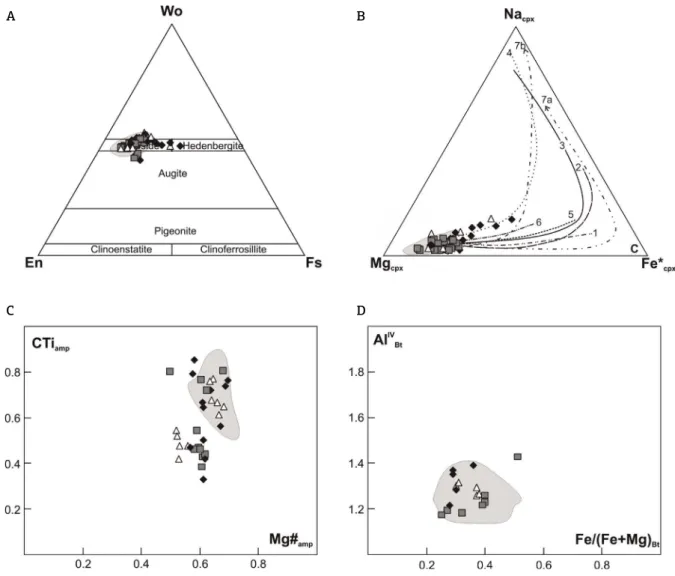
The composition of the main mafic minerals (Suppl. Tab. A1), which confirms the alkaline character of all occur-rences, is in accordance with the conclusions of Brotzu et al. (2005, 2007) in that mineral chemical trends are very similar to those of various Upper Cretaceous SMAP occurrences. Olivine macrocrysts are Mg-rich (Fo87-73), with very low Ni (up to 0.005 apfu) and CaO (up to 0.01 apfu). Clinopyroxenes constitute the chief mafic phase in all bodies and are associated with early (macro-crysts) and late (matrix) magmatic stages. Although dis-playing well-defined optical zonation, their compositions are mainly expressed as a variation of a diopside-heden-bergite solid solution series (Wo53-41En46-23Ae1-13), with late stages enriched in the Fs member (Fig. 2A). Early-stage compositions are very similar to those of the Ponte Nova massif (Azzone 2008). The evolution trend is sim-ilar to the initial part of Passa Quatro massif and amphi-bole-free rocks of the Búzios Island (Brotzu et al. 1992, 1997, Gomes et al. 2017) (Fig. 2B). Amphiboles repre-sent a trend of kaersutite compositions, grading toward pargasite and magnesian hastingsite end members (cf. Leake et al. 1997) (Fig. 2C) similar to that reported for the Ponte Nova massif (Azzone 2008). All biotite crystals belong to the phlogopite-annite series (Tischendorf et al. 2007), and the main compositions are concentrated in the Ponte Nova field (Fig. 2D, Azzone 2008).
Geochemistry
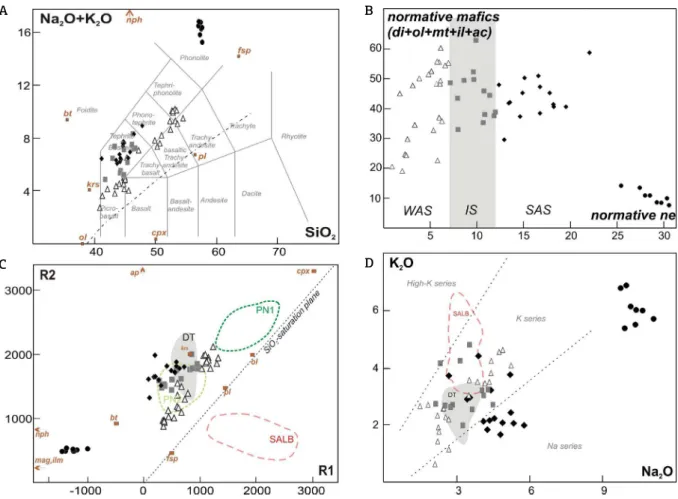
Different alkaline dike series are distinguished in the Mantiqueira Range (Fig. 3A). Although the petrographic character of the most primitive types does not allow for the recognition of clear patterns or mineral sequences, whole-rock geochemical data combined with data on intermediate and more evolved types suggest that three magmatic series could be characterized in the region based on normative nepheline content (Suppl. Tabs. A2-A4)). A weakly silica-undersatu-rated series (WAS; normative ne < 7) of potassic character is represented by basanite, tephrites, alkaline basalts, basaltic trachyandesites, phonotephrites, tephriphonolites, and tra-chyandesites (Suppl. Tab. A2). A potassic intermediate series (IS; 7 >normative ne > 13) consists only of basanites and tephrites (Suppl. Tab. A3). A sodic, strongly silica-undersat-urated series (SAS; normative ne> 13) consists of basanites, tephrites, phonotephrites, and phonolites (Suppl. Tabs. A4 and A5). Dikes cutting the Ponte Nova massif are mainly associated with the WAS series, whereas dikes intruding the Precambrian basement near Campos do Jordão belong to the SAS series.
Similar compositional trends were found for the afore-mentioned series. The mineralogical control of the bulk-chem-ical composition of the three series and their variable SiO2 -undersaturation degrees are highlighted in a R1-R2 diagram (Fig. 3C). All series are basically controlled by early frac-tionation of clinopyroxene and olivine in a similar way as observed near the Ponte Nova massif, with significant amounts of cumulate rocks (Azzone et al. 2016). The dikes described in the region by Thompson et al. (1998) are not consid-ered representative of the compositional trends discussed in this study. Phonolites are representative of extremely frac-tionated peralkaline magmas (A.I. > 1.0, Suppl. Tab. A5). An almost analogous pattern of incompatible element enrichment is presented in WAS, IS and SAS (phonolites excluded) diagrams (Figs. 4A to 4D). However, whole-rock compositions for SAS diagrams are characterized by well-de-fined positive anomalies of Ba, Sr and well-dewell-de-fined nega-tive anomalies of K, Pb, Ti, Zr and Hf in priminega-tive-mantle normalized spidergrams (Fig. 4C). The IS and WAS series, instead, display progressive enrichments in Rb, K, Pb, U and Ti (Figs. 4A and 4B). Due to their extremely fraction-ated compositions, phonolites exhibit positive anomalies of Nb, Zr, Hf, Pb and Rb and negative anomalies of Ba, Sr and Ti (Fig. 4D).
show greater LREE enrichment and higher depletion in intermediate REE, in an upward concave-shape pattern with HREE levels more enriched than those of intermediate-REE.
Sr and Nd Isotopes
Whole-rock initial isotopic ratios (87Sr/86Sr i and 143Nd/144Nd
i) for each series of the Mantiqueira Range are listed in Supplementary Tables A2-A5. Values for each series fall within the 0.704471–0.707389 interval for 87Sr/86Sr
i. For143Nd/144Nd
i, they fall within 0.512260–0.512508,
excluding the phonolites. The main trend presents a neg-ative correlation in a 87Sr/86Sr
i vs. 143Nd/144Ndi diagram (Fig. 6A).
Phonolites show very high Rb and low Sr contents, with very high 87Rb/86Sr and a wide variation in 87Sr/86Sr
i ratios (0.705675-0.711715). Two groups can be defined: one, from 87Sr/86Sr
i data, follows the main series interval (0.705675-0.705983), and the other one shows higher radiogenic values (0.710482-0.711715). In contrast, 43Nd/144Nd
i values of phonolites (0.512377-0.512443) fall within the same interval for all series.
Figure 2. Mineral compositions of weakly to strongly silica-undersaturated alkaline dike series of the Mantiqueira Range. (A) Clinopyroxene compositions in the Wo-En-Fs system (cf. Morimoto et al. 1988). (B) Crystallization
trends of clinopyroxenes compared with the main evolutionary trends for clinopyroxenes of alkaline complexes from southeastern Brazil. Fe* = (Fe2++Mn+Fe3+-Na). References: 1. São Sebastião Island (Bellieni et al. 1990); 2. Vitória Island (Motoki 1986); 3. Monte de Trigo Island (Enrich 2005); 4. Passa Quatro (Brotzu et al. 1992) and
Itatiaia (Brotzu et al. 1997); 5. Morro Redondo (Brotzu et al. 1989); 6. Morro de São João (Brotzu et al. 2007); 7(a, b).
Búzios Island (Gomes et al. 2017). (C) Amphibole compositions in the Ti of the C-site vs. Mg#
amp (MgT/(MgT+FeT, in apfu). (D) Biotite compositions on the AlIVvs. Fe/(Fe+Mg) (apfu) diagram. Symbols: strongly silica-undersaturated series, black diamonds; intermediate series, gray squares; weakly silica-undersaturated series, white triangles. Gray fields are representative of the respective mineral compositions in the Ponte Nova massif (Azzone 2008).
A
C
B
In general, the most primitive samples of SAS and IS yield the more isotopically primitive values (i.e. lower 87Sr/86Sr
i and higher 143Nd/144Nd
i) than WAS. However, these intervals are more isotopically evolved than those determined by Thompson et al. (1998) for the least contaminated basic dikes of the area. Exceptions are two samples, one from SAS and one from IS, both lying within a field similar to that of Ponte Nova intru-sions, with low degree of contamination (Fig. 6B). Host rocks are also negatively correlated in a 87Sr/86Sr
i vs. 143Nd/144Ndi diagram. Their values are more isotopically evolved than those of the alkaline series (Azzone et al. 2016; Fig. 6A).
A
C
B
D
Figure 3. Major-element discrimination diagrams for the weakly to strongly silica-undersaturated alkaline dike series of the Mantiqueira Range. (A) TAS (SiO2 vs. Na2O+K2O, in wt%) diagram (cf. Le Maitre 2002). Dashed line separates alkaline and subalkaline fields (after Irvine & Baragar 1971). (B) Normative mafics vs. normative nepheline diagram. (C) R1-R2 diagram (cf. De La Roche et al. 1980). (D) Highly-potassic, potassic and sodic series
diagram (after Middlemost 1975). Symbols: strongly-alkaline dike series (SAS), black diamonds; intermediate dike series (IS), gray squares; weakly-alkaline dike series (WAS), white triangles; phonolites, black circles. Average mineral poles compiled from Azzone (2008) are representative of the main assemblage found in the Ponte Nova massif. Abbreviations: ap, apatite; bt, biotite; cpx, clinopyroxene; fsp, feldspar; ilm, ilmenite; krs, kaersutite; mag, magnetite; nph, nepheline; ol, olivine; pl, plagioclase. The DT field is representative of primitive dikes described by Thompson et al. (1998). The SALB field is representative of heterogeneous host rocks of the Serra da Água Limpa
batolith (cf. Vinagre et al. 2014a). PN1 and PN2 fields are representative of mafic cumulates and non-cumulatic
intrusions from the nearby Ponte Nova massif, respectively (Azzone et al. 2016).
Ar/Ar ages
40Ar/39Ar ages were obtained for three ~1.5-mm-wide
biotite macrocrystals from the ST-04H tephriphonolite dike. All crystals were analyzed in high-resolution incre-mental heating experiments, in ten or more steps up to total fusion at 3W or 5W of laser power. Heating spectra are shown in Figure 7. Corresponding data is presented as supplementary material (Suppl. Tab. A6). Biotite crys-tals provided very consistent plateau ages of 85.7±0.7 Ma,
85.2±0.6 Ma and 84.7±0.6 Ma, all defined by >90% of
DISCUSSION
Intrusion timing of the alkaline dike series
Thompson et al. (1998) determined the range of emplace-ment/crystallization ages of the SMAP magmatic rocks as between approximately 80 and 50 Ma. However, new high-quality geochronological data extends the upper limit of that age interval. Sato et al. (2008) presented 84-85 Ma U-Pb ages for zircon and baddeleyite concentrates fromFigure 5. Chondrite-normalized (McDonough & Sun 1995) REE patterns for rocks of the weakly- to strongly-alkaline dike series of the Mantiqueira Range and nearby host rocks. Gray field is representative of the intermediate dike series.
Figure 4. Primitive mantle-normalized (McDonough & Sun 1995) incompatible element distribution for rocks of the (A) weakly silica-undersaturated series (WAS); (B) intermediate series (IS); (C) strongly silica-undersaturated series (SAS); (D) phonolites of the Mantiqueira Range. Negative anomalies of K, Zr, Hf, and Ti are compatible with carbonatites from around the world (Zeng et al. 2010), the feature suggesting
melts with contribution from a carbonated-metasomatized peridotite source. However, negative anomalies of Pb are typical of alkaline magmas, and such a behavior is affected by extensive contribution of crustal components, as indicated in some occurrences of the weakly silica-undersaturated dike series. Crustal assimilation also seems to be the explanation for the near absence of the negative K anomaly and positive U anomalies.
A
B
C
A
B
Figure 6. (A) Variation of 87Sr/86Sr vs. 143Nd/144Nd for weakly to strongly silica-undersaturated alkaline dike series of the Mantiqueira Range and nearby host rocks. Fields from Trindade Island and Alto Paranaíba Alkaline Province (APAP) compiled from Marques et al. (1999), Gibson et al. (1995) and Araújo et al. (2001). Field for dikes and massifs of the Serra do
Mar alkaline province (SMP) compiled from Brotzu et al. (2007) and references therein. Mixing-model curves for the least
radiogenic samples representative of the most primitive basic alkaline magmatism of the area (dike from Thompson
et al. 1998, and a plug from Azzone et al. 2016; symbols, vertical crosses) to end-members of gneiss and metasyenogranite
of the Serra da Água Limpa batholith (curves 1-3, data from Azzone et al. 2016) based on the Albarède (1995) formulae
are plotted to evaluate crustal contribution processes (after Azzone et al. 2016). Mixing-model Curve 4 represent a pole
of a sample in the Group 1 phonolites (MT-68c) to metasyenogranite end-member, indicating that phonolites could also be affected by crustal contribution. (B) Zoom of (A) diagram. DT field is representative of basic dikes of the Mantiqueira Range as described by Thompson et al. (1998). PN1 and PN2 fields are representative of Ponte Nova intrusions showing
lower and higher degrees of crustal contamination, respectively (Azzone et al. 2016).
São Sebastião island. Enrich et al. (2009), based on Ar-Ar biotite ages, reported an average value of 86.6 Ma for the Monte de Trigo alkaline suite. Azzone et al. (2009) deter-mined an average K-Ar age of 87.6 ± 1.3 Ma for biotite of
the Ponte Nova mafic-ultramafic alkaline massif. For rocks of the Mantiqueira Range, an Ar-Ar result of 80.1 Ma in biotite of a mafic dike from Campos do Jordão was assigned
that may correspond to an area of Cenozoic uplift adjoin-ing the Santos basin. There, the alkaline magmatism seems to be related to the evolution of the adjoining continen-tal margin, favoring the reactivation of ancient weakness zones, particularly NE-SW-trending parallel Proterozoic shear zones (Ulbrich & Gomes 1981, Almeida 1983, 1986, Riccomini et al. 2005). This chronogroup is also consistent with new U-Pb perovskite ages determined by Guarino et al. (2013), which define 80-91 Ma for kimberlites and phlo-gopite picrites and 78-81 Ma for kamafugites of the Alto Paranaíba alkaline province (APAP). It is noteworthy that such age intervals go against the age progression hypothesis
by Thompson et al. (1998) associated with the ESE track of the Trindade mantle plume.
Fractional crystallization
The almost similar evolutionary trends observed in the TAS and R1-R2 diagrams (Figs. 3A and 3C) for the weakly- to strongly-alkaline dike series in the Mantiqueira Range) seem controlled mainly by fractional crystallization (Figs. 3A and 3C). Previous thermodynamic crystallization models achieved through the MELTS algorithm using primitive regional basanite dikes (Menezes et al. 2015, Azzone et al. 2016) are in accordance with the petrographic descriptions. They indicate that the early-crystallized phases are olivine, spinel, and clinopyroxene, whereas apatite and plagioclase represent late fractioning phases. The evolutionary trends of these melts point to a progressive reduction of MgO, TiO2 and CaO and, subordinately, an increase in SiO2, Al2O3 and alkalis (Suppl. Tabs. A2-A5). These trends also show that basanite melts could have evolved mainly from fractional crystallization, reaching tephrite-phonolite and even more extreme phonolite compositions, as observed in the Búzios Island rocks, for example (Gomes et al. 2017). In fact, based on geochemical compositions, the parental magma of all three alkaline dike series could potentially evolve to phonolite compositions from fractional crys-tallization of a gabbroic cumulate assemblage. However, the high degree of SiO2-undersaturation of these magmas seems to link the phonolites with the SAS series. However, a compositional gap in this series is found between 50 and 60 wt% SiO2 (Figs. 3A and 3B), an interval also referred in literature as the “Daly gap”. This gap can be interpreted as a consequence of the viscosity increase in middle evo-lution steps that would prevent migration of intermediate magma to deep crustal levels (e.g., Thompson et al. 2001). However, although fractional crystallization accounts for the continuous part of the series, other scenarios could be envisaged for the origin of the phonolites and of the SAS compositional gap. For example, partial melting of basanite rocks (like those of SAS) or even of alkaline gabbroic cumu-lates possibly emplaced at deeper crustal levels could also produce phonolite magmas with similar isotopic ratios, as found by Legendre et al. (2005) in the Ua Pou Island, French Polynesia, and by Avanzinelli et al. (2004) in the Pantelleria volcano, Italy.
At the primitive extreme of each series, the petro-graphic and whole-rock geochemical data indicates that the lamprophyre samples (basanite and tephrite composi-tions) are representative of the combination of a magmatic liquid with accumulation of crystals, as already shown by Menezes et al. (2015). This is also evidenced by the behav-ior of trace elements, in which higher Cr, Ni and Co and Figure 7. Argon-release age spectra for biotite samples of
a tephriphonolite dike (ST-4H) with well-defined plateau ages (WMP). Bars are representative of 2σ errors.
A
B
lower Sr and Ba concentrations of the primitive magmas of each series (Suppl. Tabs. A2-A5) are positively correlated with a higher crystal cargo of the samples. The porphyritic character of the most primitive dikes of each series (with predominance of olivine and clinopyroxene macrocrysts) indicates a complex plumbing system prior to the final stage of emplacement at shallow crustal levels. Mega- and macrocryst populations with typical disequilibrium features are mainly referred to as antecrysts (Menezes et al. 2015), similarly to those studied by Azzone et al. (2016) in Ponte Nova occurrences. These antecryst populations could be representative of crystallization stages in a chamber envi-ronment, at lower levels in the same magmatic system. At the evolved extreme, the upward concave-shape pat-tern of the REE of the peralkaline phonolites, with high depletion of intermediate-REE (Fig. 5), is a worldwide feature of evolved phonolite magmas, typically associated with previous fractionation of titanite (e.g., Berger et al. 2014, Baudoin & Parat 2015, Melluso et al. 2017) in some intermediary stage. Although not found in primitive sam-ples of the series, titanite is a typical accessory mineral in the miaskitic nepheline syenite and syenite massifs of the SMAP (e.g., Bellieni et al. 1990, Brotzu et al. 1992, 1997, 2007, Ulbrich et al. 2005, Gomes et al. 2017, Enrich et al. 2009, Rosa & Ruberti 2017, Melluso et al. 2017), from which peralkaline magmas could have derived.
Assimilation and crustal
contribution processes
Low level of assimilation of fusible crustal rock-types by heterogeneous mantle-derived melts of the Serra do Mar province was previously mentioned by Thompson et al. (1998) and Brotzu et al. (2005, 2007). Azzone et al. (2016) showed the importance of crustal contamination even for alkaline basic magmas, postulating that they can occur at both low and high depths under turbulent emplacement flow conditions. Based on thermodynamic models developed through the MELTS algorithm, these authors proposed that parental (or primitive and high-T) alkaline basic magmas can be strongly affected by high levels of contamination subsequently to their initial stages of crystallization, when there is enough energy to assimilate partial melts of crustal host rocks. In the Ponte Nova massif, for example, assim-ilation contributed to the wide 87Sr/86Sr and 143Nd/144Nd ranges and for the increased K2O/Na2O, Ba/Sr and Rb/Sr signatures (Azzone et al. 2016). These enrichment levels were related to the important role of biotite breakdown in the assimilation of partially melted hosts. The authors also suggested that similar assimilation could be an import-ant component of the potassic character of basic alkaline dikes in the Serra do Mar province, although the mixing of
heterogeneous mantle-enriched sources might have played a predominant role.
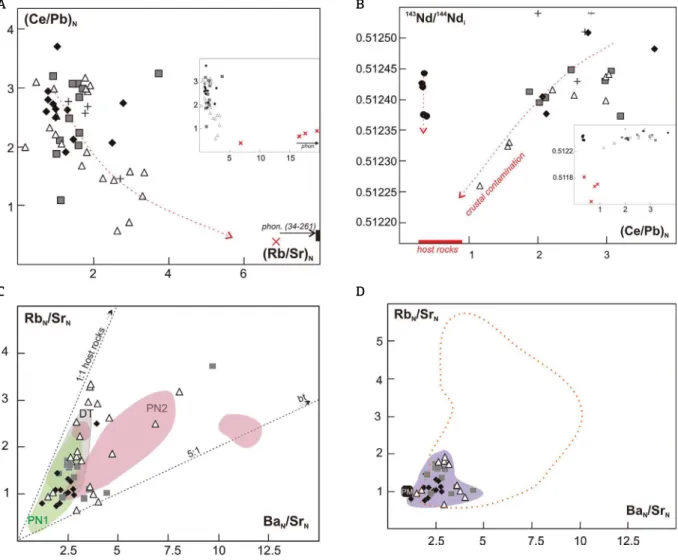
That could be the case for the three alkaline series pro-posed here for the Mantiqueira Range. Reiners et al. (1995) and Tegner et al. (2005) indicated that larger degrees of felsic crust assimilation by basic mantle-derived magmas are expected in early crystallization stages (with the ratio of crustal assimilated mass to crystallized mass, the r fac-tor, greater than a unit) due to the heat and mass transfer dependencies of the AFC processes. Hence, to better quan-tify crustal assimilation, mixing curves are considered more appropriated than common AFC curves with a fixed r during all crystallization stages. Differences in the proportions of mantle-crust components between WAS and SAS were esti-mated using mixing-model isotope curves (Fig. 6). The mix-ing-model curves for initial 87Sr/86Sr and 143Nd/144Nd ratios follow ratio-ratio relationships in binary mixing (Albarède 1995). For these models, two possibly pristine parental magma signatures were assumed for the least isotopically evolved samples from the Mantiqueira Range: one repre-senting the mafic dikes (Thompson et al. 1998), the other one representing a small inner plug in the Ponte Nova mas-sif (Azzone et al. 2016). The chosen crustal poles are repre-sentative of biotite gneiss and metasyenogranite of the Serra da Água Limpa batholith (Azzone et al. 2016). Samples of the three series are plotted in the range of the mixing lines (Fig. 6B), suggesting initial mixing between enriched-mantle parental melts (with lower 87Sr/86Sr and higher 143Nd/144Nd ratios) and partially melted hosts (having higher 87Sr/86Sr lower 143Nd/144Nd ratios), analogous to the scenario pro-posed for the nearby Ponte Nova massif by Azzone et al. (2016). An initial process, with high-T mantle-magma still dominated by the liquid phase mix and different degrees of partial melts of heterogeneous crustal rocks, could account for the isotopic differences between the least isotopically evolved samples of each series. In general terms, SAS seems less affected by crustal contamination than WAS (Fig. 6B). Geochemical signatures point to crustal contamination, and are in agreement with the isotopic data. SAS presents nega-tive anomalies of K and Pb in the priminega-tive-mantle spider-grams (Fig. 4C), high Ce/Pb (Figs. 8A and 8B) ratios, low K2O/Na2O (Fig. 3D) and Rb/Sr (Figs. 8A and 8C), whereas WAS presents a decreasing trend in Ce/Pb ratios (Fig. 8A) and a progressive enrichment in K (Fig. 3A) and Pb levels, Rb/Sr and Ba/Sr ratios (Fig. 8C), and higher K2O/Na2O (Fig. 3D). Ce/Pb ratios also present a positive correlation with 143Nd/144Nd ratios (Fig. 8B).
melts could have also assimilated crustal material within a magmatic plumbing system at deeper levels before its final emplacement at upper crust levels. The macrocryst popula-tion and their reacpopula-tion textures indicate that these magmas underwent some lower-level chamber stages, better condi-tions being then set for assimilation.
As for phonolites, the group which presents higher 87Sr/86Sr ratios and similar 143Nd/144Nd for the main trend
can also be explained by crustal assimilation from pho-nolite initial compositions. Mixing-model curves were also drawn to evaluate this group (Curve 4 in Fig. 6A). In this case, initial compositions were assigned to a pho-nolite sample (MT-68C) that follows the main isotopic trend, with chosen crustal poles representing Serra da Água Limpa batholith metasyenogranite (Azzone et al. 2016). Differently from the first ones, owing to the high
A
C
B
D
Figure 8. Primitive mantle-normalized (McDonough & Sun 1995) trace element ratios for the weakly to strongly silica-undersaturated alkaline dike series of the Mantiqueira Range and nearby host rocks. (A) (Rb/Sr)N vs. (Ce/Pb)N diagram. The inset presents the entire range of (Rb/Sr)N obtained for host rocks. (B) (Ce/Pb)N vs. 143Nd/144Ndi diagram. The inset presents the entire range of (Ce/Pb)N obtained for host rocks. Possible trends of crustal contribution processes are indicated by the dashed lines. (C) (Ba/Sr)N vs. (Rb/Sr)N diagram. Fields for low-contaminated (PN1) and highly-contaminated intrusions of the Ponte Nova massif (PN2) are shown for comparison. Host rock data and biotite compositional controls from Azzone et al. (2016). High levels of Ce/Pb for low levels of Rb/Sr and Ba/
Sr are compatible with alkaline mantle-derived melts (Orejana et al. 2008), whereas high levels of Rb/Sr and Ba/
Rb/Sr ratios found for the phonolites, the mixing curve presents a convex-like shape. Contaminated phonolites, by these models, present lower levels of crustal contri-bution at this stage. Geological evidence also supports possible crustal contamination for some phonolites. The rounded xenoliths of syenogranites with diffusion rings in the phonolite aphanitic matrix attest to this pro-cess, at least at a local scale. Due to the extremely evolved compositions of these peralkaline phonolites, trace ele-ment ratios were not too sensitive to crustal contami-nation, differently from the more primitive samples of each series as indicated above.
Crustal contribution played an important role in the dif-ferentiation trend of SAS, IS and, especially, WAS. However, it seems that the initial assimilation process could not be the sole responsible for the generation of WAS parental mag-mas from SAS parental ones, once the least radiogenic sam-ples of each series present similar 87Sr/86Sr and 143Nd/144Nd ratios with the same trace-element anomalies, but with different normative nepheline values (Fig. 3D). Therefore, other parameters need to be considered to discriminate both series, such as mantle heterogeneities.
Mantle source heterogeneities and the
role of carbonate-rich metasomatism
Thompson et al. (1998) and Brotzu et al. (2005, 2007), based on isotopic and geochemical signatures of less con-taminated samples of the Serra do Mar alkaline province, proposed a heterogeneous mantle source for the genesis of potassic magmas. Thompson et al. (1998) assigned the geo-chemical and isotopic signatures of these magmas to man-tle sources representative of a mixture between an OIB-component (similar to the composition of Trindade volcanic island) and a subcontinental lithospheric mantle component that resembled Alto Paranaíba kamafugitic rocks. In their petrological model, the source of the OIB-component is attributed to a convective mantle which, during its uprise, was mixed in variable degrees with different melts from fus-ible metasomites within the sublithospheric mantle. Brotzu et al. (2005, 2007), in turn, interpreted the same signatures as a result of low partial melting of a shallow-level conti-nental lithospheric mantle source subject to varying degrees of metasomatism, such as a phlogopite-bearing spinel-lher-zolite with minor amounts of titanite and apatite. In this scenario, kamafugite and kimberlite melts similar to those of the Alto Paranaíba province are thought to have been metasomatic agents in the lithospheric mantle. Similarly, Guarino et al. (2013) attributed the origin of the potassic, ultrapotassic and carbonatitic rocks of the Alto Paranaíba province to a source assemblage made up of metasomatized mica-carbonate garnet lherzolite.
Neither Thompson et al. (1998) nor Brotzu et al. (2005, 2007) reported the occurrence of strongly silica-undersatu-rated dike series of sodic nature in the Mantiqueira Range or the entire the Serra do Mar province, which is considered to be of potassic affinity. However, potassic and sodic alkaline series in close temporal and spatial association is a typical feature of Lages and Eastern Paraguay occurrences, which are also related to the meso-cenozoic alkaline magmatism of the South American Platform (Traversa et al. 1996, Comin-Chiaramonti et al. 1997, Gibson et al. 1999, 2006). For such situations, a phlogopite-bearing carbonate-metasomatized peridotite source was proposed by Comin-Chiaramonti et al. (1997) and Gibson et al. (2006).
Considering these hypotheses, a possible scenario for the generation of the SAS, IS and WAS series in the Mantiqueira Range could involve vein-plus-wall-rock melting (Foley 1992). In such cases, variations in the degree of alkalinity and of incompatible element (IE) enrichment would also be associated to the participation of modified signatures of the mantle wall-rock, their modal variation (e.g., cpx/gt ratios in a peridotite source), and the composition and melting degree of metasomatic veins. A potassic component of the man-tle source, attributed to veins of ultrapotassic melts similar to those of the APAP (Thompson et al. 1998, Brotzu et al. 2005, 2007), could be inferred by trace element ratios and by isotopic signatures. In a (Rb/Sr)N vs. (Ba/Sr)N diagram (Fig. 8C), SAS, IS and WAS least-contaminated primitive samples exhibit an intermediate composition between an enriched mantle component (PM, McDonough & Sun 1995) and Brazilian kamafugites, phlogopite picrites and kimberlites (KM, Comin-Chiaramonti & Gomes 2005, Brod et al. 2005, Guarino et al. 2013). In the diagram, SAS has a more restricted composition than IS and WAS, showing lower Rb/Sr and Ba/Sr signatures. In a 87Sr/86Sr vs. Nd/Nd diagram (Fig. 6), the SMAP primitive magmas (including those of the Mantiqueira Range), present an intermediate isotopic composition in a mixing-line, having one pole with a signature similar to that of Trindade sodic melts and one pole of average ultrapotassic kamafugites and kimberlites of the APAP (Thompson et al. 1998, Brotzu et al. 2007). Also, high levels of LaN/KN ratio (> 1) are owed to resid-ual phlogopite in the source (Gibson et al. 1999). For the LaN/KN ratio, WAS and IS display values between 1.0 and 2.0, most around 1.0, whereas SAS values are higher than 2.3 (Suppl. Tabs. A2-A5). These restricted Rb/Sr and Ba/Sr levels and the high La/K values indicate that phlogopite acted as a residual mineral in the genesis of SAS.
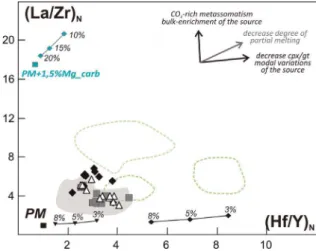
Figure 9. (Hf/Y)N vs. (La/Zr)N (primitive mantle-normalized; McDonough & Sun 1995) for the most primitive samples of the weakly- to strongly silica-undersaturated alkaline dike series of the Mantiqueira Range. Non-modal batch melting models for different mantle sources are also shown (complemented from Azzone et al. 2013). Partition coefficients from Green et al. (2000), Adam & Green (2003), and Zanetti et al. (2004). Trace element compositions of the
metasomatic veins (blue square) based on primitive mantle (McDonough & Sun 1995) plus 1.5 wt% of a mantle Mg-carbonatite (Hoernle et al. 2002). Trace
element compositions of wall-rock (black square) based on primitive mantle composition (McDonough & Sun 1995). Modal compositions of mantle source residua: inverted triangles, off-craton garnet lherzolite; black diamonds, primitive mantle garnet lherzolite; blue diamonds, theoretical wehrlite. Italic numbers indicate the degree of partial melting. Gray field represents Serra do Mar province primitive dikes (Brotzu et al. 2007 and references therein). Dashed
fields: composition of calculated primitive melts and dikes from Ponta Grossa arch occurrences (Azzone
et al. 2013, Menezes et al. 2015, Chmyz et al. 2017).
greater contribution of carbonate-veins in the mantle to its generation. Azzone et al. (2013), Menezes et al. (2015) and Chmyz et al. (2017) attributed a CO2-rich metasomatized mantle source to different basanitic compositions in equi-librium with cumulates of the Juquiá and Jacupiranga alka-line-carbonatitic complexes, as well as lamprophyric dikes of the Ponta Grossa arch. Chemically, a CO2-rich mantle metasomatism can increase CaO/Al2O3, La/Zr, Zr/Hf and decrease Ti/Eu ratios in the source and, consequently, in partial melts (Yaxley et al. 1991, 1998, Rudnick et al. 1993, Green et al. 2004, Azzone et al. 2013). Mineralogically, the action of carbonate-rich melts and fluids in a peridot-itic upper mantle reduces the amount of orthopyroxene, increases the concentration of clinopyroxene, and accounts for the presence of wehrlite assemblages (Green & Wallace 1988, Yaxley et al. 1991, Rudnick et al. 1993, Moore &
Wood 1998, Dalton & Wood 1993). The alkaline series of the Mantiqueira Range show CaO/Al2O3 ratios (0.53-1.21), similar to experimental data for a carbonated pyroxene-rich source (0.6-0.7; Hirschmann et al. 2003) and a carbonated peridotite source (1.0-11.0; Dasgupta et al. 2007), and ratios similar to lamprophyre dikes associated with the Juquiá and Jacupiranga complexes (0.74-1.72; Beccaluva et al. 1992, Gibson et al. 1999, Menezes et al. 2015, Chmyz et al. 2017). Also, they show higher La/Zr (3.2-6.8) and Zr/Hf (1.0-1.6) and lower Ti/Eu ratios than primitive mantle values (TiN/ EuN 0.43-0.85). SAS presents higher La/Zr and Zr/Hf val-ues than IS and WAS.
Non-modal batch melting models for trace elements by Azzone et al. (2013) were adapted to evaluate the contribu-tion of CO2-rich metasomatic fluids and/or melts (producing a clinopyroxene-veined network structure) in the hypothesis of a vein-plus-wall-rock mechanism for SAS, IS and WAS (Fig. 9). A comparison between the alkaline series indicate that they derive from different degrees of CO2-rich metaso-matism, SAS showing higher contribution of carbonated pyroxene-rich veins than IS, WAS and most alkaline dikes of the Serra do Mar province (Fig. 9). SAS, on the other hand, presents similar ranges of LaN/ZrN ratios than lamprophyre dikes near the Juquiá and Jacupiranga complexes, for which a carbonated pyroxene-rich source is attributed (Azzone et al. 2013, Chmyz et al. 2017). The composition of SAS is also similar to that of the intra-plate alkaline basalts of Shandong (China), from which Zeng et al. (2010) evidenced the same carbonatitic fingerprints as in the mantle source.
The alkaline series of the present study have a similar range of HfN/YN ratios plotted within the Serra do Mar province dikes field (Fig. 9). The wide variation of HfN/YN ratios suggests either a variable degree of partial melting or a garnet peridotite source with different cpx/gt proportions (Azzone et al. 2013, Chmyz et al. 2017). In the case of dikes, modal variations in the modal source seem more plausible. In fact, according to Stracke (2012), small-scale heteroge-neities (i.e. kilometer scale) in melting portions of mantle sources are expected to occur due to crust-mantle recycling.
to a phlogopite-bearing carbonated-metasomatized per-idotite in the Upper Cretaceous. The sodic nature of the strongly alkaline series appears to represent a greater con-tribution of carbonated pyroxene-rich veins in a hetero-geneous mantle source.
CONCLUSIONS
In a restricted area of the SMAP in the Mantiqueira Range, three series of alkaline dikes were characterized: a strongly silica-undersaturated series (normative ne > 13), of sodic char-acter, represented by basanites, tephrites, phonotephrites and phonolites; an intermediate series (7 > normative ne > 13), of potassic character, with only basanites and tephrites; and a weakly alkaline series (normative ne < 7), of potassic char-acter, consisting mostly of basanite, tephrites, alkali basalts, basaltic trachyandesites, phonotephrites, tephriphonolites and trachyandesites. Similar evolution trends controlled mainly by early fractionation of olivine, spinel and clino-pyroxene, followed by plagioclase and apatite fractionation are indicated for these series.
The three series exhibit different degrees of crustal assimilation, which contributed to the wide variation in 87Sr/86Sr
i and 143Nd/144Ndi isotopic ratios, the increased K2O/Na2O and Ba/Sr and Rb/Sr ratios and the decreased Ce/Pb signatures. In general, a greater influence of host rock partial melts is related to the weakly silica-undersat-urated potassic series.
A phlogopite-bearing carbonate-metasomatized heteroge-neous peridotite source responds for the main chemical variation
in the least contaminated samples of each series. Metasomatic events could have generated a veined structure and modified the chemical and modal composition of the mantle source. Therefore, the high CaO/Al2O3 and La/Zr and the lower Ti/ Eu ratios as compared with those of primitive mantle compo-sitions, together with K-, Zr-, Hf- and Ti-negative anomalies in the primitive-mantle normalized spidergrams found for the strongly alkaline series of sodic character are thought as repre-sentative of a greater contribution of carbonated pyroxene-rich veins to the heterogeneous mantle source.
New Ar-Ar data for biotite of a tephriphonolite dike yielded an average age of 85.4 ± 0.4 Ma. Such a value
con-firms the chronogroup > 80 Ma for the inland SMAP occur-rences and, together with other analytical results, go against the age progression hypothesis of an ESE migration of the proposed Trindade mantle plume model.
ACKNOWLEDGMENTS
Research funds for the present study were granted by Fundação de Amparo à Pesquisa do Estado de São Paulo – FAPESP (Grants 2010/20425-8, 2017/03768-8, RGA; 2012/06082-6, ER; 2016/23399-4, CBG).
SUPPLEMENTARY DATA
Supplementary data associated with this article can be found in the online version: Suplementary Table A1, Suplementary Tables A2-A5 and Suplementary Table A6.
Ablay G.J., Carroll M.R., Palmer M.R., Martí J., Sparks R.S.J. 1998. Basanite–phonolite lineages of the Teide–Pico Viejo volcanic complex, Tenerife, Canary Islands. Journal of Petrology, 39(5):905-936.
Adam J. & Green T. 2003. The influence of pressure, mineral
composition and water on trace element partitioning between clinopyroxene, amphibole and basanitic melts. European Journal of Mineralogy,15(5):831-841.
Albarède F. 1995. Introduction to Geochemical Modeling, Cambridge University Press. 543p.
Almeida F.F.M. 1983. Relações tectônicas das rochas alcalinas mesozóicas da região meridional da plataforma sul-americana.
Revista Brasileira de Geociências, 13(3):139-158.
Almeida F.F.M. 1986. Distribuição regional e relações tectônicas
do magmatismo pós-paleozóico no Brasil. Revista Brasileira de
Geociências, 16:325-349.
REFERENCES
Alves F.R. 1978. Nota sobre o corpo gabróide de Sapucaí Mirim,
SP/MG. Congresso Brasileiro de Geologia. Recife, Resumo dos
Trabalhos, p. 95.
Alves F.R., Ruberti E., Vlach S.R.F. 1992. Magmatismo
meso-cenozóico da região da Serra da Mantiqueira, SP/MG. Boletim
IG-USP, Publicação Especial, 12:7-9.
Araújo A., Carlson R.W., Gaspar J.C., Bizzi L.A. 2001. Petrology of kamafugites and kimberlites from the Alto Paranaiba alkaline
province, Minas Gerais, Brazil. Contributions to Mineralogy and
Petrology, 142(2):163-177.
Avanzinelli R., Bindi L., Menchetti S., Conticelli, S. (2004). Crystallisation and genesis of peralkaline magmas from Pantelleria Volcano, Italy: An integrated petrological and crystal-chemical study. Lithos, 73(1–2):41-69.
Azzone R.G., Enrich G.E.R., Gomes C.B., Ruberti E. 2013. Trace
element composition of parental magmas from mafic–ultramafic
cumulates determined by in situ mineral analyses: The Juquiá
mafic–ultramafic alkaline–carbonatite massif, SE Brazil. Journal of South American Earth Sciences41:5-21.
Azzone R.G., Munoz P.M., Enrich G.E.R, Alves A., Ruberti E., Gomes C.B. 2016. Petrographic, geochemical and isotopic evidence of
crustal assimilation processes in the Ponte Nova alkaline mafic– ultramafic massif, SE Brazil. Lithos, 260:58-75.
Azzone R.G., Ruberti E., Enrich G.E.R., Gomes C.B. 2009. Geologia e
geocronologia do maciço alcalino máfico-ultramáfico Ponte Nova
(SP-MG). Geologia USP Série Científica, 9(2):23-46.
Bastin G.F., Van Loo F.J.J., Heijligers H.J.M. 1984. Evaluation and use of
gaussian Ф(ρz) curves in quantitative electron probe microanalysis: a new optimization. X-Ray Spectrometry, 13:91-97.
Baudouin C. & Parat F. 2015. Role of volatiles (S, Cl, H2O) and
silica activity on the crystallization of haüyne and nosean in phonolitic magmas (Eifel, Germany and Saghro, Morocco). American Mineralogist, 100(10):2308-2322.
Beccaluva L., Barbieri M., Born H., Brotzu P., Coltorti M., Conte A., Garbarino C., Gomes C.B., Acciotta M., Morbidelli L., Ruberti E., Siena F., Traversa G. 1992. Fractional crystallization and liquid immiscibility processes in the alkaline-carbonatite complex of Juquiá (São Paulo, Brazil). Journal of Petrology,33(6):1371-1404. Bellieni G., Montes-Lauar C.R., De Min A., Piccirillo E.M., Cavazzini
G., Melfi A.J., Pacca I.G. 1990. Early and Late Cretaceous magmatism
from São Sebastião island (SE-Brazil): geochemistry and petrology.
Geochimica Brasiliensis,4(1):59-83.
Bennio L., Brotzu P., Gomes C.B., D’Antonio M., Lustrino M., Melluso L., Morbidelli L., Ruberti E. 2002. Petrological, geochemical and Sr-Nd isotopic features of alkaline rocks from the Arraial do Cabo Frio peninsula (southeastern Brazil). Periodico di Mineralogia, 71(2):137-158. Berger J., Ennih N., Liégeois J.P. 2014. Extreme trace elements fractionation in Cenozoic nephelinites and phonolites from the Moroccan Anti-Atlas (Eastern Saghro). Lithos, 210-211:69-88. Brod J.A., Barbosa E.S.R., Junqueira-Brod T.C. Gaspar J.C., Diniz-Pinto H.S., Sgarbi P.B.A., Petrinovic L.A. 2005. The Late-Cretaceous Goiás Alkaline Province (GAP), Central Brazil. In: Comin-Chiaramonti P. and Gomes C.B. (eds.). Mesozoic to Cenozoic Alkaline Magmatism in the Brazilian Platform. São Paulo, Edusp/Fapesp, p. 261-340. Brotzu P., Barbieri M., Beccaluva L., Garbarino C., Gomes C.B., Macciotta G., Melluso L., Morbidelli L., Ruberti E., Sígolo J.B., Traversa G. 1992. Petrology and geochemistry of the Passa Quatro alkaline complex, southeastern Brazil. Journal of South American Earth Sciences, 6(4):237-252. Brotzu P., Beccaluva L., Conte A.M., Fonseca M., Garbarino C., Gomes C.B., Leong R., Macciotta G., Mansur R.L., Melluso L., Morbidelli L., Ruberti E., Sígolo J.B., Traversa G., Valença J.G. 1989. Petrological and geochemical studies of alkaline rocks from continental Brazil. 8. The syenitic intrusion of Morro Redondo, RJ. Geochimica Brasiliensis,
3(1):63-80.
Brotzu P., Gomes C.B., Melluso L., Morbidelli L., Morra V., Ruberti E. 1997. Petrogenesis of coexisting SiO2-undersaturated to SiO2 -oversaturated felsic igneous rocks: The alkaline complex of Itatiaia, southeastern Brazil. Lithos, 40(2-4):133-156.
Brotzu P., Melluso L., Bennio L., Gomes C.B., Lustrino M., Morbidelli L., Morra V., Ruberti E., Tassinari C., D’Antonio M. 2007. Petrogenesis of the Early Cenozoic potassic alkaline complex of Morro de São João, southeastern Brazil. Journal of South American Earth Sciences, 24(1):93-115. Brotzu P., Melluso L., D’Amelio F., Lustrino M. 2005. Potassic dykes and intrusions of the Serra do Mar Igneous Province (SE Brazil)
In: Comin-Chiaramonti P., Gomes C.B. (eds.) Mesozoic to Cenozoic
Alkaline Magmatism in the Brazilian Platform. São Paulo, Edusp/ Fapesp, p. 443-472.
Cavalcante J.C., Cunha H.C.S., Chieregati L.A., Kaefer L.Q., Rocha J.M., Daitx E.C., Coutinho M.G.N., Yamamoto K., Drumond J.B.V., Rosa D.B., Ramalho R. 1979. Projeto Sapucaí: Relatório Final de Geologia. Série Geologia, n.5, Seção Geologia Básica, n.2, Brasília: DNPM/CPRM. 299p. Chmyz L., Arnaud N., Biondi J.C., Azzone R.G., Bosch D., Ruberti E. (2017). Ar-Ar ages, Sr-Nd isotope geochemistry, and implications for the origin
of the silicate rocks of the Jacupiranga ultramafic-alkaline complex
(Brazil). Journal of South American Earth Sciences, 77:286-309. Clague D.A. 1987. Hawaiian alkaline volcanism. In: Fitton J.G. & Upton B.G.J. Alkaline Igneous Rocks. Geological Society, 30, London, Special Publications, p. 227-252.
Comin-Chiaramonti P., Cundari A., Piccirillo E.M., Gomes C.B., Castorina F., Censi P., De Min A., Marzoli A., Speziale S., Velázquez V.F. 1997. Potassic and sodic igneous rocks from Eastern Paraguay: Their origin from the lithospheric mantle and genetic relationships
with the associated Paraná flood tholeiites. Journal of Petrology, 38(4):495-528.
Comin-Chiaramonti P. & Gomes C.B. 2005. Mesozoic to Cenozoic
alkaline magmatism in the Brazilian Platform. São Paulo, Edusp/ Fapesp, 752p.
Dalton J.A. & Wood B.J. 1993. The compositions of primary carbonate melts and their evolution through wallrock reaction in the mantle.
Earth and Planetary Science Letters, 119(4):511-525.
Dasgupta R., Hirschmann M.M., Smith N.D. 2007. Partial melting experiments of peridotite + CO2 at 3 GPa and genesis of alkalic ocean island basalts. Journal of Petrology,48(11):2093-2124.
De La Roche H., Leterrier J., Grandclaude P., Marchal M. 1980. A
classification of volcanic and plutonic rocks using R1R2-diagram and major-element analyses – Its relationships with current nomenclature. Chemical Geology, 29(1-4):183-210.
Enrich G.E.R. 2005. Petrogênese da suíte alcalina da Ilha Monte de Trigo, SP. PhD Thesis, Instituto de Geociências, Universidade de São Paulo, São Paulo, 229 p.
Enrich G.E.R., Ruberti E., Gomes C.B. 2009. Geology and geochronology of Monte de Trigo island alkaline suite, southeastern Brazil. Revista Brasileira de Geociências, 39(1):67-80.
Fitton J.G. & Upton B.G.J. 1987. Alkaline igneous rocks. Geological Society Special Publication, 30, 568p.
Foley, S. 1992. Vein-plus-wall-rock melting mechanisms in the
lithosphere and the origin of potassic alkaline magmas. Lithos,
28(3-6):435-453.
Furman T. & Graham D. 1999. Erosion of lithospheric mantle
beneath the East African Rift system: Geochemical evidence from
the Kivu volcanic province. Lithos, 48(1-4):237-262.
Garda G., Schorscher J.H.D., Esperança S., Carlson R.W. 1995. The petrology and geochemistry of coastal dikes from São Paulo State, Brazil: Implication for variable litospheric contributions to alkaline
magmas from the Western margins of the South Atlantic. Anais
Academia Brasileira de Ciências, 67(2):191-216.
Gibson S.A., Thompson R.N., Leonardos O.H., Dickin A.P., Mitchell J.G. 1995. The Late Cretaceous impact of the Trindade mantle plume:
Evidence from large-volume, mafic potassic magmatism in SE
Brazil. Journal of Petrology, 36(1):189-229.
Gibson S.A., Thompson R.N., Leonardos O.H., Dickin A.P., Mitchell J.G. 1999. The limited extent of plume-lithosphere interactions
during continental flood-basalt genesis: Geochemical evidence
from Cretaceous magmatism in southern Brazil. Contributions to
Gibson S.A., Thompson R.N., Day J.A. 2006. Timescales and
mechanisms of plume – lithosphere interactions: 40Ar/39Ar
geochronology and geochemistry of alkaline igneous rocks from
the Paraná-Etendeka large igneous province. Earth and Planetary
Science Letters, 251(1-2):1-17.
Gomes C.B., Alves F.R., Azzone R.G., Rojas G.E.E., Ruberti E. 2017. Geochemistry and petrology of the Buzios Island alkaline massif, SE, Brazil. Brazilian Journal of Geology, 47(1):127-145.
Gomes C.B. & Comin-Chiaramonti P. 2005. An introduction to the alkaline and alkaline-carbonatitic magmatism in and around the Paraná-Basin. In: Comin-Chiaramonti P., Gomes C.B. (eds.) Mesozoic to Cenozoic alkaline magmatism in the Brazilian Platform. São Paulo, Edusp/Fapesp, p. 21-30.
Green D.H., Schmidt M.W., Hibberson W.O. 2004. Island-arc
ankaramites: Primitive melts from fluxed refractory lherzolitic
mantle. Journal of Petrology, 45(2):391-403.
Green T.H., Blundy J.D., Adam J., Yaxley G.M. 2000. SIMS
determination of trace element partition coefficients between
garnet, clinopyroxene and hydrous basaltic liquids at 2-7.5 GPa and 1080-1200oC. Lithos, 53:165-187.
Green D.H. & Wallace M.E. 1988. Mantle metasomatism by ephemeral carbonatite melts. Nature, 336: 459-462.
Guarino V., Wu F.Y., Lustrino M., Melluso L., Brotzu P., Gomes C.B., Ruberti E., Tassinari C.C.G., Svisero D.P. 2013. U-Pb ages, Sr-Nd- isotope geochemistry, and petrogenesis of kimberlites, kamafugites and phlogopite-picrites of the Alto Paranaíba Igneous Province, Brazil. Chemical Geology, 353:65-82.
Heilbron M. & Machado N. 2003. Timing of terrane accretion in the Neoproterozoic–Eopaleozoic Ribeira orogen (SE Brazil). Precambrian Research, 125(1-2):87-112.
Heilbron M., Pedrosa-Soares A.C., Campos Neto M.C., Silva L.C., Trouw R.A.J., Janasi V.A. 2004. Província Mantiqueira. In: Mantesso-Neto V., Bartorelli A., Carneiro, C.D.R., Brito-Neves B.B. (eds.) Geologia do Continente Sul-Americano: evolução da obra de Fernando Flávio Marques de Almeida. São Paulo, Becca, p. 203-235.
Hirschmann M.M., Kogiso T., Baker M.B., Stolper E.M. 2003. Alkalic magmas generated by partial melting of garnet pyroxenite. Geology,
31(6):481-484.
Hoernle K., Tilton G., LeBas M.J, Duggen S., Garbe-Schönberg D. 2002. Geochemistry of oceanic carbonatites compared with continental carbonatites: Mantle recycling of oceanic crustal carbonate.
Contributions to Mineralogy and Petrology, 142(5):520-542.
Irvine T.N. & Baragar W.R.A. 1971. A guide to chemical classification
of the common volcanic rocks. Canadian Journal of Earth Sciences,
8(5):523-548.
Koppers A.A.P. 2002. ArArCALC - software for 40Ar/39Ar age
calculations. Computers & Geosciences, 28(5):605-619.
Le Maitre R.W. 2002. Igneous Rocks: A Classification and Glossary of
Terms, second ed. Cambridge University Press, Cambridge. Leake B.E., Woolley A.R., Arps C.E.S., Birch W.D., Gilbert M.C., Grice J.D., Hawthorne E., Kato A., Kirsch H.J., Krivovichev V.G., Linthout K., Laird J., Mandarino J., Maresch W.V., Nickel E.H., Rock N.M.S., Schumacher J.C., Smith D.C., Stephenson N.C.N., Ungaretti L., Whittaker E.J.W., Youzhi G. 1997. Nomenclature of amphiboles. Report of the Subcommittee on Amphiboles of the International Mineralogical Association Commission on New Minerals and Mineral Names.
European Journal of Mineralogy, 9(3):623-651.
Legendre C., Maury R.C., Caroff M., Guillou H., Cotten J., Chauvel
C., Bollinger C., Hemond C., Guille G., Blais S., Rossi P., Savanier D. 2005. Origin of exceptionally abundant phonolites on Ua Pou Island
(Marquesas, French Polynesia): Partial melting of basanites followed by crustal contamination. Journal of Petrology, 46(9):1925-1962. Marques L.S., Dupré B., Piccirillo E.M. 1999. Mantle source compositions of the Paraná Magmatic Province (southern Brazil): Evidence from trace element and Sr–Nd–Pb isotope geochemistry.
Journal of Geodynamics, 28:439-458.
McDonough W.F. & Sun S. 1995. The composition of the Earth.
Chemical Geology,120(3-4):223-253.
Melcher G.C. & Melcher B.A. 1972. Novas ocorrências de rochas
alcalinas no estado de São Paulo. In: Congresso Brasileiro de
Geologia. Belém, Resumo das Comunicações, p. 216-217.
Melluso L., Guarino V., Lustrino M., Morra V., Gennaro R. 2017. The REE- and HFSE-bearing phases in the Itatiaia alkaline complex (Brazil) and geochemical evolution of feldspar-rich felsic melts.
Mineralogical Magazine, 81(2):217-250.
Menezes S.G., Azzone R.G., Rojas G.E.E., Ruberti E., Cagliarani R.,
Gomes C.B., Chmyz L. 2015. The antecryst compositional influence
on Cretaceous alkaline lamprophyre dykes, SE Brazil. Brazilian
Journal of Geology,45(1):79-93.
Middlemost E.A.K. 1975. The basalt clan. Earth-Science Reviews, 11(4):337-364.
Moore K.R. & Wood B.J. 1998. The transition from carbonate to silicate melts in the CaO-MgO-SiO2-CO2 system. Journal of Petrology,
39(11-12):1943-1951.
Morbidelli L., Gomes C.B., Beccaluva L., Brotzu P., Conte A.M., Ruberti E., Traversa G. 1995. Mineralogical, petrological and geochemical aspects of alkaline and alkaline-carbonatite associations from Brazil. Earth-Sciences Review,39(3-4):135-168.
Mori P.E., Correia C.T., Reeves S., Haukka M. 1999. Development of a fused glass disc XRF facility and comparison with the pressed powder pellet technique at Instituto de Geociências, São Paulo University, Brazil. Revista Brasileira de Geociências, 29(3):441-446. Morimoto N., Fabries J., Ferguson A.K., Ginzburg I.V., Ross M., Seifert F.A., Zussman J., Aoki K., Gottardi G. 1988. Nomenclature of pyroxenes. Mineralogical Magazine, 52:535-550.
Motoki A. 1986. Geologia e petrologia do maciço alcalino da Ilha de Vitória, SP. PhD Thesis, Instituto de Geociências, Universidade de São Paulo, São Paulo, 245 p.
Navarro M.S, Andrade S., Ulbrich H.H.J., Girardi V.A.V. 2008. The analysis of rare earth elements with ICP-MS in basaltic and related
rocks: testing the efficiency of sample decomposition procedures. Geostandards and Geoanalytical Research,32:167-180.
Orejana D., Villaseca C., Billström K., Paterson B.A. 2008. Petrogenesis of Permian alkaline lamprophyres and diabases from the Spanish Central System and their geodynamic context within Western Europe. Contributions to Mineralogy and Petrology, 156(4):477-500. Petronilho L.A. 2009. Método Sm-Nd no CPGeo-IGc-USP: procedimentos analíticos atualmente em rotina. In: Simpósio 45 anos de Geocronologia no Brasil, Boletim de Resumos Expandidos, 116-118. Phillips D. & Matchan,E.L. 2013. Ultra-high precision 40Ar/39Ar ages for Fish Canyon Tuff and Alder Creek Rhyolite sanidine: New dating
standards required? Geochimica et Cosmochimica Acta, 121:229-239. Regelous M. (1993). Geochemistry of dolerites from the Paraná flood basalt province, southern Brazil. PhD Thesis, Open University, Milton Keynes, UK, 256 p.