FACULDADE DE CIÊNCIAS DEPARTAMENTO DE INFORMÁTICA
Knowledge Representation for Data Integration
and Exploration in Translational Medicine
Cátia Maria Machado
DOUTORAMENTO EM INFORMÁTICA ESPECIALIDADE BIOINFORMÁTICA
FACULDADE DE CIÊNCIAS DEPARTAMENTO DE INFORMÁTICA
Knowledge Representation for Data Integration
and Exploration in Translational Medicine
Cátia Maria Machado
DOUTORAMENTO EM INFORMÁTICA ESPECIALIDADE BIOINFORMÁTICA
Tese orientada pelo Prof. Doutor Francisco Moreira Couto e pela Prof.a
Doutora Ana Teresa Freitas 2013
A investigação biomédica evoluiu para uma ciência rica em dados, os quais podem ser recolhidos em enormes quantidades a partir de diversos recursos simultaneamente. No entanto, o valor dos dados está no conhecimento que deles se pode extraír através da sua análise. Em domínios como a medicina translacional, a integração e interoper-abilidade dos dados são um requerimento fundamental para que estes possam ser analisados eficientemente.
A web semântica e as suas tecnologias foram propostas como uma solução para a integração e interoperabilidade de dados. Uma das fer-ramentas da web semântica é a utilização de ontologias, que permitem descrever o conhecimento de um domínio de uma maneira formal e estruturada.
A tese subjacente ao presente trabalho é que a representação em on-tologias do conhecimento de um domínio pode ser explorada para melhorar o atual conhecimento sobre uma doença e os seus processos de diagnóstico e prognóstico. Os seguintes objetivos foram definidos para validar esta tese: 1) criar um modelo semântico que represente e integre as fontes de dados heterogéneos necessárias para a caracteri-zação de uma doença e do seu prognóstico, explorando tecnologias da web semântica; 2) desenvolver uma metodologia que explore o conhec-imento representado em ontologias por forma a melhorar os resultados obtidos com métodos de exploração aplicados a conjuntos de dados de medicina translacional.
O primeiro objetivo foi cumprido, tendo resultado nas seguintes con-tribuições: a metodologia para o desenvolvimento de um modelo semântico na linguagem OWL; um modelo semântico da doença car-diomiopatia hipertrófica; e uma revisão da exploração de recursos da web semântica em sistemas de medicina translacional.
de doentes; e a aplicação dessa análise de enriquecimento no mel-horamento das previsões feitas com conjuntos de dados de medicina translacional.
Palavras Chave: Representação de conhecimento, Medicina transla-cional, Web semântica, Ontologias, Integração de dados, Exploração de dados
Biomedical research has evolved into a data-intensive science, where prodigious amounts of data can be collected from disparate resources at any time. However, the value of data can only be leveraged through its analysis, which ultimately results in the acquisition of knowledge. In domains such as translational medicine, data integration and in-teroperability are key requirements for an efficient data analysis. The semantic web and its technologies have been proposed as a solu-tion for the problems of data integrasolu-tion and interoperability. One of the tools of the semantic web is the representation of domain edge with ontologies, which provide a formal description of that knowl-edge in a structured manner.
The thesis underlying this work is that the representation of do-main knowledge in ontologies can be exploited to improve the cur-rent knowledge about a disease, as well as improve the diagnosis and prognosis processes. The following two objectives were defined to val-idate this thesis: 1) to create a semantic model that represents and integrates the heterogeneous sources of data necessary for the charac-terization of a disease and of its prognosis process, exploiting semantic web technologies and existing ontologies; 2) to develop a methodol-ogy that exploits the knowledge represented in existing ontologies to improve the results of knowledge exploration methods obtained with translational medicine datasets.
The first objective was accomplished and resulting in the following contributions: the methodology for the creation of a semantic model in the OWL language; a semantic model of the disease hypertrophic cardiomyopathy; and a review on the exploitation of semantic web resources in translation medicine systems. In the case of the second
cation of the adapted enrichment analysis to improve the predictions made with a translational medicine dataset.
Keywords: Knowledge Representation, Translational medicine, Se-mantic web, Ontologies, Data integration, Data exploration
A investigação biomédica tem vindo a tornar-se uma ciência rica em dados, os quais podem ser recolhidos em enormes quantidades a partir de diversos recursos simultaneamente. No entanto, o valor dos dados está no conhecimento que deles se pode extraír através da sua análise. Em domínios como a medicina translacional, a integração e interoper-abilidade dos dados são um requerimento fundamental para que estes possam ser analisados eficientemente.
A web semântica foi proposta como uma nova abordagem para a Web, a qual, geralmente composta por documentos, passa a ser composta por dados. Esta abordagem permite uma mais fácil manipulação de dados entre domínios, e assim resolver a maioria dos problemas iner-entes à integração de dados. A implementação de uma abordagem da web semântica resulta, em última instância, numa rede de da-dos e conhecimento que pode ser explorada tanto por computadores como por pessoas. Ao trabalhar para a criação desta rede, consegue-se melhorar a interoperabilidade entre aplicações, independentemente do seu domínio do conhecimento, assim como facilitar a integração e a exploração de dados.
Uma das ferramentas da web semântica é a representação do con-hecimento de um domínio com ontologias, as quais fornecem uma descrição formal e estruturada desse conhecimento. A utilização de ontologias em medicina translacional é de extrema importância devido à necessidade de integrar e explorar dados para a sua implementação. Os dados usados em medicina translacional são recolhidos no contexto da prática médica, e como tal são frequentemente caracterizados por um número reduzido de atributos clínicos e por um número elevado de valores em falta. Estas características dificultam significativamente o
algum forma.
A forma mais direta de enriquecimento de um conjunto de dados seria através da adição de mais instâncias ou de instâncias de melhor quali-dade, mas devido à natureza restrita dos dados de doentes esta opção é raramente possível. Por outro lado, o conhecimento codificado em ontologias é público, e pode ser explorado para enriquecer conjuntos de dados da medicina translacional.
A tese subjacente ao presente trabalho é que a representação em on-tologias do conhecimento de um domínio pode ser explorada para mel-horar o atual conhecimento sobre uma doença, assim como melmel-horar os seus processos de diagnóstico e prognóstico. Os seguintes objetivos foram definidos para validar esta tese: 1) criar um modelo semântico que represente e integre as fontes de dados heterogéneos necessárias para a caracterização de uma doença e do seu prognóstico, explo-rando tecnologias da web semântica; 2) desenvolver uma metodologia que explore o conhecimento representado em ontologias por forma a melhorar os resultados obtidos com métodos de exploração aplicados a conjuntos de dados de medicina translacional.
O primeiro objetivo foi cumprido sob a forma de um modelo semân-tico da cardiomiopatia hipertrófica (CMH), uma doença que benefi-cia de uma abordagem como a da medicina translacional. O mod-elo representa dois domínios de conhecimento heterogéneos, o clínico e o genético, sendo composto por três módulos: Clinical Evalua-tion, o qual contém conceitos administrativos e os elementos clínicos necessários para o prognóstico de doentes com CMH; Genotype Analy-sis, contendo conceitos associados com a realização de testes genéticos em amostras biológicas; e Medical Classifications, um módulo auxil-iar que contém padrões médicos usados na caracterização de elemen-tos clínicos tais como sintomas. Este modelo semântico desempenha um papel importante na integração de dados de ambos os domínios
modelo. Foi desenvolvido na linguagem OWL (uma das tecnologias da web semântica), reutiliza vocabulários já existentes, e tem mapea-mentos definidos entre os seus conceitos e conceitos de vocabulários externos. Todos estes aspectos, em conjunto com o seu desenvolvi-mento em módulos, facilitam a sua utilização por terceiros. Apesar do uso de um caso de estudo, a metodologia para criar o modelo foi planeada de forma a poder ser utilizada para outras doenças, assim como o modelo em si pode ser usado e estendido para outras doenças. O primeiro objetivo da tese resultou assim nas seguintes contribuições: a metodologia para o desenvolvimento de um modelo semântico na linguagem OWL; um modelo semântico da doença cardiomiopatia hipertrófica; e uma revisão da exploração de recursos da web semân-tica em sistemas de medicina translacional.
Do segundo objetivo resultou uma metodologia que identifica termos ontológicos enriquecidos num conjunto de dados de doentes. Esta metodologia foi adaptada a partir da técnica denominada análise de enriquecimento, a qual é extensivamente usada na análise funcional de grandes conjuntos de genes identificados com técnicas de alto rendi-mento tais como microarrays de expressão. A análise de enriquec-imento explora o uso de métodos estatísticos para analisar os ter-mos ontológicos com os quais um conjunto de genes está anotado. O propósito desta análise é a identificação de atributos biológicos que es-tejam representados no conjunto de genes em estudo em maior quanti-dade do que seria esperado devido ao acaso. Esses atributos biológicos são considerados como estando enriquecidos, ou sobre-representados, no conjunto de estudo e são usados na formulação de uma interpre-tação biológica acerca desse conjunto.
A metodologia de enriquecimento desenvolvida neste trabalho foi adap-tada para analisar dados clínicos e genéticos de doentes, em vez de genes. Os dados clínicos incluem atributos como sintomas e medições
insere-se numa abordagem de prognóstico cujo propósito é auxiliar médicos na avaliação de doentes em relação à possibilidade de virem a sofrer um evento associado à doença ou de apresentarem uma man-ifestação característica da doença. A abordagem de prognóstico ex-plorará os resultados obtidos com a metodologia de enriquecimento numa subsequente tarefa de classificação com algoritmos de miner-ação de dados, de forma a obter o prognóstico dos doentes.
Foram usados dois conjuntos de dados nesta parte do trabalho: um de doentes com CMH, focando a ocorrência de um evento associado à doença - paragem cardíaca súbita; e outro de doentes com doença pulmonar obstrutiva crónica (DPOC), focando uma das manifestações características da doença - enfisema.
Os termos ontológicos identificados como enriquecidos pela metodolo-gia de enriquecimento são usados como perfil de anotação dos doentes através da sua incorporação no conjunto de dados sob a forma de atributos. Esta utilização dos termos enriquecidos foi testada com diferentes conjuntos de atributos e diferentes classificadores, e os resul-tados mostram que resulta numa incorporação de novo conhecimento no conjunto de dados que conduz a uma melhoria das previsões do prognóstico.
O segundo objetivo da tese resultou assim nas seguintes contribuições: a adaptação de uma análise de enriquecimento padrão ao uso de da-dos de doentes; e a aplicação dessa análise de enriquecimento no mel-horamento das previsões feitas com conjuntos de dados de medicina translacional.
O trabalho aqui apresentado consiste no primeiro passo para o desen-volvimento de um sistema de análise de doenças para assistir médicos nos processos de diagnóstico e prognóstico, o qual contribuirá para o avanço do conhecimento sobre a doença em análise. Este sistema contribuirá igualmente para o avanço da medicina translacional, uma
básica com dados clínicos, e a sua transformação em conhecimento que virá a ser usado na prática clínica.
Firstly, I would like to thank my supervisor Doctor Francisco Mor-eira Couto and my co-supervisor Doctor Ana Teresa Freitas for their constant guidance and support throughout these four years of work. I would like to thank Doctor Alexandra Fernandes, Doctor Susana Santos, and Dr. Nuno Cardim for providing the hypertrophic car-diomyopathy data for my study and for sharing their knowledge on the disease.
I am grateful to Doctor Deborah Penque and Doctor Bruno Alexandre for promptly accepting to share their data and knowledge on chronic obstructive pulmonary disease.
I am very grateful to Doctor Dietrich Rebholz-Schuhmann for his invaluable help and advice, both work-related and otherwise.
I would like to thank the Fundação para a Ciência e Tecnologia for my PhD scholarship (SFRH/BD/65257/2009) which made this work possible.
To my colleagues and friends in the Informatics department: Tiago Grego, Hugo Bastos, Ana Teixeira, João Ferreira, Cátia Pesquita, Juliana Duque, and Jeferson Sousa - thank you all for being such a good company every single day!
To my dear friends who were so important throughout my life: Ana Mafalda Fonseca, Paula Vieira, Leonardo Mendes, Ana Oliveira, Marta Fiúza, Rita Ferreira, and Cassilda Reis - thank you for being the way you are and for sharing your life with me!
gave me, even before I was aware of it!
To my mother and father, thank you for giving me life and so much to think about, despite everything.
To my more recent family: Adelaide Pedro de Jesus, Filipe Faria, and David Faria - thank you for accepting me so warmly in your life! Finally, to Daniel Faria, who has shared his life with me for the last 10 years - thank you for all the things we shared, for the love and care, and for helping me grow (as well as for cooking such delicious meals)!
Learn as if you were to live forever. - Mahatma Gandhi
1 Introduction 1
1.1 A data intensive world . . . 1
1.2 Using the semantic web for data integration and exploration . . . 2
1.3 Domain knowledge representation in translational medicine . . . . 4
1.4 Objectives . . . 4
1.4.1 Contributions . . . 5
1.5 Document organization . . . 6
2 State of the Art 7 2.1 Biomedical background . . . 7
2.1.1 Translational medicine . . . 7
2.1.2 Personalized medicine . . . 9
2.2 Biomedical vocabularies . . . 9
2.3 The semantic web in translational medicine . . . 11
2.3.1 Technological standards in the semantic web . . . 11
2.3.2 Knowledge representation with ontologies . . . 14
2.3.3 Translational medicine systems . . . 16
2.3.3.1 Technical implementation . . . 16
2.3.3.2 Overview of the usage of semantic web technologies 21 2.4 Data exploration with ontologies . . . 25
3 Knowledge representation for data integration 29 3.1 Methods . . . 29
3.1.1 Semantic model development . . . 30
3.2 Results . . . 35
3.2.1 First phase of ontology reuse . . . 35
3.2.1.1 Module Clinical Evaluation . . . 35
3.2.1.2 Module Genotype Analysis . . . 38
3.2.1.3 Module Medical Classifications . . . 38
3.2.1.4 Mapping between modules and with external on-tologies . . . 40
3.2.2 Second phase of ontology reuse . . . 40
3.3 Discussion . . . 44
3.3.1 Modeling decisions . . . 44
3.3.2 Participation in the semantic web . . . 53
3.3.3 Integration of translational medicine data . . . 54
4 Knowledge representation for data exploration 57 4.1 Enrichment analysis . . . 58
4.1.1 Methods . . . 59
4.1.1.1 Genetic data analysis . . . 59
4.1.1.2 Clinical data analysis . . . 64
4.1.1.3 Datasets . . . 66
4.1.1.4 Ontology annotations . . . 74
4.1.2 Results . . . 75
4.1.2.1 Genetic data analysis . . . 75
4.1.2.2 Clinical data analysis . . . 80
4.1.3 Discussion . . . 84
4.1.3.1 Genetic data analysis . . . 84
4.1.3.2 Clinical data analysis . . . 87
4.1.3.3 Study limitations . . . 89
4.2 Evaluation of the enrichment analysis with data mining algorithms 90 4.2.1 Methods . . . 90
4.2.2 Results . . . 92
4.2.2.1 Hypertrophic cardiomyopathy . . . 92
4.2.2.2 Chronic obstructive pulmonary disease . . . 96
4.3 Exploration of translational medicine data . . . 101
5 Conclusions 103
A Complete results of the enrichment profiling of SCD patients
(HCM dataset) 107
B Complete results of the enrichment profiling of no-SCD patients
(HCM dataset) 111
C Complete results of the differential enrichment analysis of SCD
and no-SCD patients (HCM dataset) 117
D Default settings of the data mining algorithms 119
2.1 Knowledge workflow in translational medicine. . . 8
2.2 Public resources integrated by the translational medicine systems surveyed. . . 17
3.1 HCM characterization workflow. . . 32
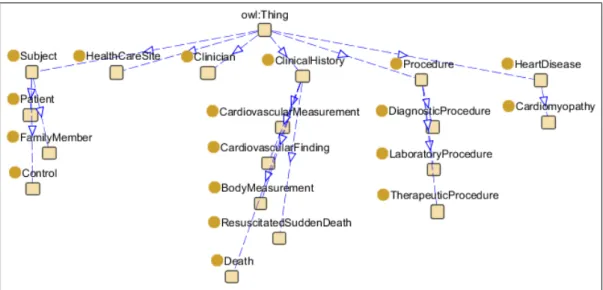
3.2 Graphical representation of the module Clinical Evaluation. . . 37
3.3 Graphical representation of the module Genotype Analysis. . . 38
3.4 Concept Heart Failure Classification, from the module Medical Classifications. . . 39 3.5 Hierarchical structure of the module Clinical Evaluation (Part I). 42
3.6 Hierarchical structure of the module Clinical Evaluation (Part II). 43
3.7 Hierarchical structure of the module Genotype Analysis. . . 44
3.8 Data properties of the module Clinical Evaluation. . . 45
3.9 Object properties of the module Clinical Evaluation (Part I). . . . 46
3.10 Object properties of the module Clinical Evaluation (Part II). . . 47
3.11 Data properties of the module Genotype Analysis. . . 48
3.12 Object properties of the module Genotype Analysis. . . 49
3.13 Class HCM Patient from the module Clinical Evaluation. . . 50
4.1 Schematic representation of the prognosis methodology. . . 58
4.2 Representation of the population and study sets in the enrichment profiling analysis. . . 61
5.1 Disease analysis framework. . . 103
D.2 Default settings of the Random Forest algorithm (decision trees). 120
D.3 Default settings of the Naive Bayes algorithm. . . 120
D.4 Default settings of the Bayes Network algorithm. . . 121
2.1 Standard semantic web technologies used in the surveyed transla-tional medicine systems. . . 18
2.2 Technical description of the surveyed translational medicine systems. 18
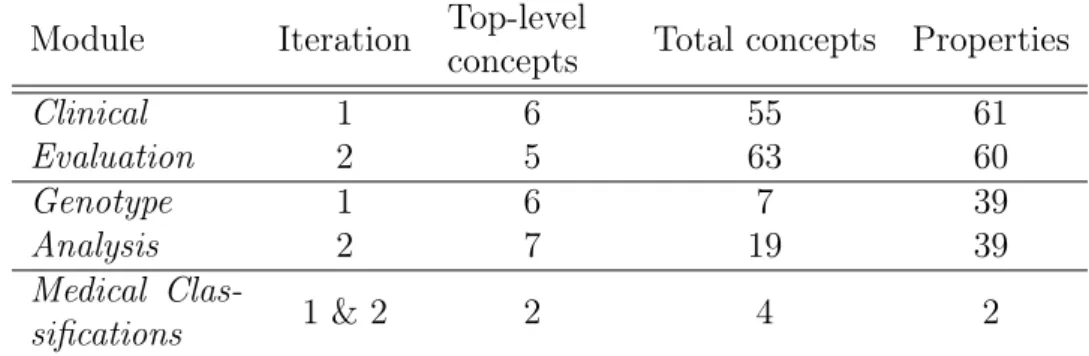
3.1 Composition of the modules Clinical Evaluation, Genotype Analy-sis, and Medical Classifications. . . 36 3.2 Percentage of concepts in the HCM semantic model mapped to
external ontologies. . . 41
4.1 Characterization of the HCM clinical features in terms of their distribution in the two patient classes: SCD and no-SCD. . . 67
4.2 Characterization of the HCM clinical features in terms of the per-centage of SCD and no-SCD patients with known values. . . 68
4.3 Characterization of the HCM clinical features in terms of their annotation with SNOMED-CT and NCIt. . . 69
4.4 Genes used for the genetic characterization of the HCM patients. . 70
4.5 Characterization of the COPD clinical features in terms of their
distribution in the two patient classes: emphysema and no-emphysema. 71
4.6 Characterization of the COPD clinical features in terms of the percentage of patients with and without emphysema with known values. . . 72
4.7 Characterization of the COPD clinical features in terms of their annotation with SNOMED-CT and NCI Thesaurus. . . 73
4.8 Number of genes considered in the profiling and the differential enrichment analyses. . . 76
4.9 Number of enriched terms in each of the genetic analyses performed. 76
4.10 Top 10 enriched biological process terms (Gene Ontology), ob-tained in the profiling analysis of SCD patients. . . 77
4.11 Top 10 enriched molecular function terms (Gene Ontology), ob-tained in the profiling analysis of SCD patients. . . 78
4.12 Top 10 enriched cellular component terms (Gene Ontology), ob-tained in the profiling analysis of SCD patients. . . 78
4.13 Enriched terms in the profiling analysis of no-SCD patients (genetic data), not identified in the SCD patients. . . 79
4.14 Complete results of the two differential enrichment analyses per-formed with genetic data: HCM patients and the sub-group of SCD patients; HCM patients and the sub-group of no-SCD patients. 80
4.15 Terms enriched in the clinical analysis of the group of HCM pa-tients and the sub-group of SCD papa-tients. . . 81
4.16 Terms enriched in the clinical analysis of the group of HCM pa-tients and the sub-group of no-SCD papa-tients. . . 82
4.17 Terms enriched in the clinical analysis of the group of COPD pa-tients and the sub-group of papa-tients with emphysema. . . 82
4.18 Terms enriched in the clinical analysis of the group of COPD pa-tients and the sub-group of papa-tients without emphysema. . . 83
4.19 F-measure results obtained with the event-positive class (SCD) of HCM patients. . . 93
4.20 Precision results obtained with the event-positive class (SCD) of HCM patients. . . 93
4.21 Recall results obtained with the event-positive class (SCD) of HCM patients. . . 94
4.22 F-measure results of the event-negative class (no-SCD) of HCM patients. . . 95
4.23 Number of instances correctly classified in the data mining tests with the HCM dataset. . . 96
4.24 F-measure results of the COPD patients with emphysema. . . 97
4.25 Precision results of the COPD patients with emphysema. . . 97
4.27 F-measure results of the healthy class of COPD patients. . . 99
4.28 Number of instances correctly classified in the data mining tests with the COPD dataset. . . 99
A.1 Complete set of biological process enriched terms (Gene Ontology), obtained in the profiling analysis of SCD patients. . . 107
A.2 Complete set of molecular function enriched terms (Gene Ontol-ogy), obtained in the profiling analysis of SCD patients. . . 109
A.3 Complete set of cellular component enriched terms (Gene Ontol-ogy), obtained in the profiling analysis of SCD patients. . . 110
B.1 Complete set of biological process enriched terms, obtained in the profiling analysis of no-SCD patients. . . 111
B.2 Complete set of molecular function enriched terms, obtained in the profiling analysis of no-SCD patients. . . 114
B.3 Complete set of cellular component enriched terms, obtained in the profiling analysis of no-SCD patients. . . 115
C.1 Complete results of the differential enrichment analysis obtained with the HCM dataset and the sub-group of SCD patients. . . 117
C.2 Complete results of the differential enrichment analysis obtained with the HCM dataset and the sub-group of no-SCD patients. . . 118
Introduction
1.1
A data intensive world
Biomedical research has evolved into a data-intensive science, where prodigious amounts of data can be collected from disparate resources at any time (Hey et al., 2009). However, the value of data can only be leveraged through its
analysis, which ultimately results in the acquisition of knowledge. In domains such as translational medicine, where multiple types of data are involved, often from different sources and kept in different formats (e.g., hospital data, genetic data and pharmaceutical data), data integration and interoperability are key requirements for an efficient data analysis.
Translational medicine focuses on the improvement of human health by bridg-ing the gap between basic science research and the clinical practice (Albani & Prakken,2009;Webb & Pass,2004;Woolf,2008). It is unquestionable that trans-lational medicine is a multidisciplinary research domain that relies both on public and protected data. Public data includes resources such as medical guidelines, scientific literature and biomedical databases, while protected data is composed of private data from patients and proprietary data from pharmaceutical and pub-lishing companies. Translational medicine thus requires appropriate technologies for the correct interpretation of distributed and disparate data resources, and it is easy to conceive that such a large scale endeavor will eventually require a versatile infrastructure that preserves data semantics at all integration levels.
1.2
Using the semantic web for data integration
and exploration
The need for data integration and data interoperability has a long-standing his-tory. The Committee on Models for Biomedical Research proposed in 1985 a structured and integrated view of biology to cope with the available data ( Com-mittee on Models for Biomedical Research,1985). Ten years later, in 1995, David-son et al. questioned the feasibility of data integration, since the resulting data structure has to follow changes in the data itself and individual research groups fail to comply with the integration structure (Davidson et al., 1995). In 2007, the challenges identified for data integration in genomic medicine were the lack of clinical data sources; the privacy issues linked to clinical data; the inherent com-plexity of medical records; and finally, the lack of data representation standards in the clinical domain (Louie et al., 2007). These selected examples show that data integration remains an open research topic and that its complexity escalates with the increase in number of the heterogeneous domains to be integrated.
The World Wide Web is the key information channel for the communication of public data, particularly for the scientific community, since it enables a fast publication of methods, results and opinions, and it is easily reached by virtually anyone, anywhere. This information channel fulfills the requirements for efficient data exchange between scientific communities and data repositories, and thus should also be explored in translational medicine for optimal progress. However, its usefulness in this context is counterbalanced by the lack of data standards across domains, of explicit data representations, and of interoperability among data resources, which hinder the sharing of data between the biomedical and the clinical domains (Sagotsky et al., 2008).
Berners-Lee et al. (2001) proposed the vision of the semantic web, where the Web of documents is replaced by the Web of data, thus enabling the manipulation of data over disparate domains and solving most of the problems previously stated for data integration. The manipulation of data is achieved by substituting the links connecting Web pages (i.e., the documents) with links connecting the data elements themselves, through the representation of the data domain of knowledge with structured semantic representations, and through the use of the standard
technologies. If built upon this infrastructure, many of the technical challenges faced by translational medicine are thus prevented.
The implementation of a semantic web approach ultimately results in a net-work of data and knowledge that can be exploited by computers and not only humans. Working towards the creation of this network improves the interoperabil-ity among applications, independently of their domain of knowledge, facilitates data integration and exploration. The mappings defined between data elements enable the issuing of queries over otherwise independent datasets, and the formal representation of the domain knowledge can be leveraged through the use of rea-soning for the identification of new implicit connections between data elements (Rebholz-Schuhmann et al., 2012).
The domain knowledge can be represented through resources that reliably abstract their real-world objects and the interactions existing amongst those ob-jects. Such representations exist in the form of ontologies, where an ontology is “an explicit specification of a conceptualization” (Gruber, 1993).
Ontologies provide a means to formally describe the domain knowledge in a structured manner that can be shared among people and computers alike. If this description of the knowledge is accepted as a reference by the community (e.g., the Gene Ontology (Ashburner et al.,2000)), its representation of the reality becomes a standard, and data integration is facilitated. This is true even if different abstraction levels are provided from unrelated datasets, since the hierarchical structure of ontologies supports the identification of a common ancestor for any two related concepts, by traversing the ontology graph (Stein, 2003).
Another common use of ontologies is for data annotation: by annotating an instance with ontology terms it is possible to obtain a description of that instance according to the knowledge encoded in the ontology. Different instances thus annotated can be compared based on their set of annotations, in order to calculate their degree of (semantic) similarity (Pesquita et al., 2009). A set of instances can also be compared against the population from which it was collected to identify the set of ontology terms that can be used to explain what differentiates it from the rest of the population (i.e., enrichment analysis) (Khatri et al., 2012;
1.3
Domain knowledge representation in
transla-tional medicine
The use of ontologies is invaluable in translational medicine due to the need of data integration and exploration for its realization. As indicated before, the use of semantic web technologies and of ontologies in particular facilitates data integration. Additionaly, the use of OWL (a semantic web technology) as the ontology encoding language enables the realization of inference over the explicitly represented data in order to identify non-explicitly represented knowledge. The exploitation of these aspects is of great interest in the data and knowledge pipeline at the core of the diagnosis and prognosis processes, two of the possible outcomes of a translational medicine approach. In those two processes, clinical and genetic data need to be integrated, consumed by medical and molecular biology experts alike, and the use of inference over both types of data can be fundamental in the identification of specific data and patients for subsequent analysis.
Since the data used in the diagnosis/prognosis process is collected in the context of medical practice, the resultant datasets are frequently characterized by a small number of clinical features and a high number of missing values. These characteristics can significantly hamper the use of such datasets for knowledge exploration purposes (e.g., data mining), and consequently it is greatly desirable to enrich them in some manner.
The most straightforward form of dataset enrichment would be through the addition of more data instances or of higher quality data instances, but due to the restricted nature of patients’ data this option is seldom available. On the other hand, the knowledge encoded in ontologies is public, and can be exploited to enrich translational medicine datasets.
1.4
Objectives
The thesis underlying the present work is that the representation of domain knowledge in ontologies can be exploited to improve the current knowledge about a disease, as well as improve the diagnosis and prognosis processes.
1. To create a semantic model that represents and integrates the heteroge-neous sources of data necessary for the characterization of a disease and of its prognosis process, exploiting semantic web technologies and existing ontologies.
2. To develop a methodology that exploits the knowledge represented in ex-isting ontologies to improve the results of knowledge exploration methods obtained with translational medicine datasets.
1.4.1
Contributions
The contributions of my work are the following:
• The methodology for the creation of a semantic model in the OWL language describing a genetic disease (Machado et al.,2010, 2012a). This methodol-ogy is composed by numerous steps such as the identification of the data to represent, the definition of the hierarchical relations between the data elements, and the identification of external resources to use. All the steps included several iterations and decision points that can be extrapolated to any model facing the same decisions.
• A semantic model of the disease hypertrophic cardiomyopathy (used as case-study), for which no public semantic representation existed upon the beginning of this work. The model is composed by three modules: Clinical Evaluation, Genotype Analysis, and Medical Classifications. The concepts in the two first modules are mapped to external resources, mappings that can be used to traverse between resources. The three modules can be used both together and independently, and can be extended to represent any disease. The model is available from https://sites.google.com/site/ hcmsemanticmodel/home-1.
• A review on the exploitation of semantic web resources in translation medicine systems, which analyzes 11 non-commercial systems (developed from 2007 to 2013) integrating genetic and clinical data (Machado et al.,2013b).
• The adaptation of a standard enrichment analysis (based on the hypergeo-metric distribution) to directly use clinical and mutation data from patients (Machado et al., 2012b, 2013a).
• The application of the adapted enrichment analysis to the improvement of a translational medicine dataset. The methodology was tested with the diseases hypertrophic cardiomyopathy and chronic obstructive pulmonary disease, and three ontological resources. The evaluation of the enrichment analysis was done based on the performance of the enriched dataset in data mining algorithms. The methodology can be used with any structured vocabulary and for any dataset, medical or otherwise, provided that there are vocabularies representing the domain of knowledge of the dataset.
1.5
Document organization
The rest of the document is organized as follows:
• Chapter 2 - a state of the art chapter divided in the four following subjects: biomedical topics; biomedical vocabularies used in this work; knowledge representation for data integration; and knowledge representation for data exploration.
• Chapter 3 - a description of the first part of my work, which is the repre-sentation of knowledge for data integration. In this chapter is described the methodology for the creation of the semantic model and the composition of the model.
• Chapter 4 - a description of the second part of my work, which is the ex-ploitation of knowledge representations for data exploration. In this chapter is described the adapted enrichment methodology and the results obtained in terms of dataset quality improvement.
State of the Art
This chapter is divided in four sections.
The first section details relevant biomedical concepts such as translational medicine and personalized medicine.
The second section introduces the biomedical vocabularies used in the present work.
The third section presentes the main semantic web standard technologies and tools, how domain knowledge is represented with ontologies, as well as eleven translational medicine implementations of a semantic web approach. These im-plementations are detailed in terms of their biomedical goal and their use of the semantic web tools, which is compared with how the semantic web tools are best exploited.
The fourth and final section describes the concepts and work relevant for the second part of my work, which is the exploration of domain knowledge repre-sented in existing ontologies for the quality improvement of translational medicine datasets.
2.1
Biomedical background
2.1.1
Translational medicine
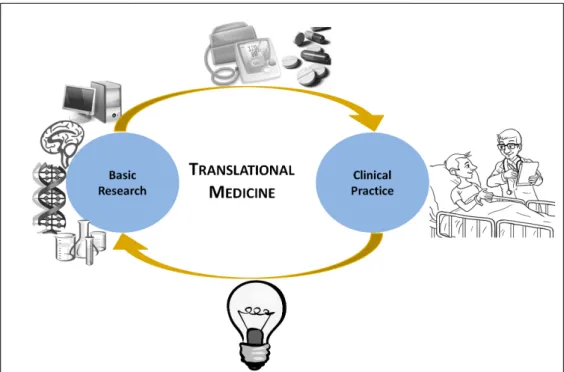
The bridging between basic science research and the clinical practice done by translational medicine approaches works at two distinct levels: at the level of
basic science research, translating it into new devices or treatments (“from the bench to the bedside”); and at the level of clinical practice, transferring the new treatments into its daily routine (Figure2.1) (Wei,2012;Woolf,2008). Addition-ally, knowledge in translational medicine can also flow in the contrary direction, resulting in the initiation of new basic research based on the clinical observations of a disease development.
Figure 2.1: Knowledge workflow in translational medicine. Translational medicine improves the knowledge on human diseases by translating basic science research results into new exams, devices and treatments, which are then incorporated into the clinical practice. It also explores the knowledge collected during patient care to identify new research topics and topics that need further research.
Delivering solutions from the “bench to the bedside” and their incorporation into the health care practice requires that data flows from research in molecu-lar biology, genetics and pharmacology into the clinical domain and in reverse. Within this flow of data and knowledge, research on the molecular mechanisms of diseases and drugs can be translated more quickly into novel treatment ap-proaches, and observations about patients can as well lead to novel hypotheses and experimental conditions.
2.1.2
Personalized medicine
Many human diseases are influenced by both environmental and genetic fac-tors (Manolio et al., 2010). One of the action fields of translational medicine is precisely genomic medicine, which consists in exploring the molecular genetics knowledge of diseases and translating it into: personalized treatments with more beneficial responses and with reduced undesired effects; the prediction of disease susceptibility; new drug targets for diseases until now untreatable (Louie et al.,
2007). For example, a clinician may analyze a patient’s mutations to explain ob-served drug side effects or may retrieve the list of biomarkers and their functions that have been associated with a specific cancer type.
A disease biomarker is any measurable characteristic that can be used as an indicator of a disease (Atkinson et al., 2001), such as blood-based proteins and genetic variants. Just as the name suggests, genetic variants are variations in the genetic code that can occur throughout the human population. With the com-pletion of the Human Genome Project, our potential knowledge on the molecular pathways underlying human diseases and on the treatment of these diseases has increased exponentially due to the possibility to associate those genetic variants with the observable manifestations of diseases. This is an invaluable accomplish-ment of modern medicine that can result in the association of individual genotypes (i.e., the genetic information of a person) with individual phenotypes (i.e., the observable characteristics of a person) (Frazer et al., 2009).
The identification of genotype-phenotype relationships is consequently an im-portant result in translational medicine approaches that can result in timely di-agnostics (i.e., the identification of a disease in a person) and increasingly ac-curate prognostics (i.e. the prediction of the likely outcome of a disease in a person).
2.2
Biomedical vocabularies
Several biomedical ontologies from the clinical and the genetic domains of knowl-edge were used in the two parts of the present work. On the first part, the develop-ment of a semantic model, the following vocabularies were considered:
SNOMED-CT1; National Cancer Institute Thesaurus (NCIt) (Sioutos et al.,2007); Ontology
of Clinical Research (OCRe) (Sim et al.,2010); Gene Regulation Ontology ( Beis-swanger et al., 2008); and Sequence Ontology (Eilbeck et al., 2005). The first three are clinical vocabularies, whereas the last two are genetic. On the second part, the enrichment of translational medicine datasets, the following vocabu-laries were considered: SNOMED-CT; NCIt; and the Gene Ontology (a genetic ontology) (Ashburner et al.,2000).
All of these vocabularies are organized in hierarchies with multiple levels of granularity and, with the exception of the Sequence Ontology, are available on BioPortal (an ontology repository from the National Center for Biomedical On-tology2). A brief description of each of these ontologies is provided below.
SNOMED-CT is a healthcare terminology created to record clinical informa-tion in Electronic Health Records, covering topics such as clinical finding/disor-der, body structure, pharmaceutical/biologic product, and social context. This terminology currently contains more than 397,000 concepts3(as of October, 2013).
The NCIt is a controlled terminology created by the National Cancer In-stitute to integrate molecular and clinical cancer-related information within a unified biomedical informatics framework. It covers topics that include cancers, drugs, therapies, anatomy, cellular and subcellular processes, and experimental organisms. It currently contains more than 103,000 concepts4 (as of May, 2013).
OCRe was created in the context of the Human Studies Database Project to model features such as design type, interventions, and outcomes to support scientific query and analysis. It currently contains more than 380 concepts5 (as
of June, 2013).
The Gene Regulation Ontology was designed to model complex events that are part of the gene regulatory processes, with the purpose of meeting the needs of advanced information extraction and text mining systems targeting the identi-fication of event representations in scientific literature. In its more recent version,
1 http://www.ihtsdo.org/snomed-ct/ 2 http://bioportal.bioontology.org/ 3http://bioportal.bioontology.org/ontologies/SNOMEDCT 4http://bioportal.bioontology.org/ontologies/NCIT 5http://bioportal.bioontology.org/ontologies/OCRE
it contains more than 500 classes1 (as of April, 2010).
The Sequence Ontology was created by a group of scientists and developers from the model organism databases (FlyBase (Marygold et al.,2013), WormBase (Harris et al.,2010), Ensembl (Flicek et al.,2013), SGD (Cherry et al.,2012) and MGI (Eppig et al.,2012)) for the annotation of genomic data, which is invaluable for sequencing experiments, bioinformatics analysis and molecular biology. This is the only ontology not currently available on BioPortal.
Finally, the Gene Ontology resulted from a coordinated effort to create a common description for gene and protein functions across species, since until then each species-specific database used its own terminology. It is composed by three orthogonal branches that enable the annotation of biological products with terms describing: the molecular functions they perform, the biological processes in which they are involved, and the cellular components where they are located or of which they are a component. This ontology currently contains more than 40,000 concepts2 (as of November, 2013).
2.3
The semantic web in translational medicine
2.3.1
Technological standards in the semantic web
Over the past decade, the semantic web community, and in particular the World Wide Web Consortium (W3C)3, has been developing a set of core technologies
to realize the vision of the semantic web. Some of these technologies have since become de facto standards4, and have brought the semantic web to life.
The existing technologies have been defined for purposes ranging from data and knowledge representation to data querying and data transformation. In this section are presented the technological aspects of the semantic web that are more relevant for data integration and knowledge representation.
1
http://bioportal.bioontology.org/ontologies/GRO
2http://bioportal.bioontology.org/ontologies/GO 3http://www.w3.org/
The Resource Description Framework (RDF) is a standard language for data representation and interchange on the Web1. It uses the Universal Resource
Iden-tifier (URI) to identify each data element represented2. The basic structure of
RDF is the triple, a statement composed of a subject connected with an object through a predicate, similar to narrative statements in English (e.g., “HomoSapi-ens isA mammal.”, “Dopamin treats ParkinsonSyndrome .”). Since either of these elements can be part of different statements, data in RDF is best visualized through a directed graph, where the nodes represent the subjects and objects, and the arcs represent the predicates (or relations).
Due to its very basic and simple format, RDF restricts the representation of data to low levels of expressiveness (e.g., it does not allow the union of con-cepts, the definition of hierarchic relations between concon-cepts, or the definition of cardinality in non-hierarchical relations). To overcome this limitation, two other technologies have been proposed: the RDF Schema (RDFS)3, a
specifica-tion language for data properties based on RDF; and the Web Ontology Language (OWL)4, a language to formally define semantics, which also enables reasoning
based on Description Logics (Baader et al.,2003). Both formal languages extend RDF and enable the inference of new knowledge. As a result, knowledge can be shared and at the same time assessed for formal semantic consistency.
The representation of ontologies in RDFS or OWL provides additional ad-vantages, namely: novel interpretations of the existing data against the ontolog-ical knowledge enabled by the mapping of data elements in RDF representation (“instances”) to the ontological concepts (“classes” or “types”); and more detailed semantic comparisons of concepts that exploit the expressiveness of these formats (Couto & Pinto,2013).
The Open Biomedical Ontologies (OBO) format5 also exists for ontology
rep-resentation, although it is not a standard semantic web technology. Due to its popularity in the health care and life sciences domains, extensive work has been
1 http://www.w3.org/TR/2004/REC-rdf-primer-20040210/ 2 http://www.w3.org/standards/techs/uri#w3c_all 3http://www.w3.org/TR/rdf-schema/ 4http://www.w3.org/standards/techs/owl#w3call 5http://www.geneontology.org/GO.format.obo-1_2.shtml
done in the conversion of ontologies in this format to OWL1,2 (Tirmizi et al.,
2011).
SPARQL, a self-referencing acronym for SPARQL Protocol and RDF Query Language3, is a query language to access RDF data. Since RDF data may be
distributed over disparate data sources (including data stores exporting RDF from non-RDF relational databases), SPARQL has to retrieve data from all these resources. Due to the graph structure of RDF, SPARQL queries are transformed into graph pattern searches that rely only on the knowledge about the relations between concepts but not on a particular data model. SPARQL is also able to query RDFS and OWL provided that the graph pattern matching of the SPARQL query is defined with semantic entailment relations instead of the explicit graph structures4. Although other query languages exist for RDF (e.g., RDQL5), the
availability of a SPARQL endpoint (i.e., an interface that provides access to a dataset through SPARQL queries) guarantees the independence from software and implementation specifications.
In addition to the technological standards, the definition of mappings be-tween resources is another key element in the semantic web, enabling interlinked structured data according to the principles defined by Tim Berners-Lee: (1) use Uniform Resource Identifiers (URIs) as names for things; (2) use resolvable URIs (e.g., based on the HTTP protocol) so that those names can be looked up (either by people or machines); (3) provide useful information for look-up through the URI, using the standards (e.g., RDF, SPARQL); and (4) include links to other URIs, so that they can discover more things6,7,8. The URI can then be used to
define any real-world entity (or “thing”), be it an object or an abstract concept (Dodds & Davis, 2012).
Examples of real-world entities in the biomedical domain are diseases, drugs, facts related to genes and protein functions, patient symptoms, biological
mea-1 http://www.cs.man.ac.uk/~horrocks/obo/ 2 http://www.bioontology.org/wiki/index.php/OboInOwl:Main_Page 3 http://www.w3.org/standards/techs/sparql#w3c_all 4 http://www.w3.org/TR/2013/REC-sparql11-entailment-20130321/ 5 http://www.w3.org/Submission/RDQL/ 6http://www.w3.org/DesignIssues/LinkedData.html 7https://dvcs.w3.org/hg/gld/raw-file/default/bp/index.html 8http://www.w3.org/TR/2013/NOTE-ld-glossary-20130627/
surements and family history. Ideally, each individual entity should have only one URI, so that every application points to the same source, regardless of its domain. This means that if the entity is altered in the original source, all ap-plications pointing to it will be automatically updated. Additionally, the correct definition of URIs ensures that mappings between resources do not lead to se-mantic inconsistencies.
2.3.2
Knowledge representation with ontologies
In computer science the term “ontology” encompasses several types of conceptual models such as thesauri and glossaries, in addition to formal ontologies, which are logical structures defined by axioms and represented in formal languages (e.g., RDFS and OWL).
The use of ontologies is widespread in the biomedical domain due to the need of common representations among databases and research groups, but they can serve several other purposes (Noy & McGuinness,2001):
• To enable reuse of domain knowledge • To make domain assumptions explicit
• To separate domain knowledge from the operational knowledge • To analyze domain knowledge
Following the definition of the same authors (Noy & McGuinness, 2001), an ontology is a formal explicit description of concepts (called classes) in a domain of discourse; of properties defined for each concept that describe various features and attributes of the concept (called properties); and of restrictions on properties that, for example, define which classes the properties can be associated with.
The development of an ontology can be a complex task. Among other aspects, its complexity increases with the complexity of the domain to model. It also requires knowledge on the ontology developing tools; for complex domains, it takes time to analyze which part to model; it requires the evaluation of different modeling options; and that a consensus is reached between developers and users.
The design of an ontology should follow three rules and six steps (Noy & McGuinness,2001). The rules are the following:
• There is no one correct way to model a domain - there are always viable alternatives. The best solution almost always depends on the application and on anticipated extensions.
• Ontology development is necessarily an iterative process.
• Concepts in the ontology should be close to objects (physical or logical) and relationships in the domain of interest. These are most likely to be nouns (objects) or verbs (relationships) in sentences that describe the domain. The six ontology design steps are the following:
1. Determine the domain and scope of the ontology. The domain is the knowl-edge to be represented in the ontology (e.g., a disease), and the scope is the purpose of the ontology (e.g., the diagnosis of a disease).
2. Consider reusing existing ontologies.
3. Enumerate important terms in the ontology. 4. Define the classes and the class hierarchy. 5. Define the properties of classes.
6. Define the restrictions on the properties.
The properties can be of two types: data properties, and object properties. The first are properties for which the value in the RDF triple is a data literal, whereas the second are properties for which the value is an individual. For both types of properties it is possible to define a domain and a range. Domain axioms state that the subjects of the property have to belong to the class(es) set as domain, and range axioms state that the objects of the property have to be of the type of literal specified (for data properties) or have to belong to the class(es) specified as range (for object properties).
The definition of restrictions is the explicit representation of data or object properties as class descriptors.
2.3.3
Translational medicine systems
According to my analysis, eleven systems have been reported in the scientific literature from 2007 to 2013 that present translational medicine solutions deal-ing with medical conditions as disparate as cardiovascular diseases, cancer and diabetes.
Three systems focused on the cardiovascular system: one on the identifica-tion and prioritizaidentifica-tion of candidate genes for cardiovascular diseases (Gudivada et al.,2008); another one on genetic association studies for hypercholesterolemia
(Coulet et al., 2008); and the third one also addressing association studies but for cerebrovascular diseases (Colombo et al., 2010).
Two systems targeted cancer and its causes: one exploring genetic association studies for cervical cancer (ASSIST) (Agorastos et al., 2009); and the other one identifying personalized treatments for colon cancer patients (MATCH) (Siddiqi et al., 2008).
Two other systems targeted type 2 diabetes mellitus: one focused on the un-derstanding of its causes to discover novel treatment hypotheses (SESL) ( Rebholz-Schuhmann et al.,2013); and the other one on genetic association studies (Pathak et al., 2012). The latter covered hypothyroidism in addition to type 2 diabetes.
Each of the remaining four solutions tackled different biomedical tasks: the repurposing of drugs (Qu et al., 2007); Traditional Chinese Medicine (TCM) (Chen et al., 2007); neuroscience research (Receptor Explorer) (Cheung et al.,
2009); and congenital muscular dystrophy (Sahoo et al., 2007).
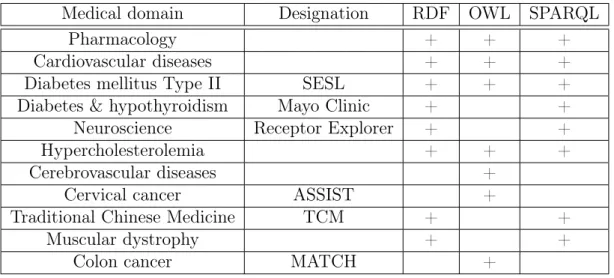
Seven of these systems integrate public resources, while the remaining four consider only private data. In Figure 2.2 is shown the distribution of public resources integrated in each solution.
2.3.3.1 Technical implementation
The translational medicine systems can be divided in four groups regarding their technical goal: exploitation of RDF as a data structure; data integration with the use of semantic web technologies; data integration through the representation of formal semantics; and data integration for inference purposes. Gudivada et al.
Figure 2.2: Public resources integrated by the translational medicine systems surveyed. The resources shown on the left are those integrated by the three systems targeting the cardiovascular system, whereas the resources shown on the right side are those integrated by the remaining four systems. The resources integrated in the cardiovascular system sub-domain that were also considered in at least one of the other sub-domains are underlined.
MRD - Mental Retardation Database; MPO - Mammalian Phenotype Ontology; Gene - NCBI Gene Database; OMIM - Online Mendelian Inheritance in Man; GO - Gene Ontology; KEGG - Kyoto Enclycopedia of Genes and Genomes; SNP - SNP Database; LSD - Locus Specific Databases; GXA Gene Expression Atlas; UMLS Unified Medical Language System; GOA -Gene Ontology Annotation; OBO - Open Biomedical Ontologies; LODD - Linked Open Drug Data; BAMS - Brain Architecture Management System; MeSH - Medical Subject Headings.
graph structure of RDF (see Tables2.1 and2.2 for a compilation of the semantic web resources used in the systems). The integrated resources were stored locally in relational databases and instantly converted to RDF when necessary for a specific disease and gene set. The conversion of the resources was mediated by the Disease Card Ontology (also referred to as Disease-Drug Correlation Ontology by Qu et al. (2007)), which was developed in OWL and included the reuse of external resources. The authors applied a graph-theory measure to the resulting RDF graph to score the importance of data elements (the graph nodes) in the data network.
Four systems exploit the semantic web technologies for data integration: Che-ung et al. (2009), Sahoo et al. (2007), Rebholz-Schuhmann et al. (2013), and
Pathak et al. (2012).
Cheung et al. (2009) present Receptor Explorer, developed by the W3Cs BioRDF task force group to demonstrate the use of the technologies and re-spective enabling tools in the implementation of a data federation (i.e., the data integrated is not locally stored but rather maintained at its original location). The system integrates resources already in RDF, mapping them at ID level, some of
Table 2.1: Standard semantic web technologies used in the surveyed translational medicine systems.
Medical domain Designation RDF OWL SPARQL
Pharmacology + + +
Cardiovascular diseases + + +
Diabetes mellitus Type II SESL + + +
Diabetes & hypothyroidism Mayo Clinic + +
Neuroscience Receptor Explorer + +
Hypercholesterolemia + + +
Cerebrovascular diseases +
Cervical cancer ASSIST +
Traditional Chinese Medicine TCM + +
Muscular dystrophy + +
Colon cancer MATCH +
This table lists the use of three semantic web standard technologies: RDF, OWL and SPARQL.
Table 2.2: Technical description of the surveyed translational medicine systems. Medical domain Designation Use of Reuse of LinksOntologies
Pharmacology + +
Cardiovascular diseases + +
Diabetes mellitus Type II SESL + * +
Diabetes & hypothyroidism Mayo Clinic +
Neuroscience Receptor Explorer +
Hypercholesterolemia + +
Cerebrovascular diseases + +
Cervical cancer ASSIST +
Traditional Chinese Medicine TCM +
Muscular dystrophy +
Colon cancer MATCH +
This table shows the use of ontologies for knowledge representation, the reuse of ontologies for both knowledge representation and data annotation (marked with *), and the use of mappings between resources.
which are part of the Linked Open Data cloud, namely DBpedia. It is through this resource that the authors are able to exploit other resources in the Open Data cloud, such as the NCBI’s Gene Database and Linked Clinical Trials. The data can be accessed through the links between datasets and through a SPARQL endpoint.
The muscular dystrophy system presented by Sahoo et al. (2007) was devel-oped at the US National Library of Medicine as a contribution to the Biomedical Knowledge Repository, and demonstrates data integration with RDF. It inte-grates the Gene Ontology and the NCBI’s Gene Database, which were stored locally and integrated through mappings at ID level. It is also through those mappings that the Gene Database is connected with the Online Mendelian In-heritance in Man knowledgebase (OMIM) (Hamosh et al., 2005), thus resulting in an indirect integration with the other two resources. The system exploits the use of inference rules over RDF to perform reasoning.
Rebholz-Schuhmann et al.(2013) describe SESL, a system integrating scien-tific literature from several publishers, namely Elsevier and Nature Publishing Group, as well as the following resources: the UniProt Knowledgebase (UniPro-tKB) (The UniProt Consortium, 2007), the Gene Expression Atlas (GXA) ( Ka-pushesky et al.,2012), and OMIM. The resources were stored locally in RDF. In terms of controlled vocabularies, the data in the GXA is annotated with the Ex-perimental Factor Ontology (EFO) (Malone et al.,2010), which for this work was mapped to the Disease Ontology (DO) (Schriml et al., 2012) in order to exploit the existing mappings to the Unified Medical Language System (UMLS) ( Boden-reider, 2004). Mappings were also defined between the integrated resources and external resources such as the Wikipedia1.
Pathak et al.(2012) present a system that integrates solely private data from the Mayo Clinic Biobank. The integration is performed through the creation of virtual RDF graphs, and the original relational schemas are mapped to several existing ontologies such as the Translational Medicine Ontology (TMO) (Luciano et al.,2011) and the Sequence Ontology (SO) (Eilbeck et al.,2005). Additionally,
the authors reused the Ontology for Biomedical Investigations (Brinkman et al.,
2010) and the Prostate Cancer Ontology (Min et al.,2009) to create new concepts
and properties for the TMO, concepts that were subsequently mapped to the National Cancer Institute Thesaurus (NCIt) (Sioutos et al., 2007).
The goal of data integration through the representation of formal semantics was pursued in three systems: Colombo et al. (2010), Siddiqi et al. (2008), and
Chen et al. (2007).
Colombo et al. (2010) were interested in exploiting the potential of ontologi-cal modeling to solve the interoperability difficulties associated with integrating resources stored in different platforms, and according to different semantic rep-resentations. The authors created the Neuroweb Reference Ontology, in OWL, for that purpose, having established mappings between the ontology and external resources. The access to the data is restricted, and is done through SQL queries formulated based on the reference ontology.
The approach followed bySiddiqi et al.(2008) in the MATCH system consists solely in the virtual integration of the data sources through the Colon Cancer On-tology, developed in OWL. According to the authors, it enables them to explicitly enunciate the domain knowledge and to aggregate and extract information from disparate sources. The ontology models the medical domain and the analytical methods used throughout the decision support process, and was used to create the database schemas for each individual data repository maintained in relational format.
Chen et al.(2007) implement a virtual integration of the TCM domain through the TCM Ontology (Fikes & Kehler,1985), developed in RDFS. For the authors, the ontology allows them to model the domain with richer semantics, which is necessary for the integration of the distributed resources. The data is maintained in its original location, in relational format, but is exposed as if in RDF.
Finally, the systems developed for inference purposes were those created by
Coulet et al.(2008), Qu et al. (2007), and Agorastos et al.(2009).
The goal of Coulet et al. (2008) in the hypercholesterolemia system was to exploit the inference capabilities of OWL to guide the selection of data (through the identification of instances of classes) to further analyze with data mining algorithms. To that end, all the integrated resources were converted to RDF with the assistance of two ontologies: the SNP-Ontology1 and SO-Pharm (Coulet
et al.,2006). Both ontologies were developed in OWL by the authors, the first for
the representation of genomic variations and the second for pharmacogenomics. SO-Pharm is articulated with several external vocabularies through the reuse of concepts. In addition to their role in the selection of patients, inference was also used to perform consistency evaluations of the ontologies.
The purpose of Qu et al. (2007) was the identification of novel therapeutic applications for drugs and of novel disease mechanisms implicitly represented in the resulting RDF network of integrated resources. The Gene Ontology, one of the resources integrated, was obtained already in RDF/XML format, but all the other resources were converted to RDF. The integration and conversion of the data was done with the assistance of the Disease-Drug Correlation Ontology (already described for the system developed byGudivada et al.(2008)). In order to perform reasoning, the authors had to define their own set of inference rules, since the triple store used did not provide support for direct inferencing over OWL.
The interest of Agorastos et al. (2009) (ASSIST) to exploit the inference capabilities of OWL resided in the possibility to automatically evaluate the disease severity for individual patients, and to assist in the unification of the database schemas of the participating hospitals. Inference was performed based on the ASSIST Cervical Cancer Ontology and on sets of medical rules. The data was converted to RDF and stored locally. The access was made available through a tree-like hierarchical visualization of the concepts defined in the ontology.
2.3.3.2 Overview of the usage of semantic web technologies
The analysis of the eleven translational medicine examples permitted the identi-fication of possible approaches to the problem of data integration and knowledge representation with semantic web standard technologies, with focus on the aspects of data and knowledge representation, use and reuse of ontologies, and definition of mappings with external resources.
As referred in Section 2.3.1, RDF is the standard language for data repre-sentation in the semantic web. If the resources to be integrated are already in this format then no transformation is required, but if they are stored in other
formats, such as relational or XML, a transformation is necessary. A third option is possible for data originally maintained in relational databases, which consists in exposing it as if in RDF, based on the mapping of the database schema to an ontology in RDFS or OWL. This last option is very interesting since it avoids the replication of the data, which is desirable to avoid different locations where it has to be independently updated, the duplication of object identifiers, and the need of extra storage space. The data can still be browsed and queried with SPARQL, however, the translation of the mapping between RDF and the schemas has to be done every time the data is accessed.
From the eleven systems described, eight use RDF (Table 2.2), of which five use it as data storage format. The cardiovascular diseases system did not store data in this format, but converted to RDF only the data necessary for an analysis. Based on the advantages presented by the authors associated with the use of semantic web technologies, and in particular RDF, it is possible to ascertain that they were interested in benefiting from the graph-like topography of RDF, but without converting all the data contained in their data sources of interest. In the case of the TCM and the diabetes/hypothyroidism systems, RDF was used to expose the integrated relational databases. In the TCM system, the results of the queries posed to the databases were also presented in RDF.
The use of ontologies during the integration process facilitates the integration itself by representing the domain knowledge in a formalized manner. When the ontologies are developed in RDFS or OWL, the translation of the resources to RDF (when such is necessary) is also facilitated, since a mapping is established between a data element in its original format and the concept that represents it in the ontology.
As referred in Section2.3.2, the development of an ontology from scratch is a non-trivial task. As such, ontologies should be reused whenever possible (ideally ontologies widely accepted by the scientific community), since this improves the level of integration with other systems. However, the process of reutilization is not always straightforward: the ontology of interest can insufficiently represent the knowledge required (under-coverage); it can model more knowledge than is necessary (over-coverage); or it can model the knowledge not quite how we wish to
convey it in our application. Three forms of ontology reutilization have been iden-tified that help to deal with these shortcomings: in the case of under-coverage, it is possible to reuse the whole ontology and add new concepts and relations; in the case of over-coverage, it is possible to extract only portions of the ontology that satisfy our needs (i.e., modules); if the ontology does not provide the necessary representation, it is possible to consider just some of the concepts and relations (thus ignoring hierarchical relations). It is important to stress out that this last option is not suitable if one wishes to infer knowledge based on the hierarchical organization of the ontology reused.
Seven systems use controlled vocabularies, three of which reusing existing vo-cabularies: pharmacology, cardiovascular diseases, and hypercholesterolemia (Ta-ble 2.2). This means that the remaining four created their own vocabulary, with a representation of the domain knowledge not shared by any other researchers. Despite the use of the standard technologies, this approach reduces significantly the interoperability among applications. The developers of the cerebrovascu-lar diseases system refer that they considered the reuse of existent resources, namely SNOMED-CT and the Disease Ontology. However, they identified some shortcomings: an unsuitable formulation of concepts in SNOMED-CT; and the adoption by the Disease Ontology of a taxonomy that is different from the one used by the clinicians participating in the project. SESL is the only system that reuses an ontology solely for data annotation purposes.
Two other advantages of the use of ontologies are the possibility to reason over the knowledge explicitly represented and to infer new knowledge, and to evaluate the consistency of an ontology (i.e., verify if there are no contradictory statements that can lead to incorrect logic assumptions). This is automatically performed by reasoning engines over RDFS and OWL, but also over inference rules (typically if-then clauses) that can be used either instead of RDFS/OWL or in conjunction with it.
The use of OWL instead of RDFS enables a more expressive representation of data, although with the possible cost of undecidability, which is the inexistence of guaranties that any algorithm will be able to provide complete reasoning when using complex ontologies and large knowledgebases. In order to deal with this problem, a set of profiles was initially defined for OWL: Lite, DL and Full. Each
of these sublanguages has increasing expressiveness over the previous one, and consequently decreasing computational efficiency. With OWL 2, three more pro-files have been defined: OWL EL, OWL QL and OWL RL 1. If OWL does not
convey the necessary expressiveness, inference rules can be defined to complement it.
Another form of improving interoperability between applications is trough the definition of mappings. They enable the explicit definition of connections between data resources, stating for example the likeliness of resources, or between data resources and controlled vocabularies through which data are linked with their describing concepts. Mappings between data instances result in the disambigua-tion of identifiers (URIs) by enabling the explicit indicadisambigua-tion of different identifiers (URIs) as referring to the same data instance in different datasets. If such map-pings are not done, those instances are treated as if referring to different things, and cannot be automatically merged (a more detailed discussion on this topic was done by Cheung et al. (2009)). All these types of mappings improve the access to resources that have them, hence increasing the interoperability among appli-cations that use those resources and the impact that those resources can have in the knowledge discovery process. Despite these advantages, only five systems exploited the use of mappings (see Table 2.2).
It is possible to have an idea of the importance of sharing resources, reusing existing vocabularies and defining links between resources when considering that some of the translational medicine systems already have the base work done for a future integration with one another through the resources used. Figure 2.2
shows the data resources integrated by seven of the systems, indicating several resources that are integrated by more than one of the systems. Additionally, the cardiovascular system and the pharmacology system reuse the NCI Thesaurus and SNOMED-CT2, resources that were mapped to the diabetes/hypothyroidism
system and to the cerebrovascular diseases system, respectively (Sioutos et al.,
2007).
1http://www.w3.org/TR/2009/REC-owl2-profiles-20091027/ 2http://www.ihtsdo.org/snomed-ct/