FUNDAÇÃO
GETULIO VARGAS
EPGE
Escola de Pós-Graduação em Economia
Centro de Estudos de
Reforma do Estado
TEXTO PARA DISCUSSÃO
N° 006
The Recent Evolution of
Competition Policy in Brazil:
An Incomplete Transition
César Costa Alves de Mattos
Outubro de 1997
Coordenação Geral
Prof Rubens Penha Cysne
Diretor de Pesquisas da
The Recent Evolution of Competition Policy in Brazil
An Incomplete Transition1
2 César Costa Alves de Mattos
July 1997
Addresses for Contact:
CADE
Conselho Administrativo de Defesa Econômica
Esplanada dos Ministérios
Ministério da Justiça Anexo 2 - sala 215 Brasília - DF CEP.: 70.064-900 Telephone: +55-61-225-1576 Fax: +55-61-321-1209 1
I would like to thank Cynthia Mattos, Russel Pittman, Mario Cuevas, Neide Mallard and Pedro Dutra for their valuable comments. Aditionally, I would like to thank CADE's President, Gesner Oliveira, since so many ideas treated here carne from our talks. As usual, remaining mistakes are exclusive
responsability of the author.
This
paper belongs to the set of papers from CERES - State Reform Studies Center of EPGE/FGV and it was presented at the Intenational Seminar of Competition Policy and Economic Reform.
I) Introduction
This article emphasizes some aspects of the transition in competition policy
law and its application in Brazil in the nineties. We use Khemani and Dutz's (1992)
classification about the three Schools of thought in competition policy: Structuralist, Statist and Chicago.
The main issue is that the country is coming from a period in which
competition
policy was based on the Statist School and progressively it is becoming a hybrid model between the Chicago and Structuralist Schools. In the second section,
we briefly describe the Schools and their influence over competition
policy in the USA, Japan, Korea and Brazil. In section three, the main aspect of the transition
related to the Structuralist School will be presented, that is, the control of mergers by CADE (Conselho Administrativo de Defesa Econômica)3.
The principal problem in the transition is the maintenance of a strong influence
of the Statist School in competition
policy making. This will be seen in sections IV and V, which deals, respectively, with the instrument of
"Compromisso de Desempenho" (Performance Commitment-PC) in merger control, and the treatment
given to abusive prices in the law.
The sixth section will evaluate one of the most striking
problems of the transition, which is the lack of a strong action of CADE towards reducing or simply eliminating
government failures4. We also argue for a more active role of CADE in the deregulation process, and as the advocate of liberalizing reforms in the public
sector. The seventh section evaluates the relationship between trade liberalization and competition policy. Although trade liberalization does not imply the obsolescence
of the enforcement of competition policy law, the opposite is also clearly inadequate. In other words, the competition
policy agency must take in consideration trade liberalization in it's analysis. As will be seen from CADE's jurisprudence related to
geographical relevant markets, there is little attention, in practice, to trade
liberalization. Section VIII will be reserved for conclusions.
II) Competition Policy in Brazil and the Three Schools of Thought
There are several targets attributed to competition laws in different periods
over the various countries. These targets will be more or less limited, depending on the policy makers view of the role of competition in national development, and the
scope of state intervention.
The easiest way to evaluate and compare competition laws and
policies around the world is to make some classification of the ways
of approaching this subject. In this context, we think that the classification proposed by Khemani and Dutz over three schools of thought on competition matters can be very useful for our
purposes. They
Administrative Council of Economic Defense. CADE is the competition policy agency in Brazil,
similar to Federal Trade Commission in USA.
There is some conffusion over this terminology. We will use government failures to designate
economic
are the Structuralist5, the Statist or Industrial Policy and The Chicago schools. The
first one takes a competitive environment in the economy and a strong intervention of
the state to keep or strengthen competition as fundamental issues.
The Chicago School shares the view of the Structuralist School about the
importance of competition. However, the Chicago School, as usual, is very skeptical
about state intervention in this area.
The Statist School does not believe that a competitive environment is very
important for development. As a consequence, the State should not interfere to
protect
or strengthen competition in the country6. It is quite surprising that the Statist School
converges to Chicago's view, when the subject is competition policy prescription.
According to Franceschini and Pereira (1996), "the
real difference between the two
Schools, apparently antagonist, is
just ideological, related to the definition of the role of the state in economics". Otherwise, the contradiction between these two Schools is
criticai in matters related to the role of the state in industrial fostering.
The Structuralist School, on the contrary, gives a high priority to competition
policy not just for conduct regulation but also for the control of market structure by
the competition agency. In fact, this statement is based on the most traditional issue in
the literature on industrial organization: the structure-conduct-performance model.
According to Viscusi (1995), "the hypothesized linkage among these three concepts is
that the structure (number of sellers, ease of entry, etc.) of a market explains or
determines to a large degree the conduct (pricing policy, advertising etc.) of the
participants in the market, and the performance (efficiency, technical progress) of the market is simply an evaluation of the results of the conduct" 1.
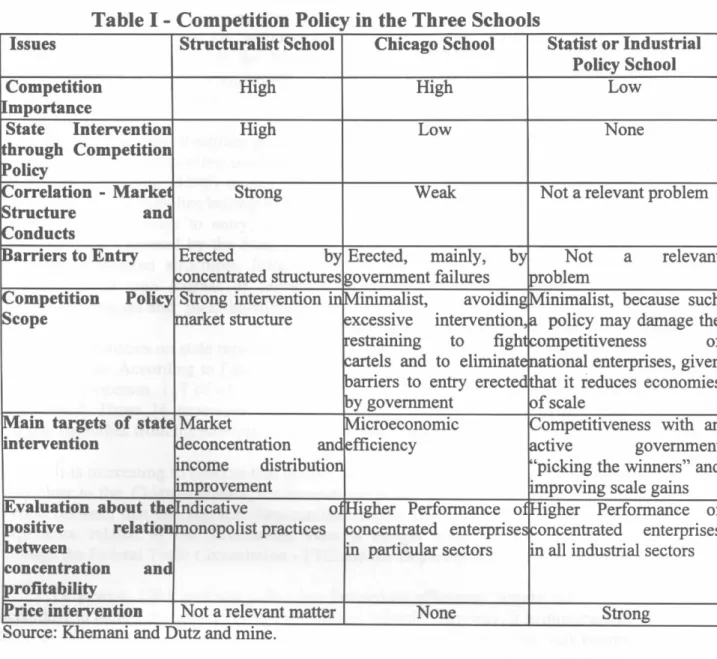
Table I makes a comparison among the three Schools, following Khemani and Dutz's classification:
It
is important to note that the term "structuralist school" is used here in a different sense from the
concept of structuralism used by CEP AL in Latin America. These
similarities between the Chicago and Statist Schools is very well decribed by Franceschini and
Pereira (1996). See
Table I - Competition Policy in the Three Schools
Issues Structuralist School Chicago School Statist or Industrial
Policy School
Competition
Importance
High High Low
State Intervention
through Competition
Policy
High Low None
Correlation - Market
Structure and
Conducts
Strong Weak Not a relevant problem
Barriers to Entry Erected by
concentrated structures Erected, mainly, by government failures Not a relevant problem Competition Policy Scope Strong intervention in market structure Minimalist, avoiding excessive intervention, restraining to fight
cartéis and to eliminate
barriers to entry erected
by government
Minimalist, because such
a policy may damage the
competitiveness oí
national enterprises, given
that it reduces economies
of scale
Main targets of state
intervention Market deconcentration and income distribution improvement Microeconomic efficiency Competitiveness with an active government "picking
the winners" and
improving scale gains
Evaluation about the
positive relation between concentration and profitability Indicative oi monopolist practices Higher Performance of concentrated enterprises in particular sectors Higher Performance of concentrated enterprises
in ali industrial sectors
Price intervention Not a relevant matter None Strong
Although the authors do not
propose any classification of countries in terms of the influence of the Schools in legal framework and practice, we think this procedure may be useful.
Korea and Japan, for instance, undertook policies very close to the Statist
School. It becomes clear when we observe that one of the main benefits given by the Japanese government through MITI to "target-sectors", was the exemption of antitrust
legislation8. However, despite the closeness of Asian economic
policies to the Statist School, competition
policy was not irrelevant in practice. According to Khemani and
Dutz ,
"strong
government policies have supplied the discipline imposed by market
forces", in that
"conglomerates
must compete for government subsidies, for access to
credit, and for foreign exchange". So, despite Statist School influence, Asian
countries paid strong attention to competition, and that made ali the difference from
the Brazilian Statist model of the past.
8
See Guimarães et alii (1995). According to Salgado(1995), Japanese antitrust legislation only began to work in 1977.
In fact, the legal framework and economic policy in Brazil from the seventies
until the beginning of the nineties, as in Asian countries, were very close to the Statist School, but in a
"purê"
way, i.e., without any drive related to competition fostering, as
had the Asians. In other words, the Asian model followed industrial policies close to Statist model, but using competition concerns as crucial parameters for state
intervention out of the market.
In the past, the Brazilian government did not make any relevant repressive
action against anticompetitive conducts nor any policy toward structure control. On
the contrary, Salgado (1995) argues that
"concentrated,
differentiated, blended or
fragmented, the oligopolies belonging to the Brazilian structure, had strong help from the state. Even barriers to entry, such as scale and access to technology, were
-directly or not - erected by the State's hand."
So the State, besides avoiding action
against concentrated structures, fostered the concentration process and even the
maintenance of high degrees of concentration, when it created barriers to entry,
through regulations and "pick-the-winners"
policies (as did Asian countries).
The statistics on state repressive action against anti-competitive conduct speak for themselves. According to Farina (1990), "from 1963 to 1990, CADE took care of about 337 processes, 117 of which were considered valid, it being that only 16 were condemned. Those 16 processes were ali suspended by the judiciary branch after
judicial resources from the enterprises accused".
It is interesting to observe that despite North American economic
policy being very close to the Chicago School, it's competition
policy model can be described as a hybrid between that one and the Structuralist School. The main aspect of American
experience related to the Structuralist view is merger control, made, nowadays,
through the Federal Trade Commission - FTC and the Department of Justice - DOJ9. Otherwise, USA antitrust
policy has focused on efflciency targets, which are, according to table I, an issue close to the Chicago School10. Anyway, it is important to keep in mind that, as a general rule, American economic
policy in the last twenty years had been increasingly close to the Chicago School, and this clearly restrained
the work of the FTC and DOJ, which can be taken as a
"Structuralist
island" in the
public policy of that country.
In the nineties, Brazilian and Asian antitrust
policies became closer to the American hybrid model. However, we argue that in Brazil there remain some
In
the USA, the judiciary branch has a strong role in antitrust policy and is not very close to the
Chicago ideas. 10 Lande
(1996) points an interesting issue of Sherman Act history related to its targets. According to the author, despite the
popular interpretation of Bork that the Sherman Act focused on efficiency and, therefore, would be close to the Chicago School in this respect, the historical evidence of the
congressmen s intentions at the time indicate that the income distribution target, close to the
structuralists, was a major issue. Being valid this interpretation, the influence of the Structuralist
School in American competition policy would be even greater. Recent American competition policy
reveals that the influence of the schools vary a lot, especially in relation to the targets. Salgado (1996) emphasizes that the strong weight given to the Chicago School in the Reagan administration is being
changed by an increasingly role of the distributive issues in the Clinton adminstration. This seems a revival of some Structuralist School concems in antitrust policies. Thus, the american hybrid model varies a lot in relation to the schooFs weight in antitrust law application.
undesirable traces of the Statist School in antitrust policy making and even in the legal
framework. In this sense, we argue that it is important for the country to complete the
transition and consolidate a hybrid model that strengthens positive aspects of both the
Structuralist and Chicago Schools. Far from exhausting ali the characteristics of the "incomplete
transition", we will focus on four crucial points, which we believe, show
the more acute problems of competition policy in the country: A) The Brazilian
merger control system, focusing on the way that CADE has used the so-called "Performance
Commitments (PCs)"11; B) Competition policy and price control in
Brazil; C) The link between competition policy and liberalizing reforms and D) The
link between competition policy analysis and trade liberalization. The next section
presents the legal evolution of merger control in Brazil.
III) Merger Control in Brazil
The change in the Brazilian antitrust model from a Statist model to a hybrid
one, with a strong weight on Structuralist tradition, is very clear when we observe the
legal evolution of merger control in the country. Law 4.137 from 1962, that created
CADE, stated that
"control
was not applicable to mergers and other transactions
between enterprises which caused change of shareholder's control". But the main
feature is that the Brazilian government would never allow CADE to block mergers.
This was perfectly consistent with the Brazilian Statist model of that time.
The evolution began only in the nineties, when the Brazilian government made
strong changes to law 4.137/62 through law 8.158 from 1991 (today it has already
been changed by law 8.884 from 1994). Differently from the earlier legal framework,
law 8.158/91 is explicit on the need of merger control. The law stated that "any
agreements that can limit or reduce competition, including mergers, whose
consequence be a market share higher than 20% in the relevant market" must be
approved. However, the evaluation of mergers would be done by the
"Secretaria
Nacional de Direito Econômico" - "Economic Law Department of
the Justice
Ministry" (today it is called Secretaria de Direito Econômico-SDE)12, which is not
independent like CADE.
Law 8.884/94 changed merger control from the SDE to CADE, and
strengthened the independence of this last one. President, commissioners and the
attorney of CADE would enjoy fixed mandates, signaling a new mindset in public
policy toward structure control close to the Structuralist School.
Even in relation to anticompetitive conduct repression, law 8.884/94
emphasizes structure control. While law 4.137/62 did not establish any structural
penalty, law 8.158/91 already stated that CADE could recommend divestiture to
punish anticompetitive conducts. Law 8.884/94 strengthens the power of CADE to
intervene in structure, punishing anticompetitive conducts. Article 24 of the law states
that one of the
possible punishments imposed by CADE for anticompetitive conducts is an order to divest assets or to
quit some of the economic activities of the company. However, this kind of punishment has not been applied yet13.
"
Article 58 of Law 8.884/94. 12 SNDE
was created in 1990 as an investigative body, separating this fiinction from the judgment one worked by CADE. Before 1990, there was no such separation.
13 Even
On the other hand, it is very important to take care in controlling structure in
Brazil, specially considering the poor tradition of the country in this area. The
reference to concentration índices like the HHI14 to define damages to competition as
used by FTC and DOJ15 must be very parsimonious when it is applied to BraziFs
reality. CADE's president stated this very clearly in the judgment of the
Kolynos/Colgate merger in 1996:
We must not overestimate concentration indexes in the antitrust decision
process given that:
despite the existence of a strong correlation between degree of concentration and
above normal profit margins, the modern theory of industrial organization and
empirical evidence do not confirm the hypothesis of a simple causai relationship
between those indicators;
the Brazilian industrial structure has some particular aspects due to the nature of the import substitution process that marked the growth dynamic in almost ali of this
century and due to it's smaller size relative to the American economy, for which the FTC and DOJ classification is applied16...
the Brazilian economy is
passing through a strong productive revolution due to the adjustment of companies to trade liberalization and price stability through deep
structural changes in great part of the relevant sectors for antitrust analysis."
These special characteristics of the Brazilian economy can be challenged by
competition authorities in three ways:
First, nowadays, a lot of mergers
in Brazil can be seen as part of a process of
search for efficiency by local companies to gain competitiveness before foreign
competitors. What this means is that efficiencies should be, on average, more
emphasized in Brazilian antitrust analyses than in the USA, in terms of offseting the increase in concentration derived from a merger;
Second, it is important to review HHI intervals as defined in the American Merger Guidelines of FTC and DOJ to evaluate potential anticompetitive effects in the
Brazilian reality;
Third, the geographical relevant market should be more frequently defined with a greater scope than the national territory than in the USA. It is important to remind
that concentration Índices are always defined in a relevant geographical market.
We will focus on this matter in the seventh section.
Thus, in average, the Structuralist content of the Brazilian hybrid model of
antitrust policy can be relaxed relatively to the parameters used in American
experience.
Beyond these
problems, we must point out a distortion. CADE has focused its work, since 1994, more on mergers than on anticompetitive conducts, which is not
consistent with the intemational trend according to Farina (1994). This can be seen by
14 Herfmdhal
Hirschman Index. 15 See
DOJ-FTC Guidelines(1992) and Viscusi (1995). 16 Brazilian
the low levei of anticompetitive conducts judged relative to the stock of such cases at
CADE in 1996: It reached 23%, compared to the same statistic for mergers of 59%. It
is not adequate that the time spent by CADE's staff on merger control impair the
work on anticompetitive conducts. In passing, this last task should be taken as the
most important work of CADE, specially to improve its educational function for
society on competition affairs. Anyway, the solution for matters related to the
sluggishness of case analysis depends on a strong
program of technical improvement of CADE, which involves a higher amount of budgetary resources írom the federal
government.
The next section studies the institute of the
"Performance
Commitment" (PC) and the Schools' influences (positive or negative) on it.
IV) Performance Commitments in Brazil and the Transition of Brazilian Antitrust Model
Brazil, like several other countries, has intermediate solutions for mergers that can cause damages to competition, besides the simple blocking of the whole
transaction. These interventions are typical of a competition
policy close to a Structuralist approach. The USA makes intermediate solutions through the
restructuring of the transaction, which are generally called "Consent-Orders",
including divestiture of assets, technology licensing, trade-mark transactions and so
on17.
According to Boner (1992), the advantages of those solutions happen specially "in
transactions involving multiproduct companies where the reviewing agency's
antitrust concerns arise out of a discrete overlap or set of overlaps that can be
eliminated by partial divestiture."
In Brazil, the so-called "Performance Commitment" (PC) l8,
regulated by article 58 of law 8.884/94, is similar to the American "Consent Order".
A remarkable difference between these two institutes is that the Consent Order focuses on structural commitments targeting the elimination or reduction of
competitive damages of the transaction, while the PC has wider scope in it's clauses, which is a strong indication (almost always negative, as we will argue) of the
remaining strong influence of the Statist School in Brazilian policy making19. The
PC's clauses can be of two types:
17
According to the DOJ's manual, "while
partial divestiture is the most common remedy, the agencies have demonstrated an increased willingness to entertain alternative remedies such as licensing of
intellectual property to create or enhance a competitor and, in unsual cases, even "conduct"relief
(permitting the acquisition to go forward conditional on certain changes in the parties' ongoing operations)" .
1
A synthetic table of the PCs already made by CADE is in Appendix I.
There is a debate among the experts as to whether "Performance Commitments" include or not
structural commitments. In practice, CADE is using "Performance Commitment" on a broader sense, which we will follow.
a) structural, involving divestiture, selling of assets, technology licensing, equipment
leasing etc... This kind of clause is similar to that used in American Consent Order.
b) behavioral, aiming to compensate, through efficiency gains or conduct restrictions,
the damages on competition. This kind of clause has a strong content based on the
Statist model, which we consider inadequate for the new Brazilian economic
environment.
Based on Brazilian experience after 1994, we suggest to dividing behavioral
clauses in three types:
i) technical efficiency guarantees, such as productivity increases,
quality and technological improvements and investment increases, when they represent a
positive net return to the company, improving the profit maximization of the
entrepreneur ( See article 54 of law 8.884/94).
These are based on the assumption that the company's benefit will increase
social welfare as well. This kind of target is linked to the Chicago School. However, it is clear that the Chicago School would be very skeptical about any kind of state
intervention through a PC to reach these improvements;
ii) non-technical or social efficiencies guarantees, involving some distribution of the
benefits of the merger to society, specially to consumers ( See article 54). These
efficiencies are not targeted to improve the company's
profít maximization, but social welfare, at least in the short run. Several commitments linked to this kind of efficiency have been demanded by CADE: lower prices or some kind of price
control, production and employment increases
(article 58 of law 8.884/94), maintenance of trade-marks, financing of social programs,
quality and technological improvement, investment increases, when they result in a net
negative return to the company;
iii) conduct commitments, which involve a
previous promise of the company to avoid some conducts considered anticompetitive in that sector or to implement some
pro-competitive actions. One important example of this kind of clause is observed in the Gerdau/Pains merger
process, where CADE demanded a guarantee of input supply to some agents20, or in the Rockwell-Albarus merger where CADE forbid the concession of
privileges that would not be extended to competitors. The "conduct
commitment" clause is close to that used in another legal tool of law
8.884/94 named "Compromisso de Cessação de Prática" (article 53 of law
8.884/94) , which is focused in anticompetitive conduct control. This last one is similar to the Consent Decree in the USA, where it is becoming increasingly
frequent with a strong emphasis on non-discrimination clauses.
Thus, behavioral clauses do not search to reduce or even eliminate the causes of damages to competition, as in the case of structural clauses. The conduct
commitment tries to compensate damages to competition, but without dealing with the primary causes linked to structural change in the market. But the first two kinds of
20 See
Appendix 1. 21 See
Mallard (1995) for a better understanding of the "Compromisso de Cessação de Práticas". See Mattos (1996) for a criticai approach.
clauses (technical and non-technical) neither reduce the cause of competition damage nor it's consequences. They only try to compensate competition damages by
efficiencies guarantees in the context of the "rule
of reason"22.
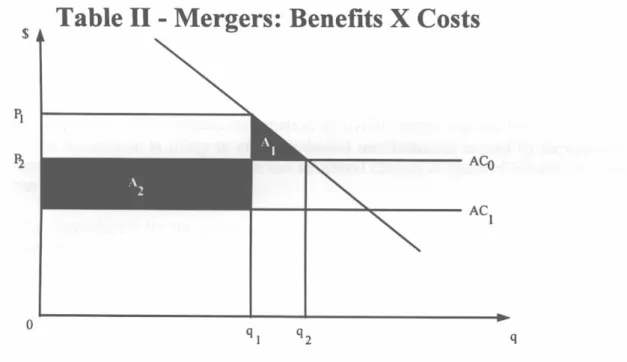
Just to elucidate the principie used in technical efficiencies clauses, we use the
graphical example of Viscusi in table II, showing benefits and costs of a horizontal merger:
"The
horizontal line Aco represents the levei of average costs of two firms
before combining and Acl shows the average costs after merger. Before merger, the
degree of competition is sufficient to force price down to Aco. After merger, costs fali
and market power is created-which leads to price increasing from Po to PI. The
merger results in a deadweight loss in consumers surplus equal to the shaded triangle
Al. However, there is a gain to society because the cost savings, given by the shaded
rectangle A2". The idea behind a technical efficiency clause in a behavioral PC is that
CADE would wish to be safe that the decrease of ACO to AC1 will be enough such
that rectangle area of A2 is greater than Al23.
$
Table II - Mergers: Benefits X Costs
Pi P2 AC0 AC, " 4i q
An useful division of behavioral PC clauses of technical efficiencies,
according to its motivations, can demonstrate the lack of practical sense in
establishing obligations for the company targeting
profit maximization improvements. So, technical efficiencies can be:
A) introduced by the company as intrinsic to the transaction, but without certainty of CADE about its truth. In other words there is asymmetric information of CADE
22 The "rule
of reason" is the opposite of "per se" rules. According to Salgado (1995), while this last one represents an "absolute prohibition for certain kind of behaviour", in the "rule of reason", "the
competition agency or courts will observe the trade-off between benefits and costs" of the practice or
merger. For a review on the use of this concepts for American antitrust policy, see Pittman (1996). 23 Williansom
(1968) introduces this explananation with more rigour. An interesting conclusion is that small decreases of costs will, normally, be enough to counteract great price increases, even with a high
relative to the company. The company states that such efficiencies are a logical
consequence of the transaction, and CADE, since it does not know if this is true, put them as an obligation of the company in the PC24. However, observe that if the
company is, in fact, lying or stating without being sure, these clauses will result in
inefficient outcomes for the company, weakening the main reason for their inclusion
in the PC: profit maximization.
B) introduced by the company as intrinsic to the transaction with CADE being sure
that this is really true. In other words, there is symmetric information of CADE
relative to the company. However, there would be no reason for the inclusion of such efficiencies in the PC, ceteris paribus, since the profit maximization behavior
hypothesis would warrant that the same would be done, independent of its inclusion as an obligation in the PC. The sole reason to insert this kind of clause in a PC would be the breaking-up of profit maximization hypothesis, based on the presumption of
the likelihood of X-inefficiency after merger, caused by damages to competition.
Viscusi puts it well: "The
pressures of competition force perfect competitors to be cost minimizes, whereas the freedom from competition makes it possible for the
monopolist to be inefficient, or X-ineffícient. That is, the monopolist may operate at a point above its theoretical cost curve". In other words even if the company
presents good faith in terms of the alleged efficiency, damages to competition will induce the
company to work inefficiently, off of it's profit maximizing equilibrium. However,
even in this case, these clauses may be looked on with some reservations:
the hypothesis of symmetric information by CADE seems implausible25;
if the transaction is likely to create technical inefficiencies caused by damages to competition, the best
procedure is to use structural clauses in place of behavioral ones in the PC.
C) Not introduced by the company, but CADE thinks that the inclusion of such
clauses must improve company efficiency, increasing its profit. The sole reason for
the inclusion of such efficiencies in the PC would be the presumption that CADE
knows more about the company than itself does, which we think, as a practical matter, should be disregarded..
Thus, it becomes clear that the reasons behind insertion of behavioral clauses related to technical efficiencies in the PC, given lack or presumption of superior
information or likelihood of x-inefficiency are, in fact, fragile. It can be taken as
undesirable vestiges of the typical interventionist approach of the Statist School. It
must be used only in exceptional circumstances, when there is a lack of potential
buyers in the case of structural clauses involving divestiture, for example.
24
The incentive for the company to increase alleged efficiencies is to reduce the rigour of CADE's analysis.
Schymura emphasizes how hard is for an antitrust agency to evaluate the magnitude of efficiency of an operation and its asymmetric information relative to the company. However, the author concludes favorably about the approach proposed by Brodley in two stages: in the first one, the agency lists the
efficiencies that the company must perform in a given term and, in the second stage, the agency must
evaluate the fiilfillment of those efficiencies. As we argued in this section, CADE already does it in practice, thus rendering Schymura's approach inappropriate.
In behavioral clauses relating to social efficiencies, the lack of any relationship
between those with profit maximization leads to the conclusion that they are not
intrinsic to the transaction. In other words, as there do not exist profit motives, the
rational entrepreneur will never work for them by his own. Thus, social or
non-technical efficiencies focus on social retum against private one, when these are not
coincident. Social efficiencies can be:
a) linked to economic decisions of the company, such as investments, quality
improvements, production and employment increases, price decreases or control,
export performance, trade-mark maintenance. These clauses can both improve
consumer welfare and/or improve government policies (inflation control,
unemployment decrease, trade balance improvement, etc. The most typical social
clauses in CADE experience with PCs are related to price and production targeting,
and aim to reduce or even eliminate the deadweight loss resulting from the merger, as
we have already seen in rectangle area Al from Table II.
Theoretically, an optimum price regulation can eliminate the deadweight-loss resulting from monopoly power, as long as this control does not exceed the limit of
the competitive equilibrium26. However, this control means, many times, a strong
restriction on a company's behavior that can distort resource allocation. More than
that, we can say that it is the antithesis of present economic policy in Brazil. It is important to remember that experience has already demonstrated that this kind of
clause is very hard to implement in practice, given lack of information by the
competition policy agency and by the unavoidable political intervention involved in
any bureaucratic control of variables like prices and production. Up to now, there are a total of 7 PCs presented in Appendix I which involve some kind of price clauses, which is remindful of the interventionist-minded time of price control through CIP.
The cases in which some kind of price control by CADE may be accepted are
very few, as we will see in the next section. However, it is important to consider that
the inclusion of some social efficiencies in the PCs seem to be unavoidable is some
cases, just to make it possible to approve certain mergers that, clearly, create enough
technical efficiencies. The problem is legislation rigidity. Observe from the area of
rectangle A2 in table II, that technical efficiencies are completely appropriated by the
entrepreneur. On the other hand, the consumer looses part of his surplus represented
by Al, lower than A2. In this case, law 8.884/94 states in article 54 that CADE can
only authorize mergers that hurt competition when they fulfill requirements of both
technical and social efficiencies. In other words, even if A2 is higher than Al, law
8.884/94 considers the merger undesirable, given that the consumer lost Al. Given
this restriction in the law, it is certainly desirable to establish social efficiencies in
order to approve the merger.
Anyhow, there are some curious examples of social clauses in the PCs such as
in the Helio/Carbex merger, where CADE ordered the maintenance of the production of some goods that were on a technological obsolescence path. Even the Statist
School would not take such a measure against technological improvement.
26
For more details see Pyndyck & Rubinfeld (1991) Chapter 10. The optimum price control should already check for the existence of increasing retums, which is not consistent with competitive
Other examples of PC clauses lacking economic sense are the order for trade-mark maintenance in Melita/Jovita and Santista/Carfepe mergers, or the employment warrant established in Oriento/Ajinomoto PC. In the first case, it is clearly better to
leave to the entrepreneur the choice about the maintenance of some trade-mark in the market. If it remains
profitable to keep a trade-mark, it is not necessary to include this obligation in the PC.
It is curious that the PC of Oriento-Ajinomoto, at the same time that it orders cost reductions, obliges the company to keep the same employment levei as before
merger. It is clearly an example of target contradiction.
Thus, as in the clauses of technical efficiencies, those social efficiencies
related to economic decisions of the company have strong Statist model contents,
which make no sense in the present moment of Brazilian economic reality. It is
important to bear in mind that we don't argue against efficiencies by itself, which, of course, are positive, but only against its inclusion in a PC monitored by CADE. This body takes the risk of
perform some functions of the old CDI (Industrial Development Council) if CADE's demands of technical efficiencies and social efficiencies related to economic decisions of the company remain a common
practice28. We can still add to those problems the low ability of CADE to perform fiscalization requirements of
those clauses, which is a problem that is really happening and is implying a fali in
credibility of the PC as a tool of the brazilian competition
policy and of CADE itself.
b) not linked to economic decisions of the company (or, alternatively, that don't affect resource allocation of the company), such as pollution control, dismissed personnel
retraining, etc....
In this case, consequences of
government failures are lower, since they do not damage either allocative or
productive efficiencies of the company. Additionally, they can improve competition aspects, as is the case in one of the points of Gerdau's
decision and one of the Kolynos/Colgate PC clauses, which were retraining of
dismissed personnel. This kind of social efficiency can: i) correct a negative
externality of sectoral unemployment caused by company restructuring; ii) enlarge the labor market supply side flexibility; iii) create a series of self-owned businesses,
improving competition in those areas. Another interesting example was the clause of dental education investments in the Kolynos/Colgate PC .
Thus, there are two promising kinds of behavioral clauses in CADE's analysis
for inclusion in a PC:
1. Conduct clauses;
2. Social efficiencies not linked to economical decisions of the companies.
As Franco and Fritsch (1994) state "in many industries the key source of regulation as regards the expansion of productive capacity and "adequate" leveis of minimum domestic content was the
project evaluation activity carried out by the Industrial Development Council (CDI) which was created in 1969 and closed in 1988".
In this sense, we agree with Schymura (1997) about the growing importance of efficiencies in antitrust analysis, but we disagree in respect of the proposal of the author to include it in PCs.
Observe that this kind of social efficiency can benefit the company, through a demand increase of lower income
groups. Thus, this program, in the limit, could be considered even a technical efficiency PC clause if its net return was positive.
But even these two must be used parsimoniously, avoiding excessive damages
to the companies.
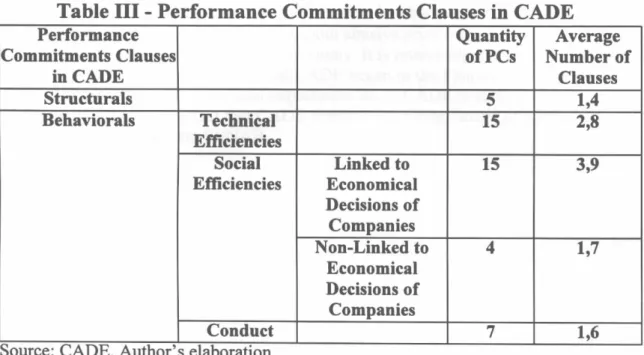
In proceeding, it is important to analyze statistics about PCs clauses, consistent
with our proposed classifícation30. Observe the strong weight of behavioral clauses of
technical efficiencies and social efficiencies involving economic decisions of the
companies, a strong evidence of the Statist School influence in the PCs. This is true
not only of the quantity of PCs but also for the average number of clauses of each
kind in the PCs in table III.
Table III - Performance Commitments Clauses in CADE
Performance Commitments Clauses in CADE Quantity of PCs Average Number of Clauses Structurals 5 1,4 Behaviorals Technical Efficiencies 15 2,8 Social Efficiencies Linked to Economical Decisions of Companies 15 3,9 Non-Linked to Economical Decisions of Companies 4 1,7 Conduct 7 1,6
Source: CADE. Author's elaboration.
Of course, even structural, conduct and social efficiencies not linked to
economic decisions clauses are not always consistent with a less Statist influence in
merger control. These clauses must be analyzed case by case, which involves research work beyond the scope of this article.
V) Price Control by CADE
One of the aspects of competition policy where CADE should be closer to the
Chicago School prescriptions is abusive price control. It is important that CADE
introduces an approach completely different from the old CIP and SUNAB31
approaches in the past. Both were responsible for a strong price control very far from
the market direction. This can be taken as one characteristic of the Statist School
Model. The control focuses exclusively on the cost structure presented by the
companies which means only the supply side of the market, disregarding the demand
side.
30 Some
methodological explanations about technical and social efficiencies will be made in the
Appendix I. 31 CIP-
Conselho Interministerial de Preços - Brazilian Price Control Council; SUNAB
This kind of intervention had two additional failures:
information asymmetry between the controlled companies and the government
bureaucracy;
the CIP became, in practice, a coordinator among companies around the price
fíxed, so it could be seen as a cartel sponsor32.
The problem is that this kind of interventionist view influenced strongly: i) the
competition law 8.884/94; ii) the public perception about CADE's role; iii) the
government expectation about CADExs role .
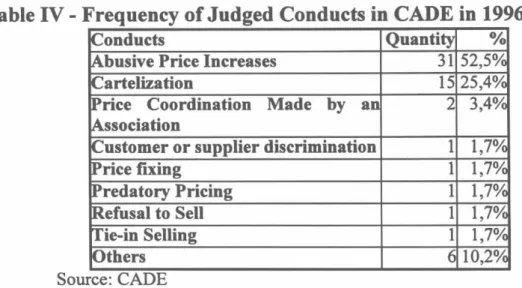
This becomes transparent when we observe in table IV that more than half of
the judged cases in CADE in 1996 were about abusive price increases, which are a
phenomenon typical of an inflationary economy. It is interesting that the majority of
the abusive price processes that entered CADE began in the Finance Ministry, which
shows that a distorted
governmental expectation about CADE is at the root of this
problem. Thus, it is important that CADE corrects this wrong image of a price controller such as CIP and SUNAB.
32 See
Salgado (1995). 33 This
Table IV - Frequency of Judged Conducts in CABE in 1996
Conducts Quantity %
Abusive Price Increases 31 52,5%
Cartelization 15 25,4%
Price Coordination Made by an
Association
2 3,4%
Customer or supplier discrimination 1 1,7%
Price fixing 1 1,7% Predatory Pricing 1 1,7% Refusal to Sell 1 1,7% Tie-in Selling 1 1,7% Others 6 10,2% Source: CADE
Another important consequence is the introduction of a new article in
Brazilian competition policy law quoting explicitly abusive prices. It is known how
hard is, conceptually and in
practice, to define abusive prices. According to Pittman in a Brazilian newspaper34,
"abusive
price increase is not considered a problem in American antitrust law. However, Brazil is not alone. The majority of countries
around the world have laws explicitly quoting punishments to
"abusive price increases", including the European Union. But these laws are not quite used in
practice, since it is very hard to know if price increases were, in fact, abusive".
According to Stevens (1995), it is even harder for the entrepreneur to know
himself if he is increasing his prices in an abusive way: "It
is also notoriously difficult
to establish a satisfactory test as to what constitutes excessive or "abusive" prices; the industrialist is often left confused or finds it impossible to apply the test in practice".
An alternative to reduce CADE's image of a
"price
controller" may be to
improve the definition of abusive price control in Law 8.884/94, that fails in three
aspects:
• remains focusing only on the supply side, neglecting the demand side. Similarly to CIP's time, competition law takes in account to define abusive prices:
i) cost evolution of the company;
ii) quality improvement;
iii) last price of the good, when there is no substantial quality changes;
iv)prices of similar goods in competitive and comparable markets and;
v) agreements toward price fixing35.
Thus, when there is a sudden increase in demand above supply possibilities of
response, the implicit rationing proposal in the law are
queues or restricted access to
goods for seller's friendsü!
34 Newspaper "Folha
de São Paulo". 35 Observe
that this is not a necessary provision, given that the conduct of price fixing jointly with the
the concept of abusive prices is not restricted, as it should be, to sectors where
there exist market failures derived from lack of information, dominant position and
strongly inelastic demand curves. Health care plans, School monthly payments and
prices from some infrastructure sectors, have a high frequency of those failures36; contestability of the particular market.
If law 8.884/94 included these reservations in the definition of abusive prices,
there would be no need for CADE's intervention in the majority of conducts related to
prices.
Thus, Brazilian law still distrusts two basic roles of the price system in
capitalist economies:
to establish rationing rules in cases of supply or demand shocks;
to help, as quick as possible, price convergence to equilibrium after shocks37.
This kind of problem derives from the specific historical moment of the law's
edition. According to Oliveira (1996), law 8.884/94 was strongly influenced by the
need to build an adequate institutional environment as a background to Real Plan. In
other words, the Real Plan policy makers were much more looking for an accessory
tool for the stabilization
plan than for a new model of competition policy for the long
run38. It is important to note that in an inflationary process such as Brazilian economy
was suffering until the first semester of 1994, abusive
price increases were intrinsic to economy working, since price system lost its informational content and signaling role.
So inflation created market failures over ali the economy, not being restricted to
specific sectors. Thus, it was logical that the focus of
government policy through CIP and SUNAB was in price control and that this kind of view still influences CADE's
working.
In a stabilized economy, there are always other anticompetitive practices at the root of abusive
prices, and CADE should act strictly on them. In other words, CADE must move the focus from the consequences of abuses (which was almost unavoidable in an inflationary environment) to its
primary causes.
We hope that CADE's image as price controller will vanish after the
consolidation of two processes:
i) price stabilization;
ii) the dissemination of competition culture in Brazilian society39, with
economic agents recognizing anticompetitive
practices which are at the root of
36 Health
and education market failures can be corrected, in the long run, more by the public
expenditures in those areas than by price controls. However, it demands the aceleration of
constitutional reforms such as social security and public administration. 37 It
is out of the scope of this article to discuss the notion of
price equilibrium and its problems. 38 Stevens
(1995) goes beyond:
"Inclusion
of abusive prices in the legislation is therefor viewed by many as part of of the government's attempt to control inflation and the main reason for the
implementation of the new antitrust law". 39 Nowadays,
abusive
price increases. Such a process demands continuous learning by economic agents and a
growing consensus about what is an anticompetitive practice.
Anyway, CADE's trend has been, as in other countries where legal framework has explicit clauses about abusive price increases, to not punish this kind of conduct.
In fact, this is a positive feature of CADE's work. In 1996, there were 22 cases in
CADE which the council considered anticompetitive, but none of them was related to abusive price increases, despite the great frequency of this kind of charge. The three
conducts observed in those 22 processes were price coordination through an
organization, Cartelization and trading restraints for customers. It is important to note that the three kinds of conducts caused abusive
prices increases as a by-product. However, the main difference was that price increases were not taken as a cause, but as a consequence of another conduct.
VI) CADE and the Liberalizing Reforms
Probably, the most important contribution of the Chicago School in the
competition
policy debate is it's diagnosis about the main cause of barriers to entry in an economy:
governmentfailures based on excessive regulations.
Thus, Boner indicates that "competition agencies have
played significant roles in regulatory
policy making and have tended to support deregulation in reforming economies". According to Pittman (1996) "a
good competition law and strong enforcement are important, even vital components of a policy of economic
liberalization". The lack of a
good competition law, as Pittman states, will have as a result that customers will not enjoy the fu.ll benefits of other liberalizing
policies, as firms collude to raise prices, merge to remove competition, or take monopolist actions
to destroy competitors, ali without
government interference".
Therefore, competition agency policies should have a strong interconnection
with deregulation
policies. Boner goes beyond, stating that
"raising
competition advocacy from an advisory to a law enforcement function helps ensure that
reforms are not weakened by subsequent regulatory action at the regional or lower
leveis of government" 40.
In other words, since there is always a trend for revival of regulation, even in other forms, it is important to strengthen the links between CADE and the general strategy of deregulation, which involves to putting
government actions under the scrutiny of competition law41. The World Bank and OECD pointed out that an important task of a competition agency may be focused in
"the
elimination of regulation in markets where it is unnecessary, and where it is necessary (because
natural monopolies exist), the agency can urge a form of regulation that is the least
restrictive and fosters the maximum
possible competitors".
The Brazilian deregulation
process that happened between 1990 and 1992 was very wide in scope and successful, but there are still many sectors where it could
go through, as labor market, insurance, transportation, etc...42. Since 1992, the
40 According
to the summary of World Bank- OECD to a
give rise to sound economic management and business principies in both the public and private sectors".
41 See
Oliveira (1996). 42 See
deregulation program, despite being formally in operation, has stopped. The
deregulation program should go on and the important synergy that should exist
between CADE's policies and deregulation ones should be improved. Besides, in
practice, CADE's prerogatives over govemment actions are not clear.
The Brazilian Constitution is clear that any govemment acts that damage
competition should be analyzed by CADE, as stated by Salomão (1996). Law
8.884/94 seconds the Constitution on this issue:
"Art
15. This Law applies to citizens and public and private law entities "
"Art
T CADE's plenary is responsible for:
X) asking the executive branches in ali leveis (Federal, State and
Municipalities) to undertake the measures to fulfill this law requirements".
However, despite that the strengthening of the links of CADE with
govemment policies is a high priority of CADE, the legal framework described above
is being neglected and we identify three reasons for that:
the lack of willingness of the executive branch in being evaluated by an
independent body;
there are some members of CADE that are following a very cautious interpretation of the legal framework related to this issue. An example of this line of thought can
be found in the view recently expressed by one of CADE's commissioners43:
in
the repressive action of govemment actions against competition, there is a role
for CADE, but a limited one. However, CADE cannot restrain any govemment
actions or their similar". According to the same commissioner "it is not practical nor
judiciously possible that CADE goes beyond recommending and asking for the
govemment to take measures to fulfill the law".
This approach clearly limits the scope of competition agency action in relation
to Boner's analysis, damaging what would be one of the most prominent roles of
CADE in Brazil. It is important to note that despite the fact that many competition
laws around the world
provide authority to the competition agency to attack
govemment actions that harm competition, every govemment and competition
authority with such a law seems to be in the same position as Brazil: there is an
extreme hesitancy in using this
power, for fear that the result would be an embarrassment or the ignoring of the competition authorities and thus a weakening of
their power44.
The Federal Trade Commission, and the Justice Department in USA and,
increasingly, the bureau of competition in Canada are exceptions to this standard.
According to the World Bank and OECD
"through
analytical studies, public
statements, formal submissions,
participation in legislative committees and regulatory
43 See
Fonseca (1996). 44 I
am indebted to Mr. Russel Pittman firom the American Justice Department for providing me with
proceedings, both the Antitrust Division of the Department
of Justice and the FTC
have often acted as catalysts for competition oriented regulatory reforms and policy
changes. The Canadian Competition Act includes a specific provision whereby the
head of the Bureau of Competition (the Director of Investigation and Research) has
the statutory right to intervene and make representations before parliamentary
commissions, federal tribunais and regulatory agencies where competition in the
provision of goods and services may be affected".
Thus, it is important to discuss the way that CADE should treat government
actions, defining its scope. This demands the consolidation of CADE's own
jurisprudence about government actions and a greater political support .
VII) Trade Liberalization and Competition Policy: A Conceptual Challenge for
CADE
According to Khemani & Dutz (1992), trade liberalization does not mean the obsolescence of competition policy. In Brazil, this was a striking debate in the recent past, and the government almost changed the law to diminish CADE's powers, especially those related to merger control. As it was argued by some Brazilian
antitrust analysts at that time, it would not be consistent with worldwide trends in
competition policy nor with the present reality of the Brazilian economy. The thesis of CADE's continuing usefulness was only accepted by the government after an acute
period of crisis for CADE. Summing up Khemani & Dutz's arguments about the role of competition policy agencies in open economies, we have the following:
45
According to Boner,
"without
political support, no competition agency can guide economic reform". The same author adds that "if economic reforms enjoy political support, competition advocacy can ensure that the actions of ali leveis of government are consistent with the chosen reforms".
Table V - The Role of Competition Policy in an Open Economy
1. In a flexible exchange rate macro-model, if local companies fail to rationalize its
production, a current account arises and exchange rate will devaluate,
imcreasing protection against imports.
2. Non-Tradables Sector Growth in the Economy. This includes goods with high
transportation costs such as cement and iron and
perishable goods as food.
3. Global cartéis can share geographical markets. In markets concentrated
worldwide such as pharmaceuticals, petrochemicals and telecommunications
equipment, this is very common.
4. Differences in income, tastes, culture, safety, consumer protection and
technological
patterns can split domestic markets from international ones.
5. Quotes, Exports voluntary restraints, antidumping rights and safeguards
may reduce import contestability.
6. A competition law reduces barriers to free trade and to investment. When
domestic companies begin to adapt to competitive culture, it becomes easier to
participate in international markets.
Source: Khemani & Dutz.
Taking as solved, at least temporarily, the debate about the necessity of
competition
policy in Brazil, it is very important to avoid the other extreme: Neglecting trade liberalization's impact on antitrust analysis. What we will
point out is that CADE, in practice, does not consider trade liberalization effects in its analysis,
especially those involving mergers46.
This can be seen by the high percentage of geographical relevant markets
which are being considered strictly on a national scope, neglecting international
competitors. It is important to remember that relevant market concepts are crucial47 to define the scope of competition matters on an operation. In this context, operations
involving tradable goods with low barriers to entry in the country should have a
relevant geographic market greater than the national territory and even worldwide.
This implies that the increase in concentration degree strictly in the national market in such cases may not hurt competition, given that trade liberalization will allow the
contestability of domestic markets by imports. If that operation does not have a
substantial impact in market concentration in international grounds, competition
concerns should be minimal.
In the case of CADE, there is still a strong resistance to consider worldwide relevant market in it's analysis, which implies neglecting
positive effects of foreign competition. CADE's statistics are very clear: In the 51 mergers judged by CADE
since law's change in June 1994 until the midst of may 1997, there is no one
geographical market defined beyond national frontiers.
In several cases, the justification found to neglect the international market is a
low import coefficient. However, this approach does not take in account that:
• even a low import coefficient does not imply that a "small
but significative
46 The
debate in 1995 in Brazil about usefullness (or uselessness) of merger control in an open economy can be seen in Possas (1996), Del Chiaro (1996) Fagundes (1996) and Simonsen (1995). 47 See