BRAND EXPERIENCE AND INTERNATIONAL BUSINESS
STRATEGIES
Morgane Jégu
In-company project submitted as partial requirement for the conferral of Master in International Management
Supervisor:
Prof. Rui Vinhas da Silva, ISCTE Business School, Departamento de Marketing, Operações e Gestão Geral
June 2018
2
BRA
ND EX
PE
RI
ENCE
AND IN
T
ERNA
TI
O
NAL B
USINE
SS
STRATE
G
IES
M
o
rg
a
ne
J
ég
u
A
n
tó
n
io
A
u
g
u
sto
d
a Si
lva
3
Abstracts
Internationalization is a strategy that is well spread when companies want to expand and grow. Many studies have already been done on this subject but this research not only aims at illustrating and understanding the internationalization process but also at linking it to brand experience. This particular study focuses on La Fée Maraboutée, a French fashion brand which has expanded in the Middle East. Although this fashion company is focused on brand experience in its domestic market, it is crucial to understand different strategies when exporting the concept abroad. Therefore, this research focuses on determining the brand experience antecedents of La Fée Maraboutée in the Middle East and their link to the international business strategies. The identification of these links will assist the brand to have a better overview of its strengths and weaknesses which in turn will aid in creating decisions in order to further develop the brand and sales performance in the Middle East.
A Internacionalização é uma estratégia difundida quando os objetivos das empresas são a expansão territorial e o aumento do volume de negócios. Diversos estudos foram realizados sobre este tópico, no entanto, este trabalho de investigação não tem apenas como objetivo ilustrar e compreender o processo de internacionalização, mas também, relacionar o mesmo com brand experience. Mais especificamente, este estudo foca-se na La Fée Maraboutée, uma empresa francesa da Indústria da Moda, que expandiu a sua marca para o Médio Oriente. Esta marca foca a sua brand experience no mercado doméstico, consequentemente, aquando da exportação do conceito além-fronteiras, é importante perceber as estratégias adotadas para entrar no novo mercado. Assim, este estudo determina a brand experience da La Fée Maraboutée enquanto marca francesa e marca global no Médio Oriente e a sua ligação com as estratégias de International Business. Identificar o que relaciona a brand experience e as estratégias de negócio, permitirá distinguir, com maior precisão, as forças e fraquezas da marca. Influenciando, o processo de decision making na escolha de futuras estratégias com a premissa de desenvolver a marca e melhorar a performance de vendas no Médio Oriente.
4
Acknowledgements
I would like to first thank my master thesis supervisor, Rui Vinhas Da Silva, who always remained available when I had questions, doubts or needed help. I am really grateful all the more since we worked together remotely while I was in France/Germany as I wrote this master thesis. He allowed me to write freely but still did not hesitate to warn and steer me in the right direction whenever he thought it was necessary.
Then, I would like to thank all the persons at la Fée Maraboutée who made my internship interesting, rich and diversified. I think about Nicole Vuilleumier, who was my internship supervisor within the company and Jean Moussa, the Sales Director, who trusted me and taught me a lot professionally as well as personally. From the beginning, I have been considered as a fully integrated worker, not just simply an intern, which was crucial for my commitment and self confidence in my job. I have also to thank the teams in the headquarter in Roanne who welcomed and integrated me very well. All these people have made this experience unique and full of teachings.
Thirdly, I would like to thank all the participants of the interviews that enabled me to validate the hypothesis and achieve this paper. Without their support and dedicated time, I would not have been able to conduct the validation interviews successfully.
Finally, I would like to thank my parents and friends who have provided me with unfailing support from the beginning of my studies and especially during these last months of writing.
5
I
ndex
Figures and tables
Figure 1 Competition map at La Fée Maraboutée
Figure 2 Repartition of Silverfleet business
Figure 3 La Fée Maraboutée’s global presence
Figure 4 Brand experience scheme
Figure 5 Brand experience dimensions
Figure 6 Hypotheses scheme
Abbreviations
DNA: Desoxyribonucleic acid
TEAV: Thought-Emotion-Activity-Value
CBBE: Customer-Based Brand Equity
SME: Small and Medium Enterprise
OM: Owner Managers
SCPP: Structure-Conduct-Performance Paradigm
6
Table of contents
Index 5
Figures and tables 5
Abbreviations 5
Table of contents 6
Executive summary 9
1. La Fée Maraboutée 10
1.1 History 10
1.2 The brand’s DNA 10
1.3 Competition and positioning analysis 11
1.4 La Fée Maraboutée’s implementation 12
1.5 The issue 13
2. Brand experience and internationalization 14
2. 1 Brand experience 14
2.1.1 Brand experience dimensions 14
2.1.2 Antecedents of Brand Experience 15
2.1.2.1. The social environment 15
2.1.2.2 Service Interface 16
2.1.2.3 Atmospherics 16
2.1.2.4 Price 17
2.1.3 Outcomes of brand experience 18
2.1.3.1 Brand equity 18
2.1.3.2 Satisfaction 19
2.1.3.3 Word-of-mouth, recommendations 20
2.2 Fashion brand experience 20
7
2.3.1 SME’s retail brand management 22
2.3.1.1 SME’s brand strategy 22
2.3.1.2 Brand Identity 22
2.3.1.3 Evaluating brand management performance 23
2.3.1.4 Brand marketing 23
2.3.1.5 Brand management structures 23
2.3.2 Retailing SMEs internationalization process 24
2.3.2.1 Drivers of SMEs’ internationalization 24
2.3.2.2 Obstacles to SMEs’ internationalization 24
2.3.2.3 International business strategies 25
2.3.3 Fashion retail market in the Middle East 26
3. Methodology 28
3.1 Introduction of Research Design 28
3.2 Sampling Method and Presentation of Interviewees 29
3.3 Method of data collection 30
3.4 Analysis of the interviews 32
3.4.1 Definition of codes 32
3.4.2 Testing the codes 35
3.4.3 Coding process and analysis 36
3.4.3.1 Categorization matrix 36
3.4.3.2 Analysis of content 38
3.4.4.3 Testing the trustworthiness of the directed qualitative research 44
3.4.4.3.1 Credibility 44
4. Discussion 47
4.1 Managerial recommendations 47
4.2 Limitations and future investigations 49
8
Appendix 59
1: Descriptive statistics 59
Appendix 2: Marketing Plan 60
Appendix 3 : Interview guide 61
9
Executive summary
Growth in the fashion industry has decreased in the previous years and to solve it, brands had to find
distinct ways to differentiate themselves from the strong competition. In order to do so, the brand experience concept has emerged and had grown in popularity. Through the studies already published, researchers and managers have identified antecedents and consequences of brand experience that allow them to focus on which levers to use in order to improve their presence and growth. Another way to expand is to internationalize. This is a decision that numerous companies take today to find other business opportunities and improve their performance. However, these decisions involve different parameters that are sometimes not well managed or not pre-planned due to cultural, procedural or business differences. In order to link both concepts and to illustrate it, the research focuses on a french fashion brand with a strong DNA, La Fée Maraboutée, and its internationalization in the Middle East.
In order to identify the brand experience antecedents of la Fée Maraboutée in the Middle East and of its overviews of the international strategies adopted regarding each antecedent, the researcher conducted semi-structured interviews to drive it to directed content analysis. The findings showed that the concept of La Fée Maraboutée, which involves 5 brand experience antecedents with one added further to interviews and not based on the literature, cannot be implemented as it is in France to the Middle East. Some changes have been already implemented but some adaptations still need to be done to better fit the market requirements. Once these changes were analyzed and links to brand experience made, the researcher gives managerial recommendations to implement them with the aim to help the brand to better perform and increase the brand exposure and presence in the Middle East. The main changes to be done are mainly focused on the product and the use of technologies because of the specificities of the region.
The researcher derived limitations and perspectives from the findings. The small sample as well as the lack of experience with directed content analysis could have biased the results. However, future researches could quantify to validate or reject the findings. Extending this research to other fashion brands would contribute to a deeper understanding of the links between brand experience and international business strategies.
10
1.
La Fée Maraboutée
1.1 History
La Fée Maraboutée was established in 1996 in Roanne, the home of the French textile industry. Under the artistic direction of its founder, Jean-Pierre Braillard, the brand has maintained its uniqueness for almost 20 years in the place where it was established. Attached to its roots, La Fée Maraboutée is proud of its values. Today, M 95% of La Fée Maraboutée’s items are made in Europe (85% in Italy and 10% in Portugal). To best fulfill its quality, ethics and responsibility requirements, La Fée Maraboutée has chosen to trust the know-how of its historical partners to whom are famous for their attention to detail and finishing touches. La Fée Maraboutée began to sell to multi-brand stores called wholesale businesses that echoes the retail business and in turn represents the stores labeled La Fée Maraboutée. The company has dramatically developed its retail network these last years but remains strongly connected to the wholesale concept.
In 2012, La Fée Maraboutée was sold to an investment fund, Silverfleet Capital, in association with its founder, Jean Pierre Braillard and its directors, Jean-Christophe Astruc and Thierry Pérusat. Currently, only Jean-Christophe Astruc remains as the Director of La Fée Maraboutée with Jean Pierre Braillard as its artistic Director. Silverfleet Capital has named Georges Spitzer, former Givenchy and “Du Pareil au même” President, to lead the Supervisory Board and guide its leaders.
1.2 The brand’s DNA
La Fée Maraboutée offers a wardrobe that will never go out of fashion and that keeps building on itself over the course of seasons and years. It imagines and creates a timeless wardrobe, made of influences and contrasts, which mixes periods, volumes and materials with a touch of impertinence. In this spirit, the collections are designed to meet the needs of women in their everyday life.
11
The dress, the “must-have” item in every woman’s wardrobe, is the core of all of the brand’s collections. Patterned or in plain colour, short or long, loose or tight, with a low or high neck, La Fée offers a wide range of dresses for all occasions.
In plain colour, flecked, patterned or jacquard, the dress is featured in every season to create embracing, comfortable, urban and sophisticated looks. Collection after collection, La Fée has been focusing particularly on knitwear to offer the softest and most natural fabrics, such as cotton, linen, viscose, wool, cashmere and angora.
Original, lively and unique shops transmit the universe of the brand. Each of its boutique shops is characterised by an exclusive blend of different objects and pieces of furniture, painstakingly personalised to reflect the spirit of the city and place in which they are located. Comfortable, welcoming and unusual. Carefully decorated around a mixture of odds and ends, antique items, travel souvenirs, family furniture or industrial details. Cosy and warm interiors where the collections naturally find their place. These “Boutique Apartments” invite you to explore and wander.
1.3 Competition and positioning analysis
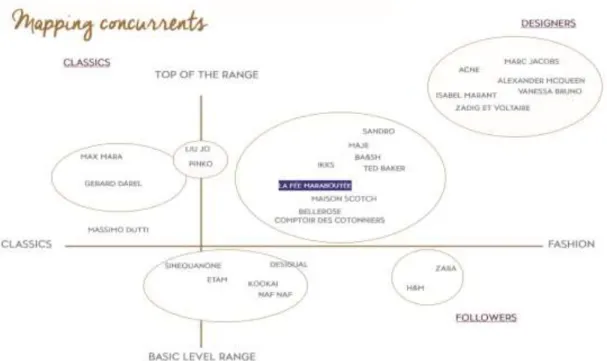
Figure 1: competition map
On this graph, we can see that La Fée Maraboutée is part of the middle/high women clothing market, where the competition is fierce. Its main competitors are Ba&sh, Maje, IKKS, Scotch
12
& Soda, as well as comptoir des cotonniers who are well established in France and internationally. To grow and keep market shares, it is crucial that La Fée Maraboutée has to maintain its spirit and roots to differentiate itself from the competition
1.4 La Fée Maraboutée’s implementation
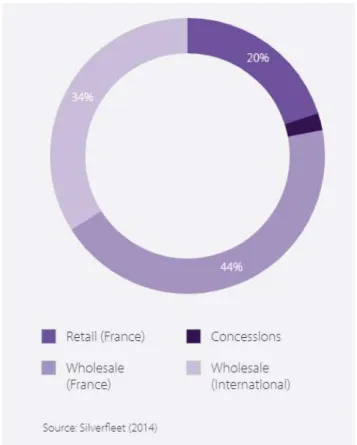
As explained before, La Fée Maraboutée follows a diversified distribution model, combining wholesale and retail businesses. On the graph, we can see that the biggest part is the wholesale business in France, representing 44% of La Fée Maraboutée’s business with a presence in 556 multi-brand stores but closely followed by the wholesale at an international level.
Figure 2: Repartition of Silverfleet business
Today, La Fée Maraboutée has 85 stores in France divided into affiliates and branches, 6 corners in department stores like Galeries Lafayette or Printemps and it is also present in 6 e-shops: La Fée maraboutée website, la Redoute and Place des tendances.
13
Internationally, you can see on the map below that the brand is well spread over the world, especially in Europe and Asia.
Figure 3 : La Fée Maraboutée ‘s global presence
1.5 The issue
When I arrived in June at La Fée Maraboutée in June 2017, they just opened retail stores in Dubai (2 locations) and in Doha. I then followed the project almost from the beginning until now. As we can see above in the DNA, La Fée Maraboutée differentiates itself from its competitors by its brand experience offered especially in the stores where the customers can feel like at home while enjoying their shopping. The decoration is made with a mix of old and contemporary items like old vases or modern and stylish skull heads. Although this model of brand experience has proved its worth in Europe, the cultural differences with the Middle East could be an obstacle to the implementation of the brand because the customers may comprehend the brand differently. Indeed, the internationalization process of la Fée Maraboutée has been very quick these last five years and we can only wonder then if all the parameters have been analyzed before implementing the brand overseas in order to perform as well as planned and hoped
14
2.
Brand experience and internationalization
2. 1 Brand experience
There are several definitions of brand experience which can be defined for example as Brakus et al. did in 2009 by defining it as a “subjective, internal consumer responses (sensations, feelings, and cognitions) and behavioural responses evoked by brand-related stimuli that are part of a brand’s design and identity, packaging, communications, and environments”. Through the subjective and the internal, the authors underline the personal and intrinsic character of brand experience. When studying brand experience, the concept of customer experience comes regularly. Customer experience itself is approximately the same as brand experience, the difference being the insistence of the personal interactions between a person and a company, its products or another organization (Gentile, Spiller and Noci, 2007; LaSalle and Britton, 2003).
When a comparison between the definitions is done, same ideas come up that lead to a summary of the concept: brand experience arises when there is a contact with a brand provoked by a stimulus that leads the consumer to intrinsically react to it involving emotional components. In addition, brand experience occurs not only during the purchase or during consumption of an item but also whenever there is a contact with the brand.
2.1.1 Brand experience dimensions
Once the concept of the brand experience is defined, it is important to add the dimensions or measurements that are linked to it. Measurements can help companies to know in which way or on which part they can affect customers. In 1986, Hirschman and Holbrook created a model called Thought-Emotion-Activity-Value (TEAV). Thought refers to the cognitive process, Emotion to feelings, expressions (facial or gestural), Activity to both physical and mental events and Value refers to evaluation. Pine and Gilmore’s dimensions are the four E’s standing for Entertainment, Educational, Esthethic, and Escapist. In 1999, Schmitt designed a model in which brand experiences can take five dimensions. The first one is the SENSE referring to the senses that is to say the sight, sound, taste, smell, and touch. The goal is to differentiate itself from competitors. The second dimension is FEEL, in reference to feelings and emotions in
15
order to a create positive link towards the brand. The third one is THINK, which is more intellectual and require more creativity. The fourth dimension is ACT referring to physical changes such as changes in consumers’ behaviours. Finally, the last dimension is RELATE, which is a mix of the four previous dimensions. It refers more to the desire of the ideal, how consumers can improve their life and how consumers want people to have a positive image of them (Cleff, Chun Lin and Walter, 2014). More recently, a brand experience scale has been developed which contains 4 dimensions that are sensory, affective, behavioural, and intellectual. They actually correspond to SENSE, FEEL, THINK, and ACT except that the fifth dimension of Schmitt’s model is missing. (Brakus et al., 2009; Cleff, Chun Lin and Walter, 2014).
2.1.2 Antecedents of Brand Experience
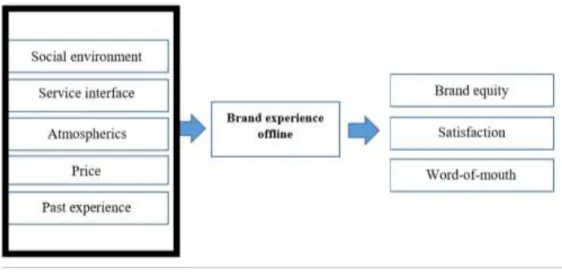
In this second sub-part we will focus on the antecedents of offline brand experience by detailing them one by one.
Figure 4 : Brand experience scheme
2.1.2.1. The social environment
The social environment can be defined by the people surrounding a consumer such as other customers,
friends, or salespeople. The influence of salespeople on customer/brand experience is immediately obvious because it directly affects a persons’ emotions and behaviours with a product, whereas other relationships or contacts among the customers themselves is less so. This interaction between the customers, called the interpersonal, is crucial to brand experience.
16
According to the need it refers to (need for control, inclusion or affection), it may have positive or negative effects. For example, someone with a need of control will perceive a crowded shop as negative whereas someone with a need of affection may see it positively because of the possibility that someone unknown in the fitting room will compliment her/him on how he/she looks.
2.1.2.2 Service Interface
Nowadays, physical settings are forced to adapt their brand to technology because their impact on the overall experience is crucial. Thanks to technology, customers can co-create and personalize their experience which in turn enhances the experience (Prahalad and Ramaswamy, 2004). However, the use of technology can also be disturbing for consumers and may lead to negative feelings and experiences. Indeed, when facing innovation and new technologies, consumers may see risks, insecurity, and discomfort but may also lead to optimism and excitement (Lam, Chiang and Parasuraman, 2008).
Thus, brands have to solve these apprehensions and improve on the positive feelings (i.e. optimism and innovativeness) in order to foster experiences (Elliott, Hall and Meng, 2013).
2.1.2.3 Atmospherics
Atmospherics refer to the sensory variables (auditory, olfactory, taste, tactile, visual) set by the brands in order to influence shopping behaviours through an affective and cognitive process. However, taste can’t directly be associated to atmospherics since an atmosphere can only be “seen, heard, smelt, and felt, but not tasted” (Kotler, 1974:.51).
The auditory component of the atmospherics refers to the music and sound. Music can affect the state of mind through emotions since it impacts a customer’s ‘pleasure and arousal’ (Dubé, Chebat & Morin, 1995) and reduces intense feelings such as fear or stress. The effectiveness of auditory atmospherics from an affective point of view is done through the stimulation. Furthermore, as music affects emotions, it also impacts customers’ perceptions. For example, when having background music, customers tend to spend a longer time browsing (Holbrook and Anand, 1990; Donovan, Rossiter, Marcoolyn and Nesdale, 1994; Yalch and Spangenberg, 2000) and thus consume more than initially planned.
17
The olfactory atmospheric is the fragrance embedded in a physical environment and may be the lesser known component. The specificity of this atmospheric is that customers do not always perceive the fragrance and its impact on behaviours and emotions. It has been showed that scent has a strong power to evoke past experiences and can link it to enjoyable experience and emotions (Halloway, 1999). These emotions and pleasure points can reduce the perceptions of time spent in stores: a consumer in a scented environment will have the impression of less time spent than a consumer in a non-scented area since it also reduces the feeling of waiting (Spangenberg, Crowley and Henderson, 1996).
Tactile atmospherics can be defined, according to Kotler (1974) as the quality of softness, smoothness, and temperature. It has been shown that consumers prefer shopping in stores where they can touch the products especially in the clothing industry since it aids in making decisions and evaluating the product further. (Peck and Childers, 2003; Grohmann, Spangenberg and Sprott, 2007). As tactile atmospherics affect consumer’s emotions and behaviours, thus it also affects their brand experience.
When entering in a store, lighting and colours are factors that can directly be noticed. Indeed, colours and lighting affect the level of stimulation (Spence, Puccinelli, Grewal and Roggeveen, 2014) and retailers manipulate it in order to subdue or increase the experience. In general, visual signals have positive effects on customer behaviours. The consequences of bright environments and some colours is that customers stay longer in stores and then tend to purchase more (Summers & Hebert, 2001). Furthermore, visuals are part of the brand and can facilitate their identification. Thus, shifting them can be disturbing and disconcerting because it changes the usual associations that customers have in mind which can then decrease brand experiences (Spence et al., 2014).
2.1.2.4 Price
Price is an antecedent of brand experience because of the programs led by retailers in order to retain customers and make them live a unique experience. The major part of this component is achieved by loyalty programs (LP) which rewards and thus encourages customers to engage in loyalty (Sharp and Sharp, 1997). At the same time, these programs involve different benefits such as utilitarian, hedonic and symbolic benefits.
Utilitarian benefits are more associated with financial or economic advantages because of the savings ensured which is the main motivation that makes consumers join loyalty programs
18
(Peterson, 1995). These utilitarian benefits lead to positive feelings and can have an effect on brand experience.
Hedonic characteristics deal with emotion, experience and may be important for loyalty programs because of the exploration and entertainment dimensions. Arnold and Reynolds (2003) showed that consumers animated by hedonic dimensions will achieve more positive experiences.
The symbolic dimension of loyalty programs refers to recognition and social characteristics. Being members of LP enables customers to distinguish themselves from non-members which in turn can make them feel privileged while also allows them to perceive that they belong to a group or community that is associated with a brand (Muniz and O’Guinn, 2001).
2.1.2.5 Past experience
The experience lived yesterday will determine the experience of tomorrow and that is why managers cannot neglect past experiences and should try to deliver a homogeneity through the whole process that constitutes brand experience. Then, the crucial component for future brand experience is the expectations previously satisfied during the last experience (Verhoef et al., 2009). Bolton (1998) showed that accumulated satisfaction increases the length of the relationship and that several months’ experiences strongly enhance satisfaction. However, satisfaction between past and future experiences can be deterred by critical incidents (CI) and may affect customer satisfaction and relationships with the brand (van Doorn and Verhoef, 2008).
2.1.3 Outcomes of brand experience
2.1.3.1 Brand equity
Brand equity has been defined by several authors. Aaker (1991) and Keller (1993) defined brand equity as the customer’s personal assessment of a brand composed of different components. Keller (1993) includes only brand knowledge that is to say brand awareness and brand image. While according to Aaker (1996) brand equity is composed of brand awareness, brand loyalty, brand associations and perceived quality.
19
Brand awareness refers to the customers ‘ability to recognize and distinguish a brand among others (Biedenbach and Marell, 2010; Keller, 1993). This remembrance includes a trace in memory that leads to the brand identification. Brand awareness is positively linked to the formation of brand associations because it is the process that makes a customer recall a brand. Brand experience has a positive effect on brand awareness but it does not appear to be stronger than traditional branding options such as social media or other communication means (Cleff, Lin and Walter, 2014; Biedenbach and Marell, 2010).
Brand association is the whole information a consumer stores in their memory about a brand (Elangeswaran and Ragel, 2014). As consumers hold information in their memory, they will build their own perceptions about a brand thus that is called brand image (Keller, 1993). When speaking about the influence of brand experience on brand associations, Cleff, Lin, and Walter (2014) have found that brand experience has a positive impact on brand image, closely linking it to brand associations. This correlation between brand experience and brand image shows that a successful experience with the brand will improve the perceptions a customer has of a brand and affects customers’ decision making because it will have an impact on the brand choice and preferences (Elangeswaran and Ragel, 2014).
Brand loyalty in its general definition is the consumers’ repeated purchase of a same brand (Amine, 1998). For Amine (1998) and Jacoby and Kyner (1973), commitment is a crucial notion to take into account when speaking about brand loyalty because it is the central component of repeated buying. A positive brand experience will encourage customers to repeat their act of purchase and prevent them from switching to competitors. Furthermore, when being satisfied of their brand experience, customers who become loyal will have a higher willingness to pay a price premium, as they have a positive perception of the brand’s performance. (Aaker, 1996; Chaudhuri and Holbrook, 2001; Thomson, McInnis and Park, 2005).
Perceived quality is the last component of brand equity and can be defined as the consumers’ performance perceptions of a product or service. Brand experience influences perceived quality because customers will evaluate the brand according to this experience and it will be then, a criterion for brand choice (Bendixen, Bukasa and Abratt, 2004).
2.1.3.2 Satisfaction
When there is a positive experience, the emotional responses are pleasure, joy and interest. On the contrary, when there is a negative experience, the responses are hostility, anger, disgust, fear, sadness, guilt, contempt, and shame. Thus, the emotional responses that lead to customer
20
satisfaction will have a major effect in enhancing the likelihood of repurchase intention (Bagozzi, Gopinath and Nyer, 1999). Another outcome of positive correlation between brand experience and customer satisfaction is that, from a vendor’s view, satisfaction will enhance trust and reputation. A reputation’s improvement is mediated by the effect of satisfaction on credibility (Ganesan, 1994).
2.1.3.3 Word-of-mouth, recommendations
If brand experience has been positive, it will create pleasure, positive feelings and satisfaction. It can even surprise customers enough that they will want to share and persuade other customers to relive that same experience (Dumitrescu et al., 2012). Indeed, consumers spread the word because of three main reasons: social, functional, and emotional. The mediator between brand experience and word-of-mouth is customer satisfaction because the feelings and emotions brought on by memorable experiences inspires customers to share their experience through word-of-mouth. A recommendation by word-of-mouth can encourage new consumers to engage with the mentioned brand, while in turn increasing the repurchase rates of the customers who generated the recommendation. (Nadiri and Gunay, 2013; White, 2010).
2.2 Fashion brand experience
In the previous part, we have defined brand experience. When applied to the retail fashion industry, it
highlights the fact that it is a synchronization between brand equity and “consumers’ cognitive, affective and behavioral experience perspectives” (Kim, H. 2012: 420). The affective dimension is crucial within the fashion brand experience because it is created by the consumers’ perceptions of the brand image, their feelings towards the brand and the relationship between the consumer and the brand. The cognitive experience is created by the brand performance or perceived quality for example and is a necessary condition to affective experience.
As mentioned in the issue definition, cultural aspects are very important when speaking about fashion brand experience because they comprehend a brand differently according to their values, norms, beliefs and mental systems that differ from one culture to another which could affect their brand experience.
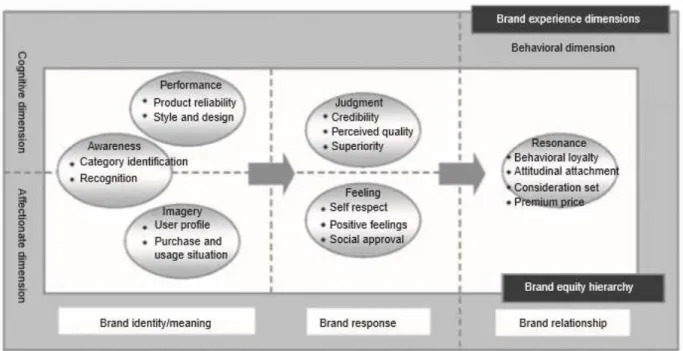
If in the brand experience we have seen that brand equity is composed of 4 components, within the fashion brand experience framework, the notion of Customer-Based Brand Equity (CBBE)
21
(Kim, H. 2012) is the reference involving 6 components that have been for some already been defined above:
• Brand Awareness
• Brand Performance: Refers to the inherent part of the brand that mainly focuses on the product characteristics. It is then important to know how the customer perceives the brand and the product.
• Brand Image
• Customer Judgement: It is the reliability the customer puts in the brand to perform. Keller (2001) identified 4 types of judgements: quality, credibility, consideration and superiority.
• Customer Feeling: It refers to the positive emotional responses to a brand experience.
• Resonance: This last component refers to the relationship created between the brand and the customer. It is the synchronization of all the previous components.
In order to better visualize the CBBE model, here is a graph conceptualizing the fashion brand experience framework:
Figure 5: brand experience dimensions
22
2.3 SME’s, internationalization and the Middle East
2.3.1 SME’s retail brand management
SME brand management is composed of different dimensions (Mitchell, R. et al. 2015; Mitchell et al., 2013)
- Brand strategy
- Brand identity formation and coordination - Mechanisms for evaluating brand equity - Brand marketing support
- Brand management structure
2.3.1.1 SME’s brand strategy
Retail SMEs have different challenges such as limited resources and a firm centric approach. Indeed, a SME’s owner managers (OMs) are more focused on the operational rather than the strategic or branding parts to which can be harmful for the brand and company, since for most of SMEs (except for manufacturing SMEs), the brand name is the company name (Omar and Fraser, 2011). The OM plays then a crucial role in the branding development of a firm. (Mitchell et al., 2015)
2.3.1.2 Brand Identity
As we have seen before, brand identity is a unique bundle of brand associations that defines the existence of the brand and what differentiates it from others. When speaking about retailing, this bundle is strongly impacted by the store environment and how the company communicates internally (Fernie, Moore, Lawrie and Hallsworth, 1997). Within the SME context, once again the OM has a central role because they often shape a brand’s associations and with that the SME’s brand identity (Craig, Dibrell and Davis, 2008). While at the same time the complexity of retail brand identity makes the challenge of OM retailers even harder to form a coherent brand identity (Kent, 2003).
23 2.3.1.3 Evaluating brand management performance
Brand performance management is usually measured thanks to brand equity evaluation. Many tools have been developed for appraising brand equity but when it is in the context of SMEs, it may become problematic. Indeed, the measurement of brand equity in retailing mainly focuses on how well the costs of developing private labels are recovered by the brands. However, in most of SME cases, OMs do not use these methods but rather adopt intuitive and non-formal methods (Spence and Essoussi, 2010; Wong and Merrilees, 2005). Thus, the SMEs’ brand equity appraisal is mainly set by the OM’s vision and ideas which can be seen as hazardous. It may also cause a problem of control and monitoring in order to improve it
2.3.1.4 Brand marketing
Usually, a SMEs’ brand marketing is not well developed because of limited resources, time, expertise and an OM’s lack of interest for marketing issues (Carson and McCartan-Quinn, 1995; Mowle and Merrilees, 2005). Thus, SMEs have to find other ways to develop their brands and mark the customers. Usually, the retail store environment is a key component of SME brand marketing because it creates an experience and then impacts the brand associations. They also impact the turnovers as we have seen above in the outcomes of brand experience. Word-of-Mouth is also an important element of SME communication that it is not easy to master.
2.3.1.5 Brand management structures
It has been found that the structure of brand management has an effect on how successful a brand is (Low & Fullerton, 1994). In SMEs, the organisation levels are reduced and usually the Owner Manager is also the brand manager. This allows a coherent, coordinated and facilitated control of the brand decisions. Yet, this practice may be in contradiction with the operating reality.
It has been shown that internal and external stakeholders are needed in order to have an effective management. Internally, the staff may play an important role by participating in the creation of brand associations while externally, manufacturer and suppliers’ networks can also help the SMEs in value co-creation (Pettinger, 2004; Varley and Rafiq, 2004).
We have seen in this part how a SME usually deals with its retail brand management and what they should do according to their constraints and advantages.
24
2.3.2 Retailing SMEs internationalization process
2.3.2.1 Drivers of SMEs’ internationalization
Drivers for retail internationalization have been separated into many different categories but we will take the most recent categorization that deals with the reactive/proactive approach (Evans et al., 2008).
The reactive approach, which uses the Uppsala internationalization model, mainly focuses on the fact that when the domestic market is saturated, companies have to go internationally (Johanson and Vahlne, 1977). In most SME cases, they investigate the domestic and international markets at the same time because even if their development is crucial, their attachment to their roots is equally important.
On the other hand, the proactive factors favour the internal & external factors that makes the foreign market interesting. Indeed, if a country offers special fiscals or economic advantages for business development, it may encourage a company to enter this market and especially in the cases of SMEs that are constrained to their limited resources. Internal factors can be the specific skills and competencies of the managers or employees to work abroad and bring an added value to the company internationalization (Vida et al., 2000).
More recently, Hutchinson et al (2006,2007) found that other factors may be taken into account by SME retailers when internationalizing. In fact, the brand itself can be a driver of internationalization because its desirability may push the management to explore opportunities in foreign markets. Furthermore, he also highlighted that the decision and process of internationalization depends on the founder and the management’s vision and personality.
2.3.2.2 Obstacles to SMEs’ internationalization
There are two main categories of obstacles to internationalization. The first one concerns the impediments that may arise before or during the initial internationalization phase. It first involves an internal element that refers to the management (Gardo, Garcia and Descals, 2015). Certainly, SMEs’ managers may be an obstacle themselves because of their lack of information about the markets and the associated procedures which can work against them. The managers’ attitude, their risk aversion and lack of ability to manage international teams can also be failure factors (Hutchinson et al., 2006; BICE, 2007).
25
The second category focuses more on the process of internationalization and especially the environmental factors that are external to companies. Indeed, many external elements such as the legislation, economic/political instability or high, fluctuating exchange rates can be crucial factors that can jeopardize an internationalization process (Alexander, 1997; Myers and Alexander, 2007) Furthermore, cultural and social elements can also be obstacles. Cultural or language differences, if not accepted or adopted, can lead to misunderstanding, non-comprehending situations and over time, failure (McGoldrick, 1995).
2.3.2.3 International business strategies
Once having studied the motives and obstacles of SMEs internationalization, it is crucial to focus on the business strategies these previous elements influence.
According to the company’s vision, resources, capabilities and strategy, it will opt for the adaptation or standardization strategy.
Standardization or global strategy can be defined as the harmonization of a firm’s marketing activities so that the elements of the marketing mix (Pricing, Product, Promotion, Place) is the same across all markets where the firm is active (Krupka, Z., Ozretic-Dosen, D. and Previsic, J., 2017; Johansson, 2006). In basic terms, it is the duplication of a concept in different countries. However, on the contrary, the adaptation strategy is focused on the adjustment of the marketing mix elements according to the customers’ specific requirements and needs of individual foreign countries.
Along the years, there has been a debate in the literature onto which strategy is the best when internationalizing. Further to these discussions, some models have been developed to find the most effective choice such as the Structure-Conduct-Performance Paradigm (SCP) also called the Bain-Mason paradigm. It represents the interconnection between the environment (Structure) of the firm, the strategy (Conduct) chosen by the management and the performance resulting from this mix (Bain, 1968). This paradigm argues that the market environment (structure) is directly impacted by the firm’s strategy that then has an effect on the performance. Furthermore, it also claims that it involves feedback effects that is to say that performance also influences a firm’s strategy and environment.
These implications are crucial for the further development of this paper because it will define one of the central elements that will find our hypothesis and results.
26
2.3.3 Fashion retail market in the Middle East
When speaking about the Middle East market, we will define it as the United Arab Emirates (UAE), Qatar, Lebanon and Saudi Arabia as these are the countries where La Fée Maraboutée is active.
In 2016, Muslim consumers spent $230 billion (State of the Global Islamic Economy report, 2015-2016) on clothing and this number should reach $327 billion by 2019. These figures show the potential growth of the Middle East fashion market. To show the importance of this part of the world, the Arab Fashion Week has become one of the biggest fashion weeks worldwide (Forbes Middle East, July 2017). However, before entering this market, it is essential to understand it.
Women in the Middle East are very well represented at work and have a strong purchase power and personality that enable them to create their own style. According to the countries or regions, women’s styles may differ. In multicultural cities such as Dubaï or Doha where people are exposed to western influences, women like mixing global and local brands. It may explain why many designers have flourished these last years in the Middle East (The Online Industry, October 2015). Brands coming from Europe or the US have then to adapt their products and marketing activities to deal with this melting pot of cultures, nationalities, religions, identities and the current Islamic fashion trends.
In this second part of the work, we will now focus on the conceptual framework where we can draw the literature review and hypotheses settings so that we can proceed to the methodology and be able to analyse the results.
In these last parts, the researcher described the context of the study and then defined the different concepts that are at the core of the thesis in order to base its study on it. Once the basis is defined, it is crucial to remind the aim of this thesis and then show the process that will allow the researcher to answer to the problem.
Since this thesis tries to identify which antecedents of brand experience applies to La Fée Maraboutée and if these experiences work the same in France as well as when internationalizing, specifically in the Middle East, it is therefore crucial to set hypotheses and to visualize the framework studied.
27
The first part of the hypotheses concerns the relevance of antecedents when applying to La Fée Maraboutée. The researcher collected all the antecedents found previously in the literature review and have assessed their influences on the brand experience at La Fée Maraboutée. Thus, atmospherics, service interface, past experience, social environment and price are tested. The second part of the hypotheses and research refers to the capacity of these antecedents to be duplicate or not when internationalizing. If found that they cannot be duplicated, the business strategy will logically be adaptation. However, if they can be duplicated, the business strategy is therefore standardisation.
Hypotheses:
H1: What do influence customers’ brand experience in the Middle East when shopping at la Fée Maraboutée?
H1a: Atmospherics influence customers’ brand experience H1b: Social environment affects customers’ brand experience H1c: Service Interface affects customers’ brand experience H1d: Price influences customers’ brand experience
H1e: Past experience influences customers’ brand experience
H2: What are the impacts of brand experience on internationalization business strategies at la Fée Maraboutée?
H2a: Brand experiences antecedents favour adaptation strategy H2b: Brand experiences antecedents favour standardization strategy
28
Figure 6: Hypotheses scheme
3.
Methodology
3.1 Introduction of Research Design
Researchers select qualitative studies to explore and reach an in-depth understanding of an unknown topic in order to develop a theory (Cooper & Schindler, 2014). The main goal of this study is to determine the antecedents of brand experience at La Fée Maraboutée and if, during the internationalisation process, they can be applied to other countries and especially in the Middle East. There is a need to describe the phenomenon and to determine the importance of each antecedent found in the literature when applied to La Fée Maraboutée’s brand experience, as well as their potential of duplication (or not) when internationalizing. As the literature is insufficient and underdeveloped, a quantitative research will not benefit the analysis, as it is meant to correct the current theory. The advantages of qualitative research rely on the unexpected, as these studies usually contain information that were unforeseen and that add value to the current research.
As a non-numerical study, it is crucial to adopt an interpretive research philosophy to acquire knowledge through a broad overview of the phenomenon in order to detect evidence beyond the current literature. In this case, the researcher is part of what is observed and collaborates with the sample. The research is thus rather explorative and descriptive in order to understand
29
the concept as well as to identify future research directions. Hence, the exploratory study will develop a theory, which quantitative studies can test in the future. This thesis is based on in-depth interviews guided by questions that will create a conversation between the subjects and the interviewer. The variables in the study are experimental as the researcher controls them to guide the interviewee to a desired path in order to acquire the desired information. Experimental variables support the analyst in the discovery of interrelation between the variables. For this thesis, the researcher decided to apply the case study method, where the subject is asked to explain a situation they engaged with a brand. The lack of budget and time did not allow the author to conduct the interviews thoroughly. Thus, the study was organized only once for each subject, i.e. cross-sectional study. The researcher decided to use qualitative content analysis to proceed and analyze the data collected. The qualitative content analysis is a systematic approach which consists of creating codes and categories in order to explore and determine linkages, relationships and structures of a phenomenon (Mayring, 2000).
Hsieh and Shannon (2005: 1277-1288) distinguishes three different approaches of qualitative content analysis: conventional, directed and summative. What differentiates these three approaches are the coding methods, their origins and values regarding their limitations and reliability. The conventional approach aims at creating coding categories directly from the raw data. The directed content analysis’ codes is built on already existing studies and findings that will guide the analysis. Finally, summative approach uses “comparisons and counting” in order to interpret the data. As the researcher decided to base their analysis on previous studies as a guide to elaborate the coding, it seems obvious that directed qualitative content analysis is the most adapted methodology to analyze the data. Based on this methodology, it will help the researcher to base its framework on solid bases to give the meaningful insights to La Fée Maraboutée’s managers and as well as future research directions (Zang and Wildemuth, 2005)
3.2 Sampling Method and Presentation of Interviewees
Since the thesis try to identify the motives behind decision-making of consumers and managers to define their business strategies, it seems coherent that the unit of analysis is customers and managers hence, relates to the decisions level. Following the previous section, qualitative researches imply probability sampling. This means that the sampling method was non-random, which used subjective procedure in terms of the selection. Furthermore, the researcher followed a restricted approach as additional controls were introduced: working or having
30
experience in the fashion retail industry within the Middle East. The analyst checked these variables prior the selection and restated the conditions at the beginning of the interview. Hence, the sampling design was purposive as the elements of the sample were selected based on judgement. The author firstly asked her colleagues and the contact person in the partner company in Dubaï but as the sample was not sufficient, she decided to extend the research to acquaintances. The analyst asked the partner to help her finding other potential interviewees within its company in Dubaï. However, only 10 participants were retained as they were complying to the control variables. In semi-structured interview, it is crucial to build trust so that the interviewees feel comfortable to share their experience without the feeling of being judged. Since the subjects were either ex-colleagues or familiar with the brand, the concern regarding the trust issue was not relevant. Furthermore, prior each session, the analyst asked for the consent of the participants to check if they were ready to share their experience for the study. Only 3 subjects didn´t accept to be named or published but agreed on the fact that their answers can be analyzed. The sample includes 10 participants: four male interviewees and six female interviewees (see Appendix 1), which shows a relatively fair repartition of gender. This inequality can be explained by the industry this master thesis is related with, i.e Fashion. The average age of the respondents is 38.3 years old with an outlier (48 years old). Four participants come from France, one come from Switzerland, two from UK and the three remaining participants come from UAE. This multiplicity of nationalities is due to the cultural diversity and expatriation phenomenon in UAE i.e. the experience is not only biased on any cultural values or behaviours. However, if 60 percent of the sample is currently living in the Middle East, the remaining participants have all have experiences with the Middle East. Lastly, 100 percent of the samples are executives and decision-makers. These characteristics will support the analysis and provide limitations regarding the overall results of this thesis. The next session will describe the method of data collection in more details.
3.3 Method of data collection
Most of the interviews were conducted via video because of the distance constraints, except for four, which were organized at La Fée Maraboutée´s office in Paris. The video surveys were either via Skype, or FaceTime because of UAE´s ban of Skype. The general environment of the interviews was crucial so that the interviewer and the interviewee could see each other in order to build more trust. Moreover, the author could adapt its attitude towards the subject by
31
analysing the body language and facial expressions. This position was important as the researcher could better revise their questions when it was evident that the respondent did not understand. Prior to each session, it was clearly stated to the participants that there were no right or wrong answers and that the researcher was there to facilitate the discussion. Furthermore, the analyst informed the interviewees that the conversations will be recorded when the meeting was set as well as during the small talk before each interview. The appointments were scheduled over two weeks due to the venues of the Middle East partner in Paris. Nevertheless, the transcriptions were completed maximum 3 days after each session in the means of not losing any additional information, which would be indispensable for the interpretation and analysis.
The directed content analysis is a guided method to conduct semi-structured interviews, which includes open questions as well as specific ones corresponding to the predetermined categories (Hsieh and Shannon, 2005). This method creates the right environment to explore the respondent’s viewpoint regarding his or her experience relevant to the research question as well as guiding the respondent to focus on the categories mentioned. The structured design of the questions list is meant to let subjects follow their own thoughts, while still reframing the discussion, when it becomes not relevant for the topic. The researcher developed an interviewer guide (see Appendix 3) to cover the main topics. Furthermore, even though the interviewer focused on one brand during the session, it was usual to ask the participants on other brands to make comparisons or generalize some facts. Each appointment was organized in the same way. Firstly, the interviewer thanked the interviewee and established the setting of the interview. Even though the participants and the researcher were often acquainted, the interviewer decided to introduce themselves to specify the reasons behind their thesis. Then, they explained the case to the participants before letting them introduce themselves as they wished. When the case was unclear, the researcher summarized the whole situation by interpreting questions and allowing the interviewee to explain the elements which were misunderstood. The analyst asked mainly probing questions to understand the concept and the viewpoint of the respondent deeper but also employed follow-up questions to clarify a vague concept.
32
3.4 Analysis of the interviews
3.4.1 Definition of codes
Directed content analysis as well as the other qualitative content analytic approaches follow the same methodologic steps such as defining research questions, choosing the sample, collecting data from the sample, defining categories and the coding process, applying the coding to the data collected, testing the validity and reliability and finally analyzing the results thanks to the coding process. What differentiates the direct content analysis from the previous is the coding process since the codes are usually already predefined before starting coding the data. It is not an ongoing coding as it is the case for the grounded theory for example.
As stated above, the researcher defined the codes before starting the coding process based on the literature. Thus, as previous studies found that there are five antecedents of the brand experience and two main international business strategies, the researcher decided to use these elements to code the data collected through the interviews. These antecedents and business strategies constitute the main labels/concepts/categories. Sub-categories have also been defined prior to interviews but changes and additions have been made through the coding process for sub-categories as well as main ones. The main categories are:
• Price • Social environment • Atmospherics • Technologies • Past experience • Adaptation • Standardization
All the antecedents have been defined in the first part of this paper so it has been judged not necessary to explain them again.
Once these main categories are defined, the researcher attributed a code in order to facilitate the coding process when analyzing data. These codes must be easy to remember and also follow a logic regarding the main category’s full label. The codes for the main categories are:
33 • Social environment => SENV • Atmospherics => ATMOS • Technologies => TECH • Past experience => PE • Adaptation => ADA
• Standardization => STAND
Thanks to the definitions of the antecedents found in the literature, some sub-categories have been logically deduced. Then, for social environment, the sub-categories staff and relations have been a priori chosen. Staff relates to the salesperson in the shops that serve, advice and help customers whereas relations refer to the family, friends or other customers around that may advise the customer. The sub-code for staff is STA and REL for relations. For price antecedent, price positioning has been logically deduced from the literature and coded as PP. By price positioning, it means competitive price positioning in comparison with the other brands which can then affect the brand experience. By simple explanation, if the customer feels that it is a fair price, it will improve the brand experience. Regarding the atmospherics, it has been deduced that the decoration and all elements that refer to visual incentives are also sub-categories since it has been studied previously by researchers that it affects brand experience. The code linked to this sub-category is IA standing for interior arrangements. Finally, for the service interface/technologies antecedent, a sub-category deduced was the digital tools in the shops such as tablets, e-shops … and thus coded with DBE for digital brand exposure in stores. For the business strategies, we can deduce from the literature that uniformization is a sub-category since they are the basic strategies used by firms when internationalizing. Then, the code is UNI. For all the other categories, we cannot deduce from the literature any sub-categories where they have been created during the analysis of the texts. Therefore, after the reading of all the data, new subcategories and categories appeared.
Indeed, after the first step of reading and underlining all the recurrent categories aside from the ones already predefined, an extra main category emerged. The category “product” seemed to be obvious to add since it appeared in every interview. The code used to define this category is PROD. The experts interviewed were quite unanimous to say that product highly influences brand experience since customers become satisfied or loyal when they like the products or services offered. However, different aspects appeared when classifying these reasons. Thus, subcategories have been used to differentiate them. The first product subcategory that appeared
34
most frequently is the “collection.” It can be well identified and holds its own style. As the sales director noted, the designer of a collection remains the same and a customer can have the feeling of that same DNA which can then influence them to buy or repurchase. Thus, COL has been chosen to code this subcategory. Another strong element of La Fée Maraboutée’s DNA is the special print on their dresses. The Middle Eastern customers tend to admire the prints since it is noticeable by everyone. As Melissa Edwards said in her interview, because these women are quite conservative in terms of lengths and style “they are looking for things that are printed” which can then allow them to stand out. Print therefore will be coded PRIN. Another important element that goes with the prints is color. Indeed, colors are also important for customers of Middle Eastern because it is first a country where it is warm and people usually do not wear dark colors such as black daily. They rather prefer colorful clothes and La Fée Maraboutée answers this need according to most of our interviewees. Thus, the researcher coded it with COLO to differentiate it from the code used for collection. The third subcategory that came regularly is the style and that has been coded with STY. Indeed, la Fée Maraboutée has its own touch regarding the design of their collections. This can be explained by the fact that although he is no longer the director of the collection, Jean Pierre Braillard is still supervising the whole collection design and is in charge of the contacts with suppliers. The last subcategory of the Product group concerns the quality coded with QUAL. In fashion, quality is a parameter that can be particularly assessed thanks to the material used. As many interviewees said, this is particularly true in the Middle East because of the climate. In warm regions, some material such as Polyester are not well appreciated for example because people tend to sweat more in Polyester clothes.
Another main category mentioned that must be added is the adaptation one, coded ADA. Indeed, different adaptations has been mentioned but 4 subcategories have emerged. The first one and the most recurrent one refers to product changes, coded PC, that differs from Europe to Middle East. The second one concerns the merchandising change that have been done in comparison to the standards we have in France to adapt to the Middle Eastern countries and culture. The code used for merchandising change is MC. Another adaptation that appears is the staff because the procedures and staffing knowledge are different in the Middle East due to the multiplicity of cultures and nationalities in this region that lead to different levels of standards. Staff changes has been coded with SC.
In the previous coding explanation, we have defined the codes of categories and subcategories that have been already found in the literature and also introduced an extra main category and
35
its subcategories. We have to now define the subcategories that appeared along the reading of the interviews that were not directly linked to previous studies.
Within the main category Price, price positioning has been detected as subcategory. Another one is also part of this main category and concerns the price-quality ratio and has been coded thanks to PQR. As mentioned above, quality is very important for customers and even more when it goes upmarket because people are ready to pay more for it. Thus, the price-quality ratio is a good parameter for customers to judge both price and quality which can then influence them to buy. Regarding the main categories, decoration has appeared to be a logical subcategory thanks to the existing literature that relates to the visual sense in brand experience. Through the reading of the texts, two more subcategories emerged. The first one is the space dimension, coded as SPA. Many interviewees, especially the merchandising managers interviewed, mentioned that the stores in the Middle East are much bigger than in France because of the different way of buying. For example, in the Middle East, women shop in groups and spend far more time in one store than the European customers. Thus, in order to have enough seats for all customers and enough space to move in the store, space becomes a crucial element in the Middle Eastern market. This element is linked to the third subcategory that deals with atmosphere. The researcher coded this element ATM to not confuse it with atmospherics. Atmosphere is related to the feelings or impressions that emanate when entering a store of La Fée Maraboutée. All the interviewees said that it is a cosy place where you feel at home and where you would want to spend time which of course influences the brand experience. When moving to service interface or the technology category, one subcategory that emerged in all interviews is the importance of social media especially in the Middle East. The code assigned to this subcategory is SM. According to all managers interviewed working in the Middle East, Instagram, twitter, Facebook… are the strongest way to communicate between a brand and customers in this region. Thus, interacting on social media highly influences the brand experience in the Middle East.
In this latter part, the codes have been defined so that the researcher can better distinguish and start deeper analyzing the links between all elements.
3.4.2 Testing the codes
Once the codes have been described and explained, the researcher decided to proceed to a test to assess code consistency before starting coding all the transcriptions. For doing so, the researcher decided to use an independent analyst to test the “interrater reliability” of the codes
36
(Conger, J.A (1998). Qualitative research is the cornerstone methodology for understanding leadership (Leadership Quarterly, 9: 107–121). The independent researcher received the codes and the sample of data without any definitions so that no biases can intervene during the testing. The task was to try to code the data given with the ones offered. If the external rater didn't agree on some codes, they had the possibility to rename them or introduce new codes.
After processing this test, it appeared that all the codes were understandable except one, which is the digital brand exposure. The independent rater said that he doesn't see the difference between this subcategory and social media. Following the test and remarks of the independent analyst, the subcategory digital brand exposure has been renamed digital sales interface in reference to e-shop or digital tools that can be used in shops for staff and customers.
3.4.3 Coding process and analysis
3.4.3.1 Categorization matrix
As the deductive analysis was chosen, the next step is to build a simplified categorization matrix. It can have different formats but has to list all the categories and subcategories.
Prix- PRI
Price positioning - PP 2
Price-Quality Ratio - PQR 2
Social environment - SENV
Staff - STA 6 Relations - REL 4 Product - PROD Collection - COL 8 Print -PRIN 6 Color - COLO 6 Style - STY 3
37
Quality - QUAL 3
Service interface/Technologies - TECH
Digital sales interface - DSI 3
Social media - SM 9 Atmospherics - ATMOS Interior arrangements - IA 4 Atmosphere - ATM 6 Space - SPA 3 Adaptation - ADA Product change - PC 13 Merchandising change - MC 7 Staff change - SC 5 Standardization - STAND Uniformization 2
Once this categorization matrix done, it is crucial to validate it. Schreier (2012) defines a categorization matrix as valid if the categories fit with the concepts described in the literature and when the matrix matches what was intended at the beginning. It seems that all the subcategories fits the main one. Only the product category was added but it does not constraint the validity of the categorization matrix since it is an intended parameter and all its subcategories suits the main one.
Once the validity of the matrix categorization is set, the researcher went through the interviews where they underlined the category and subcategory related. After that, the analyst counted how many times the same subcategory appeared. This count will help then to highlight the relevant data.
38 3.4.3.2 Analysis of content
Once the categorization matrix is finalized, validated, and the counting done, we can start to deeply describe the coded part in depth. This phase can also be done as a structured matrix because we choose some aspects in the data (Sandelowski, 1993) but the researcher preferred to proceed to the analysis thanks to the in-depth description rather than in the matrix. The researcher decided to follow the category order of the categorization matrix to analyze the link between the brand experience antecedents and the international business strategies i.e adaptation or standardization strategies chosen in the Middle East by La Fée Maraboutée. The price is a brand experience antecedent already found in the literature. As the categorization matrix shows, two subcategories have been deduced thanks to the data collected and coded. The first one is price positioning. Through the interviews, the local managers as well as La Fée Maraboutée’s managers insisted that the prices set by La Fée Maraboutée are in line with the Middle Eastern market and brand positioning. This price consistency influences the customer’s brand experience because they judge it as fair. This feeling of fairness is also due to the consistency of prices of the brand all over the world and not only in the Middle East. As local managers as well as La Fée Maraboutée’s managers said, the population of the Middle East is very diversified, composed of locals, expatriates and tourists. The strategic geographic and logistic position of Dubaï for example make people travel a lot and then a price comparison of the brand in different locations is easily made. Thus, it is crucial that the brand assures the same price range all over the world. The fact that the prices are similar in all La Fée Maraboutée’s stores shows that the price positioning tends to be standardized. Before concluding that the prices are uniformed at La Fée Maraboutée, the researcher must first analyze the price quality ratio antecedent link. The price quality ratio was mentioned especially by Melissa Edwards, brand manager of La Fée Maraboutée in the Middle East. She is the manager with the best expertise because of her experience in the Middle East and with La Fée Maraboutée. She insisted on the fact that due to the climate in the region, customers pay attention to the material used (polyester, cotton…) and the price related to the product. However, the criteria judged is not just the quality but rather more the price they would be ready to pay for a certain type of clothing while taking into account the material parameter. As the prices and the collection are the same in all La Fée Maraboutée’s stores, the standardization conclusion can be drawn. Therefore, the researcher came to the conclusion that the price is a brand experience antecedent that is standardized at La Fée Maraboutée.