261
XXX
Is San Francisco’s “The Shaking Man” an urban
depiction of parkinsonism?
Seria o “Shaking Man” de São Francisco, Califórnia, uma representação urbana de
parkinsonismo?
Francisco Manoel Branco Germiniani1,Pedro Vinícius Staziaki2, Vanessa Fiorini Furtado2, Helio AG Teive1
Medical conditions have often been portrayed in diferent genres of art. Although sometimes this depiction is purpose-ful, on a number of occasions the disease is simply another element in the artistic composition, which is set to be seren-dipitously appreciated by the careful beholder.
Several pieces of art depict either idiopathic Parkinson’s disease or parkinsonism (PK); the irst of such artistic repre-sentations is the notorious set of drawings by the artist Paul Richer. Professor Jean-Martin Charcot commissioned the artist in 1880 to illustrate every clinical feature of the syn-drome and, therefore, this is deemed the irst ‘oicial’ artistic representation of Parkinson’s disease1. Charcot, an artist
him-self, made an ample use of artistic representations as a way to teach and register neurological diseases2.
Although it is impossible to know for certain, “Madwoman Obsessed with Gambling” by French art-ist héodore Géricault might be another purposeful representation of PK. It depicts an old woman with a hypomimic face and stooped shoulders. Géricault probably painted it between 1822 and 1823 at the request of doctor
Ettiene Georget, who is another physician at the Hôpital de la Salpêtrière and wanted to have ten psychiatric patients represented on canvas. Nowadays, the work is on exhibition at the Louvre Museum in Paris, France3.
However, at other times, artistic representations of med-ical conditions might have been unintentional. In 1814, the German artist Isidorus Weiss made an engraving in Vilnius, Lithuania, called “he Selling of the Smoked Hams”. It por-trays three people inside a small shop, one of whom is a man in his sixties, possibly showing parkinsonian features. His right arm is clutching the neckband of his garment while the left and less lexed arm seems to be reaching for money on the table, his smile is constrained, the face is expressionless, and his posture is stif and bent1.
But, perhaps, even older examples of art could show char-acteristics of PK. For instance, the Cathedral el Burgo de Osma (Soria, Spain) contains a statue from the 16th century
of a priest, probably San Gregorio, with stooped posture, half-opened mouth, ixed gaze as well as an anterocollis. Amongst the priest’s hypothetical diferential diagnosis, PK is likely the
1Neurology Service, Internal Medicine Department, Hospital de Clínicas, Federal University of Paraná, Curitiba PR, Brazil; 2Medical Student, Federal University of Paraná, Curitiba PR, Brazil.
Correspondence: Francisco Manoel Branco Germiniani; Rua Buenos Aires 611 / apto. 201; 80250-070 Curitiba PR - Brasil; E-mail: [email protected]
Conflict of interest: There is no conflict of interest to declare.
Received 16 October 2012; Received in final form 01 November 2012; Accepted 08 November 2012. ABSTRACT
Art and Medicine often mingle in the most unexpected ways. One can often find in pictorial art the representation of many medical conditions. The same can happen with sculptures; however, the finding of an urban sculpture in a public space with features of parkinsonism is unique. We reported how “The Shaking Man”, an urban sculpture located in the Yerba Buena Gardens in San Francisco, USA, is a contemporary repre-sentation of parkinsonism and compared it with other art works in different media that also present such thing to laymen.
Key words: neurology, art, medicine, public art, art history.
RESUMO
Arte e Medicina frequentemente interagem das mais inusitadas maneiras. Muitas condições médicas podem ser encontradas em pinturas acadêmicas. O mesmo pode ocorrer com esculturas; no entanto, encontrar uma escultura em um espaço público exibindo sinais clínicos de parkinsonismo é um achado único. Relatou-se como “The Shaking Man”, que é uma estátua urbana localizada no Yerba Buena Gardens em São Francisco, EUA, pode ser uma representação contemporânea de parkinsonismo e foram realizadas comparações com outras obras de arte em diferentes mídias, as quais também demonstram parkinsonismo para o público leigo.
Palavras-Chave: neurologia, arte, medicina, arte pública, história da arte. DOI: 10.1590/0004-282X20130013
262 Arq Neuropsiquiatr 2013;71(4):261-263
most appropriate one. If so, it would indeed be the oldest in-stance of the syndrome depicted in the arts4.
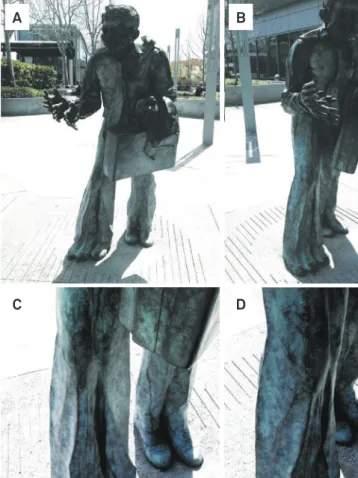
Contemporary art works could also purposelessly convey the idea and features of PK. “he Shaking Man”, sculpted by Terry Allen, is an urban statue located on the terrace of the Yerba Buena Gardens in San Francisco, USA. It is the bronze statue of a business executive, whose handshake greets the visitors to the cultural centre (Fig 1). However, a clinically ori-ented eye might also notice similarities between the sculpted man and a parkinsonian patient.
he cardinal features of PK are rigidity, rest tremor, bradykine-sia, and postural instability. Furthermore, other secondary signs can be sought in a parkinsonian patient, such as facial masking, hypokinetic dysarthria, and reduced spontaneous movements5,6.
As to “he Shaking Man”, it shows seven independent PK characteristics:
• his right arm is outstretched to greet the visitor with a handshake in the form of multiple hands displayed in se-quence. he four almost superimposed hands could be a representation of a typical parkinsonian tremor, with a 4 Hz frequency (Fig 2);
• the shaking predominates in the upper right limb over the lower one, as well as over the left leg (Fig 1); • the left arm is seemingly static, as it holds a briefcase and
coat (Fig 1);
• the statue has a stooped posture (Fig 1);
• the face is expressionless, a veritable hypomimic one (Figs 1 and 2);
• there also seems to be a gait disturbance represented by the motion of his feet, depicted again with multiple feet on either side (Fig 1);
• inally, the statue shows another striking feature: the index inger of the uppermost right hand is indented. It might not only show movement, but also be regarded as an ar-tistic representation of the cogwheel phenomenon, for the indentation provides a sense of clockwork or gear (Fig 2).
Furthermore, one can even use these clues to stage the PK depicted in the statue as a modiied Hoehn and Yahr 3.0, since there is bilateral compromise, some postural instability, but the character remains functionally independent7.
Possibly one of the most well-known portrayals of PK in mod-ern art is the 1990 ilm “Awakenings”8, starring Robbin Williams
and Robert De Niro. his movie is a retelling of Levodopa discov-ery and the remarkable efects it had on parkinsonian patients (secondary to encephalitis lethargica) who were lucid, but oth-erwise unable to express themselves or to move, frozen in their own bodies by the rigidity imposed by the disease — de facto real-life statues. hus, if a movie can present a motionless dis-ease in such a dramatic way, so can “he Shaking Man”, a statue, convey the illusion of fragmented movement with astounding results through the ingenuous use of multiple limbs.
To that efect, one can apply the theatre concepts of Serguei Eisenstein to better comprehend this achievement. Eisenstein created his theory of the “Staging of Attractions” based on the principles of biomechanics of Meyerhold, who believed that the immobility of statuary plastic and dynamic immobility of conventional montages had a great impact upon the viewer, and developed it even further. To Eisenstein, art should become an operational aesthetic and the expressive movement of the biomechanics should have a previously calculated psychological efect upon the spectator,
Fig 1. General overview of “The Shaking Man”, with front and lateral views and closer look of his legs. Pictures taken by doctor Francisco Manoel Branco Germiniani on April 9th, 2011.
Fig 2. Closer look of the hypomimic face and outstretched right hand, with multiple hands and indented index finger. Pictures taken by doctor Francisco Manoel Branco Germiniani on April 9th, 2011.
A
C
A B
D
B
263 Francisco Manoel Branco Germiniani et al. The Shaking Man
so that he/she could inally understand the inal meaning of what is presented through an intellection process. Eisenstein’s theatre concepts on biomechanics and what Didier Plassard theorized in his book on the actors’ eigy were based on other movements, such as the android theatre, the heraldic theatre, and the puppet-man theatre, all of which could be aptly applied to the interpretation of “he Shaking Man” and its conveyance of abnormal movement9,10.
he choice of the artist to place the statue in an open space, namely a public terrace in a multipurpose area, is in and of itself transforming meaning that it interferes with its immediate vicinity, at times almost blending seamlessly from a distance, while on a closer look it invites the inter-loper to interact with it and is imbued with implicit semiotic
signiicance11. Once again, this work is in accordance with
Eisenstein’s idea that each play/work of art should have not only its own scenery, but its own theatre; a place to present an experience in a unique way10.
One inal issue is why the artist chose to depict an elderly businessman, clearly in his late ifties or early sixties, instead of a younger one, which would be more common. It is possi-ble to imagine that his intention was to depict a disease that is typical of older people.
Sometimes works of art depict, either intentionally or not, neurological diseases. Even an ingenuous urban statue could represent PK. “he Shaking Man” lends itself to such an inter-pretation and is a remarkable example of urban intervention representing a neurological disease in a public open space.
1. Brudys V. Parkinson’s disease before Parkinson, Vilnius 1814. J R Soc Med 2005;98:178-179.
2. Bogousslavsky J. Charcot and art: from a hobby to science. Eur Neurol 2004;51:78-83.
3. Healy DG. Did Gericault’s “Madwoman Obsessed with Gambling” have Parkinson’s disease? Mov Disord 2007;22:1069-1070.
4. Garcia Ruiz PJ, Ruiz Esquerro JJ, Garcia Torres A, Janjul S. Ancient descriptions of movement disorders: Cathedral el Burgo de Osma (Soria, Spain). J Neurol 2006;253:731-734.
5. Ahlskog JE. Diagnosis and differential diagnosis of Parkinson’s disease and parkinsonism. Parkinson Relat Disord 2001;7:63-70.
6. Findley LJ, Gresty MA, Halmagyi GM. Tremor, the cogwheel phenomenon and clonus in Parkinson’s disease. J Neurol Neurosurg Psychiatry 1981;44:534-546.
7. Goetz CG, Poewe W, Rascol O, et al. Movement Disorder Society task Force report on the Hoehn and Yahr staging scale: status and recommendations. Mov Disord 2004;19:1020-1028.
8. Awakenings. Film. Directed by Penny Marshall. Columbia Pictures Corporation; 1990.
9. Carlos CS, Maciel Guimarães P, Oliveira Junior LC. O encouraçado Potemkin (Coleção Folha Cine Europeu; 13). São Paulo: Moderna; 2011.
10. de Oliveira VT. Eisenstein Ultrateatral: movimento expressivo e montagem de atrações na teoria do espetáculo de Serguei Eisenstein. São Paulo: Perspectiva; 2008.
11. Beck K, Ross L. Situating sculpture in the urban landscape: a dialogue. Public Art Dialogue 2011;1:193-201.
References