Hospital das Clínicas da Faculdade de Medicina da Universidade de São Paulo Mailing address: Eurico Thomaz de Carvalho Fº - Rua Frei Caneca, 1212 – conj. 92 - 01307-002 - São Paulo, SP - Brazil
Objective - To analyze in out clinic elderly patients of both sexes for the prevalence of risk factors for atheroscle-rosis and study their association with the complications of atherosclerosis.
Methods - Five hundred and sixteen outpatients, 152 men and 364 women, 60 years or older, were studied. The prevalences of hypertension, dyslipidemia, diabetes melli-tus, cigarette smoking and obesity were determined in both sexes and compared using the chi-square test. The associa-tion between these factors and the presence of atheroscle-rotic complications was analyzed by logistic regression.
Results - The comparative analysis of the factors in both sexes showed that hypertension, total cholesterol ≥240mg/ dL, LDL-cholesterol ≥160mg/dL, and body mass index >27.5 were more frequent among women, but HDL-choleste-rol <35mg/dL and cigarette smoking were more frequent among men, and no difference occurred between sexes in re-lation to the frequency of triglycerides ≥250mg/dL and dia-betes mellitus. After adjustment of the variables in the re-gression model, we observed that in the total of elderly pa-tients, risk factors for complications of atherosclerosis were: triglycerides ≥250mg/dL, hypertension, and male sex. Among men, the risk factors were: LDL-cholesterol ≥160mg/ dL, diabetes mellitus, HDL-cholesterol <35mg/dL and hy-pertension. Among women, the risk factors were: tryglice-rides ≥250mg/dL and hypertension.
Conclusion - The results showed that, in the elderly, the risk factors for atherosclerosis persist, but with different behaviors between men and women. The study suggests that the relative importance of the risk factors can change with the aging process.
Key words: risk factors, atherosclerosis, elderly
Arq Bras Cardiol, volume 74 (nº 3), 189-196, 2000
Yolanda Maria Garcia Alencar, Eurico Thomaz de Carvalho Fº, Sérgio Márcio Pacheco Paschoal, José Antonio Esper Curiati, Wong Chiu Ping, Júlio Litvoc
São Paulo, SP - Brazil
Risk Factors for Atherosclerosis in an Elderly out Patient
Population in the City of São Paulo
Cardiovascular disease as a complication of atheros-clerosis is today the most important cause of morbidity and mortality among elderly people especially in the developed countries 1-3. Although in the earlier decades of life women
have a lower prevalence of cardiovascular disease, the latter increases with age, reaching a similar level to that of men around the age of 75 4-6.
The same tendency has been observed in Brazil. Accor-ding to the Sistema Estadual de Análise de Dados (SEADE) and the Instituto Brasileiro de Geografia e Estatística (IBGE), in 1995, in the city of São Paulo coronary artery disease was more prevalent in men up to the age of 75 years, but the prevalence became similar in both sexes after that age 7.
Atherosclerosis is a disease in which multiple factors contribute to the degeneration of the arterial wall. It is evi-dent that intensity and duration of injury define the severi-ty of the alterations. Many risk factors were identified as having influence on the progression of atherosclerosis, mainly age, sex, heredity, diet composition, tobacco smo-king, physical activity, obesity, systemic arterial hypertensi-on, dyslipidemia, diabetes mellitus, plasma fibrinogen leve-ls, hyperhomocysteinemia, left ventricular hypertrophy and psycho-social factors.
Researchers in the area agree that an order of risk fac-tors exists and, in addition to age, sex, and heredity, hyper-tension, dyslipidemia, diabetes mellitus, tobacco smoking, and obesity must also be considered as major risk factors and deserve more attention. Most of the research, however, in-volves individuals of middle age and, more specifically, white males 8. More recently, population studies have been aiming
at the behavior of risk factors in the elderly, and some of these studies have cast doubt on their importance at this age 1,2,9-12.
The goal of the present study was analyze in elderly indi-viduals of both sexes the prevalence of the major risk factors and their correlation with atherosclerotic complications.
Methods
School, aged 60 or older, were randomly selected, being 245 males (28.5%) and 614 females (71.5%), during the years 1992 through 1994. All the patients enrolled in the outpatient department could potentially enter the study, and the pati-ents were chosen alternately without any special selection criteria. The proportion of men and women was similar to that observed in the outpatient clinic.
Through the medical records and by direct interview of the patients, the following risk factors were analyzed: sex, systemic arterial hypertension, dyslipidemia, diabetes mel-litus, tobacco smoking, and obesity. For the present study, we included only the elderly patients who had all the risk factors properly studied, or 516 patients, 152 (29.5%) males and 364 (70.5%) females. The patients were analyzed accor-ding to the presence or not of atherosclerotic complications. Three territories of atherosclerotic complications were con-sidered: coronary, cerebral, and peripheral. Patients with gina pectoris, previous myocardial infarction, coronary an-gioplasty, or bypass surgery were included in the coronary artery disease group. Patients with previous cerebral infarc-tion or clinical signs of transient ischemic attacks were inclu-ded in the cerebrovascular disease group. Claudication with peripheral pulse reduction and surgical treatment for the re-establishment of arterial circulation were the criteria of inclu-sion in the peripheral artery disease group.
The diagnosis of systemic arterial hypertension was made in individuals with systolic pressure of 160 mmHg or hi-gher, with diastolic pressure of 95 mmHg or hihi-gher, or with both of these 13, with a minimum of two measurements on two
different visits, or in patients already under drug treatment. The blood pressure was determined with the patient in the supine position, after resting for at least three minutes.
The diagnosis of dyslipidemia was based on total cholesterol (TC) levels of 240mg/dL or higher, low-density lipoprotein cholesterol (LDL-C) levels of 160mg/dL or hi-gher, high-density lipoprotein cholesterol (HDL-C) lower than 35mg/dL or triglycerides levels of 250mg/dL or higher. Total cholesterol and triglycerides levels were determined by enzymatic methods 14 and HDL-cholesterol levels were
determined by the Warnick-Albers method 15. The other
frac-tions were calculated as follows 16: very low-density
lipopro-tein cholesterol (VLDL-C) by the division of triglycerides/5, when triglycerides levels were lower than 400mg/dL and LDL-cholesterol by the following equation: LDL-C=TC-(HDL-C+VLDL-C).
Diabetes mellitus was diagnosed when fasting plasma glucose levels were above 140mg/dL on at least two occasi-ons, or when the patient was under drug treatment. Plasma glucose levels were determined by colorimetry after precipi-tation 17. Blood samples for glucose and lipid determinations
were obtained after 10 to 12 hours of fasting.
The patients were divided in two groups according to their smoking habits: smokers or nonsmokers. Patients who were smokers in the past, but not presently, were excluded. Obesity was defined by body mass index or Quetelet index, obtained by the formula: [body mass index = weight (kg)/height (m)2 ] 18,19. The diagnosis of obesity was made
when body mass index was greater than 27.5. For weight and height determination, the patients wore light clothes and were barefoot. Height was measured with the patient in the upright position, with the patient’s back against a wall.
The comparative analysis of the prevalences of the fac-tors among men and women was done by the chi-square (X2)
test, and the comparison between the mean of ages by Stu-dent's t test with the significance level established at 0.05.
The relationship of each risk factor with atherosclerotic complications was defined by logistic regression analysis 20.
Initially, a univariate analysis was performed as a stra-tegy for the selection of variables to be adjusted in a logistic regression model. In the final analysis, we included in the model the variables with the Pearson’s p value of up to 0.494 for the men, up to 0.503 for the women, and up to 0.560 for the total of the elderly patients, indicating that the number of variables was small and that clinical interest existed for testing them in the model.
Each one of the logistic regression models, namely, that of the men, the women, and the total of the elderly pati-ents was adjusted by means of a forward stepwise model te-chnique. For example, in the analysis of the total of the el-derly patients, we first included the variables sex and syste-mic arterial hypertension that had small p values in univaria-te analysis. In the analysis of the men, the first variables in-cluded were diabetes mellitus and systemic arterial hyper-tension; in the analysis of the women, the first variables we-re systemic arterial hypertension and triglycerides. Subquently, the other variables were included, following a se-quence of the p values obtained in univariate analysis. In this manner, we tried to estimate the independent effect of each variable adjusted to the model, controlling the respec-tive confounding effects. The likelihood ratio test of each fi-nal model was performed, defining its significance, which permitted the evaluation of the adequacy of the model.
Results
Among the 516 elderly patients studied, the average age was 75.6 years, with no statistically significant differen-ce between men and women (p=0.276).
The prevalences of the various risk factors are shown in figure 1 and in the first two left columns of the tables I, II, and III. The comparative analysis of the prevalences of the va-riables among the elderly patients of both sexes showed that systemic arterial hypertension (p=0.05), total cholesterol
≥240mg/dL (p=0.001), LDL-cholesterol ≥160mg/dL (p=-0.012), and body mass index >27.5 (p=0.009) were more fre-quent among women, HDL-cholesterol <35mg/dL (p=0.024) and tobacco smoking (p=0.044) were more frequent among men, and no significant difference was noted in relation to triglycerides (p=0.458) and diabetes mellitus (p=0.706).
Table I – Prevalence and crude odds ratio (OR) for the presence of complications of atherosclerosis in 516 elderly patients acc ording to biological-behavioral variables
Variables Total Complications of ahterosclerosis
Nº % Nº % OR ρ CI95%
Sex
Female 364 70.5 65 17.9 1
Male 152 29.5 45 29.6 1.93 0.003 1.22 - 3.07
SAH
<160 e/ou 95 168 32.6 24 14.3 1
≥160 e/ou 95 348 67.4 86 24.7 1.97 0.007 1.20 - 3.23
TC
<240mg/dl 352 68.2 74 21.0 1
≥240mg/dl 164 31.8 36 22.0 1.06 0.811 0.67 - 1.66
LDL-C
<160mg/dl 338 65.5 67 19.8 1
≥160mg/dl 178 34.5 43 24.2 1.29 0.254 0.83 - 2.00
HDL-C
≥35mg/dl 442 85.7 88 19.9 1
<35mg/dl 74 14.3 22 29.7 1.70 0.056 0.95 - 3.05
Triglycerides
<250mg/dl 475 92.0 96 20.2 1
≥250mg/dl 41 8.0 14 34.2 2.05 0.040 1.03 - 4.05
Diabetes mellitus
Absent 416 80.6 81 19.5 1
Present 100 19.4 29 29.0 1.69 0.038 1.03 - 2.77
Tabacco smoking
No 477 92.4 102 21.4 1
Yes 39 7.6 8 20.5 0.95 0.898 0.42 - 2.13
BMI
≤27.5 308 59.7 63 20.5 1
>27.5 208 40.3 47 22.6 1.14 0.560 0.74 - 1.74
CI- confidence interval; SAH - systemic arterial hypertension; TC - total cholesterol; LDL-C – LDL-cholesterol; HDL-C - HDL-cholesterol; DM- diabetes mellitus; BMI - body mass index.
RISK FACTORS
PREV
ALENCE (%)
MEN
WOMEN
S A P≥≥≥≥≥ 160x95 240mg/dlTC ≥≥≥≥≥
LDL-C ≥≥≥≥≥ 160mg/dl
HDL-C <<<<< 35mg/dl
TG ≥≥≥≥≥ 250mg/dl
D M TS BMI>>>>> 27,5
Fig. 1 - Prevalence of the risk factors for atherosclerosis in the elderly (152 men and 364 women). SAP- systemic arterial pressure; TC- total cholesterol; C- LDL-cholesterol; HDL-C- HDL-LDL-cholesterol; TG– triglycerides; DM- Diabetes mellitus; TS- tobacco smoking habit; BMI- body mass index.
In all the elderly patients, an association existed betwe-en complications of atherosclerosis and systemic arterial hy-pertension (odds ratio = 1.97), triglycerides levels ≥250mg/dL (odds ratio = 2.05), diabetes mellitus (odds ratio =1.69), HDL-cholesterol level <35mg/dL (odds ratio = 1.70), the last one with a p value of 0.056 (table I).
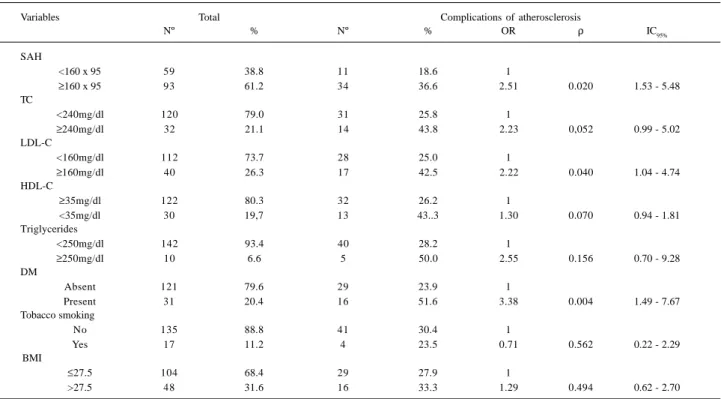
Among men, an association existed between compli-cations of atherosclerosis and systemic arterial hypertensi-on (odds ratio = 2.51), LDL- cholesterol level ≥160mg/dL
(odds ratio = 2.22), diabetes mellitus (odds ratio = 3.38), total cholesterol level ≥240mg/dL (odds ratio = 2.23), the last one with a p value of 0.052 (table II).
Among women, no significant association between complications of atherosclerosis and the risk factors was ob-served (table III). However, one may point out the odds ratio values of the following variables: systemic arterial hyper-tension (OR=1.89; p=0.056; CI95%=0.98-3.64) and triglycerides level ≥ 250mg/dL (OR=2.02; p=0.095; CI95%=0.89-4.63).
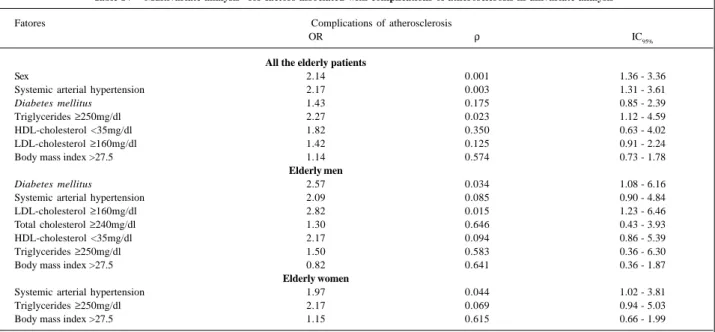
After adjustment of the variables to the regression model (table IV), we observed that in the total of the elderly patients, by the decreasing order of the odds ratio values, the risk factors for atherosclerotic complications were: tri-glycerides level ≥250mg/dL (odds ratio = 2.27), systemic ar-terial hypertension (odds ratio = 2.17), and male sex (odds ratio = 2.14).
For the men, the risk factors were LDL-cholesterol level
≥ 160mg/dL (odds ratio = 2.82), diabetes mellitus (odds ratio = 2.57), HDL-cholesterol level <35mg/dL (odds ratio = 2.17), and systemic arterial hypertension (odds ratio = 2.09); for the women, the risk factors were: triglycerides level ≥250mg/dL (odds ratio = 2.17) and systemic arterial hypertension (odds ratio = 1.97).
Table III – Prevalence and crude odds ratio (OR) for the presence of complications of atherosclerosis in 364 elderly women according to biological-behavioral variables
Variables Total Complications of atherosclerosis
Nº % Nº % OR ρ IC95%
SAH
<160 x 95 109 30.0 13 11.9 1
≥160 x 95 255 70.1 52 20.4 1.89 0.056 0.98 - 3.64
TC
<240mg/dl 232 63.7 43 18.5 1
≥240mg/dl 132 36.3 22 16.7 0.88 0.655 0.50 - 1.55
LDL-C
<160mg/dl 226 62.1 39 17.3 1
≥160mg/dl 138 37.9 26 18.8 2.11 0.702 0.64 - 1.93
HDL-C
≥35mg/dl 320 87.9 56 17.5 1
<35mg/dl 44 12.1 9 20.5 1.21 0.632 0.51 - 2.81
Trigycerides
<250mg/dl 333 91.5 56 16.8 1
≥250mg/dl 31 8.5 9 29.0 2.02 0.095 0.89 - 4.63
DM
Absent 295 81.0 52 17.6 1
Present 69 19.0 13 18.8 1.08 0.813 0.55 - 2.13
Tobacco smoking
No 342 94.0 61 17.8 1
Yes 22 6.0 4 18.2 1.02 0.967 0.33 - 3.13
BMI
≤27.5 204 56.0 34 16.7 1
>27.5 160 44.0 31 19.4 1.20 0.503 0.70 - 2.06
CI- confidence interval; SAH - systemic arterial hypertension; TC - total cholesterol; LDL-C – LDL-cholesterol; HDL-C - HDL-cholesterol; DM- diabetes mellitus; BMI - body mass index.
Table II – Prevalence and crude odds ratio (OR) for the presence of complications of atherosclerosis in 152 elderly men according to biological behavioral variable
Variables Total Complications of atherosclerosis
Nº % Nº % OR ρ IC95%
SAH
<160 x 95 59 38.8 11 18.6 1
≥160 x 95 93 61.2 34 36.6 2.51 0.020 1.53 - 5.48
TC
<240mg/dl 120 79.0 31 25.8 1
≥240mg/dl 32 21.1 14 43.8 2.23 0,052 0.99 - 5.02
LDL-C
<160mg/dl 112 73.7 28 25.0 1
≥160mg/dl 40 26.3 17 42.5 2.22 0.040 1.04 - 4.74
HDL-C
≥35mg/dl 122 80.3 32 26.2 1
<35mg/dl 30 19,7 13 43..3 1.30 0.070 0.94 - 1.81
Triglycerides
<250mg/dl 142 93.4 40 28.2 1
≥250mg/dl 10 6.6 5 50.0 2.55 0.156 0.70 - 9.28
DM
Absent 121 79.6 29 23.9 1
Present 31 20.4 16 51.6 3.38 0.004 1.49 - 7.67
Tobacco smoking
No 135 88.8 41 30.4 1
Yes 17 11.2 4 23.5 0.71 0.562 0.22 - 2.29
BMI
≤27.5 104 68.4 29 27.9 1
>27.5 48 31.6 16 33.3 1.29 0.494 0.62 - 2.70
(p=0.0304) for the women. Therefore, all the likelihood ratio test values were significant, permitting the affirmative that the models were adequate.
This significance of the likelihood ratio test in the three models of logistic regression was an important criterion for identifying the variables considered risk factors for of athe-rosclerosis. Another classic criterion was the significance of the variable individually, in our case by the p value of Wald (table IV).
The identification of the risk factors was accompli-shed, therefore, by the interaction of the above two criteria, plus the capacity of the variable to influence the odds ratio of the others, with its removal or inclusion in the model.
Discussion
Identification of risk factors for atherosclerosis is es-sential for the adoption of preventive measures. This study evaluated 516 elderly outpatients of both sexes, in order to determine the impact of systemic arterial hypertension, dyslipidemia, diabetes mellitus, tobacco smoking, and obe-sity, considered risk factors of cardinal importance that can be controlled or even removed.
Among the individuals analyzed, 21.3% presented with at least one complication of atherosclerosis. Although in this age group, the prevalence of atherosclerotic disease has shown an important increase in women 4-7, this study
showed that after age 60 a significantly greater prevalence of complications of atherosclerosis persists among men (29.6% x 17.9%; OR=1.93; CI95%=1.22-3.07).
Systemic arterial hypertension was the most prevalent of the risk factors analyzed, affecting 61.2% of the men and 70.1% of the women, and the difference in prevalence
between the two sexes was statistically significant. These va-lues were similar to those observed by the National Health and Nutrition Examination Survey (NHANES-II) 21,22 in the
United States where the authors, using the same diagnostic criteria, observed in elderly patients systemic arterial hy-pertension in 59.2% and 66.2% of white men and women, and in 67.1% and 82.9% of black men and women, respectively.
Systemic arterial hypertension is considered one of the most important causes of morbidity and mortality in the adult population of the civilized world, both by its high pre-valence and by its complications.
In the Framingham Study, higher morbidity and morta-lity by cardiovascular and cerebrovascular disease were found in hypertensive patients, but the risk was lower in the elderly 22,23. Comparing the elderly patients of both sexes,
Hall 24 observed that with the same level of blood pressure,
the risk of atherosclerotic complications was greater in men. In our study, the importance of systemic arterial hyper-tension as a risk factor for atherosclerosis and its complica-tions was demonstrated by univariate analysis and confir-med by multivariate analysis both for the total of the elderly patients and for the men and the women separately. Thus, systemic arterial hypertension was the only factors that proved to be of risk in the three groups of subjects studied. This fact, along with the high prevalence of systemic arterial hypertension, shows the great importance of this illness as a cause of atherosclerotic complications in the elderly.
The plasma lipids as risk factors for atherosclerotic di-sease have been extensively studied in young and middle-aged adults. However, few investigations have been con-ducted in the elderly 3,8.9.25.
The prevalences of total cholesterol and LDL-choleste-rol were significantly greater among women. These results are
Table IV – Multivariate analysis* for factors associated with complications of atherosclerosis in univariate analysis
Fatores Complications of atherosclerosis
OR ρ IC95%
All the elderly patients
Sex 2.14 0.001 1.36 - 3.36
Systemic arterial hypertension 2.17 0.003 1.31 - 3.61
Diabetes mellitus 1.43 0.175 0.85 - 2.39
Triglycerides ≥250mg/dl 2.27 0.023 1.12 - 4.59
HDL-cholesterol <35mg/dl 1.82 0.350 0.63 - 4.02
LDL-cholesterol ≥160mg/dl 1.42 0.125 0.91 - 2.24
Body mass index >27.5 1.14 0.574 0.73 - 1.78
Elderly men
Diabetes mellitus 2.57 0.034 1.08 - 6.16
Systemic arterial hypertension 2.09 0.085 0.90 - 4.84
LDL-cholesterol ≥160mg/dl 2.82 0.015 1.23 - 6.46
Total cholesterol ≥240mg/dl 1.30 0.646 0.43 - 3.93
HDL-cholesterol <35mg/dl 2.17 0.094 0.86 - 5.39
Triglycerides ≥250mg/dl 1.50 0.583 0.36 - 6.30
Body mass index >27.5 0.82 0.641 0.36 - 1.87
Elderly women
Systemic arterial hypertension 1.97 0.044 1.02 - 3.81
Triglycerides ≥250mg/dl 2.17 0.069 0.94 - 5.03
Body mass index >27.5 1.15 0.615 0.66 - 1.99
in agreement with a previous study carried out in the Geriatric Service that showed that total cholesterol and LDL-choleste-rol increase in both sexes with advancing age, but mainly in women 25.
In our study we observed by univariate analysis that total cholesterol ≥240mg/dL and LDL-cholesterol ≥160mg/ dL were risk factors for complications of atherosclerosis among men, but not among women, nor in the whole group of elderly patients. Multivariate analysis partially confirmed these results, because only LDL-cholesterol was shown to be a risk factor in men.
The role of total cholesterol and LDL-cholesterol as risk factors for atherosclerosis in the elderly is a subject open for discussion 26. Several studies have reached the
conclusion that they are important risk factors for coronary artery disease; however, these studies also agree on their lesser impact in the elderly as compared with middle-aged subjects 12,27-31.
Papaléo Netto et al 9 compared total cholesterol and
LDL-cholesterol levels of 31 aged patients of both sexes with atherosclerotic complications with total cholesterol and LDL- cholesterol levels of a group of healthy elderly in-dividuals and found no significant difference between the two groups.
Krumholz et al 11 followed 997 individuals of both
sexes 70 years or older for four years and did not find any correlation between total cholesterol ≥240mg/dL and higher mortality due to coronary artery disease or more frequent hospital admissions for acute myocardial infarction and unstable angina.
According to La Rosa 28 and Crouse 29,
LDL-choleste-rol may be more harmful to men. Studies performed in prima-tes suggest that the presence of circulating estrogen in women could may interfere with the uptake of LDL-choles-terol by the artery wall, which may be related to its antio– xidant effect 32.
Capurso 33 believes that the conflicting results obtained
by several investigators may be caused by the fact that in the elderly, dyslipidemia is frequently related to nongenetic cau-ses, such as hypothyroidism and the use of drugs like diu-retics. These secondary forms of dyslipidemia could be less related to cardiovascular risk, because they are of later onset and thus exert atherogenic effect for a shorter period of time. In 19.7% of men and 12.1% of women, plasma HDL-cholesterol was below 35mg/dL, and this difference was sta-tistically significant.
In a previous study of the Geriatric Service, Figueira et al 25 observed that HDL-cholesterol levels diminished with
age in both sexes, but more markedly in males.
The analysis of the importance of HDL-cholesterol as a risk factor for atherosclerotic vascular disease in the elderly has been done in several studies 34-37. In the
Framin-gham study, HDL-cholesterol <35mg/dL correlated with a greater prevalence of cardiovascular disease in elderly pa-tients of both sexes 34. According to La Rosa 28, 35 the
HDL-cholesterol levels, usually higher in women, could be one of the reasons why they have a lesser risk of atherosclerotic
complications than men. On the other hand, the Bronx Aging Study showed HDL-cholesterol <35mg/dL as an im-portant risk factor for coronary artery disease only in men 36.
In our study, we observed that HDL-cholesterol <35mg/dL corresponded to a greater prevalence of atheros-clerotic complications in men (43.3%) as compared with wo-men (20.5%). The comparison, by univariate analysis, bet-ween the subjects with HDL-cholesterol < and ≥ 35/dL, as to the presence of atherosclerotic complications did not show any difference in the women, but in the men the prevalences of complications were 43.3% and 26.2%, respectively. The comparative study by multivariate analysis also showed that HDL-cholesterol <35mg/dL was a risk factor for athe-rosclerotic complications only in men.
It has been demonstrated by comparing normal individuals, both young and aged, that triglycerides rise significantly during the aging process in both sexes 25. In our
study, only 8.0% of the patients showed triglycerides levels of ≥250mg/dL, with no significant difference between men and women.
The importance of triglycerides as a risk factor for atherosclerosis, both in elderly and middle-aged indivi-duals, and its complications has been debated in the litera-ture 36,38, with a good deal of controversy. Recently, several
studies have called attention to triglycerides as an impor-tant risk factor of cardiovascular disease, independently of the association with other factors such as diabetes mellitus and low HDL-cholesterol 39-41.
In our study, analyzing the total of patients by univa-riate analysis, we observed a significant association betwe-en triglycerides ≥250mg/dL and atherosclerotic compli-cations. When the male and female subjects were analyzed separately, in spite of the greater prevalence of atheroscle-rotic complications in those with triglycerides ≥250mg/dL in relation to those with triglycerides <250mg/dL (respectively 50.0% x 28.2% and 29.0% x 16.8%), no significant difference was noted. However, we have to emphasize the odds ratio value observed in women (OR=2.02; p=0.095; CI95%= 0.89– 4.63). Multivariate analysis confirmed these results, main-taining triglycerides ≥250mg/dL as a risk factor for the total of elderly patients and for the women.
Diabetes mellitus was diagnosed in 20.4% of the men and 19.0% of the women, with no significant difference between the two sexes.
In the Framingham Study, the risk of death by cardiovas-cular disease was 1.7 times greater in men and 3.3 times greater in women with diabetes, when compared with that in nondia-betic patients 42. The TecumsehStudy showed even more
stri-king results, with the risk of atherosclerotic complications 1.9 times greater in diabetic men and 5.3 times greater in diabetic women, when compared with nondiabetic patients 43.
atherosclerotic complications among diabetic and nondia-betic patients was practically equal (18.8% x 17.6%; OR = 1.08; p=0.813; CI95% = 0.55 – 2.13).
The fact that diabetes mellitus, in spite of its high pre-valence (19.0%), did not prove to be a risk factor among the women is in disagreement with the data in the literature, but this could mean that, among the elderly women of our group, other risk factors such as age causing senile atherosclero-sis, and estrogen deficiency, may have been of primordial importance.
As for tobacco smoking, the behavior of the 516 el-derly patients varied a great deal. Many were past smokers but had abandoned the smoking habit for variable periods of time. The number of cigarettes consumed per day also had great variation. For these reasons, two groups were considered: a) smokers, made up of patients who were smo-king at the time of the interview, and b) nonsmokers, made up of patients who had never smokers.
It was shown that the prevalence of smokers in this outpatient population was low (7.6%), with a significant pre-dominance of the men (11.2%) in relation to the women (6.0%).
The smoking habit is frequently associated with other factors related to atherosclerosis and its complications, such as lower HDL- cholesterol levels, elevation of blood viscosity, hyper-fibrinogenemia, greater platelet aggrega-tion, and anti-estrogen effect 44,45.
The role of tobacco smoking as a risk factor was de-monstrated in experimental, clinical, and anatomopathologi-cal studies. The deleterious changes caused by tobacco smoking are proportional to the number of cigarettes consu-med, the duration of the smoking habit and the age of onset of smoking 12,46,47.
Among elderly smoker the risk of atherosclerotic complications seems lower than that observed in middle-aged smokers, but still higher than that in elderly nons-mokers 12,45.
The low prevalence of smokers among the elderly pa-tients in our study, much lower than that observed in youn-ger age groups, could mean that the patients more suscepti-ble to the harmful effects of smoking had complications and died prematurely. This supposition plus the fact that during the aging process other factors such as age itself may pre-dominate could explain why smokers and nonsmokers of both sexes showed no difference in the prevalence of athe-rosclerotic complications.
The relationship between obesity and atherosclerotic complications has been a subject of controversy. Several studies have suggested this association; however, only a few demonstrated a specific effect of obesity as a risk factor, because it is usually associated with other factors, such as
systemic arterial hypertension, dyslipidemia and diabetes mellitus.
Our study observed that obesity, defined by a body mass index >27.5, was present in 31.6% of the men and 44.0% of the women; this difference was statistically significant.
By univariate analysis, no significant difference was found between complications of atherosclerosis in obese and nonobese patients in both sexes. It is possible that an analysis directed to the distribution of body fat could yield a different result, because individuals with abdominal obesity present with a greater prevalence of complications than those with gluteo-femoral obesity 48,49.
In summary, among the elderly patients analyzed in the present study, the prevalence of atherosclerotic complica-tions was significantly greater in the men compared with that in the women.
The data obtained showed that in the elderly, the risk factors for atherosclerosis and its complications have a different prevalence between males and females.
Comparative analysis revealed that systemic arterial hy-pertension, total cholesterol ≥240mg/dL, LDL-cholesterol
≥160mg/dL, and body mass index >27.5 were more frequent in the women, HDL-cholesterol <35mg/dL and tobacco smoking were more frequent in the men, and no difference was noted in relation to triglycerides ≥250mg/dL and diabetes mellitus.
The risk of complications of atherosclerosis in relation to each one of the factors analyzed also showed an important difference between elderly men and women. Thus, LDL-cholesterol ≥160mg/dL, HDL-cholesterol <35mg/dL, di-abetes mellitus, and systemic arterial hypertension were risk factors for the men, but triglycerides ≥250mg/dL and systemic arterial hypertension were risk factors for the women.
Based on these findings, we can affirm that the factors considered of risk for atherosclerosis and its complications in the elderly have different consequences in men and women. Therefore, the evaluation of these factors should be done by different weights in each sex, so that adequate preventive and therapeutic measures can be taken in the respective situation.
The results of this investigation also suggest, confir-ming the opinion of other authors 2,50, that the order of
im-portance of the risk factors can change with the aging pro-cess, as in the case of tobacco smoking for example.
1. Karvonen MJ. Determinants of cardiovascular diseases in the elderly. Ann Intern Med 1989; 21: 3-12.
2. Aronow WS. Cardiac risk factors: Still important in the elderly. Geriatrics 1990; 45 (1): 71-80.
3. Fletcher AE, Bulpitt CJ. Epidemiological aspects of cardiovascular disease in the elderly. J Hypertens 1992; 10(suppl 2): S 51-8.
4. Lemer DJ, Kannel WB. Patterns in coronary heart disease - Morbidity and morta-lity in the sexes: a 26-year follow-up of the Framingham population. Am Heart J 1986; 111: 383-90.
5. Castelli WP. Cardiovascular disease in women. Am J Obstet Gynecol 1988; 158: 1552-60.
6. Kuhn FE, Rackley CE. Coronary artery disease in women. Arch Int Med 1993; 153: 2626-36.
7. Fundação Sistema Estadual de Análise de Dados (SEADE). O idoso na Grande São Paulo. São Paulo 1990: 138-41.
8. Wenger NK. Exclusion of the elderly and woman from coronary trials. JAMA 1992; 268: 1460-1.
9. Papaléo Netto M, Carvalho Filho ET, Figueira JL, et al. Alterações lipídicas em ido-sos portadores de complicações da aterosclerose. Arq Bras Card 1988; 50: 11-4. 10. Benfante R, Reed D. Is elevated serum cholesterol level a risk factor for coronary
heart disease in the elderly? JAMA 1990; 263: 393-6.
11. Krumholz HM, Seeman TE, Merrill SS, et al. Lack of association between choles-terol and coronary heart disease mortality and morbidity and all-cause mortality in persons older than 70 years. JAMA 1993; 272: 1335-40.
12. Wenger NK. Preventive cardiology in the elderly. Current Opinion in Cardiolo-gy 1997; 12: 195-201.
13. Reed G, Anderson RJ. Epidemiology and risk of hypertension in the elderly. Clin Ther 1982; 5(spec): 1-8.
14. Allain CC, Poon LS, Chan CSK, Richmond W, Fu PC. Enzymatic determination of total serum cholesterol. Clin Chem 1974; 20: 470-4.
15. Warnick GR, Albers JJ. A comprehensive evaluation of heparin manganese preci-pitation procedure for estimating high density lipoprotein cholesterol. J Lipid Res 1973; 19: 65-8.
16. Friedewald WT, Levy RI, Fredrickson DS. Estimation of the concentration of low-density lipoprotein cholesterol in plasma without use of the preparative ul-tracentrifuge. Clin Chem 1972; 18: 499-502.
17. Trinder P. Determination of glucose in blood using glucose oxidase with an al-ternative oxygen acceptor. Ann Clin Biochem 1969; 6: 24.
18. Keys A, Fidanza F, Karvonen MJ, Kimura N, Taylor HL. Indices of relative weight and obesity. J. Chron Dis 1972; 25: 329-43.
19. Lamon-Fava S, Wilson PWF, Schaefer EJ. Impact of body mass index on coronary heart disease risk factors in men and women. The Framingham Offspring Study. Ar-terioscler Thromb Vasc Biol 1996; 16: 1509-15.
20. Campos Filho N, Franco EL. MULTLR - A microcomputer program for multiple lo-gistic regression by unconditional and conditional maximum likelihood methods. Am J Epidemiol 1989; 129: 439-44.
21. Joint National Committee on Detection, Evaluation, and Treatment of High Blood Pressure - The 1992 Report of the Joint National Committee on Detection, Evaluation, and Treatment of High Blood Pressure (JNC-V). Arch Intern Med 1993; 153: 154-83.
22. Messerli FH, Grodzicki T. Hypertension and coronary artery disease in the elder-ly. Clin Geriatr Med 1996; 12: 41-55.
23. Levy D, Kannel WB. Cardiovascular risks: New insights from Framingham. Am Heart J 1988; 16: 266-72.
24. Hall PM. Hypertension in women. Cardiology 1990; 77(suppl 2): 25-30. 25. Figueira JL, Papaléo Netto M, Carvalho Filho ET, et al. Perfil lipídico em
indiví-duos idosos normais. Arq Bras Cardiol 1987; 48: 77-81.
References
26. Hulley SB, Newman TB. Cholesterol in the elderly. Is it important? JAMA 1994; 272: 1372-4.
27. Bruckert E, Delahaye F, Richard JL, Emmerich J, Thomas D. Hyperlipidemia chez le sujet âgé de plus de 60 ans. Arch Mal Coeur 1992; 85(III) : 79-82. 28. La Rosa JC. Management of postmenopausal women who have hyperlipidemia.
Am J Med 1994; 96(suppl 6A): 19-24.
29. Crouse JR. Gender, lipoproteins, diet and cardiovascular risk. Lancet 1989; 1: 318-20.
30. Aronow WS, Ahn C. Risk factors for new coronary events in a large cohort of very elderly patients with and without coronary artery disease. Am J Cardiol 1996; 77: 864-6.
31. Corti M-C, Guralnik JM, Salive ME, et al. Clarifying the direct relation between total cholesterol levels and death from coronary heart disease in older persons. Ann Intern Med 1997; 126: 753-60.
32. Wagner JD, Clarkson TB, St Clair RW, Schwenke DC, Adams MR. Estrogen repla-cement therapy and coronary artery atherogenesis in surgically post-menopau-sal cynomolgus monkeys. Circulation 1989; 80(suppl II): 331.
33. Capurso A. Lipid metabolism and cardiovascular risk: Should hypercholestero-lemia be treated in the elderly? J Hypertens 1992; 10(suppl.2): 65-8. 34. Annel WB, Brand FN. Cardiovascular risk factors in the elderly. In: Andres R,
Bierman EL, Hazzard WR, eds. Principles of Geriatric Medicine. New York: McGraw-Hill, 1985: 104-19.
35. La Rosa JC. Dyslipoproteinemia in women and elderly. Med Clin North Am 1994; 78: 163-80.
36. Zimetbaum P, Frishman WH, Ooi WL, et al. Plasma lipids and lipoproteins and the incidence of cardiovascular disease in the very elderly. The Bronx Aging Study. Arterioscler Thromb 1992; 12: 416-23.
37. Corti M-C, Gukralnik JM, Salive ME, et al. HDL cholesterol predicts coronary heart disease mortality in older persons. JAMA 1995; 274: 539-44. 38. Leaf DA. Lipid disorders: Applying new guidelines to your older patients.
Ge-riatrics 1994; 49 (5): 35-41.
39. Jeppesen J, Hein HO, Suadecani P, Gyntelberg F. Triglyceride concentration and ischemic heart disease. Circulation 1998; 97: 1029-36.
40. Austin MA, Hokanson JE, Edward KL. Hypertriglyceridemia as a cardiovascu-lar risk factor. Am J Cardiol 1998; 81: 7-12.
41. Gotto AM. Triglyceride. The forgotten risk factor. Circulation 1998; 97: 1027-8. 42. Kannel WB. Lipids, diabetes, and coronary heart disease: Insights from the
Fra-mingham Study. Am Heart J 1985; 110: 1100-7.
43. Epstein FH, Ostrander Jr LD, Johnson BC, et al. Epidemiological studies of car-diovascular disease in a total community: Tecumseh, Michigan. Ann Intern Med 1965; 62: 1170-87.
44. Laustiola KE. Atherothrombotic mechanisms in smoking. J Intern Med 1991; 230: 469-70.
45. Khaw KT, Tazuke S, Barrett-Connor E. Cigarette smoking and levels of adrenal androgens in post menopausal women. N Engl J Med 1988; 318: 1705-8. 46. Jajich CL, Ostfeld AM, Freeman Jr DH. Smoking and coronary heart disease
mor-tality in the elderly. JAMA 1984; 252: 2831-4.
47. Vogt MT, Cauley JA, Scott JC, Kuller LH, Browner WS. Smoking and mortality among older women. Arch Intern Med 1996; 156: 630-6.
48. Despres JP, Moorjani S, Lupien PJ, et al. Regional distribution of body fat, plasma lipoproteins and cardiovascular disease. Arteriosclerosis 1990; 10: 497-511.
49. Seidell JC, Cigolini M, Charzewska J, et al. Fat distribution and gender differen-ces in serum lipids in men and women from four European communities. Atheros-clerosis 1991; 87: 203-10.