Hospital Português - Salvador
Mailing address: Luís C. L. Correia Av. Juracy Magalhães Jr, 2452/1204 -41920-000 - Salvador, BA, Brazil
Objective – To assess safety and efficacy of coronary
angioplasty with stent implantation in unstable coronary syndromes.
Methods – Retrospective analysis of in-hospital and
late evolution of 74 patients with unstable coronary syn-dromes (unstable angina or infarction without elevation of the ST segment) undergoing coronary angioplasty with stent placement. These 74 patients were compared with 31 patients with stable coronary syndromes (stable angina or stable silent ischemia) undergoing the same procedure.
Results – No death and no need for revascularization of
the culprit artery occurred in the in-hospital phase. The inci-dences of acute non-Q-wave myocardial infarction were 1.4% and 3.2% (p=0.6) in the unstable and stable coronary syndrome groups, respectively. In the late follow-up (11.2±7.5 months), the incidences of these events combined were 5.7% in the unstable coronary syndrome group and 6.9% (p=0.8) in the stable coronary syndrome group. In the multivariate analysis, the only variable with a tendency to significance as an event predictor was diabetes mellitus (p=0.07; OR=5.2; 95% CI=0.9-29.9).
Conclusion – The in-hospital and late evolutions of
patients with unstable coronary syndrome undergoing angioplasty with intracoronary stent implantation are si-milar to those of the stable coronary syndrome group, suggesting that this procedure is safe and efficacious when performed in unstable coronary syndrome patients.
Key words: coronary angioplasty, stent, unstable
corona-Arq Bras Cardiol, volume 74 (nº 6), 508 - 512, 2000
Luís C. L. Correia, José Carlos Brito, Andréa C. Barbosa, Antônio M. Azevedo Jr, Mário S. Rocha, Heitor G. Carvalho, José Péricles Esteves
Salvador, BA - Brazil
Safety and Efficacy of Angioplasty with Intracoronary
Stenting in Patients with Unstable Coronary Syndromes.
Comparison with Stable Coronary Syndromes
Coronary angioplasty with stent implantation in pati-ents with unstable coronary syndromes, theoretically, has an increased risk of thrombogenic complications, conside-ring the instability of the atherosclerotic plaque associated with the thrombogenic potential of metallic prostheses 1.
Therefore, initially, this approach was contraindicated in pa-tients with unstable angina or acute non-Q-wave myocar-dial infarction. With developments in the technique of stent implantation, this therapy has proved safe in those patients and is often indicated in those conditions 2-4.
Intracoronary stent implantation is advantageous as compared with conventional angioplasty in the following re-gards: reduction in the need for urgent revascularization with decrease in the rate of acute occlusion during the procedure; increase in the immediate gain after angioplasty (smaller residu-al stenosis and negative residuresidu-al stenosis in some cases); re-duction in the restenosis rate due to the greater amplification of the lumen and decrease in late luminal remodeling. Considering the higher risk of thrombotic complications of balloon catheter coronary angioplasty in patients with unstable angina 3-8, and
due to its thrombogenic potential, the use of the stent was limited for approximately 3 years to stable patients or those in complicated situations of balloon angioplasty 1.
The recent technique of optimal stent deployment (hi-gh pressure balloon inflation) 5,6 associated with the
addi-tional benefits of antiplatelet agents, such as ticlopidine 7,
clopidogrel 8, and intra venous infusion of glycoprotein IIb/
IIIa 9,10 antagonists has provided a greater safety to
an-gioplasty with stent placement in unstable atherosclerotic plaques, turning this into an ordinary procedure and crea-ting the need for careful investigation of the evolution of the patients.
Methods
From February ’95 to August ’98, 370 consecutive pa-tients underwent percutaneous coronary angiography in our hospital, 209 of whom had intracoronary stent implan-tation. Out of these 209 patients, 105 were screened for this retrospective cohort study and divided into 2 groups accor-ding to the following clinical characteristics: 1) stable group: patients with clinical findings of stable angina (precordial pain on physical efforts for more than 60 days) or silent myo-cardial ischemia detected on a functional assessment, such as exercise testing, stress or pharmacological stress myo-cardial scintigraphy, or stress echocardiography; 2) unsta-ble group: patients with clinical findings of unstaunsta-ble angina according to the Braunwald classification (class I, II, III) 11,
or myocardial infarction without ST segment elevation after stabilization of the clinical findings, and who underwent an-gioplasty in the first 60 days after infarction.
The following patients were excluded: 1) postacute Q-wave myocardial infarction patients who underwent angio-plasty with stent implantation, either for late opening of the occluded artery or whose procedure resulted from postin-farction risk stratification; 2) patients whose stent implanta-tion was decided upon during the procedure as a result of complicated balloon angioplasty; 3) patients who under-went balloon catheter angioplasty (without stent) in ano-ther artery on the same day of stent implantation or during the follow-up; 4) patients who underwent angioplasty with stent in venous or arterial grafts.
Balloon catheters for stent implantation were chosen to obtain an artery/balloon diameter relation close to 1:1. The inflation pressure was at least 12 atm. Unfractioned he-parin (10,000 to 15,000 IU) was administered intravenously only during the procedure, and no indication for routine heparinization occurred after the procedure. The arterial catheter was withdrawn after the activated partial thrombo-plastin time reached a level lower than 60 s. Manual com-pression was performed for as long as needed to obtain he-mostasis after withdrawal of the introducer, and then a com-pression dressing was applied. Electrocardiogram was routi-nely performed right after angioplasty, before discharge from the coronary unit, and in case of chest pain. Cardiac en-zymes (CPK and CK-MB) were measured every 6 hours after angioplasty, totaling at least 3 measurements during the stay in the coronary unit. Acetylsalicylic acid orally at a dosage of 100 mg once a day and ticlopidine at a dosage of 500 mg orally twice a day were started at least 3 days before the procedure, and acetylsalicylic acid at a dosage of 100 mg/day were used chronicelly, while ticlopidue at a dosage of 200 mg tweel e drug were maintened for at least 15 days and ticlopidine at a dosage of 250 mg twice a day were main-tained for at least 15 days.
Primary success was defined as TIMI-3 flow and visual residual stenosis smaller than 20% after stent implantation. Primary events consisted in death, acute myocardial infarc-tion (appearance of a new Q wave on the electrocardiogram or elevation of the CK-MB enzyme more than twice its
nor-mal value, or both), and new revascularization (angioplasty or surgery) of the artery that had previously undergone stent implantation (culprit artery). The following events we-re considewe-red secondary: hemoglobin variation we-resulting from the procedure and the need for a new coronary angio-graphic study. The events were separately analyzed in the in-hospital phase and late follow-up (11.2±7.5 months), which occurred through phone contact with the patient or the assistant physician, or both.
Continuous variables were expressed as mean ± standard deviation. The chi-square test for categorical data or the unpaired Student t test for continuous variables were used for analyzing population characteristics and comparing the variables representing the clinical evolution in the 2 groups. Results regarding the clinical events were expressed in confi-dence intervals of the relative risk of the unstable group as compared with the stable group. Multivariate analysis was per-formed through logistic regression, aiming to correct for even-tual differences in the characteristics of the 2 groups that could confound the statistical results, in addition to analyzing the in-teraction between several variables. Despite this being a cohort study, the results from the multivariate analysis were ex-pressed through a confidence interval of odds ratio, according to the method of logistic regression. The Kaplan-Meier method and the log-rank test were used in the analysis of event-free survival. A two-tail significance level lower than 5% were considered statistically significant. The 5.0 version of the Stata Statistical Software 12 was used for data analysis.
Results
We analyzed 105 patients, 31 of whom belonged to the stable coronary syndrome group and 74 patients to the uns-table coronary syndrome group. Two patients in each group underwent stent implantation in 2 vessels; therefore, 109 angioplasties with stent implantation were analyzed. The mean age of the population studied was 61±10 years, and 60% of the patients of the unstable coronary syndrome group were males, as were 68% of the patients of the stable coronary syndrome group. Prevalences of hypertension, diabetes, dyslipidemia, tobacco smoking, multiarterial impa-irment, and left ventricular dysfunction through echocar-diographic analysis or ventriculography with contrast medi-um were similar for both groups. In the unstable group, the mean time between the diagnosis and the procedure (time of stabilization) was 10.7±11.9 days, and the median was 7 days. Out of these patients, 90% were within the first 30 days after acute angina or myocardial infarction. Most of the patients with unstable angina were Braunwald class II (73% of the unstable group, n=55), and the remaining were equally distributed between classes I and III. Patients in Braunwald class B corresponded to 75% of the unstable group (n=56), and patients in Braunwald class C (postin– farction angina) corresponded to 15% (n=11). In the unsta-ble group, 8 patients had a diagnosis of infarction without elevation of the ST segment (table I).
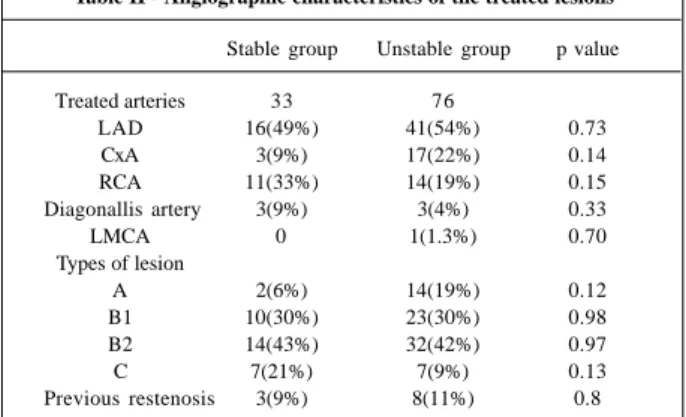
artery, and 18% in the circumflex coronary artery. Six angio-plasties were performed in the diagonal artery and one in the left main coronary artery. No significant difference existed between the groups in regard to distribution of the type of the manipulated artery. In regard to the morphology of the lesion, the majority of the cases were type B lesions (73%), and the distribution of these type B lesions was similar in the 2 groups. The number of type A lesions in the unstable group (19%) was higher than that in the stable group (6%, p=0.12), and type C lesions were more prevalent in the stable group (21% vs 9%, p=0.13) (Table II). All patients used hepa-rin and acetylsalicylic acid, but 2 patients of the stable group did not use ticlopidine. This, however, did not influ-ence the results because none of these patients had in-hos-pital or late events. Only one patient used abciximab.
Primary angiographic success was obtained in all pa-tients. No death occurred nor did a need arise for
revascu-larization of the culprit artery during the in-hospital phase. The incidences of acute myocardial infarction during hos-pitalization and after the procedure were similar in both groups (3.2% in the stable group and 1.4% in the unstable group, p=0.6), and no patient had Q wave infarction. In the multivariate analysis of logistic regression, no significant dif-ference in the incidence of events occurred between the groups after controlling for confounding variables: p=0.31; odds ratio = 0.31; 95% CI = 0.03-2.7. No variable proved to be a predictor of complication in this analysis. The mean of re-duction in the hemoglobin measured after the procedure was 0.91±1.47 g% in the stable group and 0.97±1.42 g% in the unstable group (p=0.8) (table III).
Data on the posthospital evolution of 29 and 70 pa-tients of the stable and unstable groups, respectively, were obtained. Table IV shows the results. The time between patient discharge and data collection was 11.4±1.5 months (median of 9 months) in the stable group and 9.5±0.7 months (median of 8 months) in the unstable group, which was not a significant difference (p=0.2). The incidence of combined events (death, acute myocardial infarction, and revasculari-zation of the culprit artery) was similar for both groups: 6.9% in the stable group and 5.7% in the unstable group, p=0.8. Analysis of the event-free survival showed no diffe-rence in the curves of the two groups (p=0.8) (fig. 1). One death occurred in each group, corresponding to an inciden-ce of 3.5% and 1.4% in the stable and unstable groups, res-pectively (p=0.6). Acute myocardial infarction occurred in only one patient of the unstable group (1.4%, p=0.7), with no Q wave and no elevation of the ST segment. The need for revascularization of the culprit artery had a similar distri-bution in both groups (6.5% in the stable group and 5.4% in the unstable group, p=0.8). The only infarcted patient of the unstable group underwent revascularization surgery, which resulted in death.
Analysis of the incidence of infarction considering the in-hospital and the posthospital phases showed no signifi-cant difference between the groups: 6.1% for the stable group and 3.9% for the unstable group, p=0.6. During the follow-up period, a greater number of patients in the unsta-ble group underwent a new coronary angiography due to clinical indication. This difference, however, did not reach statistical significance: 10.3% in the stable group and 18.6% in the unstable group, p=0.4. In the analysis of logistic regres-sion, diabetes mellitus was the only predictor of events (OR=5.2; 95% CI=0.9-29.9; p=0.7).
Discussion
Our results show that intracoronary stent implantati-on in patients with unstable corimplantati-onary syndromes is a safe and efficacious procedure, because of the similarity in the in-hospital and late complication rates as compared with the evolution of patients with stable coronary disease undergo-ing the same procedure. The relative risk of combined even-ts in the unstable group as compared with the stable group was 0.4 in the in-hospital phase and 0.8 in the late follow-up,
Table II - Angiographic characteristics of the treated lesions
Stable group Unstable group p value
Treated arteries 33 76
LAD 16(49%) 41(54%) 0.73
CxA 3(9%) 17(22%) 0.14
RCA 11(33%) 14(19%) 0.15
Diagonallis artery 3(9%) 3(4%) 0.33
LMCA 0 1(1.3%) 0.70
Types of lesion
A 2(6%) 14(19%) 0.12
B1 10(30%) 23(30%) 0.98
B2 14(43%) 32(42%) 0.97
C 7(21%) 7(9%) 0.13
Previous restenosis 3(9%) 8(11%) 0.8
LAD– left anterior descending coronary artery; CxA– circumflex corona-ry artecorona-ry; RCA- right coronacorona-ry artecorona-ry; LMCA– left main coronacorona-ry artecorona-ry.
Table I – Clinical characteristics of the population
Stable Unstable p value group group
Number 31 74
Age (mean ± SD) 61.4±10 60.8±9.8 0.8 Male sex 21(68%) 45(60%) 0.4 Hypertension 20(65%) 48(65%) 0.97 Diabetes mellitus 7(23%) 25(33%) 0.3 Dyslipidemia 19(61%) 53(71%) 0.5 Tobacco smoking 5(16%) 17(23%) 0.5 Systolic LVD 2(7%) 13(17%) 0.3 Multiarterial (>1 artery) 16(52%) 34(45%) 0.3 Previous CABG 2(7%) 6(8%) 0.7 Previous angioplasty 5(16%) 16(21%) 0.5 Braunwald classification
I 6(8%)
II 55(73%)
III 6(8%)
A 0
B 56(75%)
C 11(15%)
Infarction with no ST segment elevation 8(11%)
which are differences without statistical significance. Balloon catheter coronary angioplasty in patients with unstable angina has a higher incidence of thrombosis or acute occlusion within the first 24 hours after the proce-dure 13. Angioplasty followed by stent implantation
pro-vides a greater mechanical support, and recent develop-ments in the implantation technique 5,6 and antiplatelet
regi-mens 7-10 have provided greater safety in the use of stents in
conditions of instability according to Alfonso et al 14. These
authors performed angioplasty with stent implantation in a series of patients with thrombosis adjacent to the atheros-clerotic plaque and had a low incidence of thrombotic com-plications. Marzocchi et al 15 compared patients with
unsta-ble and staunsta-ble angina undergoing stent implantation wi-thout reaching statistical significance, but a higher inciden-ce of complications occurred in the unstable group. On the
other hand, our group did not find any difference favoring the stable group, and the relative risk of the unstable group was always lower than 1.0. Considering that the result of angioplasty is influenced by the time of stabilization 16,17,
this difference may result from the mean time of 7 days that our patients had between the diagnosis and the procedure, while that study analyzed a more heterogeneous populati-on, which also included patients in semi-elective and emer-gency situations with a higher risk.
Inflating balloon pressures of at least 12 atm in ad-dition to the use of ticlopidine and acetylsalicylic acid may reduce the thrombogenic potential of the stent, providing the unstable population a therapy with a lower risk of res-tenosis in the medium- and long-therm. This hypothesis would be ideally tested if a population with unstable angi-na could be randomized for the use of stent or conven-tional angioplasty. Considering the benefit of stenting in the restenosis rate, however, this type of study is not li-kely to become a reality. We believe that our study con-firms this hypothesis.
In the analysis of our data, the repetition rate of coro-nary angiography was higher in the unstable group (not statistically significant), suggesting a worse evolution in that group. These data, however, are limited to this analysis, because this test could have been performed due to ische-mia resulting from a lesion in another artery. In addition, as-sessment of a new procedure in the culprit lesion, a more re-liable criterion, did not show a significant difference bet-ween the groups.
In the multivariate analysis, diabetes mellitus was the only predictive variable of postangioplasty events. Contro-versy in regard to this result exists because recent studies with great samples of patients with diabetes undergoing
Table IV - Results of the late follow-up
Stable group Unstable group RR (95% CI) p value
Number 29 70
Follow-up (months) 11.4±1.5 9,5±0,7 0.2
Combined events 2(6.9%) 4(5.7%) 0.8 (0.1-9.2) 0.8
Infarction* 0 1(1.4%) 0.7
Revascularization 2(6.9%) 4(5.7%) 0.8 (0.1-9.2) 0.8
Death 1(3.5%) 1(1.4%) 0.4 (0.01-32.5) 0.6
Coronary angiography 3(10.3%) 13(18.6%) 1.8(0.5-9.8) 0.4
* All non-Q-wave infarctions.
Table III – In-hospital results
Stable group Unstable group RR (95% CI) p value
Number 31 74
Primary success 31 (100%) 74 (100%)
Infarction* 1(3.2%) 1(1.4%) 0.4 (0.01-32.9) 0.6
Death 0 0
Revascularization 0 0
Hb drop 0.9±1.5 g% 1.0±1.4 g% 0.8
Hb – hemoglobin; * All non-Q-wave infarctions.
Fig. 1 – Combined event-free survival curve showing similar evolution in the unstable and stable patient groups.
Unstable group
Stable group
Follow-up period (days)
stent implantation have shown that only insulin-dependent diabetic patients have a worse late prognosis 18-20.
Our conclusion is limited by the small number of patients in the sample examined, resulting in a higher chance of type II statistical errors. Unlike the study by Marzocchi et al 15, the incidences of complications in the 2
groups were very similar, even tending to be greater in the stable group, resulting in a smaller probability of this sta-tistical error favoring the determination of a false safety in the unstable group. Even though not statistically signi-ficant, a higher prevalence of type A lesions occurred in the unstable group and of type C lesions in the stable group, and some confusion may have occurred in the results. Adjustment of these variables through multiva-riate analysis, however, did not cause changes in the re-sults obtained. In the same way, the follow-up period was smaller in the unstable group (with no statistical diffe-rence), but the multivariate analysis did not reveal any significant influence of this factor in the final results.
As confirmed by the EPISTENT study 17,21, the use of
abciximab significantly reduces the incidence of large non-Q-wave infarctions (elevation of CPK higher than 5 times
its normal value), and an evident synergism of that drug wi-th stent implantation occurs. In addition, wi-the incidence of revascularization of the target lesion after 6 months is smal-ler in diabetic patients using abciximab. Despite the impor-tance of this therapy, our patients underwent the procedure when abciximab was not part of the routine adjuvant therapy to stent implantation. In spite of this, our data suggest that stenting is safe in unstable situations.
Ideally, patients with unstable angina or non-Q-wave myocardial infarction should undergo a period of stabiliza-tion of at least 48 hours before any angioplasty. In this study. The unstable group had a median of 7 days for stabi-lization, and the great majority of the patients with unstable angina were Braunwald class II. Therefore, these results apply to those patients with at least some days of stabili-zation before angioplasty, leading to the conclusion that this procedure should not be performed in the hyperacute phase of clinical presentation.
In conclusion, our study suggests that coronary an-gioplasty with stenting is a safe (in-hospital evolution) and efficacious (late evolution) procedure in patients with uns-table coronary syndromes.
1. Agrawal SK, Ho DSV, Liu MW, et al. Predictors of thrombotic complications af-ter placement of a flexible coil stent. Am J Cardiol 1994; 72: 1216-9. 2. Serruys PW, van Hout B, Bonnier H, et al. Randomised comparison of
implanta-tion of heparin-coated stents with balloon angioplasty in selected patients with coronary artery disease (BENESTENT II). Lancet 1999; 352: 673-81. 3. Stone GW, Brodie BR, Griffin JJ, et al. Clinical and angiographic follow-Up
after primary stenting in acute myocardial infarction: the Primary Angioplas-ty in Myocardial Infarction (PAMI) stent pilot trial. Circulation 1999; 99: 1548-54.
4. Stone GW, Brodie BR, Griffin JJ, et al. Prospective, multicenter study of the safety and feasibility of primary stenting in acute myocardial infarction: in-hospital and 30-day results of the PAMI stent pilot trial. Primary angioplasty in myocardial infarction stent pilot trial investigators. J Am Coll Cardiol 1998; 31: 23-30. 5. Colombo A, Hall P, Nakamura S, et al. Intracoronary stenting without
anticoagu-lation accomplished with intravascular ultrasound guidance. Circuanticoagu-lation 1995; 91: 1676-88.
6. Karrilon GJ, Morice MC, Benveniste E, et al. Intracoronary stenting implanta-tion without ultrasound guidance and with replacement of convenimplanta-tional anti-coagulation by antiplatelet therapy: 30 day clinical outcome of French Multi-center Registry. Circulation 1996; 94: 1519-27.
7. Leon MB, Baim DS, Popma JJ, et al. A clinical trial comparing three antithrombotic-drug regimens after coronary-artery stenting. N Eng J Med 1999; 339: 1665-71. 8. Moussa I, Oetgen M, Roubin G, et al. Effectiveness of clopidogrel and aspirin
ver-sus ticlopidine and aspirin in preventing stent thrombosis after coronary stent implantation. Circulation 1999; 99: 2364-6.
9. EPILOG Investigators. Effect of platelets glicoprotein IIb/IIIa receptor inhi-bitor, abciximab, with lower heparin dosages on ischemic complications of per-cutaneous coronary revascularization. N Eng J Med 1997; 336: 1689-96. 10. Lefcovits J, Ivanhoe RJ, Califf RM, et al. Effects of platelets glicoprotein IIb/IIIa
re-ceptor blockade by a chimeric monoclonal antibody (abciximab) on acute and
References
six-month outcomes after percutaneous transluminal coronary angioplasty for acute myocardial infarction. Am J Cardiol 1996; 77: 1045-51.
11. Braunwald E. Unstable angina. A classification. Circulation 1989; 80: 410-14. 12. Stata Statistical Software V5. Stata Corporation, College Station, TX, 1997-1999; 13. Myler RK, Shaw RE, Stertzer SH, et al. Unstable angina and coronary
angioplas-ty. Circulation 1990; 82(suppl II): 88-95.
14. Alfonso F, Rodriguez P, Phillips P. Clinical and angiographic implications of coronary stenting in thrombus-containing lesions. J Am Coll Cardiol 1997; 29: 725-33.
15. Marzocchi A, Piovaccari G, Marrozzini C, et al. Results of coronary stenting for unstable versus stable angina. Am J Cardiol 1997; 79: 1314-18.
16. Effects of tissue plasminogen activator and a comparison of early invasive and conservative strategies in unstable angina and non-Q-wave myocardial infarc-tion. Results of the TIMI IIIB Trial. Thrombolysis in Myocardial Ischemia. Circulation 1994; 89: 1545-56.
17. Lincoff AM, Califf RM, Moliterno DJ, et al. Complementary clinical benefits of co-ronary-artery stenting and blockade of platelet glycoprotein IIb/IIIa receptors. Evaluation of Platelet IIb/IIIa Inhibition in Stenting Investigators. N Engl J Med 1999; 341: 319-27.
18. Abizaid A, Kornowski R, Mintz GS, et al. The influence of diabetes mellitus on acute and late clinical outcomes following coronary stent implantation. J Am Coll Cardiol 1998; 32: 584-9.
19. Elezi S, Kastrati A, Pache J, et al. Diabetes mellitus and the clinical and angiogra-p-hic outcome after coronary stent placement. J Am Coll Cardiol 1998; 32: 1866-73. 20. Van Belle E, Bauters C, Hubert E, et al. Restenosis rates in diabetic patients: a comparison of coronary stenting and balloon angioplasty in native coronary ves-sels. Circulation 1997; 96: 1454-60.