UNIVERSIDADE DE SÃO PAULO
FACULDADE DE ECONOMIA, ADMINISTRAÇÃO E CONTABILIDADE DEPARTAMENTO DE ECONOMIA
PROGRAMA DE PÓS-GRADUAÇÃO EM ECONOMIA
VENDA A DESCOBERTO E INFORMAÇÃO PRIVILEGIADA SHORT SELLING AND INSIDE INFORMATION
Dimas Mateus Fazio
Orientador: Prof. Dr. Bruno Cara Giovannetti
Prof. Dr. Marco Antonio Zago Reitor da Universidade de São Paulo
Prof. Dr. Reinaldo Guerreiro
Diretor da Faculdade de Economia, Administração e Contabilidade Prof. Dr. Joaquim José Martins Guilhoto
Chefe do Departamento de Economia Prof. Dr. Marcio Issao Nakane
DIMAS MATEUS FAZIO
VENDA A DESCOBERTO E INFORMAÇÃO PRIVILEGIADA SHORT SELLING AND INSIDE INFORMATION
Dissertação apresentada ao
Departamento de Economia da Faculdade de Economia, Administração e Contabilidade da Universidade de São Paulo como requisito para a obtenção do título de Mestre em Ciências.
Orientador: Prof. Dr. Bruno Cara Giovannetti
Versão Corrigida
(versão original disponível na Faculdade de Economia, Administração e Contabilidade)
FICHA CATALOGRÁFICA
Elaborada pela Seção de Processamento Técnico do SBD/FEA/USP
Fazio, Dimas Mateus
Short-selling and inside infornation / Dimas Mateus Fazio. -- São Paulo, 2014.
25 p.
Dissertação (Mestrado) – Universidade de São Paulo, 2014. Orientador: Bruno Cara Giovanetti.
Co-orientador: Rodrigo de Losso da Silveira Bueno.
1. Finanças 2. Economia da informação 3. Operação financeira I. Universidade de São Paulo. Faculdade de Economia, Administra- ção e Contabilidade. II. Título.
i
RESUMO
ABSTRACT
SUMÁRIO
1. INTRODUCTION ... 2
2. LITERATURE REVIEW ... 6
3. THE BRAZILIAN STOCK LOAN MARKET ... 8
4. EMPIRICAL RESULTS ... 12
4.1 Are Stock Borrowers Informed Traders? ... 13
4.2 Do Stock Borrowers Process Information Better? ... 17
4.3 Do Stock Borrowers Anticipate News ... 20
5. CONCLUSION ... 24
1
Introduction
The objective of this paper is twofold. First, I ask whether and which short-sellers are informed. Second, the paper questions what are the sources of this information: do these investors process public information or do they trade on private information? While the for-mer explanation is probably related to a superior investors’ skill in interpreting news, the latter may be related to insider trading and information leakages to outsiders, since investors anticipate the content of yet unreleased public information. To do so, I employ a unique dataset containing the totality of Brazilian stock loan deals from January 2009 to June 2011.1
By itself, this is a clear improvement on the literature that only have access to partial data from either brokerage firms or the U.S. stock markets (NYSE and NASDAQ). If this does not suffice, the dataset also differentiates stock borrowers into specific groups: individuals, insti-tutions, foreigners, among others. I am able, therefore, to compare the information content of each group of short-sellers. To my knowledge, only one paper could do the same using U.S. data (BOEHMER; JONES; ZHANG, 2008).
The main conclusion of this study is that stock borrowers are informed, since a higher than usual short-selling for a specific stock predicts poor future returns for this same stock. This result is not a surprise considering previous literature on the matter. However, I also find that individuals and institutions (i.e. investment funds) are similar informed. That indi-viduals’ short selling can predict future returns in a similar magnitude as institutions is quite startling and unprecedented. When analyzing the causes of this superior information, I find that institutions appear to operate in the market on public information. On the other hand, individuals seem to know ex-ante the sign of a yet unreleased news. Interestingly, foreign in-vestors also increase (decrease) short-selling prior to bad (good) news even though in regular days they are not informed. Contrary to this paper’s results, empirical evidence in the U.S. short-selling market supports the reaction hypothesis, while evidence of anticipation is less robust.
The existence of informed outsiders, i.e., those who get information from insiders, may have serious consequences for the financial market. Although the classic view states that insider trading does help prices to become informative (MANNE, 1966), recent evidence, however, does not espouse this idea. Market efficiency may, in fact, decrease since infor-mation leakages may curb uninformed outsiders from acquiring inforinfor-mation (FISHMAN; HAGERTY, 1992), and their investment might even reduce as consequence of the loss of confidence in the market (AUSUBEL, 1991). For these reasons, the presence of illegal
in-1Note that investors may borrow stocks for several reasons, such as to escape taxes, to hedge their positions,
3
sider trading should not be desirable for regulators. That most countries possess insider trading laws is a proof of this fact. However, according to Bhattacharya and Daouk (2002), laws alone are not a sufficient condition to curb this behavior. In addition to that, there must be law enforcement in the sense of convictions and fair punishments to those who break the law.
2
Literature Review
There appear to be a consensus in the literature that short sellers are, on average, in-formed traders. An inin-formed trader is able to predict firms’ future valuations so as to profit from this operation. In this sense, short sellers that targets overvalued firms, with low future expected returns, are considered informed.2 Diether, Lee and Werner (2008), for instance, provide evidence that short-sellers correct positive market overreactions by trading after pos-itive returns and, at the same time, by predicting lower future returns. Another piece of evidence is presented by Boehmer, Jones and Zhang (2008), who find that the risk-adjusted returns of heavily shorted stocks are 1.16% lower than lightly shorted stocks over the fol-lowing 20 days. As we, Boehmer, Jones and Zhang (2008) are able to differentiate among different types of short sellers and they find that institutional investors are informed, while individual investors are not.
The causes of short sellers superior information, on the other hand, are not clear in the literature. There are two possible sources of information: (i) short-sellers may be good public information processers3, i.e., thereaction hypothesis, or (ii) they may have private
informa-tion which enable them to trade prior to the disclosure of public news, i.e., theanticipation
hypothesis. While (i) means that higher short selling predicts even lower future returns in
periods after news announcements, (ii) means that short-sellers appear to profit from news that were not yet disclosed, leading to suspicions of inside information. Note that these two sources of information are seen in the literature as alternatives. When public information is released, the asymmetry of information among investors is reduced (KORAJCZYK; LU-CAS; MCDONALD, 1991), which undermines the advantage of informed in relation to un-informed traders. This, if short-sellers possess private information, their profitability in days of announcements would be lower. On the other hand, if short-sellers are good information processers, profitability in these days would be enhanced.
Recent empirical evidence for the U.S. stock market gives a solid support to the reac-tion hypothesis. For instance, Wu and Zhang (2013) find out that short-sellers appear to trade by observing and reacting to market anomalies that explain future returns, such as momen-tum, accruals and earning surprises. In fact, when the authors control for these anomalies, short-selling is no longer a predictor of future returns, exhausting the source of short-sellers
2Even though short selling is overall informed, there may be also uninformed short selling. Uninformed
trading here means selling short for other reasons than about information and expectations regarding a firm stock price. For instance, short selling might have hedging motives. Hedge funds relies on borrowing and shorting stocks in their “long-short” strategies (D’AVOLIO, 2002).
3In fact, Rubinstein (1993) and Kandel and Pearson (1995) present evidence that investors interpret release
5
information. Additionally, Engelberg, Reed and Ringgenberg (2012) test both the anticipa-tion and better processing of informaanticipa-tion hypotheses using all corporate news released to the public and they find evidence that short-sellers do interpret public information, but they do not seem to anticipate news events. One issue with this paper, however, is that by considering all types of news, it takes into account even those news that are not surprises to the market. For instance, if the average investor already knows the content of a negative news, prices at the day of announcement will not fall much because of the release (BEAVER, 1968) and, consequently, the increase in short selling prior to the announcement will not be profitable.
3
The Brazilian Stock Loan Market
The paper’s data set contains all lending deals from January 5thof 2009 to June 29thof 2011 traded in the Brazilian stock market (BM&F Bovespa) lending system, called BTC. As a result of the regulatory system,4the Brazilian lending market is centralized, and all lending
deals must the cleared and registered on the BTC system. Thus, the data set provides us with a complete picture of lending activities for the whole market on a daily frequency. Finally, it also allows us to identify the daily amount of shares borrowed by each investors’ type, i.e., whether share were borrowed by individuals, funds (mutual and hedge funds), foreigners or others (mainly commercial banks and pension funds). Funds are responsible for 38.6% of the stock borrowing deals on the database, individuals 30%, foreigners 16.4% and others 15%.
Apart from providing an unique perspective, the data set is also representative of an im-portant lending market. The Brazilian stock lending market has become increasingly strong over the last 10 years. Lending securities currently is a common practice among Brazilian market participants. In 2011, more than U.S.$ 400 billion in stocks were lent in more than 1.4 million deals, representing about one-third of market capitalization of about U.S.$ 1.2 trillion.
The lending system in Brazil works as follows. The BM&F Bovespa provides a plat-form where brokers can register offers from their clients directly through the BTC electronic system. Lenders place shares for loan directly into the system, where borrowers can electron-ically hit the offers. Even though it is also possible for borrowers to place loan bids into the system, this is not usual. More than 99% of the offers placed into BTC come from lenders. Securities lending can also arise from over-the-counter deals, which according to Brazilian regulation, must also be cleared by BM&F Bovespa. In either case, electronic and over-the-counter deals, the BTC registers the information for every deal. As a result, the BTC data set contains historical (order by order) information on the entire securities lending market in Brazil on a daily frequency.
Using the complete data set on lending transactions, this paper constructs variables that measure short-selling activity. By doing so, I implicity assume that short-selling is the major factor explaining why an investor borrow a stock. Investors, however, may borrow a stock for other reasons than short-selling. They may borrow to have voting rights on shareholders
4Based on determinations by the Brazilian Securities Commission (CVM) and by the Brazilian Monetary
7
meetings,5or to fulfill an obligation to deliver a security to settle another transaction.6 During
the term of the contract, as the borrower is regarded by the stock issuer as the effective shareholder, it will be the recipient of all corporate events. However, in this case, the borrower is obliged to reimburse the lender the proceeds of corporate events.7
The Brazilian tax legislation gives rise to another strategy that involves borrowing stocks for a different reason than short-selling.8 As different investors have different
in-come tax deductions, an opportunity for profit arises on cash-payouts events. Suppose the owner of the stock is a foreign investor that decides to lend the stock to collect the loan fee. On the other side of the deal, a Brazilian financial institution borrows the stock, paying the agreed fee. If during the term of the loan contract the stock issuer announces dividends pay-outs, it will credit the borrowers account, and income tax will be deducted according to the borrower’s tax status. In this case, there will be no tax deduction, as financial institutions are exempt. Since the actual owner of the stock is the lender, the BTC system then puts a hold on the borrower’s account on the amount due to the lender, deducting the income tax due to the lender. As the lender is a foreign investor, the income tax deduction will be 15%. Therefore, the borrower’s profit will be the difference between the 15% of the cash dividends minus the loans fees. I do not consider in the analysis the week (5 trading days) prior to the ex-date of dividends.
There is still another aspect of the data that needs to be addressed in order to improve the short-selling activity proxies. Since I am working with equilibrium variables, the activity on the BTC market is a response to both borrowers and lenders demands and supplies. As I am interested in analyzing if short-sellers are informed and can predict future price declines,
5On the other side of the deal, the lender of the equity is entitled to dividends and other payments made
during the term of the loan agreement, including bonuses and consolidations.
6Stocks can also be lent automatically by the Automatic Loan Service (ALS). Whenever an investor sells
a stock it doesn’t have on portfolio at the time of settlement, the ALS locates shares on the BTC System and a loan agreement is automatically generated on behalf of the seller. The buyer receives the securities and the seller is registered as a borrower, paying stipulated fee.
7This process of reimbursements is performed by the BM&F Bovespa clearing house, and works as follows.
In the case of cash payouts, such as dividends, interest and yields, the clearing house creates a credit provision in favor of the lender, retaining the tax due according to the lender’s tax condition. The provision is created on the day of the announcement, and additional collateral is required by the borrower. On the payment date, the cash payment is debited from the borrowers account in favor of the lender’s; borrower’s collateral is then released. On the event of stock dividends, consolidations and splits, the clearing house adjusts the quantity of shares accordingly, maintaining the financial volume of the contract unchanged. Finally, on the case of shares subscriptions, the clearing hose allows the borrower to give the subscription rights back to the lender, but this is not enforced. If subscription rights are not given back, the lender an still buy the stock at the market price, and price difference with the issued price is covered by the borrowed.
8According to Federal law 11,033 of 12/21/2004, income taxes are differ for different investors. If the
one needs to identify demand shifts – the borrowers activity – from supply shifts.
The literature that investigates short-sellers activity from short-selling equilibrium data has proposed some ways to separate demand shifts from supply shifts. Looking at combina-tions of positive and negative changes in prices and quantities, Cohen, Diether and Malloy (2007) propose an identification that reveals weeks in which a out-wards or in-wards supply or demand shifts were predominant. In another paper using the same data set, but with a different set of stock equities, De-Losso, Genaro and Giovannetti (2013) are able to clearly identify demand shifts as, for the stocks they consider, they can control for supply shifts using points they observe on the supply curve.
In this paper, I will follow most papers in this literature, and assume that the supply curve is flatter than the demand curve and that changes in the quantities of equilibrium are a result of demand shifts. I will, however, avoid situations where supply constraints may be binding. Stocks may have zero short-selling because of binding lending supply and not because stock borrowers are optimistic about future returns of this stock, but because of well-known restrictions in the short-selling market (MILLER, 1977; JONES; LAMONT, 2002). As De-Losso, Genaro and Giovannetti (2013) have pointed out for the data set, such con-straint occur sometimes with significant effects on asset returns. Thus, in order to avoid working with illiquid stocks, I restrict the database to stocks that are lent every week, total-izing 62 stocks. I also drop from the data set deals with loan fees higher than 10%. Such high-loan fee deals amounts to only 5% of the data set.
We match the loans data with the Econom´atica dataset. This dataset provides infor-mation on historical stock equity prices (adjusted by splits, inplits, and dividend payouts); shares outstanding, trading volume and book-value. Additionally, risk-factors to adjust re-turns are taken from Brazilian Financial Studies Lab (NEFIN). In the centers’ webpage, there is a detailed description on how the factors were computed for the Brazilian case.9
Table 1 Panel A shows the cross-section statistics of the time-series averages by ticker (62 in total). First, note that only the largest stocks were considered. The average size, measured by market capitalization, is on average US$ 13.3 billions with the lowest US$ 150.99 millions and the largest R$ 152.1 billions.10 The stocks in the data set show great
dispersion on the daily trading volume spectrum. The average volume is US$ 38,3 millions with the smallest being US$ 15 thousand and the largest US$ 1.387.9 billion. The average daily raw return is 0.08% and the average daily standard deviation across stocks is 1.81%.
9Available at the NEFIN webpage on http://www.fipe.org.br/
10Market capitalization is calculated as the number of outstanding shares for the stock times its unadjusted
9
Table 1: Descriptive Statistics
This table presents summary statistics on some stock specific variables in our database (Panel A) and on short selling proxies for each stock (Panel B). We present summary statistics on market capitalization and trading volume by converting these variables from Brazilian Reais (BRL) to US dollars (USD) using a daily average exchange rate. We divide short selling for all investors, and also for their subgroups, i.e.: institutional, individ-ual, foreign and other investors. Stock lending refers to the ratio of shares lent to shares outstanding of stocki
at dayt(in %). Number of Deals equals the number loan deals closed at daytfor each stocki. Loan Fee is the
fee accorded between borrower and lender.
Variable Mean Std. Dev. Min. 25% 50% 75% Max. Panel A: Stock Equities Statistics
Market Cap. (in USD mil) 13,275 21,721 150.99 2,317 4,761,4 12,350.3 152,131 Trading Volume (in USD mil) 38.29 75.79 0.015 5.71 13.87 36.34 1,387.9 Raw Returns (in %) 0.85 2.273 -24.36 -1.196 0 1.292 14.980 Std. Dev. of Raw Returns (in %) 1.817 0.512 0.842 1.474 1.699 2.060 4.560 Risk Adj. Returns (in &) 0.003 1.802 -24.520 -1.018 -0.047 0.972 14.000 Std. Dev. of Risk Adj. Returns (in %) 1.734 0.461 0.918 1.422 1.623 1.951 4.114
Panel B: Stock Borrowing Statistics by Investor’s Type
All deals
Stock Lending (in %) 0.078 0.134 0 0.010 0.035 0.094 6.20 Number of Deals 33.63 39.59 0 8 21 45 582 Loan Fee (in %) 2.686 2.220 0 0.925 1.997 3.823 10
Institutional borrowers
Stock Lending (in %) 0.036 0.080 0 0.002 0.012 0.038 6.140 Number of Deals 12.600 15.841 0 3 8 17 360 Loan Fee (in %)a 2.346 2.273 0 0.519 1.753 3.500 10
Individual borrowers
Stock Lending (in %) 0.005 0.013 0 0.000 0.001 0.004 0.756 Number of Deals 10.776 20.283 0 1 3 12 433 Loan Fee (in %)a 2.812 2.272 0 0.963 2.159 4 10
Foreign borrowers
Stock Lending (in %) 0.024 0.054 0 0.000 0.004 0.022 1.617 Number of Deals 5.148 8.600 0 1 2 6 132 Loan Fee (in %)a
2.519 2.293 0 0.700 1.750 3.640 10 Other borrowers
Stock Lending (in %) 0.014 0.060 0 0 0.002 0.010 4.6251 Number of Deals 4.965 7.401 0 0 2 6 165 Loan Fee (in %)a 2.213 2.079 0 0.663 1.476 3.125 10
Number of Stocks: 62 Days: 637 Obs: 36,963
11
4
Empirical Results
In this section, I explain the methodology and present the results to answer two ques-tions: (i) whether and which stock borrowers are informed; (ii) where does this information comes from: (a) the processing of public information and/or (b) the anticipation of news events. Question (i) analyzes whether abnormal short selling activity is related to lower fu-ture returns. Then, question (ii) accesses the short-selling pattern around news events, more specifically “relevant facts”.
We take data regarding this news category from the BOVESPA’s BDI (Boletim Diario
da BOVESPA), which is released in the end of each session and present detailed information
regarding the trading day, such as prices, dividends and the information disclosed to the public in this trading day, as well. News that are disclosed in holidays, Saturdays, Sundays and after the business hours are assumed to be disclosed on the next trading day. I also take into account the legal hour usually between November and February of the next year that changes the closing hour of the Brazilian stock market from 17 PM to 18 PM.
We choose to work with relevant facts, because, according to Instruction 358 of the CVM, these are news that have significant impacts on security prices or on the investor’s decision to trade these securities.11 In fact, Table 2 shows that on days with relevant facts
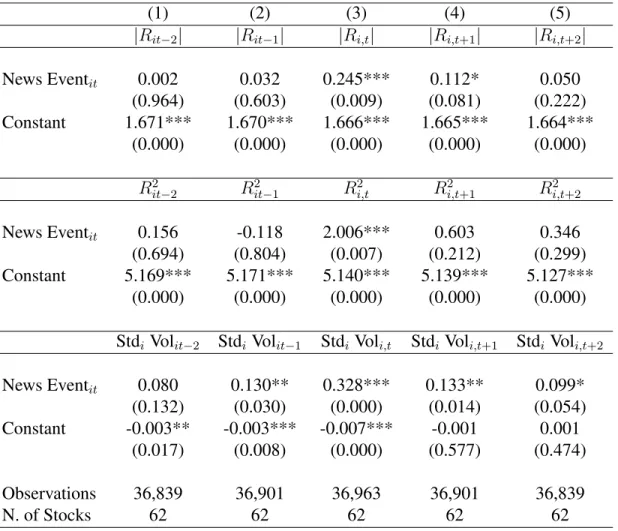
releases, there is an increase on returns’ volatility, measured as the absolute stock return. In fact, days with news announcements increases return volatility by 0.245 p.p., which is an increase of approximately 15% of the volatility on non-announcement periods (which equals the coefficient of the constant in the model).12 Note also that this effect appear to spillover to
the next day as well (significant at 10%). Volume increases significantly fromt−1tot+ 2, wheretis the date of announcement.
According to the literature on the information content of news events, an increased price volatility usually means a change in agents’ expectations of future returns, i.e. a surprise to the market. However, investors differ in their interpretation of news. Until a consensus is reached, increased trading volume would be observed, which may even after the price
11According to this instruction relevant facts are defined as:
“ Art.1 (...) any decisions by majority shareholders, general shareholders’ meetings, or by officers of publicly-held companies, as well as any other acts or facts of a political-administrative, technical, business or financial nature related to the relevant business that may significantly influence:
I –the market price of the securities issued by the relevant corporation or backed on them; II –investors’ decisions as to buy, sell, or preserve those securities;
III –investors’ decision as to exercise any rights inherent to titleholders of securities issued by the by the relevant corporation or backed on them.”
The instruction is available on the CVM website: http://www.cvm.gov.br/ingl/regu/cvm 358.ASP
12In the case of a fixed effects regression, the statistical program employed in this study report the constant
volatility returns to its normal value (BEAVER, 1968).13
Table 2: The impact of Relevant Facts on stocks returns’ volatility
This table shows the results of panel regressions of the absolute risk-adjusted stock returns for stockiand at
dayt(|Rit|), squared risk-adjusted returns (R2
it) and standardized volume (Std Volit) against a dummy (News Eventit) equal to one if at least one relevant fact is disclosed in dayt. We vary the timing of the dependent variables from t-2 to t+2. Returns, measured in %, are risk-adjusted by the three Fama-French risk factors. Std Volitequals the volume standardized within each stock, i.e., Std Volit= V olumeσi(V olumeit−V olumeit) i.
(1) (2) (3) (4) (5)
|Rit−2| |Rit−1| |Ri,t| |Ri,t+1| |Ri,t+2|
News Eventit 0.002 0.032 0.245*** 0.112* 0.050
(0.964) (0.603) (0.009) (0.081) (0.222)
Constant 1.671*** 1.670*** 1.666*** 1.665*** 1.664***
(0.000) (0.000) (0.000) (0.000) (0.000)
R2
it−2 R
2
it−1 R
2 i,t R 2 i,t+1 R 2 i,t+2
News Eventit 0.156 -0.118 2.006*** 0.603 0.346
(0.694) (0.804) (0.007) (0.212) (0.299)
Constant 5.169*** 5.171*** 5.140*** 5.139*** 5.127***
(0.000) (0.000) (0.000) (0.000) (0.000)
Stdi Volit−2 StdiVolit−1 StdiVoli,t Stdi Voli,t+1 Stdi Voli,t+2
News Eventit 0.080 0.130** 0.328*** 0.133** 0.099*
(0.132) (0.030) (0.000) (0.014) (0.054)
Constant -0.003** -0.003*** -0.007*** -0.001 0.001
(0.017) (0.008) (0.000) (0.577) (0.474)
Observations 36,839 36,901 36,963 36,901 36,839
N. of Stocks 62 62 62 62 62
4.1
Are Stock borrowers Informed Traders?
My first question is basically whether stock borrowers target overvalued firms by in-creasing (reducing) their demand for loan contracts when future expected returns are low
13Price volatility and trading volume, however, might be positively correlated (KARPOFF, 1987; HARRIS;
13
(high). The only way a short seller would profit from this strategy is if the future price drop is sufficient to compensate for the taxes it pay to the stock owner. Therefore, another inter-pretation to this question is whether the short-seller profit from its operations.14
In addition to analyzing stock borrowers as a whole, I also want to know which group is more informed. I am able to divide investors into funds, individuals, foreigners and others. The disaggregation of investors into groups enrich this paper’s analysis, because it allows us to compare the results from each group. To my knowledge, only one paper, Boehmer, Jones and Zhang (2008) was able to divide investors by their type. These authors find that institutional investors are informed, while individuals are not.
Since this paper proposes to test whether short-selling and future returns are negatively correlated, the empirical model is as follows:
Ri;w+1:w+k = β0i+β1Lendingiw +β2LoanF eeiw+γ1Ri,w−1+γ2Ri,w−2
+ Week Dummiesw +εwt
(1)
where Ri;w+1:w+k representsk-weeks ahead risk-adjusted returns (k= 1, 2), and Lendingiw is a short selling proxy for stocki and week w. I employ the Loan Fee to control for the difficulty in shorting the stock in a specific period. I also include the lagged returns (Riw−1
and Riw−2) to control for the response of stock borrowers to past returns. Diether, Lee and
Werner (2008) bring evidence that short-sellers appear to trade more after positive returns and, therefore, including these variables as controls might prove useful. Should one finds a negative coefficient for Lending, i.e. β1 < 0, then a greater (lower) short selling at weekt predicts lower (greater) future returns. This means that stock borrowers are informed traders. Table 3 shows how raw returns react to short short selling for all stock borrowers, and also divided by type: institutional, individual, foreign and other investors. I present the same regressions in Table 4, but employing Fama-French risk-adjusted returns. In both tables, I employ a standardized version of the stock borrowing variable. It is believed that this way one can better compare the results, since short selling differ in magnitudes and variability among these groups of investors. All regressions are estimated by fixed-effects and they also include week dummies.
In columns [1] and [2] of Tables 3 and 4, one can see evidence that stock borrowers are informed traders. The coefficients of Std. Lendingitare all negative and only insignificant for 1 week-ahead returns. An increase in 1 std. dev. in the shares lent to shares outstanding ratio is related with an decrease of the 2-week ahead risk-adjusted returns in approximately 0.15%.
14Remember that this paper uses stock borrowing variables to proxy for short-selling. This question,
14
This table presents the regression of one-, two-weeks ahead returns on a proxy of short-selling at weekw, Lendingiw, equal to the standardized ratio between
share lent and shares outstanding (known as shorting flow). We present the results for the aggregation of investors (columns [1] and [2]) and also disaggregated by
investor’s type: institutional, individual, foreigners and others (columns [3] to [10]). RRaw
i,w+1is the1-week ahead raw returns of stocki, measured in %; RRawi,w+1:w+2
is the2-week ahead raw returns. We add the Loan Fee of stockias an additional control. We first create the daily Loan Fee average (by number of deals) and then
employ the week-average of this variable as control. Finally, we also include two lags of Raw Returns as explanatory variables. We estimate the regressions by fixed effects and we also include time (week) dummies as additional controls. We compute standard errors clustered by stocks, which controls for cross-section effects, in parenthesis.
**** p<0.01, ** p<0.05, * p<0.1
All Institutional Individual Foreign Others
(1) (2) (3) (4) (5) (6) (7) (8) (9) (10)
VARIABLES RRaw
i,w+1 RRawi,w+1:w+2 RRawi,w+1 RRawi,w+1:w+2 RRawi,w+1 Ri,wRaw+1:w+2 RRawi,w+1 RRawi,w+1:w+2 RRawi,w+1 RRawi,w+1:w+2
Lendingiw -0.072 -0.239** -0.095 -0.237** -0.043 -0.210** 0.045 -0.001 -0.032 -0.056
(0.065) (0.097) (0.062) (0.106) (0.057) (0.089) (0.063) (0.094) (0.066) (0.077)
Loan Feeiw 0.030 0.027 0.028 0.022 0.027 0.015 0.027 0.024 0.030 0.025
(0.065) (0.107) (0.065) (0.107) (0.065) (0.106) (0.065) (0.106) (0.065) (0.106)
Constant 0.620 1.123 0.624 1.152 0.637 1.172 0.662 1.197 0.639 1.191
(0.624) (0.999) (0.627) (0.998) (0.628) (0.997) (0.624) (0.994) (0.625) (0.991)
Control forRRawi,w
−1andR
Raw
i,w−2 Yes Yes Yes Yes Yes Yes Yes Yes Yes Yes
Week Dummies Yes Yes Yes Yes Yes Yes Yes Yes Yes Yes
Observations 6,641 6,580 6,641 6,580 6,641 6,580 6,641 6,580 6,641 6,580
R-squared 0.312 0.346 0.312 0.346 0.312 0.346 0.311 0.346 0.311 0.346
15
Table 4: Are Short-Seller Informed Traders? Risk-Adjusted Return
This table presents the regression of one-, two-weeks ahead returns on a proxy of short-selling at weekt, Lendingiw, equal to the standardized ratio between share
lent and shares outstanding (known as shorting flow). We present the results for the aggregation of investors (columns [1] and [2]) and also disaggregated by investor’s type: institutional, individual, foreigners and others (columns [3] to [10]). RAdj.i,w+k is thek-week ahead risk-adjusted returns, employing the Fama-French
three factors, measured in %. We add the Loan Fee of stockias an additional control. We first create the daily Loan Fee average (by number of deals) and then
employ the week-average of this variable as control. Finally, we also include two lags of Raw Returns as explanatory variables We estimate the regressions by fixed effects and we also include time (week) dummies as additional controls. We compute standard errors clustered by stocks, which controls for cross-section effects, in parenthesis.
**** p<0.01, ** p<0.05, * p<0.1
All Institutional Individual Foreign Others
(1) (2) (3) (4) (5) (6) (7) (8) (9) (10)
VARIABLES RAdj.i,w+1 RAdj.i,w+1:w+2 RAdj.i,w+1 RAdj.i,w+1:w+2 RAdj.i,w+1 RAdj.i,w+1:w+2 RAdj.i,w+1 RAdj.i,w+1:w+2 RAdj.i,w+1 RAdj.i,w+1:w+2
Lendingiw -0.054 -0.153* -0.060 -0.158* -0.031 -0.173** -0.012 -0.072 -0.004 0.042
(0.061) (0.091) (0.062) (0.094) (0.054) (0.082) (0.063) (0.093) (0.078) (0.081)
Loan Feeiw -0.039 -0.103 -0.040 -0.106 -0.041 -0.111 -0.039 -0.101 -0.040 -0.106
(0.060) (0.092) (0.060) (0.092) (0.061) (0.092) (0.060) (0.092) (0.060) (0.091)
Constant 0.699 0.152 0.705 0.169 0.712 0.179 0.711 0.169 0.716 0.204
(0.575) (0.877) (0.577) (0.876) (0.578) (0.874) (0.577) (0.880) (0.576) (0.871)
Control forRAdj.
i,w−1and RAdj.
i,w−2 Yes Yes Yes Yes Yes Yes Yes Yes Yes Yes
Week Dummies Yes Yes Yes Yes Yes Yes Yes Yes Yes Yes
Observations 6,641 6,580 6,641 6,580 6,641 6,580 6,641 6,580 6,641 6,580
R-squared 0.056 0.067 0.056 0.067 0.056 0.067 0.056 0.066 0.056 0.066
This is not surprising given the overwhelming empirical evidence that these investors, in fact, know what they are doing.
When one looks to the results for different types of investors, one finds an intriguing result. Individuals investors are not only informed, which goes against Boehmer, Jones and Zhang (2008) results for the U.S. financial market, but they also appear to be as informed as institutional investors. On the other hand, foreigners and other investors do not appear to be informed, overall. On average, these investors may borrow stocks for other reasons than to short them, because if they sell short the stocks they borrow, they would not get any profit from it.
4.2
Do Stock borrowers Process Information Better?
Now that I have found that stock borrowers, especially institutional and individual in-vestors, are informed traders, this paper moves on to answering whether this advantage comes from superior processing abilities of public disclosed news. One hypothesis is that stock bor-rowers are able to interpret public disclosed news efficiently by inferring their sign correctly and acting in the short-selling market accordingly. If this is the case, one expects that short selling may predict even lower future expected returns on news days with news events.
To test if short sellers derive their informational advantage from information process-ing, one must run the following regression:
Ri;t+1:t+k = β0+β1Lendingit+β2LendingitN ewsi,t:t−2+β3N ewsi,t
+ γ1Ri,t−1:t−5 +γ2Ri,t−6:t−10+Week Dummies+εit
(2)
where Ri;t+1:t+krepresentsk-days ahead risk-adjusted returns (k = 5, 10), Lendingitis a short selling proxy, “Newsi,t:t−2” is a dummy variable equal to one if news are disclosed in day t, t−1ort−2. As in equation (1), I include the one- and two-week lagged returns (Ri,t−1:t−5
and Ri,t−6:t−10) to control for the response of stock borrowers to past returns (DIETHER;
LEE; WERNER, 2008)
17
Table 5 displays the results of whether stock borrowers, and their types, as well, are processors of “relevant facts” employing raw returns as the dependent variable. In Table 6, I present the same regressions, but employing risk-adjusted returns as the dependent variable.
One can see by the interaction between short selling and the news dummy in columns [1] and [2] in both Tables that future returns predictability is enhanced on days with relevant facts releases. Coefficients are significant at 10% level for both 1- and 2-week ahead returns. Note, also, that the coefficients are economically significant, since the relationship between lending and future returns is several times stronger on news announcement days. An increase in 1 std. dev. of Lendingit decreases 1-week ahead returns in 0.205% on days soon after relevant facts disclosures. This seems to give some evidence to corroborate the hypothesis that stock borrowers can interpret news more efficiently and, thus, enhance their profits by operating in response to them.
When I divide the stock borrowing by different types of investors from column [3] to [10], one can conclude that both institutional and other borrowers are actually those that are leading the results. The coefficients are statistically significant and large in size with the ex-ception of one-week ahead returns for the other borrowers’ specification. For individual and foreign borrowers, the same conclusion does not appear to hold. Even though the coefficients of the interactions are negative in columns [5] to [10], they are not statistically significant at a 10% level.
18
This table presents the regression of 5-, 10-days ahead returns on a proxy of short-selling at dayt, Lendingit, equal to the standardized ratio between share lent and
shares outstanding (known as shorting flow), a dummy equal to one if a relevant fact was released on dayt,t−1andt−2and their interaction. We present the
results for the aggregation of investors (columns [1] and [2]) and also disaggregated by investor’s type: institutional, individual, foreigners and others (columns [3]
to [10]). RRaw
i,t+1:t+k is thek-day ahead raw returns for stocki, measured in %. We estimate the regressions by fixed effects and we also include time dummies as
additional controls. We compute standard errors clustered by stocks, which controls for cross-section effects, in parenthesis **** p<0.01, ** p<0.05, * p<0.1
All Institutional Individual Foreign Others
(1) (2) (3) (4) (5) (6) (7) (8) (9) (10)
VARIABLES RRaw
i,t+1:t+5 RRawi,t+1:t+10 RRawi,t+1:t+5 RRawi,t+1:t+10 RRawi,t+1:t+5 RRawi,t+1:t+10 RRawi,t+1:t+5 RRawi,t+1:t+10 RRawi,t+1:t+5 RRawi,t+1:t+10
Lendingit 0.023 -0.056 -0.021 -0.093 0.012 -0.040 0.042 0.010 0.035 0.027
(0.040) (0.057) (0.038) (0.061) (0.036) (0.044) (0.037) (0.057) (0.022) (0.029)
Lendingit*Newsi,t:t−2 -0.221** -0.424** -0.100 -0.284** -0.033 -0.216 -0.152 -0.184 -0.317* -0.555***
(0.108) (0.186) (0.092) (0.138) (0.105) (0.134) (0.140) (0.265) (0.173) (0.204)
Newsi,t:t−2 0.175 0.059 0.168 0.050 0.159 0.025 0.167 0.032 0.169 0.038
(0.139) (0.226) (0.136) (0.224) (0.136) (0.222) (0.136) (0.220) (0.137) (0.223)
Constant 3.494*** -1.909** 3.486*** -1.915** 3.493*** -1.915** 3.501*** -1.904** 3.493*** -1.902**
(0.432) (0.856) (0.433) (0.858) (0.435) (0.855) (0.433) (0.858) (0.435) (0.856)
Control forRi,t
−1:t−5 Yes Yes Yes Yes Yes Yes Yes Yes Yes Yes
andRi,t−6:t−10
Week Dummies Yes Yes Yes Yes Yes Yes Yes Yes Yes Yes
Observations 34,546 34,238 34,546 34,238 34,546 34,238 34,546 34,238 34,546 34,238
R-squared 0.224 0.291 0.224 0.291 0.224 0.291 0.224 0.291 0.224 0.291
19
Table 6: Do Short-Sellers Process Public Information? Risk-Adjusted Returns
This table presents the regression of 5-, 10-days ahead returns on a proxy of short-selling at dayt, Lendingit, equal to the standardized ratio between share lent and
shares outstanding (known as shorting flow), a dummy equal to one if a relevant fact was released on dayt,t−1andt−2and their interaction. We present the
results for the aggregation of investors (columns [1] and [2]) and also disaggregated by investor’s type: institutional, individual, foreigners and others (columns [3]
to [10]). RAdj.i,t+1is thek-day ahead risk-adjusted returns, employing the Fama-French three factors, measured in %. We estimate the regressions by fixed effects and
we also include time dummies as additional controls. We compute standard errors clustered by stocks, which controls for cross-section effects, in parenthesis **** p<0.01, ** p<0.05, * p<0.1
All Institutional Individual Foreign Others
(1) (2) (3) (4) (5) (6) (7) (8) (9) (10)
VARIABLES RAdj.i,t+1:t+5 RAdj.i,t+1:t+10 Ri,tAdj.+1:t+5 RAdj.i,t+1:t+10 RAdj.i,t+1:t+5 RAdj.i,t+1:t+10 RAdj.i,t+1:t+5 RAdj.i,t+1:t+10 RAdj.i,t+1:t+5 RAdj.i,t+1:t+10
Lendingit 0.016 -0.042 -0.014 -0.069 0.022 -0.018 0.015 -0.033 0.031 0.049*
(0.032) (0.040) (0.035) (0.046) (0.033) (0.042) (0.033) (0.049) (0.022) (0.027)
Lendingit*Newsi,t:t−2 -0.205* -0.377* -0.154* -0.276* -0.002 -0.187 -0.120 -0.120 -0.200 -0.499**
(0.118) (0.206) (0.088) (0.141) (0.090) (0.168) (0.136) (0.244) (0.144) (0.201)
Newsi,t:t−2 -0.026 -0.194 -0.030 -0.201 -0.043 -0.224 -0.035 -0.219 -0.035 -0.212
(0.140) (0.235) (0.140) (0.234) (0.140) (0.232) (0.138) (0.230) (0.139) (0.234)
Constant -0.125 -1.937** -0.131 -1.941** -0.120 -1.937** -0.121 -1.918** -0.123 -1.928**
(0.440) (0.856) (0.441) (0.857) (0.444) (0.854) (0.442) (0.855) (0.443) (0.856)
Control forRi,t
−1:t−5 Yes Yes Yes Yes Yes Yes Yes Yes Yes Yes
andRi,t −6:t−10
Week Dummies Yes Yes Yes Yes Yes Yes Yes Yes Yes Yes
Observations 34,546 34,238 34,546 34,238 34,546 34,238 34,546 34,238 34,546 34,238
R-squared 0.045 0.066 0.045 0.066 0.045 0.066 0.045 0.066 0.045 0.066
4.3
Do Stock borrowers Anticipate News?
Another reason for short sellers’ being informed is the possessing of private informa-tion, which may enable them to even anticipate news content. The literature has pointed out some reasons why these investors might be able to “foresee” future news: (i) superior monitoring of the firm situation; (ii) inside information, i.e., the stock borrowers are people connected to the firm (insiders) or they are getting tips from insiders. The possibility of inside information by itself is worrisome and has implications for regulators.
The paper’s empirical approach to test news anticipation is to analyze how short selling behaves around news disclosures through the following regression, conditional ontbeing a news announcement day:
Stdi Lendingi,t−k:t−1 = β0+β1Ri,t:t+1+
p
X
z=1
γzControlszit+εit (3)
where the dependent variable is standardized for each stocki, i.e.:
StdiLendingit =
Lendingit−Ei(Lendingit)
σi(Lending) (4)
and then averaged for t−k to t−1 (k = 10, 5, 2, 1); and Controlsz,i,t is a vector of con-trol variables. I include past average returns (Reti,t−1:t−k), past turnover (TurnOveri,t−1:t−k)
defined as trading volume over market capitalization and 1-year price momentum.
We standardize the dependent variable within each stock so as to give the same weight to variations of stock borrowing. Otherwise, one would be giving too much weight to stocks with larger average stock-borrowing, while the interest is to know whether news are antici-pated regardless of differences in the cross-sectional characteristics of stocks.
We assume that Ri,t:t+1 (the cumulated return on the day of announcement and the day after) reflects the quality of the news. The use of this variable is justified by the increased volatility on these two days, as seen in Table 2, which means that it takes two days for the market to not consider the average relevant fact a surprise anymore.
The hypothesis that short sellers do possess private information is confirmed ifβ1 <0, i.e., if abnormal short-selling increases (decreases) before a negative (positive) news. Tables 7 and 8 present the results. On average, it can be concluded that short-sellers also appear to anticipate the content of relevant facts. An decrease in 1% of the cumulated return on day
21
Again, when I divide by investors type, one can see that the result appears to come from only a part of the investors. In this case, both individual and foreign investors anticipate news 10-days prior to disclosure, while institutions do not. Even though foreign investors are not overall informed (see section 4.1), they appear to be in the days prior to relevant facts announcements. Note that individual investors supposedly are not as qualified as institutions to acquire information and interpret news. In addition, relevant facts are news whose release dates are not predictable and information content is indeed relevant for the market. These ar-guments together give a stronger strengthen the evidence of the practice of inside information in the Brazilian stock loan market.
Some other considerations must be made regarding these results. First, it is probable that only a few individual investors have inside information, thus the results pointing to the direction of inside information might be underestimated. Second, information leakages are not likely to take place in all relevant facts disclosures, again underestimating the inside information. These two considerations might explain the apparently small coefficients of the variable Reti,t:t+1in Tables 7 and 8.
Table 7: Do Short-Sellers Anticipate News Events? All Investors
This table presents the regression (conditional ontbeing a relevant fact announcement day) of the average short
selling in the days prior to news announcement against the cumulated returns on the daytand the day aftert. We
standardize the short-selling proxy within each stock as in equation 4. We include uncontrolled and controlled specifications. The controls are: cumulated past returns; average past turnover, calculated as the ratio of trading volume to market capitalization; and 1-year price momentum.
Var. Dep.: StdiLendingi,t−k:t−1
All deals
(1) (2) (3) (4) (5) (6) (7) (8)
VARIABLES k = 10 k = 5 k = 2 k = 1
Reti,t:t+1 -0.022** -0.023** -0.019* -0.019 -0.009 -0.011 -0.005 -0.010
(0.009) (0.009) (0.012) (0.012) (0.017) (0.017) (0.020) (0.020) Constant 0.001 -0.795** 0.018 -1.197** 0.047 -1.843*** 0.068* -1.805**
(0.019) (0.404) (0.022) (0.468) (0.029) (0.670) (0.036) (0.719)
Controls No Yes No Yes No Yes No Yes
Observations 666 648 696 677 708 689 719 700
R-squared 0.007 0.035 0.004 0.023 0.001 0.020 0.000 0.019
This table presents the regression (conditional ontbeing a relevant fact announcement day) of the average short
selling in the days prior to news announcement against the cumulated returns on the daytand the day aftert. We standardize the short-selling proxy within each stock as in equation 4. We include uncontrolled and controlled specifications. The controls are: cumulated past returns; average past turnover, calculated as the ratio of trading volume to market capitalization; and 1-year price momentum.
Var. Dep.: StdiLendingi,t−k:t−1
Institutional borrowers
(1) (2) (3) (4) (5) (6) (7) (8)
VARIABLES k = 10 k = 5 k = 2 k = 1
Reti,t:t+1 -0.013 -0.014 -0.014 -0.014 0.002 0.000 0.011 0.002
(0.010) (0.011) (0.014) (0.014) (0.020) (0.020) (0.030) (0.029) Constant 0.030 -0.300 0.047** -0.618 0.086** -1.450** 0.115** -1.152 (0.019) (0.412) (0.023) (0.498) (0.033) (0.714) (0.046) (0.792)
R-squared 0.003 0.010 0.002 0.008 0.000 0.012 0.000 0.010
Individual borrowers
(1) (2) (3) (4) (5) (6) (7) (8)
VARIABLES k = 10 k = 5 k = 2 k = 1
Reti,t:t+1 -0.017** -0.016* -0.021** -0.021** -0.006 -0.009 0.002 -0.004
(0.008) (0.009) (0.010) (0.011) (0.014) (0.014) (0.014) (0.013) Constant -0.013 -0.924** -0.016 -1.347*** -0.011 -0.863* -0.012 -0.719 (0.019) (0.376) (0.020) (0.383) (0.026) (0.493) (0.032) (0.631)
R-squared 0.005 0.023 0.006 0.029 0.000 0.011 0.000 0.007
Foreign borrowers
(1) (2) (3) (4) (5) (6) (7) (8)
VARIABLES k = 10 k = 5 k = 2 k = 1
Reti,t:t+1 -0.020** -0.021** -0.017 -0.017 -0.005 -0.007 -0.006 -0.007
(0.008) (0.008) (0.010) (0.011) (0.013) (0.013) (0.017) (0.018) Constant -0.013 -0.712* 0.002 -1.117** -0.007 -1.760*** 0.005 -2.259***
(0.018) (0.366) (0.022) (0.442) (0.027) (0.615) (0.035) (0.717)
R-squared 0.007 0.024 0.003 0.017 0.000 0.018 0.000 0.022
Other borrowers
(1) (2) (3) (4) (5) (6) (7) (8)
VARIABLES k = 10 k = 5 k = 2 k = 1
Reti,t:t+1 -0.011 -0.012 -0.010 -0.007 -0.028 -0.028 -0.031 -0.033*
(0.009) (0.009) (0.011) (0.011) (0.018) (0.018) (0.019) (0.019)
Constant -0.012 -0.640 -0.001 -0.632 0.027 -0.430 0.030 -0.205
(0.017) (0.434) (0.020) (0.435) (0.028) (0.630) (0.036) (0.817)
R-squared 0.002 0.030 0.001 0.022 0.005 0.014 0.004 0.009
Observations 666 648 696 677 708 689 719 700
Controls No Yes No Yes No Yes No Yes
23
5
Conclusion
We conclude that short-sellers are informed since higher short-selling is related to lower future returns. Surprisingly, both Brazilian individual and institutional investors have a sim-ilar degree of information in the sense that short-selling by both groups predict lower future returns in a similar magnitude. This result goes against the results of Boehmer, Jones and Zhang (2008) for the U.S. market who find that only institutions are informed.
This result made us wonder the source of short-sellers information. This paper answers this question by analyzing how short-selling behaves around specific news events, known as “relevant facts”. The evidence points out that institutions have the ability to process public information disclosures better, a result consistent with the American case. Brazilian individ-uals, on the other hand, seem to anticipate news releases, by increasing their short-selling activities prior to the release of negative relevant facts.
References
AUSUBEL, L. M. Insider trading in a rational expectations economy.The American Economic Review, v. 80, n. 5, p. 1022–1041, 1991.
BEAVER, W. H. The information content of annual earnings announcements.Journal of Accounting Research, v. 6, p. 67–92, 1968.
BHATTACHARYA, U.; DAOUK, H. The world price of insider trading.The Journal of Finance, v. 57, n. 1, p. 75–108, 2002.
BLAU, B. M.; PINEGAR, J. M. Are short sellers incrementally informed prior to earnings announcements?Journal of Empirical Finance, v. 21, p. 142–155, 2012.
BLAU, B. M.; WADE, C. Informed or speculative: Short selling analyst recommendations.
Journal of Banking & Finance, v. 36, p. 14–25, 2012.
BOEHMER, E.; JONES, C.; ZHANG, X. Which shorts are informed? The Journal of
Finance, v. 63, n. 2, p. 491–527, 2008.
BOEHMER, E.; JONES, C.; ZHANG, X. What do short sellers know? 2012.
CHAKRABARTY, B.; SHKILKO, A. Information transfers and learning in financial markets: Evidence from short selling around insider sales.Journal of Banking & Finance, v. 37, p. 1560–1572, 2013.
CHRISTOPHE, S. E.; FERRI, M. G.; ANGEL, J. J. Short-selling prior to earnings announcements.Journal of Finance, v. 59, n. 4, p. 1845–1875, 2004.
CHRISTOPHE, S. E.; FERRI, M. G.; HSIEH, J. Informed trading before analyst downgrades: Evidence from short sellers.Journal of Financial Economics, v. 95, p. 85–106, 2010.
COHEN, L.; DIETHER, K. B.; MALLOY, C. J. Supply and demand shifts in the shorting market.The Journal of Finance, v. 62, n. 5, p. 2061–2096, 2007.
DASKE, H.; RICHARDSON, A.; TUNA, I. Do short sale transactions precede bad news events?Working Papers, University of Pennsylvania, 2005.
D’AVOLIO, G. The market for borrowing stock.Journal of Financial Economics, v. 66, p. 271–306, 2002.
DE-LOSSO, R.; GENARO, A. D.; GIOVANNETTI, B. Testing the effects of short-selling restrictions on asset prices. 2013.
25
DIETHER, K.; LEE, K.; WERNER, I. Short-salestrategies and return predictability.Review of Financial Studies, v. 22, p. 575–607, 2008.
ENGELBERG, J. E.; REED, A. V.; RINGGENBERG, M. C. How are shorts informed? Short sellers, news and information processing.Journal of Financial Economics, v. 105, p. 260–278, 2012.
FISHMAN, M. J.; HAGERTY, K. M. Insider trading and the efficiency of stock prices.The RAND Journal of Economics, v. 23, n. 1, p. 106–122, 1992.
HARRIS, M.; RAVIV, A. Differences of opinion make a horse race.Review of Financial Studies, v. 6, p. 473–506, 1993.
JONES, C. M.; LAMONT, O. A. Short-sale constraints and stock returns. Journal of Financial Economics, v. 66, p. 207–239, 2002.
KANDEL, E.; PEARSON, N. Differential interpretation of public signals and trade in speculative markets.Journal of Political Economy, v. 103, p. 831–872, 1995.
KARPOFF, J. M. The relation between price changes and trading volume: A survey.Journal of Financial and Quantitative Analysis, v. 22, n. 1, p. 109–126, 1987.
KARPOFF, J. M.; LOU, X. Short sellers and financial misconduct.Journal of Finance, v. 65, n. 5, p. 1879–1913, 2010.
KORAJCZYK, R. A.; LUCAS, D. J.; MCDONALD, R. L. The effect of information releases on the pricing and timing of equity issues.The Review of Financial Studies, v. 4, n. 4, p. 685–708, 1991.
MANNE, H. G.Insider Trading and the Stock Market. New York: Free Press, 1966.
MILLER, E. M. Risk, uncertainty, and divergence of opinion.Journal of Finance, v. 32, n. 4, p. 1151–1168, 1977.
RUBINSTEIN, A. On price recognition and computational complexity in a monopolistic model.Journal of Political Economy, v. 101, p. 473–484, 1993.