CASE REPORT
Acupuncture and exercise capacity: A case report
Reginaldo Ceolin do Nascimento,ICarlos Alberto Cordeiro Hossri,IOtavio Berwanger,IIVitor Oliveira CarvalhoII,IIIIHospital do Corac¸a˜o (HCor), Servic¸o de Reabilitac¸a˜o Cardı´aca, Pulmonar e Metabo´lica, Sa˜o Paulo/SP, Brazil.IIHospital do Corac¸a˜o (IEP-HCor), Instituto de Ensino e Pesquisa, Sa˜o Paulo/SP, Brazil.IIIHospital das Clı´nicas da Faculdade de Medicina da Universidade de Sa˜o Paulo (InCor HCFMUSP), Unidade de Cirurgia Cardı´aca Pedia´trica, Sa˜o Paulo/SP, Brazil.
Email: [email protected] Tel.: 55 11 3053-6611
INTRODUCTION
Although acupuncture was once a purely empirical technique; it is now used as a valuable tool in scientific research and health maintenance (1).
The physiological effects of inserting needles into specific body points have inspired studies on the prevention and treatment of various diseases and syndromes. Nevertheless, the effects of acupuncture on sedentary, healthy individuals have not yet been explored.
Acupuncture has been reported to improve endurance during a range of activities, from everyday tasks to several types of sports (1). Many benefits of acupuncture appear to be related to the release of endorphins, decreased sympa-thetic activity and an increased tolerance to fatigue (1,2). Nevertheless, acupuncture as an adjunct technique for improving physical capacity remains poorly understood.
This case report aims to describe the cardiorespiratory parameters before and after acupuncture/moxibustion in a healthy, sedentary individual.
CASE DESCRIPTION
A 30-year-old sedentary, non-smoking male patient without risk factors for cardiovascular disease was referred to our hospital for cardiovascular assessment before an exercise-training program (a program to improve health and well-being). The patient was invited to attend one hour of acupuncture sessions for ten consecutive days. The patient did not participate in exercise training during the time period of these ten acupuncture sessions. To assess his exercise capacity, the patient underwent a treadmill cardiopulmonary exercise test (MedGraphics CardiO2, Medical Graphics Corp., St. Paul, MN, USA) with a ramp protocol before and after each session of acupuncture.
In this patient, we placed 25630 mm needles in the following points: Zusanli (ST36), Neiguan (PC6), Yanglingquan (GB34), Zhongfu (LU1), Guanyuan (CV4), Shangzhong (CV17), Geshu (BL17), Shenshu (BL23), and Zhishi (BL52 or BL47). Moxibustion (a technique that involves heating the acupunc-ture points by burning herbs, usually dry Artemisia -Artemisia
vulgaris) was performed on four points: Zusanli (E36), Guanyuan (VC4), Shenshu (B23), and Zhishi (B52 or 47).
DISCUSSION
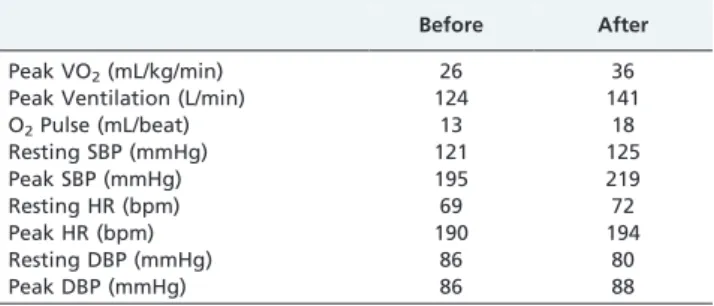
In the present report, the patient exhibited a large improvement in his exercise capacity after the acupuncture therapy. The patient improved in peak VO2by 38%, peak ventilation by 13% and O2pulse by 38%. The hemodynamic variables did not indicate an expressive increase, except for in the peak systolic blood pressure (SBP) (increase of 12%). After acupuncture, the patient exhibited a 3% increase in resting systolic blood pressure (SBP), a 2% increase in peak diastolic blood pressure (DBP), a 4% increase in resting heart rate (HR), and a 2% increase in peak heart rate (Table 1).
Several acupuncture points have been proposed to act on the cardiovascular, respiratory and metabolic systems (3), with and without the aim of improving exercise capacity. The most commonly used points are Zusanli (ST36) and Neiguan (PC6) (3). However, other acupuncture points, such as LieQue (LU7) and XiMen (PC4), have also been reported in the literature to act on the cardiovascular system (4).
For the patient in the present case, the original combina-tion of acupuncture points, in associacombina-tion with moxibuscombina-tion, appeared to result in the large improvement in his exercise capacity. Ling et al. (3) evaluated the relationship between electroacupuncture and cardiopulmonary function in three groups of healthy male volunteers: 1) acupuncture at the Neiguan (PC6) and Zusanli (ST36) points; 2) acupuncture at non-acupoints; and 3) a control group. Ling et al. (3) concluded that acupuncture can decrease the resting heart rate and the production of carbon dioxide without causing a significant change in the resting metabolic rate.
Copyrightß2012CLINICS– This is an Open Access article distributed under
the terms of the Creative Commons Attribution Non-Commercial License (http:// creativecommons.org/licenses/by-nc/3.0/) which permits unrestricted non-commercial use, distribution, and reproduction in any medium, provided the original work is properly cited.
No potential conflict of interest was reported.
Table 1 -Exercise and hemodynamic variables before and after acupuncture.
Before After
Peak VO2(mL/kg/min) 26 36
Peak Ventilation (L/min) 124 141
O2Pulse (mL/beat) 13 18
Resting SBP (mmHg) 121 125
Peak SBP (mmHg) 195 219
Resting HR (bpm) 69 72
Peak HR (bpm) 190 194
Resting DBP (mmHg) 86 80
Peak DBP (mmHg) 86 88
VO2, oxygen consumption; SBP, systolic blood pressure; DBP, diastolic blood pressure; HR, heart rate.
CLINICS 2012;67(2):193-194 DOI:10.6061/clinics/2012(02)18
The body of literature lacks studies on acupuncture and exercise capacity gain in healthy and sedentary subjects. Therefore, the most efficient combination of acupuncture points for achieving better exercise performance is still unknown and needs to be investigated as it is of great interest to exercise physiologists.
In the present report, acupuncture was demonstrated to be an efficient tool for improving the exercise capacity of a healthy, sedentary patient. Further studies are needed to better elucidate the benefits and indications of acupuncture, the optimal combination of acupoints to produce these effects and acupuncture’s role in exercise training.
AUTHOR CONTRIBUTIONS
Nascimento RC collected the data, performed the literature review and paticipated in the manuscript writing. Hossri CAC collected the data.
Berwanger O participated in the manuscript review. Carvalho VO performed the literature and manuscript review and participated in the manuscript writing. All the authors have read and approves the final manuscript.
REFERENCES
1. Ahmedov S. Ergogenic effect of acupuncture in sport and exercise: a brief review. J Strength Cond Res. 2010;24:1421-7, http://dx.doi.org/ 10.1519/JSC.0b013e3181d156b1.
2. Toma K, Walkowski S, Metzler-Wilson K, Wilson TE. Acupunc-ture attenuates exercise-induced increases in skin sympathetic nerve activity. Auton Neurosci. 2011;162:84-8, http://dx.doi.org/10.1016/ j.autneu.2011.04.004.
3. Lin JG, Ho SJ, Lin JC. Effect of acupuncture on cardiopulmonary function. Chin Med J (Engl). 1996;109:482-5.
4. Zhou J, Chi H, Cheng TO, Chen TY, Wu YY, Zhou WX, et al. Acupuncture anesthesia for open heart surgery in contemporary China. Int J Cardiol. 2011;150:12-6, http://dx.doi.org/10.1016/j.ijcard. 2011.04.002.
Figure 1 -Acupuncture/moxibustion points used for the present case report. ST36: 3 inches below the kneecap; PC6: 2 inches above the wrist crease; GB34: the depression in the anterior-inferior head of the fibula; LU1: the space between the first and second rib, 6 inches from the midline of the body; CV4: 3 inches below the navel along the midline of the abdomen; CV17: the midline of the sternum at the level of the nipples; BL17: 1.5 inches from the midline, next to the bottom of the spinous process of seventh thoracic vertebra; BL23: 1.5 inches from the bottom edge of the spinous process of second lumbar vertebra; BL52 or BL47: 3 inches from the midline, next to the bottom edge of the second lumbar vertebra.
Acupuncture and cardiopulmonary function tests
Ceolin R et al. CLINICS 2012;67(2):193-194