NURSING CARE IN A HEMATOPOIETIC STEM CELLS
TRANSPLANTATION UNIT
1Kaoana Lima2, Elizabeth Bernardino3
1 Manuscript based on thesis - Functions and contributions of nurses in hematopoietic stem cell transplantation, presented to
the Graduate Nursing Program at Universidade Federal do Paraná (UFPR), in 2011.
2 M.Sc. in Nursing. Nurse at Hospital de Clínicas da UFPR. Curitiba, Paraná, Brazil. E-mail: [email protected]
3 Ph.D. in Nursing. Adjunct Professor, Nursing Department at UFPR. Associate Professor at Université Laval. Québec, Canada.
E-mail: [email protected]
ABSTRACT: In hematopoietic stem cell transplantation units, nursing care is different from other services. The objective in this descriptive study with a qualitative approach was to identify the care activities of nurses at a transplantation unit, classiied according to the framework of nurses’ functions. The data were collected through systematic observation and treated through content analysis. Three functions were identiied for nurses: clinical nurse, management nurse and visit nurse, the irst having a wider range of care activities. The maintenance of life care is focused on patient and environmental hygiene; the general techniques involve basic techniques like instrument/drug handling and patient assessment; and the specialized care includes speciic activities, such as bone marrow collection and infusion, central catheter care and care for blood transfusion and chemotherapy. It was concluded that the care is integral, specialized and based on knowledge gained through additional training and expertise.
DESCRIPTORS: Bone marrow transplantation. Hematopoietic stem cell transplantation. Nurse’s role. Nursing care.
O CUIDADO DE ENFERMAGEM EM UNIDADE DE TRANSPLANTE DE
CÉLULAS-TRONCO HEMATOPOÉTICAS
RESUMO: Em unidade de transplante de células-tronco hematopoéticas o cuidado de enfermagem mostra-se diferenciado em relação a outros serviços. Estudo descritivo de abordagem qualitativa que objetivou identiicar atividades de cuidado dos enfermeiros de uma unidade de transplante classiicada segundo o referencial de funções do enfermeiro. A coleta de dados deu-se pela observação sistemática e o tratamento dos dados por meio da análise de conteúdo. Identiicaram-se três cargos de enfermeiros: assistencial, gerencial e enfermeiro da visita, sendo o primeiro com maior diversidade de atividades de cuidado. Os cuidados de manutenção da vida direcionam-se para higiene do paciente e do ambiente; os técnicos gerais envolvem técnicas básicas como manipulação de instrumentos/medicações e avaliação dos pacientes; e os especializados abrangem atividades especíicas, como coleta e infusão de medula óssea, cuidados com cateter central e com hemotransfusão e quimioterápicos. Concluiu-se que o cuidado é integral, especializado e fundamentado em conhecimentos adquiridos pela formação complementar e expertise.
DESCRITORES: Transplante de medula óssea. Transplante de células-tronco hematopoéticas. Papel do proissional de enfermagem. Cuidados de enfermagem.
CUIDADOS DE ENFERMERÍA EN UNIDAD DE TRASPLANTE DE
CÉLULAS MADRE HEMATOPOYÉTICAS
RESUMEN: En la unidad de trasplante de células madre hematopoyéticas cuidados de enfermería se presenta de manera diferente de otros servicios. Un enfoque descriptivo cualitativo tuvo como objetivo identiicar las actividades de atención de enfermería de una unidad de trasplante clasiicados de acuerdo con una referencia de funcións de la enfermera. La recolección de datos se realizó a través de la observación sistemática y el proceso de datos a través de análisis de contenido. Se identiicaron tres posiciones para las enfermeras: clínica, de la gestión y de la visita, siendo la primera una gama más amplia de actividades de atención. El cuidado del mantenimiento de la vida se centran en la atención al paciente y el medio ambiente; le cuidado general técnico incluyen técnicas básicas como el manejo de instrumentos/medicamentos y la evaluación de los pacientes; y los especiales cubren determinadas actividades, como la recolección y la infusión de médula ósea, el cuidado del catéter central y de la transfusión de sangre y de la quimioterapia. Se concluyó que la atención sea integral, especializado y basado en los conocimientos adquiridos por formación complementaria y especialización. DESCRIPTORES: Trasplante de médula ósea. Trasplante de células madre hematopoyéticas. Rol de la enfermera. Atención de enfermería.
INTRODUCTION
Hematopoietic stem cell transplantation (HSCT) is a treatment modality for hematologi-cal, oncologihematologi-cal, hereditary and immunological diseases, which consists in the intravenous infu-sion of hematopoietic stem cells to reestablish the patients’ medullary and immune function. The hematopoietic cells used for transplantation are obtained from bone marrow, peripheral blood or umbilical cord and placenta blood, coming from a donor or the patient.1 In many cases, this form of treatment shows to be the only chance of cure for onco-hematological patients, with very satis-factory results.
The HSCT process is very aggressive and involves the use of chemotherapeutic drugs, radiotherapy sessions, blood transfusions and other treatments, entailing countless risks for the patients’ health. Thus, in the course of the process,
the patient needs speciic care to overcome the
organic problems deriving from this treatment. The established hospitalization time for the transplantation is about one month. The actual recovery of the bone marrow, however, happens slowly in the course of six to twelve months, when the patient still needs continuous health care and is at risk of development complications, often needing new hospitalizations. Consequently, the emotional suffering the transplantation process
causes is very signiicant.2
The nurse-patient relationship is the most extensive and tight among all the professionals involved in HSCT. Due to the critical and unstable nature of the transplanted patient, nurses working
in this area should possess speciic knowledge for
the elaboration of a detailed therapeutic plan, as they act decisively in all treatment phases.3
The theoretical framework of nurses’ func-tions, used in this study as a theoretical-method-ological reference framework,4-5 indicates that tak-ing care is the nurses’ basic function, compristak-ing care to maintain life and general and specialized technical care.
In view of the particularity of nursing care in HSCT, the question that guided this study was: what are the care activities of nurses who work at an HSCT unit? The research objective was to iden-tify the care activities of nurses at a transplantation
unit, classiied according to the Canadian theoreti -cal reference framework of nurses’ functions.4-5
A study about the scientiic production on
HSCT nursing6indicated that there are a small
number of publications about the nursing work process in this area, distinguished from other ser-vices. Thus, this study intends to contribute to the
scientiic community by describing the dynamics
of nursing care at a transplantation unit, as this is the main function of nurses at this service.
METHOD
Study characterized as descriptive and quali-tative, undertaken in May 2011 at an HSCT sector of a hospital located in the State of São Paulo. The activities of the nurses working at this service were identified through non-participant systematic observation, involving 12 out of 21 nurses at the service, who were working during the day shift at the time of the data collection. In total, 77 hours of observation were accomplished.
The nurses were accompanied throughout
the work shift and their activities were identiied
and registered on observation forms. Adopting the content analysis7 technique to analyze the data, the observed activities were categorized according to the ‘boxing’ procedure,7 in which the categories are established in advance and the data are grouped
as they are found. Thus, the predeined categories were the nurses’ functions, deined according to
the theoretical reference framework used4-5 – car-ing, educatcar-ing, cooperatcar-ing, coordinating and supervising – and the observed activities were grouped inside each function, according to the
deinition of each. For the categorization, igures
were elaborated with the description of the activi-ties belonging to each category.
Approval for the research project was ob-tained from the Research Ethics Commission of the institution involved and registered under opinion CEPFHAC 10/11 on February 11th 2011. The sub-jects signed the Free and Informed Consent Term.
The complete results related to the five functions described in the Canadian theoretical reference framework by Clémence Dallaire.4-5 In this manuscript, however, the care function is discussed, due to the range of activities related to this function.
RESULTS AND DISCUSSION
and integral care delivery to the patients) and visit nurse (responsible for bureaucratic supervision and coordination activities). The latter are the same professionals working in care delivery, but are scaled weekly to work in this other function.
The systematic observation involved all of the nurses in the different activities relevant to
their functions. The activities identiied were clas
-siied based on the deinition of each function. The
life maintenance care is the basic care the subject
normally performs when in a favorable health con-dition. When this condition has altered, however, nursing becomes responsible. General technical care refers to the basic nursing procedures, such as the physical examination, dressing change and medication administration, while the specialized techniques are characterized by a high complexity
level and are speciic to the activity area. Based on these deinitions, igures 1, 2 and 3 present
the activities the nurses perform, grouped in the category of the care function.
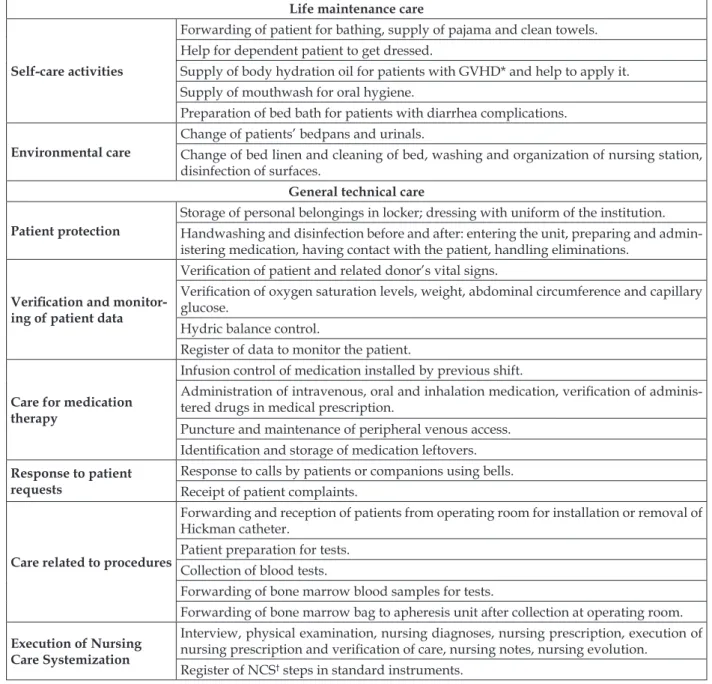
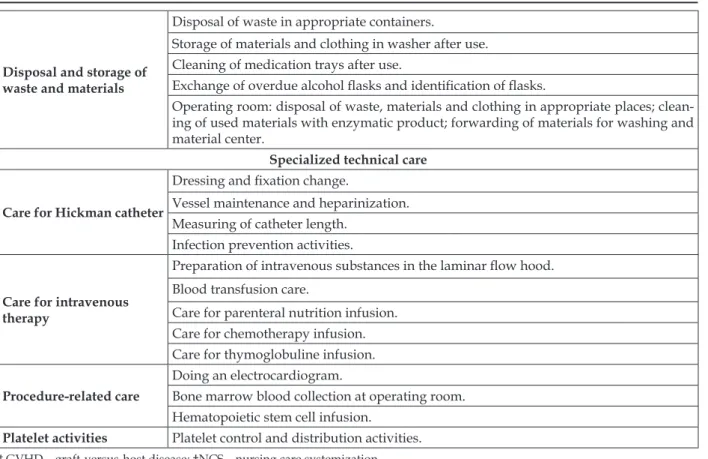
Figure 1 - Activities of clinical nurse in the care function. Brazil, 2011
Life maintenance care
Self-care activities
Forwarding of patient for bathing, supply of pajama and clean towels. Help for dependent patient to get dressed.
Supply of body hydration oil for patients with GVHD* and help to apply it. Supply of mouthwash for oral hygiene.
Preparation of bed bath for patients with diarrhea complications.
Environmental care
Change of patients’ bedpans and urinals.
Change of bed linen and cleaning of bed, washing and organization of nursing station, disinfection of surfaces.
General technical care
Patient protection
Storage of personal belongings in locker; dressing with uniform of the institution. Handwashing and disinfection before and after: entering the unit, preparing and admin-istering medication, having contact with the patient, handling eliminations.
Veriication and monitor -ing of patient data
Veriication of patient and related donor’s vital signs.
Veriication of oxygen saturation levels, weight, abdominal circumference and capillary
glucose.
Hydric balance control.
Register of data to monitor the patient.
Care for medication therapy
Infusion control of medication installed by previous shift.
Administration of intravenous, oral and inhalation medication, veriication of adminis -tered drugs in medical prescription.
Puncture and maintenance of peripheral venous access.
Identiication and storage of medication leftovers.
Response to patient requests
Response to calls by patients or companions using bells. Receipt of patient complaints.
Care related to procedures
Forwarding and reception of patients from operating room for installation or removal of Hickman catheter.
Patient preparation for tests. Collection of blood tests.
Forwarding of bone marrow blood samples for tests.
Forwarding of bone marrow bag to apheresis unit after collection at operating room.
Execution of Nursing Care Systemization
Interview, physical examination, nursing diagnoses, nursing prescription, execution of
nursing prescription and veriication of care, nursing notes, nursing evolution.
Disposal and storage of waste and materials
Disposal of waste in appropriate containers.
Storage of materials and clothing in washer after use. Cleaning of medication trays after use.
Exchange of overdue alcohol lasks and identiication of lasks.
Operating room: disposal of waste, materials and clothing in appropriate places; clean-ing of used materials with enzymatic product; forwardclean-ing of materials for washclean-ing and material center.
Specialized technical care
Care for Hickman catheter
Dressing and ixation change.
Vessel maintenance and heparinization. Measuring of catheter length.
Infection prevention activities.
Care for intravenous therapy
Preparation of intravenous substances in the laminar low hood.
Blood transfusion care.
Care for parenteral nutrition infusion. Care for chemotherapy infusion. Care for thymoglobuline infusion.
Procedure-related care
Doing an electrocardiogram.
Bone marrow blood collection at operating room. Hematopoietic stem cell infusion.
Platelet activities Platelet control and distribution activities. * GVHD – graft-versus-host disease; †NCS – nursing care systemization.
Figure 2 - Activities of visit nurse in care function. Brazil, 2011
General technical care
Patient protection Storage of personal belongings in locker; clothing using institutional uniform, hand
wash-ing before enterwash-ing the unit.
Patient forwarding
Patient reception for hospitalization at the unit; patient forwarding to nursing ward and to clinical nursing.
Patient forwarding to operating room attendant for withdrawal and installation of Hick-man catheter.
Documentation and registers
Double-checking of blood products together with clinical nursing team and attachment of
blood product bag label in patient ile.
Double-checking of chemotherapeutic drugs with clinical nursing team.
Checking in patient ile if pre-transplantation tests were done.
Transmission of medical platelet prescription to platelet nurse for internal and external release to the sector.
Figure 3 - Activities of management nurse in care function. Brazil, 2011
General technical care
Patient protection Storage of personal belongings in locker; clothing using institutional uniform, hand washing before entering the unit.
Specialized technical care
Reception of bags with frozen umbilical cord blood for transplantation, together with physician and visit nurse, and bag storage care.
According to the theoretical framework of nurses’ functions, care is the professionals’ main function. The main care class, life maintenance, is developed under the particular conditions of a
disease or weakness that justiies the nursing inter -vention.4-5 In this category, activities are grouped which the clinical nurse developed for self-care and environmental care purposes (Figure 1).
The nursing interventions used in this func-tion are countless. Among them, the reference framework indicates hygiene care, which is a frequent task among the nurses in this study.4-5 As a result of concerns with patient contamina-tion, the nurses perform a range of care related to the cleaning of all utensils the patient will have contact with.
The hygiene care for hospitalized patients require considerable knowledge of the health and
disease phenomena, of the potential modiica
-tions the health problems induce, such as fragil-ity and vulnerabilfragil-ity, and knowledge about the cure process.4 In this transplantation service, it is observed that the nurses have incorporated the knowledge about the patients’ particularities and their vulnerability as a result of the treatment and apply it in care.
The patients’ immunosuppression does not allow them to accomplish some hygiene care, particularly environmental hygiene. On the other hand, the patients themselves perform body and oral hygiene activities, as most of them have neither neurological nor physical mobility impairments, but under nursing supervision due to the particularities of this care. This interven-tion permits an approximainterven-tion with the reference framework, which indicates the nurse as the evalu-ator of self-care abilities who, based on these skills, adapts the care to favor the patients’ execution, thus aiming to restore the self-care ability.4
The life maintenance care observed are as important as other more specialized care, as it is fundamental for the patient’s recovery and the prevention of complications. The HSCT contexts demands distinguished nursing care, highlighting infection prophylaxis measures.8 The storage of personal belongings outside the unit, dressing the institutional uniform and hand washing, activities
classiied in the general technical care category, are
included in this discussion because their objective is to protect the patient against micro-organisms coming from the external environment and to avoid cross-infections. Similarly, the nurses need
speciic knowledge on infection control and pro
-tective isolation.
The technical nursing care is deined as the
necessary restoration care in view of the disease, delivered in combination with the life maintenance care.4-5 At the place of study, the technical care involves monitoring, treatment, evaluation and response to the patient’s needs during the trans-plantation process.
The technical care is mostly performed by the clinical nurses, but activities in this category were also observed among visit and management nurses. Among the general care (Figure 1), hand washing stands out, an activity the team values and the three nursing categories frequently de-velop during the work shift. Hand washing is the most effective infection control measure and a practice the nurses working in HSCT acknowledge as fundamental in care delivery to immunocom-promised patients,8 a fact that was also observed in the study. This practice also follows the standards of the National Health Surveillance Agency (AN-VISA) with regard to hand washing as an infection prevention measure.9
The veriication of the vital data and other
values that permit monitoring the patient’s evo-lution during the treatment, as well as the hydric balance control, were activities observed in the
clinical nurses and classiied as general techni
-cal care, because this is an extremely specialized service with other more complex activities. In addition, care activities for medication therapy, response to patient requests and procedure-related care were observed, mostly delivered by the clinical nurses, but also accomplished in the other categories’ activities.
The Nursing Care Systemization (NCS) is found in all phases, particularly this professional’s
speciic activities, guiding and supervising the
secondary-level professionals in their activities and also registering all information obtained in the nursing process, an activity also recommended by COFEN.10
The systemization of the nursing care observed among the study subjects involves competences established in COFEN Resolution 200/1997,11 such as the registering of information and statistical data related to nursing care for transplanted patients and the elaboration of the nursing prescription for patients in HSCT.
among the team members.12 This idea supports the determinations of COFEN in Resolution 358/2009 that the nursing care systemization organizes pro-fessional work with regard to the method, staff and instruments, permitting the operation of the nurs-ing process. Nurses in leadership positions in the execution and evaluation of the nursing process are exclusively responsible for nursing diagnoses and for the prescription of interventions.10
Another important activities in the general technical care function is the disposal and storage of waste and materials, environmental organiza-tion activities that are part of patient care. Nev-ertheless, they also cooperate with the service, as the institution executes risk management and waste separation. Hence, the nurse cooperates by performing these activities.
As regards the visit nurses, they are not re-sponsible for direct patient care. Their activities are more related to coordination and supervi-sion. Some general technical care, however, was observed when the nurses act together with the clinical team (Figure 2), such as patient forward-ing and care for documentation and registerforward-ing.
The latter is accomplished through the veriication
of blood products and chemotherapeutic drugs together with the clinical team, enhancing the safety in the infusion of these solutions through double-checking. It was observed that this is not an exclusive activity of the visit nurses, but that they work together with the clinical team to comple-ment this care activity.
During general care, the nurses observe, listen and communicate their impression so as to put order in the situation momentarily,
temporar-ily or deinitively. This care is part of all nurses’
basic education, while specialized care is reserved to one group, requiring additional education.4-5
In the context of HSCT, the nurses deliver care to patients with severe health problems
and are apt to attend to speciic complications of
transplantation and to deliver specialized care involving catheter maintenance, care for mucositis, skin, medication infusion and isolation methods,13 activities that were observed in the research.
The patients’ complications mainly vary according to the transplantation type and the conditioning regimen they were submitted to,14 important aspects the nurse needs to take into account in symptom management. To give an example, patients submitted to allogeneic trans-plantation on myeloablative regimens present more severe complications than patients submitted
to autologous transplantation.14
The specialized technical care activities, distributed in this category, required knowledge
and speciic skills from the nurses for the HSCT
area, according to the functional reference frame-work in which the author describes them as care that demands instrument handing, knowledge of technologies and use of particular protocols from the nurses in order to intervene in more complex situations effectively.4-5 In this service, the nurses exclusively perform many of the specialized activi-ties, while their execution by the technical nursing team is not permitted.
The specialized technical care is predomi-nantly executed by the clinical nurses (Figure 1).
The irst subcategory found in this function relates
to the care for Hickman catheters. That is a cen-tral venous access device, frequently used in the transplantation service due to the need to infuse a large number of solutions to the patient during treatment, such as hydration serum, antibiotics, chemotherapeutic drugs, blood transfusions and the actual infusion of hematopoietic stem cells, so that percutaneous puncture is not needed. In addition, it is also used during blood collection for tests.15 As an indwelling device,16 the patient uses the catheter while in hospital and afterwards during outpatient monitoring.
The Hickman catheter is installed at an oper-ating room and the nursing team at the hospitaliza-tion unit is responsible for its use and maintenance. It was observed that, each day, the dressing of the catheter insertion ostium is changed, a procedure developed with the use of an aseptic technique after the patient’s bath. During this activity, the nurse has the opportunity to assess the conditions of the catheter and the underlying tissue, such as
the ixation points, signs of skin infection or ir
-ritation due to the catheter ixation and traction.
Although widely used, the central catheter exposes the patient to complications, such as bloodstream and other infections. Therefore, care for its maintenance is fundamental, such as clean-ing, inspection and palpation of the insertion site and exit ostium, application of a sterile occlusive dressing, disinfection and control of the expiry date of connections, as well as strict control of the solutions infused,17 all of which are nurses’ activities.
The care related to the intravenous therapy
was also classiied as specialized techniques. This
care starts during the preparation of these
air iltering system to control for microorganisms
in medication preparation and in the protection against their toxic effects.16
Part of the activities related to the medication
therapy was classiied as general technical care
and part as specialized. Medication administration
was classiied as general technical care because all
nurses perform this practice and learn it since their basic education. The preparation of these drugs
in the laminar low hood, as well as the intrave
-nous therapy of special solutions, such as blood products and chemotherapeutic drugs, demands
speciic knowledge from the professionals, as well
as the use of technologies and service protocols. In addition, to execute these specialized activities, the nurses receive initial training in the service.
Among the procedures categorized as spe-cialized technical care, bone marrow blood col-lection at the operating room and the infusion of hematopoietic stem cells are highlighted. These are exclusive activities of nurses at this service. Their execution by nursing technicians is not per-mitted. These activities follow COFEN Resolution 200/1997,11 which establish the competency of
HSCT nurses as the execution of speciic technical
procedures related to the aspiration and infusion of hematopoietic stem cells.
Bone marrow blood is collected at the operat-ing room and involves a series of procedures, such as preparing the tables with sterile material for the collection, asepsis of the puncture site, storage of
the bone marrow blood in a speciic container after being collected by the physician and iltering and
storing in a special bone marrow blood bag. After the collection, the nurse returns to the transplantation unit to start the infusion of hema-topoietic stem cells. Besides the marrow blood, the sector transplants peripheral and umbilical cord and placenta blood cells. Throughout the procedure, the nurse monitors the patient, assesses his/her general condition, periodically controls the vital signs and observes possible secondary reactions.
The professionals and patients inside the service highly value the hematopoietic stem cell collection and infusion activities. Both are the exclusive responsibility of the clinical nurses and these activities come with all expectations related to the treatment.
The inal subcategory of specialized technical
care refers to the platelet activities, performed by the clinical nurse. This transplantation unit stores all available platelets for use by the institution and
the nurses are responsible for their control and distribution. Each week, one clinical nurse takes charge of these activities, which is also an exclusive activity for these professionals.
The platelet control involves activities that come with great responsibility, as platelet transfu-sion entails risks for the patient, requiring strict control before the transfusion. It is supposed that the institution delegates this activity to the nurses as they have knowledge about hemotherapy, about the organization and control of the inputs needed for care, besides the fact that there is a
suficient number of professionals for this activity,
who can organize themselves between these and care activities.
A similar study undertaken at an Intensive Care Unit (ICU), also based on the reference framework of nurses’ functions,18 already evi-denced the predominance of specialized technical care by nurses. This fact demonstrates that the nurses have the knowledge and skills needed to apply this care, which cannot be delegated to the secondary-level nursing professionals. In the same study,18 it was also evidenced that the service has an appropriate rate of nurses/bed, which favors the effective performance of the care function, reduces possible errors and enhances the quality of the care delivered.
Like the visit nurse, the management nurse does not assume clinical activities. Some special-ized technical care activities were observed though (Figure 3). One of them is the reception of hema-topoietic stem cell bags of umbilical cord and pla-centa blood for transplantation, coming from other institutions. This activity involves responsibilities as the patient who will receive these cells depends on them for treatment, which is why it was
clas-siied as a specialized care activity. Similarly, the
management nurse requests mesenchymal cells to other institutions. The use of mesenchymal cells has recently occurred for the treatment of graft-against-host diseases.
When comparing the range of care activities delivered by the three nurse’s functions, it was
veriied that clinical nurses have a wider range of
activities at this service, which is expected, as they assume direct patient care.
to the different forms of nursing work organiza-tion in these two environments. At the ICU, the number of nurses is small and their activities are more focused on care management than on the ap-plication of direct care. In HSCT, then, the number of nurses is large, permitting the comprehensive performance of care activities.
Hematopoietic stem cell transplantation was clearly established as an important treatment modality that is considerably expanding and evolving, with an increasingly small incidence rate of complications after the procedure.19 This is due to the different professionals’ efforts, who develop research and work in the care process for transplanted patients, where nursing plays a
signiicant role.
The nurses’ contribution to successful trans-plantations in general is undeniable. Care in this area has gained increasing complexity, demanding high-quality care for patients and family members, in which nurses play a fundamental role as health team members.20
FINAL CONSIDERATIONS
As veriied, at the HSCT unit, the nurses perform all kinds of care, eficiently intervening
in the most simple as well as highly complex activities that need long periods of practice and training. Therefore, it is considered that the care is not parceled, that is, care delivery to transplanted patients is integral, with nurses attending to all of their health needs. The amount of specialized
care and very speciic activities is highlighted at
the service. The knowledge for their execution is not gained during basic education, but through
training and qualiication, until reaching the level
of expertise and the ability to assume the required responsibilities.
The decision was made to use a Canadian and up-to-date theoretical reference framework on nurses’ functions, with a view to gaining a new perspective on these professionals’ work in the context of HSCT. This framework demonstrated its relevance to support the research and achieve the proposed objectives. In view of the range of care activities executed in their daily work, the study provided an understanding of the nurses’ care process at an HSCT service and contributed to apprehend the role of nurses working in this area. In addition, it was observed that the nurses comply with the determinations of the law on professional nursing practice and with the Federal
Nursing Council’s regulations on nursing compe-tences in HSCT.
The lack of quantitative data, including measures of the time the nurses spend on their activities, is considered a study limitation, as this
could have contributed by deining on what func
-tions the nurses spend more or less time in their daily work.
REFERENCES
1. Ortega ETT, Kojo TK, Lima DH, Veran MP, Neves
MI. Compêndio de enfermagem em transplante
de células-tronco hematopoiéticas: rotinas e procedimentos em cuidados essenciais e em
complicações. Curitiba (PR): Editora Maio; 2004.
2. Costanzo ES, Juckett MB, Coe CL. Biobehavioral
inluences on recovery following hematopoietic
stem cell transplantation. Brain Behav Immun. 2013; 30:68-74.
3. Anders JC, Soler VM, Brandão EM, Vendramini EC, Bertagnolli CLS, Giovani PG, et al. Aspectos de
enfermagem, nutrição, isioterapia e serviço social
no transplante de medula óssea. Medicina. 2000 Out-Dez; 33:463-85.
4. Dallaire C. Les grandes fonctions de la pratique
inirmière. cap. 2. In: Goulet O, Dallaire C. Soins inirmiers et société. Québec (CA): Gaëtan Morin
Éditeur; 1999. p.33-51.
5. Dallaire C, Dallaire M. Le savoir inirmier dans
les fonctions inirmières. cap. 11. In: Dallaire C,
organizador. Le savoir inirmier: au couer de la
discipline et de la profession. Montréal (CA): Gaëtan
Morin Éditeur; 2008. p. 265-305.
6. Lima K, Bernardino E, Wolff LDG, Peres AM.
Características da produção cientíica de enfermagem
em transplante de células-tronco hematopoiéticas. Cogitare Enferm. 2012 Jul-Set; 17(3):568-73. 7. Bardin L. Análise de conteúdo. Lisboa (PT): Edições
70; 2010.
8. Zavadil ETC. Representações do enfermeiro
sobre infecção em transplante de células-tronco hematopoiéticas [dissertação]. Curitiba (PR): Universidade Federal do Paraná Curitiba. Programa de Pós-Graduação em Enfermagem; 2010.
9. Brasil. Agência Nacional de Vigilância Sanitária (ANVISA) [página da Internet]. Segurança do paciente em serviços de saúde: higienização das mãos. Brasília (DF); 2009 [acesso 2011 Ago 22]. Disponível em: http://bvsms.saude.gov.br/bvs/ publicacoes/seguranca_paciente_servicos_saude_ higienizacao_maos.pdf
10. Conselho Federal de Enfermagem. Resolução
n. 358, de 15 de outubro de 2009.dispõe sobre a sistematização da assistência de enfermagem e a
Correspondence: Kaoana Lima Rua. Francisco Torres, 470, ap. 311 80060-130 — Curitiba, PR, Brasil E-mail: [email protected]
Received: March 11, 2013 Approved: September 18, 2013
ambientes, públicos ou privados, em que ocorre o
cuidado proissional de enfermagem, e dá outras providências. Rio de Janeiro (RJ): COFEN; 2009.
11. Conselho Federal de Enfermagem. Resolução n.
200, de 15 de abril de 1997: Dispõe sobre a atuação dos proissionais de enfermagem em hemoterapia
e transplante de medula óssea. Rio de Janeiro (RJ): COFEN;1997.
12. Ortega ETT, Stelmatchuk AM, Cristoff C. Assistência de enfermagem em transplante de células-tronco hematopoéticas. cap. 37. In: Volterelli JC, Pasquini R, Ortega ETT. Transplante de células-tronco hematopoéticas. São Paulo (SP): Editora Atheneu; 2009. p.1031-98.
13. Lacerda MR, Lima JBG, Barbosa R. Prática de enfermagem em transplante de células-tronco hematopoiéticas. Rev Eletr Enferm. [online]. 2007 [acesso 2011 ago 22] 9(1):242-50. Disponível em: http://www.fen.ufg.br/fen_revista/v9/n1/ v9n1a19.htm
14. Cohen MZ, Rozmus CL, Mendoza TR, Padhye NS, Neumann J, Gning I, et al. Symptoms and quality of life in diverse patients undergoing hematopoietic stem cell transplantation. J Pain Symptom Manage. 2012 Aug; 44(2):168-80.
15. Castanho LC, Silveira RCC, Braga FTMM, Canini SRMS, Reis PED, Voltarelli JC. Motivo de retirada do cateter de Hickman em pacientes submetidos ao transplante de células-tronco hematopoéticas. Acta Paul Enferm. 2011; 24(2):244-8.
16. Giovani AMM. Enfermagem, cálculo e administração de medicamentos. São Paulo (SP): Scrinium; 2006. 17. Pedrolo E, Danski MTR, Mingorance P, Lazzari
LSM, JohannDA.Ensaio clínico controlado sobre o curativo de cateter venoso central. Acta Paul Enferm. 2011; 24(2):278-83.
18. Cenedési MG, Bernardino E, Lacerda MR, Dallaire
C, Lima K. Funções desempenhadas pelo enfermeiro
em unidade de terapia intensiva. Rev Rene. 2012; 13(1):94-102.
19. Devetten M, Armitage JO. Hematopoietic cell transplantation: progress and obstacles. Ann Oncol. 2007 Set; 18(9):1450-6.