M ini-M ental State
Examination: psychometric
characteristics in elderly
outpatients
ABSTRACT
OBJECTIVE: To assess the psychometric characteristics of the Mini-Mental State Examination in elderly outpatients who seek primary health care.
METHODS: A total of 303 subjects (≥65 years) underwent comprehensive geriatric assessment with functional tools, including Mini-Mental State Examination. Sensitivity, specificity, positive predictive value, negative predictive value, and ROC curve were calculated.
RESULTS: Sensitivity, specificity, positive and negative predictive values, and area under ROC curve were 80.8%, 65.3%, 44.7%, 90.7% and 0.807 respectively (cutoff point =23/24). The best cutoff point for illiterate was 18/19 (sensitivity =73.5%; specificity =73.9%); and for literate was 24/25 (sensitivity =75%; specificity =69.7%).
CONCLUSIONS: While screening elderly outpatients for dementia, schooling must be considered in the choice of the best cutoff point in the Mini-Mental State Examination.
KEYW O RD S: Aging health. H ealth services for the aged. Cognition, classification. N europsychological tests. Geriatric assessment. Sensitivity and specificity. Validity.
Roberto A LourençoI
Renato P VerasII
I Departamento de Medicina Interna.
Faculdade de Ciências Médicas. Universidade do Estado do Rio de Janeiro. Rio de Janeiro, RJ, Brasil
I I Departamento de Epidemiologia. Instituto
de Medicina Social. Universidade do Estado do Rio de Janeiro. Rio de Janeiro, RJ, Brasil
Correspondence:
Roberto A. Lourenço Policlínica Piquet Carneiro Rua Marechal Rondon, 381 2° andar São Francisco Xavier
20950-000 Rio de Janeiro, RJ, Brasil E-mail: [email protected]
INTRODUCTION
It is common to find a functional disorder with major impact on daily activities as the first manifestation, and quite often unnoticed, of disease processes in the elderly.8 In contrast, regaining and/or maintaining the
quality of life is one of the main goals for clinically approaching impaired elderly patients.
The geriatric assessment consists of combining in-formation from conventional medical history and physical examination with those obtained from a set of specific tools. These instruments help to de-tect impairments, plan extended care, and assess disease severity and patient’s progress.19 Of all
geri-atric assessment tools, those assessing cognitive sta-tus in elderly patients are outstanding. They are es-sentially used in specialized settings as well as part of the semiotic evaluation in less specialized health care settings.
The Mini-Mental State Examination (MMSE), de-veloped by Folstein et al9 (1975), is one of the most
widely used and studied instruments worldwide. Ei-ther used alone or combined with more comprehen-sive instruments, this test allows assessing cognitive function and screening of dementia condi-tions.1,3,10,11,13,15 MMSE has been applied in clinical
settings for detecting cognitive impairment, demen-tia progress follow-up and monitoring of treatment response. In research, it has been used in population-based studies and for the assessment of experimental drug response. This test instrument has been incorpo-rated to a series of neuropsychological evaluation tools such as The Consortium to Establish a Registry for Alzheimer’ Disease (CERAD),16 Cambridge
Ex-amination for Mental Disorders of the Elderly (CAMDEX-R)18 and A Structured Interview for the
Diagnosis of Dementia (SIDAM).23
From the beginning, psychometric characteristics of the MMSE have been examined both in its original version as well as in its numerous translations/adap-tations to several languages and coun-tries.1,4,6,10,11,15,17,20,22,24 A cutoff point of 23/24 has
showed to be highly adequate to identify cognitively impaired individuals.3,21
In Brazil, MMSE has been studied by clinicians and researchers and has been used, though still in a small number of centers, in clinical practice and scientific investigation.1,4,6,7,13
The present study aimed at examining criteria valid-ity of the MMSE Portuguese version in a sample com-prising elderly subjects aged 65 attending an
outpa-tient primary care clinic. Psychometric characteris-tics of MMSE were assessed for ascertaining the best cutoff point for diagnosing cognitive disorders and how schooling affected this cutoff point.
M ETH O D S
Between April 8 and July 15, 2002, a convenience sample comprising 306 subjects was selected among those elderly patients attending an outpatient pri-mary care clinic at a university hospital in the city of Rio de Janeiro, Southeastern Brazil. After three sub-jects were excluded due to missing information, the study population comprised 303 elderly patients.
The study inclusion criteria were the following: 65 years old or more; hearing and understanding abili-ties adequate to be involved in the study; and sign-ing an informed consent form.
The study exclusion criteria were the following: (self-or inf(self-ormer) rep(self-orting of unc(self-orrected severe eye (self-or hearing impairment or advanced cognitive disorders and/or mental diseases impairing test understanding and completion; mother language other than Portu-guese; impaired hand movement due to rheumatic or neurological diseases.
A modified translated version of the MMSE, proposed by Bertolucci et al4 and Almeida,1 was used in the study.
Some items were adapted making sure the originally MMSE developed by Folstein et al9 was preserved in
order to improve their appropriateness to specific char-acteristics of Brazilian culture (Table 1).
The proposed modifications were as follows: 1) in the “Space Orientation” section, the original
items “State, County, Town, Hospital, Floor” were translated/adapted to “state, city, district, building where the interview is taking place and floor;” when interviewees did not know the district, they could name a nearby street or the city’s area where the health unit was located;
2) original objects in “registration and naming” (Apple, Penny, Table) were replaced with “car, vase, ball”;
3) in the “Attention and Calculation” section, “serial 7s subtraction” and “spelling the word world” were asked and the highest score test were recorded.
individu-als aged 65 or more who showed up at the front desk were asked to participate. The number of individuals enrolled each day varied according to their agree-ment to participate and the research team’s enrollagree-ment capacity. Those who refused to participate in the study were referred back to clinic’s routine care. Reasons for refusal and the characteristics of those who re-fused to participate in the study were not documented.
The study team consisted of two high-level research assistants (RA1) who were trained in the use of func-tional and cognitive assessment tools and adminis-tered the MMSE and other functional assessment tools.12,14 In addition, subjects were evaluated by two
geriatricians (RA2) who administered a structured clinical interview for diagnosing dementia that is included in CAMDEX-R18 section A, and by two
neuropsychologists (RA3) who administered the cog-nitive section of CAMCOG-R.18 Since there are no
studies on CAMCOG-R making recommendations on the applicable cutoff points for low schooling popu-lations, an informal translation of this tool was used as a guide for evaluating subjects’ performance and each specialist produced a report on that.
The study geriatricians had at least two-year formal training in both internal medicine and geriatrics. Also, they regularly cared for patients diagnosed with neuropsychiatric conditions in the geriatrics outpatient clinic.
All study procedures were developed and standard-ized by one of the authors (RAL). The study team
training was divided in three steps. First, the investi-gator met with all research assistants to explain and discuss in details the study routine procedures.
Second, the investigator met with each RA indi-vidually for providing training in specific proce-dures. This same investigator trained RA1s in the administration of MMSE and activities of daily life evaluation tools.12,14 Patient visits conducted
by RA2s and all criteria of dementia syndrome used were standardized. CAMCOG-R routine procedures were standardized in a sub-sample of 10 subjects during 10 sessions.
The third step involved a three-month data collec-tion where the main purpose was to monitor quality and standardization of interviews and evaluation tools. When there were any deviations, the case was discussed with the RA and advice on the correct pro-cedure was provided.
No reliability test was performed to compare the level of agreement between evaluators. A reliability test-retest was carried out and will be published timely.
All test procedures were carried out in one shift and, upon completion, RA2s and RA3s would meet for discussing and establishing each subject’s diagnosis (case/non-case). Therefore, the “reference test” for diagnosis of dementia syndrome was the specialists’ opinion (RA2) based on their structured clinical evaluations and patient’s performance in the neuropsy-chological test according to DSM-IV2 and
Interna-Table 1 - M ini-M ental State Examination. Back translation of the translated instrument (w ith modifications) proposed by Bertolucci et al.4
TIM E O RIEN TATIO N
What is the year? What is the season? What is the month? What is the day of the week? What is the day of the month? SPACE ORIENTATION
What state are we? What city are we? What district are we? What building are we? What floor are we? REGISTRATIO N
Now listen carefully. I’ll say three words and you will name them after I have said them. Ok? The words are: CAR [pause], VASE [pause], BALL [pause]. Now you name them. [Allow 5 trials but give points only to the first one.]
ATTENTION AND CALCULATION [Serial 7s]
Now I would like you to subtract 7 from 100 and then subtract 7 from the result. Then continue to subtract 7 until I tell you to stop. Did you understand? [pause] Let’s start, how much is 100 minus 7? [Give one point for each correct answer]. If the maximum score is not reached, ask: spell the word WORLD. Correct any spelling mistakes and then ask: Now, spell the word WORLD backwards. [Give one point for each letter at the correct position. Record the best result.]
RECALL M EM O RY
Ask: What are the three words I asked you to memorize? [Do not give any clues.] LAN GU AGE
[Point to the pencil and watch and ask:] What is it? (pencil) What is it? (watch)
Now I’ll ask you to repeat what I will say. Right? Then repeat the following: “ NOT HERE, NOT THERE, NOT ANYWHERE” . Now listen carefully because I’m going to ask you to perform a task: [pause] Take this paper with your right hand [pause], then with both your hands fold it in half once [pause] and then throw it on the floor.
Please read it and do what is written in the paper. Show the examinee the paper with the following command: CLOSE YO U R EYES.
Ask: Please write a sentence. If the patient does not answer, ask: Write about the weather. [Put a blank paper and a pencil or pen in front of the patient.]
tional Classification of Diseases (ICD-10) criteria.
MMSE results were kept in a sealed envelope to pre-vent the knowledge of subject’s performance to affect RA2’s diagnostic decision.
Data were entered in the Epi Info software program, version 6.04. Comparisons of frequency between cat-egorical variables were performed using Chi-square test and mean comparison between two groups were carried out through variance analysis. For compar-ing means of variables with a non-normal distribu-tion a non-parametric Kruskal-Wallis test was used. SPSS statistical package, version 9.0, was used to calculate the ROC curve, sensitivity (sen) and specificity (spe) for all the instrument’s cutoff points. Positive predictive value (PVpos) and negative pre-dictive value (PVneg) were estimated based on con-tingency tables.
The study was approved by the Institutional Ethics Committee of Pedro Ernesto University Hospital, Universidade Estadual do Rio de Janeiro.
RESU LTS
Of 303 subjects studied, 217 (71.6%) were female; their mean age was 73 years (SD±5.3), me-dian age was 72 years and mode age was 65 years. Nearly all subjects were in older age groups and almost 70% were 70 years old or more. Most of them (more than 60%) had no partners, and only 36% reported being mar-ried. Only 4.3% reported having more than eight years of schooling, and 26.4% were il-literate. Nearly 70% were retired and only 13.2% reported to be engaged in an occupa-tion. More than 80% had a monthly income of less than three minimum wages (Table 2). No significant gender difference was found in the distribution of diagnosis of dementia (χ2=0.8367; p=0.36).
In dementia subjects, the mean MMSE total score ± SD was 19.2±4.5 and median total score was 19.0. In non-dementia subjects, mean MMSE total score ± SD was 24.5±4.0 and median total score was 25.0. As this vari-able is likely to have a non-normal distribu-tion, the Kruskal-Wallis test was used and showed significant difference between these two groups (p-value=0.000).
Table 2 - Socioeconomic characteristics according to DSM-IV diagnosis of dementia (n=303). Rio de Janeiro, Brazil, 2002.
Total n (%) D ementia (%) p-val ue Gender
M al e 86 (28.4) 22.1 0.360
Femal e 217 (71.6) 27.2 Age group (years)
65-69 97 (32.0) 18.6 0.039
70-74 119 (39.3) 24.4
75-79 51 (16.8) 31.4
≥80 36 (11.9) 41.7
Schooling*
Il l i terate 80 (26.5) 42.5 0.000 1-4 years 139 (46.0) 26.6
5-8 years 71 (23.5) 8.5
≥9 years 12 (3.9) 8.3 M arital status**
M arri ed 109 (36.9) 23.9 0.874
Si ngl e 29 (9.8) 27.6
W i dow 122 (41.4) 27.9 Separated 35 (11.9) 22.9 Reti red* * *
Yes 202 (69.2) 23.8 0.186
N o 90 (30.8) 31.1
Income**** (R$)
0-200 78 (26.9) 37.2 0.001
201-600 165 (57.1) 24.8 >600 46 (15.9) 8.7 *1 case unknown
**8 cases unknown ***11 cases unknown ****14 cases unknown
Table 3 - Preexisting diseases in elderly population (n=303). Rio de Janeiro, Brazil, 2002.
D i seases Frequency %
Systemic arterial hypertension 181 59.7
D iabetes M ellitus 57 18.8
Stroke 20 6.6
M yocardial infarction 12 4
D epression 57 18.8
Cancer 7 2.3
Parkinson disease 4 1.3
Figure - The ROC curve of Mini-Mental State Examination total scores and dementia diagnosis - DSM-IV (n=303). Rio de Janeiro, Brazil, 2002.
ROC Curve
Area under the curve: 0.807 CI (95%): 0.752-0.862 SE: 0.028
Specificity
1.00 .75
.50 .25
0.00
Sensitivity
1.00
.75
.50
.25
0.00
28 27 26 25 24 23 22 21 20
19
18 17 16
Schooling in dementia and non-dementia subjects had a median of 1 and 4, and a mean of 1.89±2.48 and 3.75±3.13 respectively (F=22.739; p-value=0,000). Table 2 shows the statistical values of other variables in these two groups.
Table 3 shows the frequencies of reported preexisting diseases. Prevalences of dementia syndrome in the study sample according to DSM-IV2 and ICD-10
cri-teria were 25.7% and 15.2% respectively.
The Figure illustrates MMSE sensitivity and spe-cif icity at different cutoff points. The estimated ROC curve had an area under the curve of 0.807 (95% CI: 0.752-0.862).
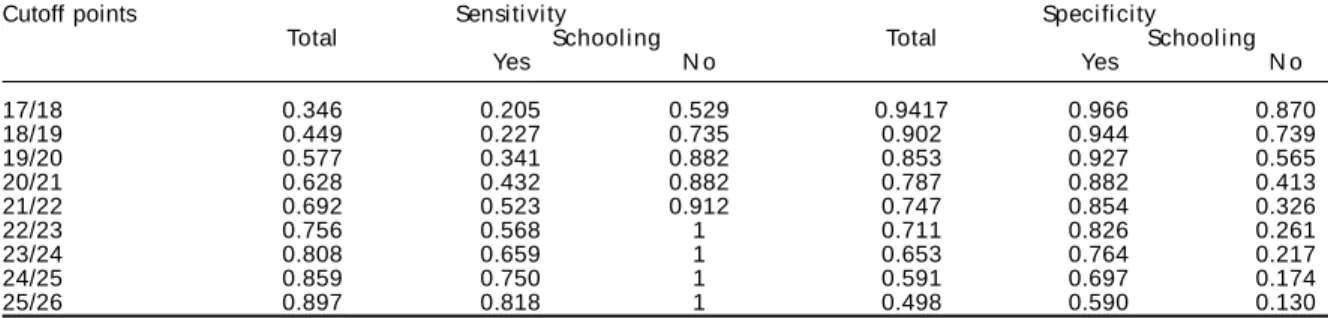
Performance assessment in the MMSE showed the following values at cutoff point of 23/24: sen=80.8%, spe=65.3%, PVpos=44.7% and PVneg=90.7%. However, in the general population, the best equilibrium cut-off point would be of 22/23, where sen=75.6%, spe=71.1%, PVpos=47.6% and PVneg=89.4% (Table 4).
Stratification by levels of schooling revealed that, of those 78 subjects diagnosed with dementia, only seven had more than five years of schooling (n=6, five to eight years; and n=1, nine years or more). Be-cause of that, the sample was divided in two sub-groups: illiterate and educated. The best cutoff point detecting cognitive disorders in illiterate subjects was 18/19; and in those educated, the best cutoff point was 24/25 (Table 4).
When ICD-10 was used as a criterion, at the cutoff point of 23/24, sensitivity was 80.8%, specificity was 60.3% and the area under the ROC curve was 0.816 (95% CI: 0.753-0.879).
D ISCU SSIO N
MMSE has been widely studied throughout its 30 years of existence. Its structure and psychometric char-acteristics have been extensively reviewed and many translations and cultural adaptations have been
pro-duced as well.
In Brazil, investigators1,4 have suggested literally
trans-lating most MMSE items, such as those assessing time orientation (except for “season of the year”), attention and calculation, object naming, understanding of spo-ken and written commands as well as those assessing writing and visual-spatial abilities. But these authors had also suggested that other items be adapted as they were not appropriate to cultural characteristics of Bra-zilian population. Nevertheless, some of these sugges-tions are still being discussed: How assessment of time and space orientation can be improved? What are the most adequate words for registration and recall? What is the best sentence to be repeated?
In the present study the translated tool by Bertolucci et al4 and approved by Almeida1 was found to be
largely appropriate but some modifications were needed. On one hand, it was more consistent with Folstein et al’s9 original propositions; for instance,
the choice of widely used simple two-syllable words for learning and recall. On the other hand, a few inad-equate choices were changed such as the use of “se-mester” instead for time orientation. This division of the year is basically part of the collective school learn-ing and so it is not familiar to most individuals seen at public health services, as those selected to partici-pate in this study.
A negative aspect of the present study was that the evaluation tool, informally translated/adapted by the before mentioned authors,1,4 has been accepted. The
fact no study has so far addressed the important issue of using adequate methodology for transculturally adapting this instrument perpetuates a number of is-sues concerning informal adaptations. Also, as the present study did not include these issues in its ob-jectives, they are still untackled.
Various Brazilian authors have studied psychomet-ric characteristics of the MMSE. To assess cognitive performance of those seeking care in a hospital’s medi-cal triage service, Bertolucci et al4 administered the
Table 4 - Sensitivity and specificity of the Mini-Mental State Examination at distinct cutoff points (n=303). Rio de Janeiro, Brazil, 2002.
Cutoff points Sensi ti vi ty Speci fi ci ty
Total Schooling Total Schooling
Yes N o Yes N o
17/18 0.346 0.205 0.529 0.9417 0.966 0.870
18/19 0.449 0.227 0.735 0.902 0.944 0.739
19/20 0.577 0.341 0.882 0.853 0.927 0.565
20/21 0.628 0.432 0.882 0.787 0.882 0.413
21/22 0.692 0.523 0.912 0.747 0.854 0.326
22/23 0.756 0.568 1 0.711 0.826 0.261
23/24 0.808 0.659 1 0.653 0.764 0.217
24/25 0.859 0.750 1 0.591 0.697 0.174
MMSE to 530 patients. There were found distinct cutoff points for diagnosis of cognitive impairment according to schooling: 13 for illiterate, 18 for low to intermediate schooling and 26 for high schooling, with 82.4%, 75.6%, and 80% sensitivity and 97.5%, 96.6%, and 95.6% specificity respectively. These cutoff points have been widely accepted by some authors and services. However, methodology issues related to the study design showed their main find-ings needed to be reviewed.
These issues were summarized by Almeida1 as
fol-lows: a) it was not possible to establish whether some individuals out of 530 assessed in the screening had dementia; b) 70 out of 94 controls for cognitive im-pairment were diagnosed with delirium but not de-mentia; c) most interviewees aged less than 60 years; d) study controls were not psychically assessed.
Similarly, aiming at exploring the best cutoff point in MMSE for the elderly and the impact of age and schooling on this population’s scores, Almeida1 (1998)
studied 211 subjects aged 60 years or more seen in a mental health outpatient clinic. They were system-atically assessed using SRQ-20, MMSE and a clini-cal interview for diagnosis of dementia according to ICD-10 criteria. After comparing scores of dementia and non-dementia patients, Almeida1 concluded that
distinct cutoff points according to patient’s past school experience were required. A cutoff point of 19/20 (80.0% sensitivity and 70.9% specificity) for those elderly without schooling and a cutoff point of 23/ 24 (77.8% sensitivity and 75.4% specificity) for those with past school experience proved to be more ad-equate. Almeida1 also concluded that “... it would be
advisable to replicate the study findings in other groups of (non-psychiatric) patients and in those liv-ing in the community as well”.
Brucki et al6 (2002) made recommendations for the use
of MMSE in Brazil. They assessed 433 subjects, of which 289 were escorts of patients attending a neurology out-patient clinic in a general hospital and 144 were ran-domly selected from a sample of an epidemiological study carried out in the city of Catanduva, Southeastern Brazil; 222 subjects had 65 or more years. Once more it was found schooling was a major factor affecting per-formance. Bruck et al6 suggested that those subjects
with MMSE scores lower than 20, 25, 27, 28 and 29 – in illiterate, 1 to 4, 5 to 8, 9 to 11, and 12 or more years of schooling respectively –, should undergo a more in-depth cognitive and functional assessment.
As it was said before, psychometric characteristics of the MMSE in Brazil have been assessed thus far in mental health outpatients or patients from various
health care services.1,4,6 Yet, given its characteristics,
MMSE can be a valuable tool mostly for cognitive screening of elderly populations without a prior di-agnosis of cognitive disorders, i.e., those seeking care in primary care outpatient clinics.
In this sense, the performance examination of patients seen in primary care outpatient offices and clinics, together with methodological considerations and Almeida’s findings1 (1998), indicate a need for
study-ing psychometric characteristics of the MMSE in this particular population group.
Table 4 clearly shows the impact of schooling on dis-tinct MMSE cutoff points. Although not reported, when schooling was divided into more subgroups (for ex-ample, four-year subgroups), sensitivity and specificity remained the same, and sometimes even greatly af-fected by the small number of “cases” identified. Ac-cordingly, specific cutoff points for two age groups, very close to those found by Almeida,1 also showed to
be adequate in this outpatient sample studied.
Major socioeconomic differences were found be-tween those with dementia and those with no cogni-tive impairment, concerning the variables age group, schooling and income. As for age group, aging is likely the major risk factor for dementiating diseases and for that reason it is well recognized and explored in the international literature.21 Similarly, it is
recog-nized the relationship between dementia, income and schooling, all variables interrelated in a complex manner. Years of schooling have been seen as a neu-ronal protection factor as well as a misdiagnosis fac-tor since the performance of individuals assessed through cognitive assessment instruments is highly affected by schooling. In contrast, behaviors that are risk factors for dementiating diseases are often seen among those individuals with lower schooling, lower income and poor access to goods and services.20-22
In regard to diagnostic approaches of dementia syn-drome, CAMCOG has been a neuropsychological evaluation tool increasingly used in some Brazilian centers and its administration guidelines and valid-ity have been discussed. Although efforts have been made for CAMCOG validation in Brazil,5 there are
no standard data available for its consistent use as a reference evaluation tool for diagnosis of dementia.
During case discussions, those providers involved in establishing the diagnosis exchanged their impres-sions and this could be further investigated as a valid model for diagnostic management.
The confirmation of existing cognitive, behavioral, functional and occupational disorders by a reliable informer (caregiver, relative, friend or others) is part of diagnostic criteria proposed by several interna-tional organizations, including that of the present study.2 Not having this procedure in the present study
is certainly a limitation and might have resulted in diagnostic misclassification.
However, the “gold standard” will be a broad geriat-ric assessment and mid- and long-term follow-up of these individuals for diagnostic confirmation. An interview with a close informer, providing new infor-mation and validating that reported in the initial
in-terview, is key for clinical follow-up. It is thus sug-gested that current results be reviewed within reason-able time, long enough to allow for diagnostic con-firmation but making sure preliminary results are not affected by new cases.
In conclusion, the present study recommends that, for cognitive screening of elderly populations in out-patient primary care units, MMSE should be used at the cutoff points of 18/19 and 24/25 according to having or not prior formal education respectively.
ACKN O LED GM EN TS
The authors thank those providers working at the Comprehensive Care for the Elderly outpatient clinic (CIPI), in the Open University of the Third Age (UnATI/ UERJ), who helped with data collection and the eld-erly who kindly agreed to participate in this study.
REFEREN CES
1. Almeida OP. Mini-exame do estado mental e o diagnóstico de demência no Brasil. Arq Neuropsiquiatr. 1998;56(3B):605-12.
2. American Psychiatric Association. Diagnostic and statistical manual of mental disorders. 4th ed.
Wa-shington (DC); 1994.
3. Anthony JC, LeResche L, Niaz, U, Von Korff MR, Folstein MF. Limits of the mini-mental state as a screening test for dementia and delirium among hospital patients. Psychol Med. 1982;12:397-408. 4. Bertolucci PH, Brucki SM, Campacci SR, Juliano Y. O
mini-exame do estado mental em uma população geral: impacto da escolaridade. Arq Neuropsiquiatr. 1994;52:1-7
5. Bottino CMC, Stoppe Jr A, Scalco AZ, Ferreira RCR, Hototian SR, Scalco MZ. Validade e confiabilidade da versão brasileira do CAMDEX. Arq Neuropsiquiatr. 2001;59(Supl 3):20.
6. Brucki SMD, Nitrini R, Caramelli P, Bertolucci PHF, Okamoto IH. Sugestões para o uso do mini-exame do estado mental no Brasil. Arq Neuropsiquiatr. 2003;61(3B):777-81.
7. Engelhardt E, Laks J, Rozenthal M, Von Poser NAS, Menkes C, Franco Neto CPB, et al. Idosos velhos (“ oldest old” ): rastreamento cognitivo com o MMSE. Rev Bras Neurol. 1997;33:201-6.
8. Fleming KC, Evans JM, Weber DC, Chutka DS. Practical functional assessment of elderly persons: a primary-care approach. M ayo Clin Proc.
1995;70:890-910.
9. Folstein MF, Folstein SE, McHugh PR. Mini-mental state: a practical method for grading the cognitive state of patients for the clinician. J Psychiatric Res. 1975;12:189-98.
10. Grut M, Fratiglioni L, Viitanen M, Winblad B. Accuracy of the Mini-Mental Status Examination as a screening test for dementia in a Swedish elderly population. Acta Neurol Scand. 1993;87:312-7. 11. Hill LR, Klauber MR, Salmon DP, Yu ES, Liu WT,
Zhang M, et al. Functional status, education, and diagnosis of dementia in the Shanghai survey. Neurology. 1993;43:138-45.
12. Katz S, Ford AB, Moskowitz RW, Jackson BA, Jaffe MW. Studies of illness in the aged: the index of ADL: a standardized measure of biological and
psychosocial function. JAMA. 1963;185:914-9. 13. Laks J, Batista EMR, Guilherme ERL, Contino AL,
Faria ME, Figueira I, et al. O mini exame do estado mental em idosos de uma comunidade: dados parciais de Santo Antonio de Pádua, Rio de Janeiro. Arq Neuropsiquiatr. 2003;61(3B):782-5.
14. Lawton MP, Brody EM. Assessment of older people: self-maintaining and instrumental activities of daily living. Gerontologist. 1969;9:179-86.
15. Lindesay J, Jagger C, Mlynik-Szmid A, Sinorwala A, Peet S, Moledina F. The Mini-Mental State
16. Morris JC, Heyman A, Mohs RC, Hughes JP, Van Belle G, Fillenbaum G, et al. The consortium to establish a registry for Alzheimer´s disease (CERAD) - part I: clinical and neuropsychological assessment for Alzheimer´s disease. Neurology. 1989;39:1159-65. 17. Murden RA, McRae TD, Kaner S, Bucknam ME.
Mini-Mental State exam scores vary with education in blacks and whites. J Am Geriatr Soc. 1991;39:149-55. 18. Roth M, Huppert FA, Montjoy CQ, Tym E. CAMDEX-R: the Cambridge examination for mental disorders of the elderly. Cambridge: Cambridge U niversity Press; 1999.
19. Rubenstein LV, Calkins DR, Greenfield S, Jette AM, Meenan RF, Nevins MA, et al. Health status assessment for elderly patients: report of the Society of General Internal Medicine Task Force on Health Assessment. J Am Geriatr Soc. 1989;37:562-9.
Study developed at the Department of Epidemiology, Instituto de Medicina Social, Universidade Estadual do Rio de Janeiro, and at the “ Comprehensive Care for the Elderly” outpatient unit of Piquet Carneiro Multispecialty Clinic, Rio de Janeiro, Brazil.
Based on doctoral thesis presented at Instituto de Medicina Social of Universidade Estadual do Rio de Janeiro, in 2002. Presented at the Annual Scientific Meeting of the American Geriatrics Society, Las Vegas, USA, 2004.
20. Salmon DP, Riekkinen PJ, Katzman R, Zhang M, Jin H, Yu E. Cross-cultural studies of dementia: a comparison of M ini-M ental State Examination performance in Finland and China. Arch Neurol. 1989;46:769-72.
21. Tombaugh TN, McIntyre NJ. The mini-mental state examination: a comprehensive review. J Am Geriatr Soc. 1992;40:922-35.
22. Uhlmann RF, Larson EB. Effect of education on the Mini-Mental State Examination as a screening test for dementia. J Am Geriatr Soc. 1991;39:876-80. 23. Zaudig M, Mittelhammer J, Hiller W, Pauls A, Thora C,
Morinigo A, et al. SIDAM: a structured interview for the diagnosis of dementia of the Alzheimer´s type, multi-infarct dementia and dementias of the other etiology according to ICD-10 and DSM-III-R. Psychol Med. 1991;21:225-36.