Rev Odontol UNESP. 2015 July-August; 44(4): 213-217 © 2015 - ISSN 1807-2577 ORIGINAL ARTICLE
Doi: http://dx.doi.org/10.1590/1807-2577.1077
Survival time of direct dental restorations in adults
Sobrevida de restaurações dentárias diretas em adultos
haís Torres Barros DUTRA
a, Zoraia Ibiapina TAPETY
a, Regina Ferraz MENDES
a,
José Machado MOITA NETO
a, Raimundo Rosendo PRADO JÚNIOR
a*
aUFPI – Universidade Federal do Piauí, Teresina, PI, Brazil
Resumo
Introdução: A cárie dentária é o principal motivo para a instalação e troca de restaurações. A preservação destas
em condição clínica satisfatória é um desafio, apesar da evolução dos materiais e técnicas cirúrgico-operatórias.
Objetivo: Investigar o tempo de sobrevida e características técnico-operatórias das restaurações dentárias diretas de adultos em Teresina, Piauí. Material e método: A coleta de dados ocorreu de setembro de 2009 a janeiro de 2010, em clínicas de tratamento odontológico sem fins lucrativos. Os dados técnicos e operatórios do preparo cavitário e da restauração foram coletados no momento da substituição. A sobrevida foi calculada a partir da data de instalação que constava no prontuário. Os dados foram registrados em um formulário criado com esse fim. Kruskal-Wallis e Mann-Whitney foram empregados para comparar a sobrevida dos diferentes tipos de restaurações e o teste qui-quadrado para associações entre variáveis qualitativas, ambos com nível de significância de 5%. Resultado: As 262 substituições de restaurações deficientes estavam em 139 pacientes. A mediana de sobrevida das restaurações foi 2 anos. As restaurações de amálgama tiveram sobrevivência maior que as de resina composta (p=0,004). O material restaurador mais substituído foi resina composta (66,4%). A maioria das restaurações localizava-se em dentes anteriores e em preparos proximais. Conclusão: As restaurações de amálgama teve sobrevida maior que as de resina composta. As variáveis técnico-operacionais não influenciaram na taxa de substituições. As restaurações diretas possuem reduzido tempo de sobrevida o que pode estar associada à filosofia adotada pelo serviço para o tratamento fornecido.
Descritores: Falha de restauração dentária; restauração dentária permanente; pesquisa baseada na prática.
Abstract
Introduction: The presence of dental caries is the main reason for the placement and replacement of restorations. Maintaining restorations to a satisfactory clinical condition is a challenge, despite the evolution of materials and surgical operative techniques. Objective: To investigate the survival time and technical-operatory characteristics of dental restorations among adults in Teresina-PI. Material and method: Data collection was carried out from September 2009 to January 2010 at a non-profit dental service. Data were collected at the moment of restoration replacement. The sample consisted of 262 defective restorations in 139 individuals. Survival time was calculated using the placement date that was registered on the individual’s dental form. Kruskal-Wallis and Mann-Whitney tests were used to compare the survival time of the different types of restorations and the chi-square test was used to assess the association between qualitative variables, at a 5% significance level. Result: The median survival time of the restorations was 2 years. The survival time for amalgam was higher than for composite and glass ionomer cement (p=0.004). The most replaced dental material was the composite (66.4%). The majority of the replaced restorations had been placed in anterior teeth, in proximal surfaces. Conclusion: Amalgam restorations have a longer survival time than composite resin. Technical and operatory variables had no influence on the survival time of restorations. Dental restorations have a low survival time and this fact might be associated with the decion-making process that is adopted by the professionals.
Descriptors: Dental restoration failure; permanent dental restoration; practice-based research.
INTRODUCTION
Despite recent advances in the prevention of dental caries, the disease continues to be a global public health problem and is the main reason for the placement and replacement of dental restorations1-6. Once placed, the restorations should be followed-up, which places a lot of demand on oral health services and their professionals.
of the clinical time spent treating adults1-9. However, preserving restorations in a satisfactory clinical condition for long periods is a challenge, despite the evolution of restorative materials and operative techniques.
A considerable number of restorative procedures are replaced in a short space of time4-6,8-10. he survival time of direct restorations has ranged from 03 to 08 years depending on the type of study and associated variables, such as the extent of the preparation and location of the restoration in the dental arch3,11-14. A careful diagnosis of the etiology of failure is crucial in order to adopt a precautionary approach and to minimally invade dental tissues4-6,15-17. However, diagnosing the reason for failures and the choice of treatment is a subjective process1-9.
he most common reasons for the replacement of restorations are secondary caries, marginal degradation, restoration fracture, tooth fracture, cosmetic changes and loss of restoration. Any such defects may relate to factors inherent to the material, the operator and the individual3,11,13.
hus, the objective of this study was to measure the survival time of direct dental restorations of composite resin, glass ionomer cement (GIC) and silver amalgam, at the time of replacement.
MATERIAL AND METHOD
his was an observational, cross-sectional study that followed the principles of Dental Practice Based Research, which aims to portray the reality of everyday dental. he dentists were not calibrated, although the data collection was standardized. hus, the dentists did not alter their routine and the results are applicable to daily practice18. he sample consisted of 262 restorations in 139 individuals.
his study followed the recommendations of the Declaration of Helsinki (2000) and Resolution No. 466/2012 of the Brazilian National Health Council. he research project was authorized by the institution where the study was carried out and by the Ethics Committee of the Federal University of Piauí (Protocol number 0145.0.045.000-09).
All individuals aged over 18 years and who received a professional diagnosis of the need for repair and/or replacement of direct restorations (composite resin, silver amalgam or GIC) were included in the study. Indirect restorations such as crowns, inlays
and onlays, and restorations where the patient’s opinion interfered with the inal decision of the procedure, were not included in the study. he data collection period was from September 2009 to January 2010, which included the annual period of highest demand for dental treatments.
he dentist who carried out the procedure answered questions regarding the study variables and the data were recorded on a form that had been previously tested in a pilot study. he survival time of the restorations was calculated using the date of the last available record on the individual’s dental form.
he data collection location (SESC - Serviço Social do Comércio) is an institution that operates throughout Brazil and assists professionals in the trade and service businesses, their relatives and dependents. Other individuals of society also have access to the services. he dental team consists of 15 general dentists, who perform around 120 clinical procedures per day, including consultations, health promotion procedures, basic periodontal procedures, exodontias and restorations.
he date of replacement of the restorations, the restorative material, the tooth surface involved in the cavity preparation and the restored tooth were recorded. he Kolmogorov-Smirnov test was used to verify the normal distribution of variables. he Kruskal-Wallis test followed by the Mann-Whitney test were used to analyze the diference between the median survival time of restorations; and for an analysis of association, Pearson’s chi-square test (χ2) or Fisher’s exact test, at a level of signiicance of 5% (p <0.05) was used.
RESULT
he survival time of restorations ranged from one month to 18 years, with a median of 2 years; 25% of the restorations had a survival time of 0.83 years; 50% survived up to 2 years, and 75% up to 3.83 years. Each individual had a mean of 1.9 restorations replaced during the data collection period of 5 months.
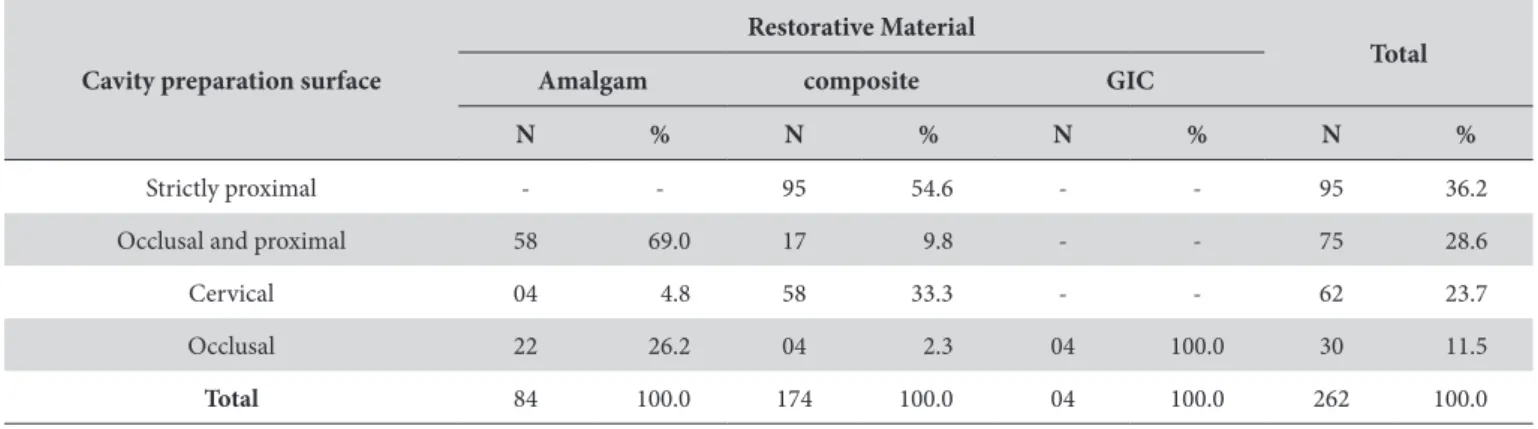
he replaced restorations were restored with: composite resin (174 - 66.4%), silver amalgam (84 - 32.1%) or GIC (04 - 1.5%). he majority of the replaced restorations were strictly on proximal surfaces (all composite resin restorations) or on the proximal and occlusal surfaces (composite resin or amalgam restorations) (Table 1).
he median survival times of amalgam, resin and GIC restorations were 3.04 years 1.56 years and 2.12 years, respectively. here was a
Table 1. he type of cavity preparation for direct restorations replaced in adults (SESC/Teresina-PI), according to the restorative material
Cavity preparation surface
Restorative Material
Total
Amalgam composite GIC
N % N % N % N %
Strictly proximal - - 95 54.6 - - 95 36.2
Occlusal and proximal 58 69.0 17 9.8 - - 75 28.6
Cervical 04 4.8 58 33.3 - - 62 23.7
Occlusal 22 26.2 04 2.3 04 100.0 30 11.5
statistically signiicant diference for the material factor (p = 0.009). he survival time of amalgam restorations was signiicantly higher than that of the resin restorations (p = 0.002).
here was no association between the replaced restorative material and the surface of the cavity (p = 0.421). For this analysis, the restorative materials were considered as aesthetic (resin and GIC) and non-aesthetic (amalgam) materials (Table 2).
Replacements were most frequent in anterior teeth (104 cases or 39.7%), followed by premolars (85 cases or 32.4%) and molars (73 cases or 27.9%). he median survival time of the restorations did not vary according to the group of teeth: 2.7 (SD = 2.8) years for anterior teeth, 2.7 (SD = 2.5) years for premolars and 2.7 (sd = 2.5) years for molars (Kruskal-Wallis, p = 0.779). he survival time did not vary according to the type of cavity preparation (Kruskal-Wallis, p = 0.616 - Table 3).
DISCUSSION
he survival times of amalgam, resin and GIC were found to be low, and lower than in other studies of the same nature1,15-18. he silver amalgam restorations had a higher survival time than the composite resin and GIC. Factors such as the material used, the professional operative technique and the individual’s characteristics may be associated with the survival time of dental restorations1,9,19.
he dental service establishes a daily quantitative target of clinical procedures to be met by dentists during their working hours, on average 30 minutes per individual treated. hus, the mean number of replacements per clinical session was considered high. During the clinical time, other types of procedures could also be carried out, which compromised even further the quality of the restorative technique. his factor may have inluenced the outcome of this
study. he restorative procedure with composite resin, for example, may require 2.5 times longer than a similar amalgam due to the greater complexity of the operatory technique12.
he prognosis of a restorative treatment is closely associated with the conditions under which it is carried out. Inaccurate diagnoses, failure to comply with the technical requirements of the procedure, overtreatment in case of failures, the wrong indication of the materials for speciic clinical situations and the underestimation or ignorance of the causes may culminate in premature failure of the restoration5,15,16,20.
Most restorations indicated for replacement due to secondary caries are free of caries when the radiographic examination is carried out21. Because most dentists in this study did not use radiographs (2.7% of the replacement procedures were carried out ater radiograph exam - data not shown), there may have been overtreatment.
Dental amalgam and composite resin were the most frequently used materials in this study 22, 23 and the fact that most of the restorations were placed with composite resin conirms the worldwide trend of using composites as a universal restorative material (for anterior and posterior teeth). he growing desire of individuals for aesthetic materials also contributes to the increase in the use of composites7,24-27.
Because composite resins are more frequently used than amalgam, they tend to fail more oten, especially because of their higher sensitivity to operative technique3,11,13,14. According to Tyas3, amalgam restorations survive for longer than composite resin, as found in this study. However, this statement is not a consensus2,3,9,11,12,15. he survival time of amalgam and composite resin restorations varies according to the nature of the study and other factors. Amalgam survival time varies between 8 and 16 years3,11,12,26,27.
Table 2. Tooth surfaces involved in the cavity preparation of direct restorations replaced in adults at SESC/Teresina, PI, according to the type of restorative material
Cavity preparation surface Restorative Material Total p* Non-aesthetic aesthetic
Occlusal 22 08 30
0.421
Occluso-proximal 58 17 75
Total 80 25 105
*Fisher’s exact test.
Table 3. Survival time (years) of direct restorations replaced in adults treated at SESC (Teresina-PI) according to the tooth surface involved in the cavity preparation
Cavity preparation surface
Survival time (years)
p*
Median minimum maximum
Proximal 2.9 0.08 18.0
Occluso- proximal 2.0 0.08 10.9 0.616
Cervical 1.75 0.08 10.9
Occlusal 2.1 0.17 9.0
Clinical controlled studies have reported longer survival times because the restorative technique used was carried out under ideal technical conditions27.
Most of the replacements (36.2%) were carried out in proximal cavity preparations, which had been restored with composite resin (Table 1), and in anterior teeth. Composite resins are technique-sensitive materials and their aesthetic failure is easily visible to the patient. his might be responsible for the high number of replacements.
Some clinical situations, such as large cavity preparations, limit the survival time of the resins in proximal cavities of anterior teeth7. Because the institution in this study does not provide indirect restorations as a restorative option, the professionals oten opt to restore certain teeth with composite resin when a crown would be the ideal indication.
he frequency of replacement of non-aesthetic material was the same as aesthetic material for the occlusal and occluso-proximal surfaces (Table 2). his result may reveal an invasive mentality for the treatment of failed restorations. Oten, failures are restricted to certain areas of the restorations or are supericial. hese failures could be resolved with repairs or resurfacing of the restoration. he incorrect indication of replacing restorations is responsible for about two-thirds of unnecessary direct restorations placement. his may result in overtreatment and the loss of sound dental tissue20,21. he repair, sealing of margins, recontouring and resurfacing of existing restorations should be part of the proposed treatment for dental restorations. hese procedures improve the clinical longevity of these restorations, avoid unnecessary loss of dental tissue and have reduced cost5,15,16.
Class II cavity preparations are the most frequently placed and replaced restorations13,17, unlike in this study. In occluso-proximal preparations, important anatomical structures which are located the masticatory stress region and that reinforce the dental crown
(such as cusps and marginal ridges) are lost. However, regardless of the material that was used, the various types of preparation had the same survival time (Table 3), which indicates that the restorations failed ater a similar period (p = 0.840).
he reduced survival time of restorations in diferent groups of teeth supported the hypothesis that the clinical performance was not associated with the type of material or the location of the tooth, but with technical failures, overtreatment and/or the patient’s characteristics. Possibly, investment in the continuing education of professionals, a paradigm shit to a more conservative approach to dental tissue and technical rigor in restorative procedures could improve this situation.
Despite the great advances in dentistry, especially regarding oral health promotion, the prevention of caries and the technological evolution of materials and restorative techniques, it is important that professionals are aware of the maintenance of functional restorations, avoiding premature or unnecessary replacements.
Systematic research on the longevity and the replacement of direct restorations in Brazilian dental clinical practice is necessary. Studies like this are critical for the assessment of the professional’s performance and for the management of the dental service (proposing protocols, reducing costs and increasing eiciency).
CONCLUSION
he direct restorations that were placed in the studied dental service had a reduced survival time. he amalgam restorations had a higher survival time than the other materials studied. he technical and operational variables did not inluence the rate of replacement of restorations of the studied materials. he reduced survival time of restorations may be associated with the philosophy adopted by the treatment providers.
REFERENCES
1. Burke FJT, Wilson NHF, Cheung SW, Mjör IA. Influence of patient factors on age of restorations at failure and reasons for their placement and replacement. J Dent. 2001 July;29(5):317-24. http://dx.doi.org/10.1016/S0300-5712(01)00022-7. PMid:11472803.
2. Forss H, Widström E. Reasons for restorative therapy and the longevity of restorations in adults. Acta Odontol Scand. 2004 Apr;62(2):82-6. http://dx.doi.org/10.1080/00016350310008733. PMid:15198387.
3. Tyas MJ. Placement and replacement of restorations by selected practitioners. Aust Dent J. 2005 June;50(2):81-9, quiz 127. http://dx.doi. org/10.1111/j.1834-7819.2005.tb00345.x. PMid:16050086.
4. Mjör IA. Clinical diagnosis of recurrent caries. J Am Dent Assoc. 2005 Oct;136(10):1426-33. http://dx.doi.org/10.14219/jada.archive.2005.0057. PMid:16255468.
5. Lustosa D No, Prado RR Jr, Mendes RF. Restaurações diretas no programa saúde da família em Teresina (PI). RGO – Rev Gaucha Odontol. 2007 Jan-Mar;55(1):55-60.
6. Hannig C, Kupilas FJ, Wolkewitz M, Attin T. Validity of decision criteria for replacement of fillings. Schweiz Monatsschr Zahnmed.
2009;119(4):328-38. PMid:19485073.
7. Manhart J, Chen H, Hamm G, Hickel R. Buonocore memorial lecture. Review of the clinical survival of direct and indirect restorations in posterior teeth of the permanent dentition. Oper Dent. 2004 Sep-Oct;29(5):481-508. PMid:15470871.
8. Moncada G, Fernández E, Martín J, Arancibia C, Mjör IA, Gordan VV. Increasing the longevity of restorations by minimal intervention: a two-year clinical trial. Oper Dent. 2008 May-June;33(3):258-64. http://dx.doi.org/10.2341/07-113. PMid:18505215.
10. Mjör IA, Shen C, Eliasson ST, Richter S. Placement and replacement of restorations in general dental practice in Iceland. Oper Dent. 2002 Mar-Apr;27(2):117-23. PMid:11931133.
11. Roulet JF. Benefits and disadvantages of tooth-coloured alternatives to amalgam. J Dent. 1997 Nov;25(6):459-73. http://dx.doi.org/10.1016/ S0300-5712(96)00066-8. PMid:9604577.
12. Mjör IA, Holst D, Eriksen HM. Caries and restoration prevention. J Am Dent Assoc. 2008 May;139(5):565-70, quiz 626. http://dx.doi. org/10.14219/jada.archive.2008.0216. PMid:18451372.
13. Asghar S, Ali A, Rashid S, Hussain T. Replacement of resin-based composite restorations in permanent teeth. J Coll Physicians Surg Pak. 2010 Oct;20(10):639-43. PMid:20943103.
14. Stefanski S, van Dijken JW. Clinical performance of a nanofilled resin composite with and without an intermediary layer of flowable composite: a 2-year evaluation. Clin Oral Investig. 2012 Feb;16(1):147-53. http://dx.doi.org/10.1007/s00784-010-0485-8. PMid:21104100.
15. Setcos JC, Khosravi R, Wilson NH, Shen C, Yang M, Mjör IA. Repair or replacement of amalgam restorations: decisions at a USA and a UK dental school. Oper Dent. 2004 July-Aug;29(4):392-7. PMid:15279477.
16. Moncada G, Martin J, Fernández E, Hempel MC, Mjör IA, Gordan VV. Sealing, refurbishment and repair of Class I and Class II defective restorations: a three-year clinical trial. J Am Dent Assoc. 2009 Apr;140(4):425-32. http://dx.doi.org/10.14219/jada.archive.2009.0191. PMid:19339531.
17. Bernardo M, Luís H, Martin MD, Leroux BG, Rue T, Leitão J, et al. Survival and reasons for failure of amalgam versus composite posterior restorations placed in a randomized clinical trial. J Am Dent Assoc. 2007 June;138(6):775-83. http://dx.doi.org/10.14219/jada.archive.2007.0265. PMid:17545266.
18. Gilbert GH, Williams OD, Rindal DB, Pihlstrom DJ, Benjamin PL, Wallace MC. The creation and development of the dental practice-based research network. J Am Dent Assoc. 2008 Jan;139(1):74-81. http://dx.doi.org/10.14219/jada.archive.2008.0024. PMid:18167389.
19. Ferracane JL. Is the wear of dental composites still a clinical concern? Is there still a need for in vitro wear simulating devices? Dent Mater. 2006 Aug;22(8):689-92. http://dx.doi.org/10.1016/j.dental.2006.02.005. PMid:16563492.
20. Sunnegårdh-Grönberg K, van Dijken JW, Funegård U, Lindberg A, Nilsson M. Selection of dental materials and longevity of replaced restorations in Public Dental Health clinics in northern Sweden. J Dent. 2009 Sep;37(9):673-8. http://dx.doi.org/10.1016/j.jdent.2009.04.010. PMid:19477572.
21. De Moor, R, Delmé, K. Black or white-Which choice for the molars? Part 2. Which does one choose for the restoration of posterior teeth: amalgam or composite? Rev Belge Med Dent (1984). 2008;63(4):135-46. PMid: 19227687.
22. Opdam NJ, Bronkhorst EM, Roeters JM, Loomans BA. A retrospective clinical study on longevity of posterior composite and amalgam restorations. Dent Mater. 2007 Jan;23(1):2-8. http://dx.doi.org/10.1016/j.dental.2005.11.036. PMid:16417916.
23. Gordan VV, Riley JL 3rd, Worley DC, Gilbert GH, DPBRN Collaborative Group. Restorative material and other tooth-specific variables associated with the decision to repair or replace defective restorations: findings from The Dental PBRN. J Dent. 2012 May;40(5):397-405. http://dx.doi.org/10.1016/j.jdent.2012.02.001. PMid:22342563.
24. van Dijken JW, Pallesen U. Clinical performance of a hybrid resin composite with and without an intermediate layer of flowable resin composite: a 7-year evaluation. Dent Mater. 2011 Feb;27(2):150-6. http://dx.doi.org/10.1016/j.dental.2010.09.010. PMid:20952051. 25. Donovan TE. Longevity of the tooth/restoration complex: a review. J Calif Dent Assoc. 2006 Feb;34(2):122-8. PMid:16724467.
26. Hickel R, Manhart J, García-Godoy F. Clinical results and new developments of direct posterior restorations. Am J Dent. 2000 Nov;13(Spec No):41D-54D. PMid:11763918.
27. Pollington S, van Noort R. A clinical evaluation of a resin composite and a compomer in non-carious Class V lesions. A 3-year follow-up. Am J Dent. 2008 Feb;21(1):49-52. PMid:18435377.
CONFLICT OF INTEREST
he authors declare no conlicts of interest.
*CORRESPONDING AUTHOR
Raimundo Rosendo Prado Júnior, Centro de Ciências da Saúde, Departamento de Odontologia Restauradora, Programa de Pós-graduação em Odontologia, UFPI – Universidade Federal do Piauí, Campus Universitário, Bloco SG 10, Ininga, 64001-020 Teresina – PI, Brazil, e-mail: [email protected]