Original Article 909
-PARTURIENT WOMEN’S COMPANIONS’ KNOWLEDGE OF LAW
11.108/2005 AND THEIR EXPERIENCE WITH THE WOMAN IN THE
OBSTETRIC CENTER
1Letícia Demarche Frutuoso2, Odaléa Maria Brüggemann3
1 Taken from the dissertation entitled - The parturient women’s companions’ perceptions regarding the experience and the organizational aspects related to their stay in the obstetric center, presented to the Postgraduate Nursing Program (PEN) of the Federal University of Santa Catarina (UFSC) in 2011.
2 Master’s degree in Nursing. Nurse of the Santa Catarina State Health Department. Santa Catarina, Brazil. E-mail: [email protected]
3 Ph.D. in Obstetrics and Gynecology. Lecturer in the UFSC’s Department of Nursing and Postgraduate Nursing Program. Researcher for the National Council for Scientiic and Technological Development (CNPq). Santa Catarina, Brazil. E-mail:
ABSTRACT: This exploratory-descriptive research, with a qualitative approach, undertaken in a public maternity hospital in the
Brazilian state of Santa Catarina (SC), aimed to investigate what information the companions possess regarding Law 11.108/2005, their perceptions of the experience in the obstetric center and the support actions undertaken with the women. The data was collected through semi-structured interviews held in November 2010 – May 2011 with 16 companions who had stayed with the parturient women throughout all the clinical stages of birth. The analysis of the data, using the Discourse of the Collective Subject, indicated little knowledge regarding this Law; the companions considered the experience positive, and evaluated the attendance given to the women as satisfactory, and carried out actions of physical and emotional support. In spite of the adversities of the obstetric center and the stressful situations which are inherent to the process of delivering the baby, it was observed that it is possible for the companion to have a positive experience and act as a provider of support for the woman.
DESCRIPTORS: Humanized birth. Social support. Patients’ rights. Obstetric nursing.
CONHECIMENTO SOBRE A LEI 11.108/2005 E A EXPERIÊNCIA DOS
ACOMPANHANTES JUNTO À MULHER NO CENTRO OBSTÉTRICO
RESUMO: Pesquisa exploratório-descritiva, com abordagem qualitativa, realizada em uma maternidade pública de Santa Catarina, que objetivou conhecer quais informações os acompanhantes possuem acerca da Lei 11.108/2005, as suas percepções sobre a experiência no centro obstétrico e as ações de apoio junto à mulher. Os dados foram coletados por meio de entrevistas semiestruturadas, de novembro/2010 a maio/2011, com 16 acompanhantes que permaneceram com parturiente durante todos os períodos clínicos do parto. A
análise dos dados, utilizando o Discurso do Sujeito Coletivo, indicou pouco conhecimento sobre a Lei, os acompanhantes consideraram
a experiência positiva, avaliaram como satisfatório o atendimento prestado à mulher e desenvolveram ações de apoio físico e emocional. Apesar das adversidades do centro obstétrico e das situações de estresse inerentes ao processo de parturição, constatou-se ser possível que o acompanhante tenha uma experiência positiva e atue como provedor de apoio à mulher.
DESCRITORES: Parto humanizado. Apoio social. Direitos do paciente. Enfermagem obstétrica.
CONOCIMIENTO ACERCA DE LA LEY 11.108/2005 Y LA EXPERIENCIA
DE LOS ACOMPAÑANTES DE LAS MUJERES EN EL CENTRO DE
OBSTETRICIA
RESUMEN: Estudio exploratorio descriptivo, cualitativo, realizado en una maternidad pública en Santa Catarina, para conocer las informaciones que los acompañantes tienen sobre la Ley 11.108/2005, sus percepciones acerca de la experiencia en el centro de obstetricia
y las acciones de apoyo a la mujer. La recolección de los datos se hizo a través de entrevistas semiestructuradas, de noviembre/2010 a
mayo/2011, con dieciséis acompañantes de las madres durante los períodos clínicos del parto. El análisis de datos, según la propuesta del Discurso del Sujeto Colectivo, mostró poco conocimiento sobre la Ley, los acompañantes consideran la experiencia positiva, evaluaron como satisfactoria la atención prestada a las mujeres y desarrollaron acciones de apoyo físico y emocional. A pesar de las adversidades del centro de obstetricia y las situaciones de estrés inherentes al proceso del parto, es posible que el acompañante tenga
una experiencia positiva como proveedor de apoyo a la mujer.
INTRODUCTION
Enabling the woman to have a companion of her own choice with her during the labor, birth and post-partum is considered a beneicial practice which must be encouraged, and which is support-ed by the scientiic evidence.1-2 The women who
receive continuous support during labor, when compared with those who do not have somebody providing support, have a greater chance of not having a caesarean and of having a normal birth without use of analgesia; they have a shorter labor, report less dissatisfaction with the experience of the birth process, and their new-borns have better Apgar scores in the irst ive minutes of life.1
In Brazil, the person chosen by the woman to accompany her during labor and birth has gen-erally been responsible for the support, carrying out measures which particularly cover emotional aspects and aspects of physical comfort. For the companion to perform this role, however, he or she must be embraced and integrated in the institu-tional context, being provided with the necessary guidance.3
The literature describes that the support measures cover four dimensions: emotional (the continuous presence, the encouragement, and allowing peace of mind); informational (explana-tions, instructions on how the labor is progressing, and advice); physical comfort (massage, warm baths and the appropriate offering of luids); and, lastly, intermediation, which aims to interpret the woman’s desires and negotiate these with the health professionals.1
The requirement to allow the presence in Brazilian health institutions of a companion of the woman’s choice during the period of labor, birth and the immediate post-partum is supported by Law n. 11.108/2005.4 This achievement is the
result of the efforts of organizations and social movements, and, principally, of the campaign organized by the Brazilian Network for the Hu-manization of Childbirth (REHUNA) in support of the right to the presence of a companion of the woman’s choice.3
However, even with women possessing this right ensured by law, some institutions have dif-iculty implementing and maintaining this practice in a regular and systematic form,5-6 indicating, as
the main hindering factors, the adoption of the model of assistance for labor and childbirth cen-tered on biomedicine, shortcomings in infrastruc-ture, and lack of preparation of the companion).7-8
Despite the dificulties mentioned by the health institutions, the companions assessed the experience as positive, expressing satisfaction in relation to various aspects, including: being able to support the woman, contributing to a tranquil experience of the birth process, having the oppor-tunity to be present at the birth of their child, and monitoring the care given, in addition to feeling welcomed by the health professionals.9-10
Considering that the integration of the com-panion in the obstetric center is a practice which has not been adopted by all the health institutions, it is necessary to investigate the multiple aspects which surround it, including how the compan-ions have access to the information regarding the possibility of remaining with the woman, and regarding the law which regulates their presence. It is also essential to describe their experience in the care context into which they are integrated, as well as their actions as providers of support to the woman. In this regard, this research aimed to investigate what information the companions have about Law n. 11.108/2005, their perceptions on the experience of the obstetric center, and the support actions carried out for the woman.
METHOD
This is exploratory-descriptive research with a qualitative approach, undertaken in the obstetric center of a public maternity hospital in Santa Catarina, which exclusively attends users of the Uniied Health System (SUS), and where the presence of a companion of the woman’s choice is instituted for all the parturient women.
Although the maternity hospital does not have a written policy on the presence of the com-panion in the obstetric center, some advice is given verbally on the sector’s routines, including the possibility of the companion being able to leave, or be substituted by another, after having stayed with the woman for a period of three hours.
The companions who remained with the parturient woman continuously during all the clinical periods of the birth (labor, birth and im-mediate post-partum) were included, while those who accompanied those parturient women who were being assisted by the researcher in her role as a nurse in the obstetric center were excluded, to avoid this fact inluencing the content of the accounts. The number of participants was deined by data saturation.11 The identiication of the pos
researcher to the obstetric center and the rooming-in of the maternity hospital.
Data collection took place in the period No-vember 2010 – May 2011, through semi-structured interviews guided by scripts which had been previously tested with four companions. All the interviews were held in the irst 24 hours after the companion had left the obstetric center, prior to the parturient woman’s discharge from the hospital, in a meeting room in the rooming-in , so as to facilitate the conversation and maintain the companion’s privacy. For the data to be recorded and analyzed, the interviews were recorded, tran-scribed in full, and checked.
The data was analyzed using the technique of thematic discourse analysis, in line with the proposal of the Discourse of the Collective Subject (DCS). This methodological proposal for organiz-ing and tabulatorganiz-ing the qualitative data is based on the premise that the collective thinking can be seen as a set of discourses on a given theme. The meth-odological route leads to the wording of the DCS, which is a synthesis-discourse, retyped in the irst person singular, made up of the key-expressions which have the same Central Idea (CI).12
To facilitate understanding, the CIs were numbered consecutively, with the DCSs follow-ing the same order of identiication, as each one of them corresponds to a CI.
This research followed the norms of Resolu-tion 196/96 of the NaResolu-tional Health Council, which establishes guidance and regulatory norms for research involving human beings. The research protocol was approved by the Research Ethics Committee of the hospital where the study was
undertaken, under protocol n. 051/10. All the participants signed the Terms of Free and In-formed Consent.
RESULTS
A total of 16 companions, chosen by the women, participated in this research, these being: 13 partners, one sister, one mother-in-law, and one aunt. The age range varied between 18 and 50 years old, and the predominant educational level was senior high (nine), followed by junior high (six) and degree (one). The majority (12) were going through the experience for the irst time; three had already been companions twice, and one, three times.
The CIs emerged based on the analysis of the interviews held, and were grouped into ive themes, which shall be exempliied by some DCSs: companions’ knowledge regarding Law n. 11.108/2005 (Table 1); source of information on the possibility of being a companion (Table 2); feelings experienced in the obstetric center (Table 3); perceptions of the care given to the woman (Table 4); and support actions carried out by the companion (Table 5).
Theme 1 - Companions’ knowledge regarding
Law n. 11.108/2005
CI1 (Table 1) and its respective DCS1 show that the companions are unaware of the Law. Some, however, reported that they knew about it, although with little clarity as to its purpose, asso-ciating it with the need to have somebody to check for possible errors in the care ( CI2, DCS2 - Table 1).
Table 1 - Theme and central ideas regarding Law 11.108/2005, ‘The Companion’s Law’. São José-SC, 2011
Theme Central ideas
1. Companions’ knowledge regarding Law n. 11.108/2001
CI1 – Had never heard of the Law which permits the companion in the maternity hospital.
CI2 – Knew about the existence of the ‘Companion’s Law’.
No, I didn’t know about the law [...], I had never heard about this. I didn’t hear this bit [refer-ring to the law] told about anywhere [...] why, are there some people who don’t allow it? [...] actu-ally, there are lots of laws which give us privileges which they don’t tell you about, and as a result we don’t know about our rights (DCS1).
Everybody says it’s the law now, that there has to be a relative present because of medical errors [...],
that’s how I knew that we can accompany the person when they’re giving birth. I know about it because of Brazilian Civil Law. [...] yes, I knew that there was a law [...], they had already told me (DCS2).
Theme 2 - Source of information on the
possibility of being a companion
woman in the obstetric center, these being: their social network, the woman herself, the media, the health professionals from the maternity hospital,
and their own previous experience as a companion (CI3, 4, 5, 6 and 7 - Table 2).
Table 2 - Theme and central ideas on the source of information regarding the possibility of being a companion. São José-SC, 2011
Theme Central ideas
2. Source of information on the possibility of being a companion
CI3 – Informed about the possibility of being a companion by members of the social network.
CI4 – Heard that they could be a companion from the woman herself. CI5 – Obtained information that they could be a companion through the media.
CI6 – Received information from the health professionals in the maternity hospital.
CI7 – Had prior experience as a companion.
I think it was my cousin who told me, she didn’t have her here, but she said I would be al-lowed to stay [...] and recently, my sister had two children here. [...]other people comment on it [...] comments, by word of mouth [...], through friends [...], my friend had a child and was a companion there in X Maternity Hospital, and another friend of mine also had a child and was a companion, [...] other acquaintances said: you can stay, you can be the companion (DCS3).
Theme 3 - Feelings experienced in the
obstetric center
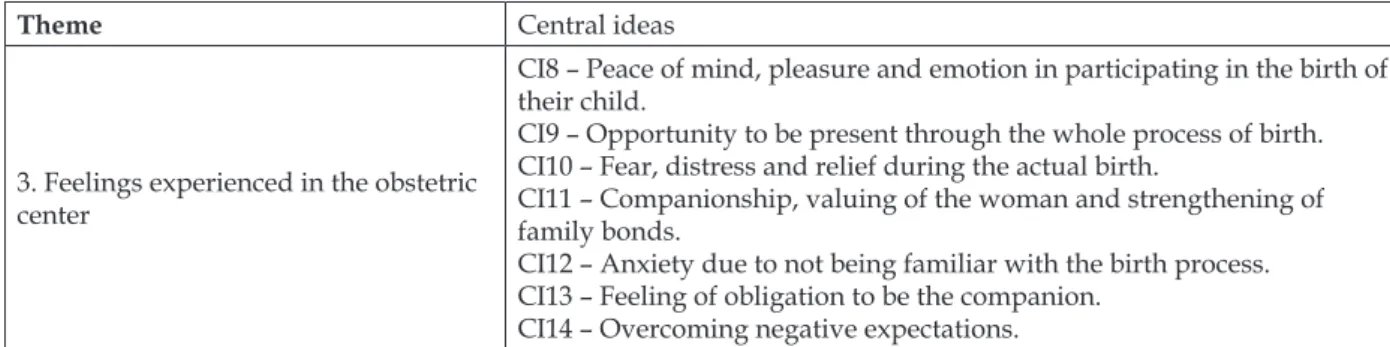
The CIs and their respective DCSs revealed the diversity of feelings expressed by the compan-ions, some positive, such as peace of mind, pleasure and emotion in participating in the birth, overcom-ing negative expectations, companionship and valuing family bonds, and some negative, such as fear, distress and anxiety due to not being familiar with the birth process, in addition to the feeling of obligation to be the companion (Table 3, DCS8).
Table 3 - Theme and central ideas on the feelings experienced in the obstetric center. São José-SC, 2011
Theme Central ideas
3. Feelings experienced in the obstetric center
CI8 – Peace of mind, pleasure and emotion in participating in the birth of their child.
CI9 – Opportunity to be present through the whole process of birth. CI10 – Fear, distress and relief during the actual birth.
CI11 – Companionship, valuing of the woman and strengthening of family bonds.
CI12 – Anxiety due to not being familiar with the birth process. CI13 – Feeling of obligation to be the companion.
CI14 – Overcoming negative expectations.
I thought I wouldn’t be able to manage [...] but I surprised myself, I was calm, I didn’t think I would be like that [...]. I thought it was very good [...], for me it was an immense pleasure, because of me being able to be there, being part of it all [...] seeing my son born was the best thing in the world! [...] I’ll never forget it, my whole life long, you know. I am very happy [...] it’s a present I received [...] it was stirring... whew! [...] a re-birth, something which does you good,
you can see, you can look, smile, cry, know that... that’s your son being born there [...], you see him being cleaned, you see how he is, you can talk to him (DCS8).
Theme 4 - Perceptions of the care given to
the woman
16, 17 - Table 4, DCS15), including considering it to be better than that received during the birth of
their own children, in the cases where the com-panion was a woman.
Table 4 - Theme and central ideas on the companion’s perception of the care given to the woman. São José-SC, 2011
Theme Central ideas
4. Perception of the care given to the woman
CI15 – Positive opinion on the attendance of the team to the parturient woman. CI16 – The attention given to the parturient woman was better than that received by the companion when she was giving birth.
CI17 – The team showed motivation and disposition to provide the care. CI18 – Dissatisfaction with the attendance on admission.
CI19 – The team’s calmness in the light of the companion’s anxiety created a feeling of “indifference” in relation to the assistance to the woman.
I thought it was really good [...], kind, inter-ested people who were concerned with what they were doing [...], they attended her very well, they were always close by [...] I really liked the treatment they gave [...] they were there caring the whole time [...], everybody was very helpful [...]. Every so often somebody would put their head in to ask how it was going. When she cried, one put an arm around her, and stayed talking with her [...] they even mas-saged her back. [...] the people were really humane. There are some who are more strict, so everybody has their own way. [...] she was pretty lucky. It was a really good team on duty, I even said to her: you got a really good team on duty (DCS15).
CI 18 and DCS 18, on the other hand, show discontent with the care given on admission to the maternity hospital. Attention is also called to the team’s calmness in situations which create anxi-ety in the companion, which may be perceived as “indifference” in relation to the care given to the woman (CI19) (Table 4).
It was good, apart from... there was this one doctor [...] who attended her [the parturient
woman]. She didn’t want to let the doctor examine her, and the doctor snapped: ‘do you want to have your child on the street?’ [...] she shouldn’t have spoken to her like that, because she’s a young girl, she [the doctor] should be more patient. It’s bad for a person who is already in a weak state when she comes in [...]. I don’t know what I asked, but she answered me very rudely, and to her too [to the parturient woman], really dificult to deal with [...], but we didn’t answer back, you know, we needed her (DCS18).
Theme 5 - Support actions carried out by the
companion
The CIs show that the companion carries out some form of support for the woman during all the phases of the birth process and in the varying environments of the obstetric center, i.e. from the pre-partum period through to the post-partum recovery room (Table 5). The support actions were of physical and emotional comfort, as well as help in breastfeeding.
Table 5 - Theme and central ideas regarding the support actions carried out by the companion. São José-SC, 2011
Theme Central ideas
5. Support actions carried out by the companion
CI20 – Physical comforting during the period of dilation. CI21 – Emotional support during the period of dilation. CI22 – Emotional support during normal birth.
CI23 – Emotional support during caesarean birth.
CI24 – Physical and emotional support in the recovery and anesthetic rooms.
CI25 – Companion’s participation in breastfeeding in the irst hour after the birth.
The actions of physical comforting carried out during the period of dilation were related to helping with walking around, the bath, breathing
exercises, use of the birth ball and providing mas-sages for relaxation (CI20, DCS20).
with the nurses to take her to shower [...] when she went to the toilet, I had to take her [...] I mas-saged her leg, because she was getting a lot of cramp, there was a lot of contraction, massaging her leg [...], shifting from side to side, moving the hips in circles [exercise with the birth ball] and afterwards, when the contractions came, for her to squat [...], keeping her feet on the ground, and helping her there so she wouldn’t fall, they [the health team] taught her to breathe, and I encour-aged her too, how the woman taught her to breathe and sometimes she gave up, so I kept on teaching her, sometimes I did it with her too [...], and so it went on, and the baby was born. So, when she saw that the baby was being born, we dashed to the birthing room (DCS20).
Still in the period of dilation, the companions carried out actions of emotional support (CI21), aiming to “keep the parturient woman calm”, manifested through behaviors such as: remaining sat by her side, holding her hand, talking to her and kissing her (DCS21).
I was helping her not to get nervous, to re-lax [...]. I stayed sat by her side [...] she cried, and yelled quite a bit [...] she held my hand, squeezed, I carried on trying to keep her calm [...], I stayed there talking with her, I held her hand, sat with her [...], gave her a kiss on her lips, because she had got very nervous [...], she was scared of having the baby, actually [...] I think I helped a little, I think my presence helped her to be calmer, that’s why she didn’t get so nervous (DCS21).
In the same way, during the accompaniment of the woman during a normal birth or caesarean, the actions of emotional support carried out by the companion were: staying by her side, calming her, holding her hand, stroking her face, saying sup-portive words and encouraging her, particularly during the period of the baby’s expulsion (CI22, DCS22 and CI23).
I stayed by the top of the bed, and asked her to keep calm, and to push. When the pain came, for her to push, and that’s what she did [...] I stayed with her, stayed holding her hand, by her side, I said, nearly there, he’s coming out, he’s being born [...] I said that, he’s being born, nearly there, and she said: it hurts love, it hurts, love! And I said keep calm, keep calm, he’ll soon be out, and the doctor was pulling her out slowly and gently, and her pushing, it was fast (DCS22).
The companions’ participation in the actions of physical and emotional support was also
identi-ied, as well as in support for breastfeeding in the immediate post-partum (CI24, DCS24 and CI25)
I stayed with her the whole time, talking so she would calm down because of her leg. The doctor asked me to massage her leg, and said: ‘do massage to see if it comes back quicker’, because she had become too agitated, she was trying to get up, and I was telling her: don’t strain yourself because you’ll end up breaking your stitches, and you’ll have to go back to the operating room (DCS24).
DISCUSSION
Although Law n. 11.108/2005 – which made it obligatory for the Uniied Health System (SUS) health services or associated institutions to allow the presence of a companion of the woman’s choice during the pre-partum period, birth, and immedi-ate puerperium – has been in force for eight years, some companions were completely unaware of it; that is, they are not being informed of this right of the woman’s. This evidences that there may be shortcomings in its dissemination by the media, as well as in the health services, as emphasized by a separate study undertaken previously.13
Speciically in the present study, the com -panions who mentioned being aware of the law showed little knowledge about its objective, relat-ing it to a role of checkrelat-ing for possible errors in the care provided. Even with the publication of the state Regulatory Instruction, which speciied that the health institutions must implement measures to ensure that service users are informed about this right,14 it is observed that this is not taking place.
The possibility of being a companion during the delivery, has been spread informally, by the women themselves and by the medoa, and gener-ally only when they are taken into the maternity hospital or ward, backing up the need for greater publicising of Law 11.108/2005 during pre-natal consultations and in the primary care units, ma-ternity wards and hospitals.
In spite of the little information received in relation to the possibility of being a companion, which does not permit prior preparation, the DCSs showed that the experience in the obstetric center was signiicantly positive and surrounded with much emotion, touching on all sorts of feelings, including that of pleasure in being present at the birth of one’s child, and that of overcoming nega-tive expectations.
Bearing in mind that the majority of the com-panions who participated in the study were the parturient women’s partners, it may be inferred that these feelings experienced can contribute to strengthening conjugal and family ties, for bond-ing parents and children and brbond-ingbond-ing them closer to each other.7,13,15
Other studies emphasize that in spite of there initially being negative expectations, resulting from the preconceived idea that the environment of childbirth is surrounded with fear and suffer-ing, a process of demystiication occurs, based on the experience.13,15
In this regard, in the present study, distress, fear and anxiety were also expressed by some com-panions, especially those who were participating for the irst time, this possibly being related to the unawareness of the birth process, to the dificulty in dealing with the intense periods close to the time of the baby’s expulsion and with the woman’s pain, in addition to the uncertainty regarding the outcome of the birth. Even considering these feelings, the companions try not to show them, because they recognize the importance of their role as providers of support.
Thus, one can observe that a certain adapta-tion occurs to the situaadapta-tions experienced during the labor and birth, motivated by the desire to support the woman and show solidarity, as em-phasized by other studies.7,16 This ability to adapt
evidences that the dificulties presented by the companions cannot be considered as factors im-peding their participation.7
The fact that the companion is continuously by the woman’s side in the obstetric center makes it possible for him to evaluate the care given. The CIs revealed that the positive perception of the care is anchored in the valuing of the professionals’ attitudes – that is, of interest in and concern with the care, in showing sympathy and solidarity and being always present.
It is worth noting that the attendance to the companions’ needs and the advice given to them also contributed to this perception. Other
stud-ies also indicated that the companion’s presence contributes to the health professionals having attitudes which are more humanized and less rou-tinized, and giving greater value to the subjective aspects which surround childbirth, contributing to the good relationship between the health profes-sionals and the service users.8-10
Not all the companions felt embraced and respected, however, as certain attitudes still persist on the part of some medical professionals, show-ing that there remain relationships of inequality and power, revealing a certain resistance to in-corporating this “new” proposal. In this unequal relationship, on one side one has the health profes-sional, holder of the technical scientiic knowledge, valued as necessary to ensure risk-free assistance; while on the other, there is the public health service user, who feels coerced to unconditionally accept the conducts imposed on him or her.17-18
In spite of the companions having experi-enced some dificulties in the interpersonal rela -tionships with the team and in dealing with their own feelings, generally speaking they participated actively in the actions of support for the woman, as evidenced in the CIs and DCSs. The effort in responding to the needs for physical and emo-tional comfort in the period of dilation and birth extended to the post-partum period, corroborating the indings of other studies.9-10,13
However, it was not observed that the com-panions functioned in the other two dimensions of support; the informational dimension, in which the provider of support gives the woman informa-tion, guidance and advice; and the dimension of intermediation, in which the woman’s desires are interpreted and ‘negotiated’ with the members of the health team.1 This may result from the little
or no information that they have regarding their role as providers of support, and from unaware-ness of the various aspects which surround the birth process.
It should be highlighted that the actions of physical support carried out by the companions, such as helping the woman walk around, giving her massage, breathing exercises and helping with the supervised shower are non-pharmacological methods of pain relief which have beneits rec -ognized by scientiic evidence, and which, when used together, help reduce pain, anxiety and stress during the birth process.19-20
encourage-ment and motivation, is shown to be an important measure which contributes to reducing anxiety and affords security to the parturient woman. In addition to this, the companion’s empathetic support before and during labor helps the woman to bear the pain better, as well as contributing to reducing the need for pharmacological methods to relieve pain.2 These support actions create
feelings of gratiication in the companion, to the extent that he or she perceives his or her contribu-tion to a more tranquil experience of the process of giving birth.9-10,13
FINAL CONSIDERATIONS
This study’s indings show that in spite of Law n. 11.108/2005 being in force, the majority of the companions are unaware of this right of the woman’s, evidencing that this information is little-publicised by the health services. In spite of this, and of the adversities of the environment of the obstetric center, it is possible for the companion to have a positive experience and to act as a provider of physical and emotional support for the woman. In the obstetric center, the companion ex-perienced diverse and ambivalent feelings. Nev-ertheless, even in the face of stressful situations, speciic to lay persons who are accompanying the progression of the birth process, one can perceive that the companions overcome the dificulties, as they recognize the importance of their presence as a source of support.
Moreover, the companion evaluates the care given to the woman positively, when he or she identiies that the health professionals undertake actions based in the principles of humanization and have attitudes showing respect and interest in the care for the parturient woman.
The actions of support carried out by the companions in the obstetric center are anchored in physical and emotional support. However, in-formational actions and actions of intermediation were not identiied in the companions’ discourses. This gap may be related to the lack of prior prepa-ration and guidance which instrumentalizes them regarding these dimensions of support.
It is therefore recommended that health professionals involved in assistance during gesta-tion should advise the woman at an early stage to choose who shall accompany her during the pre-partum period, birth and post-pre-partum period and encourage this person’s inclusion whenever pos-sible in ante-natal care, providing him or her with
guidance in relation to the birth process and his or her role as a provider of support. Independently of this, when the woman is brought in to have her child, the obstetric center health team must be prepared to receive, encourage and advise the companion, promoting his or her participation in all the dimensions of the support. Such measures will contribute to the woman and the companion exercising their citizenship and feeling more secure and empowered. It is also observed that it is necessary for there to be greater publicising of the “Companions’ Law”, both by the Ministry of Health’s means of communication and by the health professionals and health institutions.
REFERENCES
1. Hodnett ED, Gates S, Hofmeyr GJ, Sakala C. Continuous support for women during childbirth. (Cochrane Review) [online]. 2011 [accessed 2013 Abr 20134]. Available at: http://apps.who.int/rhl/ reviews/CD003766.pdf
2. Organização Mundial da Saúde. Maternidade
segura, assistência ao parto normal: um guia prático.
Genebra (CH): OMS; 1996.
3. Brüggemann OM, Parpinelli MA, Osis MJD.
Evidências sobre o suporte durante o trabalho de parto/parto: uma revisão de literatura. Cad Saúde Pública. 2005 Set-Out; 21(5):1316-27.
4. Brasil. Lei n. 11.108, de 7 de abril de 2005. Altera a Lei
n. 8.080, de 19 de setembro de 1990, para garantir às parturientes o direito à presença de acompanhante
durante o trabalho de parto, parto e pós-parto
ime-diato, no âmbito do Sistema Único de Saúde - SUS. Diário Oicial da União [internet]. Brasilia; 2005 [ci
-tado 4 Abr 2011]. Disponível em: http://www3.da
-taprev.gov.br/sislex/paginas/42/2005/11108.htm
5. Hoga LAK, Pinto CMS. Assistência ao parto com
a presença do acompanhante: experiências de proissionais. Invest Educ Enferm. 2007 Jan-Jun;
25(1):74-81.
6. Mabuchi AS, Fustinoni SM. O signiicado dado
pelo proissional de saúde para o trabalho de parto
e parto humanizado. Acta Paul Enferm. 2008; 21(3):420-2
7. Carvalho MLM. Participação dos pais no nascimento
em maternidade pública: diiculdades institucionais e motivações dos casais. Cad Saúde Pública. 2003;
19(sup 2):389-98.
8. Nassif AA. O acompanhante na maternidade:
concepções dos profissionais de saúde. 2009 [dissertação]. Florianópolis (SC): Universidade
Federal de Santa Catarina, Programa de
Pós-Graduação em Enfermagem; 2009.
9. Brüggemann OM, Osis MJD, Parpinelli MA. Apoio
acompanhantes escolhidos pela mulher. Rev Saúde Pública. 2007 Fev; 41(1):44-52.
10. Pinto CMS, Basile ALO, Silva SF, Hoga LAK. O acompanhante no parto: atividades desenvolvidas
e avaliação da experiência. Rev Min Enferm. 2003
Jan-Jul; 7(1):41-7.
11. Fontanella BJB, Ricas J, Turato ER. Amostragem
por saturação em pesquisas qualitativas em saúde: contribuições teóricas. Cad Saúde Pública. 2008 Jan;
24(1):17-27.
12. Lefèvre F, Lefèvre AMC. O discurso do sujeito
coletivo: um novo enfoque em pesquisa qualitativa
(Desdobramentos). Caxias do Sul (RS): EDUCS; 2003.
13. Tomeleri KR, Pieri FM, Violin MR, Serafim D,
Marcon SS. “Eu vi meu ilho nascer”: vivência dos pais na sala de parto. Rev Gaúcha Enferm. 2007 Dez;
28(4):497-504.
14. Instrução Normativa n. 001/2009/SES, de 06 de abril
de 2009 (SC). Estabelece diretrizes para os serviços de saúde efetivar a inserção do acompanhante de
livre escolha da mulher durante o pré-parto, parto e pós- parto imediato. Diário Oficial do Estado
n 18.667, Secretaria de Estado da Saúde de Santa
Catarina, 12 ago 2009.
15. Espirito Santo LC, Bonilha ALL. Expectativas,
sentimentos e vivências do pai durante o parto e nascimento de seu ilho. Rev Gaúcha Enferm. 2000
Jul; 21(2):87-109.
16. Motta CCL, Crepaldi MA. O pai no parto e apoio emocional. A perspectiva da parturiente. Rev Paidéia. 2005 Jan-Abr; 15(30):105-18.
17. Nakano AMS, Silva LA, Beleza ACS, Stefanello J, Gomes FA. O suporte durante o processo de
parturição: a visão do acompanhante. Acta Paul
Enferm. 2007 Abr-Jun; 20(2):131-7.
18. Carvalho VF, Kerber NPC, Busanello J, Gonçalves
BG, Rodrigues EF, Azambuja EP. Como os
trabalhadores de um centro obstétrico justiicam a utilização de práticas prejudiciais ao parto normal.
Rev Esc Enferm USP. 2012 Fev; 46(1):30-7.
19. Gayeski ME, Brüggemann, OM. Métodos não
farmacológicos para alívio da dor no trabalho de parto: uma revisão sistemática. Texto Contexto
Enferm. 2010 Out-Dez; 19(4):774-82.
20. Smith CA, Collins CT, Cyna AM, Crowther CA. Complementary and alternative therapies for pain management in labour (Cochrane Review). In: The Cochrane Library, Issue 1, 2006. Oxford: Update Software.
Correspondence: Letícia Demarche Frutuoso
Rua Silvana Goedert, 165
88104-663 – Fazenda Santo Antônio, São José, Brazil.
E-mail: [email protected]