764
INTRODUCTION
www.scielo.br/rsbmt Revista da Sociedade Brasileira de Medicina Tropical 45(6):764-767, Nov-Dec, 2012
Case Report
Address to: Dr. Fred Bernardes Filho. Ambulatório DST/Insituto de Dermatologia Prof. Rubem David Azulay. Rua Marques de Caxias 9, 24030-050 Niterói, RJ, Brasil.
Phone: 55 21 9826-7765
e-mail: [email protected]
Received in 02/01/2012
Accepted in 03/05/2012
HAART: a risk factor for development of porphyria cutanea tarda?
Fred Bernardes Filho
[1], Maria Victória Pinto Quaresma Santos
[1], Felipe Nazareth de Matos Pinto de Carvalho
[1],
Carlos Gustavo Carneiro de Castro
[1], Elisabete Dobao
[1], Marcelo Rosandiski Lyra
[3],
Vinícius de Menezes
[2]and José Augusto da Costa Nery
[1],[2][1]. Ambulatório de Doenças Sexualmente Transmissíveis, Insituto de Dermatologia Prof. Rubem David Azulay, Santa Casa da Misericórdia do Rio de Janeiro, Rio de Janeiro, RJ. [2]. Laboratório de Hanseníase, Insituto Oswaldo Cruz, Fundação Oswaldo Cruz, Rio de Janeiro, RJ. [3]. Insituto de Pesquisa Clínica Evandro Chagas, Fundação Oswaldo Cruz, Rio de Janeiro, RJ.
ABSTRACT
Porphyria cutanea tarda (PCT) is caused by inherited or acquired parial deiciency of the uroporphyrinogen-decarboxylase (Uro-D) enzyme acivity. It is
the most common form of porphyria.The main triggering factors to the development of porphyria cutanea tarda are alcohol, hepaiis C virus and human
immunodeiciency virus. There are several reports of PCT associated with drugs, among them, aniretroviral therapy. We describe three HIV-posiive paients, which showed photosensiivity as well as the emergence of tense blisters on sun-exposed areas during the use of highly acive aniretroviral therapy (HAART) and discuss the possibility of PCT ater the use of these drugs by those paients.
Keywords: Porphyria cutanea tarda. HAART. HIV.
Porphyria cutanea tarda (PCT) is caused by inherited or acquired parial deiciency of the uroporphyrinogen-decarboxylase (Uro-D) enzyme acivity. It is the most common form of porphyria and is prevalent in men over 40 year’s old1. Porphyria cutanea tarda can be
divided into four types according to its characterisics. The sporadic or acquired form (type I), the most common type of PCT, is characterized by decreased hepaic Uro-D enzymaic acivity during the acive disease state. This type of PCT is commonly induced by alcohol, estrogen, iron, drugs, hepaiis C virus, human immunodeiciency virus, systemic lupus erythematosus or chemical materials. The hereditary form of PCT (type II) is an autosomal dominant disorder with geneic mutaions of the Uro-D gene and it is associated with a family history, although most of the gene carriers are asymptomaic. Recent reports suggest that there is a relaionship between hemochromatosis (HFE) gene mutaion and PCT types I or II. The toxic form of PCT (type III) is characterized by its sporadic nature with a familial history. Hepatoerythropoieic porphyria (HEP), the fourth type of PCT, is caused by a homozygous defect of Uro-D2-4.
The main triggering factors that often contribute to the development of porphyria cutanea tarda are alcohol, hepaiis C virus (HCV) and human immunodeiciency virus (HIV)5. There are
several reports of porphyria cutanea tarda associated with drugs, among them, the antiretroviral therapy. Although drugs that increase porphyrin synthesis in the liver commonly exacerbate acute intermitent porphyria (AIP), they may be related to PCT6.
Celesia BM et al. report the onset of porphyria cutanea tarda in HIV-infected paients ater iniiaion of ipranavir/ritonavir. Ater withdrawal of these drugs associated with chloroquine 125mg twice
a week and photoprotecion remission was observed7. Roca B et al.
report the appearance of PCT three days ater the paient started using nelinavir. This drug was disconinued, weekly phlebotomies were iniiated and the lesions disappeared within a few days8. Ong
ELC et al. report the emergence of tense PCT blisters ater iniiaion of azidothymidine therapy. This drug was disconinued and there was spontaneous resoluion in a few weeks. With the reintroducion of azidoimidina (AZT) ater clinical improvement a recurrence of bubbles was observed9. In our opinion, this case strongly supports
the hypothesis that a direct causaive relaionship exists between highly acive aniretroviral therapy (HAART) and the development of PCT.
We describe three HIV-positive patients, which showed photosensiivity as well as the emergence of tense blisters on sun-exposed areas. The paients were undergoing aniretroviral therapy. In various drug databases searched, drugs are classiied into categories relecing the risk of provoking porphyria and range from non-porphyrinogenic drugs, which can be used safely, to the class of high-risk porphyrinogenic drugs10-12.
This report is to demonstrate the development of porphyria cutanea tarda by drugs used in HAART in HIV paients.
It is a retrospecive study. We conducted a medical literature search in PubMed with the keywords porphyria cutanea tarda, HAART, HIV and ideniied in the last 24 years, 3 cases of PCT occurring in paients receiving HAART therapy. In addiion we searched the drug databases of The Norwegian Porphyria Centre (NAPOS), The American Porphyria Foundaion (APF) and The Brazilian Associaion of Porphyria (ABRAPO). We report on three HIV-posiive paients, one from the
Ambulatório de Doenças Sexualmente Transmissíveis, Insituto de Dermatologia Prof. Rubem David Azulay (IDPRDA), Santa Casa de Misericórdia, Rio de Janeiro, one from the Laboratório de Hanseníase,
Insituto Oswaldo Cruz, Fundação Oswaldo Cruz (FIOCRUZ), and the other from Insituto de Pesquisas Clínicas Evandro Chagas (IPEC). Data were collected in the period from October 2007 to December 2011.
765 Bernardes Filho F et al - HAART and porphyria cutanea tarda
Case RepORT TAB LE 1 - Cl in ic al c ha ra ct er isi cs a nd o ut co m e of th e pa ie nt s w ho d ev el op ed P CT d ur in g HAAR T th er ap y. Ti m e el ap se d at er b eg in ni ng o f S pe ci ic HAAR T HAAR T an d on se t Ski n la bo ra to ry Th er ap eu ic Ca se Re fe re nc e Ag e/ se x co m or bi di ie s m ed ic ai on s of th e le si on s ex am in ai on in di ng s m an ag em en t O ut co m e 1 Ce le sia et al 59 F HC V, al co ho l ip ran av ir/ rit on av ir 4 m on th s bl ist er pr ot op or ph yr in e an d lo w -d os e cl or oq ui ne co m pl et e re co ve ry w er e hy pe rp ig m en ta io n co pr op or ph yr in e to pi cal sk in p ho to pr ot ec io n ex cl ud ed in th e ur in e ip ran av ir/ rit on av ir w er e st op pe d 2 Ro ca et al 41 M N R ne li na vi r 3 da ys ve sic le s an d bu llae o n ur op or ph yr in ne li na vi r w as st op pe d sk in le sio ns d ram ai cal ly su n ex po se d ar eas le ve l 2 08 3 m cg /d ay ph le bo to m ie s im pr ov ed hy pe rtr ic ho sis hy pe rp ig m en ta io n 3 O ng e t al 42 M N R zid ov ud in e 2 w ee ks te ns e bl ist er in g ur in ar y po rp hy rin AZ T w as st op pe d co m pl et e re co ve ry ex cr ei on 4 In de x cas e 1 49 M HC V, al co ho l lam iv ud in e/ te no fo vi r/ 8 w ee ks bl ist er o n su n ur op or ph yr in e an d lo w -d os e cl or oq ui ne sig ns an d sy m pt om s p er sis t w er e lo pi na vi r/ rit on av ir/ ef av ire nz/ ex po se d ar eas h yp er tr ic ho sis co pr op or ph yr in e to pi cal sk in p ho to pr ot ec iv e HA AR T w as ex cl ud ed ral te gr av ir/ en fu vi ri da Mi lia in th e ur in e no t d isc on in ue d 5 In de x cas e 2 57 M HC V, al co ho l ph ot os en sii vy N R to pi cal sk in p ho to pr ot ec iv e sig ns an d sy m pt om s p er sis t w er e ex cl ud ed zid ov ud in e/ lam iv ud in e/ 11 w ee ks te ns e bl ist er in g HA AR T w as n ot le pr os y ef av ire nz/ rit on av ir di sc on in ue d (Han se n’ s d ise as e) 6 In de x cas e 3 46 M HC V zid ov ud in e/ lam iv ud in e/ 16 m on th s bl ist er o n su n ex po se d ar eas N R to pi cal sk in p ho to pr ot ec iv e sig ns an d sy m pt om s p er sis t lo pi na vi r/ rit on av ir hy pe rtr ic ho sis HA AR T w as n ot m ili a di sc on in ue d PC T: p or ph yr ia cu tan ea tar da; HAAR T: h ig hl y ac iv e an i-re tr ov iral th er ap y; N R: n ot re po rt ed ; F: fe m al e; M: m al e. HC V: h ep ai is C v iru s; AZT : azi do im id in a.
the literature. Clinical summaries of these paients are provided in Table 1. The interval from the irst administraion of HAART treatment to the onset of PCT was variable (ranging from 3 days to 4 months). All patients received treatment for PCT: two used chloroquine and topical skin photoprotection, one initiated weekly phlebotomies and stopped HAART and the other only stopped HAART. All patients that stopped HAART experienced complete resoluion. Our three paients were maintained on HAART and coninued to have symptoms. It is important to noice that the three paients in whom the symptoms continued without recovery had blisters on sun exposed areas.
Case 1
A 49-year-old HIV-infected man presented a skin reacion that consisted of vesicles and bullae on sun-exposed areas, especially the dorsa of the hands. The patient had taken lamivudine (3TC), tenofovir disoproxil fumarate (TDF), lopinavir/ritonavir (LPV/R), from October 2009 to March 2011 when he began an associaion with efavirenz (EFV). Eight weeks later, he started presenting the appearance of vesicles and bullae on sun-exposed areas, especially on the backs of the hands. On skin examinaion, friable skin areas were observed with tense blisters on the hands and feet as well as hypertrichosis and hyperpigmentaion on the face (Figures 1A and 1B). Despite implemening more ani-invecive drugs, such as raltegravir and enfuviride, blood analysis showed that the CD4 cell count was 32cells/mm³, HIV RNA (ribonucleic acid) viral load was 38,602 copies/ml, uroporphyrin level 4,425μg/day: (reference value less - RV: inf.: 60μg/24h) and coproporphyrin level 1,200μg/day (RV: inf.: 120μg/24h) were markedly increased.
Case 2
766
Rev Soc Bras Med Trop 45(6):764-767, Nov-Dec, 2012
DIsCUssION
Case 3
A 46-year-old male, born and dwelling in Rio de Janeiro, HIV posiive since October 2007, with previous HAART composed by TDF, 3TC and EFZ. In May 2009 genotype-guided change of the drug scheme for ZDV, 3TC and LPV/R was indicated because of treatment failure. In October 2010, the paient presented photosensiivity, skin tanning, facial hypertrichosis, as well as the presence of tense blisters, scarring and formaion of milium distributed difusely, but predominaing on the back of the hands and feet (Figures 1E, 1F and 1G). The CD4 count was 158 cells/mm³ and the HIV viral load was undetectable at the onset of the skin lesions. Ani HCV was posiive and hepaiis B markers were negaive.
The examinaion of the paient’s case 1 urine with a Wood’s lamp revealed coral pink luorescence (Figure 1H) as well as the paient’s case 3 urine (Figure 1I)
FIGURE 1 - Clinical features of paients 1 (A-B), 2(C-D), 3 (E-G) and the examinaion of the paient’s urine with a Wood’s lamp (H-I).A: Hypertrichosis and hyperpigmentaion on the face.B: Tense blisters of the let foot; C-D: Skin fragility and bullae on the dorsal skin of the let foot.E-G: Photosensiivity, skin tanning, scarring and formaion of milium; H: Coral pink luorescence paient’s case 1 urine at Wood’s lamp; I: Coral pink luorescence paient’s case 3 urine at Wood’s lamp.
A
B
C
D
E
F
G
H
I
Porphyria cutanea tarda is an iron-related disorder that results from decreased acivity of hepaic uroporphyrinogen decarboxylase (Uro-D), the ith enzyme of the heme syntheic pathway. This condiion develops when hepaic Uro-D acivity becomes less than 20% of normal. When Uro-D becomes markedly deicient in the liver, porphyrins accumulate and spill out into the blood, from where they may be either excreted into the urine, or deposited in various issues around the body. When these porphyrins are deposited in the skin, they can absorb light. The porphyrins that accumulate in PCT are unable to store the energy of the light. This energy is released into the skin in photochemical reacions that cause damage to the skin. Thus persistent exposure to light leads to skin damage, blistering, and scarring.
The associaion of porphyria cutanea tarda to HIV infecion is well recognized, although not completely understood. Has been suggested that HIV might alter the porphyrin metabolism, interfering with the funcion of the cytochrome P450.
Pseudoporphyria is clinically similar to PCT, but usually lacks the biochemical abnormaliies, and is diicult to disinguish clinically and histologically. Occurs in associaion with uremia, hemodialysis, and certain drugs such as naproxen, tetracyclines, furosemide, sulfonamides, oxaprozin, cyclosporin, inhibitors of cyclooxygenase (COX) and acitrein.
When searching in various drug databases, it is noteworthy that aniviral medicaions, such as protease inhibitor and non-nucleoside reverse transcriptase inhibitor classes, have a high porphyrinogenic risk, so paients taking these medicaions should be monitored. It is well established scieniically that some medicaions used in HAART, for example, nucleoside reverse transcriptase inhibitors, can develop PCT in a greater or lesser porphyrinogenic degree.
There is gradual improvement ater idenifying and suspending this disease`s trigger. Phlebotomy is the treatment of choice for uncomplicated forms of porphyria cutanea tarda. One of its contra-indicaions is HIV infecion. Animalarial medicaion, such as chloroquine, can be used in low doses. Hydroxychloroquine is not widely used and is associated with early relapse.
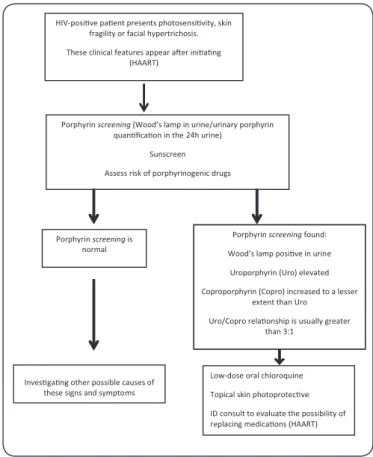
To prevent recurrence, the paients must be monitored for urinary porphyrin dosage because porphyrinuria precedes dermatological manifestations. Therefore, HIV-positive patients that present photosensiivity, skin fragility or facial hypertrichosis must undergo porphyrin dosage tests and sunscreen is recommended.
Considering the rarity of this associaion along with the relaively short follow-up of the reported cases, available data are insuicient to extract irm conclusions about the follow-up of these paients. However, as outlined in Figure 2, we suggest that paients being treated with HAART should be closely monitored for the development of PCT signs and symptoms. If clinical and laboratory evaluaion leads to the diagnosis of PCT, insituion of low-dose oral chloroquine treatment and topical skin photoprotecive treatment in addiion to considering the possibility of disconinuaion of the medicaion should be a priority.
767 Porphyrin screening (Wood’s lamp in urine/urinary porphyrin
quanficaon in the 24h urine) Sunscreen Assess risk of porphyrinogenic drugs
Porphyrin screening is normal
Porphyrin screening found: Wood’s lamp posive in urine
Uroporphyrin (Uro) elevated Coproporphyrin (Copro) increased to a lesser
extent than Uro Uro/Copro relaonship is usually greater
than 3:1
Low-dose oral chloroquine Topical skin photoprotecve ID consult to evaluate the possibility of replacing medicaons (HAART) HIV-posive paent presents photosensivity, skin
fragility or facial hypertrichosis. These clinical features appear aer iniang
(HAART)
Invesgang other possible causes of these signs and symptoms
FIGURE 2 - Algorithm for HIV-posiive paient using HAART with features of porphyria cutanea tarda.
HIV: human immunodeiciency virus; HAART: highly acive aniretroviral therapy.
aBsTRaCT IN pORTUgUese
HAART
: fator de risco para desenvolvimento
de poriria cutânea tarda?
Porfiria cutanea tarda (PCT) é causada pela deficiência parcial, adquirida ou hereditária, da aividade da enzima uroporirinogenio-decarboxilase (Uro-D). É a forma mais comum de poriria. Os principais fatores desencadeantes para o desenvolvimento da poriria cutânea tarda são o álcool, vírus da hepaite C e vírus da imunodeiciência
ReFeReNCes
1. Vieira FMJ, Marins JEC. Poriria cutanea tardia. An Bras Dermatol 2006; 81:573-584 2. Jalil S, Grady JJ, Lee C, Anderson KE. Associations among Behavior-Related Suscepibility Factors in Porphyria Cutanea Tarda. Clin Gastroenterol Hepatol 2010; 8:297-302.
3. Lee KG, Hyun JJ, Seo YS, Keum B, Yim HJ, Jeen YT, et al. Liver cirrhosis induced by porphyria cutanea tarda: a case report and review. Gut Liver 2010; 4:551-555. 4. Oliveira Júnior JV, Paiva DLM, Rocha SFVCB, Valente N. Poriria cutânea tardia.
Relato de dois casos. Rev Bras Clin Med 2010; 8:286-289.
5. Lisboa Neto G, Tengan FM, Cavalheiro NP, Barone AA. Inluência da infecção pregressa pelo vírus da hepaite B na ibrose hepáica em portadores de hepaite C crônica: avaliação retrospeciva de uma série de casos. Rev Soc Bras Med Trop 2010; 43:416-420.
6. The American Porphyria Foundaion (APF). Porphyria Cutanea Tarda [Internet]. Houston, USA: APF; 2010. [Cited 2012 January 31]. Available from: www. porphyriafoundaion.com/fo-healthcare-professionals/types-of-porphyria/PCT/. 7. Celesia BM, Onorante A, Nunnari G, Mughini MT, Mavilla S, Massimino SD,
et al. Porphyria cutanea tarda in an HIV-1-infected paient ater the iniiaion of ipranavir/ritonavir: case report. AIDS 2007; 21:1495-1496.
8. Roca B, Lapuebla C, Roig B. Porphyria cutanea tarda induced by nelinavir. Aniviral Therapy 2001; 6 (supl IV):71.
9. Ong ELC, Ellis ME, McDowell D, Gebril M, Weinkove C, Ead R. Porphyria cutanea tarda in associaion with the human immunodeiciency virus infecion. Postgraduate Medical J 1988; 64:956-957.
10. The Norwegian Porphyria Centre (NAPOS). The drug database for porphyria. United Kingdom: NAPOS; 2007. [Cited 2012 January 31]. Available from: htp:// www.drugs-porphyria.org/.
11. The American Porphyria Foundaion (APF). Drug database: safe/unsafe drugs. [Internet]. Houston, USA: APF; 2010. [Cited 2012 January 31]. Available from: www.porphyriafoundaion.com. [accessed January 31, 2012].
12. Associação Brasileira de Poriria (ABRAPO). Medicamentos e a poriria. [Internet]. Curiiba, Brazil: ABRAPO; www.poriria.org.br/.
humana. Há vários relatos de PCT associada a drogas, entre elas, à terapia anirretroviral. Descrevemos três pacientes HIV-posiivos, que mostraram fotossensibilidade, bem como o surgimento de bolhas
tensas em áreas fotoexpostas durante o uso da highly acive aniretroviral
therapy (HAART) e discuimos a possibilidade de ocorrência PCT com
o uso desses medicamentos.
Palavras-chaves: Poriria cutanea tarda. HAART. HIV.